Trego's Mountain Ear

"Serving North Lincoln County"

Tag: pistol

  • Preparing My Old Toys

    2Sam asked for my HK-4. It’s been the small pistol that slides onto my belt, never gets in the way, and always functions. And I realized as I removed the 22 barrel, put in the 32 ACP barrel, and moved the firing pin to centerfire – I have to explain the quirks. Knowing the pistol’s weakness, and keeping an eye on the recoil buffer, has made it my ultra-reliable light belt gun for the last 40 years – but I can’t just pass on the gun and share the memories – I have to pass on the skills of maintaining the HK-4. Fortunately, Youtube has videos of changing calibers – and mine has only 2, 22LR and 32ACP. No problem there. The challenge is finding new recoil buffers – less than 52,000 HK-4 pistols were made, and the last one went out of the factory in 1984.

    Fortunately, the fourth caliber was 380. I’ve never had a 380 barrel, and that’s a good thing. The buffer functions well in 32 – but the increased recoil of the 380 tears it up. That means that several 380 users have began using laser cutters to build replacement buffers. So long as replacement buffers are available, I think the pistol will be functioning well when it turns 100 fifty years from now.
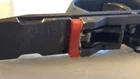
    I’m wondering if I should order one now, and tape it to one of the original boxes? The boxes tell me that the pistol was originally issued to a West German Border Troll, named Lamke, back in 1973. It’s been an American civilian piece a lot longer than it was German.

    The Ruger, made in 1958, is even older. While it is still being made, it’s now in the 4th variant, while mine is so old the grip frame doesn’t have an identifying number. The biggest problem in it’s future is that the magazines are old and the new ones don’t fit. Fortunately, there are articles on how to modify new magazines to fit. A few years ago, a new hammer strut support was developed that retrofits to the old pistol. While I haven’t needed one, adding one to it now will probably make the pistol easier to clean and reassemble for someone in the future. They’ve been good to me, and it’s time for me to make sure the unseen maintenance continues.
  • My Ruger is Changing Duties

    Folks look at my old Ruger pistol, and see it as a Mark I. It isn’t. Made back in 1958, the markings show that it left the factory as a Ruger Standard Pistol, then fell into the hands of Jim Clark at Shreveport, Louisiana.

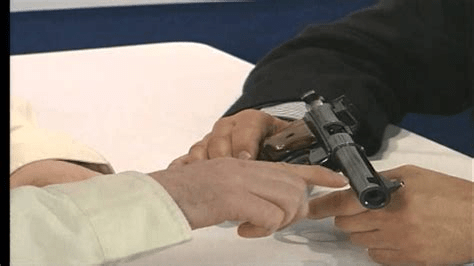
    I never met the man – but Jim Clark was a national champion in Bullseye, and built fantastic guns. This photo of Clark’s Ruger comes from the NRA program ‘I have this old gun’:

    Mine looks about the same – and has always been a lot more accurate than I am – or ever was. At 76, I’m not so steady as I once was – but I have just found (and ordered) New Old Stock Pachmayr grips for the old pistol – I’ll stash the old Herrett target grips, set the pistol in a holster (the match grips make it uncomfortable for belt carry), and I will see how it works for carrying around the place. Age makes hitting well a bit harder, but we shall see. The sights are still visible, the trigger is good, and while the muzzle brake on a 22 seems a bit of an overreach, I’ve had it for years.

    Some might warn me that a 22 isn’t enough gun for bear. Frankly, having encountered a couple of Grizzlies up close and personal, I don’t believe anything you can hang on your hip is enough gun. Second, my walks are usually on the place – my pistol is more for protection of my little dogs – and they have threats that are less formidable than Grizzlies. Third, as a teenager and a young man, I took 10 black bears with my 22 single shot, and three with my High Standard revolver. So I don’t believe I’m particularly undergunned with my 67 year old Ruger.

    Some folks tell me that Rugers dominated Bullseye back when my pistol was converted from a Ruger Standard pistol to a Clark converted match gun. In Clark’s hand, that was so. My memory tells me that High Standards, Colts and Brownings led the scoring more often. Anyway, as I age, and presbyopia makes it harder to keep a sight picture, and weakness makes me less steady, it’s good to give a different job to a tool that I have trusted for years.

  • I’ve Never Fired A Glock

    It isn’t that I’m some sort of a bigot – or perhaps it is. With a long double action trigger, I tend to shoot low and left. Not a big deal – with the SCCY, I took the sight pusher – a tool that uses a bolt thread to move the rear sight – and put the rear sight in a spot that corrects for my weakness. The SCCY is different from a Glock – a plastic frame and a stainless slide – and double action only – but what do I know? I’ve never fired a Glock. When Glocks first came out, I was learning the ins and outs of the 1911 – and it didn’t seem that good habits for the 1911 transfer seamlessly to the Glock.

    As a kid, it was pretty much revolvers. Dad packed a Smith Victory model that he had salvaged from a sunken plane, and he started me with a High Standard Sentinel. Dad liked 4-inch barrels and double action revolvers. And I learned to use them single action. When I started teaching at Trinidad State, in the mid-eighties, they taught me that God carries a model 1911A1. I learned to hone the sear so I could have a 3 pound trigger pull (the other important changes were a fitted national match bushing in the front, and a tight link at the back. When the trigger doesn’t move far, and doesn’t take much pressure, it’s a lot easier to hit. And the model 1911 (like the 1873) is single action only.

    I guess my first match quality pistol was Thompson Center’s Contender – I used it with a heavy 22 barrel when I hung out with a bunch that shot metallic silhouette. Renata medaled. I never did. In most of my competitive shooting I’ve been treated respectfully, but never had the ability to regularly finish at the top.

    Glocks call their striker fired action ‘safe actions’. They may well be – but the early striker models (around WW1) depended on some cheesy safeties. So, as Glock was coming on, I was learning the 1911. I’m not bigoted against the Glock – it’s just that it came out in the mid-eighties, and it’s probably a bit too modern for me.

  • Seeing The Sights

    Aging eyes create challenges for a guy who carries a short gun. The old match pistols still have usable sights, but are heavy and long. The old 1911 sights became hard to see because of cataracts – and after cataract surgery still2 are hard to use because I am now far sighted. I can focus with the old sights if I wear reading glasses – but that kind of defeats the purpose.

    So I’ve gone over to three dot sights. They look something like these illustrations (taken from the NRA. The difference from my perspective is that the front sight is pretty well focused and the dots on the rear sight are a bit blurry.

    It’s not a problem. Forty years ago, I watched a man with a white cane, using a 1911, score well above me. Hoping I could learn something, I started a conversation, explaining that his score was higher than mine, and his white cane suggested I had better vision. His answer was simple: “Son, all I can see distinctly is the front sight. The rear sight is a blur. The target is a blur. You just have too many distractions. As you get older, you’ll get better at focusing on your front sight.” Well, I’m older. I can focus better on the front sight. And I did manage to put 8 rounds inside the 8 ring -despite being shaky. And yes, that’s at Bullseye’s 25 yards (though I was doing slow fire, where the match distance should be 50). It’s hard to take shooters seriously that shoot at 3, 7 and 15 yards.

    Sights have improved over time – Hickock’s 1851 Navy Colts had a little notch in the hammer with a brass front sight – and it worked well for him.

    Sixty years later, John Moses Browning put slightly better sights on his model 1911. I could change to these more modern variants:

    Glocks have really nice sights – but I’m old fashioned. I want a hammer, not a striker. I prefer the Browning designs. So it’s either a new one, or a $45 expense to bring the 1911 technologically up to the 1990 sights.

    I’ll write on the newer optics when my vision further declines – I can still view the front sight clearly.

  • My Cheap, Accurate Pistol

    I’m not much of a collector.  A collector has a theme to the collection.  John McBride’s collection included American Military firearms.  I’m not sure how a collector would describe my TT Olympia – it’s a Chinese copy of the Walther that beat out the Colt Woodsman at the 1936 Olympics.  Somehow mine isn’t marked with anything to say ‘made in China’ – but it is.  It’s also well finished, and, since my cataract surgery a few years ago, shoots well for me again.

    It’s an example of how things connect in the gun world.  I never found a Woodsman for sale at the right price when I wanted one – not that I couldn’t stretch a budget to include one, but that they’re more costly than I can justify for my purposes.  So is the Walther.  Instead, my Chinese knock-off was more accurate than pricey – so I kept it.  It came in cheap cardboard and styrofoam, like this: 

    The Chinese builders did a nice job – good trigger pull, and must be at least close to the pre-war German workmanship.  Admitted, the wood in the grips would never have made it into either Walther or Colt’s factory – the grips are downright ugly – but they do fit my hand well.  Bolting the weight on does control the minimal recoil of a 22 cartridge – and it’s set up to be used with one hand.  The right hand – it doesn’t fit the left.

    When Walther got too busy with World War II, Hammerli (in Switzerland) picked up the design and produced slightly improved versions.  As the Olympic competition got tougher, the basic design went to America and became the basis of the Smith and Wesson model 41.  And mine is the Chinese knock-off that directly copies the 1936 Walther.  As you can see, good looking grips didn’t seem to be a Chinese priority.  

    So what do I actually have?  A cheap, accurate, well built pistol that just barely made it into the United States before Clinton cut off importation.  Then it briefly sold well in Canada before the Trudeau government shut off sales.  I have no idea where it might be sold today, or where parts might be available.  The TT Olympia’s barrel is just under 5 inches long, it feeds just about any 22 shells I load, and, while sight acquisition is a little slow, is amazingly accurate.

    I’ve written about cheaply made poor quality guns.  This little pistol was cheap, well made, and accurate.  I’ll keep using it -though the barrel weight will stay in the drawer.  And I expect it will still be working fine when it goes to the next generation.