Trego's Mountain Ear

"Serving North Lincoln County"

Tag: short-story

  • Preparing My Old Toys

    2Sam asked for my HK-4. It’s been the small pistol that slides onto my belt, never gets in the way, and always functions. And I realized as I removed the 22 barrel, put in the 32 ACP barrel, and moved the firing pin to centerfire – I have to explain the quirks. Knowing the pistol’s weakness, and keeping an eye on the recoil buffer, has made it my ultra-reliable light belt gun for the last 40 years – but I can’t just pass on the gun and share the memories – I have to pass on the skills of maintaining the HK-4. Fortunately, Youtube has videos of changing calibers – and mine has only 2, 22LR and 32ACP. No problem there. The challenge is finding new recoil buffers – less than 52,000 HK-4 pistols were made, and the last one went out of the factory in 1984.

    Fortunately, the fourth caliber was 380. I’ve never had a 380 barrel, and that’s a good thing. The buffer functions well in 32 – but the increased recoil of the 380 tears it up. That means that several 380 users have began using laser cutters to build replacement buffers. So long as replacement buffers are available, I think the pistol will be functioning well when it turns 100 fifty years from now.

    I’m wondering if I should order one now, and tape it to one of the original boxes? The boxes tell me that the pistol was originally issued to a West German Border Troll, named Lamke, back in 1973. It’s been an American civilian piece a lot longer than it was German.

    The Ruger, made in 1958, is even older. While it is still being made, it’s now in the 4th variant, while mine is so old the grip frame doesn’t have an identifying number. The biggest problem in it’s future is that the magazines are old and the new ones don’t fit. Fortunately, there are articles on how to modify new magazines to fit. A few years ago, a new hammer strut support was developed that retrofits to the old pistol. While I haven’t needed one, adding one to it now will probably make the pistol easier to clean and reassemble for someone in the future. They’ve been good to me, and it’s time for me to make sure the unseen maintenance continues.


  • When I Needed A Gun

    This story goes back about 40 years – Renata has encouraged me to get it down on paper, and as I think about it, the story still seems unreal, like it couldn’t have happened. But it did. At the time, I was teaching at Trinidad State Junior College, and driving a 78 Dodge Colt. Renata and I had finished shopping and were headed South from Pueblo, Colorado, on I-25. By today’s standards, the road was isolated, and cell phones hadn’t taken off yet – by our standards, accustomed to Montana, it was a four lane highway, and downright populated compared to the stretch from Wolf Point to Glendive. We had heard of travelers along this stretch of highway being pulled over, robbed and assaulted – but it was one of those things that couldn’t happen to us.

    The back held our groceries and K-Mart purchases, and we hadn’t reached Walsenburg when six cycles pulled alongside and behind us on the left. The guy alongside pointed his hand to tell me to pull over. It didn’t look like a great location, and the crew on motorcycles didn’t look like Walsenburg’s Welcome Wagon, so I just shook my head and started wondering how many Harleys I could knock down with the little Colt if it was time to start playing bumper cars. He again pointed at the side of the road, so I looked for the easiest way (at 55mph) to explain that I had no intention of pulling over. I reached between the seats, still looking at the cyclist and driving with peripheral vision. I smiled my sweetest smile, and lifted a cocked and locked 1911 Colt with my right hand.

    He returned my smile, waved a ‘follow me’ to his companions, and six motorcycles courteously passed the little Dodge Colt and quickly drove out of our lives. When I got back to campus, I shared the story with Walker, the cop instructor. He shared it with Ernie, second-in-charge of the town’s police force. Ernie showed up, asking why I hadn’t got the license plate numbers – “Because I didn’t think of it.” and telling me that this crew had a record of assaults on people who had pulled over – even introducing me to one student who had been robbed and beaten. He wanted them.

    As I write it up, it still seems unreal. I still wonder how many Harleys I could have knocked down with the little Dodge Colt – that little car was my primary weapon. The 45 Colt only had 7 rounds in the magazine – and while I was shooting Bullseye competition at the time, six moving targets and eight rounds didn’t look like a good situation. (Renata remembers more cyclists – but my recollection is that I had only two spare cartridges.)

    The little Dodge Colt (made by Mitsubishi, and the motivator to owning an Eagle Talon) looked like this:

    I think it had about 85 horsepower in the overhead cam 4 cylinder.

  • The Lady in the Latrine

    In telling this story, I have to go back about 40 years, to my first time teaching college. Somehow, Colorado had gotten off on the idea of workfare – that people physically capable of work should have a job to qualify for welfare benefits.

    The science building had a janitor – nice guy, worked a 4 to midnight shift, which meant that he had the time to clean the classrooms, labs and offices when they were empty. The building, built back in the sixties, had the janitor’s workspace located in the men’s room. I was a bit surprised at about 3:00 pm one afternoon, I headed for the head, and was greeted by a woman about my age and her 10-year-old daughter as I walked into the room. She explained she was there to help our janitor, I agreed that was nice – and then I walked down the hill to the restroom in the admin building. There was no point in warning my colleagues by sharing the story – they would have laughed at me.

    Turned out, I should have said something. I was one of the younger faculty – I didn’t think much of an 80 yard walk, outside, to find a facility that didn’t have a pre-teen girl and her mother as observers. And, having moved to southern Colorado from northern Montana, there weren’t many afternoons when the trip required a coat. But a lot of my colleagues were in their sixties. Now I recognize the difference. Then I didn’t. When the college president realized the hardship on our old biology instructor – past 70 and with prostate problems calling for a lot of trips – well, our little school went out of being a site for the workfare program.

    It probably seemed like a good idea – but reality has a way of showing the problems that come with good ideas. Single parents and the janitorial space located in the men’s room created a situation where working for the welfare benefits cost the school more in (male) faculty time than the help cleaning the building was worth. And unpaid labor didn’t leave her many options for childcare.

  • Thoughts On Tattoos

    I can’t claim to have a body free from tattoos. Mine came in 2009, when the radiation folks were zapping the body to kill off any remaining cancer cells. They added the tattoos to help sight in the radiation into the right areas. While my tattooing seems to have been successful, I still harbor some resentment – they should have at least given me a beer or two first.

    I’m reading of a politician in Maine who got an SS tattoo while drunk in eastern Europe. That is the sort of bad judgement I can understand. His excuse was being a young, drunk soldier. I learned differently as a kid – Dad was retired Navy, CWO4 (Chief Warrant Officer) and spent a career at sea without tattoos, and as a small boy I saw lots of tattoos, and heard stories of the problems associated with them.

    I think the petty officer with the big tattoo was named Carillo – but the story came to me at least 70 years ago, so their may be some factual flaws. Carillo’s story went back to 1941 – he was Guamanian, and had taken a month’s leave to visit his family on Guam. Yeah, that month – December, 1941. When World War II came to the US, he was an American sailor on Guam – and, lacking any other way of avoiding capture, ditched his dungarees for native apparel. Unfortunately, he had a tattoo showing the gunboat Panay on his chest.

    In the 21st Century, the Panay is a mostly forgotten little ship – but in December of 1941, she was remembered by Americans and Japanese alike. https://military-history.fandom.com/wiki/USS_Panay_incident probably provides as good a link to the story as any:

    He had a picture of this little ship inked across his chest – and, as the article says “The USS Panay incident was a Japanese bombing attack on the U.S. Navy river gunboat Panay and three Standard Oil Company tankers on the Yangtze River near the Chinese capital of Nanjing on 12 December 1937. Japan and the United States were not at war at the time. The boats were part of an American naval operation called the Yangtze Patrol, which began following the joint British, French, and American victory in the Second Opium War.”

    The old petty officer spent the war as a POW, and credited the tattoo. The end of his tale was the simple admonition “Never get a tattoo.” There have been tattoos with some appeal – a pig and a rooster tattooed on your heal was said to prevent death by drowning. I knew older people with blue numbers tattooed on their arms – tattoos that spoke of their time in German camps. Still, the old man’s admonition “Never get a tattoo.” held for my first fifty-nine years. And I still think that common decency should have included a shot of rum or a beer before they tattooed sighting markers on my belly.

  • Why Did He Have 22 Longs?

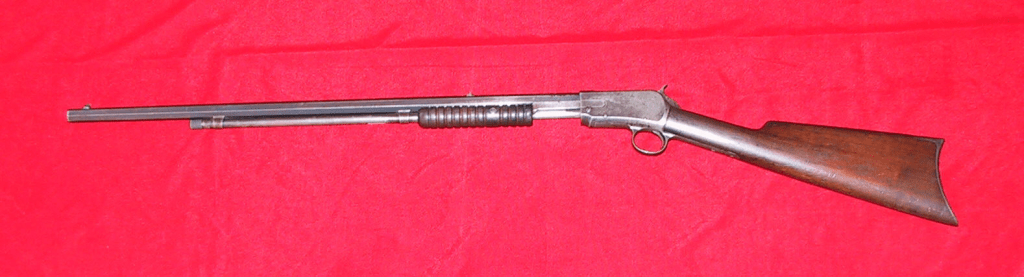
    I was just short of my twelfth birthday when John Clerget gave me a spilled box of 22 longs with the comment that if I could get them all back in the box right, he would let me have them. I didn’t understand why he used 22 longs instead of the cheaper, more powerful 22 long rifle cartridges – like Dad, he had a Winchester pump action 22, though his had a visible hammer.

    Much older, as I look back, I realize his rifle was a model 1890 – and that early pump action was designed to function exclusively with one cartridge – instead of 22 short, long, or long rifle, interchangeably, his second or third model 1890 worked only with 22 longs. Much later, I acquired a third model which fed only 22 Winchester Rimfire – a cartridge much harder to find than his 22 longs.

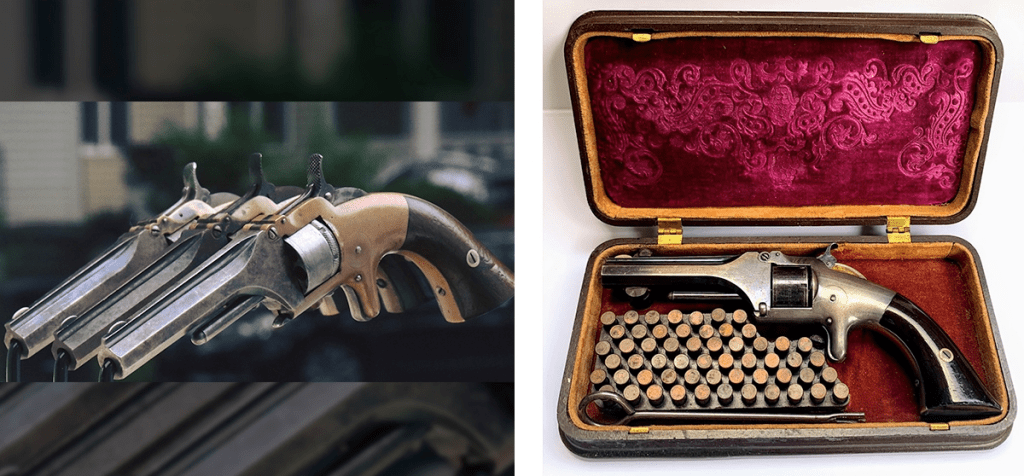
    Smith & Wesson brought out a revolver in 22 short back in 1857 – though it was just the 22 at the time. Their home page shows this revolver and explains that they produced 260,000 of them over the next 25 years.

    The 22 long came out in 1871, with a longer case (holding one more grain of black powder – a 25% increase in power). In 1887,a heavier bullet was added to the 22 long’s case to develop the 22 long rifle that we use today. By 1908, the Winchester Model 1906 was able to handle both 22 long and 22 long rifle interchangeably.

    There was a lot of development based on the humble 22 rimfire. At first, Winchester built the 22 short with a rifling twist rate of one turn in 20 inches. That was fine for the 30 grain bullet in the 22 short and long – but when 1887 brought the 22 long rifle cartridge, with it’s larger 40 grain bullet, it became necessary to speed up the twist. (I’ve heard that the ideal twist rate for the 22 short was one turn in 24 inches – and that it was a request from the Marine Corps during WWI that brought the change to 1:16 rifling for the 22 long rifle – list that as probably true, but I can’t back the statement up).

    Anyway, at age 12 I wound up with a box of 22 longs because my father’s friend had an older model rifle – and it took me a long time to understand that he chose 22 longs for the simple reason that John Moses Browning hadn’t worked out the problem of interchangeability when his rifle was built.

  • SCCY Is Gone

    Years ago, I used my Cabelas card points to buy a SCCY pistol that was on deal.  Half of the reason I bought it was the impressive warranty.  Then the doggone thing worked so well that I never used the guarantee.  The only problems I ever encountered were some ancient Egyptian ammunition that had been captured by Israel in the Six Days War (back in 1967) and stored poorly until they auctioned it off as military surplus.  When ammunition is over a half-century old, and has been stored poorly, it probably isn’t the pistol’s fault when it doesn’t fire.

    It isn’t a bad little pistol – but SCCY (which produced 987,075 pistols between 2017 and 2023 according to BATF) found itself sued by Rochester and Buffalo (New York) in 2022.  In 2024, SCCY learned that the company’s insurer didn’t cover this sort of liability.  (Another comment was that there were over 50,000 SCCY pistols recovered from crime scenes – I’m not sure what the time length was for this statistic).  Anyway SCCY went under the auctioneer’s hammer – and mine still hasn’t malfed.  I’m pretty sure I don’t have a warranty anymore.

    Mine looks like this:

    Other colors are (or maybe were) available – like this:

     The bright colors and the pastels never were my thing.  Neither was the newest model – the SCCY cpx-3 versions.  I’m old fashioned.  I like hammers, and the new versions solved the problem of a heavy trigger pull by replacing the hammer with a striker mechanism.  On my cpx-2, I can’t cock the hammer (double action only) but I can see it through a slot in the back of the slide.  And a long, hard trigger pull is the only safety on the pistol.  To be fair, the hammer isn’t cocked until the trigger makes it all the way back – so it’s really just as safe as the old double action revolver.  Safety aside – baby blue, bright orange, and pink just aren’t colors that belong on my sidearm.  If you feel differently, that’s fine.  

    Back to the striker versus hammer argument – my only striker fired pistol is a 1914 Mauser design.  It cocks every time the slide goes back, and the only protection is the safety.  One safety.  The old 1911 design (Colt, by John Moses Browning) with a hammer has a bunch of safeties.  Mauser had only one.  There have been a lot of changes to strikers over the past century – but I didn’t get my first semi-automatic until Browning’s design was almost 75 years old.  Since I’m now 75, I don’t expect to ever be comfortable with a striker fired semi-auto pistol.  Heck, I’m not comfortable with a concealed hammer single action.

    Anyway, SCCY is no more – and without that outstanding warranty, the prices on both new and used SCCY pistols seem to have dropped.  My own experience is simple – I have taken my magazines apart, and smoothed the rough edges.  They worked before, and I’m not certain they needed the smoothing – it’s something I learned at TSJC, and I do it more based on faith than science.