Trego's Mountain Ear

"Serving North Lincoln County"

Tag: Teaching

  • The Quality of Numbers

    Not all numbers are suitable for math, yet we can still use them. Section, Township and Range allow us to find a location on a map, or travel to a specific location. It’s usually expressed in terms Like T37W R25N S19 – which translates to Township (36 Square Miles) 37 W (west of the point of origin) Range 25 North (of the point of origin, section 19. That’s a numeric system that has been with us since 1785 – we have had the rectangular coordinate system longer than we’ve had the Constitution. At the northwest corner of the state, it’s pretty easy to use. Down by Virginia City, around the point of origin, you have to be real careful about the N,S,E and W. I found myself off by six miles a couple times when I got careless there. For those who can’t handle that system, we have street names and numbers. There are still some advantages to street numbers – on Fortine Creek Road, the street numbers show distance from the railroad track crossing at Trego.

    In some cases – social security numbers, for example – the number exists only as an identification. When I couldn’t get decent data on migration, I started using U-Haul rental rates as a substitute. For example, renting a U-Haul 15′ truck from Los Angeles to Eureka shows up as $4,817. Taking the truck back from Eureka to LA is $1,112. I can’t turn that into precise migration data – but I have no problem inferring that there is a lot more migration from Los Angeles to northwest Montana than the other way around. It’s valid – but I have had people dismiss the conclusions because the data is not adequately precise for them. For me, U-Haul provides a great resource on migration. I can find more specific numbers – but not as current. So we have numbers that are only useful as identifiers, and we have numbers that are useful in determining locations, and I can even use U-Haul prices to determine migration trends (and in this application I have had the mathematically illiterate question my conclusions).

    Ordinal numbers show position in a list – or first, second, third in a contest. My street address shows not just my position on the street, it also shows the distance from the railroad crossing at Trego. The U-Haul prices show that there is a lot more migration from Los Angeles to NW Montana than vice-versa. There are a lot of times when I can’t get perfect data – but I can get usable data. Usable data beats non-existent data.

    In the movie “Tombstone” Doc Holiday describes gambling: “Poker’s an honest trade – only a sucker bucks the tiger.” There are different significant numbers in various forms of poker. In draw poker, where the hand is not seen until the end of the game, the odds have been calculated, published and frequently memorized. In five card stud, where a single card is concealed and the next four are dealt one at a time, face-up, you can develop a rough estimate of each hand’s statistical probability. Draw poker is an honest trade – stud poker even more so – it is a statistician’s game (I ignore the psychological aspects of the game). The numbers have a different quality when four cards in each hand are visible.

    There are people who think they aren’t good at math – I think that they were taught by people who didn’t share all of the wonderful ways to use numbers. Of course, I am the guy who used a rather large set of loaded dice to help teach statistics. One of my former students asked where the dice were when he visited campus, and I explained my daughter had taken them with her when she moved to study at USD. His comment still puzzles me – “I guess that she doesn’t call home for money very often.” Language can be as confusing as numbers – and, as Doc Holiday said, “Poker’s an honest trade.” Dice usually are – but I guess most teachers don’t use loaded dice.

  • Thoughts on Schooling

    I read these statistics, posted in response to a New York Times article: Public School: 40% of kids bullied, 30% sexually harassed, 34% read at grade level, $18K a year.

    Homeschoolers: 0% bullied, 0% sexually harassed, 99% read above grade level, $1000 a year. I don’t know how solid his statistics were – but it got me pondering on the problems of education.

    About the same time, I read Joel Graves’ commentary on Home School – and Joel’s thoughts were not a lot different than mine when we first started publishing the Ear. Still, I was younger then – I had 4 years experience teaching and heading the ag department at a junior college. As I moved to different experiences teaching – the next six years were in the Academic Reinforcement Center, followed by years of Extension education, and culminating in time as graduate faculty, I gained a lot of experience with people whom their education system had failed. Emphasize that phrase: Their Education System had failed them. These weren’t people who had failed – most were high school graduates. Some held a bachelor’s degree. The problem is that, often, public education needs the support of other forms of education – Extension education, such as 4-H is one example, while education at home is another. Vocational education is another form. Back to my point: at a number of different levels of post-secondary education, I dealt with students who had been failed by their education systems.

    I recall a young woman – a high school graduate with a tested IQ of 108 – who read at the beginning third-grade level. That 108 IQ says she was ahead of 70% of the population – yet the public school from which she graduated failed her for at least ten years (third grade through twelfth). She hadn’t failed – she walked through the high school graduation.

    I remember Gerald – my student for over a year – he had graduated high school (to be fair, not in Montana) but was unable to do math without a calculator, and even with a calculator couldn’t get the order of operations correct. I failed at correcting the problem.

    My list could go on – but when students graduate high school without being able to read or do simple algebra, the educational system has failed them. I recall a carpenter, a dropout, who used his framing square to perform his mathematical calculations. It seems fairly obvious that he found a way of compensating for his math weaknesses through Vocational education – whether shop class or on job – that Gerald never found in a math class. On the other hand, Ray has a BS in animal science – but his Extension education experience in 4-H rounded it out so that over a lifetime he could retire with a respectable herd of beef cattle and a decent-sized ranch. He needed both the formal training at the Land Grant plus the 4-H experience.

    I recall taking my GRE test – the woman seated next to me (a teacher) needed to score at the 25th percentile to be admitted to her graduate program. She had already taken the GRE twice without achieving that score, and had completed all of her coursework. Obviously, her schooling had failed her.

    So I fully understand that public school can fail to educate students while going on to graduate them. One of the problems I see with Extension education occurs when the market sale becomes more important than the 4-H education. Home school can be bloody awful – what can you learn if your teacher is an ignorant idiot and you keep that same teacher for a dozen years? On the other hand, Home schooling can be fantastic – it depends on the parent and the kid. Vocational education offers a second way to support the classic 3 R’s as well as a potential career for kids who aren’t on an academic track.

    I spent 4 years teaching Freshman and Sophomore classes – some vocational, some academic. I spent 6 years in academic reinforcement at a community college – that’s teaching college students what they didn’t learn in high school. I don’t know how to break down my Extension career – I served as an agent, administrator and a specialist, and everything crossed over. And I ended a career as a specialized sociologist usually teaching senior and graduate classes. I did work a bit with a variant on home school – my daughter was interested in quantum physics and couldn’t get the information she wanted from the high school. I checked out books and read, so that we could discuss quantum as we drove.

    During those many years, I met more students who had been failed by the system than failed at the local high school. I’ve seen parents make a decision to pull a kid out of school and do a bad, or at least incomplete, job of teaching at home. I’ve seen high schools that graduate students and never worry that their students’ ACT scores leave their school ranked in the bottom third. The system and parents combine to fail the kids more frequently than the kids fail on their own.

    In my perfect world, every kid would have the opportunity for Vocational education. I had planned to finish high school with 4 vocational classes taught by Harry Donaldson. It didn’t work that way – I finished with 3 or 4 academic classes taught in the morning, and working every afternoon. The first Fall semester I took a drafting class – and was acing the tests and flunking the homework. The only constructive criticism I received was “WRONG SCALE!” written in red. I dropped the class. Years later, when I was looking at my drafting equipment, I realized the bookstore had included an architect’s scale in the package for an engineering class. My instructor didn’t explain the difference. If I had taken Harry Donaldson’s mechanical drawing class, I would have been trained to catch the problem myself. I dropped a class to avoid an F – and taking Harry’s class would have made me successful.

    So I see a lot of point-source opportunities to fail students. I’ve described an intelligent young woman whose reading teachers spent ten of her twelve years of school failing to teach her to read, but she still graduated on schedule. I’ve watched Connie Malyevac teach others the math that they missed in high school – and every student deserves a Connie to help fill the potholes in their education. I’ve learned that a parent can read incomprehensible physics books, and stay 15 minutes (or less) ahead of his daughter, and see the success of her graduation with a Phi Beta Kappa pin. I’ve seen students from Dave Peterson’s “slow class” go on to graduate from college and move on to a career of teaching high school. The standard expectation of Vocational education – that academics aren’t for everyone – provides an alternative.

    My prescription? I have seen our public schools fail too many students. Despite that, I believe our public schools should be education’s foundation. (I do believe that there is a staffing problem that needs resolution when a school is below the mean for years and years – and that does need to be addressed instead of ignored.) I want parents to be active in their kids’ education (I recall that the teachers had other parents than Renata and I that they felt could have benefitted more from parent/teacher conferences; and I recall one who was stymied by Renata’s question, “Exactly which part of your math class won’t she need when she goes on to college?”

    I believe in 4-H – yet I think that there is a lot more Extension education in an entomology project than in selling a market steer. Same thing for sewing and cooking projects.

    Every youngster deserves to learn by doing – which is the big part of vocational education.

    I want remedial education – early. I am less than impressed by special education that is prescribed late and relies on paraprofessionals to put in a certain amount of hours on the weakness. We measure success in touchdowns, not practice yardage.

    To sum it up – we do not need to look at education as public education or home school. We need public education, supported by home education, supported by Extension education, plus Vocational education, plus other forms of education (formal or informal) that are available in the communities. To focus on just one form of education is to provide a situation where that single education system can, and frequently will, fail the students.
  • Sick as Christmas Approaches

    It’s an unpleasant lung and sinus infection. It goes well with asthma to cut down what I can do – yet this time, the disease vector was my grandson. Somehow, the sickness is kind of mitigated by that – it didn’t come from some anonymous student passing through the hallway in an unseen cloud of microbes.

    This time, I got Remi while I was working on the old service station – and despite the illness, I had the joy of giving him the rolling magnet to pick up nails. I may feel a bit crummy – hell, I do feel crummy – but I have the memory of the toddler rolling the magnet, and smiling with every click as a nail was pulled up and magnetism overpowered gravity. He doesn’t have the words yet – but in another ten or twelve years, there’s going to be a discussion about physics with his mother. I may or may not be there to see the interest in physics develop – but I was there when he discovered that magnetism can overpower gravity. It is enough to make the illness an insignificant cost.

    As my daughter took an interest in physics, and moved into quantum, I checked out books on the topic – studying to stay along with her for the next conversation, often in the car as we would drive home. It brought home thoughts to me – the realization that the power of probability combined with chemistry to make elegant experiments, while some atoms manage to stay out of the reaction. 99.9% purity is close enough for what we need – and things happen consistently.

    So I look forward to the next lessons, as the little guy discovers that pieces of copper, aluminum and lead are immune to the power of his magnet. I look forward to his learning of the special aspects of ferrous metals – and possibly moving on to the relationship of a compass to the planet he inhabits. A stuffy nose, sore throat, and congested lungs are a small price to pay for being the grandfather that sets the lessons in motion.

  • What Happens to Credentialism?

    Colleges – and even high schools – exist to provide credentials. Probably the highest example of credentialism is the MD or DO – but most of our programs boil down to taking the correct group of classes, achieving a certain minimum score, and acquiring a credential. You pretty much have to get the credential to get the interview that gets you the job. In this simplification, there isn’t a lot of difference between the bachelors, masters and doctorates in the academy and the classifications of apprentice, journeyman and master in the skilled trades (take plumbing or electricity for examples).

    There are a whole lot of jobs where I lack the credentials to even apply. We’ve developed a credentialed society, and sometimes the benefits of the credential seem hard to find. Sometimes the requirements in terms of work experience seem like gatekeepers. And more frequently, people are asking what is the value of the credential.

    My credential is a Ph.D. in sociology. If you haven’t noticed, there are a lot of people who recommend against getting a degree in sociology. I suppose I’m lucky – I got a job in the subject, and retired working at the same topic that interested me as an undergrad. Other folks have other credentials. I’m reading Neil Howe’s book about the fourth turning – and his jacket blurb identifies him as a demographer holding graduate degrees in history and economics from Yale. There are a lot of ways to get the title of demographer – his was, obviously, different than mine.

    After retiring, I’ve spent a few years on the local school board – and teaching jobs are open only to the certified. I started with the belief that certification in special education brought with it some incredible teaching skills – yet as I left the board, I left with a strong suspicion that we had hired people with the credential to evaluate our students, but once the evaluation was complete we wound up with teacher’s aides who did most of the actual teaching. I knew Dave Peterson – and saw more than one of his students go on to graduate and become teachers. But those years of closer observation showed me that Dave was a special teacher – but that wasn’t directly related to a special education certificate. At the Libby Campus of FVCC, I worked in the Academic Reinforcement Center with Connie Malyevac. Connie was a better teacher than I – I watched her reach out and find ways to get students on track, students who were beyond my reach. I was good – Connie was great. It wasn’t a question of credentials – she simply had more ability to reach out and bring students back onto the path.

    Remembering those days when I Worked with Connie makes me understand why we need to be moving into some different forms of credentials that reflect ability. I’m looking at the SAT – the Scholastic Aptitude Test is now reducing the length and complexity of statements to which students respond and from which they determine the correct information. These are the questions my students referred to as “story questions.” The real world has too much information – much of the problem of thinking is just deciding the data that is relevant to the problem.

    I’m glad to have had the University system as a place to work – but I could see how it was breaking down and no longer providing valid credentials. I think on Howe’s work – where his credentials are more the Ivy League degrees than the topic – and I recall the Whorfian Hypothesis. Benjamin Whorf was a Chemical Engineer (MIT BS and MS) who studied the Hopi language and came up with the idea that people experience the world based on the structure of their language. This link shows that MIT still remembers (web.mit.edu.allanmc.www.whorf.scienceandlinguistics.pdf )

    Benjamin Whorf’s name moved into social science fields because of his competence in linguistics, while his credentials were degrees in Chemical Engineering from MIT. Perhaps it’s time for us to start looking at developing competence over credentialing?

  • What Education Could Be

    What Education Could Be

    Imagine that you are a student. Fifth grade. You arrive at school and eat your breakfast with your classmates and your teacher. You know all of them, because it is a small school and you know everyone. Your teacher asks about your pets, your family, your hobbies because it’s a small class and your teacher knows you too.

    You and your classmates get into the bus- except, it isn’t actually a bus. It’s technically a class-3 school bus, which means it’s a van. It’s cozy, has seat belts, and it’s easy to talk to the people around you.

    Your teacher asks you if you know why pine trees shape their leaves like needles. And you listen, and you ask questions. Learning is a conversation, things pointed out as you drive by or when you stop to look at something more closely. Your teacher welcomes your questions and encourages your curiosity. Sometimes the answer to your question is known and sometimes it goes on the list of things to research later. The geological history of the area is written in the stones and in the shape of the mountains and now that you know what to look for, you can see it.

    You see ecosystems, in a pond, in a forest, in a meadow, and even on the moss covered rocks. You take samples of water and look at them under microscopes (the kind that use mirrors for light and require no electricity). You can see the stages of ecological succession; You can see the pioneer species that move in on bare stone, a pond that will one day become meadow, and a meadow that will one day become a forest. The future of the landscape is there and you can see it now.

    You see human history, too. Old fire lookouts, and the places that the roads once were, when they were traveled by wagons. You see dynamite scarring that came when roads were built, and you pass stump cultures from Christmas tree farming.

    You eat lunch back at school and your afternoon teacher joins you. Your afternoon is a vocational class. This trimester it’s Building Trades, and you are learning the basics of carpentry, plumbing, wiring and masonry. Last trimester was Culinary Arts and next will be Engineering.

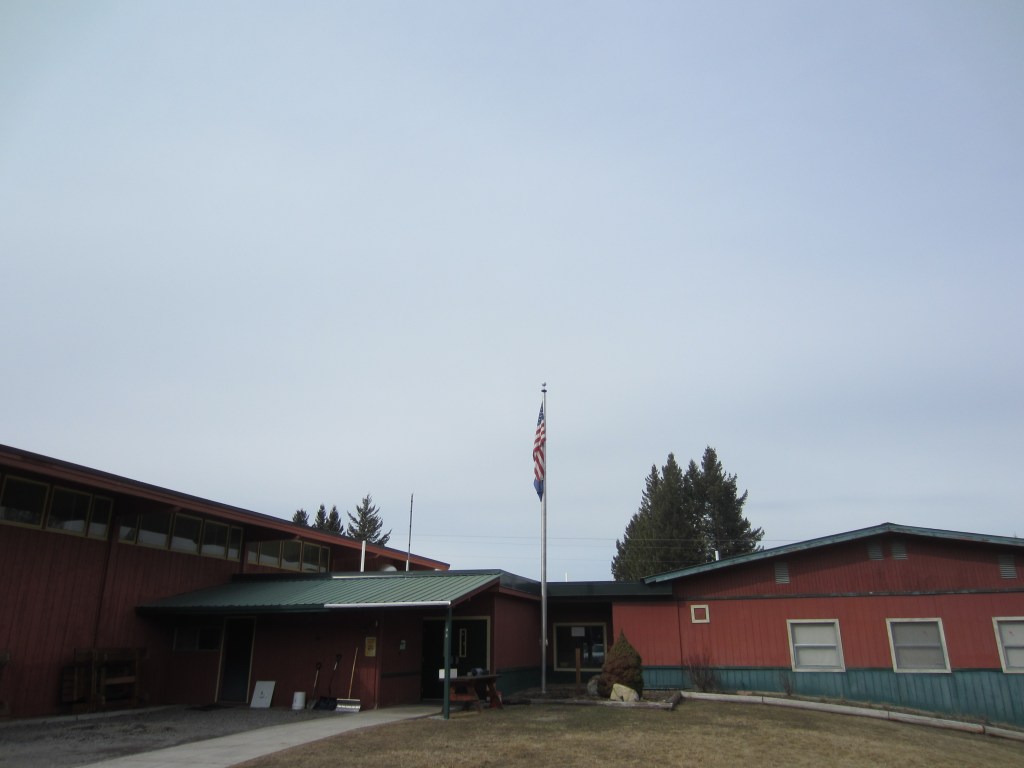
    This could be Trego School. This is a glimpse of the future we want for the children of our community. We want them to have opportunity to learn how to do things, to ask questions, and to reach their potential as confident, capable adults.

    Help us build the future. Do you have a skill or a profession that would benefit the children of our community? Consider putting in an application at Trego School and applying for a Class-4 (vocational) teaching license.

  • Part-Time Social Studies Position Available at Trego School

    Trego School is looking for a part-time social studies teacher.

    Who Qualifies? Anyone licensed in the state of Montana to teach social studies for grades 5-8. That is, anyone with an elementary k-8 endorsement, or an appropriate secondary 5-12 license.

    Part-time? Yes. Trego School is looking for someone (or several someones) to teach four hours of social studies one day a week for at least one thirteen week trimester. Fifty-two hours. With three trimesters, this position could be filled with as many as three teachers or as few as one.

    Why Work Part-Time? There are plenty of reasons people choose to work part-time. Part-time employment is a good answer for anyone with a reason to stay home most of the time. It has the benefit of allowing time in the rest of the week for errands and appointments. And, for those that are unable to work full-time for health reasons, part-time employment can be an answer.

    Additionally, working for a partial school year leaves more time for travel, or to not travel. Don’t want to drive in the worst of winter? Don’t work that trimester!

    Would this still count for TRS? If you’ve already paid into Montana TRS, definitely! This would be an easy way to add some extra years (if not highly paid years, part-time being rather less income than full-time) to a retirement.

    Four hour blocks? Core classes, such as social studies, will be taught in four hour blocks, meaning the teacher will only be expected on campus once a week.

    Why teach on a block schedule? Having taught on both, I’ve personally found the block schedule to be superior. Transition times between classes present a major loss of instructional time. Additionally, short classes prevent students spending much time being deeply involved and engaged in activities. Longer classes allow for instruction and work-time both, which gives students the benefit of practice supported by their teacher.

    One of the major perks of a block schedule is the potential for lengthy activities. In a science classroom, this is typically labs. In a history class, it might well be field trips. Ultimately, the classroom we must prepare children for is the world. Four hours is plenty of time to visit old buildings, to learn the local parts of Montana History through experience instead of through pictures.

    What classes? A teacher could apply to teach each social studies class for the school year (three trimesters), or for only a single trimester (13 weeks). Montana divides its social studies standards into four categories: Civics and Government, Economics, Geography, and History. Classes could easily be fit into those categories (with care to include the relevant standards from other categories), but a Montana History Class could easily include elements of geography, civics and government as well as economics. The categories of social studies are highly interconnected, so there is considerable freedom for class design. In other words, teach the class you always wanted to teach. Share the topic you love.

    Interested? Contact Shari Puryer (clerk@tregoschool.org) for more details and to pick up a copy of the District Application.