Trego's Mountain Ear

"Serving North Lincoln County"

Tag: Weather

  • Weather Changes – And Climate Does Too

    I’m looking at the ten day forecast – basically rain and above freezing. The precipitation side matches the NOAA long-term outlook, while the temperatures do not. Still, the national outlook suggests that the lines on NOAA’s map just wound up a few miles off. Weather forecasting is a science where errors are not uncommon – and climate is not constant. If it were, there would be glaciers north of Eureka covering the drumlins.

    One of the consistencies is the adiabatic lapse rate – the decrease in temperature as a chunk of moist air rises. It’s not a perfect way of modifying a weather prediction for Eureka – but if I guesstimate that, because of the 3,100 feet elevation at Trego (opposed to 2,700 feet at Eureka) the temperatures will be 2 degrees (Fahrenheit) cooler than Eureka, it winds up fairly close. Right now, with lows around the freezing mark, I figure most of the snow will be gone before it gets cold again – and the pond will be full before it freezes a second time. The predictions call for daytime thaws until the solstice – and after the solstice, the days begin to get longer.

    Ten thousand years ago the area went into an interglacial – a time when the glaciers went away. Technically, so long as we have polar (and Greenland) ice sheets, we’re in an ice age. Still, at the least, more melting can lead to a longer interglacial. This interglacial was the time when most (an argument could be made for all) of our food crops were developed. Warming may give us a longer growing season – but if our local precipitation stays the same, water, not growing degrees becomes the limiting factor.

    But the management choices are the same – my hay needs to include water tolerant, drought tolerant, and salt tolerant species. As I can get out with the chainsaw, the timber needs to be thinned for better growth, for a return to grazing and for fire control. Climate, like weather, changes.
  • An Evening Like 1917

    It’s a little over a century since my grandparents bought the place in Trego. With the power outages, we’ve experienced a little of what their ordinary day and evenings were as the season moved toward Christmas – the wood stove keeping the house warm, and, for use, battery powered lanterns, where their light was kerosene. A kettle on the stove for coffee or tea – and no internet or electricity. I suspect we’re a lot less able to keep ourselves entertained during the long winter nights – but as I look at my stash of harmonicas, I realize it was my grandmother’s harmonica that led me to playing them – and that I can play harmonica in the dark as well as the light. Their power outages didn’t affect a refrigerator or freezer.

    I have a shallow well – and I’m realizing that a solar panel on the south wall of the pumphouse, charging a 12 volt battery, can power an inverter, so that we can keep water running by going to the pumphouse, turning the inverter on, and taking the pump off the grid and plugging it into the inverter. Our record power outage, to date, is 18 hours – and keeping the water running, without having to start a generator, has some advantages.

    The grill on the porch runs on propane – and it will take little effort to add a propane burner to handle a coffee pot or scramble eggs. Admitted, the top of the wood stove already does that – but it takes little to avoid the occasional return to pre-electric existence.

    Still, I suspect we have lost a lot of the family social interaction with the luxury of rural electricity. I think of being a Trego kid in the early sixties, when there were only two Spokane TV channels – and reading the entire encyclopedia before finishing the eighth grade. If nothing else, it made high school a bit easier.

    The connection with my grandparents is not strong – my grandfather died shortly after I turned 5. There were a lot of things that couldn’t be shared. But the occasional power outage does offer a little understanding of what their lives were like in the early days of Trego.

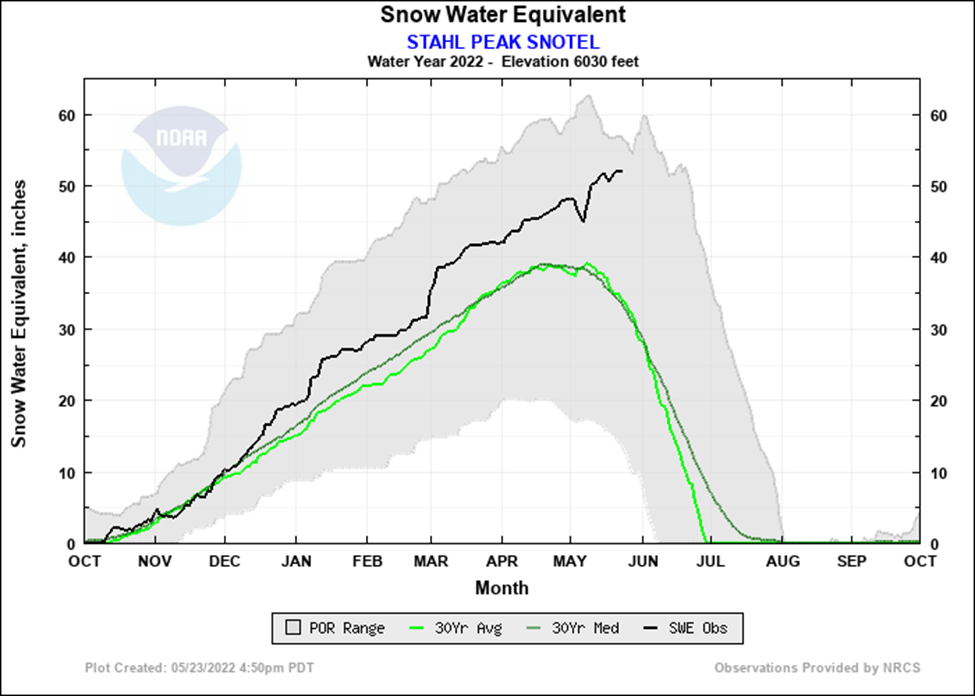
  • Stahl Peak on 5/23

    Stahl Peak on 5/23

    It’s the time when the snowpack can rise quickly – a cool, rainy Spring.  The latest observation is 34.3 inches of water on the pillow – 151% of the 30 year average.  It is definitely a lot easier to click the link than it was to haul the snow tubes up to get the data in the late seventies.

    What happens next is a question for the weather forecasts.  NOAA has released these projections for June, July and August. 

    The folks who know about these things are calling for a warmer and drier summer than normal.  If that’s the case, it is good to be going in with a little extra water in the high country.

  • So, How Bad Are the Roads, Anyway?

    With snow and ice season well and truly upon us, it seems like the first thought to mind when considering travel is the state of the roads. Good? Bad? Clear? Icy?

    An inquiring mind has a few options.

    • Facebook: There are Facebook groups dedicated solely to road reports, and if the timing is right, one can find a post by someone who just traveled the same path.
    • The Travel Info Map: has nice, color coded details for the entire state. Covers major highways.
    • Web Cameras: These are useful for a look outdoors without actually having to look out doors. I often check the Dickey Lake Camera from the Travel Info Map, although Eureka has its own and there are several down in the Flathead.

    There isn’t a really good source, other than people who’ve been out and about, for roads like Ant Flat and Fortine Creek Road. They just aren’t big enough to make it onto the Travel Info Map. Some good internet research (and some luck) can tell you all about the roads in Eureka, the trip down towards Whitefish, and the condition of the roads within Whitefish and Kalispell. The usual sources aren’t as much good for the (very) local roads.

    That said, it’s often my experience that the first few miles after leaving home are the worst for driving.

  • Blessed Rain

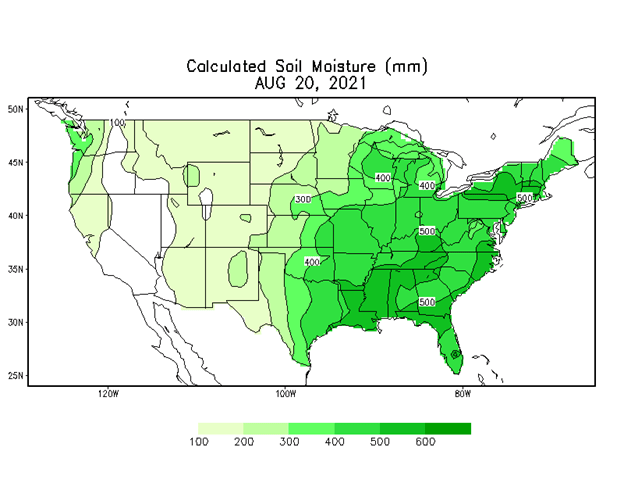
    It isn’t perfect, but it is improving.  My alfalfa seedlings are recovering from the long dry spell – on the other hand the deer are discovering them and trying to graze them down.  NOAA shows this map for soil moisture:

    This next map shows precipitation during August – again, it isn’t perfect, but coming out of a drought it shows us on the fringe of recovery – far ahead of southeast Washington down through most of Oregon and California.

    It may be too early to say that we dodged the bullet for another month or so – but at least the recent precipitation has moved us to a place where we can dodge. At least the long-term predictions are pretty much back to normal probabilities of precipitation:

  • What Last Week’s Rains Did for Us

    These maps, taken from NOAA’s website show what the early August rains did to change the moisture stored in our soil.  For us, the rains lifted the pond by almost an inch and a half.  They didn’t add enough soil moisture to fill the cracks in the vertisols, or create any puddles – but we have hopes that the slight increase in soil moisture will help at least some of the little alfalfa plants survive. At any rate, the NOAA website demonstrates how much more information on weather is available now compared to a half-century ago.  The difference between July 31 and August 9 is impressive – though we will probably check again next week to see how the soil is doing.