I notice that a small part of the huge “Infrastructure” bill is a billion dollars to plant trees to increase “tree equity.” I probably need a professional forester to explain the significance of “tree equity” to me – but looking at my small piece of the west, “tree equity” seems somewhere between impractical and impossible. Maybe I need a climate activist to correct my thinking – I’m not sure a forester could manage the mental gymnastics. Foresters tend to be more grounded in the real world.
The little I’ve learned about forests implies that spacing is the biggest part of management. If you work at keeping the spacing relatively correct you wind up with a relatively open forest where trees grow well. That suggests to me that “tree equity” comes more from judicious use of the chainsaw than the planting spade.
Naturally, my interpretations return to demography – and the idea of “tree equity” gets back into Malthusian demography – where limited resources command limited populations. Now, in demography, the clueless dude who wrote The Population Bomb back in 1968 – Paul Ehrlich – was a sure-enough Malthusian . . . and his training and department was entomology. Specifically butterflies. And he wrote on demography. Most aggies and Marxists realize that the industrial revolution, and the green revolution, came along and knocked the footings out from Malthus’ thesis.
The problem with Malthusian demography is that Malthus only has to be right once. You can never rule him completely out.
Malthusian demography does work pretty well for trees. The resources – soil nutrients, soil water and sunlight are all things that can’t be easily increased. From watching, I’d think about a hypothesis that optimally spaced trees would actually get more soil moisture – I can conceive of a situation where crowded trees would intercept more rain and snow that would evaporate back into the atmosphere instead of infiltrate the soil. I suspect the research has been done somewhere, but not where I worked. I really can’t see where my country needs to spend a billion dollars planting trees for “tree equity.”
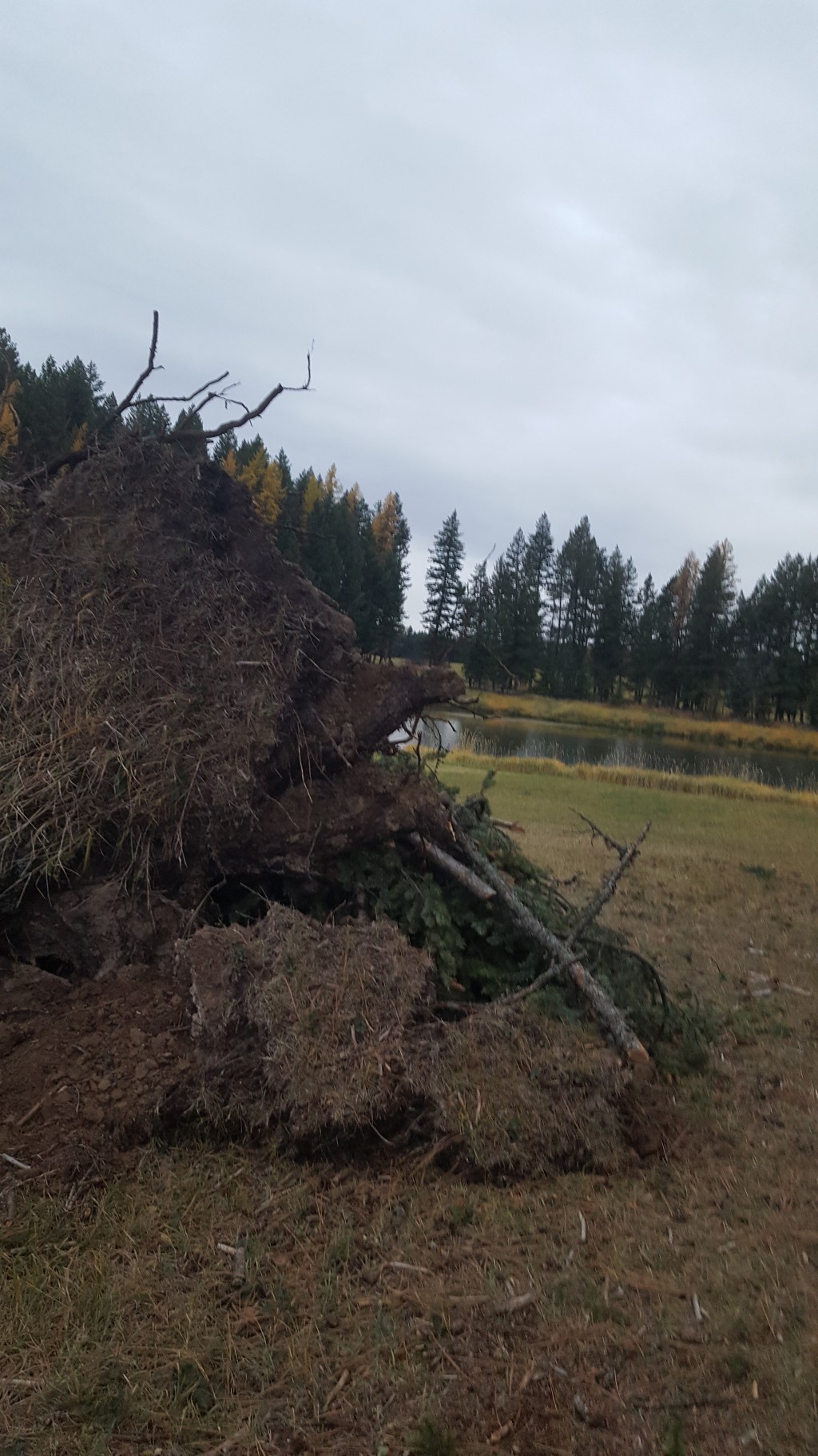
The last windstorm showed me a bit about “tree equity.” Trees with double tops were sometimes reduced to single tops, other times left with no tops. Trees with a lot of branches were more susceptible to the wind, and went over with root wads.
This photo shows how much the branches could fill the hole where the roots had been – and brings back memories of Jack Dickinson’s tall tale of a blowdown sale that he got for a small bid, and then read the fine print that he had to jack all the stumps back up. Trego was a better place when Jack was in it.
As I cut the branches, and stash them in the hole the root wad left, I think about the comments Jack would have made about being taxed to plant trees to promote tree equity. They would have been funnier than my demographic approach.


 Trego's Mountain Ear
Leave a comment