Trego's Mountain Ear

"Serving North Lincoln County"

Author: EntomologistJed

  • Kids’ Programs at TFS Community Hall take a hiatus

    Kids’ Programs at TFS Community Hall take a hiatus

    In the face of a stretch of poor weather and heating difficulties, kids’ events at the TFS Community Hall will pause until early-to-mid January.

    The Hall does not yet have a HVAC system. While the Hall Board received a grant to purchase and install one this past year, they experienced shipping delays in receiving the pieces. While all the parts necessary to build it have finally come in, Bakkila Plumbing & Heating has been, quite understandably, focused on restoring heat to individual families. It’s a poor time of year to be without a source of warmth, and I’m sure many families are grateful for their priorities.

    Presently, the TFS Community Hall’s board expects its new HVAC system to be installed some time in early January. In the meantime, the Hall continues to rely solely upon wood heat. With a slow heat time due to a large space to heat, draftiness, and old insulation, event organizers must begin heating the hall several hours in advance, and feed the fire continually throughout.

    In light of the Hall’s small chimney fire this past Friday, and events canceled on account of it, its patrons are looking forward to new heating systems more than ever.

    This proposition is made more tenuous by questionable roads and lengthy travel times, especially in the case of Kootenai Gymnastics. And, in the case of Trego Kids Learn & Play, that extra time spent heating the facility in the early mornings, and the recent rash of colds going around the local kids, make this a sensible time to pause, let kids get healthy again, regroup… (and pray for a HVAC system)! Both programs shall return in early-to-mid January.

    Let’s take a look at what the kids programs at the TFS Hall have accomplished – these ongoing programs, in addition to single-day events, have been a great way for kids to build and develop friendships in what has been a comparatively isolationist post-Covid world.

    To give some sense of the scale of their efforts, in less than a year’s time, Trego Kids Learn & Play has served 56 kids from 43 families, and I suspect its second year will serve even more.
  • On polarized lenses.

    I recently got a pair of polarized prescription glasses, and have been amazed by how much better I am able to see the world, particularly when driving in the morning and evening, confronted by people’s bright headlights.

    While they do make my world noticeably dimmer, they bring out many small details, and seem to make colors more intense – I find myself able to discern grass stalks and foliage from much further ranges than I used to be able to. I suspect it’ll help with spotting wildlife as well.

    It’s important to realize that not all glasses claiming to be polarized are – many cheap lenses claim to be polarized, while merely being tinted. If a lens is truly polarized, it will block out a portion of polarized light, meaning light that vibrates more in a certain direction. What portion of light is blocked out depends on the lenses’ orientation.

    The lenses on most glasses are polarized to filter out horizontally reflected light, i.e. from puddles on roads, or from bodies of water, plastic, or a well-maintained car. Meanwhile, light reflected from bare metal generally won’t change its polarization. Here’s a link explaining the physics, and explaining what makes light polarized or unpolarized.

    If you’d like to check if sunglasses that claim to be polarized are genuine, you can take two pairs of them, place them so their lenses overlap, and rotate them until they are perpendicular to each other. This should noticeably darken the view through the lenses, as you are filtering out most of the incoming light.

    Alternatively most laptop screens are linearly polarized, so rotating a pair of polarized lenses in front of one should have a clearly bright orientation, where nearly all light emitted from the screen passes through the lenses successfully, and a clearly dark orientation (about perpendicular to the bright orientation) which blocks out nearly all the the light emitted from the screen.

    The polarized lenses, aligned to allow all light emitted by the polarized computer monitor to pass through.
    Nearly aligned to filter out all incoming polarized light,
    but not quite, so some light still passes through the lenses.
    Perfectly aligned, and now all the polarized light emitted from the screen is blocked by the lenses.

    As a side effect of filtering out horizontally reflected light, my new lenses should help block out reflections from bodies of water, meaning I should be able to see fish moving beneath the surface of the water. Here’s a video showing the effect of looking through polarized lenses at water. Looking forward to getting out there, and seeing how efficient that is.

  • Backwoods Accordion Festival, Round 3

    Backwoods Accordion Festival, Round 3

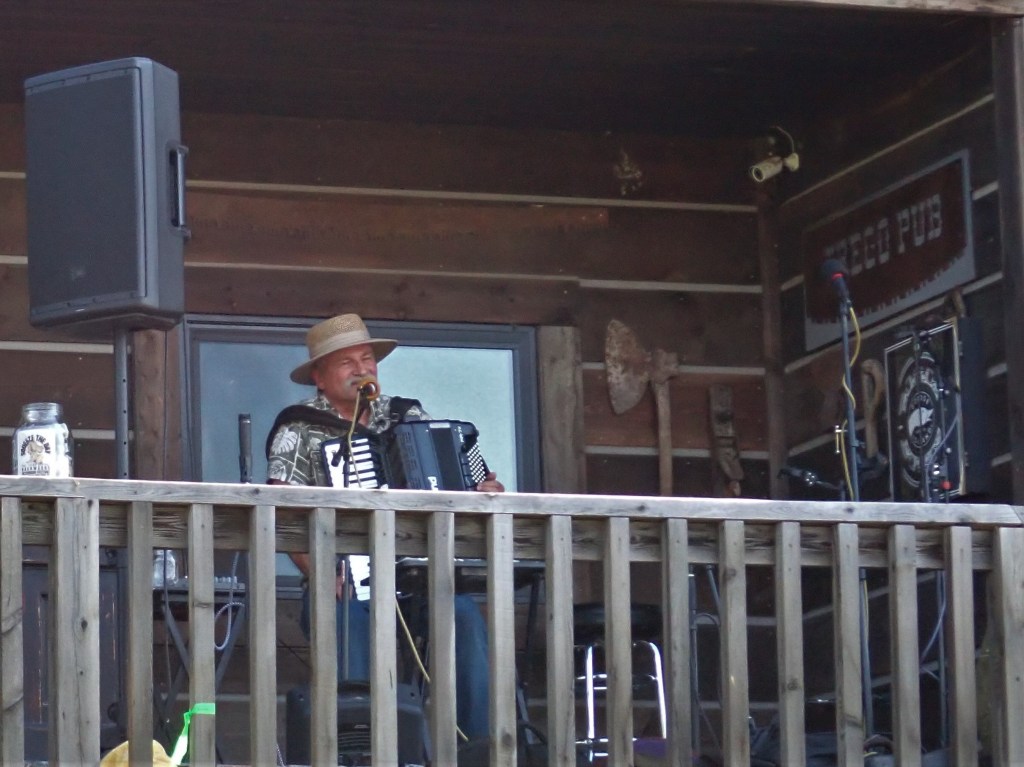
    Trego’s third annual Backwoods Accordion Festival was the best-attended yet! We saw quite a few return visitors, as well as new faces, some of whom we fully expect to meet again next year.

    The Trego Pub outdid itself with covered seating (a pleasant reprieve from the hot sun), and was buzzing with activity, serving both food and drink throughout the festivities.

    Euphonium Spaceship, in mid-song.

    Musical acts included Ray and Shirley Jacobs (in the guise of “Earthquake Jake” and “La Vie Est Une Fête”, respectively), Pom and Kathi Collins (of Euphonium Spaceship), Bob Mislivek (as himself), and Andrew Santiago (aka Ol’ Santi).

    Bob Mislivek playing the John Deere Model A Polka – a new favorite for me.

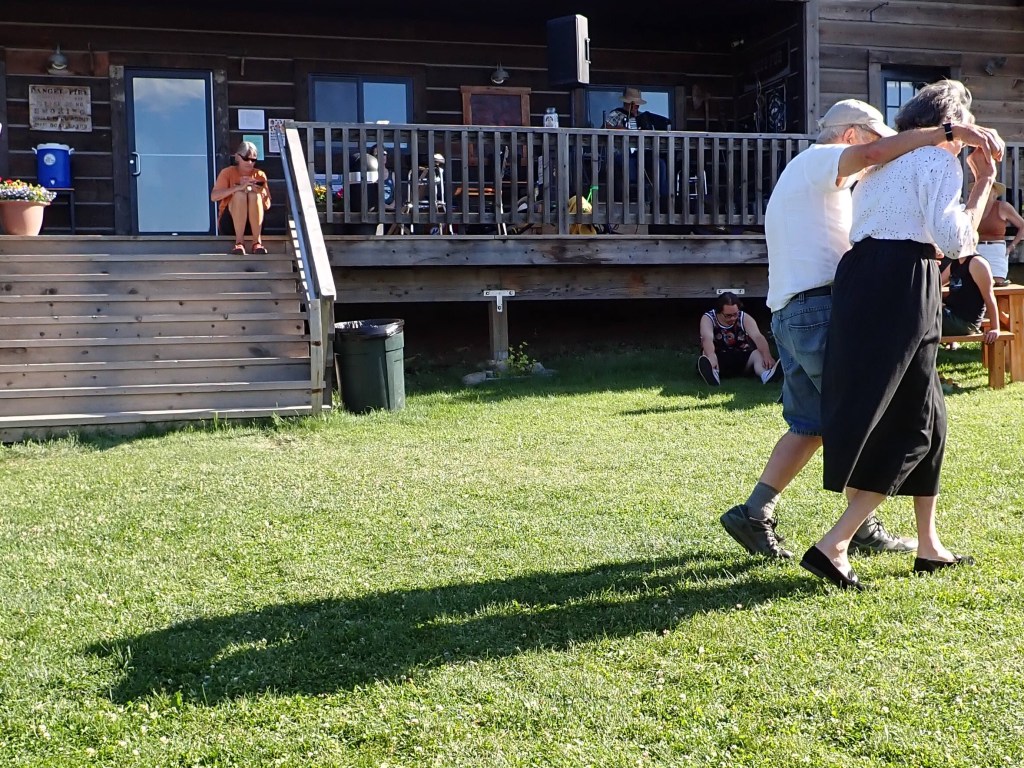
    There was a wide range of music for dancing, ranging from traditional dancing fare – polkas, waltzes, and schottisches; as well as sung music of a variety of styles. I particularly enjoyed the artists’ reminisces in between their songs – glimpses of how accordions, and music and culture more broadly, have featured in their lives.

    This spry young couple coaxed more than a few attendees into joining them.

    Much praise to the organizers, and all the folks who helped them! Well done.

  • David Thompson Black Powder Shoot (2022)

    David Thompson Black Powder Shoot (2022)

    This year’s David Thompson Black Powder Shoot was somewhat better attended than last year’s, perhaps due to a loosening of Covid strictures. 57 shooters competed in some combination of three separate events – rifle (a trail of 21 targets), pistol (a trail of 19 targets), and knife & hawk (both used at each of the ten stations).

    For one’s shooting score to count, their muzzleloader must use open ironsights, and patched roundball (no peepsights, nor Minié ball or sabots, in the interest of a more even playing field).

    The final station in the rifle trail – the long gong was about 160 yards away.

    Saturday Evening’s dynamite shoot was a blast, but I became caught up in conversation, and neglected to get a photo of the event. This year’s final round was very well-shot, and anticipation hung in the air. The winner received a fine rifle wall mount.

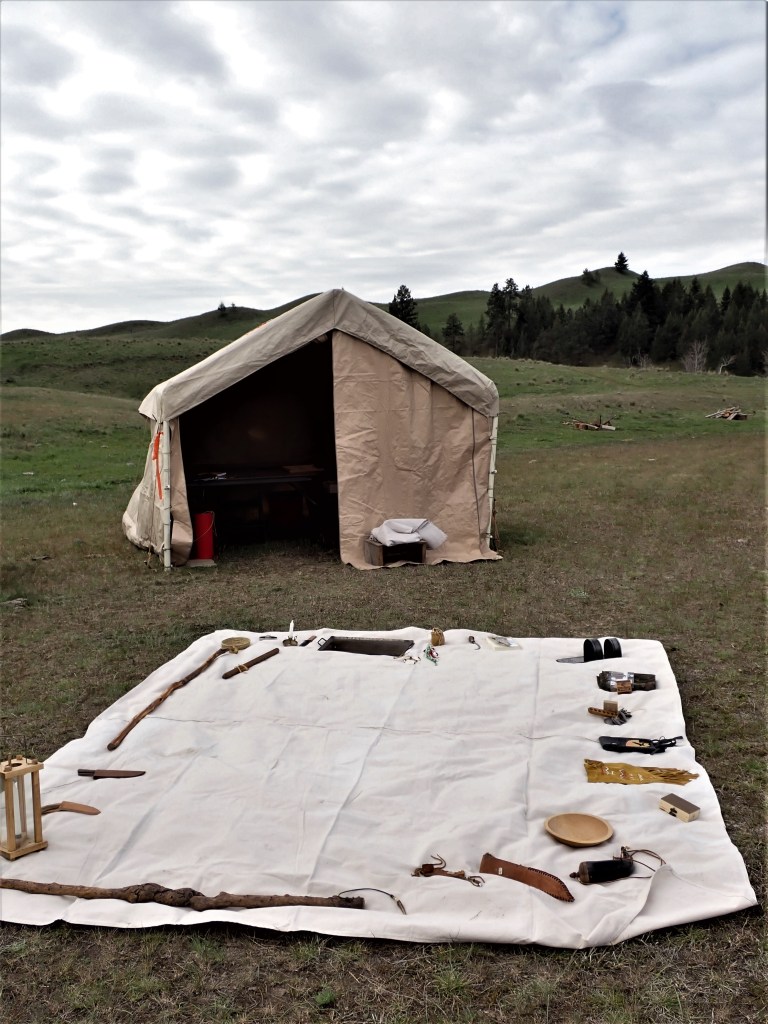
    The blanket prizes, laid out in front of the registration tent on Sunday morning.

    Blanket prizes took place on the final day. To participate, a person brings some relevant item to exchange. The person with the highest overall score from the three main events selects a prize first, the second-highest score next, and on down the line.

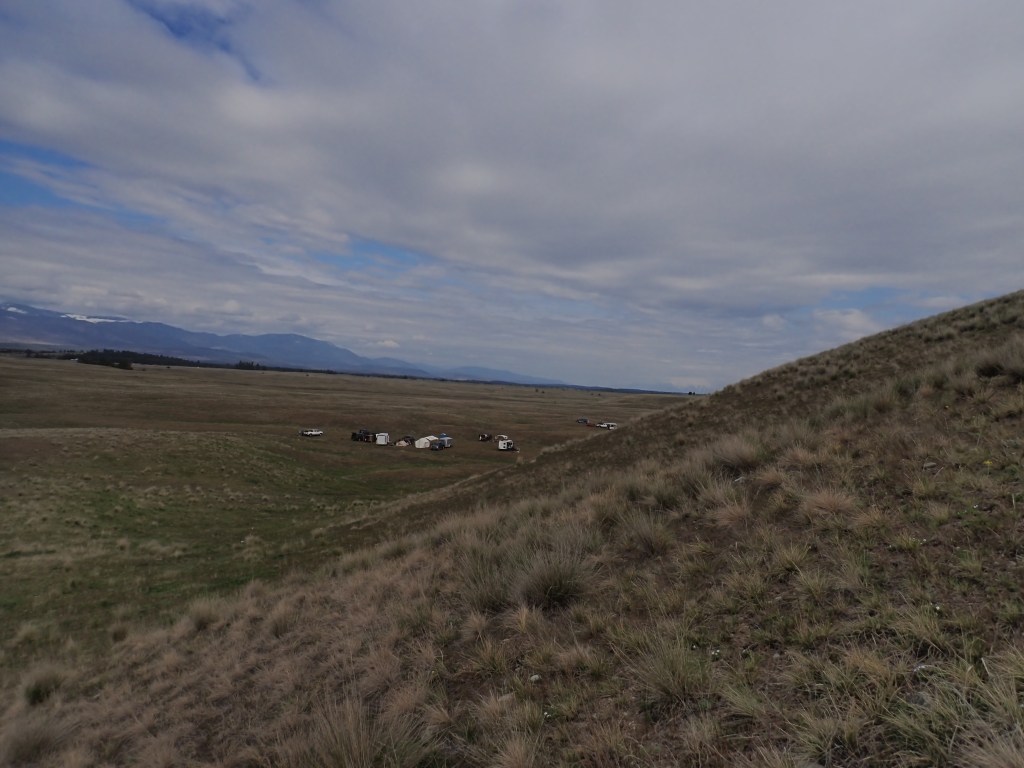
    The rendezvous concluded, targets dismantled and loaded up, camp was swiftly struck.

    Hoping to see you all next year.
    -Mr. Smiley

  • Snow fleas have been out and about.

    Snow fleas have been out and about.

    Snow fleas have been out and about this past week.

    Despite their name, snow fleas bear no relation to the parasitic insects. Truth be told, snow fleas aren’t even insects! They have six legs, but aren’t divided into three body regions like insects, so instead belong to a larger grouping, the hexapods. Snow fleas are more properly called “springtails”, after the furcula, meaning “little fork” in Latin, a forked structure they use to fling themselves into the air.

    Just below Lincoln’s shoulder, there is a snow flea – a Hypogastrura springtail.

    Here’s a close-up video of a distantly-related springtail leaping, with a bit of an explanation of how the furcula works.

    A few more snow fleas and a fir needle.

    Unlike many arthropods, springtails grow to maturity faster in cool and moist conditions. Many are winter-active as well.

    Similar to some of the insects I discussed in our piece on cold adaptations, many springtails have glycerol compounds in their blood, which lets them stay active in cold temperatures. Some food scientists are currently studying this blood antifreeze to make ice-cream less-susceptible to freezer damage.

    Here’s a broader-field video than I was able to take of the snow fleas.

    Despite being very common, and covering a vast range, very little is known about springtails. Most tend to live in the soil itself, either in woodlands or grasslands, but I’ve found them in caves and on the surface of streams before as well. Wherever there is moisture to keep springtails from drying out, as well as bacteria or mold for them to eat, there you can find springtails.

  • Be wary of scams when deal-hunting.

    As holiday shopping rears its ugly head, we can anticipate more scams.

    Let’s say John Smith did some Black Friday/Cyber Monday internet bargain-finding.
    He found a deal he’d been dreaming of. A price too good to be true, and, to his sorrow, several weeks later it turns out that it wasn’t true at all.

    Here are several common scam types:

    1. You purchase from an online retailer, but never receive information or a package.
      The seller fails to reply when you try to contact their helpline.
      You contact your bank, card company, or PayPal, and have them cancel that transaction.
      Suddenly, the seller is responsive! They supply a tracking number that was delivered to your approximate area. Onward to scam type two.
    2. You receive a real tracking number, but never get the package.
      On further investigation, the tracking number was for something sent to the same area (town, zip code, etc.), making it easy to shift blame onto the package delivery service.
      However the tracking number isn’t for your package – it doesn’t have your address, and often has a very different weight. Even if you’ve been given a valid tracking number, it doesn’t necessarily mean that your package is real!
      And now you, the scam victim, are stuck with the burden of proof.
    3. You receive a tracking number, and the package associated with it is sent to you, but isn’t what you ordered.
      Perhaps you open it up, think “what the H-E-double-hockysticks is this?” and promptly forget about it…
      A month or so later, when you realize that you never got those fancy pajamas, you realize that the time window to contest the charge is now closed.
      (This is a common scheme for international scam packages – even if you want to return it for your money back, the postage to ship it back may be more than what the item or refund is worth). For example, mailing a package from China to the USA is far less expensive than vice versa.

    eBay and PayPal will almost always side with the scammer if they can produce a tracking number that got delivered in your town. And, regardless of how they’re doing this, scammers seem to be pretty good at finding tracking numbers.
    You can appeal this, by showing evidence that the item you ordered was not the item that they sent. The US Post Office, FedEx, and UPS all have the ability to check the addresses associated with their tracking numbers, and sometimes may have GPS coordinates for delivery as well. If you have a FedEx or UPS tracking number, chances are you can get the package weight and dimensions from their tracking websites, too.

    Here’s a story from a relatively local eastern Idahoan who experienced a valid tracking number scheme earlier this year. The comments below the story are good and discuss a number of scam websites and apps to avoid buying from.

    Safeguard your purchases ahead of time by checking the sale websites – google it, and see if folks think it’s a good place to shop, or if the website sells lower-quality items than it claims. Do a search on the Better Business Bureau’s “Scam Tracker” to see if the site you’re contemplating buying your firepit or that steal of a computer from is legitimate.
    Consider trying to call the helpline phone number provided on an online retailer’s website. Be wary if an online retailer redirects you to a new website to pay via PayPal.

    If you receive a package you’re not expecting, take pictures of it while you open it.
    Photograph the label and tracking number, and record the weight and parcel dimensions – it might pay off just a little ways down the road.