Trego's Mountain Ear

"Serving North Lincoln County"

Author: EntomologistJed

  • Festive Parasites

    Mistletoe is a classic Christmas decoration, which has always struck me as rather odd, considering that all varieties of mistletoe are parasitic plants. Depending on how bad the infestation is, mistletoe is quite capable of killing its host plants.

    There are many types of mistletoe (117 species globally, 5 species of dwarf mistletoe are common in Montana). While mistletoe have many different host plants, around here our mistletoe varieties tend to be specialists on conifers – I’ve spotted some local Western Dwarf Mistletoe, generally found on Ponderosa Pines.

    As for why we associate mistletoe plants with kissing?
    They’ve been plants of spiritual importance for quite some time. And with that come many attempts at medicine… don’t try these at home, folks.

    It’s easy to see why folks thought mistletoe might help fertility, though – Europe’s common mistletoe is an evergreen plant. It’s easy to find flourishing, clearly healthy and alive, even when all the deciduous trees are leafless. And think of how much more special the mistletoe would be thought, if it came from a type of tree held to be sacred, such as an Oak or an Ash.

    The Roman historian Pliny the Elder claimed that Druids used mistletoe gathered from sacred oak trees in their rituals, though there’s little enough proof of that… it’s a long time back, the druids didn’t keep written records, and Pliny isn’t without error. Similarly, in northern Japan, the Ainu people used mistletoe gathered from their sacred willow trees to try to encourage fertility, as well as cure ailments.

    In the great Roman epic, the Aeneid, the hero Aeneas is told to carry a golden branch of mistletoe with him on his journey to the underworld, so that he’ll be allowed to return to the surface world again. When there, he speaks with the dead, notably his father, and hears stories of how the Caesars will be his descendants.

    However, it’s most likely that mistletoe’s connections to our holiday festivities come out of its ties to Norse mythology.

    There’s a legend that the queen of the Norse gods, Frigga, went through all the world, making everything promise that it would not hurt her son, Baldr. You see, Baldr had recently begun to have visions of his death, and it is said that even gods find death a concerning prospect.

    Now Baldr was a god of summer, beauty, and peace – best loved of all the gods. All the world pledged their love for Baldr. Stout oak and ash trees promised that their wood would never harm Baldr, stone and metal, beast and people alike. All pledged that they would not harm Baldr.

    Loki, troublemaker of the gods, disguised himself as an old woman, and coaxed Frigga until she revealed the one thing she didn’t ask this of – mistletoe. She thought it too young, too weak a plant to harm Baldr, and hadn’t worried about asking it.

    After hearing this, Loki journeyed east from Asgard, home of the gods, until he came to the forests where mistletoe grew. There he found mistletoe, and taking a particularly healthy plant, fashioned it into a throwing dart, and came back to the gathered gods celebrating Baldr’s invulnerability.

    To test Baldr’s invulnerability, the gods held a celebration, and tried to harm Baldr with various weapons, lightly at first, then with more grievous and more grievous attacks. They delighted when nothing could harm Baldr, and believed that he had successfully cheated his visions of death.

    At the outskirts of the gathering stood Hodr, Baldr’s blind half-brother. Another god of the seasons, Hodr was a god of winter, and surviving dark and harsh times. Loki asked Hodr why he wasn’t joining in the celebrations, and Hodr replied that he didn’t have a weapon to use against Baldr, and even if he did, he couldn’t see to use it properly. Loki offered to help Hodr join in the fun, gave him the dart of mistletoe to throw, and even helped guide his hand… When Baldr was struck, and mortally wounded, Loki made himself scarce, leaving poor Hodr to be executed for the murder of his brother.

    The tale runs on, but the gist is that the Norse gods were unable to retrieve Baldr from the underworld. His mother, Frigga, wept, and her tears became the mistletoe berries. As Frigga was a goddess of love, marriage, motherhood and all things associated, mistletoe berries gained importance in treating infertility…

    Not that I’d suggest you try to do so. Most mistletoe varieties are somewhat toxic.

  • Winter Crane Flies: widespread and little-known

    Winter Crane Flies: widespread and little-known

    As I was walking over to my in-law’s place one chill and sunny afternoon, I happened to spot a fly. A gangly, long-legged fly, seeming to bounce up and down in the brisk winter air. Unlike the cluster flies lining the edges of our ceilings, this one was fairly active, despite the temperature.

    Naturally, I snatched it out of the air for a better look.

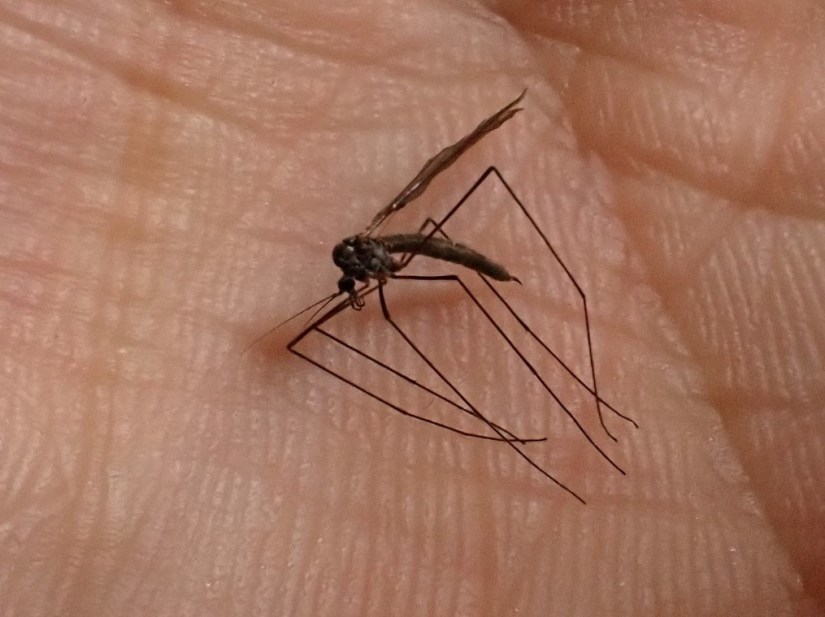
    It wasn’t just any fly – at first glance it appeared to be a crane fly… but parts of it weren’t quite right. It had simple eyes in the center of its forehead, something absent in true crane flies. Nor was it quite the right size – it’s perhaps 1.5 to 2 times the size of an average mosquito, whereas crane flies can be far larger, and with a broader leg-span. It was a winter crane fly.

    If you look closely, you’ll find that the winter crane fly, like its true crane fly relatives,
    does not have stabbing mosquito-like mouthparts.

    While not true crane flies, winter crane flies are close relatives, and both develop in similar areas and eat similar foods. Wet spots on land, perhaps along a stream or seep, are perfect for a growing winter crane fly maggot. True crane fly maggots (often called “leatherjacket slugs”) prefer to swim in the stream itself, and can make excellent fishing bait. Both types of maggot like places that have plenty of moist decaying plantstuff to feed on.

    Interestingly, winter crane flies have been documented gathering in large numbers underground… both here and in the Old World. I observed this in a number of western Kentucky stream caves while I was studying a group of eyeless cave beetles, but little has been written on the behavior in this organism. I wonder if it could be similar to how mosquitoes overwinter in caves…

    To my surprise, Winter Crane Flies have become invasive in Antarctica in the past decade… it’s thought that they started out by colonizing the polar scientists’ sewage treatment plant, and escaped to the outside. Impressive for a wee beastie that is only active for a couple of months out of the year here. Of course, the Winter Crane Flies invading Antarctica have much less competition than those around here!

    What is a pest in one place may be entirely harmless in another.

  • Ask the Entomologist: Bug on my kitchen wall

    Ask the Entomologist: Bug on my kitchen wall

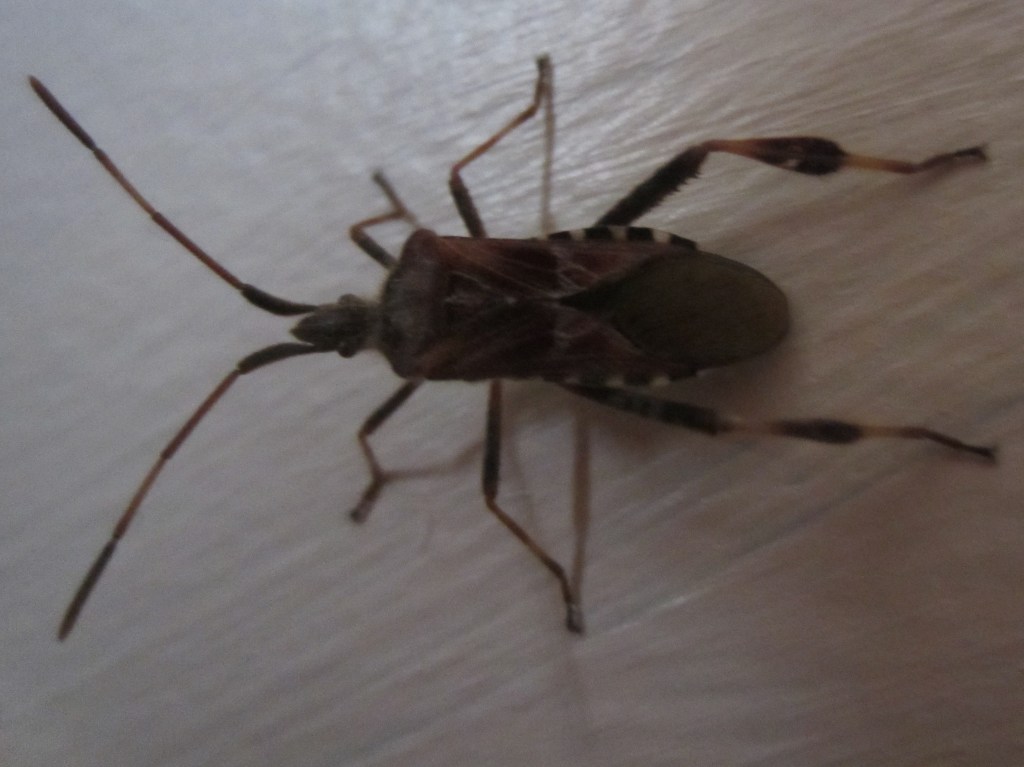
    “Is this a stink bug? Our house has a few of these, and they’re often walking on the walls. Why?”

    Your particular leaf-footed bug is Leptoglossus occidentalis, the Western Conifer Seed Bug.
    Very nice photo, by the way.

    This isn’t a stink bug, but that’s a very good guess!
    This is a leaf-footed bug, a close relative of the stink bugs – they’re both members of Hemiptera, what entomologists call “the true bugs”. Beyond this, leaf-footed bugs and stink bugs both belong in Infraorder Pentatomorpha. While leaf-footed bugs do emit a strong smell when stressed or handled, but it’s not nearly as strong as a stink bug’s scent, in my experience.

    These bugs are similar in behavior as well – they have piercing mouthparts, and tend to be herbivorous, especially seed-feeding. Both have been crop pests – stinkbugs are detrimental to agricultural pursuits like soy farming, while leaf-footed bugs tend to be more damaging in tree plantation contexts. In some regions, both may be present as minor citrus farming pests.

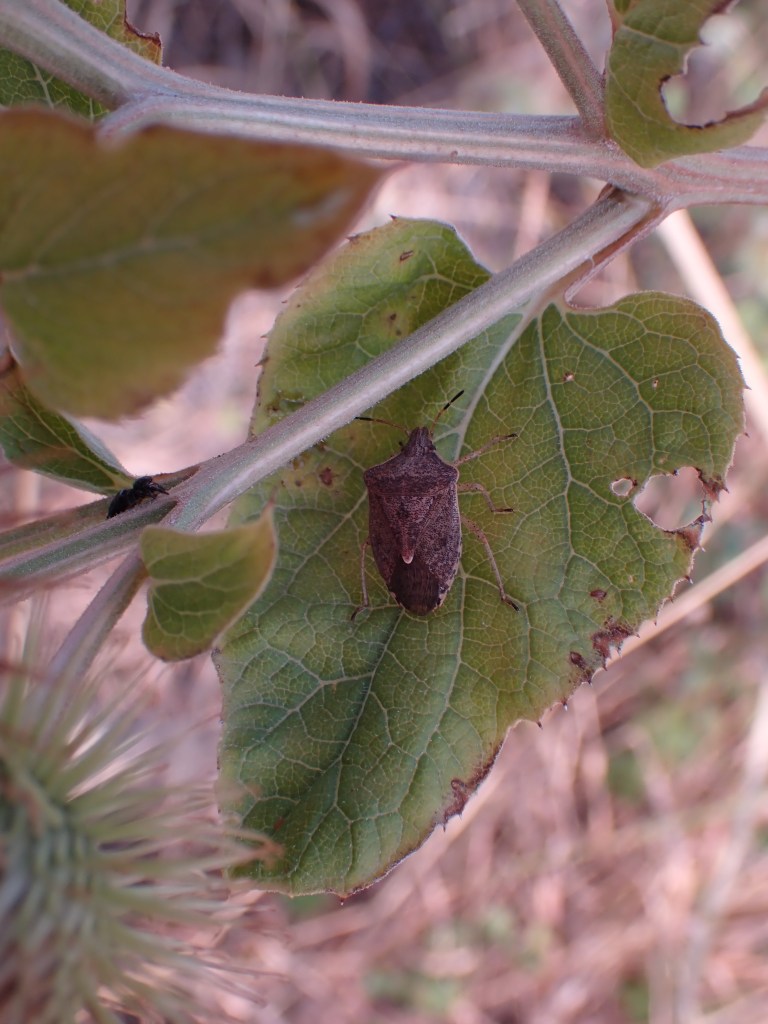
    Here’s a stink bug I met this fall, perched on a burdock leaf. Note the differences:
    The leaf-footed bug is slender and has fins on its hind legs.
    The stink bug is stout in comparison and has larger spines on its shoulders.

    However, when the weather turns cold, both stink bugs and leaf-footed bugs seek shelter from the elements. In winter, both stink bugs and leaf-footed bugs build up protective alcohol-based compounds in their blood that make it much more difficult for them to freeze. However, if they do end up freezing, they die. Leaf-footed bugs are what entomologists would call “cold-tolerant, freeze-avoidant“. Their quest to find someplace warm to spend the winter sometimes leads them to bother us indoors. Without human homes to invade, leaf-footed bugs and stinkbugs both tend to overwinter inside large dead trees.

    While they may be annoying for a time, rest assured that neither stink bugs nor leaf-footed bugs are harassing your houseplants this winter. During overwintering, these bugs avoid feeding – after all, the more moisture they take in, the more likely it is that ice crystals could form inside them. However, many leaf-footed bugs do release aggregation pheromones which spread the news that your home is a great warm place to wait out the winter.

    As for why your new houseguests are walking on your walls, that I don’t have as good an answer for.
    I imagine that your walls might be warmer than the floor, and that could make them more attractive. I’d also hazard a guess that your leaf-footed bugs prefer being on inside walls, rather than outside walls.

    Thank you for the question!

  • Non-human immigrants

    Non-human immigrants

    As Thanksgiving draws near, and we hear tales of “The First Thanksgiving”, and explanations of the tales’ inaccuracy, my mind turns to other immigrants. For better or worse, humans from the Old World journeyed across the Atlantic Ocean, and carved lives for themselves here in the New World. But humans are far from the only species to have done so.

    Once upon a time, the Americas had no grasshopper species – genetic evidence suggests that our North American “Bird Grasshoppers” are descended from West African grasshopper immigrants which flew across the Atlantic. While this sounds rather far fetched at first, it become less so, when realizes that Schistocerca grasshoppers flew from West Africa to the Caribbean in 1988…
    A decade before, in 1977, related Bird Grasshoppers flew from Central America to Hawai’i with the help of a strong storm system, where they have since caused problems. Most invasive species, though, have made use of human help to travel such vast distances.

    Here in Montana, we have no shortage of invasive weeds, and many of them are immigrants that are here thanks to human activity. Spotted Knapweed stowed away in seed shipments, Mullein, Plantain, Dandelions, even Stinging Nettle All came over with European settlers, and were put to many uses.
    On the other hand, Spotted Knapweed, both a more recent import and a more noxious weed, was not deliberate. Its seeds stowed away as contaminants in seed shipments, and the species has since spread through much of North America.

    Honeybees, as well, are newcomers to this continent – deliberate introductions, unlike many insects. According to Thomas Jefferson, Native Americans called the honeybee the “white man’s fly,” and thought it associated with European settlements. While North America once had its own native species of honeybees, they went extinct long before the European honeybee made American landfall in the 1600s.

    Our homes’ infestations of Cluster Flies? I suspect their introduction was less than planned. Likewise, European Paper Wasps, Asian Longhorned Beetles, and Multicolored Asian Ladybeetles were all stowaways who have done quite well for themselves here in the Americas.

    Immigrant species aren’t all bad, however. Indeed, I’m very glad we have immigrant species – for every “bad” one, there’s another out there, somewhere, that presents a solution. Biological control can be a wonderful way to put imbalanced systems back into stability.

    If you’re interested in learning more about what species became immigrants alongside European colonists, consider browsing Nunn & Quian’s “Columbian Exchange“. It gives a good summary of what foodstuffs, diseases, and technologies arose from immigrant species on both sides of the Atlantic.

    Some of my favorite insect immigrants – flies which help control knapweed.
    These two adults died with the coming of the cold,
    but their young are safely overwintering inside seed heads.

  • Weird Words: Procrustean

    “Procrustean” is a fun word with an interesting history.

    According to Merriam-Webster, it means: “marked by arbitrary often ruthless disregard of individual differences or special circumstances”

    The story the word come from is marked by someone who was precisely that.
    Προκρουστης, known to us as Procrustes, is a figure from Greek mythology. He was a robber who invited travelers to his home, then, after supper, put them to bed. As his unfortunate guests would discover, Procrustes’ guest room’s bed was made of iron, and he was determined to make it fit everyone perfectly.

    If a guest was too small for his massive iron bed, he’d tie their ankles to one end of the bed, and stretch them until they were the right size… tearing limbs out of joint in the process. In the unlikely event that a guest was too tall for his bed, he’d take his hacksaw and remove as much of their feet and lower legs, as was needed to make them the perfect length.

    The name “Procrustes” itself comes from two Greek root words: “προ” (pro) meaning “in front of” and “κρουειν” (krouein) meaning “to strike” or “to beat”. These words paint the picture of a smith lengthening a piece of metal by beating it out.

    A fellow who goes around murdering travelers doesn’t really add to the quality of one’s local community, but Procrustes got away with his crimes for quite a while by claiming to be the son of the sea god, Poseidon. Eventually, he was killed by another Greek who claimed divine parentage. Theseus, ostensibly another son of Poseidon, was the last person to stay in Procrustes’ home. You see, Theseus made Procrustes fit his own bed.

    A procrustean policy is one that treats everyone the same, regardless of circumstances, with the implication that it does so in a way that is harmful. Of course, those complaining that a policy is procrustean are the people “the bed” doesn’t fit. If the policy fits most people, there will be few that find it procrustean in their experience.

    What policies do you feel are procrustean?

  • Why are there flies in my house? There’s snow outside!

    Why are there flies in my house? There’s snow outside!

    If your home is anything like ours, it has had an abundance of flies lately. You may ask yourselves “why now?” – after all, it’s snowy out, and there can’t be much food for them. Shouldn’t they die with the cold like everything else?

    You’d be entirely right in thinking so. Regardless of the type of fly, most of the good food sources are rather scarce this time of year, and the cold kills many. However, insects are just as uninterested in freezing to death as we are. Most of these gathered indoor flies are trying to avoid that particular fate.

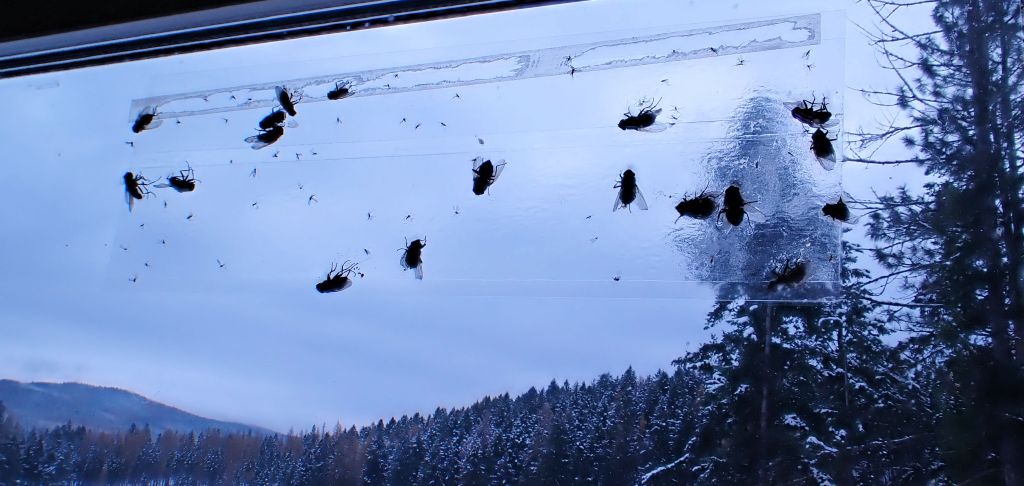
    My Mother-in-Law’s elegant, clear sticky traps, thoroughly filled with Cluster Flies and Fungus Gnats.

    While we see many house flies, flesh flies, and blow flies in the summer, they aren’t the primary species to invade our homes in the winter (though I’ve met a few of each overwintering inside my home).

    The vast majority of our new fly guests are a different group entirely – the Cluster Flies. Until quite recently, the Cluster Flies were grouped as a special sort of blowfly, but just over a year ago, they were given their own scientific family name, Polleniidae.

    Cluster Flies get their name from their habit of gathering in large groups, often in windows. Some try to stay warm outdoors, nestled deep inside rotting tree trunks. More sensible ones move inside with us to stay warm and survive the winter. Cluster Flies don’t want anything to do with your food, plants, or pets – they’re just here to avoid freezing.

    Eternal optimists, Cluster Flies often come out on warmer days, and try to find their way outside.
    Thus the accumulation of dead ones on your windowsills when weather turns cold again.

    It’s this habit of moving inside for the winter that is thought to have introduced Cluster Flies to the New World. You see, the Cluster Flies we have now aren’t North American natives. No. They’re thought to have sailed over from the Old World with some of the first European colonists.

    Back when European countries were busy sending ships to build colonies in the New World, they brought many unintentional stowaways with them. Many of these scalawags are with us today, for better or worse. In this story, we care about two such emigrants. Earthworms (especially the Green Worm) and Cluster Flies.

    It’s thought that earthworms were transported across the Atlantic in ships’ ballast. Meanwhile, some Cluster Flies took refuge from bad weather inside the ships themselves, just like they’re doing in our homes this winter, and so found their way to America as well.

    Earthworms flourished when ships made landfall. Many of the formerly-glaciated parts of North America no longer had earthworms, and were ripe for Lumbricid conquest. The spread of earthworms, in turn, opened up North America to the spread of Cluster Flies. Both spread like wildfire, and now can be found all over our continent.

    Why are earthworms important to Cluster Flies? You see, Cluster Flies are specialist parasites. Their maggots feed almost exclusively on earthworms. Mother Cluster Flies sensibly lay their little ones near earthworm burrows, and the newly-hatched maggots then see about journeying into earthworm burrows. There they lurk in ambush, waiting for a worm to pass by.

    Thinking of tiny maggots catching hold of vast earthworms with their mouth-hooks as the worm passes by very much brings scenes of Frank Herbert’s “Dune” to my mind. I like to imagine the tiny Cluster Fly maggots singing this song as they hunt their earthworm prey, and carve their way inside.

    Our friendly, local Cluster Fly – Pollenia pediculata.
    As you can see, they’re a bit larger and hairier than our common houseflies, as well as easier to catch.

    Because of their worm-based diet, Cluster Flies are actually remarkably clean compared to other flies with carrion- or dung-based diets. While you may not appreciate Cluster Flies’ presence, at least they will not spread disease.

    Additionally, both my dog and I can attest to their superb flavor.