Trego's Mountain Ear

"Serving North Lincoln County"

Category: A Science for Everyone

  • Proving nonexistence

    It’s probably a half-century and more since I realized the amount of faith it takes to be confident something doesn’t exist.  Most recently, it was a positive, confident statement that there was no voter fraud in the last election.  A half-century back, it was a college student answering the question, “How can you possibly be an atheist?”  The answer is the same – there are some things you just have to take on faith.

    Just as it takes faith to be an atheist, it takes faith to be certain that voter fraud didn’t occur.  It’s the old saw “Absence of evidence is not evidence of absence.”  Now there are occasions where the statement is worded so that it can be tested – for example, “There’s a sasquatch living in my refrigerator.”  Easy to disprove – open the refrigerator door, and if there is no sasquatch curled up in the refrigerator, we have evidence of absence.  There are items where we can prove nonexistence under specific circumstances.

    During the early 1920s, my mother, a pre-teen walking to Trego school, encountered a bear.  Her parents, and the other adults of the community explained to her that she could not have seen a bear – there were no bears in Trego.  When Dad retired, and we moved to Trego, she didn’t tell the story with every bear shot on the place, but she did enjoy having evidence that confirmed her grade school encounter.  The authorities of the day had denied her experience as false – but later evidence negated the falsification.

    From a scientific perspective, evidence is falsifiable, but not false – there isn’t such a thing as negative evidence.  On the other hand, all it takes is evidence of a single sasquatch, a single incident of voter fraud, or a single deity to show evidence of presence. 

    Every scientific explanation is tentative, and just awaits a better explanation.  Some theories explain things better than others do – particularly in the social sciences. I have no problem with folks taking things on faith – but science is not based on faith or revelation.  Science makes a virtue of skepticism.   Proof, on the other hand is binary – yes or no.  Philosophers and mathematicians have proofs – but operate in a more limited universe.
  • Vaccination by the Pyramid

    Vaccination by the Pyramid

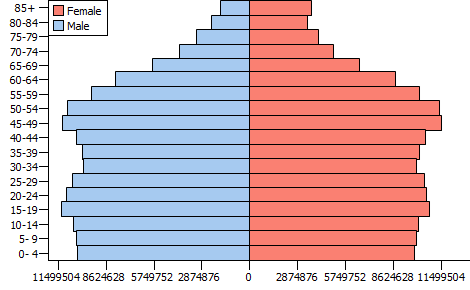
    The term “population pyramid” goes back to a time when plotting populations by age really did produce a triangle, with a large base of young people and each older age cohort narrowing, until there were very few at the top.  As diseases became more controlled, and birth control entered the picture, the population pyramids changed shape,  The pyramid below is for the US in 2010.

    (Data from http://www.proximityone.com/chartgraphics.htm )

    Now, if we look at covid death rates by age cohort, Florida’s governor released survival rates back in September:

    The numbers for the age cohorts are below – no need to extrapolate from the bars in the pyramid.  We’ll just take the complement of the survival rates, assume the vaccine is 100% effective, and calculate the potential lives saved in each cohort.

    AgePopulationDeath RateLives Saved by Vaccination
    70+22.8 million5.4%1,502,967
    50-6985.8 million0.5%429,045
    20-49127.5 million0.02%2,550
    0-1983.3 million0.003%250
    The Death Rate is 100% minus the survival rate for each age group. Lives Saved by Vaccination is the population of the age group multiplied by the death rate.

    If everyone over the age of 70 were vaccinated (and the vaccine worked perfectly) 1,502,967 Lives would be saved. If everyone under the age of 20 were vaccinated, 250.

    No editorializing here – just simple addition and multiplication with data from the census.  I know where I would put the first vaccinations if I had a limited supply.

  • Defund the Police and Legalize Marijuana

    I never liked teaching criminology.  Usually, sociology departments get a former or off-duty cop to teach Crim.  It works pretty much OK – he or she teaches the science of criminology to a room full of undergraduates.  The problem is getting a scientist to teach criminology.

    Criminology is a moving target.  Last November the people of Montana voted to legalize marijuana.  Harry Anslinger was appointed to head the Bureau of Narcotics in 1930, responsible for cocaine and heroin, and it just wasn’t enough to keep a bureau busy.  In what we now term “mission creep” Anslinger managed to outlaw marijuana by 1937.  Nobody cared before that.

    In 1636, the Plymouth Colony made five crimes punishable by death:
    1) willful murder, 2) making a compact with the devil by witchcraft, 3) arson (ships and houses), 4) sodomy, rape, and buggery, and 5) adultery.  Well, Massachusetts still frowns on murder, rape and arson – but the rest are pretty much mainstream.  It’s difficult to call it science when things change so much – in 1637, John Alexander was branded and banned from the colony for homosexual conduct.  From 1981 to 2013, Barney Frank represented his part of Massachusetts in the US Congress.  Nothing personal, but it’s hard to do science when the definitions keep changing.

    Teaching Criminology did convince me that the whole concept of deviance is socially constructed.  I could have probably got into teaching the social construction of deviance – but we had a good, reliable deviance guy in the department.  He was still married to his high school girlfriend when he retired.  About the only thing I could see deviant about Bob would have been what the texts call positive deviance.

    When faced with losing federal highway funds, Montana’s legislature made the 55 mph speed limit state law, then fixed the fine at $5.  It was a time when breaking the law wasn’t considered particularly deviant. 

    I can’t see where criminology is good science. That’s OK.  Defunding the police seems even less scientific.  In either case, politicians define crime and politicians determine police funding.  Both change with the political winds.

  • How unhealthy is loneliness?

    Are isolation and loneliness actually bad for our health? Do they increase the risk of dying?

    Short answer: Well, it isn’t good for you. How harmful probably depends on the extent and your age. Risk of dying? That’s a bit more complicated.

    This isn’t actually a new question, even if it is a topic of increasing interest lately. Since it isn’t a new question, there’s actually plenty of existing research to look at. There are a few major difficulties to keep in mind:

    • Experiments in this area are rare, primarily due to ethical concerns.
    • Loneliness is difficult to measure (it doesn’t have a number like blood pressure).
    • Determining if something is a cause is surprisingly difficult.

    One of the different categories studied is age. Loneliness in children has been studied separately than in adults.

    Children: We know isolation is extremely problematic in children. Large studies on this are limited, but there were some early ones done comparing children raised in orphanages to those in prisons, and some subsequent studies isolating baby monkeys. There have been some case studies done of individual children that have been raised in isolation as well. At any rate, it’s a bad thing. It certainly substantially impairs normal social development, and studies suggest cognitive damage as well.

    Adults: One very popular study used a biobank in the UK (Follow-up study was easier to find and more recent, so here’s that link). They found a slight excess risk of death (i.e. hazard factor) in the socially isolated, even when they accounted for other factors, such as age. This is somewhat complicated by the question of whether or not being socially isolated happens due to underlying health conditions.

    How severe are the effects of loneliness?

    While it’s a bit difficult to determine if it increases the likelihood of dying, the health effects are significant. The researcher’s term for loneliness is perceived social isolation (PSI). For adults it comes with a greater risk of depression, inflammation, and cardiovascular disorders. There certainly appears to be a link between loneliness and poor health, but precisely how/why is less clear.

    Given the current widespread social experiment taking place, the future should hold many more studies on the topic.

    Social experiment? There are some experiments one simply cannot do, for ethical reasons or practical limitations. The current situation of shutdowns, quarantines, and social distancing wouldn’t be practical to implement as an experiment on the scale we’re currently seeing it. But, as it is being implemented, we can certainly expect the data out of it to be studied. After all, it’s not the sort of experiment any scientist could dream of implementing- and, with so many states and countries doing things differently, there’s going to be lots of data to compare. It is, effectively an experiment, and if it is one with more variables and design flaws than a scientist would include, well, no scientist could have done it.

  • Evidence of Cheating

    There has been a lot of conjecture about voter fraud, and evidence of cheating.  One group says there is no voter fraud and never has been.  Another points out something statistically unlikely, and says that proves cheating.  Neither is right – in the first case, you can’t prove something doesn’t exist – an atheist I knew once explained to a priest, “Father, there are some things you just have to take on faith.”

    On the other hand, statistically unlikely doesn’t mean impossible.  I came up with four of a kind in draw poker.  Once.  Statistically, 0.000240096 chance of happening.  Still glad I wasn’t dealing, but I was dealt three of a kind (queens, as I recall).  When I drew two cards, I knew where 47 cards were, and that one of them was another queen.  I had two chances to pick her up.  The odds of getting a fourth queen on the draw are a lot better than getting the first three on the deal.

    On the third hand, if you see four of a kind, and three are the same color, you don’t need a lot of math to work out the probability.  If you see three red aces, assume someone is cheating until proven otherwise. 

    The probabilistic universe in a poker game is 52 cards (unless someone brings in a joker).  Even if you can’t do the math, it’s available online and in books.  Our presidential election universe was about 155 million voters – but the voters are kind of like cards.  A Republican in California doesn’t count – Gallup shows 45% Democrat and 24% Republican.  Basically, the California Democrats don’t need to cheat in the presidential elections, and the gap is too big for the Republicans.  Gallup shows Montana at 46% R, 39% D.  On the other hand, Georgia is 43% D, 42% R.  In Georgia, it doesn’t take nearly so much to tilt the balance.  Iowa is listed at 32%D, 32%R.  If I were looking for fraud, I’d check the primaries in California or Massachusetts.

    When you find a pattern in the numbers, the proper response is “That’s interesting.”  Voting, arrest rates, academic success or failure – it doesn’t make any difference to a numbers guy.  We did a large, mailed out survey a few years back – and wound up with more surveys addressed to Gann Valley – population 14, the nation’s lowest population county seat – than in Fort Thompson – the largest settlement (population 1,282) on the Crow Creek Reservation.  Both are census-designated places, and we had a lot of calculating to do, to figure out why random post office addresses wound up biased toward white box-holders when the Native population was so much larger.  It was interesting – and Mary Kills-a-hundred’s thesis is Undercount and Underrepresentation of American Indians in the Quality of Life Survey. The abstract explains “the towns within the counties that had a large concentration of American Indians had a smaller likelihood of selection for the survey than did the white majority populated towns”.  Believe it or not, there are cultural differences that change the likelihood of having a post office box of your own.  When you find a pattern, it begs for an investigation.

    Accountants are also numbers guys – not the same type as I – but they look for patterns too – the forensic accountants call them red flags.  Let’s say the auditor sees red flags and thinks that a bit of embezzling has been going on – he’s got the pattern, he’s seeing red flags, and a duel is carried out in the audit.  The auditor knows something hokey has gone on – but if the embezzler has covered tracks well enough, there might not be enough evidence to get past “reasonable doubt.”  The auditor is certain, but the evidence can be too murky for a conviction.

    If that data is as I have read, there are some really interesting patterns just waiting to be investigated.  The pattern may be benign or it may turn out to be voter fraud.  But the pattern is interesting – and that’s a call for research.  If we could put up with the courts resolving the hanging chads in 2000, we might as well get the courts to resolve this one.  The pattern is interesting.

  • Standard Deviation and Stable Genius

    About three thoughts came together and gelled last week.  One was a headline that explained voter turnout in Wisconsin was 5 standard deviations from the mean.  The other was looking at Trump assessing himself as a “stable genius” and Biden’s frequent challenge of having a high IQ.  I realized that I don’t have to explain how to calculate a standard deviation – there is a chart that shows it all in terms of IQ, and it really simplifies matters. 

    If you look at the linked table, on the scale that accepts 15 points as the standard deviation, an IQ score of 175 is 5 standard deviations above the norm.  To make that statement understandable, that’s one person out of 3,483,046.  Chances are that I have never met one, despite a career in science and the academy. 

    Nasim Taleb writes “IQ” is a stale test meant to measure mental capacity but in fact mostly measures extreme unintelligence”, so let’s look at the IQ 25 – whom I also haven’t met.  0.0000287105% of the population would score below this mark.

    Tierman’s classification for genius (based on a standard deviation of 16) was 140 and over – so if you check the chart, that’s one out of every 161 people.  Statistically, we should have four or five living within the Trego school district boundaries.  I don’t know what it takes to be a stable genius – maybe a horse?

    IQ RangeClassification
    140 and overGenius or near genius
    120-140Very superior intelligence
    110-120Superior intelligence
    90-110Normal or average intelligence
    80-90Dullness
    70-80Borderline deficiency
    Below 70Definite feeble-mindedness
    Table developed by Tierman, source: IQ Comparison

    When we look at Biden’s quote, “I think I probably have a much higher IQ than you do, I suspect.” and look at the chart in Talib’s paper, toward the bottom we see the range for “legal professions”.  Talib’s comment at the bottom is just as valid for attorneys as college professors.  It does add a bit of perspective.