Trego's Mountain Ear

"Serving North Lincoln County"

Category: Laws, Ordinances & Regulations

  • Why Did it Have to be …Guns?

    Why Did it Have to be …Guns?

    Why Did it Have to be … Guns?

    by L. Neil Smith

    lneil@lneilsmith.org

    Over the past 30 years, I’ve been paid to write almost two million words, every one of which, sooner or later, came back to the issue of guns and gun-ownership. Naturally, I’ve thought about the issue a lot, and it has always determined the way I vote.

    People accuse me of being a single-issue writer, a single- issue thinker, and a single- issue voter, but it isn’t true. What I’ve chosen, in a world where there’s never enough time and energy, is to focus on the one political issue which most clearly and unmistakably demonstrates what any politician—or political philosophy—is made of, right down to the creamy liquid center.

    Make no mistake: all politicians—even those ostensibly on the side of guns and gun ownership—hate the issue and anyone, like me, who insists on bringing it up. They hate it because it’s an X-ray machine. It’s a Vulcan mind-meld. It’s the ultimate test to which any politician—or political philosophy—can be put.

    If a politician isn’t perfectly comfortable with the idea of his average constituent, any man, woman, or responsible child, walking into a hardware store and paying cash—for any rifle, shotgun, handgun, machinegun, anything—without producing ID or signing one scrap of paper, he isn’t your friend no matter what he tells you.

    If he isn’t genuinely enthusiastic about his average constituent stuffing that weapon into a purse or pocket or tucking it under a coat and walking home without asking anybody’s permission, he’s a four-flusher, no matter what he claims.

    What his attitude—toward your ownership and use of weapons—conveys is his real attitude about you. And if he doesn’t trust you, then why in the name of John Moses Browning should you trust him?

    If he doesn’t want you to have the means of defending your life, do you want him in a position to control it?

    If he makes excuses about obeying a law he’s sworn to uphold and defend—the highest law of the land, the Bill of Rights—do you want to entrust him with anything?

    If he ignores you, sneers at you, complains about you, or defames you, if he calls you names only he thinks are evil—like “Constitutionalist”—when you insist that he account for himself, hasn’t he betrayed his oath, isn’t he unfit to hold office, and doesn’t he really belong in jail?

    Sure, these are all leading questions. They’re the questions that led me to the issue of guns and gun ownership as the clearest and most unmistakable demonstration of what any given politician—or political philosophy—is really made of.

    He may lecture you about the dangerous weirdos out there who shouldn’t have a gun—but what does that have to do with you? Why in the name of John Moses Browning should you be made to suffer for the misdeeds of others? Didn’t you lay aside the infantile notion of group punishment when you left public school—or the military? Isn’t it an essentially European notion, anyway—Prussian, maybe—and certainly not what America was supposed to be all about?

    And if there are dangerous weirdos out there, does it make sense to deprive you of the means of protecting yourself from them? Forget about those other people, those dangerous weirdos, this is about you, and it has been, all along.

    Try it yourself: if a politician won’t trust you, why should you trust him? If he’s a man—and you’re not—what does his lack of trust tell you about his real attitude toward women? If “he” happens to be a woman, what makes her so perverse that she’s eager to render her fellow women helpless on the mean and seedy streets her policies helped create? Should you believe her when she says she wants to help you by imposing some infantile group health care program on you at the point of the kind of gun she doesn’t want you to have?

    On the other hand—or the other party—should you believe anything politicians say who claim they stand for freedom, but drag their feet and make excuses about repealing limits on your right to own and carry weapons? What does this tell you about their real motives for ignoring voters and ramming through one infantile group trade agreement after another with other countries?

    Makes voting simpler, doesn’t it? You don’t have to study every issue—health care, international trade—all you have to do is use this X-ray machine, this Vulcan mind-meld, to get beyond their empty words and find out how politicians really feel. About you. And that, of course, is why they hate it.

    And that’s why I’m accused of being a single-issue writer, thinker, and voter.

    But it isn’t true, is it?

    “Permission to redistribute this article is herewith granted by the author—provided that it is reproduced unedited, in its entirety, and appropriate credit given.”

    L. Neil Smith passed away recently – for folks who are unfamiliar with his writings, many are available at https://lneilsmith.org/   It’s worth checking out.  I’ve learned that few of these blogs live longer than a year past the author, and Neil Smith was worth reading.

  • Beyond Ghost Guns

    Beyond Ghost Guns

    I ran across an article called “Beyond State Control” published by   SmallArmsSurvey.org.

    The report takes up 128 pages, and does a pretty good job of showing spots where gun control legislation has failed.  Page 80 shows production of submachine guns in Canada:

    Canadian authorities have also seized significant numbers of craft-produced submachine guns from criminals. In December 2015, Toronto police found what was described as a ‘Tec9’ sub-machine gun in an abandoned vehicle (CityNews, 2015). The gun, actually a craft-produced copy of the Intratec TEC-9, was one of many produced at a plant in Montreal, Quebec. The Royal Canadian Mounted Police have since traced more than two dozen of these to 18 locations across Canada (Berthiaume, 2018). The sub-machine guns in question were produced at a metal-working factory and feature two CNC-machined polymer halves used to form the frame of the gun, a distinguishing feature of other TEC-9/DC-10 copies (see Image 38). The barrels were threaded to accept craft-produced suppressors, also made in the factory. Two factory directors were charged with firearms offences; they had reportedly told factory employees that they were manufacturing parts for paintball guns (Berthiaume, 2018).”

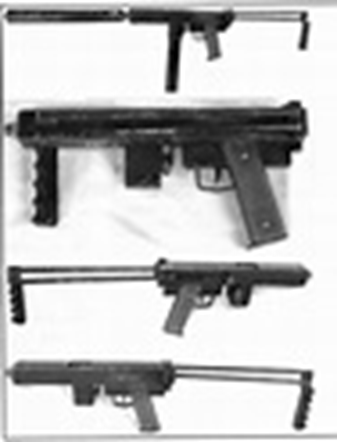
    Their illicit product looked something like this:

    Earlier, the authors explain why the submachine guns are so common as what they term “craft-produced small arms: “Sub-machine guns are perhaps the most widely documented craft-produced small arms in circulation (ARES, 2018; ImproGuns, n.d.). Their high rate of fire and low cost make them attractive to organized criminal groups. Often chambered for the common 9 × 19 mm cartridge, they are frequently based on Second World War or cold war designs, such as the British Sten and the US M3 ‘grease gun’. As such, they almost always operate on the simple blowback69 principle, firing from an open bolt (ARES, 2018; Jenzen-Jones, 2017a). Pulling the trigger releases not the firing pin but the entire bolt, which picks up a cartridge from the magazine, chambers it, and fires it by means of a fixed firing pin. The bolt is then ‘blown’ backward by the fired cartridge, such that the empty case is extracted and ejected, while the bolt is returned to the rear, where it is ready for the next shot. These weapons require none of the complex machining and engineering needed to create a reliably functioning locked-breech firearm, and they can be relatively safe to operate.”

    The photographic quality is probably lower than the machining quality – while these examples were taken from a protestant group in Northern Ireland, I suspect the Provisional IRA has equally skilled folks in their workshops.

    Another article, from the same folks in Switzerland is “Craft Production”, found here.

    It begins with “Craft production of small arms refers principally to weapons and ammunition that are fabricated largely by hand in relatively small quantities. Government authorities may tightly regulate and oversee these artisans’ activities and outputs (expensive replica antique firearms legally produced in the United States are a good example). Often, however, this material is produced outside of, or under limited, state controls. These weapons are often used in crimes and against government targets.” 

    The problem with legislating gun control is that some folks out in the real world are better at making guns than the folks trying to stop them.  If they’ve been making submachine guns in Quebec, I suspect the idea of shutting down ghost guns by legislation is closing the barn  door after the horse is in the garden.

  • Dear Senator Tester

    Dear Senator Tester:

    I notice that the proposed director for ATF, David Chipman, has said he would like a ban on the AR-15 rifle, that it is not suited for use other than military.

    Since you come from Big Sandy, I’d like to share a story about my daughter.  She was hit by a semi as she was stopped to make a left hand turn.  The concussion left her with prosopagnosia (face blindness and object recognition challenges),  and the impact pretty well trashed her right shoulder – she can’t even handle the recoil from an M1 carbine, but the lighter .223 bullet, with the direct gas impingement, is gentle enough that she can handle the recoil of an AR-15.

    Here in Trego, we live in grizzly country.  She can hike the woods in my quarter section where I have the trails blazed to show which way leads to the house and which way leads away.  She has a small dog who does an amazing job at identifying people.  And the AR-15 rifle gives her a much more even chance if she encounters a grizzly (or two) than the other light recoil option of a 22 long rifle.  The injury has taken her ability to use a large caliber handgun – she is pretty well limited to a .32 ACP blowback to make recoil manageable.  The dog takes care of recognizing threats and she can still have a chance with an aggressive bear or cat if she has the light recoil of the AR-15 with the .223 (larger cartridges like the 30 blackout still are beyond her recoil tolerance, and she’s not fond of my .223 bolt gun.

    So I’m hoping that, with Choteau close to your home, you can understand that she has a use for the AR-15.  Frankly, I wish she were still able to use a 45 – but I am happy for the recovery she made – she is a high school science teacher and she and her dog really enjoy having 160 acres of forest where she can hike without fear of getting lost.  But last year, we had two problem bears (with collars) that FWAP wound up euthanizing.  They were 5 yards from my front door.  A couple years ago, a griz trapped by FWAP on the place had his video go viral as he tried to use the rope on the gate to reel in the warden when he (the bear) was released.  We have had two adult grizzlies through this year, one a sow with cubs. 

    I can understand how the President, coming from Delaware, doesn’t share my reality – but I figure that, while your place in Big Sandy may not see as many grizzlies as we do, you probably have neighbors that are more similar to us.  I have friends who are scarred from their grizzly encounters – for myself, I have had nothing worse than confrontations that ended with the bear leaving. 

    I figure that with the Senate split as evenly as it is, I should ask you to vote with Montana instead of the President, and keep the AR-15 available.

    Thanks,

    Michael McCurry

    Trego, MT

  • Gun Control – The Miller Case

    We have to look out for things that aren’t so.  Years ago, the dean I worked for explained that the Second Amendment allowed the National Guard to be armed and was a collective right rather than an individual right.   He confidently cited United States v Miller, and it sounded like he had a strong point.  Since he was also the chair of the local Democrats, I figured it was worth checking the actual case – there are people who sound good, but their facts aren’t always so.  If you want a good read that covers United States v Miller, it’s here.

    The case was about a couple bank robbers taking a sawed-off shotgun across state lines, and it’s important to understand a few things about Jackson Miller.  He was a poor shot with a handgun.  He was a career criminal.  And, he was a snitch, an informant, a narc who had rolled over on virtually all of his buddies.  If anyone needed that sawed-off double to enhance his life expectancy, it was Jackson Miller. 

    The abstract explains “Miller was a Second Amendment test case, teed up with a nominal defendant by a district judge sympathetic to New Deal gun control measures. But the Supreme Court issued a surprisingly narrow decision. Essentially, it held that the Second Amendment permits Congress to tax firearms used by criminals. While dicta suggest the Second Amendment guarantees an individual right to possess and use a weapon suitable for militia service, dicta are not precedent. In other words, Miller did not adopt a theory of the Second Amendment guarantee, because it did not need one.”

    Brian L Frye University of Kentucky College of Law

    Basically, the whole Supreme Court Ruling is based on the actions of Heartsill Ragon, a conniving gun control former congressman and judge.   This excerpt has been sliced for better readability, basically with the intent to get you to read the whole story.

    “ JACKSON MILLER AND THE O’MALLEY GANG Jackson “Jack” Miller was a gambler, roadhouse owner, and small-time hood from Claremore, Oklahoma. Born in about 1900, he grew into a hulking, 240-pound thug. By 1921, he was in trouble with the law. His troubles worsened on August 14, 1924, when he accidentally killed H.A. Secrest, a young court reporter from Tulsa, while working as a bouncer at the Oak Cliff Resort near Claremore.  Secrest was plastered and roughing up his date, so Miller decked him, breaking his jaw.  Unfortunately, Secrest died of septicemia a couple of weeks later. Miller turned himself in on September 11, 1924, and immediately posted $5,000 bail. 

    But Miller did not hit the major leagues until he joined the O’Malley Gang in 1934. The Depression was the golden age of Midwestern bank robbery, and the O’Malleys executed some of the era’s most daring and successful heists. From 1932 to 1935 they claimed “most of the major bank robberies in the Southwest,” hitting banks in Missouri, Arkansas, Kansas, and Illinois.  Originally known as the Ozark Mountain Boys, the gang consisted of a score of hoods, most of whom met in the Missouri State Penitentiary.

    A reporter christened them the O’Malley Gang after the dashing Leo “Irish” O’Malley, notorious for his sensational but remarkably inept kidnapping of August Luer. In fact, O’Malley was only a bit player.  The gang’s real leaders were Dewey Gilmore, Daniel “Dapper Dan” Heady, and George Leonard “Shock” Short.

    In the summer of 1934, Short moved to a rented farmhouse outside of Claremore. The rest of the gang soon followed. Heady recruited Miller as a “follow-up man” (lookout) and “wheelman” (getaway driver). Then the O’Malleys got to work.

    On September 14, 1934, they hit the McElroy Bank and Trust in downtown Fayetteville, the oldest bank in Arkansas. While Miller and Art Austin circled the block, Gilmore, Heady, Virgil “Red” Melton, and Fred Reese broke into the bank before it opened, shanghaied the employees as they arrived, and made off with about $5,700.28

    Then, on December 22, 1934, the O’Malleys robbed two Okemah, Oklahoma banks at the same time, one of the few successes.  They drove a Plymouth and a Ford into Okemah at dawn, wore bandages concealing their faces, and struck shortly before the banks opened. Gilmore, O’Malley, Short, and Russell Land Cooper hit the Okemah National Bank, while Heady, Melton, and Reese hit the First National Bank of Okemah.

    Miller “was stationed at the Okemah city limits to guard against possible breakdowns and to pick up members of the gang if their autos failed.” Armed with pistols and machineguns, the O’Malleys bound and gagged the unsuspecting bank employees as they arrived, then forced a bank officer to open the safe. The Okemah National Bank yielded $13,186 and the First National Bank of Okemah yielded $5,491.25.33 The police pursued, to no avail.

    Miller returned to Claremore with his $2,100 share of the Okemah job, half of which he kicked back to Gilmore on the sly. But he soon grew restless. On the night of January 11, 1935, he and some friends decided to rob Joe Lewis’s gas station and café in Salina, Oklahoma.

    Nineteen-year-old Percy Bolinger was alone behind the counter when Miller, Earnest Tennyson, Ray Anderson, Norman Hoch, Howard Bridwell, Cap Ellis, Bill Meyers, and Blue Culver sauntered in at about 2 a.m. They ordered coffee and started playing the slot machines. When they got unruly and started tilting the machines, Bolinger asked them to leave. The hoods returned a few hours later, accompanied by Jeff Armstrong, who promptly pistol-whipped Bolinger. They stole $23.71 from the till and $120 from four slot machines, which they dumped in Lake Cherokee.

    A week later, the police arrested the whole crew in Claremore. It was the beginning of the end for the O’Malleys.  Today, Okemah is best known as Woody Guthrie’s hometown. On May 3, 1935, the O’Malleys hit the City National Bank of Fort Smith, Arkansas, stealing about $22,000.37 It was their last big job.

    The police arrested Cooper as a likely suspect and struck gold. Cooper ratted out Gilmore, who was already on the lam. The police caught up with Gilmore on May 22, outside of Lancaster, Texas. Gilmore sang too, fingering the rest of the gang. The police pinched O’Malley and Heady in Kansas City, where they’d rented a swanky pad from James Maroon. O’Malley immediately confessed to the Luer kidnapping and was extradited to Illinois. But the FBI took Heady to Muskogee, Oklahoma, to face federal charges on the Okemah job. A couple of weeks later, the police nabbed Short in Galena, Missouri. And on August 8, they caught up with Melton and Reese at a fishing camp in Taney County, Missouri. The FBI took all three to Muskogee for trial.

    In the meantime, federal prosecutors indicted the O’Malleys in the Eastern District of Oklahoma. The Oklahoma trial came first. Federal prosecutors charged Gilmore, Cooper, O’Malley, and Short with robbing the Okemah National Bank and Heady, Melton, and Reese with robbing the National Bank of Okemah. All seven pleaded not guilty and the trial was set for October 16. But on October 2, the United States re-indicted the lot of them, added Jack Miller to both counts, and postponed the trial to November 25.

    Miller soon flipped, confessing to his role in the Okemah job and turning state’s evidence. Miller was the government’s ace in the hole. To preserve the surprise, federal prosecutors sequestered him in the county jail until trial. As soon as the trial began, Miller’s lawyer H. Tom Kight announced, “Jack Miller, my client, will testify only on condition that he be granted complete immunity.” Judge Robert L. Williams agreed, on the condition Miller “gives a complete and truthful account of the crime.” |

    He did, and then some. “Miller, placed on the witness stand, identified the defendants as coconspirators and testified Dan Heady, charged with participation in the robbery of the First National bank approached him ‘regarding robbery of some banks.’ He testified the plan of robbing the Okemah banks was agreed upon and he was employed as a ‘follow-up man.’ He said he received $2,100 as his share of the loot taken from the banks.” Miller’s erstwhile companions branded him a “squealer,” Cooper even requesting to leave the courtroom while Miller testified.

    The trial was over almost as soon as it started. On November 27, the jury convicted the seven defendants on all counts. Williams acquitted Miller as promised, but added an admonishment. “You had a narrow escape this time . . . and you won’t be so lucky again. Get into something honest and quit this gambling business.” Miller immediately returned to Claremore.

    Williams set a sentencing date of December 9, 1935. But on December 3, Heady’s wife “Pretty Betty” slipped him a pistol during a visit. Heady used the pistol to break out of prison, escaping with Gilmore, Short, and Cooper, among others. During the jailbreak, Heady shot Muskogee Chief of Detectives Ben Bolton, who died a couple of days later.

    A huge posse of Oklahoma police and federal agents, aided by bloodhounds and observers in airplanes, tracked the fugitives to Pushmataha County into the Kiamachi Mountains near Clayton, Oklahoma. On December 5, the posse caught Cooper while he was walking down a country road twelve miles north of Clayton. And the next day, they found Heady and Gilmore in a farmhouse near Weathers, Oklahoma.

    When Heady and Gilmore refused to surrender, the police opened fire, killing Heady. Gilmore quickly gave up and led the police to Short, about a mile and a half away. Short was already dying, having been critically burned in an accidental fire the night before, and he drowned when a boat used to evacuate him accidentally capsized.

    On December 9, Williams sentenced Gilmore, Cooper, O’Malley, Melton, and Reese to 25 years. Miller was terrified of the fugitive O’Malleys, so the FBI held him in a county jail during the manhunt. They needed their snitch alive for the Arkansas trial.

    On January 10, 1936, federal prosecutors charged Dewey Gilmore, Russell Cooper, Otto Jackson, and Floyd Y. Henderson with robbing the McElroy Bank and Trust Company of Fayetteville and the City National Bank of Fort Smith, Arkansas.

    At first, all four pleaded not guilty, but Gilmore flipped when Miller implicated him in the Fayetteville job, and the others quickly folded. On January 14, Judge Hiram Heartsill Ragon sentenced Gilmore, Cooper, and Jackson to 25 years, and Smith to 56. Short was very popular in Galena – over 1,000 people attended his funeral – and his death was controversial. The police denied shooting him, but a Galena undertaker insisted he found several buckshot wounds in the corpse. And on February 14, Gilmore and Cooper got another 99 years for murdering Bolton. That was the end of the O’Malleys. Melton, Cooper, Gilmore, and Reese started in Leavenworth and ended up in Alcatraz. O’Malley did his time in Illinois, but soon went mad and died in 1944. And Miller returned to his penny-ante ways.

    In 1937, the United States Fidelity and Guarantee Company sued him for the proceeds of the Okemah job, to little effect. Eventually, he fell in with Frank Layton, another small-time Claremore hood. On April 18, 1938, the Arkansas and Oklahoma state police stopped Miller and Layton outside of Siloam Springs, Arkansas, en route from Claremore.  They had an unregistered, short-barreled shotgun in the car and apparently were “making preparation for armed robbery.” So the police arrested them.”

    The postscript supports my belief that Miller wasn’t all that good with a pistol:

    POSTSCRIPT   In the meantime, Miller resurfaced. On April 3, 1939, Miller, Robert Drake “Major” Taylor, and an unidentified accomplice robbed the Route 66 Club, a Miami, Oklahoma dive. Armed with shotguns, they stole about $80, superficially wounding two bystanders in the process.

    Apparently, it was an inside job. Earl “Woodenfoot” Clanton, the uncle of notorious bank robbers Herman and Ed “Newt” Clanton, owned the bar. Taylor was a former associate of Newt Clanton’s, and a peripheral member of the O’Malley Gang. At about 9 a.m. on April 3, two or three men in a car picked up Miller at his home in Ketchum, Oklahoma. T|

    he next day, around noon, a farmhand named Fisher discovered Miller’s bulletridden corpse on the bank of the “nearly dry” Little Spencer Creek, nine miles southwest of Chelsea, Oklahoma. Miller was shot four times with a .38, twice in the chest, once under the left arm, and once through the left arm. The .45 automatic next to him had been fired three times.  On April 6, someone found Miller’s torched 1934 sedan off a dirt road in the Verdigris River bottoms, about four miles southeast of Nowata. It was stripped and still smoldering. A farmer said he saw it burning shortly before noon on April 3.

    Taylor was a suspect in the investigation. On October 8, 1939, Sheriff Ellis Summers arrested him in Kermit, Texas, after he got in a “fight with an oil field worker over a dice game.” Ultimately, what happened on April 4 is unclear. Maybe Miller and Taylor disputed the proceeds of the robbery. Maybe Taylor shot Miller for snitching on the O’Malleys. In any case, Oklahoma charged Taylor with murder, but eventually dropped the charges for lack of evidence. Still, he pleaded guilty to armed robbery and got ten years in McAlester.

    On January 8, 1940, Layton pleaded guilty to the reinstated NFA charge and Ragon sentenced him to five years probation. Ragon expected an appointment to the Eighth Circuit, but died suddenly of a heart attack on September 15, 1940. Layton’s probation ended on January 29, 1944.He died in 1967. Both Miller and Layton were buried at Woodlawn Cemetery in Claremore, Oklahoma.”

    As I read the article, Judge Heartsill Ragon was a former congressman of the gun control persuasion.  Wikipedia, the bio of Heartsill Ragon sums it up elegantly:

    In 1939, Ragon authored an opinion in United States v. Miller, 26 F. Supp. 1002, stating that a federal statute violated the Second Amendment. Ragon was in reality, in favor of the gun control law and was part of an elaborate plan to give the government a sure win when they appealed to the supreme court which they promptly did. Miller, who was a known bank robber, had just testified in court against his whole gang and would have to go into hiding as soon as he was released. Ragon knew that Miller would not pay for an attorney to argue the case at the supreme court and so the government would have a sure win because the other side would not show up. The plan worked perfectly. His opinion was reversed by the United States Supreme Court in United States v. Miller (1939).”

    Wikipedia

    Click the link, and download “The Peculiar Story of United States v Miller”. It really is worth reading, to help understand how the court ruling was achieved.  Miller, died a week and a half before the ruling.

  • Illegal Meetings- Open Meeting Laws

    How to avoid having an illegal meeting?

    Having read about the recent meeting during which two of the county commissioners and the mayor of Troy (among others) ran afoul of Montana’s Open Meeting Laws, it seems time to consider how not to have an illegal meeting.

    Montana’s Open Meeting Laws require that “Meeting of Public Agencies” be open to the public. Public Agencies include boards, bureaus, commissions, agencies, etc.

    First, what is a meeting? According to Montana’s Code Annotated, if it has a quorum, it’s a meeting. And it certainly doesn’t have to be in-person! (An email exchange is quite sufficient to be considered a meeting – especially now).

    Now, quorum is an important word. On a five member school board, a quorum constitutes three members. Any two members can talk on the phone without having an illegal meeting. Of course, if the number of board members drops, the situation becomes more complicated.

    In general, the smaller the board, the more important it is to be certain meetings are announced well in advance, so that state laws are followed. With small, three person boards, an illegal meeting could be just a careless phone call away.

    Decisions made at meetings that violate Montana’s Open Meeting laws may be declared void (there is a time limit on that, though).

    When does the public need to know? The requirements that the public be given notice in advance of the meeting are actually part of Montana’s public participation laws, and only apply when the meeting will include something of “significant public interest“.

    How long in advance should the public know? Depends- the rule is that the more significant, the more notice should be given. (Forty-Eight Hours is the suggested minimum for County Commissioner’s meetings, according to the Attorney General).

  • Possibly the Nastiest Death Sentence Ever

    When I began teaching at Trinidad State, the cop instructor’s classroom was kitty-corner across from my office in the science building.  Each Spring, he would greet his class with a recitation of this sentence from Judge Kirby Benedict, in Taos, New Mexico.

    Jose Manuel Miguel Xavier Gonzales, in a few short weeks it will be spring. The snows of winter will flee away, the ice will vanish, and the air will become soft and balmy. In short, Jose Manuel Miguel Xavier Gonzales, the annual miracle of the years will awaken and come to pass, but you won’t be there.

    The rivulet will run its soaring course to the sea, the timid desert flowers will put forth their tender shoots, the glorious valleys of this imperial domain will blossom as the rose. Still, you won’t be here to see.

    From every treetop some wild woods songster will carol his mating song; butterflies will sport in the sunshine, the busy bee will hum happy as it pursues its accustomed vacation; the gentle breeze will tease the tassels of the wild grasses, and all nature will be glad, but you. You won’t be here to enjoy it because I command the sheriff or some other officers of the country to lead you out to some remote spot, swing you by the neck from a knotting bough of some sturdy oak, and let you hang until you are dead.

    And then, Jose Manuel Miguel Xavier Gonzales, I further command that such officer or officers retire quickly from your dangling corpse, so that vultures may descend from the heavens upon your filthy body until nothing shall remain but bare, bleached bones of a cold-blooded, bloodthirsty, throat-cutting, murdering son of a bitch.”

    This version seems a little sanitized with politically incorrect comments removed – but it didn’t take a lot of time to find it.  It is Spring, and Terry Walker, the criminal justice instructor back in the mid-eighties and I are still here to enjoy it.