Trego's Mountain Ear

"Serving North Lincoln County"

Category: Laws, Ordinances & Regulations

  • How Long do Gift Cards Last?

    Buying gift cards has some appeal, as a way to help out local businesses. Buy it now- giving the business some much needed cash, redeem later when business is better. What about using an existing gift certificate?

    Does putting off redeeming a gift card actually benefit the business? It depends on the state, and how long you want to put off using the gift card.

    When a gift card is purchased, the business gains cash and marks an IOU down on its ledgers, more or less. For a business, Cash is good, and an IOU that’s never redeemed would seem like a good thing.

    This is where the government comes in. If a gift card sits around long enough, unused, it starts to run afoul of unclaimed property laws. Many states require that unclaimed property be transferred to the state, a process known as escheatment. This isn’t, as it happens, an issue for the chap with the gift card sitting under a pile of papers. It’s an issue for the business.

    Businesses keep track of gift cards sold, and redeemed. In some states, the profit from an unredeemed gift card must be given to the state, so the business doesn’t profit from the sale. Instead of the customer getting value back, the customer has essentially made a donation to the state government, which the business has been required to keep track of for a while.

    What about in Montana? In Montana, gift cards don’t expire. That doesn’t mean the state government doesn’t get involved though- after three years, it’s abandoned property, and the state would like the funds. Not all the funds- depending on the type of gift card, the state of Montana may only want 60% of the value. And for businesses that don’t make very much from gift cards (less than $200,000 in the past year), the gift card won’t be considered abandoned.

    So- in short, even in Montana, whether putting off using a gift card for more than three years is a benefit to the business depends on how many gift cards the business sells. For your small town business, putting off using a gift card probably won’t leave them writing a larger check for their state taxes.

  • Irish Democracy

    I started looking for a definition of “Irish Democracy.”  Found all sorts of descriptions of government in the Republic of Ireland – but nothing that described the unorganized ignoring of laws that lack popular support.  The term “Irish democracy” refers to uncoordinated, wide-spread civil disobedience.  An example is a sign in the window requiring face masks by order of Governor Bullock – and once you’re inside, you’re the only one masked.

    I started into a store, pulling my mask on.  The guy in a Stetson alongside me was humming “Desperados waiting for a train.”  I haven’t seen so many public scofflaws since they repealed Nixon’s 55 mph speed limit.  Heck, even Montana’s legislature got into the act, limiting the fine to five bucks.  It cost more than that for police to stop a car and issue a ticket – and that was when it started.

    Meanwhile, back east, New York’s governor gives orders that churches can’t hold services with more than ten people in attendance – and the Supreme Court rules 5 to 4 that it violates the first amendment’s guarantee of religious freedom.  In Canada, a guy named Skelly opens his bbq joint and serves sandwiches – he gets busted, they start a gofundme account to pay his fines, and folks start bringing their propane grills from home to his parking lot.   

    I didn’t need to find the definition – it’s all around me.  When our leaders come up with orders that won’t be obeyed, civil disobedience becomes the norm.

  • I need a license for what?

    One of the worst shocks of growing up was how much paperwork adulthood requires. Recently, I’ve been learning about licenses. Not fishing licenses, or hunting licenses, which I did know about, but professional and occupational licenses.

    Some professions are obvious. It’s clear that a doctor, an MD, will need a license to practice medicine. Clear, too, the reasons. It’s an obvious issue of public health and safety that people doing surgery ought to have some education on the topic!

    Which professions require a license is a matter determined by each state. Montana’s Department of Labor regulates 40 boards/programs for licensure. A list of some of the professions licensed by Montana’s Department of Labor follows:

    • Midwives
    • Athletic trainers
    • Barbers
    • Electricians
    • Morticians
    • Hearing Aid Dispensers
    • Addiction Counselors
    • Massage Therapists
    • Nursing Home Administrators
    • Outfitters
    • Plumbers
    • Property Managers
    • Real Estate Salespeople

    Of course, the Department of Labor doesn’t have a monopoly on issuing licenses (or on requiring them). The department of environmental quality regulates water system operators, which sounds like something obscure, but is surprisingly common. Whether a water system operator is (legally) required is determined by how many people use the system, and how often. A public school will almost certainly need one. A church? Perhaps.

    And we cannot forget the Office of Public Instruction (the state agency dealing with education). That office controls the licensing process for teachers, guidance councilors, and principals.

    Additionally, local governments can also add licensing requirements. The city of Billings, for example, requires any business within the city (even home businesses) to obtain a license. This is distinct from registering a business with the state, and seems to be primarily for the purpose of taxing the business.

    All this, without getting into permitting! Which licenses have you been surprised to need?

  • Community Decay Part 4

    Community Decay Part 4

    Q: What’s the difference between lawn art and community decay?

    A: Up to 500$ and/or 6 months imprisonment!

    *Picture not taken in Lincoln County- credit to Goran Horvat of Pixabay

    Read about the Community Decay Ordinance:

  • Community Decay: Part 3

    At long last, what exactly is community decay?

    Community decay “may include, but is not limited to any discarded substance, item, or material, such as cardboard, paper, pallets, tires, iron, or metal; demolition waste; construction or building material, such as bricks, concrete, or wood; junk vehicles; ruined or unusable boats, trailers, campers, or mobile homes, vehicle or machine parts; dead animals or animal parts; appliances; furniture; branches, logs, yard trimmings, or garden waste; or any other similar materials, items, waste, parts, or substances.”

    So, what is, and what isn’t community decay? I’ll offer some examples and consider whether they might potentially be community decay.

    • That old car your neighbor is working on. It’s blocked up and he’s been making repairs on it after he gets home from work

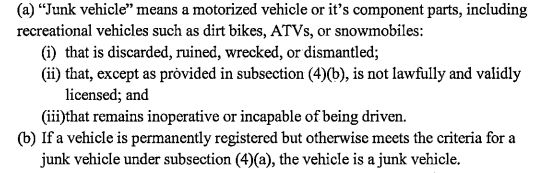
    Is that old car community decay? Looking at the definition of junk vehicles…

    That car could be described as dismantled, and it’s definitely not capable of being driven at this precise moment. So, junk vehicle? Based on this definition, it may well be one. Is it community decay? To meet the definition of community decay, the car would have to be “discarded”, so probably not. The more interesting question is how long can the project car sit, while the owner is busy with other things, before it is considered “Discarded”, and thus, community decay?

    The community decay ordinance fails to provide a definition for discarded, but one suspects it’s a word with gradations of meaning. After all, my “I’ll get to this project again someday” pile looks an awful lot like abandoned clutter until I get back to the project.

  • Community Decay… Part 2

    What exactly is community decay? Who does this apply to?

    The Community Decay Ordinance for Lincoln County (2018-05) reads “It is unlawful for any person to maintain conditions that contribute to community decay on property owned, occupied, or controlled by him or her on or adjacent to any public roadway within the county.”

    At this point, one might breath a sigh of relief. “On or adjacent to any public roadway”- that can’t apply to very much of the county, right?

    Ah, but this ordinance begins with definitions. Adjacent: “beside, next to, contiguous or nearby. Properties adjacent to any public roadway and properties within public view, as defined within this ordinance”

    This is a rather broad definition of adjacent, and I’d encourage the reader to consider how many places they know of that are “beside, next to, contiguous or nearby” a public roadway.

    Next. Public view: “any area visible from any point up to six feet above the surface of the center of any public roadway”

    So now we have any property “beside, next to, contiguous or nearby” any public roadway and “any area visible from any point up to six feet above the surface of the center of any public roadway”…

    I’d encourage the reader to imagine just how far one could see from six feet above the center of a public roadway on a hill.

    But wait- there’s more! All this assumes that we know what a public roadway is (it’s a road- right? Not quite). Fortunately, the ordinance includes a definition. Public roadway- “any highway, road, alley, lane, parking area, or other public or private space adapted and fitted for public travel that is in common use by the public”

    So, that leaves us with a rather broad idea of what sort of places community decay is not allowed. And we haven’t even gotten to what community decay actually is! More next time.