Trego's Mountain Ear

"Serving North Lincoln County"

Category: Plants

  • Remnants of an Industry

    Remnants of an Industry

    Walking the place in November’s fresh snow, I notice the remnants of an industry – stumps that were left to grow a second, third or fourth Christmas tree.  The phrase was “stump culture” and the practice fit in with production of wild Douglas Fir Christmas trees.  By cutting high and leaving branches on the stump, it took less time to grow the next tree.  Whether the stump kept superior genetics, or had a better microenvironment for producing Christmas trees, stump culture worked.  The next tree had the benefit of a pre-existing root system, and, if it looked like it was growing too fast, could be slowed by peeling a bit of bark on two sides.
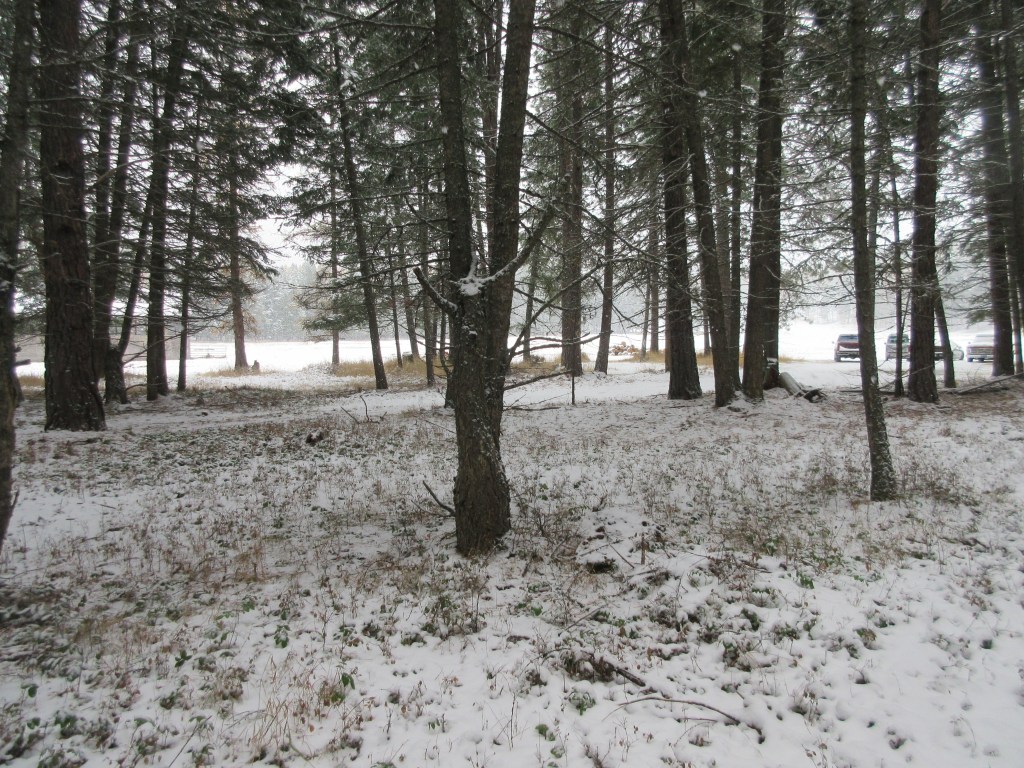
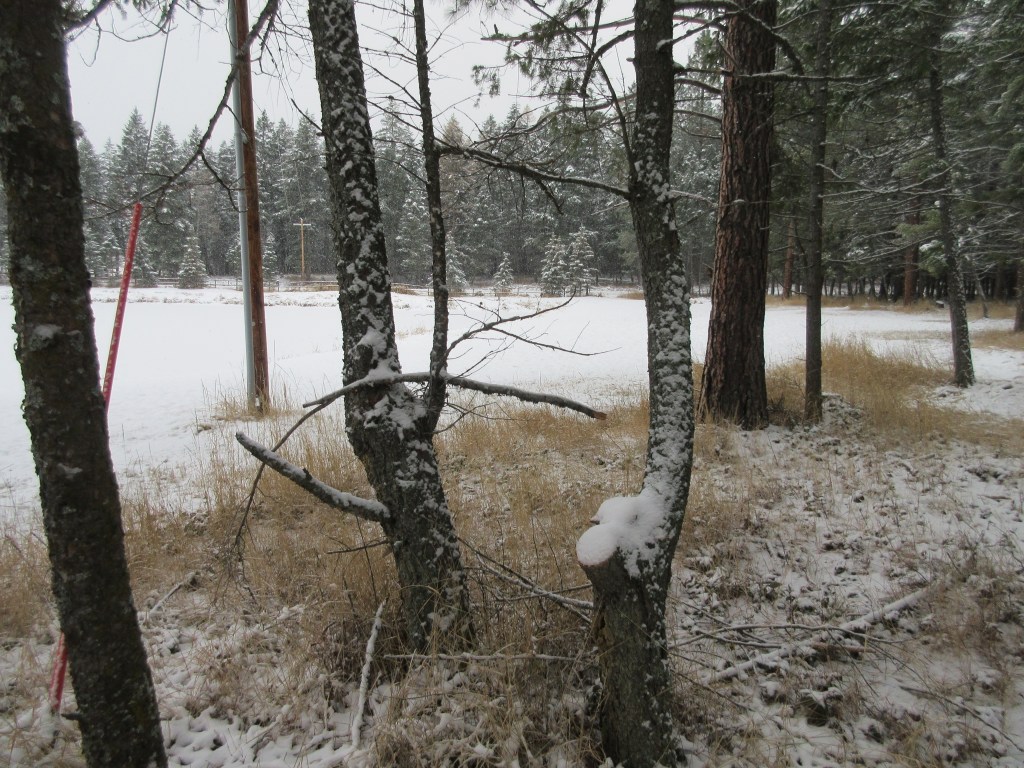
    As the photographs show, it has been a long time since Christmas trees were harvested – the stumps now have 30’ tall trees growing where the Christmas trees weren’t harvested.  The stumps, left by my father and grandfather (and a few by me) stand as a monument to a vanished industry.
    I entered the Christmas tree industry at age ten – dragging the trees from where Dad cut them to the trail where we would load them on the old Chevy pickup.  Unloading them along another old road, and sorting stacks by sizes – deuces, fours, sixes, eights, tens and twelves.  Eight deuces made a bale, six fours, four sixes, three eights . . . later I learned to tie, building my sawhorses with guides for the trees, wrapping the twine and pulling the figure eight knot tight, then cutting the butts straight with the smallest one hand crosscut.  If I’m remembering correctly, I made 10 cents per bale for tying them.  Good pay – ideally fours and sixes, and it wasn’t hard to tie 20 bales an hour.  Cutting trees was a good business for a teenager – an axe and an old pickup, and a handshake deal where the landowner got half and you were in business.  A hundred trees a day on weekends, cutting and dragging.  Memory brings back pay at $2.50 to $3.00 per bale, plus the dime for tying.  The landowner didn’t get half of the dime.

    Tying trees was the intense season – the load had to go out by Thanksgiving.  Cutting started after the first hard frost, so usually around October – tying trees probably in mid-November, and the loads of Christmas trees leaving the valley on Thanksgiving, or the following Friday. 

    And now, the stumps are left, showing the remnants of an industry long gone.

  • Adapting to the Cold- Conifers

    As it starts to get colder, animals have several options. “Leave for warmer places” is the primary strategy of migratory birds. Many animals take the “Find somewhere warm and stay there” strategy that is my personal approach to winter. Many animals find warm dens for the winter and hibernate, avoiding the cold and snow altogether. Finally, there is the “Bundle up real warm and live with it” strategy of of some of the fluffier varieties of wildlife. Of course, some mix and match of strategies is common; Venturing out for food and returning to a warm den is common enough.

    But plants have one major handicap to their potential strategies. Unlike animals, which can move, plants are rather stuck. This means that a tree has no choice but to go with the “Live with it” strategy for coping with cold. Consequently, the trees we have in the area tend to be rather well equipped for that strategy.

    We’re dominated by evergreens, or conifers. Conifers do not generally shed their leaves in the fall. The reason for this is that they don’t generally need to. The needles of a conifer are shaped very differently then the leaves of a broad-leafed tree (such as a maple), despite having pretty much the exact same purpose. Not losing all the leaves (they will lose some to wear and tear) is a huge advantage; it means that conifers can keep doing photosynthesis as long as there’s enough warmth and light to do so.

    Why the needle shape? Snow load. Everything about the shape of a conifer helps with snow load. A tree is a lot like a roof, in that it can be damaged by the weight of accumulating snow. Conifer needles are shaped to avoid accumulating snow, and each needle will hold far less snow than the leaf of a deciduous tree. The tree itself is shaped to shed snow, with branches that tend to be fairly flexible. While branches may break from a particularly wet (and thus heavy) accumulation of snow, for the most part they bend and shed snow.

    Freezing is, for most living things, a pretty serious problem. Water expands as it freezes, and at the cellular level this is quite destructive. Conifers avoid serious damage from this by allowing water outside of the cells to freeze, and by having cell walls that are harder, hard enough to generally withstand the pressure of expanding ice.

    The final challenge of winter is not drying out. For conifers, that especially thick waxy coating on the needles is a way of preventing that.

    Lessons to be learned from conifers?

    • Too much snow piled atop one is a bad thing. Being cone shaped helps
    • A waxy coating prevents water loss (chapstick?)
    • Don’t freeze

  • Plants: Black Medic

    Plants: Black Medic

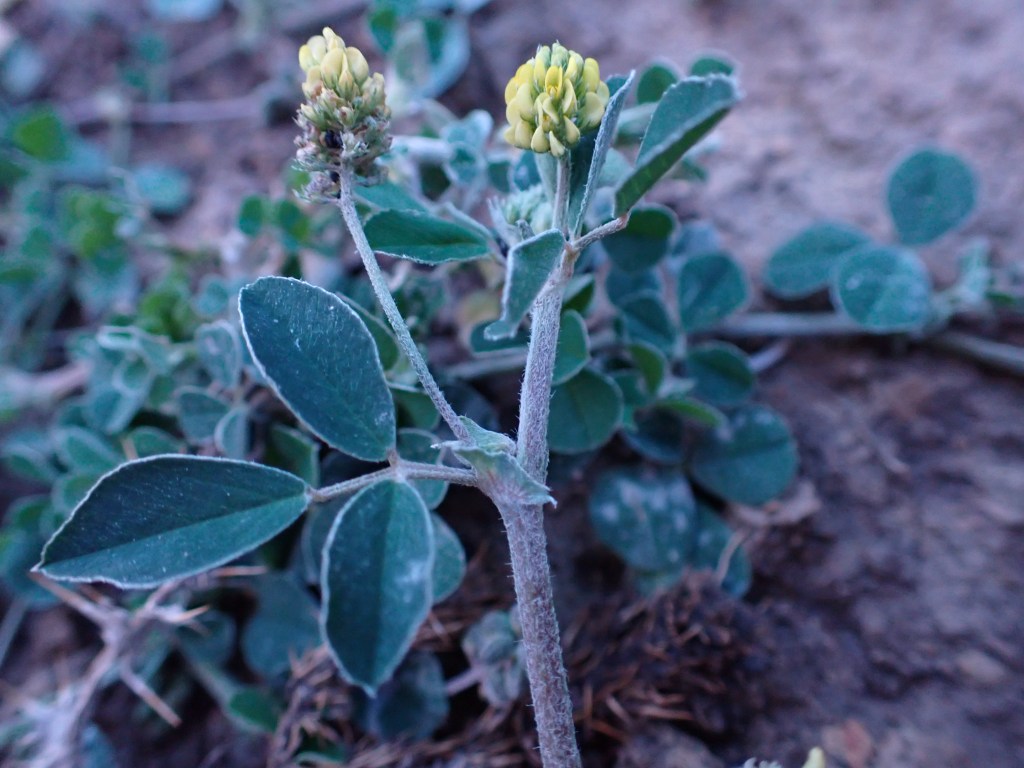
    What were those interesting yellow flowers in the lawn? Or, this time of the year, what are those interesting little black clusters of seeds? Black Medic (Medicago lupulina), also known as black clover, yellow trefoil, or hop medic, is an introduced species, related to clover. While it’s found as a weed throughout Montana (the rest of the US, and Canada), it’s actually native to Europe.

    Flowering Black Medic

    Like other members of the pea family (e.g. alfalfa & sweet clover), it is a nitrogen-fixing species. This means that Black Medic plants have symbiotic bacteria that take nitrogen (a vital element for plant growth) out of the air and deposit it into the soil in a form that plants can use. This is good for surrounding plants, as well as for the Black Medic.

    Black Medic produces vast quantities of seeds, and can easily take over sparse lawns. It grows well in compacted soil, or soil that is low in nitrogen. In fact, if it does better than the grass, it may indicate that the soil is lacking in nitrogen.

    Management of Black Medic should include high mowing, fertilization (it likes soil with little nitrogen) and irrigation. Reducing soil compaction would also be beneficial. Mowing black medic will not kill the plant.

    Black medic apparently has edible uses, theoretically as a pot herb (stir-fried or in stews). The seeds can be sprouted and eaten like alfalfa sprouts. Of course, like clover and alfalfa, it’s rather high in fiber, which means eating it in large quantities is likely to have unpleasant side-effects.

  • Knapweed, my current enemy.

    Knapweed, my current enemy.

    At this time of year, many hill-slopes have turned a sharp pink-purple color. Whether you’re in Glacier or driving along 93, you’ll see its flowers in the cuts alongside the road. Here in Trego proper, you can often find it in ditches, or there’s an abundant field of it downslope from the Trego Pub. Knapweed. It’s everywhere, and looking far healthier than anyone would like it to.

    Spotted Knapweed: note the black markings on the green, just below the flower blossom – these are the “spots”.

    Knapweed (Centaurea sp.) is a genus of invasive plant that plagues rangeland across western North America. Its seeds made landfall on the west coast, back in the early 1900s, possibly due to contaminated alfalfa seed. Now, over a century later, knapweeds flourish across America, from sea to shining sea, more successful than they were in their homeland of southern Russia.

    Thanks to the absence of the specialist insect herbivores that didn’t journey with it to the New World, and its bad taste, few things eat knapweed. And even if you are able to get something to eat it, with taproots reaching up to four feet deep, Spotted Knapweed is able to resprout with ease. Most knapweeds are only palatable to cattle early in their growing phase, quickly outcompeting grasses in overgrazed areas. To emphasize how terrible it can be in rangeland, feeding on Russian Knapweed may even prove fatal to horses.

    Several common native North American grasshoppers, notably the Red-Legged Grasshopper, feed on knapweed, but they weren’t effective at controlling it. Biocontrol began in the 1980s, with introduction of knapweed-specialist weevils, flies, and wasps. Over the past 40 years they’ve proven quite useful – if there are enough seed-head feeding insects, many fewer knapweed seeds are produced each year. It’s still not a quick fix – knapweed seeds can lay dormant in the soil for at least seven years.

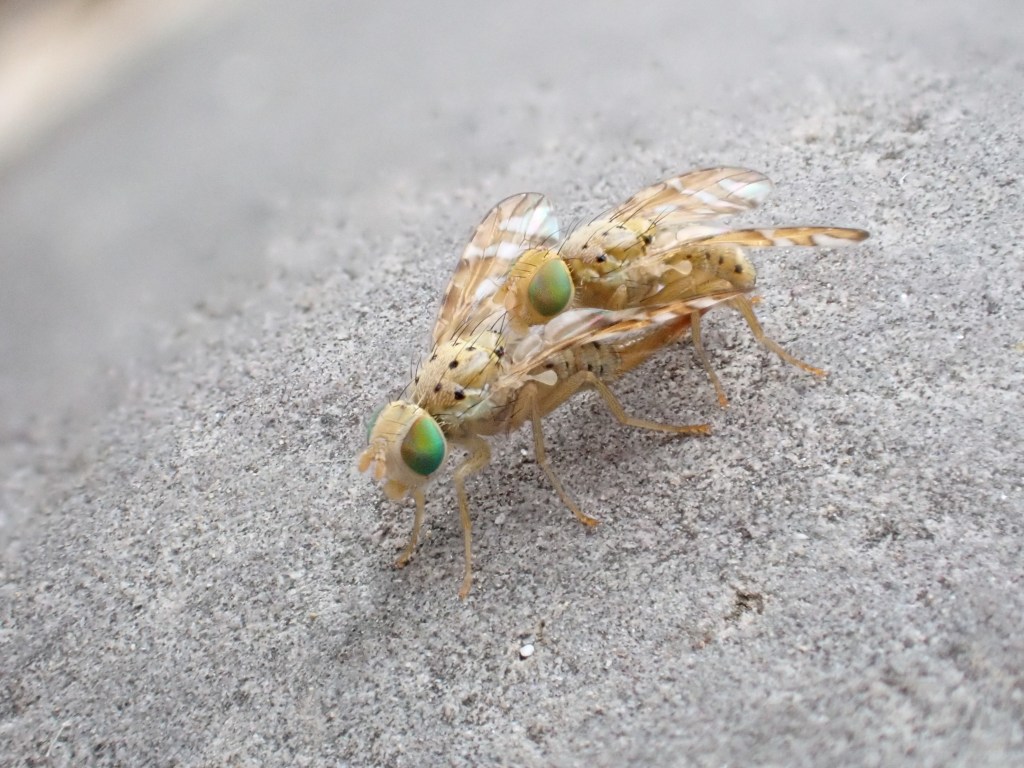
    The Knapweed Peacock Fly: introduced for biocontrol, its maggots destroy knapweed seedheads.

    These introduced bugs have done wonderful things. Knapweed is much less a problem than it once was, but biocontrol alone isn’t enough. If you happen to have knapweed on your property, the best thing you can do is to start spraying herbicide. I’ve been having decent success eliminating it with Milestone (Aminopyralid).

    As best I can tell, knapweed’s one virtue seems to be a high rate of nectar production – some folks enjoy making knapweed honey.

    What are your thoughts on knapweed? Have you ever tried knap honey?