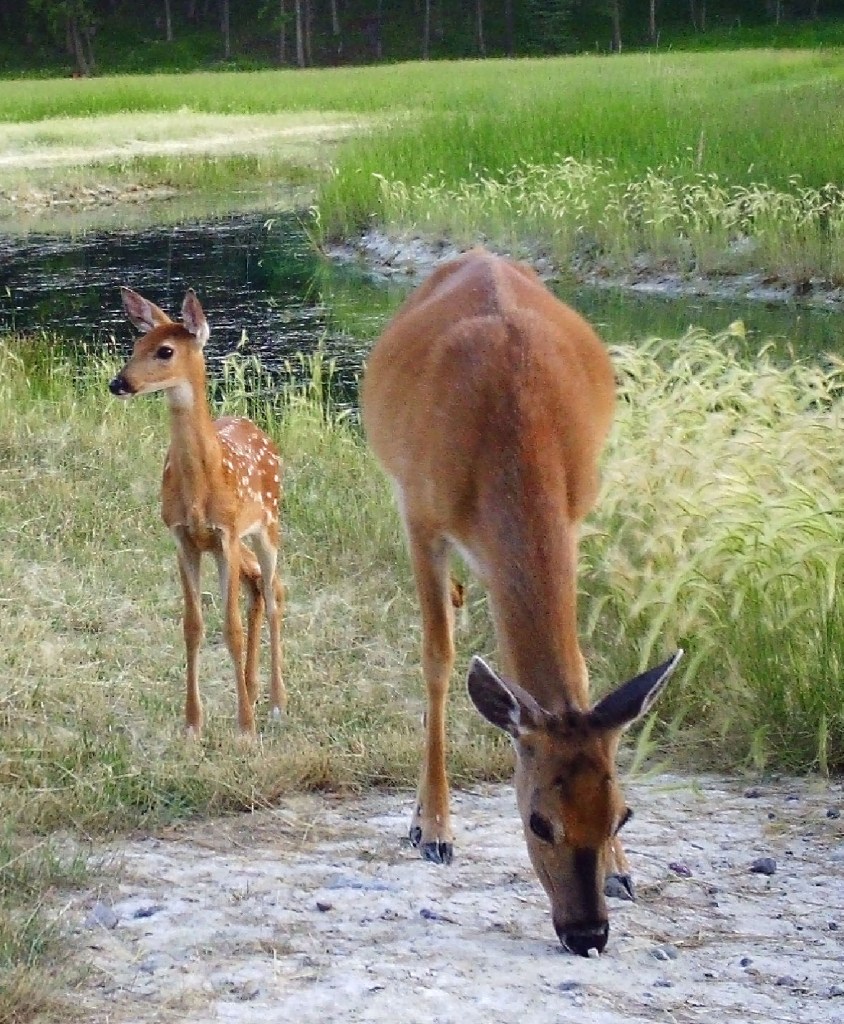
When I start the chainsaw, I attract deer. The inflow starts with a doe who learned, as a fawn, that my chainsaw meant there would be winter food near the house, She shows up, with her yearling daughter and two fawns. She often chooses to browse the mosses and lichens on the trees, as do the rest of her family. The newer dependents usually just browse the needles – and they seem to come to dinner in their own family groups to minimize conflict.
The place needs thinning. The large stumps bear witness to the first logging – done around 1910, with smaller stumps showing a second, smaller harvest a little after the second world war. Yet another scattered group of stumps shows where a man with a horse, a saw and a broadaxe could be in the crosstie business – opportunity, if hard work. The other stump evidence shows the Christmas tree industry . . . and I wonder if we could have yarded Christmas trees along the old road in the sixties and seventies without the deer browsing destroying them.
I had a visitor comment, “You’re parking it out.” I don’t see it that way – nearly 50 years ago, a forester taught me a simple principle – each acre will produce about the same amount of wood. Spaced properly, the wood grows into harvestable logs. Additionally, with the open canopy, it will produce about 80% of the grass that would grow on an open meadow. Forest management pays, but takes a long-term perspective and consistent maintenance. Others may think I’m parking it out close to the house – I think I’m still that same conservationist . . . though I left that career path almost 40 years ago.
And I learn – doing my thinning mostly in the winter provides food for my semi-domestic dependents. There is something pleasant about trimming branches on one end of a log while deer browse 15 feet further up.
Apologies to our subscribers if you were notified about this article twice. An unfortunate result of working in the wee morning hours on little caffeine. We’re still only coming out on Tuesdays.
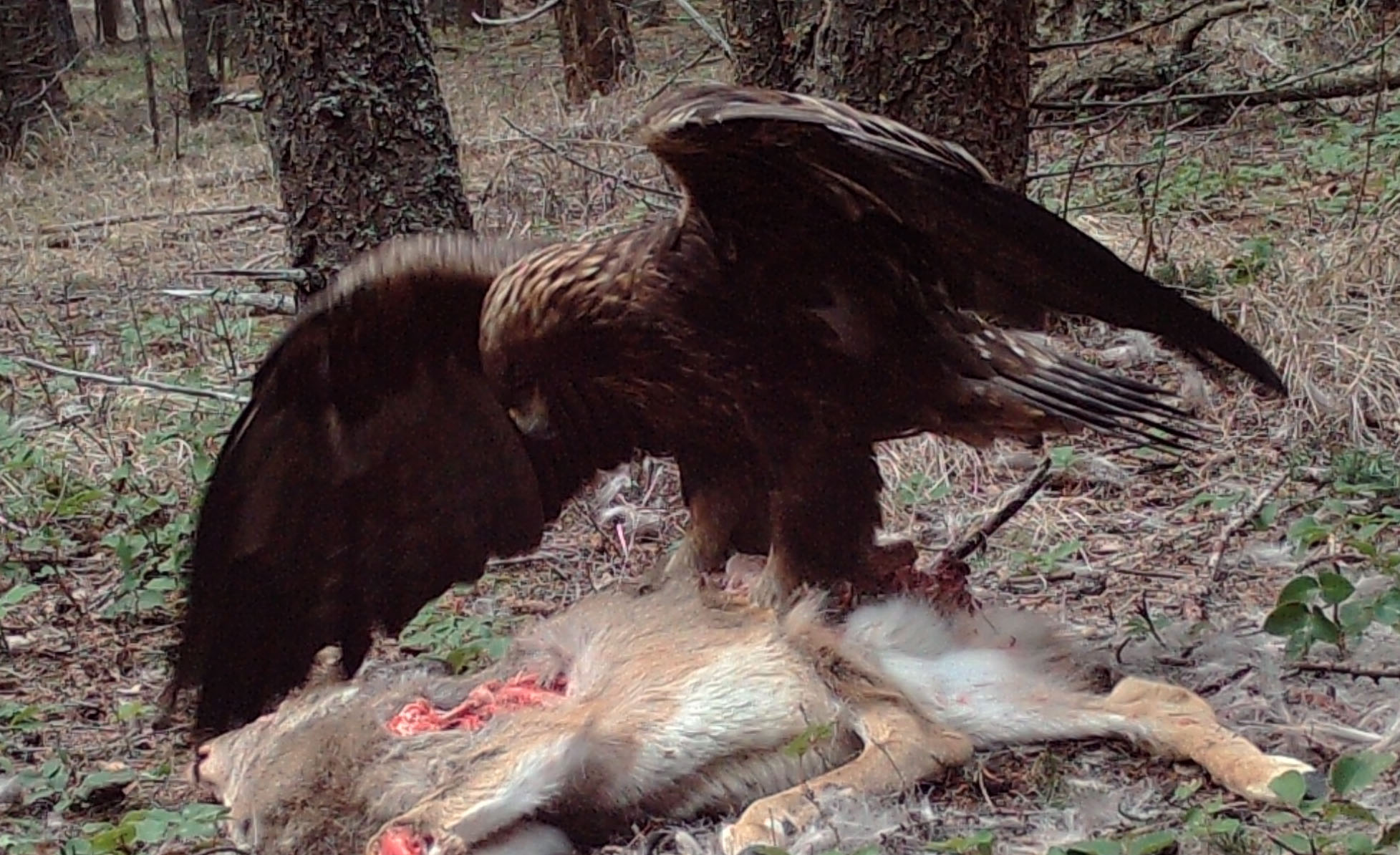
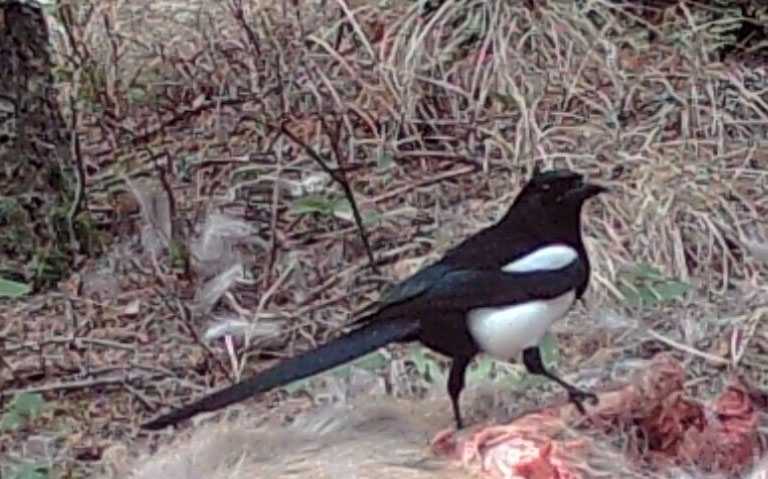
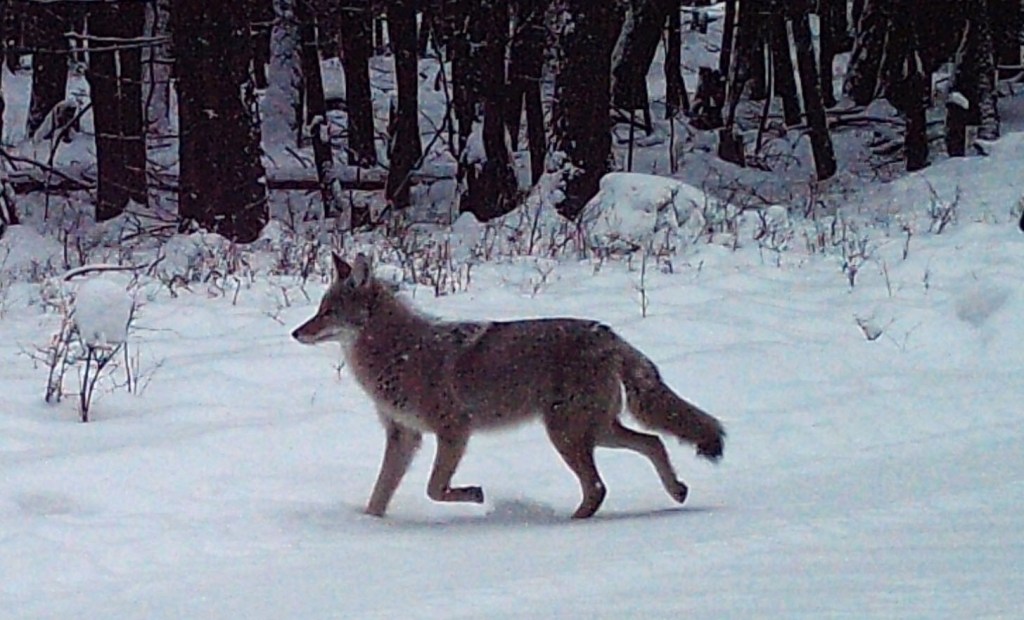
The sound of ravens noisily calling and the presence of eagles in the field, led us to walk the wooded trails. We did indeed find a fawn, the victim of a predator. A game camera was moved to observe the predator’s return. No sightings of lions or coyotes on the game camera instead there were birds. A camp robber, magpie, and golden eagle posed for the camera. With her wings spread the golden eagle seemed to be almost as large as the fawn.
As the seasons wear on, and we begin another year with our movements restricted by Covid19, it’s easy to see cabin fever creeping up on folks. People who wouldn’t ordinarily have conflict, begin to. Those who started out with strife and high tempers can’t be said to have improved. This plight turns my mind to the voles, and how much better they handle winter than us humans.
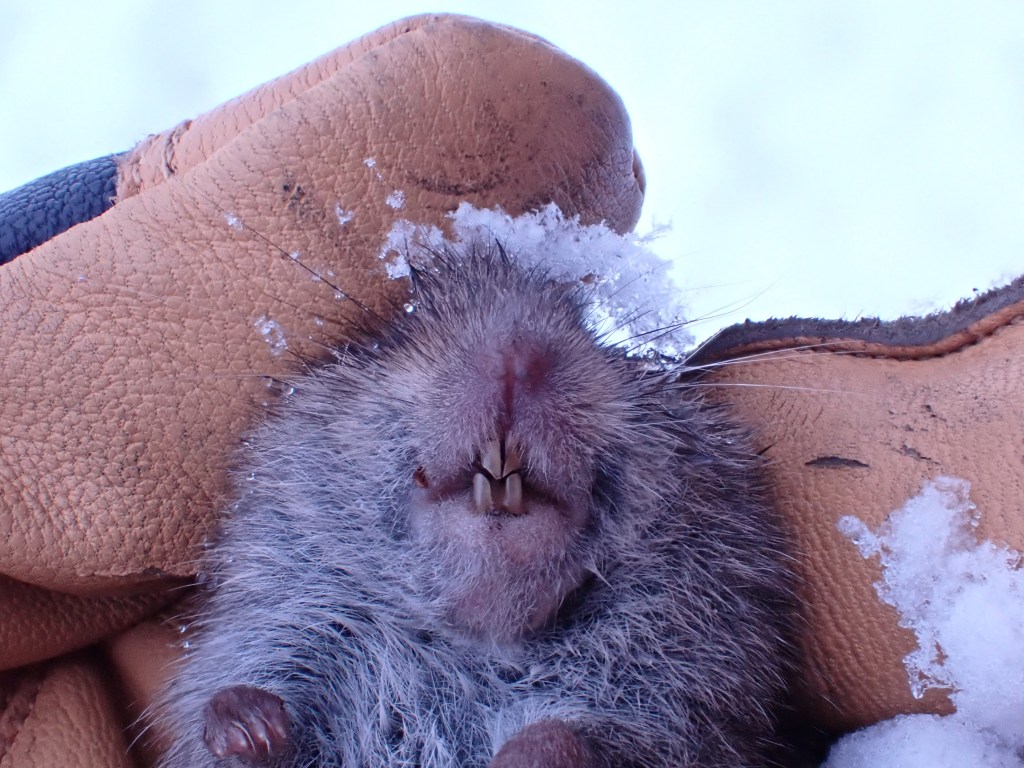
Voles are kin of mice – not true mice, biologists will tell you, as they’re more closely related to muskrats and lemmings, but functionally they behave much like true mice. Voles can be distinguished from mice by having shorter & blunter snouts, smaller eyes and ears, shorter tails, and classically bad teeth. To me their teeth bring British films to mind –Monty Python & The Holy Grail, for example.
This handsome gentleman made the mistake of trying to fight the little Pomeranian mouser. He reared up on his hind legs, squeaking menacingly… and the other Pomeranian grabbed him from behind.
Voles, genus Microtus, are territorial little beasties. While primarily herbivorous, voles do appreciate a varied diet, and some are fierce grasshopper hunters. Like many small mammals, voles seem to believe that one should encourage annoying neighbors to live elsewhere by devouring their children…(I’m rather glad most humans don’t espouse this belief). Sensible little creatures, voles will readily dine on carrion, and aren’t opposed to eating dead (or mostly dead) kin caught in traps.
Largely solitary-living, voles are ready to fight and kill in defense of their sovereignty in summer. This is particularly true for actively reproductive females, who tolerate no other reproductive female trespassers.
However, vole behaviors change with the seasons. Unlike you or I, voles become more sociable and tolerant of others during the cold of winter. Instead of eviscerating that annoying cousin, as their first inclination would be in the summer, when wearing winter’s brain, voles instead perceive that nuisance relatives could be of utility and might generate enough warmth to be worth keeping around.
Voles realize that they’ll only get through the cold harshness of winter together. You see, voles don’t make burrows deep enough to avoid the frost, and thus need the warmth of others to survive. And so they build wintertime nests of dry grass, and pile within those nests, keeping warm by shared bodyheat.
The importance of food: But one can not survive on warmth alone – voles need to eat throughout the winter months as well.
To do this, they build tunnels leading away from their dry grass nests, and feed on plantstuffs wherever they can. This is the main reason why voles become pests in winter months. For such small animals, they can be quite destructive – they’re quite capable of girdling trees, if it’s what it takes for them to get food.
While this allows foraging, voles only forage a few at a time – always leaving a number of voles behind, sleeping in the nest to keep it warm. Once those voles that are foraging have returned, it will be others’ time to seek food.
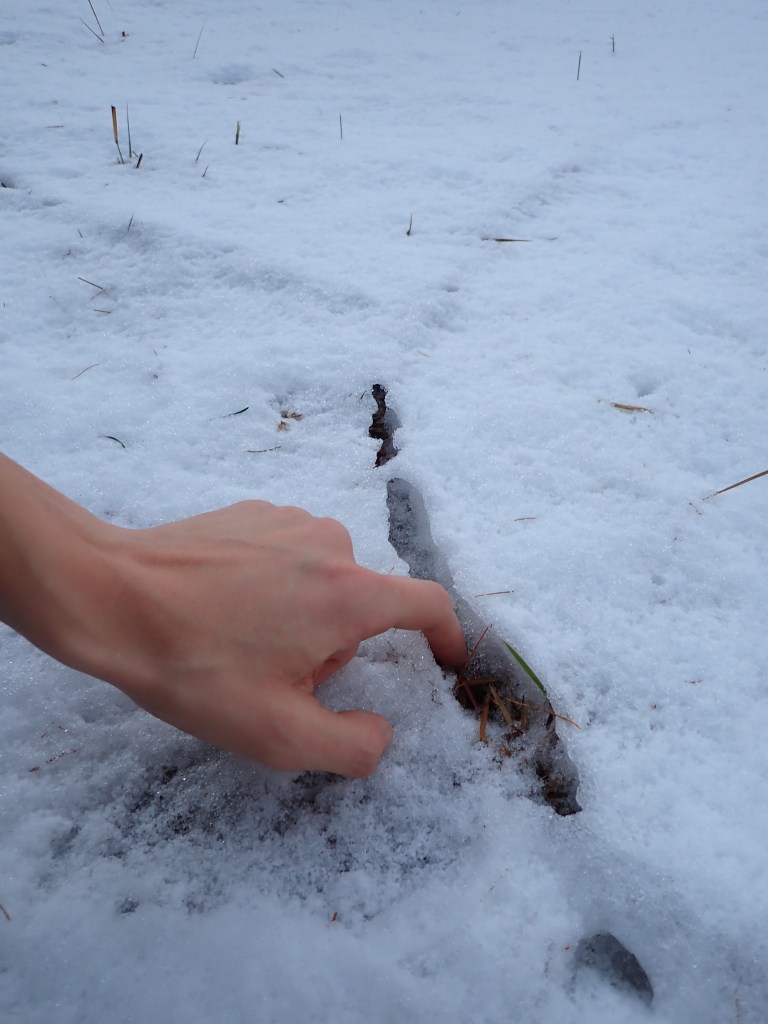
Here’s a vole foraging runway, partly uncovered by melting snow. These paths are about 1.5 inches wide. Note that the tunnel branches like a “Y” at the top of the image.
Vole control: The best means of controlling voles is by predators. Garter snakes will contribute, as will hawks, but for our geographic area, our various weasels are likely the best means of controlling voles. In the absence of good weasels, a cat or dog with aspirations of becoming a good mouser will be helpful as well – and oh, the joy if they happen to find the winter nest full of scrumptious voles.
In the absence of total control by predators, ringing the bases of trees you want to protect (either with wire hardware cloth or with protective plastic sheathing) is a wise idea. Regardless of what you pick to protect your plants, be sure to bury it 4-6 inches deep, so that voles will be less likely to tunnel beneath it. Reducing groundcover around plants you want to protect is a good idea as well – the voles won’t place their foraging tunnels across much bare ground.
If you’d like to take a more active approach, the thaw has been sufficient for me to find vole trails with little difficulty. Follow the trails long enough and you’ll discover their winter nests, little edifices of dry grass, about 8 inches across. Find one of the nests and you may well make a little dog’s day.
I carry a gun when I go for walks. Occasionally I see an article about carrying an everyday pistol – yet these folks might as well be in a different world. I don’t need the pistol to protect myself – I have two small dogs that are at some level of risk when we run across coyote or cougar. Come to think of it, the last encounter was when Kiki decided to protect me from 2 grizzlies – they ran for about 80 yards, and then one must have realized that there wasn’t much dignity in 2 grizzlies being chased by a 7-year-old Pomeranian.
The nice lady who handles problem bears for FWAP explained the advantages of bear spray to me. I even kind of agree that my aging, overweight Pomeranian has an awesome ability to make a stressful grizzly encounter worse. That said, bear spray is short range – 7 to 10 yards sticks in my mind. My little companions can range 50 yards from me, and they have already encountered coyotes, a cougar, and an eagle that regarded them as prey. I’ve had a wolf kill a fawn within 150 yards of the house. They’ve all been beyond the range of bear spray, and they have all backed off at my confident approach. Still, at 71, that confidence is enhanced by the pistol on my hip.
Robert Ruark penned the phrase, “Use enough gun.” I believe – but it is inconvenient to carry enough gun for a pair of grizzlies everywhere I walk . . . and there are only a few moments of my life spent in grizzly encounters. Coyotes are more common, as are cats – and over a half-century ago, Paul Totten explained that a 22 is adequate for cougar. Even a 45 feels small when you’re looking at the real bear, and politely asking, “Please Mr. Bear, you go your way and I’ll go mine. Neither one of us wants trouble, OK?” So far the conversation has been effective every time.
So I carry a small, inadequate HK4. It can protect my small dogs from the common predators, and, if worse comes down to worst, I think I’d feel more competent concentrating on my sights and trigger than praying.
It is an unfortunate happening. Many game cameras will be vandalized or pilfered over their lifetime. Python locks are used to keep the game cameras from being lifted. My vandals usually have 4 legs but occasionally there are those that have two.
The two-legged variety of vandals perch and defecate on the camera. The four-legged variety usually hit the camera with speed, resulting in the tripod mount being broken and the camera somewhere on the ground.
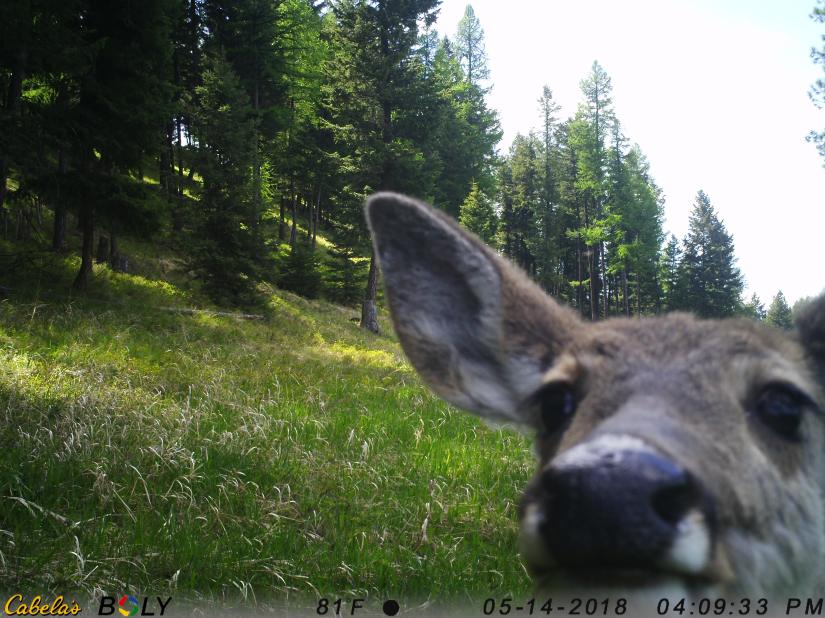
My usual 4-legged suspects are deer. Curious elk and cranky bears will also displace cameras. This week, I found two tripod mounted cameras upside down and facing the opposite direction of their intended targets. After reviewing the video, I have determined the vandal was a curious cow.
The cow investigated the camera in the early morning hours. -Patches
An opportunity to capture pictures of scavengers on a carcass presented itself. I placed two cameras overlooking the carcass. I had hoped the bears would find this substantial food source. If not, maybe I would have pictures of coyotes or foxes. I had 65 videos, some as long as 4 minutes of ravens, a lot of ravens. It is gruesome and repetitive to watch ravens feast on a carcass. Finally, the eagles show up.
It is still gruesome to watch eagles on a carcass. But on the video, there was a surprise. A brave and reckless raven would tug on the tail feathers of the bald eagle. The raven was more persistent in harassing the juvenile bald eagle than an adult eagle. The only reaction from the eagles appeared to be flapping their wings resulting in a temporary scattering of the ravens.
I also had 7500 photos of ravens and eagles to review. Not one picture clearly shows a raven tugging on the tail feathers of an eagle. Game cam videos do provide glimpses of animal behavior hard to capture on a still camera. The down side, video uses your batteries and SD cards quickly. Both accessories need to be replaced often.












 Trego's Mountain Ear