Trego's Mountain Ear

"Serving North Lincoln County"

Tag: Data

  • Our Communities by ACS Numbers

    I listened to a comment about the median household income in Trego – and defaulted to my professional statement before retirement – “That’s American Community Survey data, and it’s not very good for small communities.”  When I checked it, the $36,458 median household income for Trego translates as “somewhere between $27,478 and $45,438.  ACS data has its uses, but it has to be used with a lot of caution.

    So here’s a little ACS data on our communities – you can check for margin of error (MOE) here.   I wouldn’t recommend using any of the numbers without reviewing MOE – but just sharing the data shows the variance.  It’s safe to admit that my household was one selected for the ACS. With two retirees at home, I didn’t hurt Trego’s school enrollment rate, I raised the percentage of bachelors degree or above, kept the employment rate down, and raised the median age.

    Trego CDPFortine CDPEureka CCDRexford Town
    Population5153176,47078
    Median Age60.527.950.153.3
    Median Household Income$36,458$68,036$40,827$30,481
    Bachelor’s Degree or more26.10%19.20%22.40%0.00%
    Veterans6.80%16.20%12.90%16.80%
    Poverty9.50%5.20%20.40%23.60%
    School Enrollment97.80%72.30%81.90%100%
    Employment Rate40.20%59.50%38.30%20.60%
    Housing Units2831773,71673
    Occupied Housing Units2371442,79646
    Disabilities31.10%18.80%26.70%65.90%
    Children under 189.30%32.50%22.10%13%

    It looks like the Fortine sample drew some younger respondents.  Eureka CCD with a larger population and larger sample is probably closer to correct, and the town of Rexford data is probably close to useless because the small sample size almost guarantees sampling bias

  • The Quality of Data

    We live in a world filled with data – but a lot of the presentations are slanted.  Sometimes the slant is political, sometimes the slant is a bizarre sense of humor.  I like Wikipedia – but I don’t rely on it.  I tapped in to look for a bio on George Washington Carver, and I read the damndest story about carving peanuts into busts of our first president.  If I want satire, I’ll go to the Onion or the Babylon Bee.  Wiki is accessible, fast, and I’ll continue to use it – but I check wiki data against other sources.  Using Wiki as a reliable source of data is similar to accepting President Biden as a fact-checker.

    If I want information on shootings and murders in Chicago, I start with https://heyjackass.com/  It’s reliable, but not respectable.  They even sell T-shirts.  I’d never use it in a professional article – but whoever puts the data together does a pretty good job.  For example, as I write this, heyjackass shows

    Year to Date

    Shot & Killed: 586

    Shot & Wounded: 2843

    Total Shot: 3429

    Total Homicides: 619

    It’s a fast source of data that usually checks out. It even goes into neighborhoods, cause of death, race and gender – well, I’d say race and sex, since it lists male and female, but I may be a bit old fashioned.  It would be nice if all the violent cities had their own heyjackass, but this one seems unique to Chicago.

    Climate data – at least the sort of data that shares first and last frosts, annual precipitation, and other medians gleaned from past records – is much more available.  For years, while some stuck with the Farmers Almanac, we carried with us Climate and Man – a 1941 yearbook of Agriculture that had compilations for most of the US.  Now, I can get online to check snow depth at each snow course, NOAA offers answers to all sorts of questions.  Climate data is vastly improved – though you still need to weed through and select reliable sources.  Personally, I stick with USDA and NOAA.

    It is hard to find quality data on illegal immigrants and crime.  Texas’ Department of Public Safety provides data on crimes and convictions in Texas, but other states don’t provide data of similar quality.  I’m not sure we can generalize from Texas – but better data is hard to find.

    The quality of data on abortion is impressive – each state provides data in a similar form.  You can sort between states and years – there’s a requirement that data be kept and published.  Unlike crime and illegal immigrants, this data is easy to access and use.

    This publication presents itself as quality data: “30 Facts You Need to Know”.

    Unfortunately, the folks who put it together didn’t include the links to those 30 facts that make them easy to confirm or reject.  I really don’t know which of the “30 Facts” I should accept and which ones should be rejected.

    There is a lot more data available than there was in my younger days.  But a lot of that data is still less than easily confirmed – and a lot of folks are still trying to pass opinion off as fact.

  • CDC Data Visualization

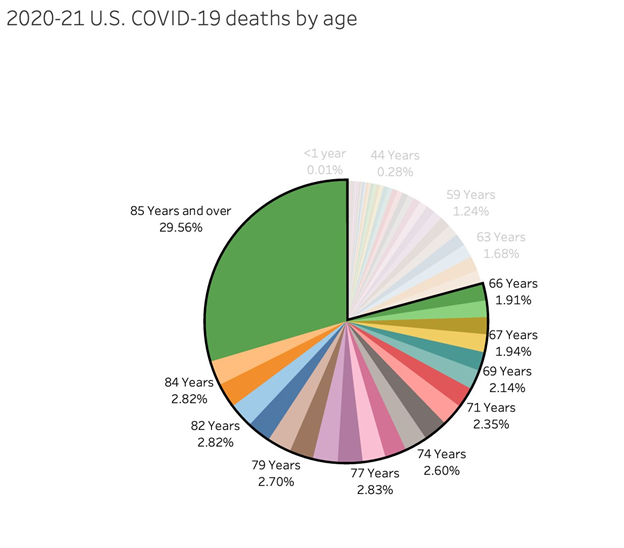
    CDC Data Visualization

    Raw data is nice, but can be hard to visualize.  The CDC link at the bottom provides the data, but also a variety of ways to view it in chart and graph formats.  As the saying goes, past performance does not guarantee future results – but it isn’t a bad guideline.

    https://data.cdc.gov/NCHS/AH-Provisional-COVID-19-Death-Counts-by-Age-in-Yea/3apk-4u4f
  • Measuring Migration

    When you work with Census data, migration numbers can be very precise – but the 10 years between each Census often make the data obsolete.  As demographers, we had to find ways to work around that – and U-Haul had the websites that let me better understand and explain migration.

    For example, if I price renting a 15’ truck in Bakersfield, California, heading to Eureka, Montana, I get a price quote of $5,173 today.  On the other hand, it costs $1,109 to rent the same truck in Eureka and drive it to Bakersfield.

    If I want to see beautiful Bend, Oregon in the rear view mirror of my 15’ rental truck, the website tells me the trip to Eureka, MT is $3,052.  Renting the same truck in Eureka, to go to Bend is only $654.

    I didn’t learn to abuse U-Haul’s website in a classroom – I got the general idea while riding a bus seated alongside a very successful retarded guy.  He made a living riding the bus – back then there was a pass that was good for six months travel in country – and then driving a car or small truck back to Denver.  He may not have completed high school – but he gave me the foundation of a method to quantify migration.  Obviously, Bakersfield and Bend have more people trying to leave, and Eureka has more inmigration. 

    If we look at the trip from Minneapolis to Eureka, it’s $1,703.  Eureka to Minneapolis is $1,362.  Park City, Utah showed up as $990 to Eureka, while Eureka to Park City was $495. 

    It provides a better feel for migration in central locations like Park City – where you can go in any direction.  You can’t go north from Eureka in this time of Covid – and you can’t drive west from California.  Still, it gives data in something resembling a ratio – the challenge the rental truck industry has is getting the trucks from destination locations (inmigration) back to the places they came from (outmigration) without hiring my friend with the Greyhound pass.

    TaxFoundation.org gives last year’s data, and it is massaged and compiled from more moving companies.  Guess what?  The top destination state (inmigration) is Idaho – and Idaho has a lot of similarities to western Montana.  Oregon was a destination state – and still needs the rental trucks from Eureka to keep things going.  I think the last person renting a truck to leave New Jersey might want to turn the lights off as he or she pays the last toll to drive out.

    I’ve rented U-Haul trucks a couple of times – but the company has provided me a lot of comparative data on migration during my career.  It’s still science, and it’s still numbers driven. 

  • Electronic Visit to the Snow Course

    Electronic Visit to the Snow Course

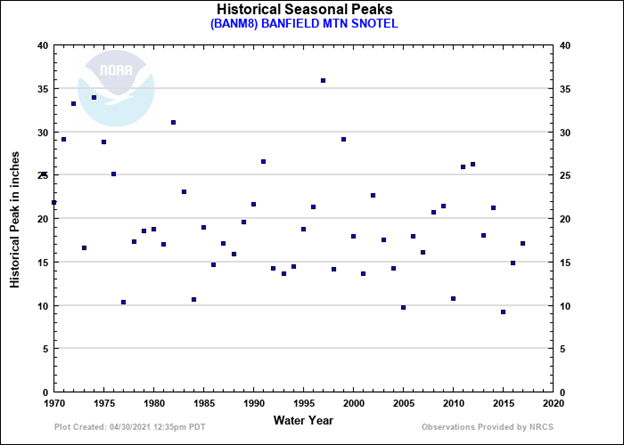
    It still amazes me that I can turn on the computer and, in 15 minutes, get the data that used to take a week’s work to obtain.  Of course it also amazes me that my work is so far in the past that it no longer shows up in the 30-year averages.  Still, some of that data – starting with my first run in the mid-seventies are still available:

    As I look at the little squares on the left, I do see that Jay and I did measure the lowest year on this chart, back in 1977.

    My closest snow courses are Stahl Peak and Grave Creek. Stahl is listed at 27.7 inches and 75% of average – but still significantly better than the 20-inches of water back in my youth.

    Grave Creek is listed at 3.8 inches and 60% of average. 

    Banfield Mountain shows 9.9 inches – 66% of average.  The chart shows that this is fairly close to the record low measurements.

    Hawkins Lake, in the northwest corner of the county, shows 20.9 inches and 81% of the 30 year average.  The historic peaks chart shows that I measured the record low in 1977, and the snowpack is still above that.

  • When the official data isn’t good data

    As I was retiring, the American Community Survey(ACS) was replacing the long-form Census questionnaire.  There is merit to the argument that a survey can provide data that is as good as a form that one out of six people fill out – both are, after all, actually surveys.  Still, as a rural sociologist whose primary duties were rural demography, I wasn’t comfortable with the American Community Survey results – the sampling size was too small.

    Now, I can access data that compiles five years worth of estimates – so here is some data on Rexford, Eureka, Fortine and Trego, by zip code, in two separate five-year conglomerates:

    2012-2016Rexford
    59930
    Eureka
    59917
    Fortine
    59918
    Trego
    59934
    Total Population5664,425584562
    5 to 9212823452
    10 to 14353052249
    Median (Average) Age58.043.650.749.2
    Per capita income$22,377$18,799$21,203$25,999
    2015-2019Rexford
    59930
    Eureka
    59917
    Fortine
    59918
    Trego
    59934
    Total Population6584,769747476
    5 to 953212
    10 to 14502163520
    Median (Average) Age56.046.847.260.4
    Per capita income$13,438$22,867$28,753$26,671

    The American Community Survey is a well-conducted survey.  The data is correct, in both cases, within the limits of the survey.  The small samples, however, can create some large swings and make the data less useful.  I have been looking forward to reviewing the Trego data since I was selected to return the ACS survey.  Trego’s median age went up 11 years.  The population dropped by 15%.  The youth population plunged.  Meanwhile Fortine incomes increased by 36%, as Rexford plunged into the depths of poverty.  All the survey data is correct – but sampling bias, due to the small number of participants, has given us data we can’t use.

    I still prefer the old, time-consuming long form results over the ACS.