Trego's Mountain Ear

"Serving North Lincoln County"

Tag: Government

  • Why Lincoln County Government Doesn’t Work

    I was reading an article that described several reasons why the government doesn’t work.  It was a generalized article, and as I thought of the additional challenges our three county commissioners have – beginning with the geographic challenges – I realized that it was time to develop a few articles that explain the challenges to good government that our county faces.

    It isn’t that we have bad county commissioners – as I was retiring from SDSU and moving back home, Lincoln County had one of those rare elections for commissioner . . . one with two good candidates, Mike Cole and Steve Curtiss.  Mike won – but whichever way the vote had gone, the county would have had a good commissioner.  After a single term, Mike Cole lost his bid for reelection to Josh Lecher.  This year, after a single term, Josh lost the primary to Noel Durum.   And whether he does a good job or a poor one, Noel is unlikely to win reelection at the end of his first term.

    To understand why Lincoln County’s government doesn’t work well requires a bit of study.  I’m going to start in 1909, when Lincoln County was carved out of Flathead.  Things started with a good, logical base.  The problem in function came 60 years later, with a change in geography.

    Lincoln County was created to duplicate the Kootenai’s drainage – and along with that, the county was connected by the railroad.  In 1909, the county towns (excepting Yaak and Sylvanite) were connected by the railroad.  A slow train, stopping at each station, connected what had been isolated communities.  It wasn’t a bad idea.

    Sixty years later, the gates at Libby Dam closed, and Ural, Warland, Rexford and Gateway were flooded.  The railroad was relocated to a spot where it runs through Stryker, Libby and Troy, stopping only at Libby.  Still, the railroad served as central to the county for a short time – but the link was the ranches and towns along the Kootenai.  When Libby Dam was complete and Koocanusa filled, the commercial link between north county and south county was severed.  J. Neils had linked lumber workers from Libby through Rexford for 60 years – but the Dam ended the railroad, the social linkages and the commercial timber connections.

    For the past half-century, Lincoln County has been disconnected, with a nearly unpopulated area that exists from Jennings Rapids to the mouth of Pinkham Creek – connected by the lonely highway 37.

    Next issue – why our elected county government lacks control over our hired bureaucracy.

  • Why Did it Have to be …Guns? by L. Neil Smith

    Why Did it Have to be …Guns? by L. Neil Smith

    Editor’s Note: This seemed timely, so we’re running it again.

    Why Did it Have to be … Guns?

    by L. Neil Smith

    lneil@lneilsmith.org

    Over the past 30 years, I’ve been paid to write almost two million words, every one of which, sooner or later, came back to the issue of guns and gun-ownership. Naturally, I’ve thought about the issue a lot, and it has always determined the way I vote.

    People accuse me of being a single-issue writer, a single- issue thinker, and a single- issue voter, but it isn’t true. What I’ve chosen, in a world where there’s never enough time and energy, is to focus on the one political issue which most clearly and unmistakably demonstrates what any politician—or political philosophy—is made of, right down to the creamy liquid center.

    Make no mistake: all politicians—even those ostensibly on the side of guns and gun ownership—hate the issue and anyone, like me, who insists on bringing it up. They hate it because it’s an X-ray machine. It’s a Vulcan mind-meld. It’s the ultimate test to which any politician—or political philosophy—can be put.

    If a politician isn’t perfectly comfortable with the idea of his average constituent, any man, woman, or responsible child, walking into a hardware store and paying cash—for any rifle, shotgun, handgun, machinegun, anything—without producing ID or signing one scrap of paper, he isn’t your friend no matter what he tells you.

    If he isn’t genuinely enthusiastic about his average constituent stuffing that weapon into a purse or pocket or tucking it under a coat and walking home without asking anybody’s permission, he’s a four-flusher, no matter what he claims.

    What his attitude—toward your ownership and use of weapons—conveys is his real attitude about you. And if he doesn’t trust you, then why in the name of John Moses Browning should you trust him?

    If he doesn’t want you to have the means of defending your life, do you want him in a position to control it?

    If he makes excuses about obeying a law he’s sworn to uphold and defend—the highest law of the land, the Bill of Rights—do you want to entrust him with anything?

    If he ignores you, sneers at you, complains about you, or defames you, if he calls you names only he thinks are evil—like “Constitutionalist”—when you insist that he account for himself, hasn’t he betrayed his oath, isn’t he unfit to hold office, and doesn’t he really belong in jail?

    Sure, these are all leading questions. They’re the questions that led me to the issue of guns and gun ownership as the clearest and most unmistakable demonstration of what any given politician—or political philosophy—is really made of.

    He may lecture you about the dangerous weirdos out there who shouldn’t have a gun—but what does that have to do with you? Why in the name of John Moses Browning should you be made to suffer for the misdeeds of others? Didn’t you lay aside the infantile notion of group punishment when you left public school—or the military? Isn’t it an essentially European notion, anyway—Prussian, maybe—and certainly not what America was supposed to be all about?

    And if there are dangerous weirdos out there, does it make sense to deprive you of the means of protecting yourself from them? Forget about those other people, those dangerous weirdos, this is about you, and it has been, all along.

    Try it yourself: if a politician won’t trust you, why should you trust him? If he’s a man—and you’re not—what does his lack of trust tell you about his real attitude toward women? If “he” happens to be a woman, what makes her so perverse that she’s eager to render her fellow women helpless on the mean and seedy streets her policies helped create? Should you believe her when she says she wants to help you by imposing some infantile group health care program on you at the point of the kind of gun she doesn’t want you to have?

    On the other hand—or the other party—should you believe anything politicians say who claim they stand for freedom, but drag their feet and make excuses about repealing limits on your right to own and carry weapons? What does this tell you about their real motives for ignoring voters and ramming through one infantile group trade agreement after another with other countries?

    Makes voting simpler, doesn’t it? You don’t have to study every issue—health care, international trade—all you have to do is use this X-ray machine, this Vulcan mind-meld, to get beyond their empty words and find out how politicians really feel. About you. And that, of course, is why they hate it.

    And that’s why I’m accused of being a single-issue writer, thinker, and voter.

    But it isn’t true, is it?

    “Permission to redistribute this article is herewith granted by the author—provided that it is reproduced unedited, in its entirety, and appropriate credit given.”

    L. Neil Smith passed away recently – for folks who are unfamiliar with his writings, many are available at https://lneilsmith.org/   It’s worth checking out.  I’ve learned that few of these blogs live longer than a year past the author, and Neil Smith was worth reading.

  • When Congress is for Sale

    I saw some comments about NRA buying Congress – and I got to thinking that someone must have the data on who it really is that buys congresscritters.  I got this list from opensecrets.org

    Lobbying ClientTotal Spent
    AARP$3,530,000
    AbbVie Inc$3,980,000
    Amazon.com$5,310,000
    America’s Health Insurance Plans$4,680,000
    American Hospital Assn$6,598,718
    American Medical Assn$6,665,000
    Blue Cross/Blue Shield$7,572,485
    Business Roundtable$4,820,000
    Cigna Corp$3,630,000
    ConocoPhillips$4,600,000
    CTIA$3,660,000
    CVS Health$3,720,000
    General Motors$4,900,000
    Meta$5,390,000
    National Assn of Realtors$12,190,052
    Northrop Grumman$4,530,000
    Pharmaceutical Research & Manufacturers of America$8,285,000
    Roche Holdings$3,565,000
    United Parcel Service$4,300,000
    US Chamber of Commerce$19,060,000

    The National Rifle Association didn’t make the big spender list – 19 million for the Chamber of Commerce, 12 million for the Realtor’s – General Motors just a touch under 5 million . . . I think I remember Barack Obama firing the president of GM.  AARP for 3 ½ million . . . and adding up the different health insurance lobbying bills with the hospital association, AMA, and pharmaceutical bill comes to 37.5 million.  I suspect we do have the best health laws money can buy.

    Still, Statista says NRA is getting close to making the list – 2021 lobbying expenses went up to 3.31 million dollars, from 2.2 million in 2020.  If this increase in NRA lobbying continues, they may knock AARP off the big spenders spreadsheet.  It will take more effort to dislodge Amazon or UPS.

    I don’t have the answers here, or even enough information to come up with a question.  I do have a conclusion – if there wasn’t a payoff to lobbying Congress, these corporations wouldn’t be doing it.  UPS spends 4.3 million bucks lobbying Congress because the investment pays off.  Amazon spends 5.3 million because the investment pays off.

    I’m not particularly happy with Wayne LaPierre and his cronies at NRA – the data from New York has convinced me that the management is ripping off the members.  I’m not surprised – Eric Hoffer said “Every great cause begins as a movement, becomes a business, and eventually degenerates into a racket.”

    Hoffer was likely correct.  Still health insurance is probably a bigger racket.  I suspect every outfit on the spreadsheet could be improved by a RICO investigation or three.

  • It Isn’t One Citizen One Vote

    When it comes to the House of Representatives, I’m a Constitutional scholar.  Specifically Article 1, Section 2 – “The House of Representatives shall be composed of Members chosen every second Year by the People of the several States, and the Electors in each State shall have the Qualifications requisite for Electors of the most numerous Branch of the State Legislature.

    No Person shall be a Representative who shall not have attained to the Age of twenty five Years, and been seven Years a Citizen of the United States, and who shall not, when elected, be an Inhabitant of that State in which he shall be chosen.

    (Representatives and direct Taxes shall be apportioned among the several States which may be included within this Union, according to their respective Numbers, which shall be determined by adding to the whole Number of free Persons, including those bound to Service for a Term of Years, and excluding Indians not taxed, three fifths of all other Persons.) (The previous sentence in parentheses was modified by the 14th Amendment, section 2.) The actual Enumeration shall be made within three Years after the first Meeting of the Congress of the United States, and within every subsequent Term of ten Years, in such Manner as they shall by Law direct. The Number of Representatives shall not exceed one for every thirty Thousand, but each State shall have at Least one Representative; and until such enumeration shall be made, the State of New Hampshire shall be entitled to chuse three, Massachusetts eight, Rhode Island and Providence Plantations one, Connecticut five, New York six, New Jersey four, Pennsylvania eight, Delaware one, Maryland six, Virginia ten, North Carolina five, South Carolina five and Georgia three.

    When vacancies happen in the Representation from any State, the Executive Authority thereof shall issue Writs of Election to fill such Vacancies.

    The House of Representatives shall chuse their Speaker and other Officers; and shall have the sole Power of Impeachment.”

    The lines highlighted in yellow govern the decennial Census and apportionment of Congresscritters.  Congresscritters are apportioned according to population – not according to the number of citizens a state has.  As you look at the data, you can see that one out of each seven people represented by a California Congresscritter isn’t a US Citizen. 

    If Congress were to pass a law requiring seats in the House of Representatives be apportioned based on citizens instead of population, California would probably lose 5 seats, New York and Florida each 2, and New Jersey  and Illinois 1 each.  Somehow, I don’t think it will happen.

    State demographics by citizenship status|
    Citizenship status of residents, 2014

     State Total Population NativeForeign-born
    Total
    Foreign-born
    Naturalized
    Foreign-born
    Non-citizen
    Alabama4,817,6784,651,201166,47755,514110,963
     100.0%96.5%3.5%1.2%2.3%
    Alaska728,300676,62051,68027,91023,770
     100.0%92.9%7.1%3.8%3.3%
    Arizona6,561,5165,677,869883,647339,481544,166
     100.0%86.5%13.5%5.2%8.3%
    Arkansas2,947,0362,811,266135,77040,38495,386
     100.0%95.4%4.6%1.4%3.2%
    California38,066,92027,776,28410,290,6364,911,8995,378,737
     100.0%73.0%27.0%12.9%14.1%
    Colorado5,197,5804,690,377507,203192,391314,812
     100.0%90.2%9.8%3.7%6.1%
    Connecticut3,592,0533,101,593490,460235,507254,953
     100.0%86.3%13.7%6.6%7.1%
    Delaware917,060840,18176,87935,52741,352
     100.0%91.6%8.4%3.9%4.5%
    District of Columbia633,736545,11088,62634,48354,143
     100.0%86.0%14.0%5.4%8.5%
    Florida19,361,79215,571,9633,789,8291,960,0091,829,820
     100.0%80.4%19.6%10.1%9.5%
    Georgia9,907,7568,945,010962,746371,908590,838
     100.0%90.3%9.7%3.8%6.0%
    Hawaii1,392,7041,143,424249,280140,906108,374
     100.0%82.1%17.9%10.1%7.8%
    Idaho1,599,4641,503,82995,63534,22961,406
     100.0%94.0%6.0%2.1%3.8%
    Illinois12,868,74711,081,8211,786,926838,686948,240
     100.0%86.1%13.9%6.5%7.4%
    Indiana6,542,4116,229,726312,685112,699199,986
     100.0%95.2%4.8%1.7%3.1%
    Iowa3,078,1162,934,406143,71054,01789,693
     100.0%95.3%4.7%1.8%2.9%
    Kansas2,882,9462,687,052195,89468,325127,569
     100.0%93.2%6.8%2.4%4.4%
    Kentucky4,383,2724,235,463147,80952,65395,156
     100.0%96.6%3.4%1.2%2.2%
    Louisiana4,601,0494,419,407181,64272,250109,392
     100.0%96.1%3.9%1.6%2.4%
    Maine1,328,5351,281,40647,12925,63121,498
     100.0%96.5%3.5%1.9%1.6%
    Maryland5,887,7765,050,375837,401397,433439,968
     100.0%85.8%14.2%6.8%7.5%
    Massachusetts6,657,2915,639,9251,017,366520,931496,435
     100.0%84.7%15.3%7.8%7.5%
    Michigan9,889,0249,278,502610,522308,236302,286
     100.0%93.8%6.2%3.1%3.1%
    Minnesota5,383,6614,980,116403,545193,791209,754
     100.0%92.5%7.5%3.6%3.9%
    Mississippi2,984,3452,917,37466,97123,49843,473
     100.0%97.8%2.2%0.8%1.5%
    Missouri6,028,0765,792,081235,995103,033132,962
     100.0%96.1%3.9%1.7%2.2%
    Montana1,006,370985,85020,52010,8949,626
     100.0%98.0%2.0%1.1%1.0%
    Nebraska1,855,6171,735,200120,41742,72177,696
     100.0%93.5%6.5%2.3%4.2%
    Nevada2,761,5842,234,549527,035233,551293,484
     100.0%80.9%19.1%8.5%10.6%
    New Hampshire1,321,0691,247,65773,41238,52934,883
     100.0%94.4%5.6%2.9%2.6%
    New Jersey8,874,3746,969,9691,904,405989,166915,239
     100.0%78.5%21.5%11.1%10.3%
    New Mexico2,080,0851,874,204205,88170,926134,955
     100.0%90.1%9.9%3.4%6.5%
    New York19,594,33015,218,3854,375,9452,317,7872,058,158
     100.0%77.7%22.3%11.8%10.5%
    North Carolina9,750,4059,009,170741,235240,268500,967
     100.0%92.4%7.6%2.5%5.1%
    North Dakota704,925684,37020,5557,48413,071
     100.0%97.1%2.9%1.1%1.9%
    Ohio11,560,38011,091,189469,191233,953235,238
     100.0%95.9%4.1%2.0%2.0%
    Oklahoma3,818,8513,604,070214,78170,846143,935
     100.0%94.4%5.6%1.9%3.8%
    Oregon3,900,3433,516,357383,986150,498233,488
     100.0%90.2%9.8%3.9%6.0%
    Pennsylvania12,758,72911,976,626782,103401,469380,634
     100.0%93.9%6.1%3.1%3.0%
    Rhode Island1,053,252915,234138,01870,04967,969
     100.0%86.9%13.1%6.7%6.5%
    South Carolina4,727,2734,500,820226,45381,502144,951
     100.0%95.2%4.8%1.7%3.1%
    South Dakota834,708810,30824,4009,09615,304
     100.0%97.1%2.9%1.1%1.8%
    Tennessee6,451,3656,146,570304,795109,057195,738
     100.0%95.3%4.7%1.7%3.0%
    Texas26,092,03321,795,0854,296,9481,454,6722,842,276
     100.0%83.5%16.5%5.6%10.9%
    Utah2,858,1112,618,427239,68484,697154,987
     100.0%91.6%8.4%3.0%5.4%
    Vermont626,358600,17826,18015,20110,979
     100.0%95.8%4.2%2.4%1.8%
    Virginia8,185,1317,236,647948,484454,434494,050
     100.0%88.4%11.6%5.6%6.0%
    Washington6,899,1235,978,429920,694427,201493,493
     100.0%86.7%13.3%6.2%7.2%
    West Virginia1,853,8811,826,34127,54012,96914,571
     100.0%98.5%1.5%0.7%0.8%
    Wisconsin5,724,6925,456,268268,424114,684153,740
     100.0%95.3%4.7%2.0%2.7%
    Wyoming575,251555,91519,3367,06312,273
     100.0%96.6%3.4%1.2%2.1%
    Source: United States Census Bureau, “Selected Characteristics of the Native and Foreign-Born Populations”
  • Congress Protected Me and Took Away My Asthma Meds

    Congress Protected Me and Took Away My Asthma Meds

    I was a little boy at the time.  I was a little boy with a 39 cent benzedrine inhaler, and I could sniff the inhaler and hold my breath for two minutes.  And then we moved to Montana and my new inhalers didn’t work worth dammit.

    I didn’t realize that Congress had protected me and taken the vital ingredient out of the inhaler for another 30 years.  Then, I got sandbagged into teaching the drugs class, and as I researched to prepare myself, I learned.  I realized the timing was a coincidence – they took the vital ingredient out of the inhaler just before we moved to Trego.  Those miserable congresscritters took away a medicinal inhaler that controlled my asthma, and sentenced me to 30 years of sniffling with a usually runny nose.  The article “On a Bender with Benzedrine” showed up in 1946 – and a dozen years later, Congress was busy in DC working to take away my inhaler.

    This article tells about the use and misuse of the inhalers before they classified my inhaler as a schedule 2 drug and sentenced me to years of a runny nose, sneezing, and eventually a series of injections to overcome the allergies.  I couldn’t find any record of any congresscritter’s concern about a little boy with allergies to Ponderosa pine pollen, Juniper pollen and Brome Grass pollen. 

    They figured that they could save speed freaks lives and never considered the folks with allergies.  Nothing personal – just pointing out that these elected SOBs never considered how important breathing is to a kid.

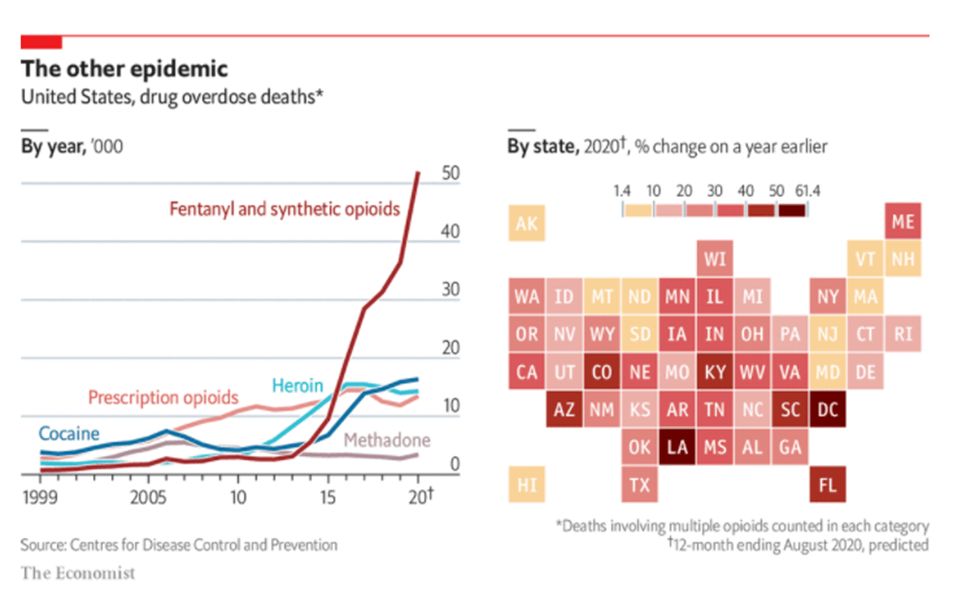
    As I drive and listen to AM radio, I hear public service spots telling what a great job they are doing by not prescribing opiates – yet I read headlines that say “Opioid Deaths Skyrocket Among Teens Due to Fentanyl.”  So we check CDC, and find out just how much of the opiate deaths are fentanyl, and then look at the states where opioid deaths are on a major increase.  People aren’t overdosing on Tylenol 3 and the big increases are in Louisiana and DC.

    I think I can come up with a better bunch of folks to protect me than Congress. 

  • Thinking Government- Machiavelli

     Max Weber provided the simplest definition: “A government is an institution that holds a monopoly on the legitimate use of violence.”  Another, fancier way he phrased it is “A state is a human community that (successfully) claims the monopoly of the legitimate use of physical force within a given territory.”  I kind of like using Weber’s perspectives on government and bureaucracy.

    One of the classic writers on government was Machiavelli. 

    I must at the beginning observe that some of the writers on politics distinguished three kinds of government, viz., the monarchical, the aristocratic, and the democratic; and maintain that the legislators of a people must choose from these three the one that seems most suitable.  Other authors, wiser according to the opinion of many, count six kinds of government, three of which are very bad, and three good in themselves, but so liable to be corrupted that they become absolutely bad.  The three good ones are those we just named, the three bad ones result from the degradation of the other three, and each of them resembles its corresponding original, so that the transition from the one to the other is very easy.

    Thus monarchy becomes tyranny; aristocracy lapses into oligarchy; and the popular government lapses readily into licentiousness.  So that a legislator who gives to a state which he founds, either of these three forms of government, constitutes it but for a brief time; for no precautions can prevent either one of the three that are reputed good, from degenerating into its opposite kind, so great are in those attractions and resemblances between the good and the evil.”

     Niccolo Machiavelli, Discourses

    There is more to Machiavelli than his simple quotations – but I’ll end with one: “Princes and governments are far more dangerous than other elements within society.” Niccolo Machiavelli