Trego's Mountain Ear

"Serving North Lincoln County"

Tag: Government

  • The Shadow Economy

    There are some confusing terms about the economy.  Household production fits in with the things that you do for yourself that makes life a bit better.  “Underground economy” and “shadow economy” refer to transactions that could be considered black market.  Some things – drugs, prostitution, stolen merchandise – are in the underground economy practically by definition.  Other items can be either in the regular economy or in the shadow economy.”

    “Italy also has a sizable underground economy, which by some estimates accounts for as much as 17% of GDP. These activities are most common within the agriculture, construction, and service sectors.”  This gives us the idea that it isn’t just an illegal immigrant involved.  The underground economy can include otherwise respectable citizens.”

    https://internationalliving.com/countries/italy/the-economy-in-italy/

    Household production isn’t mentioned in the analysis – but here, in northwest Montana, a single product provides an example – firewood.  It benefits me to report the money that comes in from firewood sales.  It helps me qualify as a farm, and make deducting expenses and depreciation possible.  As household production, it probably cuts down the cost of heat by $700 – $1000 each winter.  For others, it’s an underground economy, advertised on facebook, unreported to the government.  The definition and source follows:

    Investopedia puts the underground economy at 11 or 12% of the gross domestic product in the US. California’s Attorney General has an “Underground Economy Unit” and lists restaurants, janitorial work, the garment industry, retail, construction and car washes as the industries most impacted by wage theft. I don’t know – I recall talking about the US underground economy with a grad student.  With a student visa, he wasn’t allowed to work in the US – yet he had held a job somewhere in the southern US, in a business owned or managed by an Indian national, who sent the paycheck to his father in yet another country.  I think the term “wage theft” in that case would be accurate if you only looked at US records – and I doubt if it was reported to the IRS.

    The Institute of Economic Affairs uses the term “shadow economy” and describes: “The main drivers of the shadow economy are (in order): tax and social security burdens, tax morale, the quality of state institutions and labour market regulation. A reduction in the tax burden is therefore likely to lead to a reduction in the size of the shadow economy. Indeed, a virtuous circle can 
be created of lower tax rates, less shadow work, higher tax morale, a higher tax take and the opportunity for lower rates. Of course, a vicious circle in the other direction can also be created.”

    They go on to describe Denmark, where about half the population hires “shadow” workers.  Much of the “shadow economy” they describe is labor from people who have a regular job, performing a non-deductible service for other private parties.  The “shadow economy” is as much, or more, a place for our neighbors as for illegal migrants.

    “In Canada, Schneider (2005) found similar reactions of people facing an increase in indirect taxes (VAT, GST). After the introduction of the GST in 1991 in Canada, in the midst of a recession, the individuals, suffering economic hardship because of the recession, turned to the informal economy, which led to a substantial loss in tax revenue. Unfortunately, once shadow economy habit is developed, it is unlikely that it will be abandoned merely because economic growth resumes (Schneider, 2005). The People who engage in shadow economic activities may not return to the formal sector, even in the long run. This fact makes it even more difficult for policymakers to carry out major reforms because they may not gain a lot from the reforms.”

    https://www.usi.edu/media/3654690/Shadow-Economy.pdf

    Nearly 6 years ago, California passed legislation allowing legal marijuana sales – yet somewhere around 85% of the marijuana sold in California today is still in the “traditional” market – that’s right.  Despite having laws and a system that allows for legalized sales, the illegal market provides 5 times as much marijuana to users than the legal market. 

  • Montana Moves to Control Burgeoning Wolf Population

    The Reintroduction of Wolves into Montana has been very successful, from only about 60 in the state in the 1990’s to estimates of over a thousand today. The State Government has recently passed a law to reduce the wolf population.

    Here’s Dean Weingarten’s writing on the topic:

    On 20 August, 2021, the Montana Fish & Wildlife Commission voted to follow the intent of bill SB315, passed by the legislature and signed into law by Governor Greg Gianforte, on 30 April, 2021. SB314 was passed with the goal of reducing the wolf population while maintaining a minimum of 15 breeding pairs or 300 wolves in Montana. The 15 breeding pairs or 300 wolves are mandated to keep the wolf in Montana from being re-listed as an endangered species by the Federal government.

    Re-listing would remove management of the wolf population from state control. The bill passed 62 to 35 in the House, 29 to 20 in the Senate, and was signed by Montana Governor Greg Gianforte on 30 April, 2021. From ktvq.com:

    After a public comment period that drew more than 26,000 comments, the Montana Fish & Wildlife Commission at its August 20 meeting adopted several changes to the 2021/2022 wolf hunting and trapping regulations.

    Changes include eliminating quotas, increasing the number of wolf trapping and hunting licenses allowed for individual hunters, extending wolf trapping seasons, and the allowance of snares for trapping wolves.


    Here is a summation of the rule changes, from a transcript of the Commission adoption of Wolf Harvest rules for 2021-2022.

    There is no quota for the number of wolves to be harvested. A review of the harvest by the Fish & Wildlife Commission is required when 450 wolves are reported as taken. Another review will be triggered whenever an additional 50 wolves are harvested.

    Wolf trappers are allowed a total of 10 wolves for the season. Wolf hunters have to buy a license for each wolf taken, with a limit of 10 licenses per hunter. There are limitations on what type of snares can be used. Spring powered snares are allowed on private land, but not on public land. Limitations on the snares used are designed to prevent the death of non-target species. Night hunting for wolves, with artificial lights and/or night vision devices, is allowed on private land.

    When wolves are harvested, the harvest is required to be reported to the Fish, Wildlife and Parks (FWP) within 24 hours. A review of the harvest will be triggered if a grizzly bear or lynx is captured in a snare or trap.

    In most parts of Montana, the wolf season will start on the first Monday after Thanksgiving to March 15. FWP is given the authority to delay the season start in those districts designated as Grizzly Bear Recovery Zones, but the season cannot be delayed later than 15 December, when most bears are expected to be denned up and hibernating. Grizzly Bear Recovery Zones are a small part of the state.

    From 2012 to 2019 the average annual wolf harvest in Montana was 242 wolves. In 2020, the harvest was 328 wolves. The wolf population in Montana has been estimated at 1200 wolves.

    The foremost wolf expert in the field, David Mech, suggested 50% of wolves over 5-10 months old need to be harvested each year to keep a stable population. Others suggested the number could be as low as 30%. From Wolf population dynamics (state of the art) p. 184:

    Mech (1970, 63-64) suggested that over 50% of the wolves over 5-10 months old must be killed each year to control a wolf population, basing his estimate on Rausch’s (1967) age structure data on over 4,000 harvested Alaskan wolves. Because these wolves were killed in fall and winter, the 50% kill figure would have been in addition to natural mortality from birth to 5-10 months of age. Keith (1983) reevaluated the proposed 50% kill figure by assembling data from several field studies. He concluded that the figure should be less than 30%, including a precautionary hedge. However, the data he used (Keith 1983, table 8) included populations that may have been stationary when 41% were taken, and declining populations with a 58%-70% take. These data do not conflict with the 50% figure.


    The Commission adopted the changes on a 3 to 2 vote. Elections have consequences. From mtpr.org:

    Pat Byorth voted against the proposal. Byorth is the only commissioner who is a holdover appointee from former Gov. Steve Bullock; the rest of the commission was appointed by Gov. Greg Gianforte. Byorth said the new measures run at odds to long-established hunting ethics and fair chase in Montana.


    If the commission is to follow the law, they need to reduce the wolf population. A harvest of 450 wolves would be a step in the right direction. To reach a harvest of 450 wolves, the commission loosened some of the many restrictions on wolf hunting and trapping.

    Whether the removal of those restrictions will be enough to reach the minimum goal of 450 wolves harvested will become known in the 2021-22 wolf season.

    The Wisconsin Natural Resources Board reached a similar conclusion to the Montana Fish & Wildlife Commission in 2021. The Wisconsin Board increased the wolf harvest goal in to 300, in an attempt to reduce the burgeoning number of wolves in the state.

    Grey wolves migrated from northern Alaska to what is now Canada, the lower 48 states, and South America about 10,000 to 13,000 years ago. The migration of man to the same area may have happened that late. There are persistent archeological indications man may have preceded the wolf by thousands of years.

    As long as the grey wolf has existed in most of Alaska, Canada, the lower 48 states and South America, they have been in competition with man for prey. Before the grey wolf became established, the dire wolf, the sabre toothed tiger, and the short faced bear became extinct. Many think man was the cause of that extinction.

    ©2021 by Dean Weingarten: Permission to share is granted when this notice and link are included. http://gunwatch.blogspot.com/2021/09/montana-moves-to-control-burgeoning.html

  • Back at Tester

    Last week I got a few comments telling me how vile the authors figured Jon Tester is.  Now it may just be that I have a soft spot for fat men, or it may be a strong belief that virtue is relevant.  Still, I clipped from Wikipedia (no point in finding a more impressive source for the same data)

    Below is the current line of succession for the President of the United States:

    No.OfficeIncumbent
    1Vice PresidentKamala HarrisDemocrat
    2Speaker of the House of RepresentativesNancy PelosiDemocrat
    3President pro tempore of the SenatePatrick LeahyDemocrat
    4Secretary of StateAntony BlinkenDemocrat
    5Secretary of the TreasuryJanet YellenDemocrat
    6Secretary of DefenseLloyd AustinDemocrat
    7Attorney GeneralMerrick GarlandDemocrat
    8Secretary of the InteriorDeb HaalandDemocrat
    9Secretary of AgricultureTom VilsackDemocrat
    10Secretary of CommerceGina RaimondoDemocrat
    11Secretary of LaborMarty WalshDemocrat
    12Secretary of Health and Human ServicesXavier BecerraDemocrat
    13Secretary of Housing and Urban DevelopmentMarcia FudgeDemocrat
    14Secretary of TransportationPete ButtigiegDemocrat
    Secretary of EnergyJennifer Granholm[A]Democrat
    15Secretary of EducationMiguel CardonaDemocrat
    16Secretary of Veterans AffairsDenis McDonoughDemocrat
    Secretary of Homeland SecurityAlejandro Mayorkas[B]Democrat  
    https://simple.wikipedia.org/wiki/United_States_presidential_line_of_succession

    Nothing personal folks, but I had to get down to number 9 on the list, Tom Vilsack, before I found anyone who seemed to equal Jon Tester’s morality and ability. 

  • Why Did it Have to be …Guns?

    Why Did it Have to be …Guns?

    Why Did it Have to be … Guns?

    by L. Neil Smith

    lneil@lneilsmith.org

    Over the past 30 years, I’ve been paid to write almost two million words, every one of which, sooner or later, came back to the issue of guns and gun-ownership. Naturally, I’ve thought about the issue a lot, and it has always determined the way I vote.

    People accuse me of being a single-issue writer, a single- issue thinker, and a single- issue voter, but it isn’t true. What I’ve chosen, in a world where there’s never enough time and energy, is to focus on the one political issue which most clearly and unmistakably demonstrates what any politician—or political philosophy—is made of, right down to the creamy liquid center.

    Make no mistake: all politicians—even those ostensibly on the side of guns and gun ownership—hate the issue and anyone, like me, who insists on bringing it up. They hate it because it’s an X-ray machine. It’s a Vulcan mind-meld. It’s the ultimate test to which any politician—or political philosophy—can be put.

    If a politician isn’t perfectly comfortable with the idea of his average constituent, any man, woman, or responsible child, walking into a hardware store and paying cash—for any rifle, shotgun, handgun, machinegun, anything—without producing ID or signing one scrap of paper, he isn’t your friend no matter what he tells you.

    If he isn’t genuinely enthusiastic about his average constituent stuffing that weapon into a purse or pocket or tucking it under a coat and walking home without asking anybody’s permission, he’s a four-flusher, no matter what he claims.

    What his attitude—toward your ownership and use of weapons—conveys is his real attitude about you. And if he doesn’t trust you, then why in the name of John Moses Browning should you trust him?

    If he doesn’t want you to have the means of defending your life, do you want him in a position to control it?

    If he makes excuses about obeying a law he’s sworn to uphold and defend—the highest law of the land, the Bill of Rights—do you want to entrust him with anything?

    If he ignores you, sneers at you, complains about you, or defames you, if he calls you names only he thinks are evil—like “Constitutionalist”—when you insist that he account for himself, hasn’t he betrayed his oath, isn’t he unfit to hold office, and doesn’t he really belong in jail?

    Sure, these are all leading questions. They’re the questions that led me to the issue of guns and gun ownership as the clearest and most unmistakable demonstration of what any given politician—or political philosophy—is really made of.

    He may lecture you about the dangerous weirdos out there who shouldn’t have a gun—but what does that have to do with you? Why in the name of John Moses Browning should you be made to suffer for the misdeeds of others? Didn’t you lay aside the infantile notion of group punishment when you left public school—or the military? Isn’t it an essentially European notion, anyway—Prussian, maybe—and certainly not what America was supposed to be all about?

    And if there are dangerous weirdos out there, does it make sense to deprive you of the means of protecting yourself from them? Forget about those other people, those dangerous weirdos, this is about you, and it has been, all along.

    Try it yourself: if a politician won’t trust you, why should you trust him? If he’s a man—and you’re not—what does his lack of trust tell you about his real attitude toward women? If “he” happens to be a woman, what makes her so perverse that she’s eager to render her fellow women helpless on the mean and seedy streets her policies helped create? Should you believe her when she says she wants to help you by imposing some infantile group health care program on you at the point of the kind of gun she doesn’t want you to have?

    On the other hand—or the other party—should you believe anything politicians say who claim they stand for freedom, but drag their feet and make excuses about repealing limits on your right to own and carry weapons? What does this tell you about their real motives for ignoring voters and ramming through one infantile group trade agreement after another with other countries?

    Makes voting simpler, doesn’t it? You don’t have to study every issue—health care, international trade—all you have to do is use this X-ray machine, this Vulcan mind-meld, to get beyond their empty words and find out how politicians really feel. About you. And that, of course, is why they hate it.

    And that’s why I’m accused of being a single-issue writer, thinker, and voter.

    But it isn’t true, is it?

    “Permission to redistribute this article is herewith granted by the author—provided that it is reproduced unedited, in its entirety, and appropriate credit given.”

    L. Neil Smith passed away recently – for folks who are unfamiliar with his writings, many are available at https://lneilsmith.org/   It’s worth checking out.  I’ve learned that few of these blogs live longer than a year past the author, and Neil Smith was worth reading.

  • Inflation Since 1914

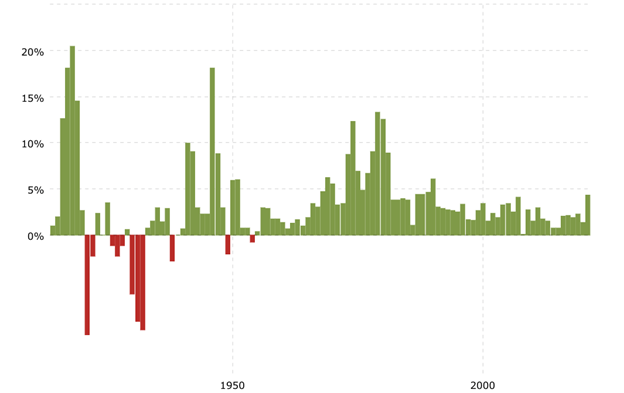
    Looking at our nation’s deficit spending, I got thinking back to the Carter years, the high inflation and the high interest.  Then I decided to grab a table or a chart to see how things looked from a historical perspective.  This chart give inflation figures from 1914:

    Found at macrotrends.net

    It turns out that our highest inflation was under Woodrow Wilson.  20.44% in 1918 – 18.1% in 1917, and 12.62% in 1916.  Back then we were on the gold standard – yet the price of gold remained at $20.67 from 1910 through the twenties.  During the worst years of the great depression, inflation (deflation?) was about -10%. 

    Carter’s highest year – 1979 – saw 13.29% inflation . . . and to be fair, Carter inherited a good portion of his challenges from Nixon – whose highest (and final) year was 1974 at 12.34% inflation.  Trump’s last year, 2020, had only 1.34% inflation.  Biden’s at 4.31% on this chart, and we’re not through 2021 yet.  Still, it will be a challenge to top Woodrow Wilson.

    Above the chart is this statement “Interactive chart showing the annual rate of inflation in the United States as measured by the Consumer Price Index back to 1914. The current rate of U.S. CPI inflation as of August 2021 is 271.70.”  As I write this, the net tells me that I can buy gold for as low as $1827 per ounce.  Dividing that by $20.67 shows that the price of gold has only increased by a factor of 88.39. 

    C.P. Snow described the second law of thermodynamics as “You can’t win, you can’t break even, and you can’t quit the game.”  Who says physics can’t be applied to government?

  • What is a Farm

    What is a Farm

    A dozen years ago, I wrote “What is a Farm” and now I have one.

    The bottom line that defines a farm is production.  “The current definition, first used for the 1974 census, is any place from which $1,000 or more of agricultural products were produced and sold, or normally would have been sold, during the census year. (1992 Census of Agriculture).”  It’s kind of fun to be able to quote myself, and find that the commentary is still accurate 12 years later.

    This July, I harvested 275 little round bales of grass hay, and stored them in the log shed.  I figure if I sell them at $4 each, the place makes the minimum to be a farm.  Logically, that makes me a farmer, for the first time in my life.  I remember seeing a neighbor in Ag Hall when I worked for Extension – and commenting to Todd that he was the first farmer I had seen in that building . . . to be fair, I hadn’t worked in Ag Hall all that long.  Now that I’m a farmer I do have to sell those cute little bales to actually qualify.

    Since I’ve already done the research, I can help others determine if they also qualify: “The definition also makes it easy to be a “small farmer”: if a family has a couple dozen hens and eats organic eggs from its own free-range chickens, the family probably produces enough to be living on a farm. Similarly, a two-Holstein-steer feedlot with all purchased feed can meet the definition of a farm. Obviously, a large hog confinement facility is a farm, even if it lacks plows and fields.” 

    This table shows how the government’s definition of a farm has changed over time: