Trego's Mountain Ear

"Serving North Lincoln County"

Tag: hiking

  • The January Run

    It’s the week before Christmas. Fifty years ago, I was on a Ski-doo Alpine, making the January Run. It was a partial run – mostly for the purpose of rewinding the clockwork recorders that measured the height of the antifreeze solution as deeper snows compressed the snow pillows (a snow pillow is a rubber bladder, filled with antifreeze – I measured a lot of them, but rarely saw one).

    It’s a different world now – instead of pushing twin tracked snowmobiles up Grave Creek to sample Weasel Divide, then sample Stahl Peak and rewind the pillow, I can download the measurements from my armchair. Today, the only need for snow surveyors is to visit the site, and provide the measurements that allow the correlations with the (longer established) snow course. The real iron men of snow surveys were the generation before me – they did it all on skis and snowshoes.

    So, in memory of the job that once brought me envy (“You really get paid to ride snowmobiles?”) Here’s what the data recorder has to say about Stahl Peak today:
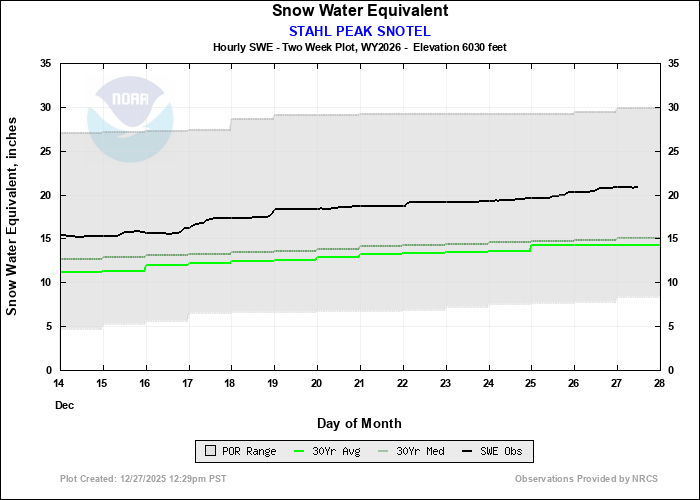
    I like the chart – and the long-term data (for the last 30 years – it really does make me feel old to see that my measurements from 50 years ago, are so far in the past that they’re not included. But even a half century ago, I had learned that climate, like weather, changes – it’s just slower to change).

    6 Hour
    SWE Change
    (inches)
    12 Hour
    SWE Change
    (inches)
    24 Hour
    SWE Change
    (inches)
    48 Hour
    SWE Change
    (inches)
    1 Week
    SWE Change
    (inches)
    0.000.000.501.202.40
     Daily Statistics
    Latest Observation is 20.90 inches which is 147 % of average
     Note: The Median/Average is based upon the 30 year period 1991 to 2020.
    The Min/Max is based upon the Period Of Record (POR).

    So, at this time, the snowpack on Stahl is about 150% o the average. If you click on the NCRS site, you’ll see where the Kootenai basin sits:

    Basin
      Site Name
    Elev
    (ft)
    Snow Water EquivalentWater Year-to-Date Precipitation
    Current
    (in)
    Median
    (in)
    Pct of
    Median
    Current
    (in)
    Median
    (in)
    Pct of
    Median
    KOOTENAI RIVER BASIN
      Banfield Mountain55806.8   6.2   110   19.5   10.3   189   
      Bear Mountain546016.8   18.8   89   47.4   31.8   149   
      Garver Creek42503.3   4.7   70   15.2   9.0(24)169   
      Grave Creek43503.0   5.2   58   28.8   14.3   201   
      Hand Creek50303.6   3.9   92   11.6   7.2   161   
      Hawkins Lake646014.3   9.8   146   25.8   15.2   170   
      Poorman Creek50508.8   11.4(22)77   46.1   25.9(22)178   
      Stahl Peak604020.9   14.2   147   27.1   18.2   149   
    Basin Index (%)104   168

    The percentages are impressive – but there is a lot of winter yet to come. I don’t have data based on the Bouyoucos blocks we once measured to show how much moisture is stored in the soil at the sites – but I’d bet the soil moisture is at 100% capacity too.

    It’s a pleasant thing that the data is so readily available anymore.
  • Merry Christmas to All

    I’m accustomed to white Christmases since I was ten years old. Admittedly, I spent a few Christmases south of a projected Mason-Dixon line – but it was at 6,000 feet elevation. Most of the time, as I recall Colorado, I remember that mountains are neat, but altitude sucks. There, I lived at 6,000 feet and looked out at Fisher’s Peak (9,633 feet). Driving north, I’d see Pike’s Peak (14,115 feet). Here, I live at about 3,200 feet and look at Mount Marston (7,340 feet). Life is good – lower elevations, like Libby and Troy have the flooding. My challenge is that nature leaves me firewood and logs to cut and move.

    This year, with wet soils and high winds, we’ve had a lot of blowdown – which will give me plenty to do next spring and summer. The Douglas fir has generally pushed over at the roots, while the Ponderosa pine have tended to snap 20 or 30 feet in the air. The larch, with their needles dropped for the winter, generally stand undisturbed. The leave tree selection will be larch first, P. pine second, D. Fir third. I think the spruce are pretty much gone, but I will try to save the one remaining aspen.

    This Christmas is above freezing, despite NOAA’s projection of cooler than normal. I see a couple of goats down at the old Ranger station – when I stopped to complete my doubletake, they approached the car – I think the message they were trying to convey was “We’re a pair of really nice, really cute goats, and we’re feeling abandoned.” Empty handed, they left me my space – but I think they would have followed me home if I had a bucket and some oats. I note that someone has rescued one of the pair – hopefully they’ll get the other soon. A single goat is a lonely goat.

    On the 23rd, there was a two vehicle wreck, with injuries up above us on Fortine Creek Road. Like Highway 93, we have a lot more traffic now than years back, and it’s the same road as it was in 1967.

    Anyway, Merry Christmas, and a Happy Easter Bunny to all.

  • The Two Goat Herd

    My grandson, Remi, gave me his first complete sentence about six weeks ago. “I need a goat.” I thought back over 65 years – and realized that, just before Dad retired from the Navy, my parents bought their first house – in Washington – then bought an additional acre of blackberry brambles, and goats to eat down the brambles. I realized that I had liked having goats around as a kid – so I messaged a great lady I met who had goats.

    Long story short, she introduced Remi and I to a pair of Nigerian Dwarf does. Remi was enchanted, so I got him two goats just as soon as I got a small goat house set up for his front yard. There’s going to be a lot more work setting up the permanent goat corral.

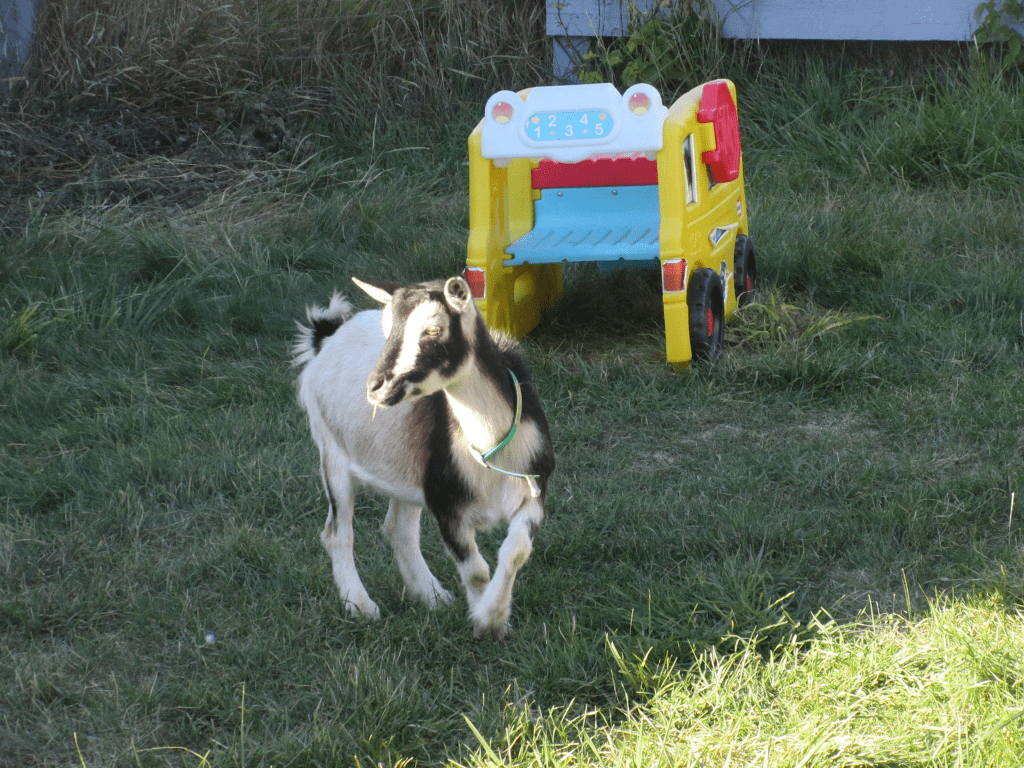
    I’m no expert on goats – but I started this project knowing you don’t get one goat. They’re a herd animal, and need a friend. So the deal was made for two little goats. The one pictured kept her original name – the other became ‘Stormy’. Which is a lot better than Sam referring to her as ‘that little black witch’ on her third escape the first evening we brought Remi’s goats home. The escapes were (I believe) just to show us she could do it – she might jump to the top of the goat house, and then over the fence, but leaving her friend wasn’t in the cards.

    Nigerian Dwarfs are small dairy goats – and the breed page says that they are primarily kept as pets. Which is fine by me – I’m guessing the smaller of the two weighs about 40 pounds and the larger a little over 50 pounds. The average dairy goat weighs in at 120 pounds – these little does are tiny. And they have all of us feeding them – family and neighbors. After the first night, they settled in and are getting by fine.

    I’m reading a post from the Brown Family Farmstead on Nigerian Dwarf goats: “Don’t let their small stature fool you, they may be small but they can still jump a six foot fence.” I thought a four foot fence was plenty. Sam and Jed have held out for a six foot fence. Now I realize the pair stay in the fence out of courtesy.

    On Sunday, we took the little goats out on a walk. After maybe a hundred yards, they remembered their 4-H training and enjoyed the walk. Then came the recollection – small humans often have treats stowed in pockets. So Remi is checked carefully for grain, pellets, etc. Remi’s complete sentences have gotten longer – “I’m taking my goats for a walk.” is a frequent comment.