There are few meals more easily assembled than a can of soup. Anymore you don’t even need a can opener – a lot of them come with a pull ring. Unfortunately, if that’s as far as you go, it isn’t that great a meal.
I shared Mom’s quick technique for improving chicken and noodles with Sam – and she asked if I could go through all I could remember. Mom’s mastery of basing the soup off a can meant that getting a couple unanticipated dinner guests was never a problem. A hearty soup would go along with slightly smaller portions and everyone would be happy and well fed.
That can of chicken noodle soup is a pretty thin meal – but half a handful of dried onions, a carved up carrot and a small can of chicken turns it into something resembling a meal. A can of tomato soup, accompanied by a can of milk and a can of diced tomatoes (preferably with a bit of peppers) turns it into a near-great tomato soup. We’re 500 miles from the sea, so there’s nothing wrong with beginning your clam chowder with a can, adding another can of clams, and making a decent clam chowder – decent only, because fresh clams are definitely better, but not available in the rural Rock Mountains.
She knew how to use cans to improve the quality of soup – that and a few other tricks. I’ve picked up a few of them.
I noticed a headline that referenced “North of the 49th Parallel” as a descriptor for Canadians. Here, where I’m 20 miles south of the 49th Parallel, that’s correct – basically the Canadians I know are north of 49. Still, they’re unusual Canadians. Toronto is further south than Sioux Falls, South Dakota. 72% of Canadians live below the 49th Parallel.
This website shows that half of Canada’s population lives below “the redline”, a line drawn at 45 degrees 42 minutes. From a westerner’s perspective, this map makes Canadian politics a lot easier to understand. Half of them live further south than Billings. And, as you can see from the map, they’re crowded together – unlike our own northern neighbors.
The Red line is drawn at 45 42 minutes- For Context, the Canadian Line we border is at the 49th Parallel
There’s a Durham report going around now, as Durham reports on the shenanigans around the Trump-Russia investigations. It’s about 180 years ago that Canada had its own Durham report, after a bit of civil unrest. Back then, Canada was divided into upper Canada and lower Canada.
Upper Canada was the area just north of the great lakes – largely settled by Loyalists (Tories) after the American revolution. The head of each family received 100 acres for settling there, with 50 acres more for each additional family member. Soldiers who had fought for the crown received significantly more. Family histories go way back – and at the turn of the 19th century, this area was home to some downright anti-US Canadians. The Canadian Encyclopedia provides us this description:
“The term Family Compact is an epithet, or insulting nickname; it is used to describe the network of men who dominated the legislative, bureaucratic, business, religious and judicial centres of power in Upper Canada (present-day Ontario) from the early- to mid-1800s. Members of the Family Compact held largely conservative and loyalist views. They were against democratic reform and responsible government. By the mid-19th century, immigration, the union of Upper and Lower Canada, and the work of various democratic reformers had diminished the group’s power. The equivalent to the Family Compact in Lower Canada was the Château Clique.”
If we think about those early settlers of “Upper Canada” – the area that today is shown below the “red line”, they weren’t folks who wanted the representative democracy that was established in the new American republic. They were monarchists, and Canada bloody well had a king. Sure, it’s a couple centuries back, but the Tories (Loyalists) had soldiered for the crown, and the government they wanted was not a representative democracy.
In 1837 and 1838 there were rebellions in both Upper and Lower Canada. Basically, the French Canadians didn’t particularly like the English speaking Canadians, and that was reason enough for small uprisings in Lower Canada, and the newer settlers of Upper Canada didn’t particularly like being governed by the old guard Loyalists. Lord Durham looked the situation over, and recommended uniting the provinces into a single Canada – remember, the Brits had a lot of experience ruling conflicted peoples in Ireland . . . there it was Protestant and Catholic, but it could work. So he moved things to a spot where the English speakers wound up with a readily identifiable political opposition – while Durham’s report is regarded as paving the way for Canadian independence and responsible government, the roots of that government were planted by moneyed Loyalists who lost the American Revolution, and largely made their identities in opposition to the US form of government.
As we watch the truckers protest, it may be a good idea to remember that there is a lot of historical difference between the Canadians of Eastern British Columbia and Alberta whom we know and the heirs of the Family Compact and the Chateau Clique. Somehow, it seems appropriate that Durham reports are a historical commonality.
Edward Stahl shared a bit about his early days – the early days of Trego and Stryker – in his writings about his time at Ant Flat . . . a time when the Ranger was expected to build his own cabin, among other things. The whole story is at npshistory.com and the following excerpts cover his time spent at Ant Flat.
I was among the group at Kalispell, Montana, that took the first Civil Service examination there for Forest Ranger, in 1905. My rating placed me at the top of the eligible list, and early the following spring I received appointment as Forest Ranger, assigned to work under the direction of Fred Harrig at Ant Flat. . .
With Byron Henning, we cut trail the spring of 1906 up the Stillwater Valley. It rained continuously. Fred told me that the year before, he sent in his monthly diary with a lot of daily records reading, “Rain, stayed in camp.” His next check was quite a bit short and it never rained so hard again!
We camped at Fish Lake. I packed my horse in and walked while Fred and Byron Henning rode. We planned to go to Ant Flat for the weekend, but I was handicapped with a mean horse and no riding saddle. I rigged up a bridle with small rope, but got bucked off at the first attempt. Fred said, “Eddie, you might as well stay in camp. You’re crazy as hell to try to ride that horse bareback.” A school ma’am boarded at Fred’s place and I had a date to take her to a dance at Gateway, so I felt honorbound to get to Ant Flat in time. I cinched a lash rope around the horse for a handhold and blindfolded him. When Fred pulled the blind, I whacked the horse over the ears with my hat and arrived at the station far ahead of the other two.
The old stage road led through a narrow pass at the summit near Stryker. The canyon was so narrow that at turnout places there were signs reading, “Stop and holler,” as warning for freighters to wait to pass. Fred used to go to sleep while riding his horse and would wake up saying, “Dot vas a great improvement.” One dark night he woke up sitting on the solid rock road in the canyon, which was not much of an improvement, and he had to walk home. He rode a big snorty black and the horse may have been spooked by a bear.
The big dance of the year was the Mulligan Ball held at Gateway by the Order of the Sons of Rest. Mulligan was made in a washboiler, and it was rumored that Old Crow whiskey was one of the ingredients. The ball was held in an abandoned honky-tonk building, a relic of the boom days of 1900 when, at the end of each dance, the call was “Promenade to the bar,” where the bartender served drinks and passed a 15-cent check to the lady to put in her stocking as commission. Today there is not enough left of Gateway to call it a ghost town. Although it is on the U.S.-Canadian boundary, there is no custom office there. The railroad that was built in 1900 is torn up and the line is blocked off with page-wire fence.”
Well, I’m not sure what a page-wire fence is, and Gateway is a pretty wet place anymore – but I’m glad to find Stahl’s notes on the net. Taking a school marm from Trego to Gateway for a dance in 1906? Maybe he rode down Friday for a Saturday night dance? Edward Stahl was definitely a man of character.
Following events as they are happening takes a bit of work, and this more so than most. It has the advantage of being stretched out in time, so the reader isn’t overwhelmed by a bunch of things happening all at once, but finding what, and why and when proved more difficult.
Here’s what I have found (incomplete, both due to the sheer amount of information, and my inability to read French).
“Freedom Convoy” set to pass through Regina on trek to Ottawa (620 ckrm)
Alberta senator calls anti-mandate protesters a “systemic problem” (The Counter Signal)
Trudeau slams ‘fear mongering’ over COVID vaccine mandate for truckers (National Post)
Who’s Fuelling the Truckers Protesting Vaccine Mandates? (The Tyee)
The trucker caravan from the Edmonton, Alberta, area alone yesterday was said to be more than 40 kilometers in length before arriving in Calgary to head east to Ottawa.”
50,000 trucks heading toward Ottawa to demand an end to COVID mandates (Life Site)
Wednesday Jan. 26– Convoy scheduled to depart Kenora for Thunder Bay
(Posted Jan. 26- but may include video from prior days
Transport minister concerned trucker convoy becoming a lightning rod for far-right fringe (National Post)
“Freedom Convoy” organizer says it’s not affiliated with extremist groups (Daily Hive)
Massive Crowds Cheer as Canadian Truckers Lead ‘Freedom Convoy’ Protesting Vaccine Mandates (CBN News)
Trucker convoy reaches Ontario amid fears of violence from fringe groups in Ottawa (blogTO)
“The small fringe minority of people who are on the way to Ottawa who are holding unacceptable views that they are expressing do not represent the views of Canadians who have been there for each other”
-Canadian Prime Minister Justin Trudeau
“…small fringe minority….”
Friday Jan. 28– Convoys depart for Ottawa- with only two routes scheduled to reach Ottawa on Saturday
Ottawa is canceling police officers’ days off as the Freedom Convoy protests continue. Some have worked 2 weeks without a break. (Insider)
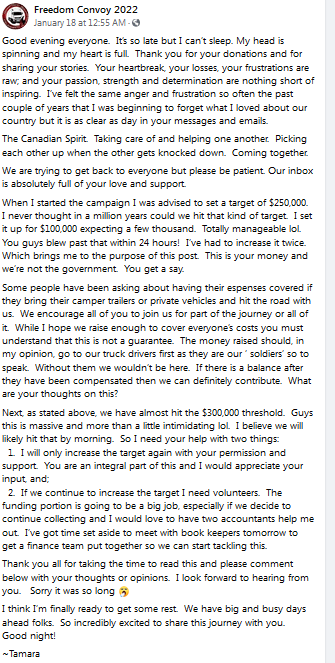
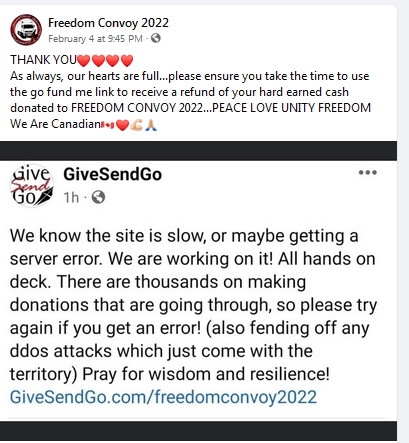
GiveSendGo fundraiser for Freedom Convoy hits $4.5 million after GoFundMe shuts page down (The Gazette)
SaturdayJanuary 15th- requirements for entry into Canada changed for unvaccinated (or partially vaccinated) truck drivers. While Canadian truck drivers can still enter Canada (and be subject to testing and quarantine requirements), those that are not Canadian will be turned away at the border.
COVID-19 vaccine mandate, ongoing labour shortages challenging for Manitoba trucking industry (CBC News)
Wednesday Jan. 19– Canadian Trucking Alliance (CTA) releases statement on Protests- in short, they do not support them.
The trucking industry was caught by surprise on Jan. 12 when the Canada Border Services Agency sent a statement to media saying that unvaccinated and partially vaccinated truck drivers crossing into Canada from the United States would remain exempt from the vaccine mandate that had long been expected to come into force last weekend.
The federal government reversed that the next afternoon with a statement that said the information shared the day before had been sent in error. The exemption would still end Jan. 15, meaning truck drivers would need to be fully vaccinated if they wanted to avoid a two-week quarantine and pre-arrival molecular test for COVID-19 before crossing into Canada.
President of the Private Motor Truck Council of Canada, Mike Millian, discussed the vaccination requirements in both the United States (beginning Jan. 22) and Canada
Convoy of truckers against vaccine mandates ready to roll on Ottowa (Toronto Sun)
Sunday Jan. 23– Convoy was scheduled to leave Prince George at 7 AM, bound for Calgary, while another departed for Calgary from Vancouver.
Hundreds of truckers headed to Ottawain ‘Freedom Rally’ convoy against vaccine mandate (CBC News)
At this point- I might recommend muting youtube, otherwise there is a lot of honking.
Canadian Truckers Lead ‘Freedom Convoy’ To Ottawa To Protest Vaxx Mandate (Daily Wire)
Thursday Jan. 27– Several Groups rolling on thursday; The group from Thunder Bay scheduled bound for Sault STe. Marie, with additional groups departing from St. Johns, Enfield, Riviere-du-Loup, Windsor, Sarnia, Niagra and Toronto
Canadian ‘freedom’ truckers massive vaccine mandate protest convoy may smash world record (Fox News)
Canadians Furious After Trudeau’s ‘Fringe Minority’ Comment As Thousands of Truckers Head to Capital (Daily Wire)
Prime Minister Justin Trudeau says he is isolating after learning of COVID exposure (Toronto Star)
Freedom Convoy plans to gridlock Ottawa until all vaccine mandates repealed (Edmonton Journal)
Elon Musk tweets in support of Canadian truckers ahead of ‘Freedom Rally’ protest (MSN)
This trucker thing probably isn’t going to end well (National Post)
Polls Show Popular Support for Trucker Convoy in Canada Despite Trudeau’s Claim it Represents ‘Fringe Minority’ (American Greatness)
Saturday Jan. 29– Last two convoys scheduled to arrive in Ottowa
Freedom Convoy: Why Canadian truckers are protesting in Ottawa (BBC News)
Trucker convoy rumbles into Canada’s capital carrying COVID and mandate beefs (Freight Waves)
Canada’s ‘Freedom Convoy’ of up to 50,000 truckers begins to arrive in Ottawa ahead of a weekend of protests against the vaccine requirements to cross (Canada Free Press)
Washington Post political cartoon labels trucker convoy as ‘fascism,’ which ignites fierce firestorm: ‘Devoid of wit or truth. Shameful and pathetic.’ (Blaze Media)
Demonstrators descend upon Sask. Legislative Building for ‘solidarity convoy’ opposing vaccine mandate for truckers (CTV News)
Fact Check: Canada truck convoy not an official Guinness World Record (Yahoo News)
Freedom Convoy 2022, Saturday: Thousands pack Parliament Hill for protest (National Post)
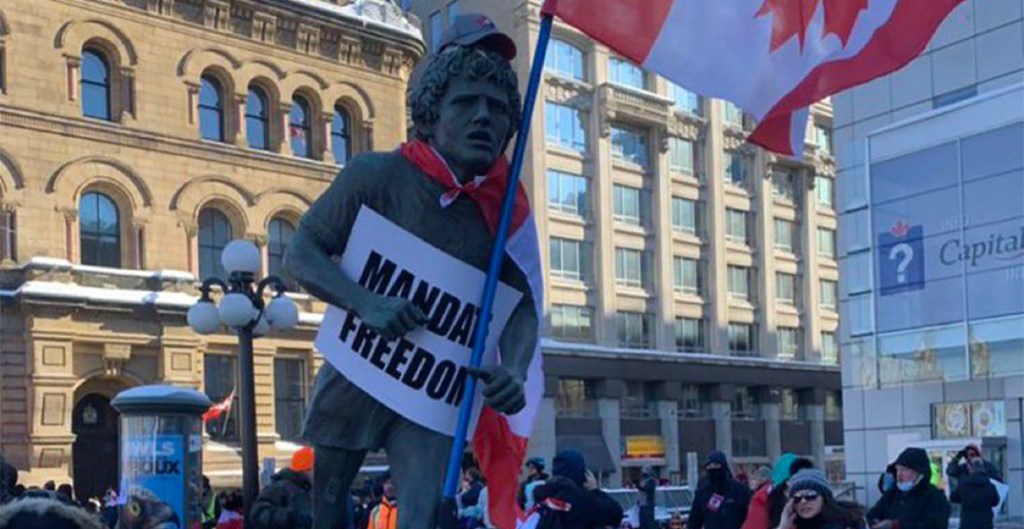
Terry Fox statue defaced with “mandate freedom” amid Ottawa Protest (Daily Hive)
Province in Canada bans gathering along highway ‘in support of the 2022 Freedom Convoy’ (BizPac Review)
Trudeau Flees as trucker convoy Enters Ottawa (The Week)
Trucks traveled great distances to be in Ottawa, so did police snipers (Toronto Sun)
Prime Minister Justin Trudeau silent as thousands join truckers’ protest in Ottawa (National Post)
Justin Trudeau and his family flee Canadian capital Ottawa as up to 50,000 ‘Freedom Convoy’ anti-vaccine mandate truckers arrive at his office -days after he dismissed them as a ‘small fringe minority’ (Daily Mail)
The “Freedom Convoy” is being prepared in Europe (French Daily News)
Military tells Ottawa to find someone else to evict the truckers (National Post)
Freedom Convoy Expected to Grow! Truckers Vow to Continue “Until It’s A Free Nation Again (SGT Report)
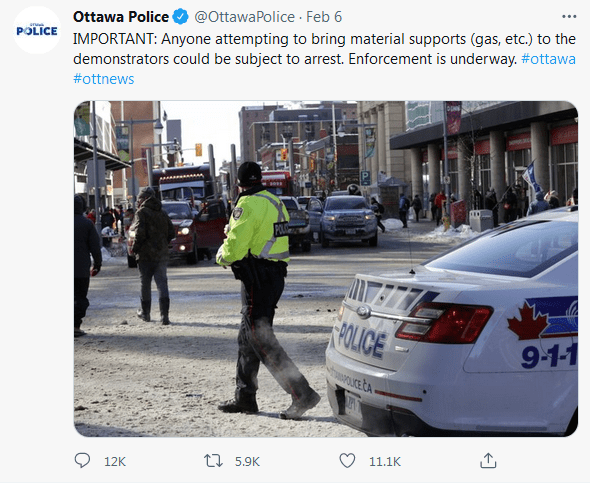
Ottawa police deploy more officers ahead of weekend demonstration
Where did all of the THOUSANDS of trucks end up in Ottawa? Diverted by police AWAY from downtown (Rebel News)
Tow Truck Companies Refuse to Remove Convoy Trucks
Truck convoy: $9.8M class-action lawsuit filed against “Freedom Convoy”; GoFundMe ends fundraising campaign; Protesters spotted in the suburbs; Kitchen erected in Confederation Park (The World News)
‘Vancouver doesn’t want you here’: Mayor addresses Saturday’s planned protest convoy (Vancouver is Awesome)
Possibly a Freedom Convoy getting started in Berlin, but my German is as poor as my French, so I’m not certain.
Sunday Feb. 6 Protest Day 9
State of emergency declared in Ottawa
Breaking: Man charged in Winnipeg car attack on convoy protest is radical-left anarchist (Rebel News)
Freedom Convoy Raises $2M on GiveSendGo After GoFundMe Removes Campaign (Newsweek)
Slow Roll Protests have emerged at several crossings over the past month, as well as full and partial blockades. Protests are against the new vaccine mandates for crossing the border, and in support of the Freedom Convoy in Ottowa protesting the same.
A Slow Roll Protest began at 3 in the morning, Monday January 17th on the US Manitoba border at the Crossing between Pembina, North Dakota and Emerson, Manitoba. The Pembina/Emerson crossing is a 24 hour port of entry, with three commercial lanes and 4 auto lanes. It is the most heavily traveled border crossing in North Dakota. Between 30 and 40 semi-trucks moved in a slow loop, passing through the crossing, then turning, and crossing again.
The largest port of entry in Alberta is the Coutts Border Crossing, between Coutts, Alberta and Sweet Grass, Montana where traffic has been disrupted since Saturday, January 29th. On the 29th, the RCMP said that several hundred vehicles took part in the protest.
Also on the 29th, a blockade was set up at the Houlton-Woodstock border crossing, between Woodstock New Brunswick and Houlton Maine. The blockade was scheduled to last 24 hours, and to demonstrate support for the Trucker Convoy protesting in Ottawa.
The current blockade of Highway 4 at the Coutts border crossing violates the Alberta Traffic Safety Act. It is causing significant inconvenience for lawful motorists and could dangerously impede the movement of emergency service vehicles. This blockade must end immediately.”
On January 31st, Rebel News reported on a standoff between the RCMP and the protesters, including ongoing negotiations. The protest at the Coutts border crossing continued on February 1st, with further negotiations between RCMP and the protesters. The protest continued to grow on the 2nd. There is a group set up to fund the legal defense for the protesters. At some point a second blockade occurred in the area. With so much coverage for the Coutts border crossing, it’s difficult to find news about any other ports of entry. That said, there are videos that suggest protests (with lotsof honking) have been occurring in other places along the border.
Saturday February 4th Video Update from Rebel News on the Coutts, Alberta Border Blockade. Also on the 4th, an article came out suggesting that companies will be rerouting their shipping to crossings to the east or west of the Coutts crossing.
On Sunday, February 6th, there were reports of a protest at a different crossing: Convoy slows traffic at the border and closes 402 westbound Sunday– CBC News. A convoy slowed traffic at Ambassador Bridge, a 24 hour crossing that connects Windsor, Toronto to Detroit, Michigan, another major port of entry.
The protest at the Coutts crossing continues- it’s well worth watching the youtube videos. The written press coverage has been fairly limited- youtube and twitter both provide more information, if less linearly.
Local News- if you’ve been watching the Eureka Montana Community Page, you’ll have seen that a Freedom Rally in support of the Freedom Convoy 2022 is scheduled for February 12th, b/w 1 and 4 PM, gather at the parking lot of the First & Last Chance Bar.
Sam Billings wrote of his experience as a Forest Service guard on Pinkham Creek. We do need to remember that the Pinkham Creek residents of the time did not have the same access to the historical record that the Forest Service did – the stories I heard as a youngster suggest there was only one man specializing in arson . . . but it was a different time. Billings’ story gives a perspective on the early times on Pinkham.
THE PINKHAM CREEK CLOSURE – 1924
By Sam Billings
Sometimes referred to as the Pinkham Creek Insurrection or the Pinkham Creek Rebellion, the entire Federal lands in the Pinkham Creek drainage, Kootenai National Forest, were closed to entry without permit beginning about the first of August 1924 and were kept closed until the September rains.
For several years preceding this closure, the Forest Service had had to contend with incendiary fires that were set within or adjacent to the drainage. These fires were believed to have been set by homesteaders in Pinkham Creek who set the fires in order to obtain work as firefighters. In the latter part of July 1924 a rash of these fires were set—some 32 fires, if the writer remembers right, were set at one time; and the Forest Service decided to take drastic action. The Forest was closed to entry except by permit, and seven camps were established around the valley, out of which patrolmen enforced the closure. There were three men in each camp – two patrolmen and a camp tender, who did the cooking and watched camp during the day. All the patrolmen were armed and were supplied a saddle horse apiece for riding out over the trails. Wages were $100 per month and food.
This writer was one of the patrolmen and was assigned to Camp No. 1 the first camp on the road at the lower end of Pinkham Creek. Andy Fluetsch, sent over from the then Absaroka National Forest, was the other patrolman in this camp, and Bill Hillis, from Libby, was the camp tender. Andy was a long, lean cowpuncher-type and was a fast-draw artist. Bill was short and round and bald and was a retired professional gunman who had worked for years for the Peters Arms Company, doing exhibition shooting at circuses and on the vaudeville circuit. They picked me – they told me later – because I had served in a tough outfit, the First Division, in World War I.
The people who organized this armed patrol must have thought there would be violent resistance to the closure, but there was none—only the threat of it one day. Fluetsch and I usually left camp around 8 a.m. and rode out in different directions each day, sometimes together and sometimes each in a different direction. We usually returned to camp at around 4 p.m. Bill Hillis usually stayed in camp all day, but occasionally, he would catch a ride into Rexford or Eureka on business of his own, or rarely, he would go duck hunting. One day we returned to camp around 4 p.m., as usual, and found a note on the dish up table. Bill had gone to Eureka and had not yet returned. The note read “You get to hell out of here or we will shoot up your camp,” and it was signed “Pinkham Creekers.” Andy and I slept on cots in one tent, and Bill slept on a cot in the cook tent where we ate our meals. Naturally, we were a little nervous for a while after reading the note; and both Andy and I had our guns under our pillows at night. I carried a Luger 9 mm automatic, but Andy had a .38 Smith & Wesson, with an 8-inch barrel; and as stated earlier, he was a fast draw artist and practiced every morning at it before he sat down to breakfast.
The third night after receiving the note, and soon after getting to sleep some rattling of cooking utensils woke me up. There was a tarp stretched out in front of our tent and a small mix-up table under it on which Bill had stacked some pots and pans. I raised up on my elbow and looked out the tent flap and saw a pack rat rummaging around on the table and in and out of the dishes. There was a full moon – and very bright. Without arousing Andy, I pulled the Luger from under my pillow, leveled on the pack rat and fired. Andy’s reaction was instantaneous. It wasn’t a second before his feet hit the dirt floor and he stood there with the .38 in his hand. I don’t think I ever saw a man move that fast before. Had there been someone out there, it would have been just too bad.
Bill Hillis, our camp tender, had made a profession of shooting practically all his life. As a young man, he was a market hunter in California and made his living shooting wild ducks and geese before there were any game laws. He shot them day in and day out, as long as there were any to shoot; and he became as skilled at it as anyone alive. He could do anything with a shotgun and often demonstrated his skill while we were in camp. His favorite trick was to load his pump gun full of shells and start firing into the air, and he knew how to jerk his gun while ejecting the shell so that it would fly up and ahead, and he would shoot and hit each ejected shell.
After game laws went into effect, he went to work for the Peters Arms Company and traveled all over the United States and Europe with vaudeville companies and circuses doing trick shooting. He could take any type gun, whether he had ever had it in his hands before or not, and do amazingly accurate shooting with it.
I recall one Sunday a doctor from Eureka and his family stopped at the camp to visit. The doc had a .22 caliber rifle with him and was quite proud of his ability to shoot with it. He belonged to a rifle team and the National Rifle Association. He used a small pine knot on the tamarack flagpole we had at camp and put a very creditable group of five shots around the knot. Hillis complimented him on his marksmanship and asked if he might try his luck. The doc said Sure, and handed him the rifle with five shells in it. Bill fired the five shells at the same distance at another pine knot (about the same size as a .22 bullet) in quick succession, and all holes overlapped. He apologized for the overlaps, saying his eyes were failing him.
There were two arrests made during the patrol; both for trespass on a closed area. One of the arrests was made by Fluetsch and me. We knew that one of the homesteaders, living one-half mile or so up a draw and away from the creek, had to haul water for himself and family and stock. He had none whatsoever on his place. He hauled two barrels at a time on a stone boat pulled by a team of horses. His horses, when not in use, were turned loose and grazed on the National Forest. We knew what they looked like, where they grazed, and when they were used. The homesteader had been told two different times that he could have a permit for the length of the closure and to go out and get his horses. He assured us both times that his horses never went onto Government land – he always kept them on his place and, therefore, didn’t need any so-and-so permit from us. He even told us what we could do with said permit.
Our camp was near the creek and within a short distance of the willows and alders that lined the creek. We discovered tracks in the soft, moist earth that indicated possibly two barefoot boys were sneaking through the brush after dark to within hearing distance of our camp and listening in on our conversation as we sat around the campfire and discussed where we would patrol the next day. We presumed our plans were pretty well distributed among the residents up and down the creek.
So, one night we talked about our next day’s plans in tones loud enough to make sure anyone could hear it out in the willows. We were to go out along some trails on the east side. At our usual bedtime, we went into our tent, lay down for a half hour or so, and then rolled up our blankets and stuffed them into packsacks along with an alarm clock and a breakfast lunch Bill Hillis had prepared for each of us. We strapped on our guns and, with packsacks on our backs, we crawled out under the back end of the tent and across the creek in pitch darkness. There was no moon that night, and we had difficulty in finding the trail on the west side but finally did and without too much trouble reached the area where we knew the aforementioned horses would be grazing. They both had bells on them so they were easy to locate, and we bedded down on the trail close by after setting the alarm clock to wake us just before daybreak. When the alarm went off, we stuffed our blankets into our packsacks, hid out in the brush beside the trail while we ate our sack lunch and waited for the suspect. We waited but a short while before he came up the trail with halters and a pail of oats in his hand. Andy Fluetsch jumped out into the trail with gun in hand, and it scared the poor fellow to where I thought he was going to faint. We told him he was under arrest for trespassing in a closed area of the National Forest, helped him gather up his horses, and took him back to his home and thence to the U.S. Commissioner in Eureka, where he was placed under $500 bond. As far as I know, neither he, nor the other man that was arrested, were ever brought to trial.
The closure ended in September with the first heavy rain, and some of us were assigned to construct the new cabin up the creek and some to build a new 72-foot lookout tower on Pinkham Ridge. After the first heavy snows the tower job was brought to a halt and I was assigned to go on game patrol with Charlie Hudson from the Upper Yaak country. I never knew the reason for this game patrol. Both Hudson and I were made honorary deputy game wardens, but we made no arrests or saw any evidence of poaching and very seldom saw any game.
We were quartered in tents with the crew building the new cabin. By the time the cabin was finished in mid-November the snow around the tents was stacked up against the canvas walls to the roofline. When construction was complete, all except putting a partition through the middle, it was decided to have a dance and invite the Pinkham Creekers. Most of us had become pretty well acquainted with most of them and found them nice, friendly people; and we had a very happy party that night. Whole families came – children and all. The younger kids were put to bed in the tents.
Our cook was a young Italian fellow, and besides being a good cook he was a good mandolin player. One of the Pinkham Creekers was a good fiddler, and he and the cook really made the folks step lively in the square dances. There was some moonshine imbibed outside between dances but none to excess. The cook had prepared a lot of food and coffee for midnight lunch after which the dance went on for another couple of hours. After everyone had gone and I crawled into my tent, I found the blankets soaked.
These people were largely from the hills of West Virginia and Kentucky and had been poverty stricken all their lives. Their ways of living back East had changed little or possibly for the worse in Pinkham Creek. The soil on most of the homesteads was white clay, too acid for the raising of most crops, and in dry summers not enough water was available for irrigating any land but that close to the creek. Some of the more able-bodied made a partial living hacking railroad ties from the tamarack and Douglas fir stands on their homesteads and adjacent National Forest. These they hauled to the Great Northern tracks at Eureka for which they got $.43 a tie – if they passed inspection. Some made moonshine; some had a few head of cattle and tried to raise hay. All of the land had been timberland – largely Douglas fir and tamarack (western larch) but some ponderosa pine – and there were stumps in almost every clearing. Some clearings were also rocky, and it was the custom with some to pick up the rocks and place them on the stumps. Noticing one day that the stumps in a quite large field were pretty well rotted out, I asked the owner why he didn’t get rid of them so he could raise more hay; and he replied, “Well, what in hell would I do with all of the rocks?”
All at that time lived in log cabin homes. There was no electricity in the valley nor was there telephone line except Forest Service. All farm work was by manpower or horses. No one had any powered farm machinery. There were no radios. I bought an early battery-operated Radiola with earphones – the first one in the valley – soon after the Forest Service cabin was completed.
One Sunday I invited old Mr. O’Brien, who lived a mile or so down the road, to come up and listen to a church service from a Catholic church being broadcast from Winnipeg, Canada. He had never seen a radio before, and although a devout Catholic, he had not been to church for some 20 years or more. I sat him at the table on which the radio was placed, adjusted the earphones on his head, during which process he showed considerable nervousness, and turned it on. The services had just started and were coming in real good. The old fellow sat there with both hands cupped over his cane during the full hour without moving a muscle or saying a word. When it was over he carefully removed the headphones and placed them on the table; and without saying a word, he took his cane and left. But he spent the rest of the day walking up and down the valley talking to anyone who would listen about the great miracle he had just been a party to. He had attended church in Winnipeg while sitting in the Forest Service cabin in Pinkham Creek.
Tony, our mandolin playing cook, another man whose name I can’t recall but who had a good singing voice, and myself visited the O’Briens two different Sundays. The conditions under which they were living appalled us. They had no running water but dipped it out of a barrel outside; a two-lid wood-burning cook stove that was warped all out of shape; an outside toilet, the door of which wouldn’t close because the top hinge was gone; a potbellied stove for heating that seemed as though it put more smoke into the room than went up the chimney; windows that you could barely see through and with two panes of glass missing and covered with paper. They did have an old foot pump organ that the old couple said was brought over from Ireland by their grandparents and was in playing condition. Their granddaughter, a girl about 18 years old, was living with them and caring for them, and she could and did play the organ while Tony played his mandolin; and the rest of us sang from an old hymnal they had. The old folks’ lives seemed to be made a little happier by these visits.
Money for my employment that year ran out the first week in December, and I left Pinkham Creek. Having just come from Massachusetts in early July, the things seen and experiences gained have remained rather vividly in my mind these 50 years. It is hoped that these recollections may add to those already placed on record by others.














 Trego's Mountain Ear