Trego's Mountain Ear

"Serving North Lincoln County"

Tag: Montana

  • The Shadow Economy

    There are some confusing terms about the economy.  Household production fits in with the things that you do for yourself that makes life a bit better.  “Underground economy” and “shadow economy” refer to transactions that could be considered black market.  Some things – drugs, prostitution, stolen merchandise – are in the underground economy practically by definition.  Other items can be either in the regular economy or in the shadow economy.”

    “Italy also has a sizable underground economy, which by some estimates accounts for as much as 17% of GDP. These activities are most common within the agriculture, construction, and service sectors.”  This gives us the idea that it isn’t just an illegal immigrant involved.  The underground economy can include otherwise respectable citizens.”

    https://internationalliving.com/countries/italy/the-economy-in-italy/

    Household production isn’t mentioned in the analysis – but here, in northwest Montana, a single product provides an example – firewood.  It benefits me to report the money that comes in from firewood sales.  It helps me qualify as a farm, and make deducting expenses and depreciation possible.  As household production, it probably cuts down the cost of heat by $700 – $1000 each winter.  For others, it’s an underground economy, advertised on facebook, unreported to the government.  The definition and source follows:

    Investopedia puts the underground economy at 11 or 12% of the gross domestic product in the US. California’s Attorney General has an “Underground Economy Unit” and lists restaurants, janitorial work, the garment industry, retail, construction and car washes as the industries most impacted by wage theft. I don’t know – I recall talking about the US underground economy with a grad student.  With a student visa, he wasn’t allowed to work in the US – yet he had held a job somewhere in the southern US, in a business owned or managed by an Indian national, who sent the paycheck to his father in yet another country.  I think the term “wage theft” in that case would be accurate if you only looked at US records – and I doubt if it was reported to the IRS.

    The Institute of Economic Affairs uses the term “shadow economy” and describes: “The main drivers of the shadow economy are (in order): tax and social security burdens, tax morale, the quality of state institutions and labour market regulation. A reduction in the tax burden is therefore likely to lead to a reduction in the size of the shadow economy. Indeed, a virtuous circle can 
be created of lower tax rates, less shadow work, higher tax morale, a higher tax take and the opportunity for lower rates. Of course, a vicious circle in the other direction can also be created.”

    They go on to describe Denmark, where about half the population hires “shadow” workers.  Much of the “shadow economy” they describe is labor from people who have a regular job, performing a non-deductible service for other private parties.  The “shadow economy” is as much, or more, a place for our neighbors as for illegal migrants.

    “In Canada, Schneider (2005) found similar reactions of people facing an increase in indirect taxes (VAT, GST). After the introduction of the GST in 1991 in Canada, in the midst of a recession, the individuals, suffering economic hardship because of the recession, turned to the informal economy, which led to a substantial loss in tax revenue. Unfortunately, once shadow economy habit is developed, it is unlikely that it will be abandoned merely because economic growth resumes (Schneider, 2005). The People who engage in shadow economic activities may not return to the formal sector, even in the long run. This fact makes it even more difficult for policymakers to carry out major reforms because they may not gain a lot from the reforms.”

    https://www.usi.edu/media/3654690/Shadow-Economy.pdf

    Nearly 6 years ago, California passed legislation allowing legal marijuana sales – yet somewhere around 85% of the marijuana sold in California today is still in the “traditional” market – that’s right.  Despite having laws and a system that allows for legalized sales, the illegal market provides 5 times as much marijuana to users than the legal market. 

  • More Stories About Herrig

    Edward Stahl joined Fred Herrig at Ant Flat in 1904.  He shared his stories with folks on the Kaniksu and Kootenai National Forests in the 1950’s.  They are available at npshistory.com

    In the early days, until about 1904, before Ant Flat was designated as a Ranger Station it was a regular camping ground for freighters and cattle drivers. The owner of adjoining land fenced it, although it was still public domain. About 1901, I was helping an Irishman named Riley with his wife and grown daughters, drive his cattle north from the Flathead Valley to Rexford. We were caught in a late spring snowstorm and put the cattle in the pasture at Ant Flat, and got in an old cabin for shelter.

    Louis Ladue, the neighbor, rode up and started to drive the cattle out. Riley tried to get his rifle, but it was under some household effects in the wagon. Considerable confusion followed as the girls and I tried to drive the cattle the opposite way, with one of the girls crying and Mrs. Riley calling, “Mr. Ladue, will you listen to me a moment?” He paused long enough for Riley to slip up and get the horse by the bridle and belabor Ladue and the horse with his cane. As Ladue galloped away, he shouted, “You no man, big man, use club, call man name like dat.”

    Riley dug out his rifle, went down to the south gate and lay in wait behind a big, pine tree for Ladue’s return. Mrs. Riley asked me to go and coax him back. I was reluctant, but she said, “You can do more with him than anyone else.” I soon had him laughing and we returned to the cabin.

    Ladue went home and had taken his rifle down off the rack when his wife and some freighters prevailed on him to listen to reason. The result might have been tragic if he and Riley had met while still under the urge of the heat of anger.

    Ant Flat was withdrawn from entry about 1903, and Fred Herrig built a Ranger cabin there.

    After returning to Fish Lake, an incident occurred of which Fred and I were not very proud. We considered ourselves woodsmen, but ate herbs that were poisonous. Byron Henning said it was wild rhubarb and good to eat. Fred and I ate some, and by the time we reached camp were pretty sick. I rode four miles to Stryker to get help for Fred. The woman railway agent thought I was drunk and directed me to the section house. A railway agent called “Doc” was there on his fishing vacation. I passed out, and he told me later that he gave me strychnine to keep up my heart action, and was mighty worried. Henning helped Fred down on a gentle horse, and the agent flagged the fast train that took us to Eureka. A pill peddler gave us some dope and we returned to work the next day. I threw my medicine away but Fred used his and for a week could not speak above a whisper. We had all the symptoms of poisoning, with spasms, constricted chest and throat. A sample of the plant was sent to the U.S. botanist, and he reported that it sometimes killed cattle and sheep, but we were the first men who were fools enough to eat it.”

  • Monitoring Snow- the Easy Way

    Monitoring Snow- the Easy Way

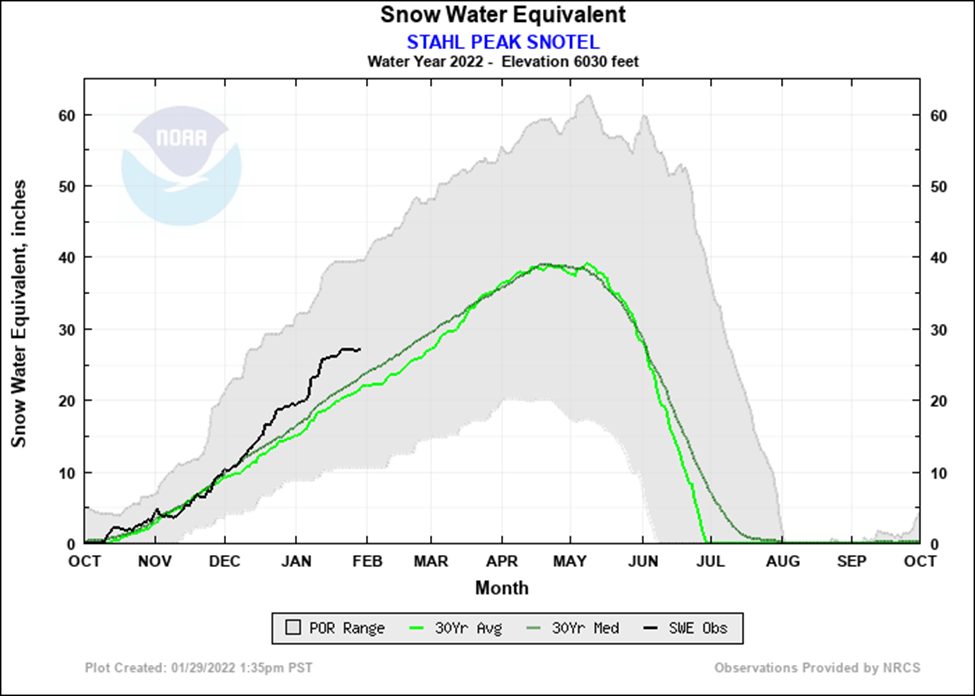
    Times have changed.  In the seventies, I would have been up and out this morning to snowmobile in to Weasel Divide, Stahl Peak, and Grave Creek snow courses, and worked the details out in the evening in a Libby motel room.  Now, I can get the data in my kitchen by clicking a link.

    So we’re going into February at 127% of average – 5 ½ inches of water more.  Something interesting happened between 2:00 pm and 3:00 pm on January 27 – the snow depth reported went from 187 inches to 75 inches, while the snow water equivalent stayed the same at 27 inches.  This is why we carried so many spare parts on the back of the old Ski-doo Alpines – one ski up front, two tracks behind, and a small pickup bed behind the seat.  Monitoring equipment needs to be monitored.

    DateTime PSTSnow Water Equivalent (inches)Snow Depth (inches)Snow Density (%)Precipitation To-Date (inches)Current Temperature (degrees F)
    01/28/2022090026.9187.01446.118.0
    01/28/2022080026.9187.01446.116.9
    01/28/2022070026.9187.01446.212.4
    01/28/2022060026.9187.01446.112.4
    01/28/2022050026.9187.01446.112.9
    01/28/2022040026.9187.01446.113.1
    01/28/2022030026.9187.01446.215.4
    01/28/2022020026.9187.01446.215.1
    01/28/2022010026.9187.01446.213.3
    01/28/2022000026.975.03646.214.5
    01/27/2022230026.9187.01446.212.7
    01/27/2022220026.975.03646.213.5
    01/27/2022210026.976.03546.213.6
    01/27/2022200026.976.03546.214.0
    01/27/2022190026.976.03546.214.2
    01/27/2022180026.976.03546.213.8
    01/27/2022170027.076.03646.214.4
    01/27/2022160027.075.03646.216.7
    01/27/2022150027.076.03646.218.1
    01/27/2022140027.0187.01446.217.6
    01/27/2022130027.0187.01446.221.4
    01/27/2022120027.0187.01446.218.1
    01/27/2022110026.9187.01446.216.9
    01/27/2022100026.9187.01446.2   

    So what’s in store?  As the chart below shows, there isn’t enough data yet for projecting seasonal precipitation reliably on the first day of February.  Still, with the normal high around 39 inches on the first of May, we need only10 more inches of water to make it, spread over the next 90 days.

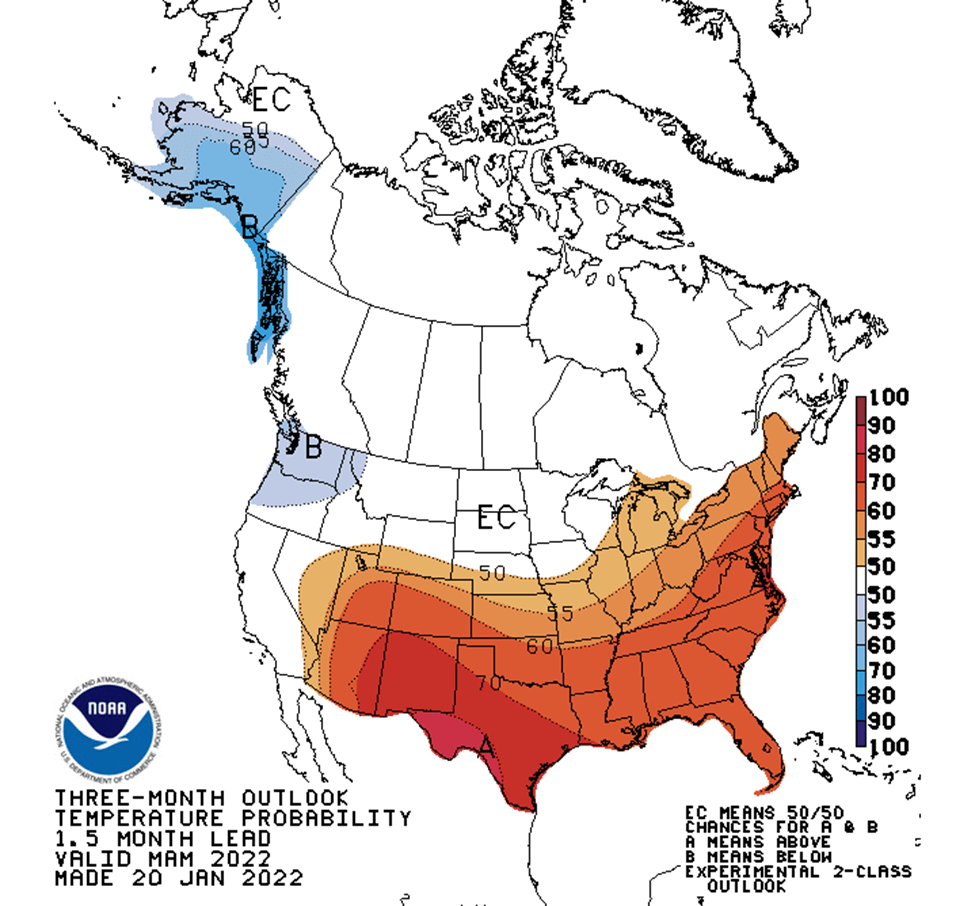
    If you want more data relative to the upcoming temperature and precipitation projections, NOAA has the official long-lead forecasts available at:  cpc.ncep.noaa.gov

    It looks like our temperatures will be a little below normal for March-April-May, leading to a bit slower snow melt.

    The precipitation probability is also above average – so things look good for the Spring.

    As I look back, it is easy to see how a career starting in snow surveys provided good experience as I moved into demography.  There really isn’t a lot of difference between projecting snow depth and human populations.

  • Firearms and Marijuana

    An illegal combination, under federal law. Regardless of the legality at the state level, marijuana is still classified at the federal level as a schedule 1 prohibited substance. This means that possessing both is a federal crime, punishable by up to $10,000 and as many as ten years in prision.

    The Montana Free Press contacted the Bureau of Alcohol,Tobacco and Firearms to confirm, learning that the Federal Gun Control Act prohibits anyone who uses a controlled substance from purchasing firearms or ammunition.

    Even if its medical? Yes. Even if it is medical, federal law still prohibits possession.

    While the possession of marijuana alone is still a federal crime, it carries only a $1000 and up to a year of jail time for the first conviction. Add a firearm to the mix, and the potential consequence is multiplied by ten.

    The state of Montana has an estimated 66% rate of gun ownership. Estimates suggest that about 20% of the adults in the state use marijuana, but those are probably low (given that using was illegal at the time of the survey, it seems very likely that people would under-report). Given these numbers, it is very probable that the two groups intersect. Federal law makes that risky.

  • The Fred Herrig Story

    The Fred Herrig Story

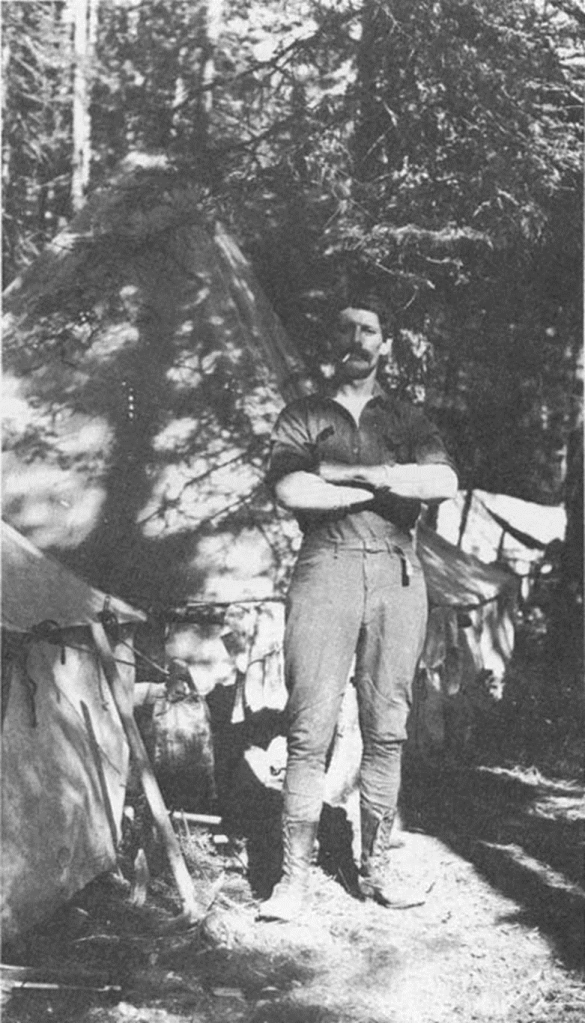
    This photo of Ant Flat’s first Forest Ranger, Fred Herrig, was taken from npshistory.com

    The book is online, and tells the early stories of the area.  The following article, from http://npshistory.com/ tells the story.

    FRED HERRIG STORY

    Fred Herrig was a rough and ready, early-day Forest Ranger. He administered the area of Ant Flats, Tally Lake, and part of the North Fork during his tenure. Herrig was from Alsace-Lorraine, was very dark, and wore a handlebar mustache.

    A veteran of service in the Spanish-American War with Roosevelt’s Rough Riders, he was the largest man in the regiment. He punched cows for Roosevelt on his ranch on the Little Missouri in North Dakota. When Roosevelt organized the Rough Riders for his Cuban campaign, Fred was packing ore in British Columbia. Roosevelt wired him from San Antonio, Texas, to come down and join them. Herrig did. In Roosevelt’s book “The Rough Riders,” Herrig is mentioned several times. He was breveted second lieutenant (a commission higher than that for which he received pay) for special services for tracking a string of mules, loaded with machine guns, that got away during a skirmish. Several full-blooded Indians gave up the job. Then Fred tracked the mules into Spanish territory and recovered the mules and the guns.

    After Roosevelt became president, he appointed Herrig as Forest Ranger with headquarters at Ant Flats. Herrig built the first Ranger Station there in 1904.

    Herrig told the story that, in 1905, he sent in a monthly diary with a lot of daily records reading, “Rained hard, stayed in camp.” When his next check was quite a bit short, Herrig saw to it that it never rained so hard again. A story which persisted over the years was that the Supervisor became perturbed at Herrig one day and relieved him of his responsibilities as Forest Ranger. When President Roosevelt learned of this, he immediately sent out orders for Fred to be reinstated.

    There is also a story that Teddy Roosevelt, on a western tour, saw Fred in the audience and motioned for him to come to the speaker’s platform. But before this big, dark, villainous-looking fellow got very far, he was collared by two plainclothesmen.

    (Some of the details regarding Fred Herrig were provided by material written by Edward G. Stahl. Stahl left the Forest Service in 1911; he died in 1957.)

  • Trego School Adopted New Salary Schedule

    Trego School Adopted New Salary Schedule

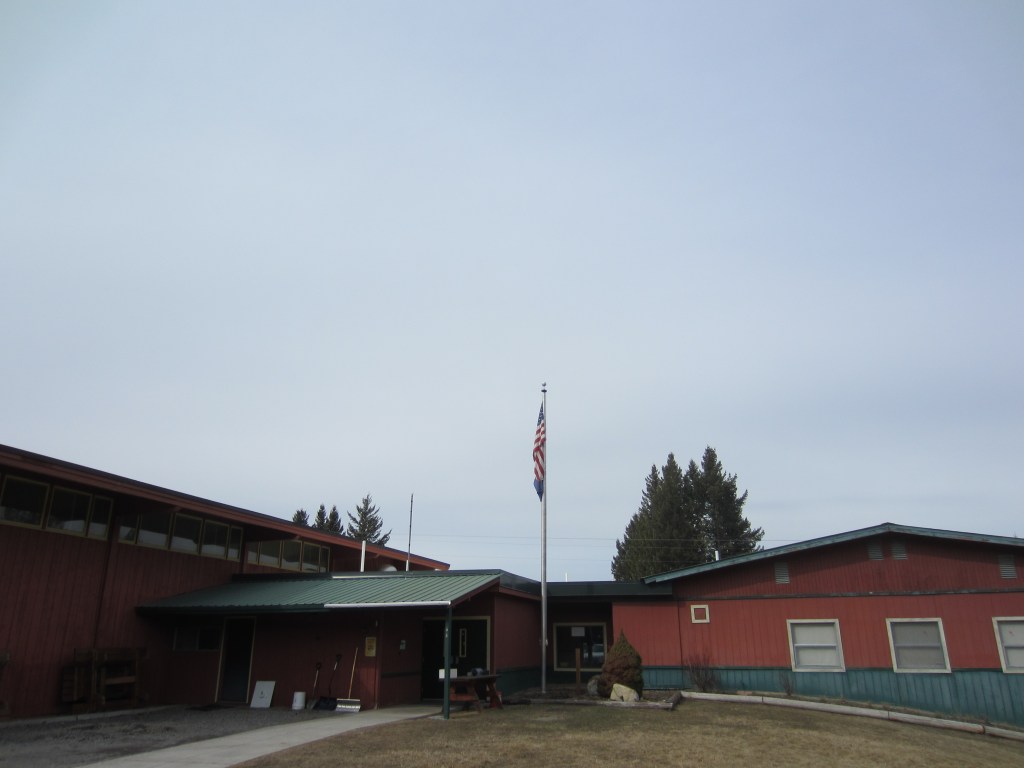
    The Trego School board adopted a new salary schedule during the meeting on Wednesday, January twelfth. The new salary schedule will be applicable starting in the fall of the upcoming school year.

    The schedule is split into three sections, by number of teaching endorsements.

    Single Endorsement
    BABA+10BA+20MAMA+10
    Experience yrs$33,920$34,598$35,290$35,996$36,716
    1$34,598$35,290$35,996$36,716$37,450
    2$35,290$35,996$36,716$37,450$38,199
    3$35,996$36,716$37,450$38,199$38,963
    4$36,716$37,450$38,199$38,963$39,743
    5$37,450$38,199$38,963$39,743$40,538
    Dual Endorsement
    BABA+10BA+20MAMA+10
    Experience yrs$37,450$38,387$39,346$40,330$41,338
    1$38,387$39,346$40,330$41,338$42,372
    2$39,346$40,330$41,338$42,372$43,431
    3$40,330$41,338$42,372$43,431$44,517
    4$41,338$42,372$43,431$44,517$45,630
    5$42,372$43,431$44,517$45,630$46,770
    Third Endorsement
    BABA+10BA+20MAMA+10
    Experience yrs$42,372$43,643$44,734$45,852$46,999
    4$43,643$44,952$46,076$47,228$48,409
    5$44,952$46,301$47,458$48,645$49,861
    6$46,301$47,690$48,882$50,104$51,357
    7$47,690$49,120$50,348$51,607$52,897
    8$49,120$50,594$51,859$53,155$54,484

    Trego’s Salary Schedule is unusual in a few ways. While most salary schedules increase with the number of years of teaching experience, few consider the number of teaching endorsements. Though some offer fixed bonuses for coaching.

    A teaching endorsement is granted by Montana’s Office of Public Instruction. These can include K-8 endorsements, which allow the teacher to teach any subject to students from kindergarten to 8th grade, as well as music and art. High school teachers are typically licensed for their specific subject areas -in my case, a Broadfield Science license allows me to teach science for grades 5-12. Special Education, Counseling, and Administrative Endorsements can also be found in public schools.

    For comparison, Eureka’s Salary Schedule can be found on their website.

    In comparison, this salary schedule has far more years of teaching experience included, and considers twenty further credits beyond a master’s degree.

    The base salary for a teacher fresh out of school, without any credits past a bachelors degree would be slightly lower in Eureka, except that the district starts new teachers at step three on the schedule. Trego’s schedule is similar, but adding endorsements (this varies in difficulty, but typically involves some coursework and passing a praxis test) provides teachers with the more significant pay increase than additional coursework does alone.