Trego's Mountain Ear

"Serving North Lincoln County"

Tag: School

  • Did I Prevent a School Shooting?

    It’s been years.  I really don’t know if I prevented a school shooting or not.  A guy walked into the school and I could see the print of his snubby – so I walked up close, smiled an engaging smile, and asked, “What are you packing there?”  His answer was “I didn’t come here to see you.”  When someone is wandering into your college with a sneaky little gun, that’s probably the most reassuring answer you can get.

    My answer was to bring him into my office, pour a cup of coffee, and reply with, “Now, tell me what’s up.”  I think he really did come in to see me – the tale was a bit unusual.  His wife, a student, had been into an amateur attempt at sex conversion therapy with another student, “a cute young gay man.”  It had worked to the extent that she was pregnant – and the guy with the sneaky little gun had gone through a vasectomy on his first marriage.  I think he mostly wanted to be able to talk to someone – so I listened, unloaded his Brazilian made revolver, stashed the cartridges, listened some more, and, after a half-hour or so, returned his revolver and sent him home with an empty cylinder.  I may have prevented a school shooting – but probably not.  I think it was just a case of an overpowering problem and a need to find an audience who took him seriously.  To this day, I don’t remember where I stashed the cartridges – but I’m willing to bet someone was really surprised to find them when I moved on.  I know I didn’t send the shells back home with his wife.

    My experience was with one man, emotionally charged, who wanted to be talked out of it, who really timed things so he could be defused.  We had no school shooting.  We had no police called.  I suspect that, even so, I’ve been closer to school violence with this one incident than most of the folks who are willing to tell us exactly what needs to be done.

    I don’t have the answers.  I developed a personal answer in 1989, when I read of the Montreal Polytechnique Massacre

    “On 6 December 1989, a man entered a mechanical engineering classroom at Montreal’s École Polytechnique armed with a semi-automatic weapon. After separating the women from the men, he opened fire on the women while screaming, “You are all feminists.” Fourteen young women were murdered, and 13 other people were wounded. The shooter then turned the gun on himself. In his suicide note, he blamed feminists for ruining his life. The note contained a list of 19 “radical feminists” who he said would have been killed had he not run out of time.” 

    My personal answer was simple enough: I will not leave my students. 

    There was always a secure feeling in a class where I had a Marine enrolled – probably a bit more than sailors or army.  That was a security that elementary and secondary teachers never will have – that if worse came to worst in the classroom, I had reliable backup.  I don’t believe that a teacher exists who hasn’t looked at the world, and already determined what he or she will do if Hell comes through the classroom door. 

    I’ve read of Sandy Hook – I have no doubt that Dawn Hochsprung and Mary Sherlach knew what they moved toward, and that their decisions were made long before Hell entered their school.  The wonderful thing is that such women lived – and that their actions and warnings protected others.  The sadness is that the only items they possessed to protect their students were their bodies.

    Perhaps I do have a small suggestion – I believe that most teachers have thought about what they will have to do if their classroom is invaded.  Perhaps if every police officer spends a bit of time thinking about how to respond, when Hell enters the classroom they might be a bit more effective.

  • Trego’s 99-Year Lease

    Trego’s 99-Year Lease

    Part of Trego School’s playground was leased to the school in 1960 in return for water.  It makes a lot more sense if we go back in time and figure out what was going on in the fifties.

    Electricity was new, and the closest telephone was at Osler Brothers sawmill, just north of Mud Creek.  The general land price at the time was $30 per acre . . . less if you weren’t looking at the more desirable downtown Trego locations.

    From the documents, it looks like the school got electricity, drilled a well, added wiring and plumbing to the school, and then thought “a bigger playground would be nice.” The neighbors to the north, Bill and Madeline Opelt thought “Water would be nice.”  So a trade was made – in return for a 99 year lease for an acre of playground – relatively flat – the school would provide water for 99 years to the Opelt family, their heirs and assigns. 

    Trego School is on a 4.64 acre (rectangular) parcel. The area the school leases (highlighted yellow) is about .9 acres. The playground is located behind the school and includes swings, a slide, monkey-bars and several large tires, painted and partially buried

    Originally, the water went to the horse trough, not the house.  Bill had three elderly work horses that he called appaloosas – while they had the spots, they were definitely draft horses, and I didn’t realize the history that they represented for years – until I took a job at Chinook, near the Bear’s Paw Battlefield, and learned of the glorious military efforts of the Montana State militia at that location.  As near as I recall the story, the militia was tasked with running off the Nez Perce horse herd . . . and once they got them moving, drove them southeast to Billings or some such location, and sent them through the auction.  The Nez Perce mares were crossed with draft stallions, and provided work horses across Montana.  Bill may not have known the whole story, but he was right – his horses were descendents of the Nez Perce Appaloosas.

    I could end the story there – Bill wasn’t interested in putting the water indoors.  He explained how he had a deep hole under his outhouse, with even deeper poles under each corner, and nobody could tip it over.  It wasn’t an argument that I would have used – but I was raised around flush toilets and kind of bigoted.  Bill later lost his vision – as I recall he took a fall after cataract surgery.  He was one of our last veterans of World War I.

    It looks to me that on January 22, 2059, much of the school’s playground will go back to the assigns of the Opelts. 

  • College and Student Debt

    College and Student Debt

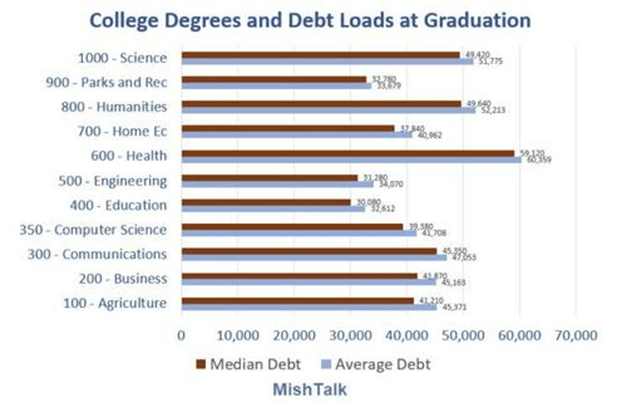
    I saw the graph below in an article on, obviously, college degrees and debt load, at ZeroHedge.

    The article is worth a look – the author points out that “a significant percentage of the 48,000 students who enroll in history programs for their undergrad studies literally believe that they eventually will become a history professor. Less than half of those who enroll in history actually graduate with that degree after 6 years. None become history professors, while about 15% become elementary school teachers. The ambitious are undeterred, and ~1900 enroll in a masters program, specializing in an arcane field of history. Roughly 80% graduate with a masters in history after 3 years. Almost none will become history professors.

    Rather than torture you by continuing with this exercise, we’ll cut to the chase. Nationwide, about 300 jobs open up each year for history professors at the university level. All will require a PhD and those who dedicated 10 to 12 years of their lives (and have $200,000 in student debt to prove it) will be the candidates for those jobs. The same dynamics apply to the other soft majors.”

    I’m pretty sure I was one of those “other soft majors.” Frankly, a crushed vertebra gave me the push I needed to get into a graduate program, and I got back into college employment before I got back into grad school . . . yet I see fewer opportunities in the academy than existed in the 90’s.  I recall one fellow explaining how easy a Ph.D. was – his research, in history, had been handed to him by an old neighbor who had, as a personal obsession, spent his spare time hunting down poems written by Abraham Lincoln.  Some folks luck into easy research, good topics and publications.

    In general, we tried to treat our grad students well – working to get them the assistantships that kept them going – qualifying them beautifully for a world that no longer exists.  Employment in the academy is now a game for administrators – and in a world full of adjunct faculty, the number of ranked and tenured faculty is dropping.  I’m pretty sure we were not doing all of our students  favors by getting them assistantships. 

    City-Journal.org offers some data on bachelor’s and graduate degrees. 

    “Between 1980 and 2017, the share of adults with at least a four-year college degree doubled, from 17 percent to 34 percent. The Great Recession intensified the trend, since people often choose to return to school to burnish their résumé when finding jobs is tough. From 2010 to 2019, the percentage of people 25 and older with a bachelor’s degree or higher increased by 6 percentage points, to 36 percent, where it sits today.

    The more surprising part of the story is that the college degree is declining in status: postgraduate degrees are now where the real action is. The coveted B.A. from all but the most elite schools has become a yawn, a Honda Civic in a Tesla world. It’s not just metaphorical to say that a master’s degree is the new bachelor’s degree: about 13 percent of people aged 25 and older have a master’s, about the same proportion that had a bachelor’s in 1960. Master’s mania began to spread through the higher-education world in the later 1990s, but it picked up steam during the Great Recession, even more than the bachelor’s did. From 2000 to 2012, the number of M.A.s granted annually jumped 63 percent; bachelor’s degrees rose only 45 percent. In 2000, higher-ed institutions granted an already-impressive 457,000 master’s degrees; by last year, the number had grown to 839,000. And while the Ph.D. remains a much rarer prize, its numbers have also been setting records. Some 45,000 new doctoral degrees were awarded in 2000, a number that, by last year, had more than doubled, to 98,000.”

    I calculated that it takes a population of 30,000 to create one job for a Ph.D. sociologist.  Years ago, I read how Imperial Japan, strapped for kamikaze pilots, sent draft notices to (among others) sociology and law students.  In a weird way, it makes sense – they had proven they were trainable, and they weren’t on solid career tracks. 

    The world needs plumbers, mechanics, machinists, electricians.  Imperial Japan was correct – it takes a rich society to have jobs for Ph.D. sociologists. 

  • Trego School Enrollment Soars

    Trego School Enrollment Soars

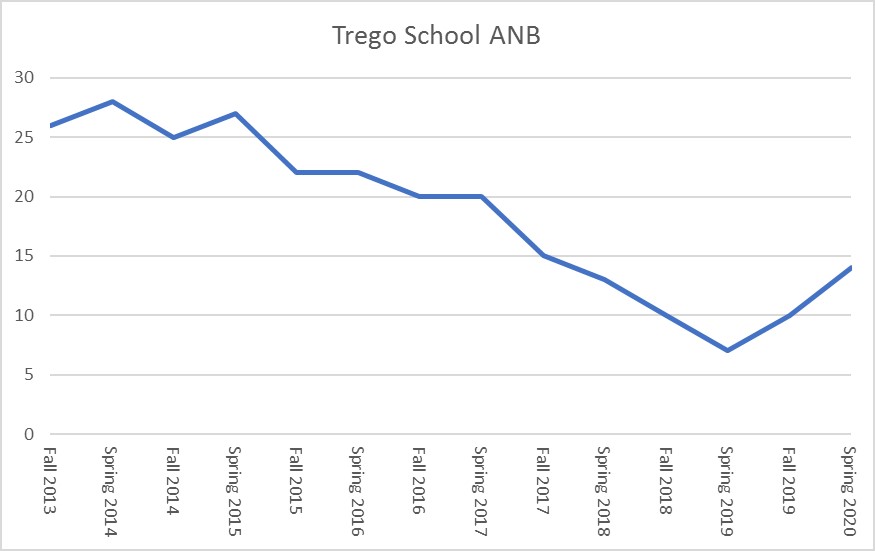
    Enrollment at Trego School continues to rise, in defiance of the historical trend. For the last few decades, school enrollment has been fairly steadily dropping. How low did enrollment actually get? The lowest official ANB (Average Number Belonging -i.e. the official state count of students) that I can find is seven, in the spring of the 2018-2019 school year. Enrollment actually continued to decline after that date, but didn’t make the official state count which is used to determine the district’s funding.

    The most recent data, using the spring and fall ANB count provided by the state looks like this:

    Time PeriodNumber of Students
    Fall 201326
    Spring 201428
    Fall 201425
    Spring 201527
    Fall 201522
    Spring 201622
    Fall 201620
    Spring 201720
    Fall 201715
    Spring 201813
    Fall 201810
    Spring 20197
    Fall 201910
    Spring 202014
    Official ANB for Trego School, data from Montana Office of Public Instruction
    In graph form the trend is somewhat clearer.

    This data for this school year (2020-2021) isn’t available from the state yet, so the best way to find out about enrollment is to call the school and ask. Back in November, we reported the exciting news that enrollment was up to 23 students and we shared the following graph which incorporated that data.

    Trego School enrollment as of November 2020

    This January, enrollment reached 26.

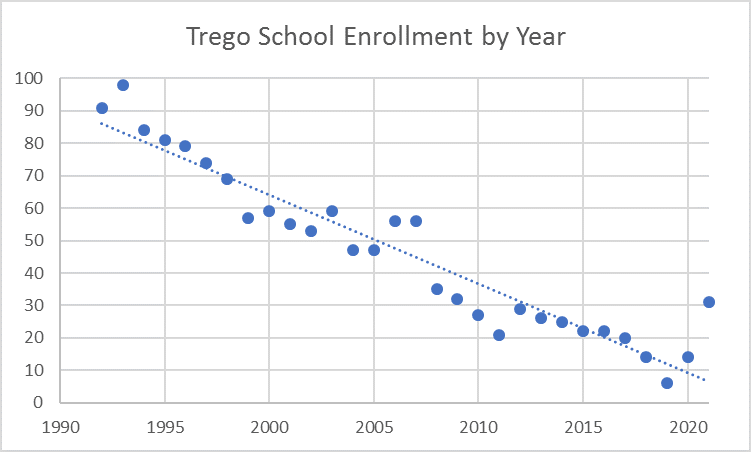
    Now, enrollment is up from January’s 26, to a total of 31 students. A 35% increase from November of 2020. This fall, Trego school optimistically began with three teachers. Now, with 31 students the average class size is slightly over 10. The school has been working to improve its enrollment, and has seen an amazing turn around. Even if we use the lowest official ANB number (which is decidedly higher than the lowest number the school reached), the school has more than quadrupled enrollment in the past two years.

    Trego School enrollment, by year, as of late February, 2021. We’re going to have to consider changing our trend-line….

    Well done, Trego School. Where will you go from here?

  • Trego School Continues Distance Learning

    Trego School has adopted something of a wait-and-see approach to determining the date they will resume in-person learning.

    In any school, the requirement that individuals that have been exposed must quarantine themselves for fourteen days can quickly make in-person learning impossible. Substitute teachers are always difficult to find, and finding one that is able to teach two weeks’ worth of classes on short notice is even more difficult. School districts with multiple staff members required to quarantine can quickly exhaust their “sub lists”.

    In a smaller school, while there are fewer staff members and students to expose one another, there is also a greater degree of interaction. While in large school districts, kindergartners are seldom exposed to 8th graders, interaction among students is almost guaranteed in smaller schools.

    It’s worth remembering, especially as favorite places are closed and much anticipated events are postponed and cancelled, that the school board is not responsible for mandating/enforcing quarantine. Rather, they have the difficult challenge of figuring out how to keep education continuing. For further information on who exactly is responsible, I’ll quote the county health department.

    You can read the full text of the County Health Department’s COVID FAQ here.

    Updates on the number of active cases of Corona Virus can be found from the county health department, and from the state. Monday’s update has a total of 67 active cases in North Lincoln County, with no current hospitalizations in the county. While the county does break the cases down by location and age, it doesn’t combine the two.. The county had 53 cases in the 0-19 range, but knowing it at the county level isn’t as good as knowing it at the school district level. The requirements of quarantine create a situation that mandates quick decisions. The available data? Never as good as we’d like it to be.

  • Trego School Annual Fishing Field Trip

    Trego School Annual Fishing Field Trip

    As the first chills of autumn hang in the air, and the salmon run, the older students of Trego School spend the day fishing with their teachers and support staff. While this year’s trip was marked by somewhat fewer salmon and smaller fish, students returned grinning and eager to show off their catch.

    Photos by Lindy Ziemke-Smith

    Field trips are a favorite for students and an opportunity to take the classroom outdoors. The salmon themselves offer a chance to talk about the way nutrients flow through ecosystems, the ecology of our streams, and of course the life cycle of the fish themselves. Of course, it’s also an opportunity for students that have never gone salmon snagging to experience it first-hand.

    When the students returned, school board chair, Ken Smith, and school cook, Joe Puryer, cleaned the fish. Cheerful students sat around them, talking about their day and asking questions about the fish.

    School Board Chair Ken Smith cleans fish and explains how to tell the difference between male and female salmon

    It was, by all accounts, a very good trip, though many of the adults came back rather sodden from wading into the water to rescue tangled fishing lines.

    Fish were carefully packaged and chilled before they were taken home.