Trego's Mountain Ear

"Serving North Lincoln County"

Author: EntomologistJed

  • Stimulus payments, not junk mail!

    Stimulus payments, not junk mail!

    Covid19 stimulus payments have begun to trickle into North Lincoln County again, and as the current PSE/Postmaster of Fortine, I feel it’s quite important to spread this information around. You see, some of these stimulus payments aren’t as official-looking as they could be.

    The above piece of suspicious-looking mail is actually a stimulus payment from the federal government, not junk mail. Covid stimulus payments were first issued as prepaid debit cards this past May. There wasn’t much coverage of the different payment method, and as a result, is it any wonder that folks all over the country accidentally threw them away?

    A couple of stimulus payments later, the same thing is happening again. Folks all across the nation have begun to accidentally throw their EIP (“Economic Impact Payment”) cards away. .

    If you received your previous stimulus payments as direct deposits, you should have received this one as a direct deposit as well. However, receiving an actual stimulus check last time does not guarantee that you’ll get a check this time.

    An example of what our EIC Card envelope looked like.
    (I’ve obscured the address, but it was right beneath the barcode.)

    The above envelope contains a prepaid debit card, though how much money that card contains may vary depending on whether or not it is a joint card for you and your spouse, etc. You’ll want to activate your card promptly and check its value on the official EIP Card website. Nowhere on the EIP Cards, or in their enclosed letters is their value stated! Your EIP card can be used similarly to a normal debit card, but it’s worth noting that there are extra fees associated with using it.0

    Fees associated with the EIP Card:
    I’m not terribly fond of these cards – there’s a number of ways your balance gets whittled down.
    Doesn’t it feel like death by a thousand cuts? The fees are as follows:

    ATM withdrawals – Domestic——$2.00 fee,
    This applies to all out-of-network ATMS, but is waived for your 1st withdrawal.
    There are no-fee ATMs, though few and far between.
    Our only one in the North Lincoln County area is at Stein’s Market in Eureka.
    Your next closest options are Libby and Whitefish.
    ATM balance inquiry—————-$0.25 fee
    This fee applies at all ATMs – both in-network and out-of-network.
    Instead of wasting those 25 cents, check your balance online for free.
    You can also check your balance by calling Customer Service: 1.800.240.8100.
    Bank/cashier withdrawal————$5.00 fee
    Like the out-of-network ATM withdrawals, this fee is waived for your first cash withdrawal, but will apply to all others.

    What if your card was thrown away, lost, or stolen?
    Call the EIP Customer Service helpline at 1.800.240.8100.
    If you manage to get through to them, (and then jump through the relevant hoops to deactivate the damaged or missing one), they’ll send you a replacement card at no extra charge.

    If you can’t get through to the IRS via their phone number (their line has been rather busy lately), consider downloading IRS Form 3911, filling it out, and submitting it via the IRS website.

    Here’s the IRS page on how to request a trace of your EIP (card or check). It also contains information on how to properly submit form 3911.

  • Chickarees, our local Pine Squirrels

    Chickarees, our local Pine Squirrels

    Two weeks past, Sandi Elster asked if I knew anything about our red squirrels. While I’ve spent some time with Pine Squirrels in other places, I’ve not had a chance to observe for an extended period of time here yet – the presence of dogs interferes with that. However, I have met them once or twice since moving to Trego, despite our little predator’s best efforts.

    In this neck of the woods, an American Red Squirrel is often called a “Chickaree” or a “Chicory”. My personal preference is for “Chickaree”, as the other spelling can also refer to a plant related to the dandelion – it makes a decent tea, and a rather sad coffee substitute, but isn’t the squirrel we seek.

    The pine squirrel most common on our place is the American Red Squirrel, Tamiasciurus hudsonicus. These are considerably smaller than the Fox Squirrels I grew up calling “red squirrels” in South Dakota. Additionally, the American Red Squirrel tends to prefer far more forested areas. Fox and Gray Squirrels (both in genus Sciurus) tend to do well for themselves in town, but Tamiasciurus pine squirrels seem to do better on the outskirts or away from towns.

    A summer picture of an American Red Squirrel from several years ago -it’s not often they pose so well.

    Pine Squirrels defend territories throughout the winter months, and when sufficiently established, they leave behind territory to their children, and children’s children.

    These territories focus on things called “middens“. These are basically large piles where squirrels have been processing pine nuts for generations. If a female is well-off enough, she may defend several middens, and may give control of some of them to her offspring, to help them get through the winter. If an American Red Squirrel doesn’t have a midden of its own by its first winter, it is unlikely to survive, so inheritances can be very important.

    Though it may come as a surprise to some, all squirrels seem to enjoy eating meat on occasion. They often visit carrion, both to feed on the flesh, as well as to gnaw on the bone (a habit more common in females – having kids makes calcium intake awfully important). While occasional and opportunistic, many squirrels hunt as well. As is the case in our voles, these small mammals agree that there are few better ways of convincing your annoying neighbors to move on than by devouring their little ones.

    John Muir had great regard for the Pine Squirrel, particularly the Douglas Squirrel, the western relative of our American Red Squirrel.

  • Winter changes voles’ moods, too.

    Winter changes voles’ moods, too.

    As the seasons wear on, and we begin another year with our movements restricted by Covid19, it’s easy to see cabin fever creeping up on folks. People who wouldn’t ordinarily have conflict, begin to. Those who started out with strife and high tempers can’t be said to have improved. This plight turns my mind to the voles, and how much better they handle winter than us humans.

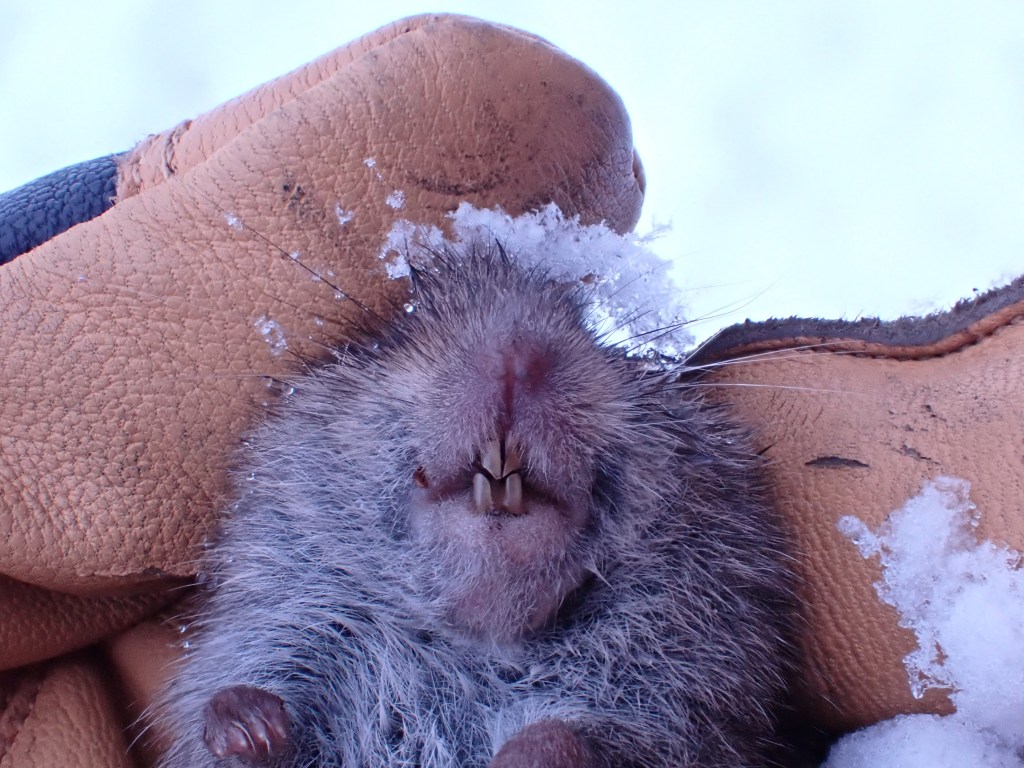
    Voles are kin of mice – not true mice, biologists will tell you, as they’re more closely related to muskrats and lemmings, but functionally they behave much like true mice. Voles can be distinguished from mice by having shorter & blunter snouts, smaller eyes and ears, shorter tails, and classically bad teeth. To me their teeth bring British films to mind – Monty Python & The Holy Grail, for example.

    This handsome gentleman made the mistake of trying to fight the little Pomeranian mouser.
    He reared up on his hind legs, squeaking menacingly… and the other Pomeranian grabbed him from behind.

    Voles, genus Microtus, are territorial little beasties. While primarily herbivorous, voles do appreciate a varied diet, and some are fierce grasshopper hunters. Like many small mammals, voles seem to believe that one should encourage annoying neighbors to live elsewhere by devouring their children (I’m rather glad most humans don’t espouse this belief). Sensible little creatures, voles will readily dine on carrion, and aren’t opposed to eating dead (or mostly dead) kin caught in traps.

    Largely solitary-living, voles are ready to fight and kill in defense of their sovereignty in summer. This is particularly true for actively reproductive females, who tolerate no other reproductive female trespassers.

    However, vole behaviors change with the seasons. Unlike you or I, voles become more sociable and tolerant of others during the cold of winter. Instead of eviscerating that annoying cousin, as their first inclination would be in the summer, when wearing winter’s brain, voles instead perceive that nuisance relatives could be of utility and might generate enough warmth to be worth keeping around.

    Voles realize that they’ll only get through the cold harshness of winter together. You see, voles don’t make burrows deep enough to avoid the frost, and thus need the warmth of others to survive. And so they build wintertime nests of dry grass, and pile within those nests, keeping warm by shared bodyheat.

    The importance of food:
    But one can not survive on warmth alone – voles need to eat throughout the winter months as well.

    To do this, they build tunnels leading away from their dry grass nests, and feed on plantstuffs wherever they can. This is the main reason why voles become pests in winter months. For such small animals, they can be quite destructive – they’re quite capable of girdling trees, if it’s what it takes for them to get food.

    While this allows foraging, voles only forage a few at a time – always leaving a number of voles behind, sleeping in the nest to keep it warm. Once those voles that are foraging have returned, it will be others’ time to seek food.

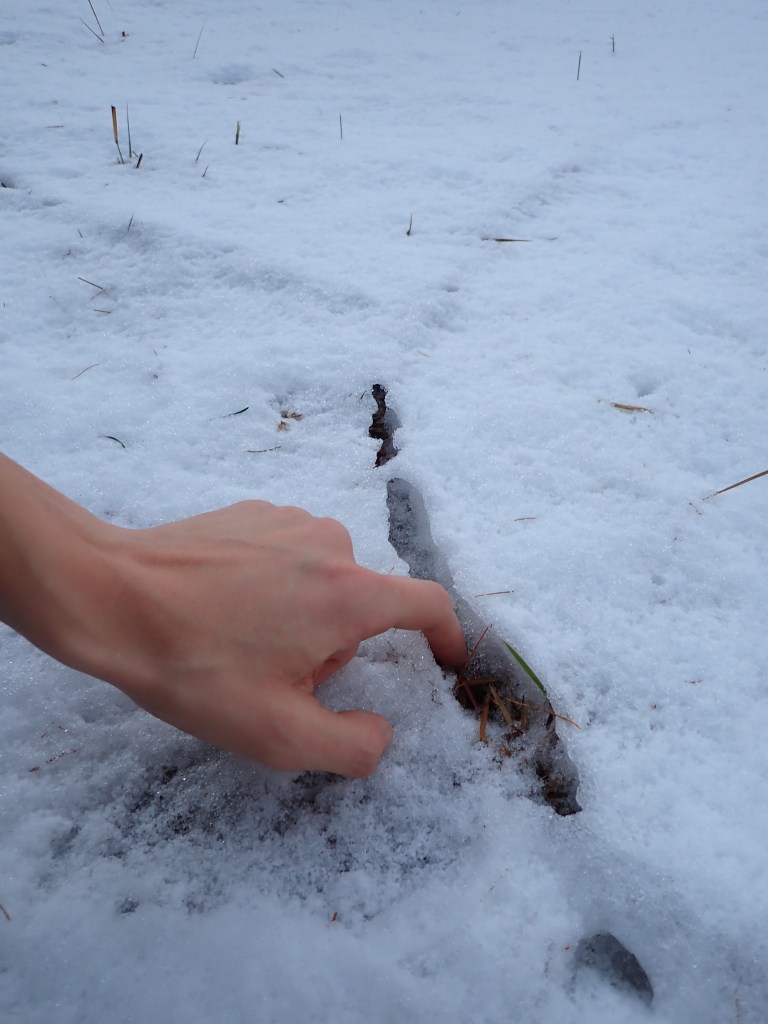
    Here’s a vole foraging runway, partly uncovered by melting snow. These paths are about 1.5 inches wide. Note that the tunnel branches like a “Y” at the top of the image.

    Vole control:
    The best means of controlling voles is by predators. Garter snakes will contribute, as will hawks, but for our geographic area, our various weasels are likely the best means of controlling voles. In the absence of good weasels, a cat or dog with aspirations of becoming a good mouser will be helpful as well – and oh, the joy if they happen to find the winter nest full of scrumptious voles.

    In the absence of total control by predators, ringing the bases of trees you want to protect (either with wire hardware cloth or with protective plastic sheathing) is a wise idea. Regardless of what you pick to protect your plants, be sure to bury it 4-6 inches deep, so that voles will be less likely to tunnel beneath it. Reducing groundcover around plants you want to protect is a good idea as well – the voles won’t place their foraging tunnels across much bare ground.

    If you’d like to take a more active approach, the thaw has been sufficient for me to find vole trails with little difficulty. Follow the trails long enough and you’ll discover their winter nests, little edifices of dry grass, about 8 inches across. Find one of the nests and you may well make a little dog’s day.

  • Hungarian Lentil Stew for a prosperous New Year

    Hungarian Lentil Stew for a prosperous New Year

    Once, when I was a small child, growing up in eastern South Dakota, my father took my siblings and me to see reindeer in the parking lot of a Lewis Drug. One of the better customer-drawing gimmicks I had seen, at that point. While there, my father overheard a tall, dark-bearded fellow conversing with his two children in a strange tongue.

    Now, my father is very fond of languages, and enjoys learning more whenever the opportunity presents itself. I’ve early memories of him carrying one of his foreign-language Bibles to Church on Sunday, reading along with the sermon, albeit in a different tongue. The Estonian Bible was his most frequent church companion, I think.

    Anyway, the language this tall, dark-bearded father was speaking was as foreign to my own father as it was to me. So my father waited for a break in the conversation, and then went over, and asked that fine-bearded fellow what language he was speaking – might it be Hungarian? It wasn’t a language he was familiar with, but it had its similarities to Finnish and Estonian.

    As it turned out, Dad had guessed the language correctly – helped, no doubt, by his fondness for Finno-Ugric tongues – borne out of his Finnish heritage. While Dad shared his love of languages with me, and I’ve extensively pursued Latin and Greek, I’ve yet to spend much time on the tongues of my northern forbears.

    We ended up becoming close friends with that family of Hungarians, and were both guests and hosts many times over the next few years, sharing many meals. Friendships we’d never have had without Dad being inquisitive about language, and eager to have new, chance acquaintances over for coffee. And, of course, the help of a couple of reindeer.

    Here’s a traditional Hungarian recipe from the mother of that family.
    Something to eat on New Year’s Eve to bring fortune to you and yours throughout the next year.

    Lentil Stew:
    3 cups Lentils (for prosperity – see how the lentils look like little coins?)
    2 Tbsp Yellow Mustard
    Paprika powder
    1 medium Red Onion, quartered.
    1 small lemon, halved.
    5 bay leaves
    Garlic (either a generous sprinkling of powder or about 2 chopped cloves)
    Salt and Black Pepper to taste.
    A little smoked meat (if memory serves, smoked turkey was used the first time I had this, though lean pork is most traditional, especially cold smoked shortrib – Pork is supposed to bring good luck)

    Cook this assemblage in water until lentils are done – I like it to have the consistency of a porridge.
    Remove the onion, bay leaves, and lemon before serving with the following sauce.

    Paprika Sauce:
    Place 1-2 Tbsp flour in 2-3 Tbsp of hot oil, whisking until homogeneous.
    Add red paprika powder generously, letting it bloom in the hot oil.
    Mix with 1/2 cup sour cream and some milk, until desired consistency is reached.
    The sauce should be smooth and a bright orange in color.

    I suspect that this was how the mother of our Hungarian friends substituted for Hungarian Paprika Paste, being unable to get it in the American Midwest. She later brought us some Univer Red Gold paste as a gift, after a visit back to Hungary. What a treasure that was!

    The completed Lentil Stew with Paprika Sauce!
    May your New Year be filled with flavor.

  • Thoughts on Invertebrate Houseguests

    Thoughts on Invertebrate Houseguests

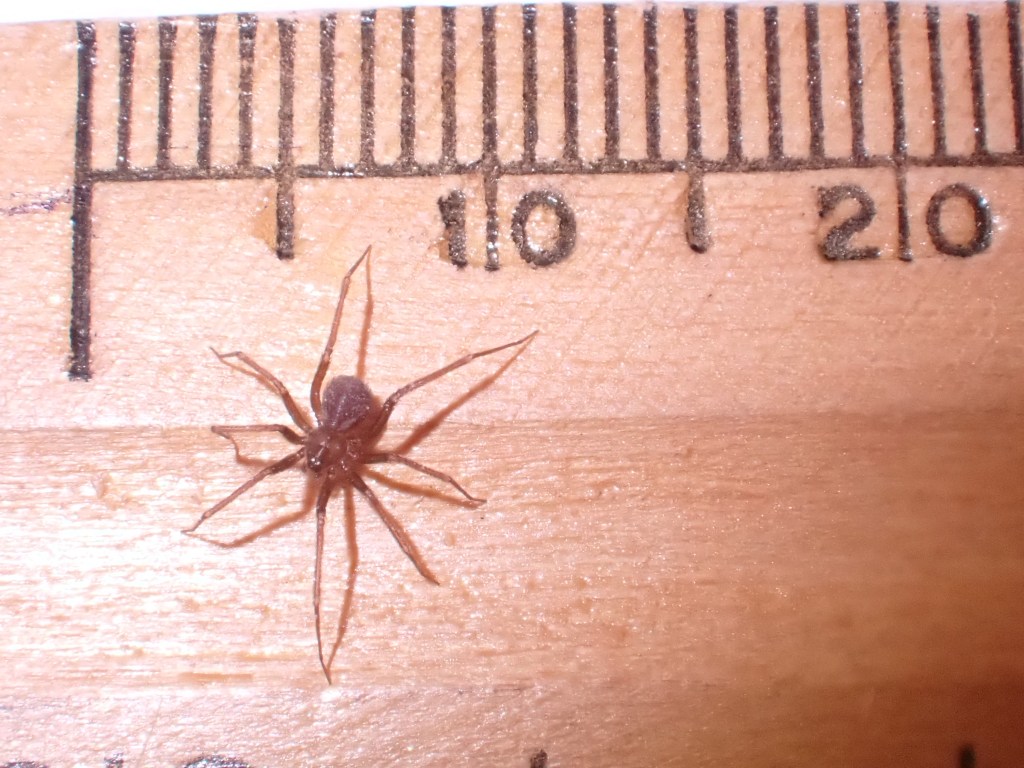
    Just last night, my wife asked me to identify a spider that was perched on the wall of our shower. A small thing, its body was only about 3 millimeters long, or about 1/10 an inch. It was an immature spider, and I didn’t manage to get a good look at the layout of its eyes, so I was unable to identify it as well as I’d like. (Many identification resources tend to be more helpful for identifying adult bugs than immature bugs).

    While I myself couldn’t identify it to genus level, I shared the observation to iNaturalist, in hopes that somebody with more expertise in spiders would be able to get a closer identification. Regardless of what it is, the chances of its bite and venom being of medical importance are just about nill. The only spider of real medical importance we have here in Montana is the Western Black Widow.

    From just in front of the eyes to the tip of the abdomen, about 3 mm.
    Sadly, I could only make out the two central eyes, and I’d need to see the others to identify her.

    Insects and their kin have been living alongside humans for a very long time – it’s thought that some of our current house-dwelling insects started out as cave dwellers, also living alongside our human forbears. Some early cave art even features cave crickets, as in the Cave of the Three Brothers in southwestern France.

    An ongoing project on iNaturalist, “Never Home Alone”, attempts to learn more about our long-term arthropod houseguests. Thus far, this project has led to the discovery of a number of new species – organisms whose behavior “in the wild” is entirely unknown. They’ve only ever been observed and collected from human dwellings.

    The scientific paper that this project arose from found that upwards of 100 species of insects could be found in just about every home they surveyed. Defying the stereotype, folks with larger homes in better parts of town had more species of insects, not fewer! Regardless of homeowner’s income, the vast majority of the insect houseguests discovered were non-pest species, and some hadn’t been observed in the region before.

    If an entomologist finds that your home is full of bugs, you shouldn’t feel too bad – chances are good that your neighbors’ homes have similar numbers of insects. They’re mostly harmless, and some are even beneficial…. Case in point, at closing time, the spider from the shower had been identified as a harmless variety of cellar spider, Pholcophora americana, who had likely been feeding on moth flies from our drains.

    At present, the cellar spider has been relocated to the holly to join our Christmas Spiders.

  • The Christmas Spider, an Eastern European Legend

    The Christmas Spider, an Eastern European Legend

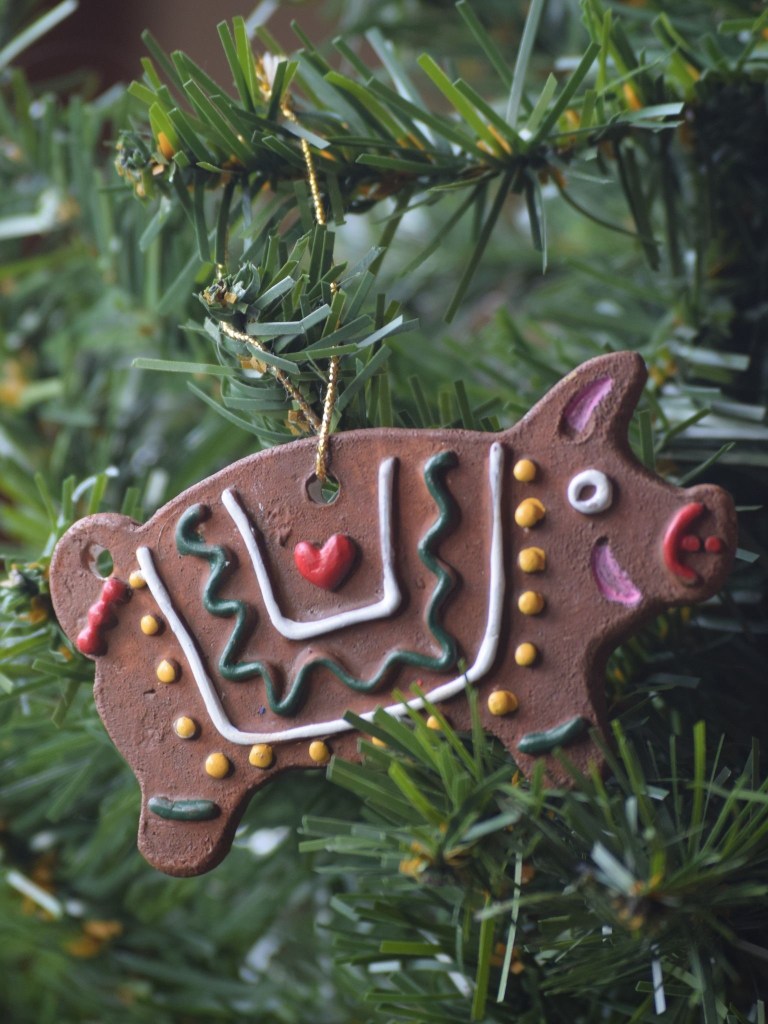
    Many cultures have their own unique Christmas ornaments… When I was little, my folks had a straw goat ornament from Finland, a “Joulupukki“, or “Yule Goat”, a representation of the harvest season’s spirit – something that made an appearance when folks celebrated the return of the light. They also had a clay Christmas Pig ornament from Germany as well – representing the feast that poorer folks would make, slaughtering their one pig for the midwinter festivities.

    Yule Goat

    Both goats and pigs feature in winter solstice holiday traditions all the way back to pagan times. However, the Christmas Spider, a decoration and legend more common in Eastern Europe, has a relatively recent origin.

    Christmas Pig

    There are a number of tales explaining why spiders deserve a place on our Christmas trees, but here are two of my favorites.

    As we’ve all heard tell, Jesus was born in the town of Bethlehem, perhaps in a cave. Shortly thereafter, Mary & Joseph fled to Africa with the Christchild, to escape the soldiers of King Herod. In their flight, it is rumored that they hid in caves to avoid the pursuing soldiers. In one case, the soldiers are said to have been close on their heels… and the holy family was saved by spiders, who swiftly covered the entrance of their cave with webs. When the soldier sent to scout their cave saw the webs, he decided that nothing had been in that particular cave recently, there was no need to waste time checking it. In recognition of those ancient Israeli spiders’ good deed, some people place spider ornaments on their Christmas trees… and the tale has even made its way to the pages of a children’s book.

    Sometime thereafter, in the not-so-distant past, somewhere in the Ukraine, a family was preparing for the winter holidays. They cleaned the house in preparation for decorating it. Of course, being thoughtful people (and not wanting bad luck) they made sure to not harm spiders when they removed their webs. Once that was taken care of, they put their decorations up, and took a well-deserved rest.

    Once all the humans had all gone to sleep, the spiders scurried out from their hiding places. Or perhaps, just perhaps, the spider egg sacs brought in on the tree hatched in the warm house. Regardless of how the spiders got there, they began to investigate the tree.

    The spiders marveled at its decorations – so different from the trees outside! In an attempt to contribute, the spiders coated it in their webs… Unfortunately, many humans don’t think spiderwebs make good decorations. Later on in the night “Дід Мороз” – Father Frost appeared (or Father Christmas, Saint Nicholas, or the Christ Child… there are many variant tales). Regardless of who the holiday wonderworker was, he saw what the spiders had done, and turned all their webs into skeins of silver and gold! And thus the very first tinsel was created. Born of spiders’ desire to contribute to the winter celebration.

    Here are some instructions if you’d like to make a Christmas Spider of beads and wire for your own family’s tree, after the Ukrainian tradition. As for me, my Christmas spiders, my pavuchky” – little spiders, are origami, folded from bright foil, and hidden among the branches.

    One of this year’s origami Christmas Spiders.