Trego's Mountain Ear

"Serving North Lincoln County"

Category: A Science for Everyone

  • A Covid Risk Calculator

    Johns Hopkins has a covid mortality risk calculator that is both interactive and online: https://covid19risktools.com:8443/riskcalculator 

    Remember, I like statistics and correlations, and covid has provided a bit of an enigma since the data came out from the Diamond Princess outbreak last year.  This calculator takes in age, health and location and coughs up your probability of dying from covid.

    My own numbers were reassuring – I answered the questions . . . age 71, height, weight, history of asthma, cancer and diabetes, and the model churned out that I was 1.1 times as likely to die of covid as the model’s norm.  Essentially I was at a normal risk.  The analysis was:

    “Based on the information you have provided, the tool estimates that you have 1.1 (95% CI: 0.95 – 1.3 ) times the risk of dying from COVID-19 compared to the average risk for the US population.

    Based on the estimated risk, you are categorized to be at Closer to or lower than average risk based on the following chart:

    Further, based on the information available from pandemic projections in your state of residence, the tool estimates an absolute rate of mortality of 0.6 (95% CI: 0.3 – 1.3 ) per 100000 individuals in subgroups of the population with a similar risk profile to yours during the period of 05/15/2021 – 06/04/2021. This estimate is calculated based on the CDC’s Ensemble mortality forecast data.

    *95% CI: Error bounds with 95% confidence.”

    It’s a model – and only as good as the data that went into its development.  That said, Johns Hopkins has a pretty good reputation, and I would guess they will continue to refine the model.  Scientific method and statistical analysis do not allow perfect data for the individual.  That said, I like having a model that I can use.  Give it a try with your own data.

  • Lilacs Blooming? Time to plant Beans (among other things)

    Lilacs Blooming? Time to plant Beans (among other things)

    I’ve noticed the lilacs beginning to bloom in Eureka, and remembered that the blooming time of lilacs corresponds to the planting time for some crops. They are an “indicator” species, as it were.

    The study of when plants bloom and other seasonal events (such as migration) is phenology. It can be used by observant gardeners to determine when to plant, even across different regions. Lilacs bloom at the same number of growing days, even when they do so at different dates.

    Beans, cucumbers, and squash should be safe to plant when the lilacs are in full bloom.

    The timing of lilac blooming (and leafing) was studied in-depth by a professor at MSU. We wrote about him last year.

    Montana’s Greatest Climatologist

    My one class in climate studies was about 40 years ago at Montana State University.  The professor was Joe Caprio . . . yeah, “The Father of Scientific Phenology.”  It’s interesting how many state climatologists make their starts as meteorologists.  Anyway, I was back in school, getting enough credits in ag engineering to qualify as a professional with SCS, and when I took his class on climate, and when he learned of my experience in snow surveys, it became Mike and Joe – a very honored Mike that was told “Call me Joe.” Dr. Caprio’s specialization and research was climate…

    Keep reading
  • Using Science

    Using Science

    I noticed a Dilbert cartoon that seemed to epitomize a lot of the comments I’ve seen on Facebook.

    The challenge is that there are a lot of folks who believe in science, or at least think they do.  The thing is, science is a method of understanding parts of the world, or universe, around us.  We call it scientific method – and skepticism even toward your own results is an important part.  I too am skeptical of the chipmunk understanding what he heard.

    Part of my job description included the expectation of “using science-based information.”  There’s a difference between “science-based” and “evidence-based.”  Court verdicts are based on evidence – and decisions often made based on a jury of reasonable men and women.  Science doesn’t require consensus, agreement, or a majority vote.  It requires formulation and testing of a hypothesis – and if the hypothesis doesn’t meet the test, it is discarded or modified.  If it does meet the test, the hypothesis is tentatively accepted . . . until a better explanation comes along.

    Sometimes it’s difficult for scientists to use scientific method in their daily lives – we all have this thing called confirmation bias.  In a meeting on hiring, someone mentioned the high cost of getting a computer background check through the police.  My comment was “Well, we might just require a South Dakota concealed carry permit – that gets the check completed, and only costs $10.”  The reply, from the department head (full professor and  Ph.D) was direct: “I can’t believe that.”  It was the week after my daughter’s 18th birthday – and I had just bought the permit as part of the birthday gifts.  My fact was solid – but there was no space for it in her reality.

  • Now That’s Inflation

    Now That’s Inflation

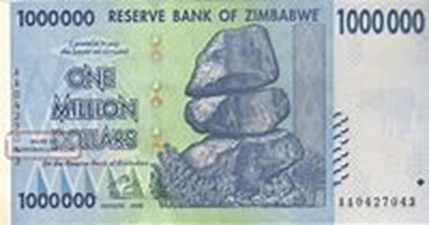
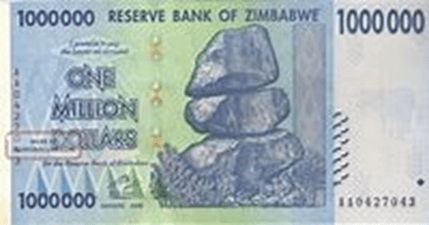
    A bit less than 10 years ago, my department head, Donna Hess, retired.  As a gag gift, I bought a million dollar Zimbabwe note – everyone should retire as a millionaire.  It cost me a little less than 8 dollars US on ebay.  The note, and the sentiment, circulated around at retirement events throughout the year.

    Today, I noticed that Zimbabwe currency is still on the ebay market, with even more zeros added.   This time it’s ten hundred trillion dollar bills for $4.40 US.  I think part of the reason I’m writing this is just to have an example that lets me count how many zeros there are in a trillion. 

    Still, ten bills represent a thousand trillion dollars.  We know that the guy who is selling a thousand trillion dollars Zim for $4.40 US is making a profit – just like the guy who sold me the million dollar note for $8.00 US.

    In Zimbabwe, they have added eight zeros to the currency in ten years – and it only buys 1/20th as much when you measure it in yankee dollars.  Now that’s inflation.


  • Electronic Visit to the Snow Course

    Electronic Visit to the Snow Course

    It still amazes me that I can turn on the computer and, in 15 minutes, get the data that used to take a week’s work to obtain.  Of course it also amazes me that my work is so far in the past that it no longer shows up in the 30-year averages.  Still, some of that data – starting with my first run in the mid-seventies are still available:

    As I look at the little squares on the left, I do see that Jay and I did measure the lowest year on this chart, back in 1977.

    My closest snow courses are Stahl Peak and Grave Creek. Stahl is listed at 27.7 inches and 75% of average – but still significantly better than the 20-inches of water back in my youth.

    Grave Creek is listed at 3.8 inches and 60% of average. 

    Banfield Mountain shows 9.9 inches – 66% of average.  The chart shows that this is fairly close to the record low measurements.

    Hawkins Lake, in the northwest corner of the county, shows 20.9 inches and 81% of the 30 year average.  The historic peaks chart shows that I measured the record low in 1977, and the snowpack is still above that.

  • IQ Testing Government Officials

    Donald Trump described himself as a “stable genius.”  Joe Biden challenged another old man to an IQ test competition.  These are things that never happened with George Bush, and I scoured the internet for reliable IQ numbers on politicians.  I learned that a US government official IQ tested a group of German military and political leaders.  So near as I can tell, the only data available on the intelligence of government officials came from the Nuremberg trials after World War II.  An American psychologist, Gustave Gilbert tested the 21 former Nazi officials with an early Wechsler IQ test, with the following results:

    Position HeldIQ
    Schacht, HjalmarMinister of Economics143
    Seyss-Inquart, Arthur Reichkommisar of Netherlands141
    Dönitz, KarlAdmiral138
    Göring, HermannChancellor138
    Papen, Franz vonChancellor134
    Raeder, ErichGrand Admiral134
    Frank, HansGovernor of Poland130
    Fritzsche, HansDirector of Propaganda130
    Schirach, Baldur vonHitler Youth Leader130
    Keitel, WilhelmField Marshall129
    Ribbentrop, Joachim vonMinister of Foreign Affairs129
    Speer, AlbertMinister of Armaments128
    Rosenberg, AlfredMinister of Occupied Territories 127
    Jodl, AlfredColonel General127
    Neurath, Konstantin vonMinister Foreign Affairs125
    Frick, WilhelmMinister of Interior124
    Funk, WaltherEconomics Minister124
    Hess, RudolfDeputy Fuhrer (until 1941)120
    Sauckel, FritzHead Labor Deployment118
    Kaltenbrunner, ErnstSS, Head of Security113
    Streicher, JuliusNewspaper Publisher106

    All were above average – most, excepting the publisher of the party newspaper and the head of security (Streicher and Kaltenbrunner) above the “normal range” of intelligence.  The only thing I can generalize from the sample is that you don’t have to be dumb to be a nazi, and that isn’t a conclusion I like.

    There’s a chart at IQ Comparison that shows the probability of each score.  For example, Julius Streicher, with an IQ of 106, almost made it into the top third of the population.  Kaltenbrunner, at 113, scored in the top fifth.  Hermann Goring, at 138, was statistically the sharpest knife in a drawer with 177 others.  Hjalmar Schacht, with an IQ of 143 was one out of 278 . . . and he was acquitted of all charges at Nuremberg. 

    There is a clickbait series on US presidential IQ scores – complete to two decimal points, and it looks unreliable to me – so this seems to be the best available data.  I suspect we could develop some pretty good estimates on recent presidents, if we had their ASVAB or college placement scores – but most of our presidents preceded IQ tests.  In 1916, Terman set the minimum standard for genius at 140 . . . so Trump may well have scored above that – basically, the probability in the general population is 1 in 261.  Biden probably did have a better than 50-50 chance of beating a random 83-year-old in an IQ test.  I’ve seen Einstein listed at 160 – a one in 31,560 probability.

    In a nation of 330 million, we have about as many smart people as dumb ones – and, if we extrapolate from the Nurenberg IQ tests, we have some equally bright people in politics, and bright politicians can do some really dumb things.