Trego's Mountain Ear

"Serving North Lincoln County"

Tag: Ask The Entomologist

  • Your Annual Reminder: The time to start trapping wasps is now.

    While winter isn’t quite done with us yet, we’ve had a good period of warmth recently. Wasps, as well as bears, are waking from their winter hibernation. I’ve seen a few queen paper wasps scouting for new nesting sites.

    With this in mind, if you want to control wasps in or around your property, the time to start is now. If you can catch and kill the wasp version of a queen, you’ll stop her whole colony from bothering you the rest of the summer.

    (A wasp queen is called a “gyne”, which means “woman” in ancient Greek. Gynes are quite large – perhaps twice the size of a standard wasp. Gynes are the wasps most likely to not die in hibernation.)

    While most paper wasps will try to hibernate through the winter (the reason we see them moving indoors in fall), most are unsuccessful. Most wasp queens have to start anew in spring, building their new colonies (and sometimes their nests) from scratch.

    Raising kids can be hard work, as any parent can tell you. It’s no different for wasps. As gynes start building their new nest, and laying their first eggs of the season, they spend most of their time looking for food for their young.

    (A gyne’s first eight or so children are called “haplogynes” meaning “half-women” – these are about half as large again as a standard wasp. These haplogynes take over caring for their little siblings, leaving the gyne free to lay more eggs and expand the nest.)

    Developing wasp larvae, just like developing human children, need diets rich in protein to grow and build muscle tissue. As such, a gyne caring for her first batch of larvae will spend much of her time looking for meat to feed them with. Later in the year, wasp larvae will often be fed caterpillars. But early on, carrion forms much of the available meat.

    If you want to control your wasp problem before it starts, consider setting a wasp trap and baiting it with a bit of leftover meat and letting it spoil. If you manage to catch and kill a gyne, or her crew of haplogynes, you’ll have won a war before giving it a chance to start.

    (Bear in mind, we do live in an area with bears, who are also beginning to leave hibernation. Be bear aware, and cautious in your use of meat to bait wasp traps.)

  • In Case You Missed It

    In Case You Missed It

    This time last year, we were writing about the Health Hazards of Loneliness (many!), Irish Democracy (not exclusively Irish), trying recipes: Frybread (good) & Dried Corn Soup (we’re doubtful), and learning about the insects we see at this time of year, both indoors and outdoors (Crane Flies).

    How unhealthy is loneliness?

    Are isolation and loneliness actually bad for our health? Do they increase the risk of dying?

    Irish Democracy

    I started looking for a definition of “Irish Democracy.”  Found all sorts of descriptions of government in the Republic of Ireland – but nothing that described the unorganized ignoring of laws that lack popular support.  The term “Irish democracy” refers to uncoordinated, wide-spread civil disobedience.  An example is a sign in the window requiring face masks by order of Governor Bullock – and once you’re inside, you’re the only one masked. I started into a store, pulling my mask on.  The guy in a Stetson alongside me was humming “Desperados waiting for a train.”  I haven’t…

    Fry Bread

    South Dakota’s official state bread is Fry Bread – Probably the best I ever tasted was with wojapi when I visited the Lower Brule Reservation.  I was fortunate to meet, and get to know, Mike Jandreau, who was Tribal President.  His first question was, “What do you know about tribal sovereignty.”  I could answer competently because I had traveled with Joel Clarenbeau as he studied the topic.  The Lower Brule Reservation was settled under the leadership of Chief Solomon Iron Nation (1815-1894), a man who accomplished a great deal for his people.  I don’t have the…

    Dried Corn Soup

    Once, when I visited the Lower Brule, I was served soup made from dry field corn.  There was no large explanation, just the opportunity for the wasichu to recognize how tough the times were in the first days of the reservations and the last days of the buffalo.  While it’s not five-star cuisine, the recipe probably has a place with anyone who stashes a couple bushels of dried corn in the emergency rations stash. 1 lb. lean boned beef, cut in cubes1 tbsp. bacon drippings4 c. water1 c. dried corn1/2 tsp. salt Brown meat.  Add water;…

    Winter Crane Flies: widespread and little-known

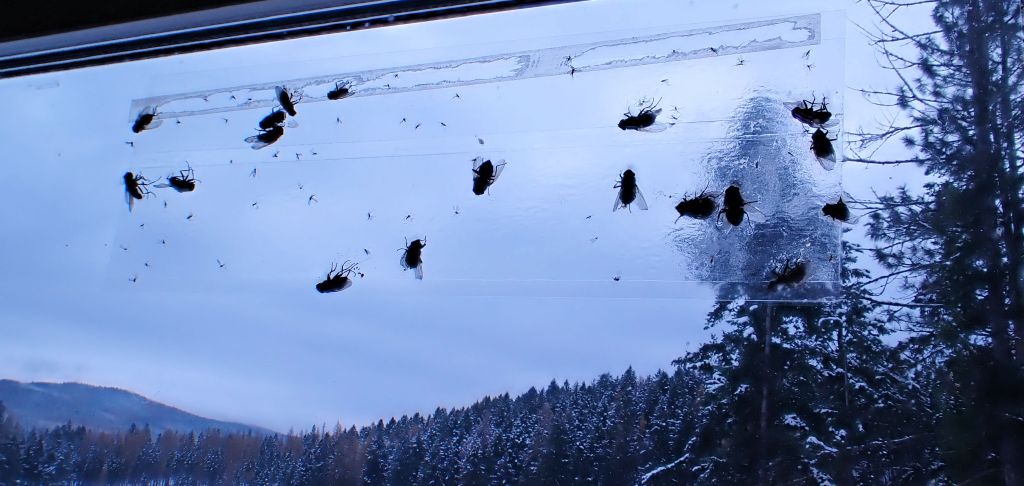
    As I was walking over to my in-law’s place one chill and sunny afternoon, I happened to spot a fly. A gangly, long-legged fly, seeming to bounce up and down in the brisk winter air. Unlike the cluster flies lining the edges of our ceilings, this one was fairly active, despite the temperature.

  • Why all the indoor flies?

    Why all the indoor flies?

    As it turns out, the inside flies of this time of the year aren’t the same as the flies of summer. Winter’s flies are looking for a nice, warm place to spend the winter- and our homes tend to be very appealing.

    Why are there flies in my house? There’s snow outside!

    If your home is anything like ours, it has had an abundance of flies lately. You may ask yourselves “why now?” – after all, it’s snowy out, and there can’t be much food for them. Shouldn’t they die with the cold like everything else? You’d be entirely right in thinking so. Regardless of the type of fly, most of the good food sources are rather scarce this time of year, and the cold kills many. However, insects are just as uninterested in freezing to death as we are. Most of these gathered indoor flies are trying to avoid that particular…

    This year, despite the growing cold, we’ve had far fewer flies in our windows. Unfortunately, it isn’t a miraculous new fly swatter -it isn’t even one of those gizmos that let you shoot them with salt. While I’m not sure how the kittens are going to be for catching mice, they are certainly hell on flies.

  • Cicadas – not just Brood X!

    Cicadas – not just Brood X!

    Chances are you’ve seen internet articles about the mass cicada emergences that’ll be happening across the eastern United States this year. Here’s a decent writeup from the National Park Service.

    Periodical cicadas are named for the long stretches of time between their emergences (13 or 17 years, depending on the lineage). The thought is that this makes them an unreliable source of food for predators – it’s hard to be a specialist wasp if your food species vanishes and is unaccessible below ground for over a decade at a time.

    And, when you emerge, surrounded by thousands of others like you, it’s statistically unlikely that you’ll be the one who gets eaten – be it by bird, dog, or unattended small child. Though many of your kin will be devoured, you’ll probably be safe. It’s the same tactic the now-extinct Passenger Pigeon used. Passenger Pigeons built undefended nests on the ground, and relied on numbers to make any individuals odds of survival better. A tactic that worked excellently until it didn’t.

    Here we have a little member of genus Okanagana, the whip cicadas.
    Fittingly for this area, they’re named after one of Canada’s First Nations which spoke a Salish tongue.

    While we don’t have periodical cicadas (genus Magicicada) this far west, we do have other types of cicadas, especially genus Okanagana. I’ve been hearing their males sing in the trees on my drive back from work over the past couple of weeks. One way cicadas avoid predators is by being active in the sweltering heat when nothing wants to hunt. Cicadas cope with the heat by drinking tree sap nearly constantly, and releasing excess moisture through pores in their thoraxes, much like how we humans sweat to cool down.

    Our cicadas here have life cycles maxing out in the 3-year range. As such, these species can be pretty reliable hosts for certain predators, like the cicada killer wasp… but our cicadas lead a charmed life. The Western Cicada Killer Wasp only goes as far east as Idaho, and the Eastern Cicada Killer Wasp only really goes as far west as the Dakotas.

    Our local cicadas are convinced that this truly is God’s country.

    An Okanagana cicada I met last fall – note that this one has brighter orange markings.
  • The time to start trapping wasps is now.

    While winter isn’t quite done with us yet, we’ve had a good period of warmth recently. Wasps, as well as bears, are waking from their winter hibernation. I’ve seen a few queen paper wasps scouting for new nesting sites.

    With this in mind, if you want to control wasps in or around your property, the time to start is now. If you can catch and kill the wasp version of a queen, you’ll stop her whole colony from bothering you the rest of the summer.

    (A wasp queen is called a “gyne”, which means “woman” in ancient Greek. Gynes are quite large – perhaps twice the size of a standard wasp. Gynes are the wasps most likely to not die in hibernation.)

    While most paper wasps will try to hibernate through the winter (the reason we see them moving indoors in fall), most are unsuccessful. Most wasp queens have to start anew in spring, building their new colonies (and sometimes their nests) from scratch.

    Raising kids can be hard work, as any parent can tell you. It’s no different for wasps. As gynes start building their new nest, and laying their first eggs of the season, they spend most of their time looking for food for their young.

    (A gyne’s first eight or so children are called “haplogynes” meaning “half-women” – these are about half as large again as a standard wasp. These haplogynes take over caring for their little siblings, leaving the gyne free to lay more eggs and expand the nest.)

    Developing wasp larvae, just like developing human children, need diets rich in protein to grow and build muscle tissue. As such, a gyne caring for her first batch of larvae will spend much of her time looking for meat to feed them with. Later in the year, wasp larvae will often be fed caterpillars. But early on, carrion forms much of the available meat.

    If you want to control your wasp problem before it starts, consider setting a wasp trap and baiting it with a bit of leftover meat and letting it spoil. If you manage to catch and kill a gyne, or her crew of haplogynes, you’ll have won a war before giving it a chance to start.

    (Bear in mind, we do live in an area with bears, who are also beginning to leave hibernation. Be bear aware, and cautious in your use of meat to bait wasp traps.)

  • Winter Crane Flies: widespread and little-known

    Winter Crane Flies: widespread and little-known

    As I was walking over to my in-law’s place one chill and sunny afternoon, I happened to spot a fly. A gangly, long-legged fly, seeming to bounce up and down in the brisk winter air. Unlike the cluster flies lining the edges of our ceilings, this one was fairly active, despite the temperature.

    Naturally, I snatched it out of the air for a better look.

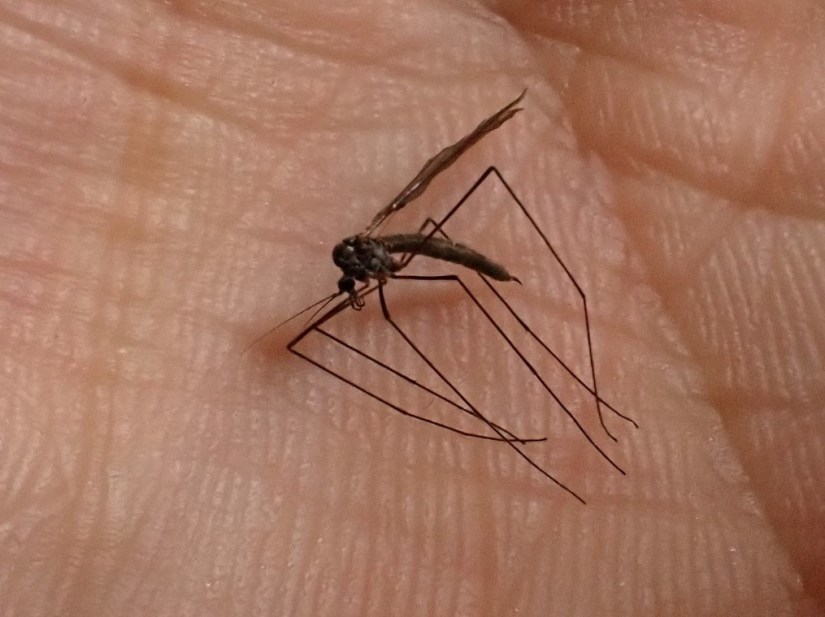
    It wasn’t just any fly – at first glance it appeared to be a crane fly… but parts of it weren’t quite right. It had simple eyes in the center of its forehead, something absent in true crane flies. Nor was it quite the right size – it’s perhaps 1.5 to 2 times the size of an average mosquito, whereas crane flies can be far larger, and with a broader leg-span. It was a winter crane fly.

    If you look closely, you’ll find that the winter crane fly, like its true crane fly relatives,
    does not have stabbing mosquito-like mouthparts.

    While not true crane flies, winter crane flies are close relatives, and both develop in similar areas and eat similar foods. Wet spots on land, perhaps along a stream or seep, are perfect for a growing winter crane fly maggot. True crane fly maggots (often called “leatherjacket slugs”) prefer to swim in the stream itself, and can make excellent fishing bait. Both types of maggot like places that have plenty of moist decaying plantstuff to feed on.

    Interestingly, winter crane flies have been documented gathering in large numbers underground… both here and in the Old World. I observed this in a number of western Kentucky stream caves while I was studying a group of eyeless cave beetles, but little has been written on the behavior in this organism. I wonder if it could be similar to how mosquitoes overwinter in caves…

    To my surprise, Winter Crane Flies have become invasive in Antarctica in the past decade… it’s thought that they started out by colonizing the polar scientists’ sewage treatment plant, and escaped to the outside. Impressive for a wee beastie that is only active for a couple of months out of the year here. Of course, the Winter Crane Flies invading Antarctica have much less competition than those around here!

    What is a pest in one place may be entirely harmless in another.