It’s the week before Christmas. Fifty years ago, I was on a Ski-doo Alpine, making the January Run. It was a partial run – mostly for the purpose of rewinding the clockwork recorders that measured the height of the antifreeze solution as deeper snows compressed the snow pillows (a snow pillow is a rubber bladder, filled with antifreeze – I measured a lot of them, but rarely saw one).
It’s a different world now – instead of pushing twin tracked snowmobiles up Grave Creek to sample Weasel Divide, then sample Stahl Peak and rewind the pillow, I can download the measurements from my armchair. Today, the only need for snow surveyors is to visit the site, and provide the measurements that allow the correlations with the (longer established) snow course. The real iron men of snow surveys were the generation before me – they did it all on skis and snowshoes.
So, in memory of the job that once brought me envy (“You really get paid to ride snowmobiles?”) Here’s what the data recorder has to say about Stahl Peak today:
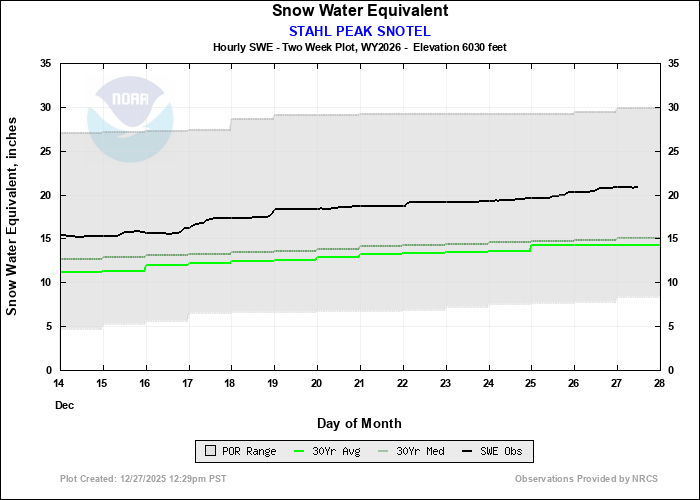
I like the chart – and the long-term data (for the last 30 years – it really does make me feel old to see that my measurements from 50 years ago, are so far in the past that they’re not included. But even a half century ago, I had learned that climate, like weather, changes – it’s just slower to change).
| 6 Hour SWE Change (inches) | 12 Hour SWE Change (inches) | 24 Hour SWE Change (inches) | 48 Hour SWE Change (inches) | 1 Week SWE Change (inches) |
| 0.00 | 0.00 | 0.50 | 1.20 | 2.40 |
| Daily Statistics Latest Observation is 20.90 inches which is 147 % of average Note: The Median/Average is based upon the 30 year period 1991 to 2020. The Min/Max is based upon the Period Of Record (POR). | ||||
So, at this time, the snowpack on Stahl is about 150% o the average. If you click on the NCRS site, you’ll see where the Kootenai basin sits:
| Basin Site Name | Elev (ft) | Snow Water Equivalent | Water Year-to-Date Precipitation | ||||
|---|---|---|---|---|---|---|---|
| Current (in) | Median (in) | Pct of Median | Current (in) | Median (in) | Pct of Median | ||
| KOOTENAI RIVER BASIN | |||||||
| Banfield Mountain | 5580 | 6.8 | 6.2 | 110 | 19.5 | 10.3 | 189 |
| Bear Mountain | 5460 | 16.8 | 18.8 | 89 | 47.4 | 31.8 | 149 |
| Garver Creek | 4250 | 3.3 | 4.7 | 70 | 15.2 | 9.0(24) | 169 |
| Grave Creek | 4350 | 3.0 | 5.2 | 58 | 28.8 | 14.3 | 201 |
| Hand Creek | 5030 | 3.6 | 3.9 | 92 | 11.6 | 7.2 | 161 |
| Hawkins Lake | 6460 | 14.3 | 9.8 | 146 | 25.8 | 15.2 | 170 |
| Poorman Creek | 5050 | 8.8 | 11.4(22) | 77 | 46.1 | 25.9(22) | 178 |
| Stahl Peak | 6040 | 20.9 | 14.2 | 147 | 27.1 | 18.2 | 149 |
| Basin Index (%) | 104 | 168 | |||||
The percentages are impressive – but there is a lot of winter yet to come. I don’t have data based on the Bouyoucos blocks we once measured to show how much moisture is stored in the soil at the sites – but I’d bet the soil moisture is at 100% capacity too.
It’s a pleasant thing that the data is so readily available anymore.

 Trego's Mountain Ear