-
Renata saw that one of our spruce trees by the pond has a budworm infection. It’s common. I can’t think of a year that one logger or another didn’t stop by the store to visit Dad, and share the arcane knowledge “Mac, you’ve got spruce budworms in your trees. Need to log ‘em.” Dad’s reply was always something on the order of “Poor little bugs got to have something to eat.” And he’d go on letting the trees grow and the bugs dine.
My lazy way of research is to type in the topic, along with the word “extension” and see what someone else has already done on the topic. In this case, I hit Idaho’s Extension Service, and that’s close enough (having driven across Montana many times, I know how much is grassland.) Randy Brooks is Idaho’s Extension Forester – so I’ll pretty much stick to his publication “ID18 Western Spruce Budworm.”
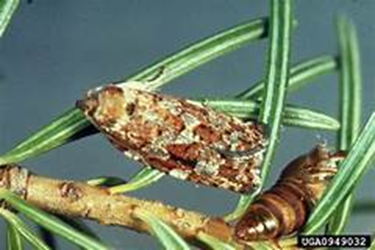
Here’s the moth form – which I’ve seen through the windows when I’ve left the porch light on.
And here’s the caterpillar, which has been chewing on the buds.
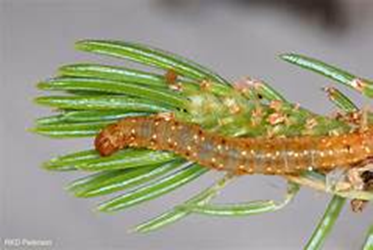
Now the Western Spruce Budworm has some wide-ranging tastes – Brooks describes it: “Western spruce budworm (WSB) is native insect and is the most widely distributed and destructive forest defoliator in western North America. Susceptible tree species include Douglas-fir, true firs and spruces. Larvae will also feed on pines and other conifers when insect populations reach outbreak levels. Buds, current year foliage, and developing cones are fed on voraciously. Larvae initially feed on new needles throughout late spring and early summer causing a red-halo appearance on outer portions of infested branches.”
In other words, we have a lot of host species, and, in Dad’s words “Poor little bugs got to have something to eat.” The reality is that
Chemical control over large areas may not be economically feasible, but can be used to protect high value trees from defoliation and associated Western spruce budworm larvae. damage. The materials listed for chemical control in Idaho are carbaryl, cyfluthrin, and spinosad (several trade names). For proper application timing, always read and follow the recommendations on the label. Another management control option is Bacillus thuringiensis (BT), a microbial insecticide which is registered for use against WSB. BT is a naturally occurring, relatively host specific pathogen that affects only the larvae of moths and butterflies. It can be used in sensitive areas along streams, lakes, and rivers. Chemical or BT applications can be conducted from the ground or aerially for short term protection. Users should consult State or Federal Forest Health Specialists regarding formulations, dosage, and treatment timing.”
I suspect that the real challenge of combating spruce budworms around Trego is that it is hard to beat a winged pest that finds so much habitat acceptable. I could spray BT, year after year, but I think that the Spruce Budworms will eventually outlast me. Still, Brooks’ article is informative and a good read.
-
“Among philosophers, Karl Popper (1902-1994) is best known for his contributions to the philosophy of science and epistemology. Most of his published work addressed philosophical problems in the natural sciences, especially physics; and Popper himself acknowledged that his primary interest was nature and not politics. However, his political thought has arguably had as great an impact as has his philosophy of science. This is certainly the case outside of the academy. Among the educated general public, Popper is best known for his critique of totalitarianism and his defense of freedom, individualism, democracy and an “open society.” His political thought resides squarely within the camp of Enlightenment rationalism and humanism. He was a dogged opponent of totalitarianism, nationalism, fascism, romanticism, collectivism, and other kinds of (in Popper’s view) reactionary and irrational ideas.”
https://iep.utm.edu/popp-pol/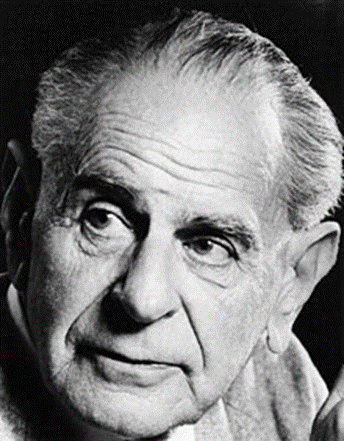
I’ve read Popper for years – mostly within the academy. Applying his thoughts to democratic elections and the two-party system is something that makes more sense now. The political world became more significant after I retired from the world of academic research.
There’s a series written at jedleahenry.org that applies Popper’s philosophy of science to voting, political systems and candidate selection. I didn’t have the advantage of reading Popper when I took the undergrad philosophy of science class at Bozo. It was taught by the Philosophy department and stressed Kant – as an older, self-directed student, I found myself extracting the philosophy of science from scientists (often physicists) and not from philosophers. I like Karl Popper – and his view on falsification has dominated my own research.
The linked article describes how, since Plato, the wrong question dominated: “How do we get the best people in power?” The deductive paragraph is: “Again, the problem was buried inside of the question, and not the answer. Until Popper, people had understood the term knowledge to mean ‘that which you can know for certain’ or ‘how it is that we can be sure about something’. It wasn’t just the wrong emphasis, but it was also claiming access to something that was never available to us. The idea of proving something to be true is a mistake in itself, all we can ever do is prove something to be wrong through a process of conjecture and refutation – guesswork (ideally educated), and then the testing of those guesses through criticism. The ideas that survive this ordeal are never accepted as true, but simply not discarded as false. No truth is ever so undeniable that it cannot be questioned. And so instead of certainty, all we can ever hope for is improvement – the replacement of bad ideas, with less bad ideas, and so on.”
It shows the lack of understanding in the phrase “Trust the science.” That isn’t how science works. And Popper’s view moved that into voting. I’ve known people who voted straight party line, and could make an argument for it. My father explained that you need to vote for the best man. If we work his idea into Popper’s Falsification Theory, you just keep voting for the best man until he pans out short weight and you have to vote against him.
Karl Popper’s Falsification Principle is a method of telling science from non-science. If a theory is to be considered scientific it must be able to be tested and conceivably proven false.
The next step is in the linked article: “Instead of asking ‘who should rule?’, we should only be asking ‘how do we best remove bad leaders without violence?’ It is a political theory built on the understanding of how knowledge develops through constant flaws, missteps and error; and that there is no such thing as an obvious truth. Just as it is wrong to pursue certainty in knowledge, it is also wrong to pursue utopia in politics – or utopian leaders. As Popper quickly recognized, the source of all tyranny comes from the idea that the truth is manifest. “
“Any viable political system needs two simple qualities: 1. The ability to highlight errors as quickly as possible, and 2. The most efficient mechanism for removing bad leaders and changing bad policies once they have been recognised as such. More than anything, the goal here is the minimisation of harm. Democracy matters, and is a superior political system to theocracy, aristocracy, communism or anarchy (which Popper had a slight sympathy for in its attempts to escape the control of the state), only because it matches most neatly with these criteria.”
Logically, the best – by no means ideal – is an elected two party system. It isn’t necessarily good – I recall the presidential choices of 2016, when I had to select between Hillary Clinton and Donald Trump, based on my knowledge of the two. At least I was certain that one bad candidate wouldn’t win. Picture our neighbors to the North – last year, Trudeau won 157 seats in parliament – and needed 170 to rule. Instead of peacefully accepting the voter mandate, he got two minor parties to join with him and keep ruling Canada. Multi-party systems are almost as bad as single party systems when it comes to removing poor leaders.
The best thing about the two party system is how well it works to vote the bastards out.
-
Greetings Paula:
Two long weeks ago, I reminded you that you have not shared information I requested, specifically: “Please send me the names and numbers of all write-in votes on Lincoln County ballots, by party and position, as well as the date those write-in votes were counted, and the name or names of anyone who has filed as a write-in candidate, from the recent primary election last June, at your earliest opportunity. (emphasis added)”
You have provided names, numbers and positions. I can determine the date they were counted from the spreadsheet. You did not include “the name or names of anyone who has filed as a write-in candidate.”
Montana’s Constitution says, “No person shall be deprived of the right to examine documents or to observe the deliberation of all public bodies or agencies of state government and its subdivisions, except in cases in which the demand of individual privacy clearly exceeds the merits of public disclosure.”
Since you have chosen either to ignore the state constitution (in depriving me “of the right to examine documents”) I assume that you are an ethical bureaucrat, and have determined that “the demand of individual privacy clearly exceeds the merits of public disclosure.” Therefore I ask that you either provide which party ballots votes were written in, and the individual names on those ballots, or explain how “the demand of individual privacy clearly exceeds the merits of public disclosure.”
I believe that choosing to ignore and omit 13-10-211 7 (in yellow)
(7) Except as provided in 13-38-201(4)(b), the requirements in subsection (1) do not apply if:
(a) an election is held;
(b) a person’s name is written in on the ballot;
(c) the person is qualified for and seeks election to the office for which the person’s name was written in; and
(d) no other candidate has filed a declaration or petition for nomination or a declaration of intent.in conducting elections is detrimental to our two-party system . . I will continue to express this belief on the pages of Trego’s Mountain Ear – founded in the mid-eighties, now in electronic format at . . . well, Paula, you sent me a reference to a website without the link, I’ll provide the same courtesy.
I have played nice because Mike Cuffe described you as a “nice lady.” I’m feeling that the “nice lady” is stonewalling me and denying information to a portion of the news media, as well as denying information that would support my research into my county’s descent into unopposed elections (I am a retired state demographer and hold a research Ph.D.)
Please respond with the information that the Montana Constitution entitles me to receive. If you choose to allow me to examine the documents in your office, please set aside several days, as I am a bit elderly and need reading glasses.
I figure that if I have not received the courtesy of a reply by mid-August, I will have to assume Mike Cuffe erred in his analysis of your character, and will follow up with other methods. A website that may help you is http://www.montanafoi.org/index.php
Sincerely,
Michael McCurry
-
Robert Heinlein may have started the definition for Irish Democracy when he wrote “I am free, no matter what rules surround me. If I find them tolerable, I tolerate them; if I find them too obnoxious, I break them. I am free because I know that I alone am morally responsible for everything I do.” (The Moon Is a Harsh Mistress) I don’t believe he intended to write a definition – but some of his quotations suggest that he wrote descriptions of the term we discovered long after his death.
Heinlein described the virtue of transparency in government: “I began to sense faintly that secrecy is the keystone of all tyranny. Not force, but secrecy…censorship. When any government, or any church for that matter, undertakes to say to it’s subjects, This you may not read, this you must not see, this you are forbidden to know, the end result is tyranny and oppression, no matter how holy the motives. Mighty little force is needed to control a man whose mind has been hoodwinked, contrariwise, no amount of force can control a free man, a man whose mind is free. No, not the rack, not fission bombs, not anything—you can’t conquer a free man; the most you can do is kill him.” (Revolt in 2100)
Heinlein may have written a handbook for Irish Democracy in his many novels.
-
Tip O’Neill may not have originated the phrase “All politics is local.” but he used it frequently enough that he is credited with it. Still, as we relearned in 2020, it might be better phrased “Politics, like real estate, is location, location, location.”
This map showed up in The Hill in 2020 – showing the election would be decided in 10 counties. It isn’t too much to expect that the 2022 midterms will also be decided in a handful of locations.

This map, following the 2020 election reflects the article:

Most locations are politically consistent. Los Angeles votes Democrat – you can take it to the bank. When I worked in South Dakota, Leroy was the most diehard Democrat I knew – and a registered Republican, so he could actually vote in the primary. As a young adult, my Lincoln County was a Democrat stronghold. This year, the closest Democrat on the county’s primary ballot was in Polson. Six years ago, just before Trump won the presidency, David Schultz had an opinion piece in MinnPost, predicting that “If my calculations are correct, it is perhaps no more than 19 counties in 11 states — fewer than 500,000 voters — who truly matter in the 2016 contest.”
PEW research, back in 2016, provided this map of “swing counties” from the 2012 presidential election:
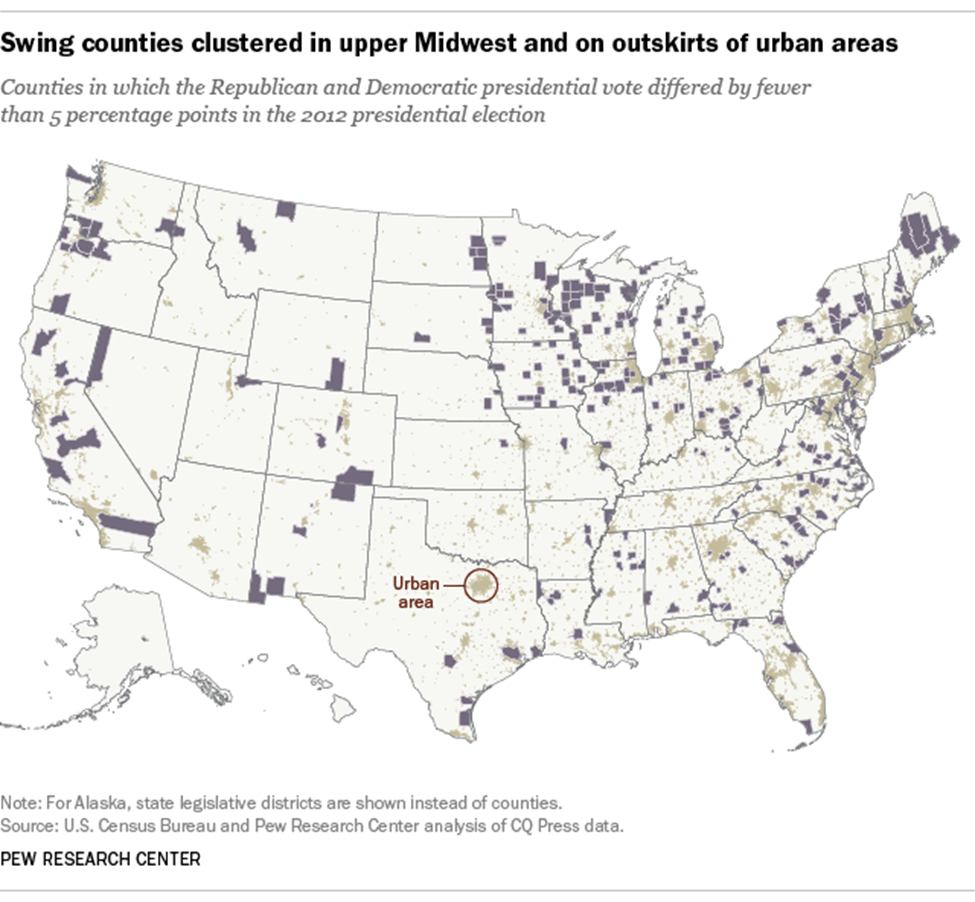
“As a 2014 Pew Research Center report noted, there’s a clear ideological divide both in the types of places people would like to live and where they actually live, with liberals preferring cities and conservatives favoring small towns and rural areas.”
Looking back at 2020, 10,000 votes in Maricopa County put Arizona into the Biden camp.
This article from the Daily Kos, following the 2020 election, does a pretty good job of supporting The Hill diagnosis that there are 10 counties to watch.
I really do prefer having a 2 party system where I do my voting. I wouldn’t mind 3 or 4. But I despise the attitude that locking the position for one party – whether republican or democrat – is a good thing.
-
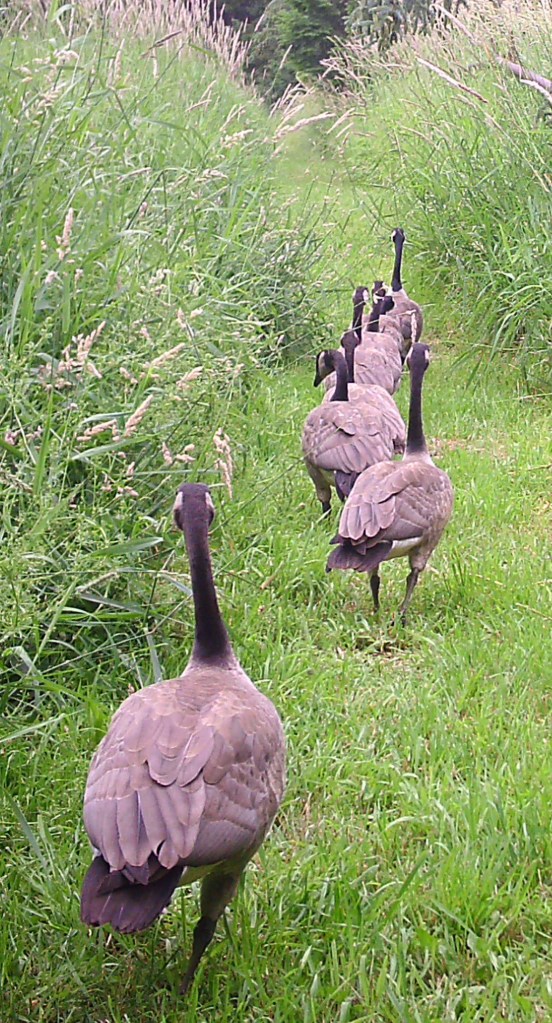
This is my seventh year watching Gander raise goslings. The first six years, it was Goose and Gander, but she was frail last year, and didn’t make it back. This year, it was Gander and Sweet Young Thing . . . plus four of his older descendants and their mates.
In the past, Gander has made solid efforts at training his goslings in formation flying – starting with water landings from the dock before they could fly. Eventually, the formations tighten up – but this year is different. First he trained this year’s goslings, then one hatch at a time he has been incorporating the grand-goslings into the flight. It’s a small pond for 40 geese to land simultaneously. He started ground landings when I mowed the hay – and it looked like raking the hay just added another training complication for his flight school.
The youngest hatch are still on the pond – but I expect most of the geese will be gone by the end of the month, living on larger lakes, and then there will be the last landing and overnighter of fall, as the young geese make the final imprint that will lead them back to the pond next year. Most won’t return, but some will return with their mates to raise their own hatches – returning in pairs where they left flying formations.
There are seven little coots on the pond – they will probably make it . . . though the parental coots are about as far removed from Gander’s family responsibility as can be. This year has been good for coots. The Cinnamon Teal has four little birds following her.
The blue heron has perched on the top of a Ponderosa pine – and I think the heron is the source of the small perch I see in the canal. I think the perch in Rattlebone lay eggs in the grass along the shore, the scales on the heron legs attach a couple of fish eggs, they’re dropped in the pond . . . and most of the time the tiny perch becomes a snack for the little diving ducks. Someday, there will again be fish in the pond – life finds a way. When they do, the aeration will make their lives a little more secure in the winter. The pond really does have too much shallow water.
The multitude of geese increase the algae production – too much natural fertilization. Last Fall I noticed a goldfish – I don’t believe the birds helped it along. I figure someone decided the pond looked like a home for it – since I haven’t noticed any carp in the pond, I think that was an introduction that failed . . . or possibly a single large goldfish is working the algae. If so, that fish has its work cut out for it.
The last couple of years, the fluctuation between high and low water seems to be more than the resident muskrats could handle – but others will hike in and make the pond their own one day. Life finds a way. The crayfish are there – and I should probably set up some traps for the mini-lobsters.
I think I get to pay the taxes on the pond, and do the maintenance to keep it going – but the owners are the frogs, the birds, the missing muskrats, the barely established fish that might, or might not, make it.
The salamanders from the shoreline, the voles along the edge, swimming like their larger relatives the muskrats as they evade the small predators – the least weasels. The red winged blackbirds do their best to protect all nesting birds from eagles and ravens. The nighthawks have hatched and are learning to fly and catch insects on the wing.
Thoreau had Walden as a young man – my two acres of pond provide an old man a lot to watch.
-
Calculating inflation of the US dollar was fairly easy back in the old days – gold was somewhere on the order of $16 an ounce during the California Gold Rush and during our own Virginia City days. The real complication came in 1944, at a place called Bretton Woods, when the decision was made to peg international currencies to the US dollar (which was then pegged to gold).
Habits have a way of becoming habitual. While the Bretton Woods agreement basically fell apart back when Nixon was a President, there were 30 years when hanging on to US dollars was as good as hanging on to gold – and a lot lighter. The US dollar is the world’s currency. Here are some estimates:
“There are now officially more $100 bills in circulation than $1 bills. The interesting aspect is that when we dig deeper, what is revealed is the fact that the bulk of them are being hoarded outside the United States. This is very interesting for we see the same basic trend emerging from the dollar v other currencies. There is a shift to the dollar as the US economy continues to hold up the entire world.”
“More recently, the amount of US currency in circulation outside the United States has now exceeded 70%.”
Posted Aug 22, 2019 by Martin ArmstrongNow I’m kind of accustomed to Canadian currency, living just south of the 49th. But most Canadian hundred dollar bills are in Canada. Most Mexican currency is in Mexico. That simple fact makes inflation easier to quantify in our neighboring countries.
“What is the U.S.’s greatest export? Banknotes. There is probably no other product for which the balance of trade is so tilted in the U.S.’s favour. No foreign bills circulate in the U.S., but U.S. bills are eagerly used all over the world.
According to the Federal Reserve, there are currently $1.74 trillion paper dollars in circulation. How many of these notes circulate in the U.S. and how many are used overseas?
Because banknotes cannot be tracked, this question is particularly difficult to answer. This blog post explores several approaches for determining the location of notes. These approaches offer a wide range of estimates, from as low as 40% of all currency being held outside of U.S. borders to as high as 72%.”
Posted July 3rd, 2019 by JP KoningIf we split the difference, and assume that 56% of US currency is outside the country, that means 0.97 trillion is outside our borders and .76 trillion inside. It’s easy to see why printing more money hasn’t been as inflationary to the US as to smaller nations whose currency is not the international reserve.
The national debt is about 30 trillion dollars. Of that, 6.5 million is owed to US government agencies – if you add in the portion owed to social security, about half the national debt is owed to retirement funds of one sort or another. The Treasury notes 7 trillion owed to foreign governments and international investments. My guess is that our national debt isn’t a great inflationary factor at present – but it has the potential to become one. The article linked above has a lot more specific data.
It is easy to think of inflation as caused by printing too much money – but the Post-Columbus treasure fleets of Spain, bringing silver and gold to Europe, in about 150 years, raised Europe’s prices by about six times. On the other hand, that massive importation of precious metals still only caused about an annual inflation of about 1.5% – something that today would be regarded as stable. Too many dollars chasing a finite amount of goods.
That data is easy to find searching the net – and it lets us see why US politicians can spend a lifetime in elected offices and still not understand that printing more money creates inflation: Most US dollars are outside the United States.
-





(Ðâ@½è -
The map below shows a stable population for Lincoln County over the past half-century.

https://montana.reaproject.org/analysis/comparative-indicators/growth_by_decade/population/reports/#page_2 As with all data, timing is everything. The 1970 Census documented the boom that accompanied the Libby Dam, the railroad and highway relocation and the tunnel:
Year Population
1940 7,882
1950 8,672
1960 12,537
1970 18,063
As the map shows, the county population has been fairly stable over the past 50 years – it’s one of those spots where the numeric data doesn’t give the whole picture. That 44 percent population increase between 1960 and 1970 wasn’t just people moving in – that decade also includes the loss of the Kootenai valley from Libby Dam to the 49th parallel.
Another aspect is that the new housing for the boom was built quickly – and the quickest way to get more housing was to develop water and sewer connections and bring in trailers – mobile homes was the nice term back then.
Until 1954, laws limited trailer width to 8 feet on the highways – and that meant that when the influx started in the mid-sixties, the used trailer market offerings were dominated by 8-wides. Sure, Walsh-Groves purchased new 12-wides and moved them in for their cadre – but individual laborers generally picked up a second-hand 8-wide and moved to Lincoln County. This photo reminds me of an elderly couple (probably both far younger than I am now) who moved in 3 trailers set up as a rooming house . . . one was the first 2-story trailer I ever saw. Pat and Nora, their names were.

Simply put, the housing that came in for the boom that showed up in the 1970 Census wasn’t always the sort of housing that lasted. An unanticipated consequence of building trailer courts to provide affordable housing was trailer abandonment. At the time, it was fairly cheap to buy a used trailer and move it in – and more costly to move it out after 3 or 4 years.. It kind of left the trailer court owner with an unplanned labor demand. When you couldn’t sell – or even give away – an old trailer, the option was a little diesel, a match, and bury the frame.
One of those old trailer frames is buried in my hay field. Another – from when the Trego post office expanded due to the influx of population – serves as the bridge across the channel between the ponds. That 0 to 0.5% growth includes housing that came in old and was abandoned as workers headed to the next construction boom. (I think that was the Alaska Pipeline, and those old 8-wides would never have made that trip on the Al-Can.)
Most of the construction boom was in Libby – and the immigrant population after 1970 was different. Those new residents were looking to own homes – and as the trailer pads diminished, so did the readily subdivided parcels of land. More recently the population growth has been occurring in the North part of the county than around Libby, as well as the tax base increasing more rapidly.
-
From Lori Rowson:

“Small bull moose seen right on Fortine Creek Rd.”
Photo by Lori RowsonFrom Patches




Want to tell us something or ask a question? Get in touch.

Recent Posts
- A Few Charts and Trends
- The Density of Water Explains When Dickey Lake Freezes
- Watching Iran
- The Quality of Numbers
- Robert Treat Payne Had Traveled To Greenland
- 75 Years Ago in New York
- Recovery Time for a Retiree
- Venn Diagram and DSM
- When Castro Was Cool
- You Have To Beat Darwin Every Day
- Computer Repair by Mussolini
- Getting Alberta Oil to Market
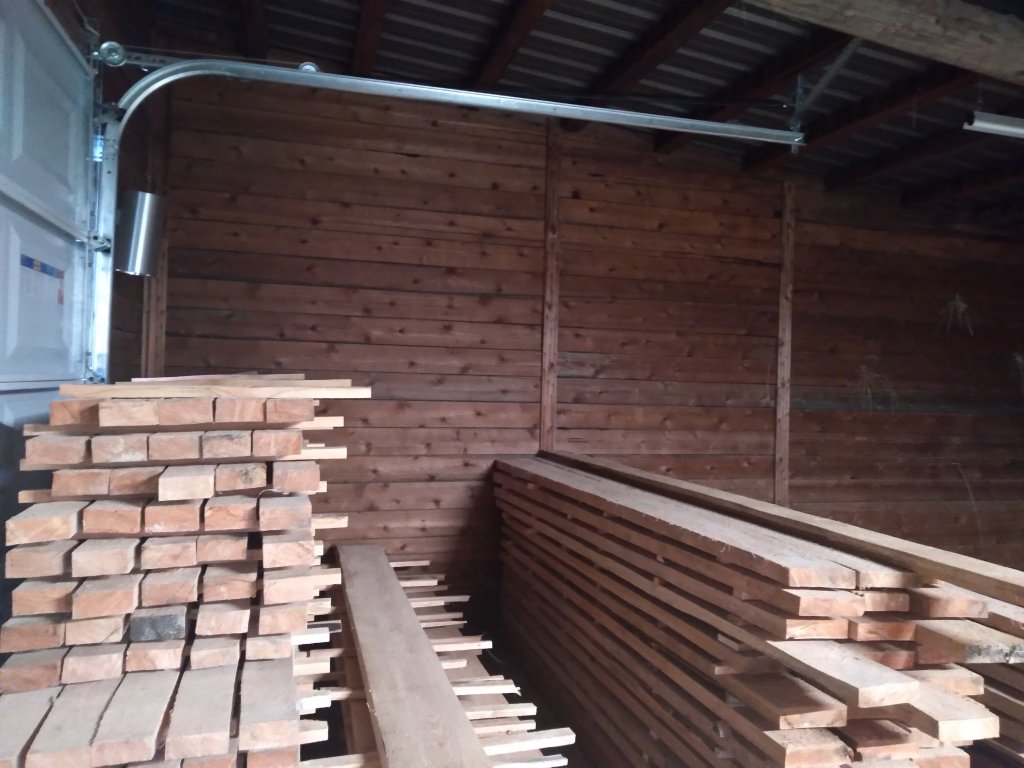
Rough Cut Lumber
Harvested as part of thinning to reduce fire danger.
$0.75 per board foot.
Call Mike (406-882-4835) or Sam (406-882-4597)
Popular Posts
Ask The Entomologist Bears Books Canada Census Community Decay Covid Covid-19 Data Deer Demography Education Elections family Firearms Game Cameras Geese Government Guns History Inflation life Lincoln County Board of Health Lincoln County MT Lincoln Electric Cooperative Montana nature News Patches' Pieces Pest Control Politics Pond Recipe School School Board Snow Taxes Teaching travel Trego Trego Montana Trego School Weather Wildlife writing
 Trego's Mountain Ear