Trego's Mountain Ear

"Serving North Lincoln County"

Tag: Lincoln Electric Cooperative

  • Light Breeze . . . Vane sets to wind, sock begins to fill

    I’ve been asked several times to put the story of the 1988 member uprising that replaced the Lincoln Electric Board on paper.  I suppose it should be written down – few electric cooperatives have had successful member uprisings, and, of the most active members of CREAM (Concerned REA Members), only Craig Eaton and I are still around to tell the tale.  Kenny Gwynn, Al Luciano, Duke Baney have long since passed on, but this is their story just as well.

    And I am not going to identify the inside source.  Promised to keep the secret over 30 years ago, and the promise is still good.  Not going to tell you if our source – the other side used the word snitch – is male or female, alive or dead. 

    I wasn’t involved at the beginning.  We started watching the board meetings in June or July, when Craig had commented on nepotism in LEC hiring.  The June 27, 1988 issue of the Mountain Ear headlines “Lincoln Electric Has New Nepotism Policy.”  “The new policy prohibits hiring of relatives (of management and supervisory employees) of the third degree and closer.”  July 25 included, “The board discussed proposed policy #700.  Policy #700 will require the public to be on the agenda before being heard.  The policy seems to be in response to Craig Eaton’s appearance before the board last May.”  September 5 headlined “REA Manager to Retire” and described how the manager would stay in Eureka for two years after retirement, as a consultant, with no managerial responsibilities or duties, receiving his regular salary as fixed in June 11, 1989.

    In retrospect, it’s obvious things were heating up, and we were reporting them.  In the September 19 issue, I commented that I had 3 months off because of a broken back.  On September 26th we wrote:

    “We’ve been attending Lincoln Electric co-op meetings for about 3 months now–since Craig Eaton told of nepotism in REA hiring. 
    By and large, we hadn’t seen a need to cover these meetings before.  I turn the switch, and my lights, computer, whatever go on.  Trego has better electric service than anywhere else I’ve lived or worked–and considering the places I’ve packed a computer into as a consultant, that says a lot.
    Unfortunately, several of the trustees, along with Craig Eaton, have brought us to the realization that you can’t judge every aspect of your electric co-op by pulling a light switch in the morning.
    There’s a story to be told, and some accusations to be investigated.  We’ll be running a series of articles on the REA covering the accusations and making our own conclusions.  The Mountain Ear is too small a publication to cover all this in a single issue, and advertising is the tail that wags the dog–we can’t afford the single issue approach.
    Besides, with this much controversy, we’ll get even better readership during the next couple of months.   

  • 75th Annual Meeting of Lincoln Electric Coop

    75th Annual Meeting of Lincoln Electric Coop

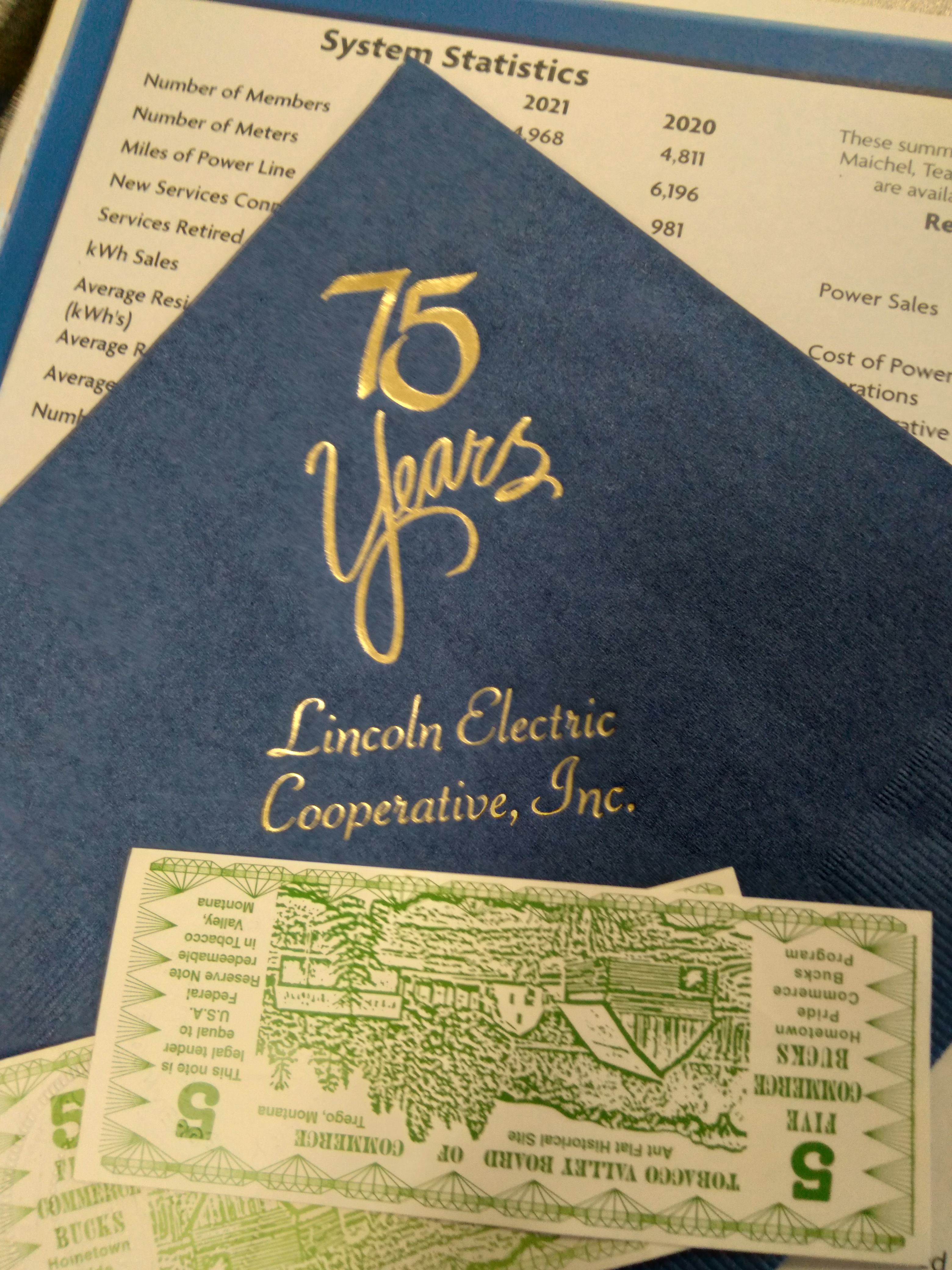
    Like last year, the meeting took place at Lincoln County High School, and could be attended by car. Unlike last year, in person attendance was also possible. Voting for trustees had already been done (Exclusively by mail), though the results were announced at the meeting.

    In a somewhat novel experience, there were (for one district) more candidates than vacancies, so the election had the possibility of making a difference. All three incumbents were reelected, including Tina Taurman (District 7). Taurman ran unopposed, with 335 votes.

    With coffee, breakfast (Four Corners) and 75th Anniversary cake (Second Chance Bakery) available outside the auditorium (and a video stream of the stage), it was a very comfortable meeting. Attendees could choose between the easy to get out of chairs outside the auditorium (but no back support) or the chairs inside the auditorium that offered back support if perhaps a bit more difficulty in getting up. Of course, the food (and coffee) was outside the auditorium.

    Folks were evidently pleased by the opportunity to be around friends and neighbors. It had the sense of after church coffee hour, if after church coffee happened during the service. Talking stopped for the pledge, and things were a bit quieter during the doorprize drawings, and much quieter for the luck of the draw scholarships. This year, the gift cards included one to Trego Pub.

    I did try to get closer to the speakers, since the actual meeting content sounded interesting. Unfortunately, standing up gave neighboring tables a view of my service dog, and the whispering kept things just as hard to hear as when I had been seated.

    So, having cake and hearing the meeting did not combine well. That said, I do still have at least some details to share. Ryan Hall (whose article can be found in the recent issue of Rural Montana) spoke about the efforts that Montana Electric Cooperatives’ Association (MECA) made to combat a feasibility study of breaching the Lower Snake River Dams. Replacing the Lower Snake River Dams with other clean-energy options would be very expensive, and, at least in the case of solar, impractical.

    Dam breaching is proposed for environmental benefits, in this case restoring fisheries to benefit salmon is a major concern. The electric cooperatives consider the new proposed study to be part of a strategy by people that want the dams breached to keep ordering studies until one meets their needs. Members attending the meeting were encouraged to fill out postcards to be sent to the governor, supporting MECA’s aims with regards to the Lower Snake River Dams.

  • Lightning Strikes and Power Outages

    Can lightning cause power outages?

    As it turns out, lightning doesn’t even have to strike a power pole or knock over a tree to cause a power outage. The build up of charge nearby can actually cause power surges -no contact necessary.

    Additionally, lightning gives off electromagnetic radiation. The phenomenon itself is called “sferic“, and it means you might notice static on the AM radio frequencies around the time of a strike.

    That said, outages are more likely to be due to tree branches hitting power-lines than an actual lightening strike; Power-lines are often in the position of being the most attractive thing around for a lightening strike, and that is considered in their design.

    What brought all this to mind?

    It was a dark and stormy night. Well, it was a bit after midnight on what had just become Saturday morning. Heavy Rain. A flash. A house-shaking kaboom. The power suddenly out. It seems to have been the start of an outage on the section of power-line that goes up along Griffin Road. Lincoln Electric had everything back up and running later on Saturday.

    Speaking of outages, though- there’s a planned one this week (11 PM Wednesday ’til 5AM Thursday) for everyone served by Lincoln Electric. Another overnight maintenance outage, courtesy of Bonneville Power Administration, since they need to replace structures damaged by gunshots (They’d love to have more information about that- call the BPA Hotline if you have any).

  • Comparing Annual Meetings

    Comparing Annual Meetings

    InterBel Telephone Cooperative held its annual meeting on Saturday.

    Registration- two lines

    It was a bright, sunlit morning and a well attended meeting; 311 people were registered when the meeting began (Unlike Lincoln Electric’s Meeting with only 97 members registered).

    Attendance: InterBel definitely had better attendance- but more about whether or not that’s a virtue for attendee’s later.

    Registration: The lines were definitely longer for InterBel; Unlike Lincoln Electric, InterBel had a single registration point. Of course, they were handing out capital credits at that point, so the reason for the lengthy line was pretty self-explanatory.

    The Radio: InterBel wins this one. Unlike the static of Lincoln Electric’s pre-meeting, when visitors sat in cold cars and wondered if they had the right station, InterBel provided a concert. By a local musician, no less!

    Length: About equal, actually. And they felt equally long. InterBel’s had what felt like longer stretches with people talking, but the cold and nasty weather made the Lincoln Electric Meeting feel long as well.

    Content: If you wanted to learn what was going on, InterBel held the better meeting. It was almost a shame to attend in person and miss the livestream, because there was a video and presentation.

    The representative of the audit firm didn’t just state that they’d provided an unbiased opinion (which was the case for Lincoln Electric) but actually explained some of the features of the balance sheet. While seeing the graphs would have been helpful (printouts next-time?) it was a fairly clear, easy to follow, useful explanation.

    In related news: InterBel is working on converting the Eureka business corridor to fiber optics, extending fiber to the West Kootenai, and expects to have fiber access to most of Eureka by the end of the year.

    Trustees Election: When was the last time we had an election? And I don’t mean election by acclamation, I mean an actual election where people voted. Neither meeting had an actual election with voting. No, not even Lincoln Electric- there was literally no more candidates than vacancies, despite the mail-in ballot members received.

    Prizes: Lincoln Electric definitely had more available. InterBel had 8 total (Including the grand prize). The odds were also better at the Lincoln Electric Meeting -far lower attendance! With only 97 people registered, and over ten prizes, the odds of winning something were at least 10% (and increased as each winner was removed from further drawings). The prizes for InterBel were a bit larger though.

    My preference was for the InterBel meeting, which ran smoothly, included plenty of content, and for the most part seemed better planned. But folks interested in winning prizes (any prizes) would definitely have been better served by attending the Lincoln Electric Meetings. Not to mention the Luck of the Draw scholarships which Lincoln Electric provides.

    One complaint: No bathrooms- this does limit the people who are able/willing to attend somewhat.

  • Lincoln Electric Held Annual Meeting

    Lincoln Electric Held Annual Meeting

    Saturday, Lincoln Electric Coop held their annual meeting as a drive-in meeting at Lincoln County High School.

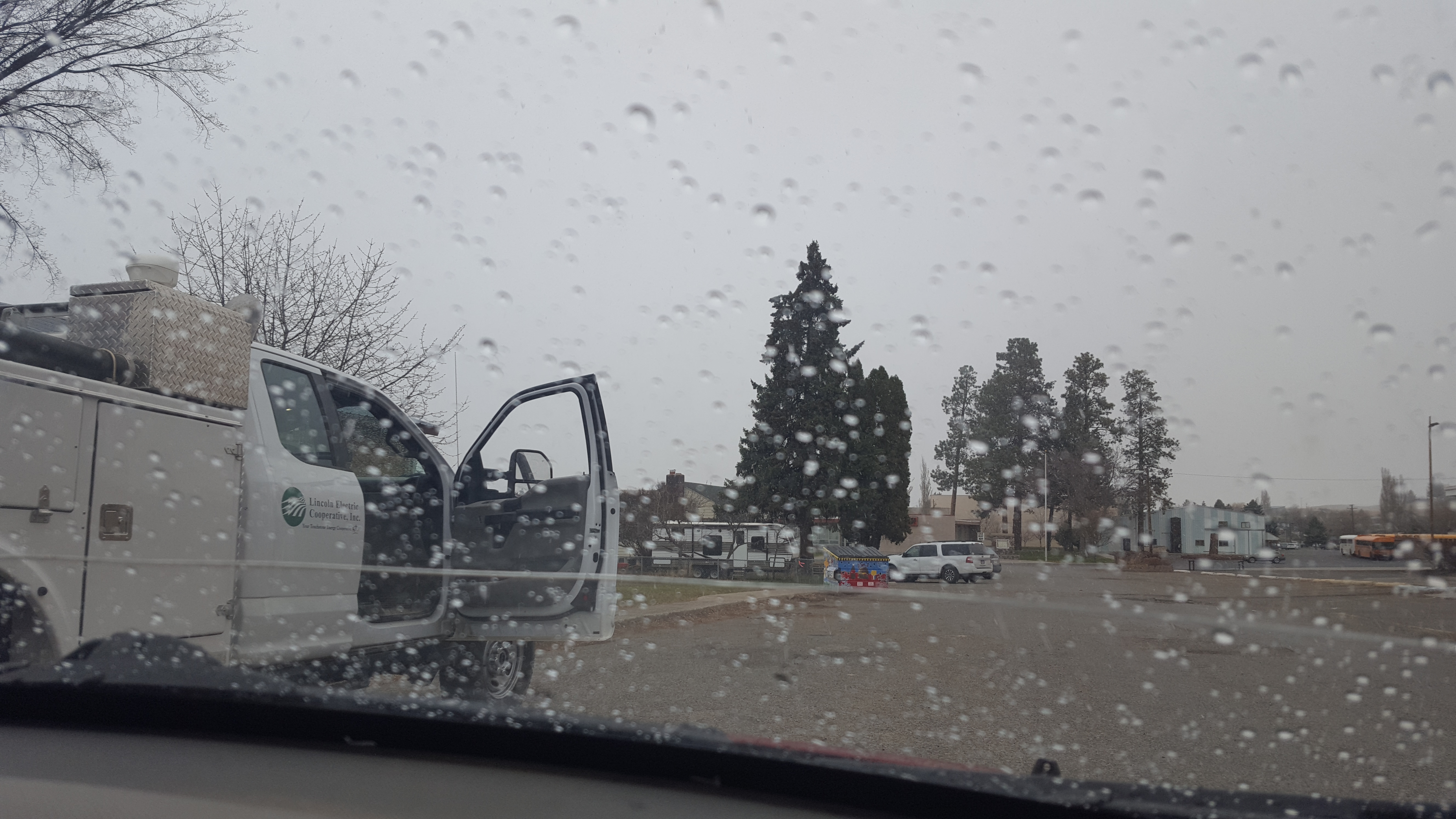
    As with last year’s meeting, it was drive-in, with attendees tuning their radios to listen in. Unlike last year’s smoke, this year’s meeting was cold, wet, and windy.

    View from one of the registration checkpoints (before the weather really started to worsen)

    At 9 am when the meeting started, there were 97 members registered. With last meeting‘s bylaw change, a quorum only required 2% of coop members, so the meeting was able to continue.

    To say the meeting was uneventful might actually be an understatement. Members did vote by mail -over 200 of them, in fact- but it made little difference since there were no more people running than open seats. In fact, each incumbent was reappointed.

    Capital credit checks were mailed, we heard a few California jokes, and a bit about the state legislature.

    What’s the difference between California and the Titanic? The Titanic had its lights on when it sank.

    (I’m paraphrasing the joke, but it was something along those lines)

    The discussion on legislation was informative; We learned about House Bill 475 which proposes to classify hydroelectric power as a renewable resource. The representative of the Montana Electric Coop Association was optimistic that the bill will be signed.

    As renewable energy sources become increasingly required, having a reliable energy source that qualifies (such as hydroelectric) becomes important in avoiding blackouts and brownouts.

    Other news: Rural Propane Services had a rough year but “is on the rebound”, expect to see a rate adjustment (but most residential members won’t see much of a change)

    The meeting closed in under 45 minutes.

  • Developing International Socialism

    As you could figure, the problem with Marx’ theoretical communism is in two concepts – first “from each according to his abilities, to each according to his needs” kind of breaks down fast in the real world scenario, and second, when all property is publicly owned,  real decision-making is in the hands of the manager.  Lincoln Electric is our closest example – with the slogan “owned by the people we serve.”  I remember how many of the owners showed up over 30 years ago to take the co-op back – and what an unusual accomplishment it was.  The cooperative is technically owned by the members – but it is controlled by the manager except for rare occasions.

    The term for the manager controlling a socially owned means of production was first used by Joseph Weydemeyer – a lieutenant colonel in the Union army, a Republican and a Marxist. He formed the first Marxist organization in the US.  I never did get a quiet chance to ask Winton Weydemeyer politely about what he might know about Joseph, and still regret the unasked question – there just never was a courteous opportunity.   Anyway, since a socially owned means of production can’t be managed by the owners, Joseph Weydemeyer gave us the term “dictatorship of the proletariat.”  It is an important term in differentiating between Marx’ view of communism and the international socialism we think of as communism.

    While Marxist communism couldn’t get past this management problem, it wasn’t a problem until the Russian Revolution.  All at once the communists had a big country to manage – and the successor to Marxism was Leninism.

    “Leninism can be explained as the political theory that works towards the organization of a vanguard party which is revolutionary and achieves to attain dictatorship of the proletariat in order to establish socialism. This vanguard party’s aim was supposed to provide the proletariat consciousness about their class in order to destroy capitalism in Imperial Russia. He knew that imperialism was caused by capitalism and it was the exorbitant point of capitalism. Communism is a higher form than that of capitalism, it was proposed that the revolution by the proletariat had to occur first in the economically and industrially advanced countries.

    According to Lenin, the Communist party consisted of a scientific understanding of the history and of a society guided by the Marxist principles. They were deeply committed to ending capitalism and replacing it with socialism. They believed that this was only possible with the acquisition of political power. The aim of achieving this political power made them do anything that was possible, be it violence or revolution if required. Lenin argued that the workers or proletariats alone could acquire revolutionary and class consciousness that was needed. Deep within he was afraid that the proletariats would become easily content with smaller gains in their living as well as working conditions acquired through the various trade union activities. He feared that the proletariats would be diverted easily in their motive to dethrone capitalism. This was the point where Leninism differed from Marxism. For the Marxists, material conditions were enough to facilitate the workers to realize their need for revolting . . . Some of the unprecedented results of Leninism were that its pursuit of creating a socialist society led to the creation of a totalitarian state where all the social, economic, cultural, aspects of life were being controlled by the Communist party. Marxism and Leninism predicted the victory of the proletariat; it resulted instead in the increased power of the state.”

    Basically, Joseph Weydemeyer and V. I. Lenin melded the dictatorship of the proletariat to the utopian socialist ideals of Robert Owens and the Communist Manifesto of Marx and Engels to develop the ideology of Leninism – the ideology of the Union of Soviet Socialist Republics – international socialism.