Since the state was kind enough to go through every K12 school in the state (back in 2008) and evaluate the condition of the buildings, there’s a fair bit of information to play with.
The general facts- as taken from the Facilities Condition Inventory.
Building
Year Constructed (according to the state’s report)
Deficiency Ratio
Renewal Cost (estimate as of 2008)
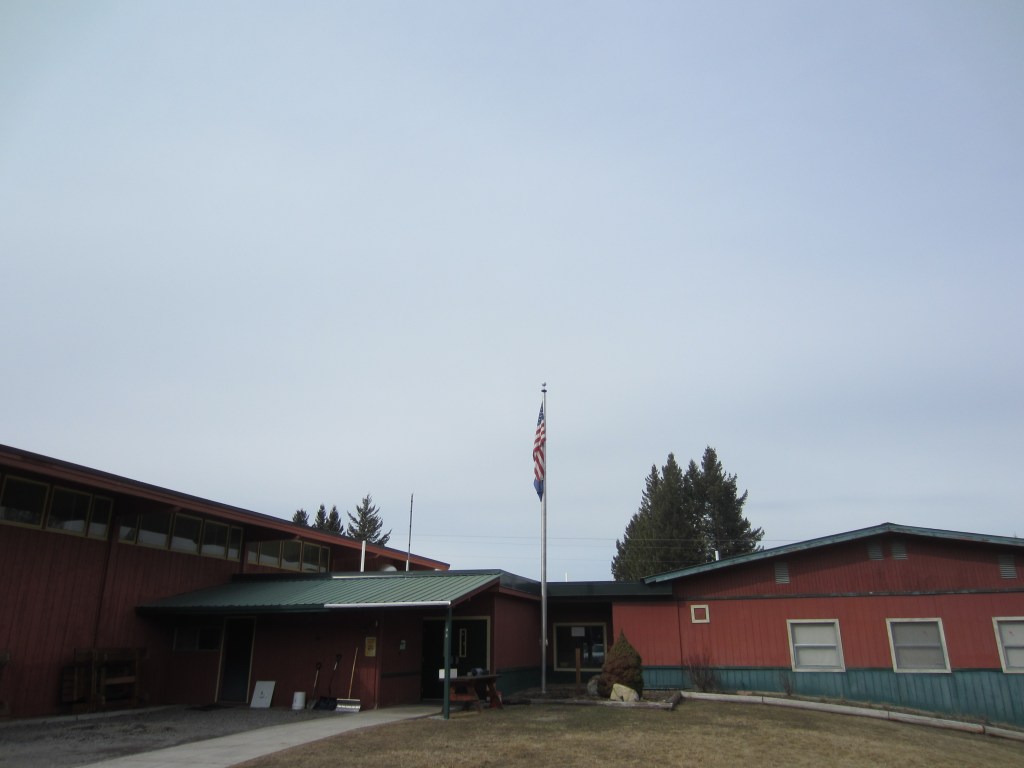
Trego School (the school building proper, including the portable classrooms on the East end)
1967
30.1%
$594,743
Teacherage
1967
5.1%
$7,152
Bus Equipment Shed
1960
1.8%
$104
Fuel Storage Unit
1960
1.8%
$104
While it might seem a bit odd that the last two are exactly the same- since the complaint (paint peeling) was identical, the identical deficiency ratios and renewal costs make some sense.
Evidently, then, the problem was (and given the comparatively low costs of the other repairs, surely still is) the school itself, with a deficiency ratio of 30.1%. With the report estimating the total cost of repairs of the school building at $594,743, the school board will have to prioritize the necessary repairs (surely some of them have been addressed since 2008).
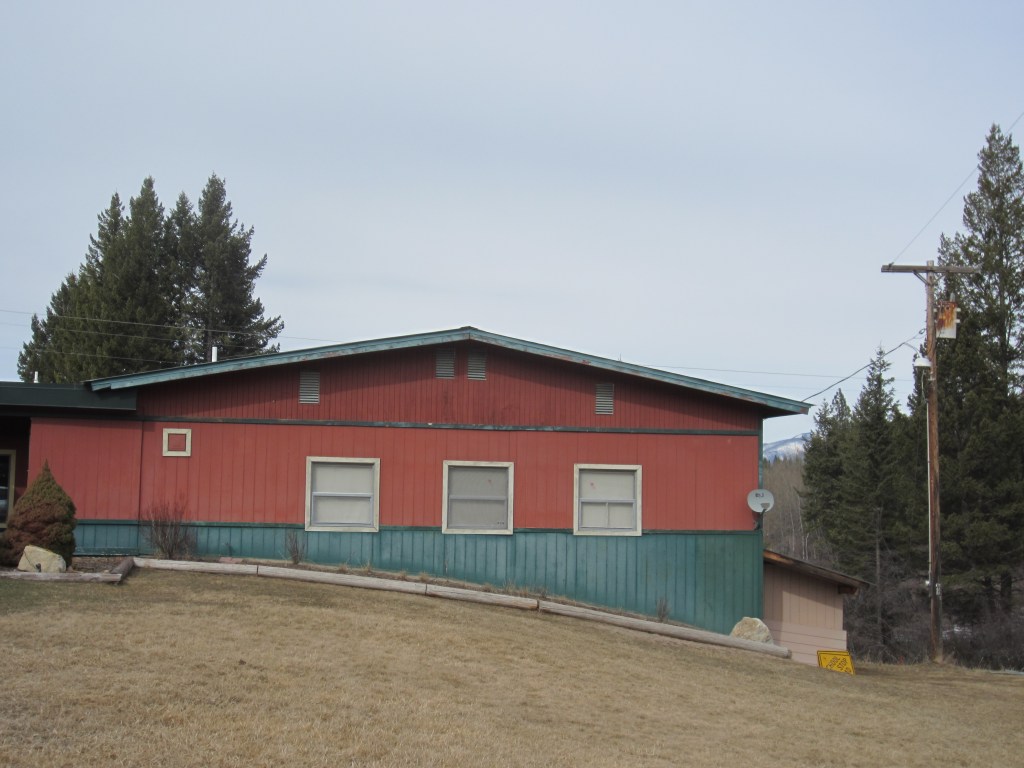
Many of the complaints in the report were reasonably straight forward; Windows should be double paned rather than single and window frames should have thermal breaks. Simple, though the renewal cost is quite spendy ($86,107 in total for windows). Another big ticket item is the two “portable” classrooms on the east side of the school. The report observed “Floor sagging or showing other similar such failure”, and estimated $88,058 to renew.
While the school board did pass a permissive levy which will amount to around $25,500, that’s not going to be sufficient for some of the costlier repairs the school is going to need. With the budget tight (enrollment has gone up, but the funding received from the state is based on a three year average), the school board is going to have to prioritize spending very carefully.
I knew I would one day read Freddie’s obit. Few are granted long-term cancer survival. Each of us went on with our own lives after high school – but I remember Jay Penney dragging me to a restaurant in Kalispell. Jay was one of those half-generation older friends and coworkers who help you grow into a capable adult. That day, because he was the type of man who shared friends, he had decided that Freddie and I needed to meet. She knew our introduction was coming, and briefly kept a straight face – finally explaining to him that we had known each other from grade school as she poured coffee. I’ve known two tremendously competent women who earned their livings as waitresses – and Freddie’s obit brought back good memories of Flo as well.
I don’t know how she convinced me that it was a good idea to head up Deep Creek to observe a beaver dam baptism. I do know that when our surreptitious observation failed, she was in the center seat of the pickup, encouraging more speed as I drove away. My junior year, I think. It seemed like a good idea at the time.
We met at Trego grade school. Christened Fredricka Louise Osler, she referred to her formal name as “Freddie and contraption.” I’ve always felt that, had Bobby enlisted her help instead of grabbing the jump rope and running, we would have succeeded in capturing the bear cub and moving it into the kitchen. Probably just as well we failed.
I recall that Freddie was walking along the highway with Alvin Rongholt when he was hit by a vehicle and died. My memory of Alvin is of a kid who showed me his parody of “The Ballad of the Green Berets” that morning, who left only an out-of-focus photo in the school yearbook. I guess he also left me an appreciation for parodies of Sergeant Sadler’s song, and a wish that people’s lives be remembered.
Obituaries that bring good memories are rare. Thanks for the memories.
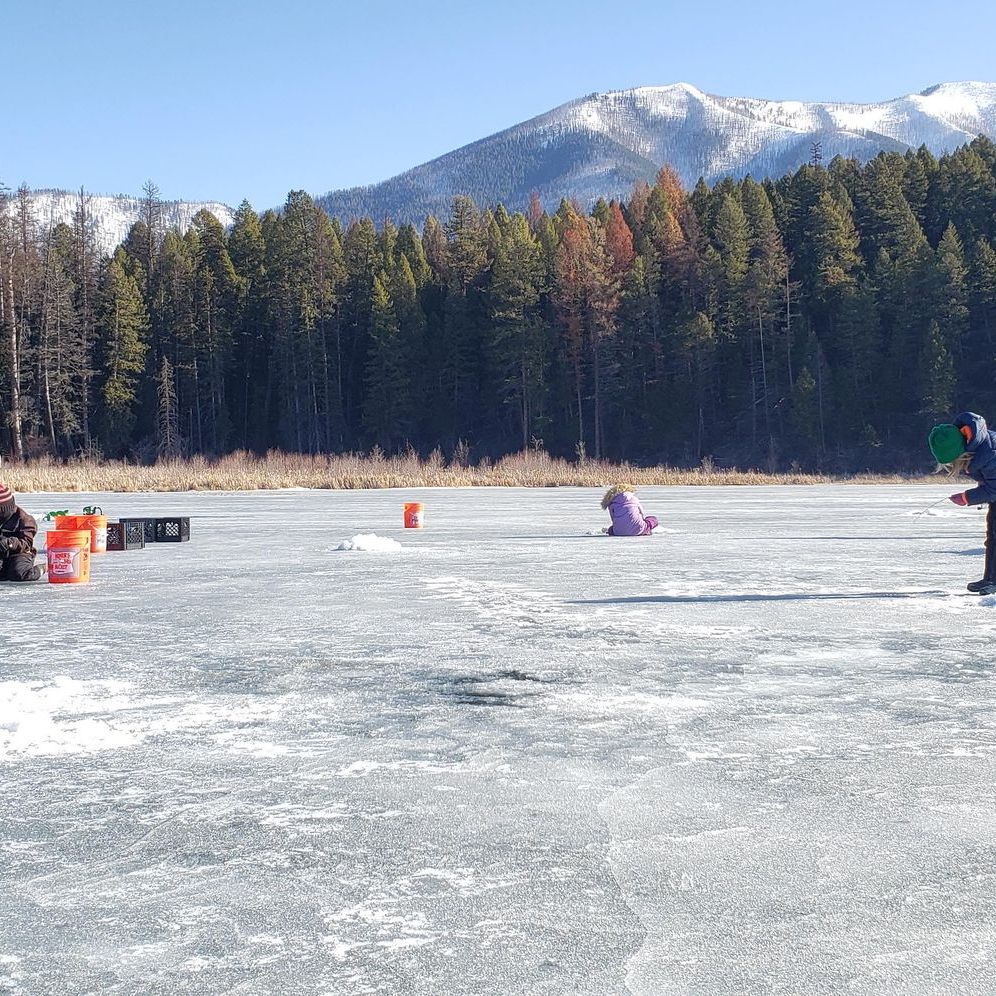
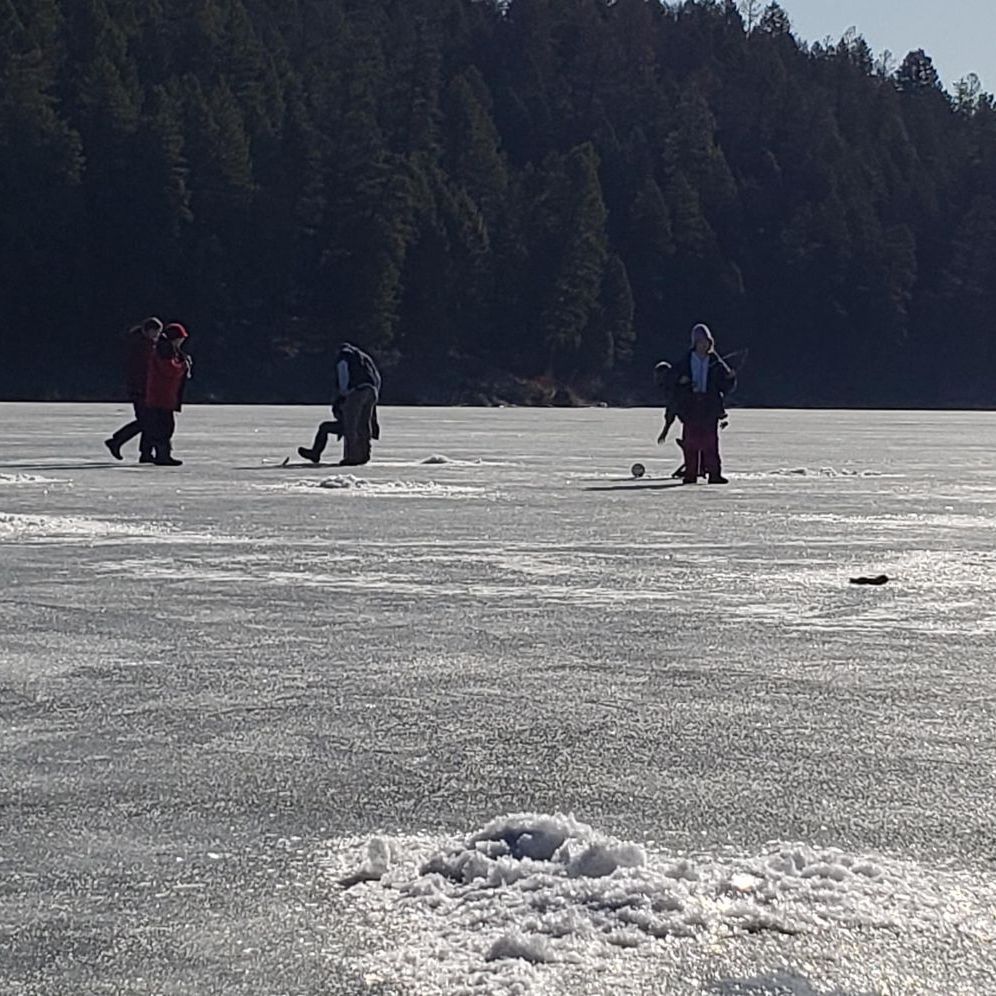
Last week, students and their families made their way to Murphy Lake for an Ice Fishing trip. It was a warm, pleasant day with chili dogs grilled beside the lake. A successful trip, since all but one student caught fish.
Where are the kids now? Spring break runs throughout the rest of this week. Classes will resume on the 15th and we can expect to see the buses back on their usual routes.
Adults planning similar trips should remember that Fishing Licenses expired February 28th- be sure to get a new one.
More information about school field trips can be found on the school calendar.
As we wrote about earlier this year, the school board had decided to use a permissive levy to establish a building reserve fund. One of the requirements of the permissive levy is that “The projects must be listed and the priority for projects are listed on the Facility Condition Report under their deficiency categories. Those need addressed first.”
Not a fan of permissive levies? The school board election is coming up in May.
To find out what that means, we have to go to the Facility Condition Report. Back in 2008 the state of Montana arranged for every k12 building in the state to be inspected and its condition reported on. While these reports are theoretically public information, and publicly available, chasing down anything the government did over a decade ago is a bit of a challenge. A few government agencies and several emails later, I obtained copies of the original reports.
Looking at the 2008 report makes the need for a building reserve fund obvious. The school building proper has a deficiency ratio of 30.1%. The statewide report considered buildings with deficiency ratios greater than 20% to be in poor condition, and those greater than 50% to be in such bad shape that replacement might actually be preferable to repair.
The classrooms on the right side of the school entrance were originally portable classrooms and rest atop a “walkout” basement.
While some of the items in the report are minor- things that need paint or other simple repairs, not everything is that straight forward. The report describes the stair treads/risers as 100% deficient, stating that “Stair flight is settling or the under-structure physically failing”. On the same page, another description remarked that “Floor strength integrity of portable structures is questionable”. Trego School was constructed in response to the large flood of people associated with the tunnel, and included several portable classrooms, two of which remain in use today.
The roof system also included a 100% deficiency rating; “Condition observed: History of leaks; seams separating, punctured, or lifting at edges”. The estimated cost to repair, back in 2008? $29,365.
The school board will be meeting Wednesday, March 10th, at 4PM. The meeting can be attended long-distance. The Agenda (available in the post office) includes the building reserve. Those interested in attending can do so via the Gotomeeting App.
Want to see the school facilities condition inventory for yourself? I’d be happy to share what I received from the state- otherwise, Richard Knatterud (rknatterud@mt.gov) of the department of commerce was the person who provided me with copies.
School taxation is not a simple subject. Part of the school taxes go to Helena, and are returned, not dollar for dollar, but apportioned according to school enrollment. Another part of taxes are assessed and go from the county revenues into the school accounts. Each portion has minimum and maximum levels. It isn’t hard math, but it is a challenge to keep things straight.
At Trego, the board needs to begin funding a building reserve fund. That means adding a permissive levy to raise $5,232.32 – about 2.71 mills. The state allows us a “District Major Maintenance Amount” with a maximum of $16,500 – and to get to that maximum, we have to levy $5,232.32 – 2.71 mills. The school was built over 50 years ago, and more maintenance planning and effort is becoming necessary. Folks give some simple explanations – “that will be about three dollars on a 100,000 assessment” which are simplified, easy to understand, and wrong.
Where to find information:
MT Revenue instructs us on how to calculate taxes from mills – not a particularly challenging math exercise, but worth using so you can understand how each additional levy affects your tax bill. As we look at the numbers, we’ll see that, in Trego, where nearly half the taxable value is “Centrally Assessed” we need a bit more understanding.
MT Office of Public Instruction provides spreadsheets of the budget files for each school district in the state. They’re in pdf format, but provide a lot of information – and are only slightly confusing.
State Information Technologies Services Division provides information that shows how each district is valued – for example, as you look at the tables below, you will notice that Market Value and Taxable value vary significantly.
If you contrast Trego, District 53, with Fortine, District 14, you will note that Fortine shows a market value of $119,644,515 while Trego shows $114,462,957. Still, the taxable value leans in the opposite direction: Fortine 1,5436,104 vs Trego at 1,931,429. The difference is in the category shown as “Centrally Assessed.” Taxable value of Centrally Assessed” property is about 3% of market value, while taxable value of “Real Property” is slightly over 1% of market value.
Since centrally assessed property in the Trego School District will primarily be railroad property, and since it represents a significant proportion of the total taxable value ($932,774/$1,931,429 = 48.3%) taxpayers in Trego School District can thank the railroad for taking a significant portion of the tax burden.
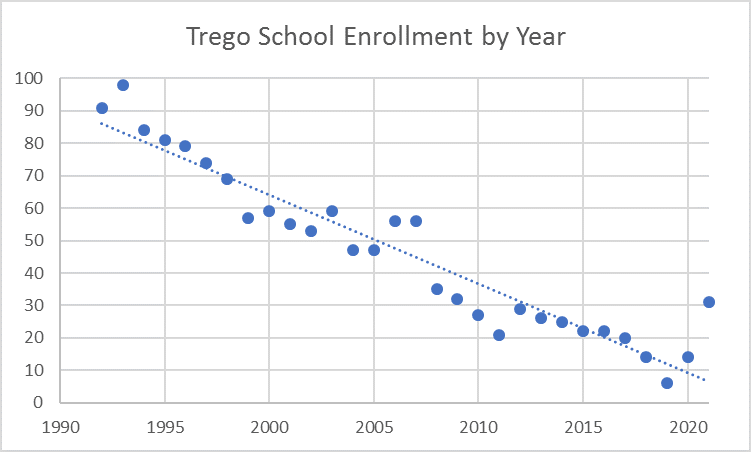
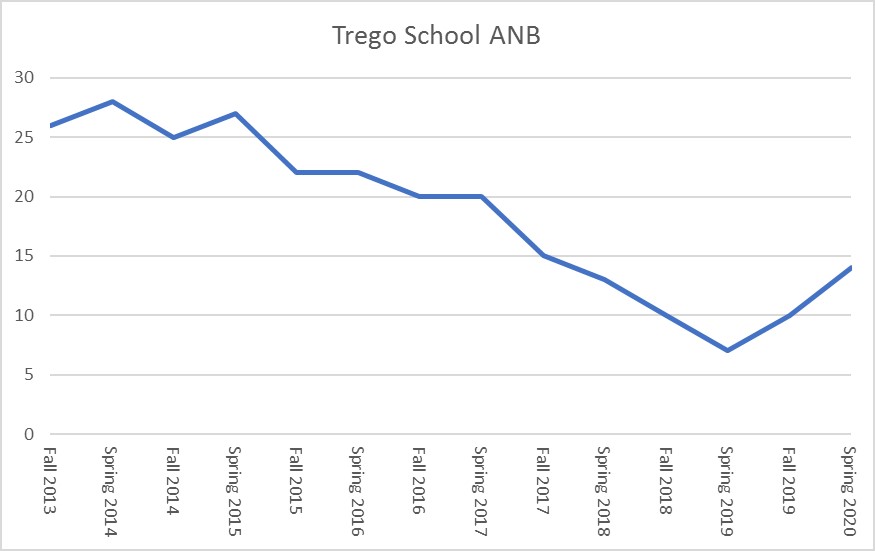
Enrollment at Trego School continues to rise, in defiance of the historical trend. For the last few decades, school enrollment has been fairly steadily dropping. How low did enrollment actually get? The lowest official ANB (Average Number Belonging -i.e. the official state count of students) that I can find is seven, in the spring of the 2018-2019 school year. Enrollment actually continued to decline after that date, but didn’t make the official state count which is used to determine the district’s funding.
The most recent data, using the spring and fall ANB count provided by the state looks like this:
Time Period
Number of Students
Fall 2013
26
Spring 2014
28
Fall 2014
25
Spring 2015
27
Fall 2015
22
Spring 2016
22
Fall 2016
20
Spring 2017
20
Fall 2017
15
Spring 2018
13
Fall 2018
10
Spring 2019
7
Fall 2019
10
Spring 2020
14
Official ANB for Trego School, data from Montana Office of Public Instruction
In graph form the trend is somewhat clearer.
This data for this school year (2020-2021) isn’t available from the state yet, so the best way to find out about enrollment is to call the school and ask. Back in November, we reported the exciting news that enrollment was up to 23 students and we shared the following graph which incorporated that data.
Now, enrollment is up from January’s 26, to a total of 31 students. A 35% increase from November of 2020. This fall, Trego school optimistically began with three teachers. Now, with 31 students the average class size is slightly over 10. The school has been working to improve its enrollment, and has seen an amazing turn around. Even if we use the lowest official ANB number (which is decidedly higher than the lowest number the school reached), the school has more than quadrupled enrollment in the past two years.
Trego School enrollment, by year, as of late February, 2021. We’re going to have to consider changing our trend-line….
Well done, Trego School. Where will you go from here?





 Trego's Mountain Ear