-
In 2020, we were in the last year of Make America Great Again. With the change from Orange Man rule to Slow Joe management, we entered 2021 with Build Back Better. Now I’m reading predictions of food shortages happening in 2022. That one kind of bothers me – on one hand, I like eating. On the other hand, famines have a fairly strong correlation with rapid, unstructured governmental changes.
Somehow it seems difficult to build back better if you’re short on calories. Higher energy and fertilizer prices tend to limit production. Famines were becoming less frequent until about 5 years back, when they started showing up again in Africa. Memory takes me back to 1959 to 61, when the famine in China starved between 20 million and 50 million people, and is classified as one of the greatest man-caused disasters in history.
A Malthusian demographer would see the time of famine as natural, as unavoidable. Since I’m not particularly Malthusian, I see causality as human caused – unfortunately, agriculture is a real world practice, and politicians seem to concentrate on their particular chosen ideology and live lives that are immune to Real World 101. The upbeat side of the war in Ukraine is that it has demonstrated that Russia’s leaders are just as incompetent as our own.
So what are we looking at? The Ukraine’s wheat crop is going down due to war, expensive fuels and lack of fertilizer. Russia’s crop isn’t likely to improve. Here’s a list of wheat production from: worldpopulationreview
Top 10 Wheat Producing Countries (in tons of wheat produced 2020)*
- China — 134,254,710
- India — 107,590,000
- Russia — 85,896,326
- United States — 49,690,680
- Canada — 35,183,000
- France — 30,144,110
- Pakistan — 25,247,511
- Ukraine — 24,912,350
- Germany — 22,172,100
- Turkey — 20,500,000
We tend to associate rice with China and India – and between them they account for just under 400 million tons of production annually. India is the world’s largest rice exporter – and China doesn’t make the exporter list. The top 5 wheat exporting countries are Russia, the US, Canada, France and Ukraine – and it isn’t hard to predict lower exports from Russia and Ukraine. When a system is running close to capacity, it doesn’t take a large drop to affect the whole.
If we go back and look at the potato blight in Ireland, during the 7 years of the blight, the country continued to export food. The big cause of the famine was the blight – put politics and leadership intensified the damage. The holodomor, in Ukraine, was a deliberate famine caused by the Soviet government to eliminate a social class. While drought played a role in the Chinese famine of 1959 – 1961, the famine was more caused by governmental decisions.
I recall Red Foxx describing the famine in China – it’s been years, so I won’t get the lines exactly right, but he made his own version of Comrade Mao’s speech: “Comrades, I address you now with bad news and good news. First the bad news: Our Great Leap forward has stumbled. It has fallen. Agricultural production has fallen. By this time next month, there will be nothing left to eat but horse manure. But there is good news, comrades: There won’t be enough to go around.”
Biden has made a living as a politician since he was first elected to the Senate in 1972. Putin started work for the KGB in 1975. Neither has a whole lot of work experience outside government jobs. Zelensky, like Biden, started with a law degree, but then went into comedy. From 2015 to 2019 his main gig was a role as President of the Ukraine – then he became President. Perhaps people in all nations should better consider the leadership levels we accept.
-
This article is kind of an inside joke – but the group of insiders is large, consisting of most everyone who has read The Iliad. (Not to be confused with The Idiot which is a Russian Novel). This time my story starts with viewing an article about the change in administrations, and comparing the treatment to Achilles’ treatment of the “trash-talking Trojan warrior Hector.”
About 30 years ago, I was talking about social norms and social change in a Libby classroom of Flathead Valley Community College. Somehow I drifted to the happenings of the Trojan war a little over 3000 years ago, without remembering that Montana’s Troy is a few miles west, and downstream of Libby. I mentioned the kidnapping of Helen of Troy – who, before being kidnapped was Helen the Mycenaean. Then I explained how Achilles tied Hector’s body to the back of his chariot and dragged the corpse around Troy for a couple of days – and, while this was unusual enough to be reported, it wasn’t so unusual as to rouse any of Achilles colleagues to help it – it was on the border of being socially acceptable.
I thought I had made my point, when a young woman in the back of the class addressed me: “Mr. McCurry, I’ve lived in Troy all my life and I don’t remember anything like that ever occurring.” Sometimes what seems like a great example misses the point.
-
In fact, in Montana neither party actually has to be present. We are the only state that allows double proxy weddings (for residents and members of the armed forces). So, while someone has to stand in your place, it doesn’t need to be you. We also allow a “declaration of marriage” to be filed, which is more of an after the fact “We got married on this day” piece of paper (though, provided it had the right information, it needn’t be on paper. A napkin should work just fine).
Of course, in Montana you don’t have to actually have a wedding. We are also a common law marriage state, which means marriage doesn’t actually require paperwork. Common law marriage requires competent, consenting adults to “confirm their marriage by cohabitation and public repute“.
The second part, “public repute” means that it would be difficult to establish marriage accidentally. People must present themselves as married in public, file taxes as married, or other similar indications.
While common law and proxy marriage may both be products of being rural (difficult to find someone available to officiate), they seem to have gained some popularity during the lockdowns.
Any other weird facts about our state? Let us know!
-
Just to cover the bases – my first 22, that I’ve owned for 60 years, has no serial number. Mom bought it for me at the Fairchild PX just outside of Spokane in 1962. Frankly, she liked the idea of a safety that came on automatically every time you opened the bolt. Since it clicked off with equal ease, it didn’t bother me. I was happy to have my first rifle. Sam didn’t have to wait until she was 12 to get her first rifle – it’s important not to make the same mistakes in raising children that your parents did.

That old Remington isn’t a ghost gun – although the receiver is made from seamless steel tubing, rather than a separate forging. Back in January of 1962, before leaving the factory, the barrel was stamped with a B (for January) and the letter J to indicate 62. The number 5 indicates that it was supposed to be an employee sale. Over a half-million TargetMasters were made between 1939 and the end of 1962 – and Remington dispensed with serial numbers in 1941.
The month code is memorable – BLACKPOWDERX. My B is January. The last one made would b XJ, for December 1962. That J letter was also used to indicate 1940 – but in that year they had a serial number on the bottom of the barrel. My old single shot may not have a serial number – but the 2 letters and a number give me a pretty good chance of picking it out from most of its 550,000siblings.
Despite its total lack of serial numbers, I can testify that it has never been involved in terrorist activities, though the shades of several black bears might debate the point. I never considered it a bear rifle, but it did the job when I needed it. As I look into the field from the house, I recall my badger hunting partner who hunted gophers with me one summer – picking them up and (I surmised) taking them back to her den for the offspring I never saw.
As I got older, I wanted a 513T – the same basic rifle, set up as a repeater, and wearing target sights. I never did get one of those – but the 510 did well for me. I didn’t get a repeater until I was pushing 30 – and it wasn’t as accurate as my old single-shot.
-
I’ve been passing out links to the first Dunning-Kruger article since 1999. Now, I have a link to an article that tested Dunning-Kruger on college students who were taking the LSAT – the admissions test for wannabe lawyers. I like studies that use standardized tests as the test for the hypothesis.
The first article I read on the Dunning-Kruger Effect had the long title “Unskilled and Unaware of It: How Difficulties in Recognizing Incompetence Lead to Inflated Self-Assessments”.
Testing the hypothesis against the LSAT scores yielded this graph:
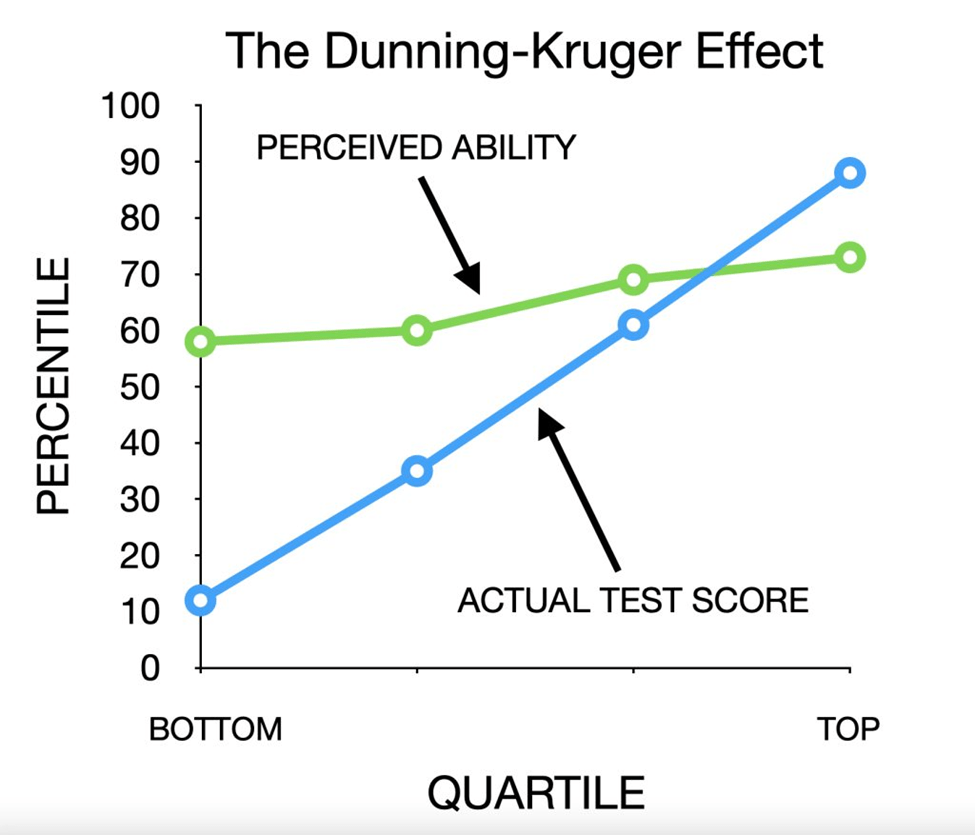
So the next thing was to sort out the statistical noise:

The results showed an astonishing level of inaccuracy in expected scores. For example, on the grammar test, the lowest performers who got either zero or one question right (out of twenty questions) expected on average to have scores of approximately twelve right (!). By comparison, high performers who got all twenty questions correct underestimated their performance by a much more modest amount, expecting on average to get approximately sixteen right.”
As the article goes through the mathematica that support the reality of the Dunning-Kruger effect, the article ends with:
“But perhaps the hardest lesson to learn about DK—often stressed by David Dunning himself—is that this problem is not limited to some other group of people safely off in the distance. Depending on the area of expertise, the Dunning-Kruger effect applies to us all. If ignorant enough, under many circumstances, we will fail to recognize how ignorant we are. Ideally, the message of the DK effect is both troubling and humbling.”
Both articles are available online, at the links, and well worth reading.
-
I don’t even notice them, until I’m watching on someone else’s system. Subtitles are such a ubiquitous part of my viewing experience that they’re on even for the movies I show my students at work.
Subtitles are the difference between being totally lost and being, maybe, able to figure out the plot. I caught a glimpse of Macbeth playing. I say glimpse, perhaps without full honesty. Opening few scenes. Which knowing the plot in advance should be really helpful for. And it is. Just, not enough, not this time. Now I’ve read Macbeth and I know the plot. The words are the same as ever, more or less. But without subtitles, and without the ability to ask someone what was going on, I found myself adrift.
So when a video came across my facebook feed, as they so often do, in sign language (with subtitles) advocating for ubiquitous subtitles, I pondered the utility. Obviously, for those that are not hearing, subtitles are essential, more so than they are for me.
Videos are everywhere. My students, when tasked with finding information, turn more often to video than to text. Would having subtitles on everything improve their use of language? Their spelling? I don’t know.
I know that subtitles help me to pick up names more easily, and to catch aspects of a plot I might otherwise miss. They give me an anchor, one more edge in figuring out things the rest of the world can catch via facial recognition. Videos, for all that I prefer to avoid them, seem to be the norm, as we shift into a world that is very, very visual.
-
What do you call it when only one person runs for office? An uncontested election. It seems like this must be a bad thing, and also that it is increasing in frequency. Is it?
It seems, given the explanation about removing term limits at the last Interbel Meeting, that the situation is at least increasing in the telephone cooperatives. Watching the local school board shows a similar trend.
How common are they by state? The data’s a bit hard to find- but at least some of it is out there. According to ballotpedia.org in 2020, 100% of Wisconsin’s local elections were uncontested. This seems a bit high- and they didn’t cover the local elections for Montana, so we can’t compare.
That said, Massachusetts had 100% for state executive and 75% for state legislative. Alabama and North Dakota were 100% for state judicial. If it’s showing up at the state level, where it really ought to be easier to find two candidates, uncontested elections are likely more frequent at lower levels.
Is this a bad thing? There’s an argument that electing (appointing?) the same people over and over ensures that an experienced person holds the position. However, there’s also an argument that doing so increases the likelihood of solving today’s problems with yesterday’s solutions.
And, if the outcome is predetermined, why show up and vote? Our cooperatives have attempted to solve member disengagement by reducing the number required for a quorum. It’s a treatment- but it doesn’t consider any of the underlying causes.
-
It’s that time of the year again- time to watch for frog eggs, listen for sandhill cranes, examine thatch ants and watch for salamanders.
Game Camera: Sandhill Cranes
Perhaps you’ve heard the distinctive call of the sandhill cranes recently? -Patches We’re actually in at the very south edge of the breeding range for Sandhill Cranes. They’re not particularly picky eaters- they’ll eat snakes, frogs, insects, seeds… Often, we’ll see them in the spring, hunting frogs in shallow water.
Frog Eggs and Toad Eggs
Spring seems to have finally arrived, and soon the pond will be full of little frogs. As it turns out, frog eggs and toad eggs are different, and far easier to tell apart than the tadpoles. Frog eggs typically form nice clumps. -this years batch are particularly muddy. Toad eggs, however, will generally be in…
Thatch Ants
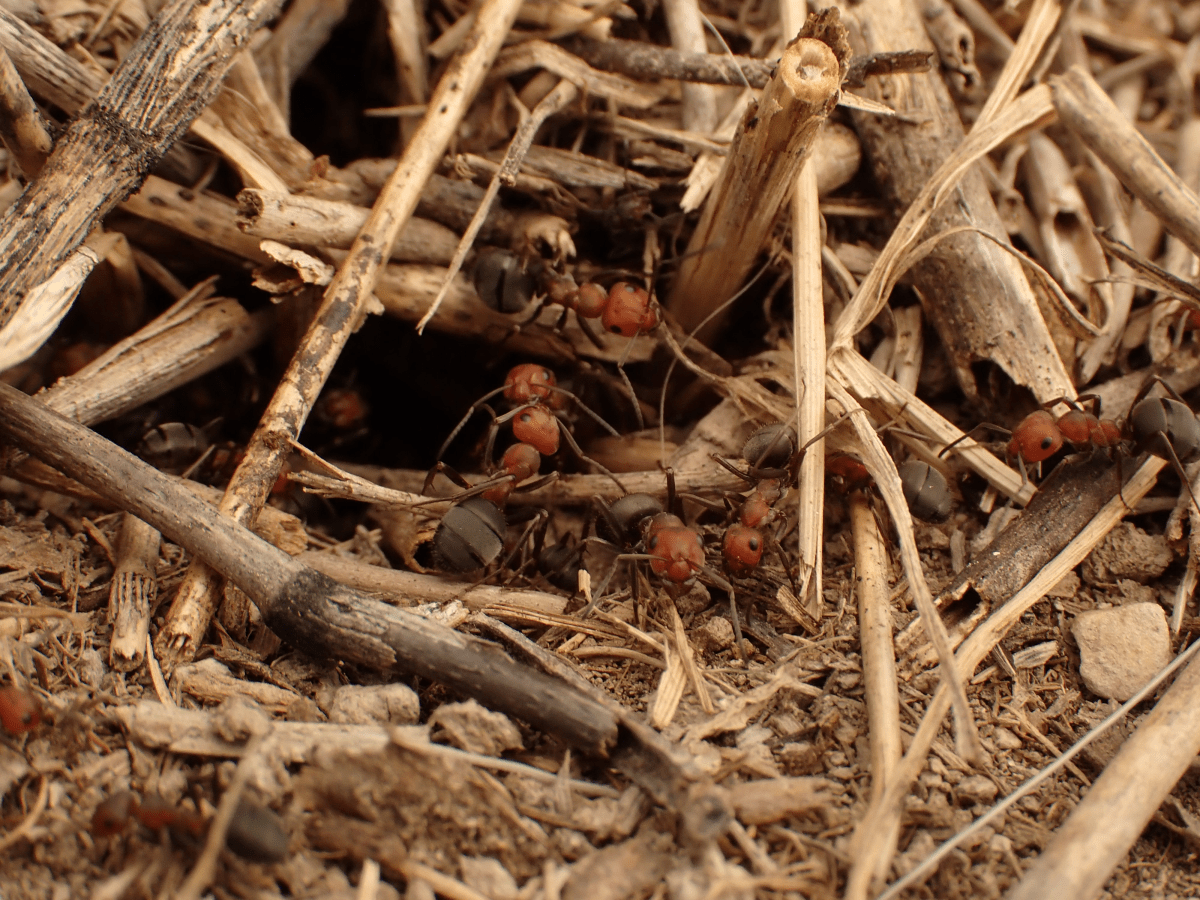
Our mound-building ants in this part of the country are Western Thatching Ants, Formica obscuripes.These ants are rather special because they generally have multiple active queens in a single colony – the young queens often help out and reproduce at home, instead of founding their own new colonies…
Usually I don’t see Salamanders
We seem to have made a good location great for salamanders – ours are long-toed salamanders. Despite being in a near-perfect location for salamanders, most of the time we don’t see them. The information is online- and the field guide does a pretty good job explaining why we see them rarely. They’re classified as “mole”…
-
I spotted this graph, describing a study from India, on CO2 and plant growth. It brought back my Junior College lectures on soil fertility. It isn’t a new topic for research – but it is one that considers one of the concerns about atmospheric CO2.
The lecture worked from fertilizers – and the big three are Carbon, Hydrogen and Oxygen. In general, the carbon comes from organic material in the soil. Here in Trego, I’m raising grass on relatively new soil – maybe 12,000 years of development since the glaciers left. It doesn’t have a lot of organic carbon . . . a nice way of saying it isn’t particularly fertile. The hydrogen and oxygen come from rainfall and irrigation. The nitrogen either comes from soil bacteria or commercial fertilizer.
We look at nitrogen, phosphorus and potassium as macro-nutrients – but compared to carbon, oxygen, hydrogen and nitrogen, they too are micronutrients. We call them macronutrients – they’re the ones on the fertilizer sack. But carbon and water are the heavy lifters in plant growth.
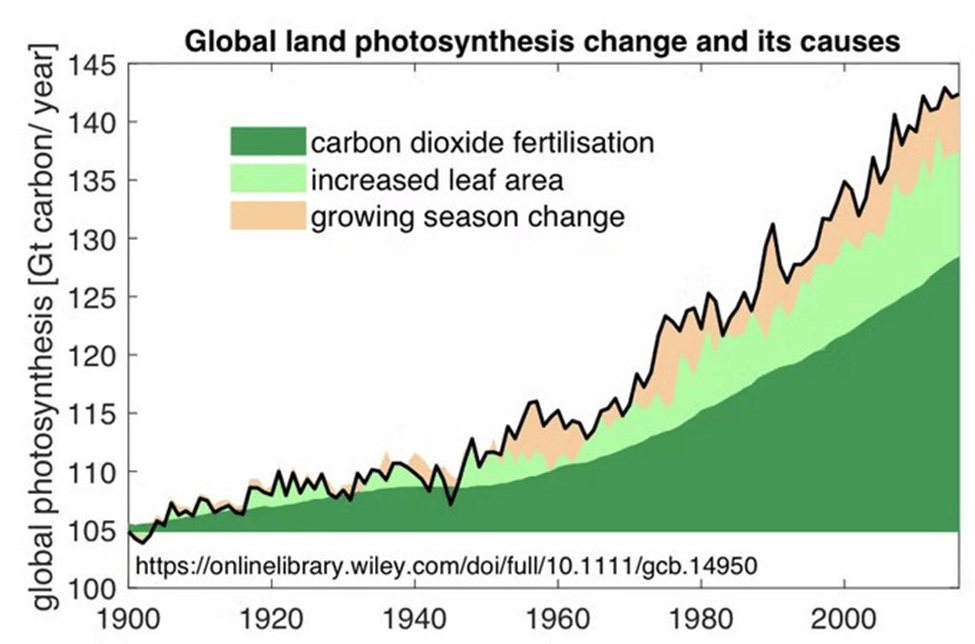
As the graph shows, much of our CO2 fertilization has been a byproduct of industry – CO2 emissions. That increased CO2 has an influence on crop yields. Like many things, atmospheric CO2 can be a blessing or a curse. Input and output appear to have an imperfect positive correlation.
Another study includes this NASA illustration:

I would expect more nutrients and a little longer growing season to result in more plant growth. On the other hand, I suspect those purple fringe areas may indicate reduced precipitation, and its subsequent lower production.
Meanwhile, in sciencealert there’s a piece taken from the Journal of Political Economy supporting a hypothesis that I also first taught in the mid-eighties. The journal abstract is:
The conventional theory about the origin of the state is that the adoption of farming increased land productivity, which led to the production of food surplus. This surplus was a prerequisite for the emergence of tax-levying elites and, eventually, states. We challenge this theory and propose that hierarchy arose as a result of the shift to dependence on appropriable cereal grains. Our empirical investigation, utilizing multiple data sets spanning several millennia, demonstrates a causal effect of the cultivation of cereals on hierarchy, without finding a similar effect for land productivity. We further support our claims with several case studies.”
My lecture from nearly 40 years ago was that cereal grains – wheat, barley, rye, rice, corn – were easily stored, nutrient rich, and made government possible . . . if you consider the first governments to be roughly the equivalent of neighborhood gangs. “Nice little granary and family you have here. Be a shame if something were to happen to it.” As Max Weber reminds us, when you get to the bottom line, government is a monopoly on the legitimate use of force.
If someone “taxes” your crop and you can’t prevent it, that someone is well on his way to becoming a government. I can make the argument that the next stage of government grew from irrigation canals and ditch riders. The guy who controls the H and O that your crops need has power. If his power is legitimized, he’s a government man – only different from the FBI or IRS in degree.
“Even when some parts of the world adopted farming and began producing a surplus of food, it did not necessarily lead to complex hierarchies or tax-levied states.
Only when humans began farming food that could be stored, divvied up, traded, and taxed, did social structures begin to take shape.
That’s probably why cereal grains like wheat, barley, and rice – rather than taro, yams, or potatoes – are at the root of virtually all classical civilizations. If the land was capable of cultivating grains, evidence shows it was much more likely to host complex societal structures.”
I don’t believe that the article coming out 35 years after I mentioned it in lectures proves that I was brilliant and ahead of my time. I suspect that it’s a new topic now because we have a generation of economists who grew up urban – without the on-farm experience that makes some of these things intuitively obvious.
-
I ran across a great lead-in to life expectancy explanations: “One of the difficulties, of course, is that “life expectancy” is a concept most people do not understand to begin with, but it’s in units they’re familiar with – years.”
Her article includes some good graphs, and is well worth reading. She includes a good description of crude death rates and age-adjusted death rates:

This next graph comes from Mary Pat Campbell and she has an article that needs a click and a read.

In this article she points out the changes in life expectancy.

Then she shares what occurred with the Spanish Flu epidemic:
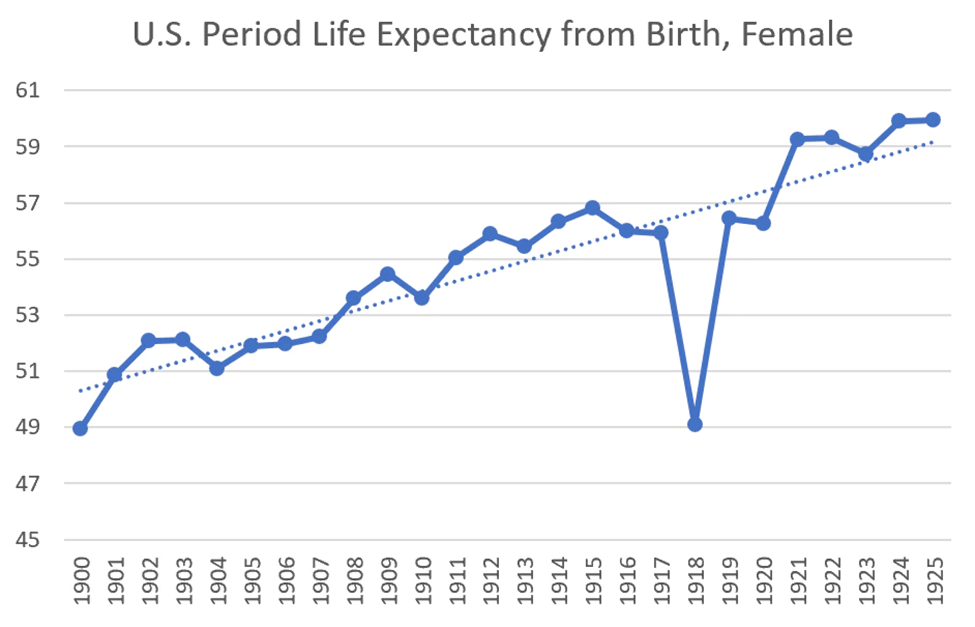
This graph demonstrates what we have encountered during the pandemic:
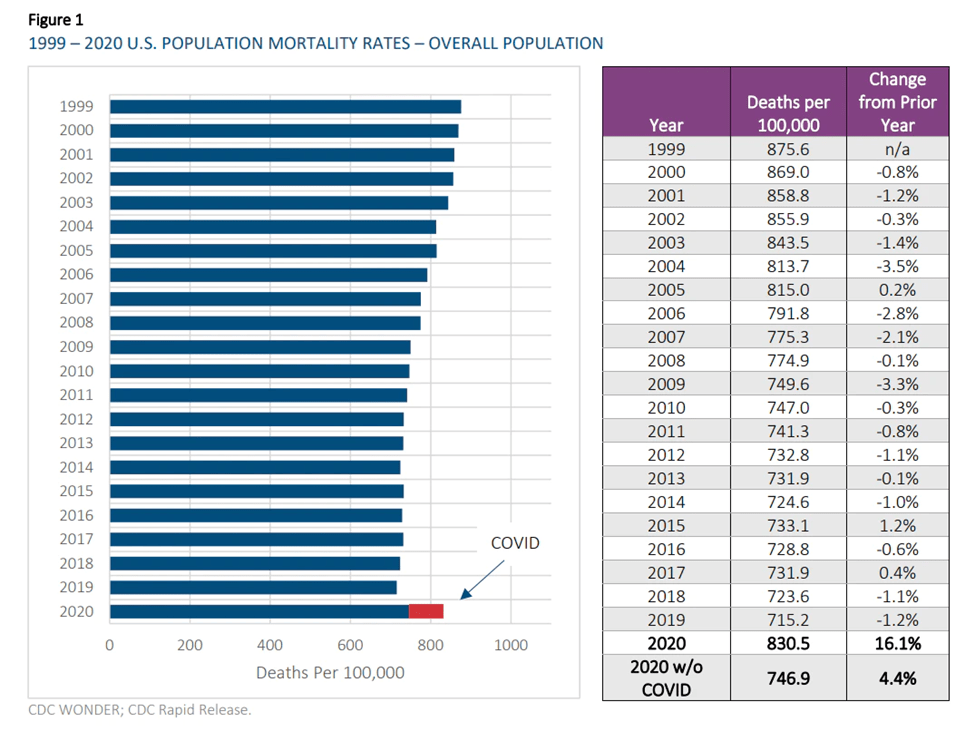
I think keeping up on her posts is likely worthwhile. She does a great job on her specialty aspects of demography. Somewhere in her posts, she explained that a man has to live to be 69 years old before he is looking at a 1% chance of dying in a given year. She’s good, and worth reading.



Want to tell us something or ask a question? Get in touch.

Recent Posts
- A Few Charts and Trends
- The Density of Water Explains When Dickey Lake Freezes
- Watching Iran
- The Quality of Numbers
- Robert Treat Payne Had Traveled To Greenland
- 75 Years Ago in New York
- Recovery Time for a Retiree
- Venn Diagram and DSM
- When Castro Was Cool
- You Have To Beat Darwin Every Day
- Computer Repair by Mussolini
- Getting Alberta Oil to Market
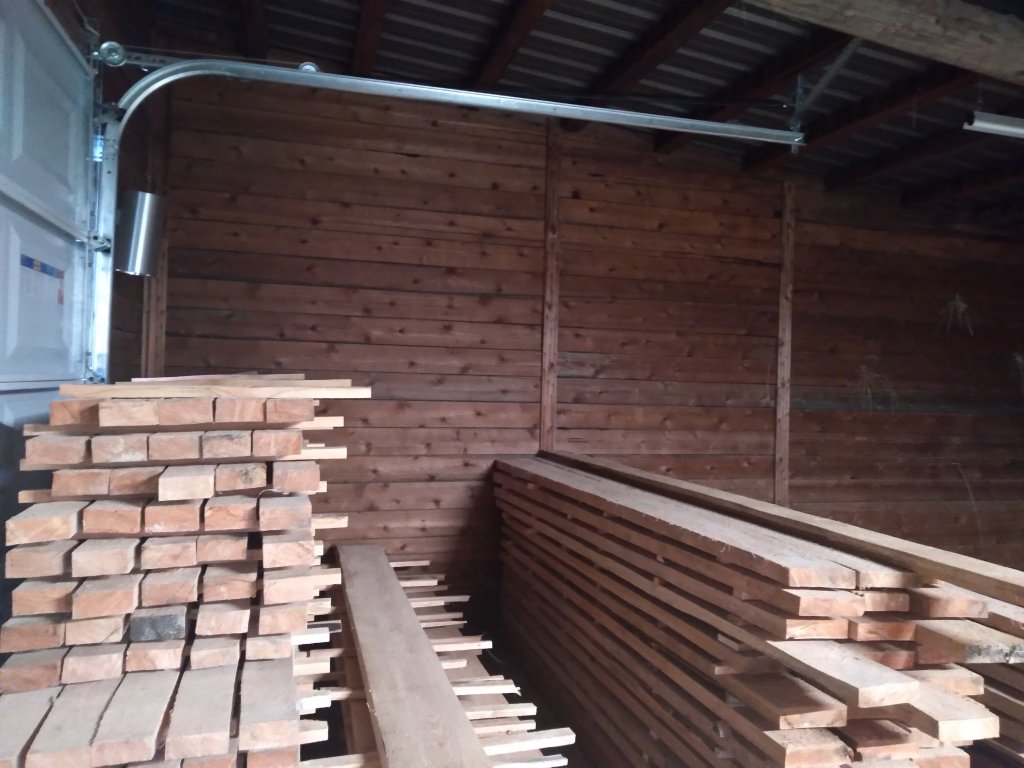
Rough Cut Lumber
Harvested as part of thinning to reduce fire danger.
$0.75 per board foot.
Call Mike (406-882-4835) or Sam (406-882-4597)
Popular Posts
Ask The Entomologist Bears Books Canada Census Community Decay Covid Covid-19 Data Deer Demography Education Elections family Firearms Game Cameras Geese Government Guns History Inflation life Lincoln County Board of Health Lincoln County MT Lincoln Electric Cooperative Montana nature News Patches' Pieces Pest Control Politics Pond Recipe School School Board Snow Taxes Teaching travel Trego Trego Montana Trego School Weather Wildlife writing
 Trego's Mountain Ear