-
I ran across a great lead-in to life expectancy explanations: “One of the difficulties, of course, is that “life expectancy” is a concept most people do not understand to begin with, but it’s in units they’re familiar with – years.”
Her article includes some good graphs, and is well worth reading. She includes a good description of crude death rates and age-adjusted death rates:

This next graph comes from Mary Pat Campbell and she has an article that needs a click and a read.

In this article she points out the changes in life expectancy.

Then she shares what occurred with the Spanish Flu epidemic:
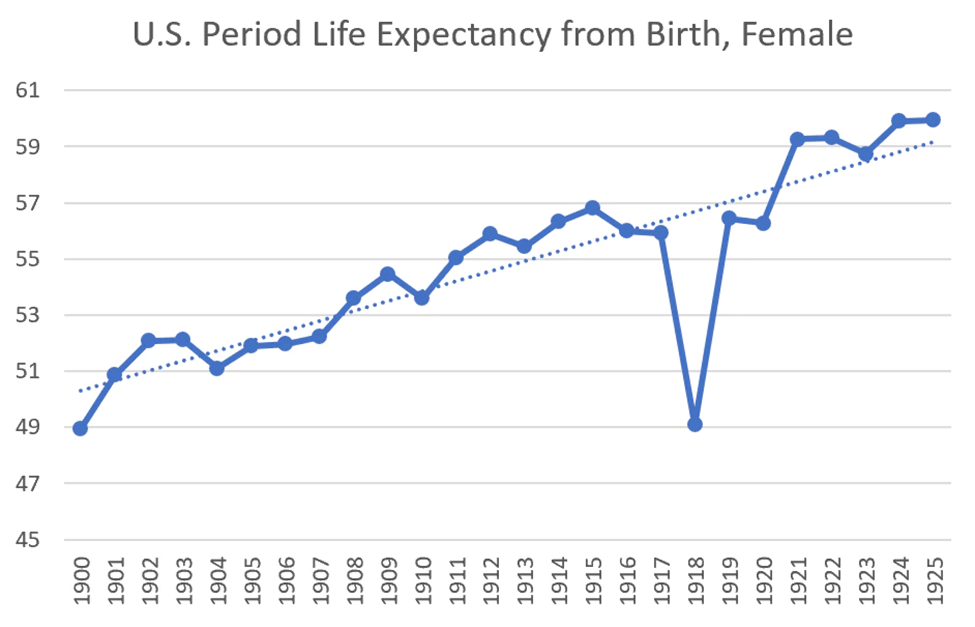
This graph demonstrates what we have encountered during the pandemic:
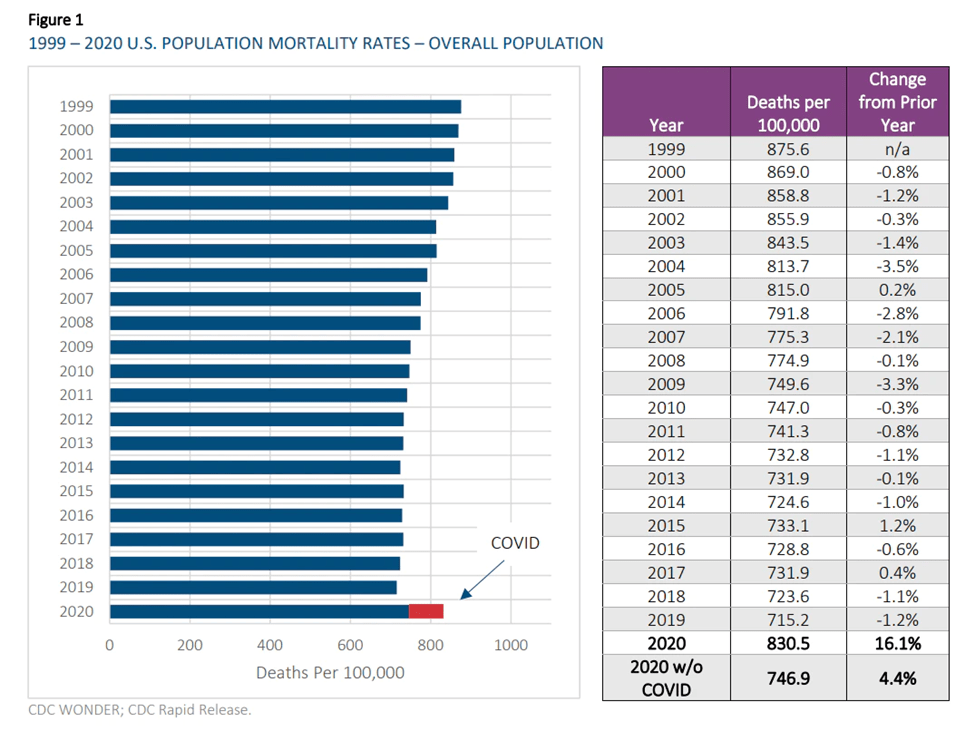
I think keeping up on her posts is likely worthwhile. She does a great job on her specialty aspects of demography. Somewhere in her posts, she explained that a man has to live to be 69 years old before he is looking at a 1% chance of dying in a given year. She’s good, and worth reading.
-
I was a little boy at the time. I was a little boy with a 39 cent benzedrine inhaler, and I could sniff the inhaler and hold my breath for two minutes. And then we moved to Montana and my new inhalers didn’t work worth dammit.
I didn’t realize that Congress had protected me and taken the vital ingredient out of the inhaler for another 30 years. Then, I got sandbagged into teaching the drugs class, and as I researched to prepare myself, I learned. I realized the timing was a coincidence – they took the vital ingredient out of the inhaler just before we moved to Trego. Those miserable congresscritters took away a medicinal inhaler that controlled my asthma, and sentenced me to 30 years of sniffling with a usually runny nose. The article “On a Bender with Benzedrine” showed up in 1946 – and a dozen years later, Congress was busy in DC working to take away my inhaler.
This article tells about the use and misuse of the inhalers before they classified my inhaler as a schedule 2 drug and sentenced me to years of a runny nose, sneezing, and eventually a series of injections to overcome the allergies. I couldn’t find any record of any congresscritter’s concern about a little boy with allergies to Ponderosa pine pollen, Juniper pollen and Brome Grass pollen.
They figured that they could save speed freaks lives and never considered the folks with allergies. Nothing personal – just pointing out that these elected SOBs never considered how important breathing is to a kid.
As I drive and listen to AM radio, I hear public service spots telling what a great job they are doing by not prescribing opiates – yet I read headlines that say “Opioid Deaths Skyrocket Among Teens Due to Fentanyl.” So we check CDC, and find out just how much of the opiate deaths are fentanyl, and then look at the states where opioid deaths are on a major increase. People aren’t overdosing on Tylenol 3 and the big increases are in Louisiana and DC.
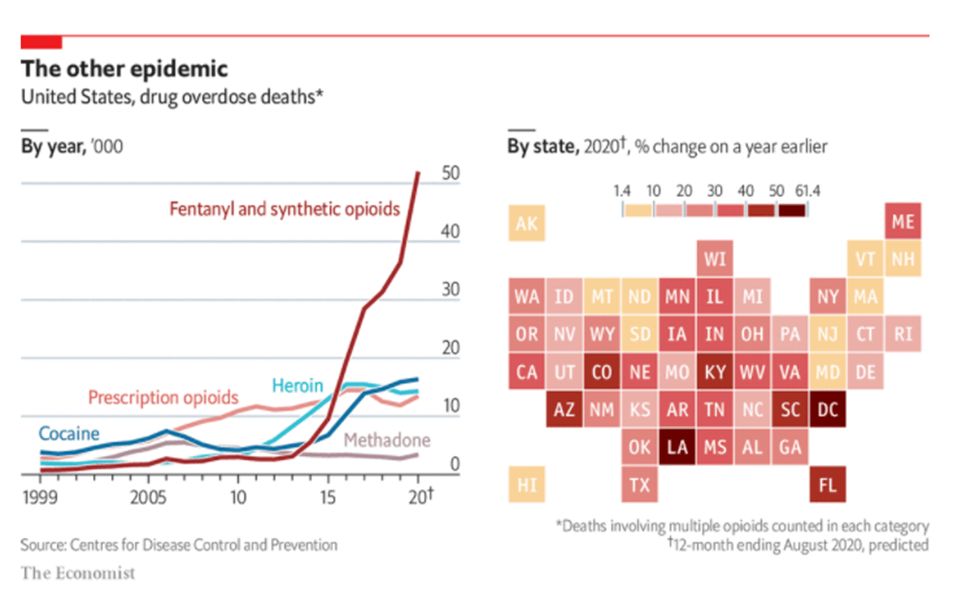
I think I can come up with a better bunch of folks to protect me than Congress.
-
I spotted this chart in an article on college graduates who wish they had been taught more life skills.

The disparity isn’t surprising – I am surprised at the agreement on teamwork and collaboration, and digital technology. Still, I wonder if we’re not looking at the tyranny of low expectations.
What are we actually looking at when employers evaluate Professionalism/Work Ethic? Obviously, employers have a radically different idea than new graduates – yet I remember the song “What’s the matter with kids today?” It was back in the early sixties, and the complaint “Why can’t they be like we were? Perfect in every way” is firmly recorded in my mind.
It may be more an example of the Dunning-Kruger effect. Probably the way of describing the Dunning-Kruger effect is to copy the abstract of the 1999 article: “People tend to hold overly favorable views of their abilities in many social and intellectual domains. The authors suggest that this overestimation occurs, in part, because people who are unskilled in these domains suffer a dual burden: Not only do these people reach erroneous conclusions and make unfortunate choices, but their incompetence robs them of the metacognitive ability to realize it. Across 4 studies, the authors found that participants scoring in the bottom quartile on tests of humor, grammar, and logic grossly overestimated their test performance and ability. Although their test scores put them in the 12th percentile, they estimated themselves to be in the 62nd. Several analyses linked this miscalibration to deficits in metacognitive skill, or the capacity to distinguish accuracy from error. Paradoxically, improving the skills of participants, and thus increasing their metacognitive competence, helped them recognize the limitations of their abilities.”
Unskilled and unaware of it: how difficulties in recognizing one’s own incompetence lead to inflated self-assessments. J. Kruger, D. Dunning 30 November 19, Journal of personality and social psychology
Frankly, the whole article is worth reading – when it first was published, I must have printed off a dozen copies that I shared with colleagues and students. More recently, I ran across a guy spouting off about “midwits with advanced degrees in public health.” He really grabbed my attention with the comment that “they should have to list their GRE scores alongside their degrees.”
Now that one got my attention. First I had to find out what a midwit is – the urban dictionary gives me this description:
“Described by Vox Day as “individuals of above average intelligence, yet not too far from average”.
Generally found in the 105-120 IQ range. These are the people who are considered “gifted” in primary school and perhaps “honors” in high school. In the same vein, they either think of themselves as “smart but lazy” or perform well in school yet do poorly/mediocre on standardized testing. May attend a low-tier university or none at all. Almost always very online, with strong opinions that lack nuance.
Midwits are truly cursed to be neither blissfully dumb nor reap the benefit of being of superior intelligence or a genius. They can grasp general concepts, but are less capable of digging deeper, understanding nuance, or adapting quickly to complex problems, leading to an entire middle class of perpetually unhappy, often vaguely angry people.”
So we have Dunning-Kruger as a descriptor of people who are smack-dab in the middle of the lowest quartile, and midwit for yet another group that ranges between the top 37% and the top 10%. Somehow, I think the idea that they are “very online” probably means that these folks find opportunities to build their reputations down.
The quickest, most useful article I’ve read on the topic is James Thompson’s The Seven Tribes of Intellect. He’s brief, has a way of describing things in layman’s terms, and cuts the actual differences down to 5 groups. I may not agree with him on everything, but we’re looking at his specialty, not mine.
-
This year’s annual meeting for InerBel fell in April (as ever), but that may not be the case next year, due to changes in the bilaws.
It made for an interesting meeting- not just because the reports were interesting, but because members voted on proposed bylaw changes. Why was this interesting? In short, because members first voted to accept of all changes without amendment, which passed in an verbal vote. Then, there was a discussion about the changes, and then a paper vote over whether or not to repeal the results of the previous vote.
If this sounds a little backwards, it isn’t your imagination- it was. So- in order of events: Promotional Video, Various Reports, Election, Vote to accept bylaw changes, Debate over bylaw changes, Vote (failed) to rescind the vote that accepted the bylaw changes.
The changes (which were approved together as a single vote):
- Customers that aren’t within the district boundaries are not members.
- Annual Meeting takes place at a date/time appointed by the Board each year
- Not having an annual meeting at that time does not dissolve the cooperative or “affect the validity of any corporate action”
- Five Percent of all members or 50 members present whichever is fewer will constitute a quorum
- No more term limits for the Board
- Various board positions essentially have all other duties as assigned in their descriptions now
- Voting by mail is okay
The commentary (from various members):
- Substituting elections for term limits is comparing apples to oranges
- The trend in rural cooperatives is to abolish term limits because finding board members is hard
- Term limits are an important part of the democratic process
- Term limits are a stupid reason to lose a good board member
- 50 people is way too few to represent 4,000
- It’s really hard to get a quorum- we barely made it today
- The quorum definition is consistent with state law
- Why didn’t we vote on these individually?
- Why didn’t we get to discuss these first?
- Who exactly doesn’t get to be a cooperative member? What was the reasoning?
- Limiting the members keeps the southward expansion from adding a bunch of new people more concerned with their local issues than those of North Lincoln County
The election- which probably led into some of the concerns about term limits. As is rather typical, there were no more people running than vacancies. Both incumbents ran and were elected. I begin to wonder how often we actually have elections?
The LCHS robotics team came and spoke, presumably because InterBel has been providing them with funding- which evidently worked well, since they’re going to a Worldwide competition. They were pretty enthused- and I, at least, was pretty impressed.
InterBel has put fiber through all of the legacy territory, with about 500 homes left in Eureka and Rexford, which should hopefully be connected this year. There are 130 service requests on the south route. Capital credit checks went out at record rates, there’s been a 30% increase in broadband use, a significant increase in members, and an impressive amount of new construction requests this year.
In general, the cooperative has been experienced substantial and rapid growth. This is presenting some challenges- probably worsened by the inflation and supply chain problems. While the federal government has been providing some unexpected funding, it’s coming with regulatory strings that make it a mixed blessing. On the whole, management seems pretty optimistic about another good year- though they are having to anticipate material needs 6-8 months in advance in order to actually have supplies to work with.
-
I’m looking at folks showing Russian, Ukrainian, and Chinese population pyramids, and ominously stating “Demography is Destiny.” Of course I’ve been looking at Paul Ehrlich’s book The Population Bomb all of my student and professional life, and know what the population pyramid showed him in 1968 – and his interpretation sure as hell didn’t pan out.

Ehrlich predicted famine because of the rapid population growth. Politicians looked at 9.2% of the population over 65, and knew that the Social Security System would be solid forever. After all, “Demography is destiny”, right?
By 1970 – the year I turned 21 – the base of the pyramid showed where the trend was changing. Lifespans had been increasing over the 20th century, and the 1970 pyramid showed that reproduction was slowing down. Ehrlich had ignored the green revolution, and the politicians who could do simple math could realize that Social Security wasn’t going to be a cash cow. We had passed the point where the Demographic Transition Model kicked in. By the way – use PopulationPyramid.net to grab your own data – for years I’ve used spreadsheets to develop my pyramids, but these folks have put the data onto the net, helping make demography everyone’s science.
By 2000, the population pyramid had lost most of the resemblance to a pyramid, and even the most ignorant congresscritters could see the threat to Social Security. Did I mention that Ehrlich’s training is in biology, and that his dissertation was on butterflies?

I have no problem with the idea that “Demography is Destiny.” The problem is that destiny is more readily observed in hindsight than in projecting today’s data into the future.


I’m a rural demographer – well ahead of the curve in my specialized areas, but my areas are rural US – the real specialized areas are Hutterite and Reservation populations. I can make some projections from the Russian, Ukrainian, and Chinese pyramids – but they basically start with, “Gosh! There are a heckuva lot of old people in these countries. There should be plenty of work for the younger generations.”
Seriously, go to PopulationPyramid.net, find the answers to your own questions. In 1970, demography was based in the universities because their libraries held all the data. Now, the data is online, and the science is open to everyone. And I enjoy being able to share my science.
-
Looking at where your school ranks in comparison with others is important. Montana’s Small School Alliance conducted a survey of small schools, and we’ve excerpted where Trego ranks in certain specific categories. Here they are, with some explanations for abbreviations. Many of us speak fluent English, but are not fluent in bureaucrat.
Taxable Value per ANB – $84,491 – pretty much the median. Still, this category needs an explanation, and then the explanation needs a second explanation. ANB is an abbreviation for Average Number Belonging. Since that doesn’t really explain anything, consider this to be taxable value per student (it isn’t but it’s close enough).
General Fund Budget wo SPED – $190,972 – #20 out of 33. Since the median is 16 or 17, 20 is pretty close to the center of the pack. SPED is an abbreviation for Special Education – and for a small school, SPED can really affect the budget. There are two ways SPED affects the budget – generally, somewhere around a sixth of the students qualify for SPED. That’s the group statistic. Then the individual student can qualify as needing very little, or a great deal. It’s easy to see why the survey took SPED out of the calculation – if it were left in, the survey would be apples and oranges.
Cost per ANB to General Fund Budget wo SPED – $7,638 – right at the median. Basically cost per student, excluding SPED.
General Fund Reserve as percentage of General Fund – 8.45% – third from bottom. This number isn’t a great surprise – it’s only in the past couple of years Trego’s school board has even started on a building reserve fund. Reserves are important, but need to be used at times.
2021-22 Guaranteed Tax Base – $0 – a dozen of the 33 surveyed schools tied for bottom. I’m not sure this is a bad place to be.
Over Base Budget – $43,038 – 20th of 32 – still very close to the median.
Over Base Mills – 20.38 – median.
Transportation Budget per ANB – $1,960 – fourth from top, more than double the median. This category shows Trego with high expenses to bring students to school. Just the statistical placement of this category shows that it needs to be reviewed. It may just be the remote nature of the district, but it may also mean alternatives need to be examined.
SPED personnel -17th out of 32 – another median. Remember that SPED can be a statistical artifact – if it turns out to be 10% or 25% eligibility, opposed to 16%, the general statistic isn’t the controlling one.
Teachers Salaries as percent of General Fund – 59.81% -6th from top. This means in the top 20% in this category.
Teacher/Enrollment Ratio – 5.55 students per teacher – 27th lowest ratio of 31 schools. This is probably a good thing from an education perspective. From an economic perspective, a slightly higher ratio might be appropriate.
Base Teacher Salary – $32,000 – median. (For 2022-23, the base salary is $33,920.
Average Teacher Salary – $36,909 – 31st of 41- a figure that is in the bottom quartile because none of our teachers have longevity – remember, it wasn’t that long ago that we only had 4 “ANB”.
School Clerk – low in survey $15, high $45.64 per hour, Trego $20 per hour. Trego is about in the middle.
Bus Driver – low in survey $12.85, high $27.58 per hour. Trego is $18 per hour. Since the entire transportation program merits examination, this probably deserves a glance too – but is close enough to the median that it seems unlikely to be driving the transportation budget up.
Curious? Want more information? Barring confidentiality issues, school information is typically very public, as it is publicly funded. Contact the school clerk if you have any questions, or just want to learn more.
-
We tend to believe we grew up in normal circumstances. We’re not always right, but our home lives usually seem normal to us. As we grow older, we learn that our view of normalcy doesn’t match our friends and colleagues view.
To me, it is normal to share my backyard with a grizzly or two every year. Likewise it is normal not to have venomous snakes underfoot. Neither situation is normal to folks living in North Carolina or Florida. So with this sort of concept in my head, I looked at an article on Real Clear Science “Four Reasons Why Our Solar System is Really Weird”.
Now that’s kind of the difference between Newtonian physics and Quantum. If we look at the universe, most of it kind of lacks air – it’s essentially vacuum. Newton’s normal world had air – but the rest of the universe doesn’t. Here are a few excerpts from Real Clear Science – and I hope you will read the whole article.
“Only one other known system, Kepler-90, contains as many planets as the solar system, according to The Extrasolar Planets Encyclopaedia,” Harry Baker wrote for Space.com.”
NASA explains “Our Sun is a little unusual because it doesn’t have any friends. It’s just one Sun surrounded by planets, asteroids, comets, and dwarf planets. But solar systems can have more than one sun. In fact, that’s often the case. More than half of all stars are in multiple star systems. That means the solar system has two or more suns in it.”
Yellow Dwarf in the System. Our sun is what’s called a G-type main-sequence star, more commonly known as a yellow dwarf.Jupiter is the juggernaut of our solar system, with a mass more than two and a half times that of all the other planets combined. The simple fact that our solar system hosts a gas giant of this size sets us apart, says astrophysicist Sean Raymond. Just 10-15% of Sun-like stars have one.
-
Edward Stahl shared a bit about his early days with the Forest Service. This segment starts with his elevation to the Supervisor’s office in Libby. I hadn’t realized that Stahl was a seasonal – I never met a Forest Service seasonal who wound up with a mountain named for him. It looks like he was responsible for the route over Dodge Creek to the Yaak. The whole story is at npshistory.com.
I was laid off October 1st and met a party from Eureka and joined them hunting goat at Bowman Lake. We had an early snowstorm and crossed the range to Eureka via Yakinikak and Grave Creek. This trail traverses the locale described by Ernest Thompson Seton in his story, “Krag, the Kootenay Ram.”
My vacation at Eureka had just ended on January 1, 1907, when I received instructions to report for duty to David Kinney at Libby, Montana, Supervisor for the Kootenai National Forest. (Glen Smith, Roscoe Haines, and I.)
We built a Ranger cabin near Pipe Creek, twelve miles north of Libby, that winter. Bill Doak, our neighbor, had been purser on a steamboat that plied the Kootenai River between Jennings, Montana, and Fort Steele, British Columbia, in the late ’90’s. It takes some stretch of the imagination to believe a steamboat could navigate the Koontenai. Two steamboats were wrecked on the same day in the rocky canyon north of Jennings. Boat traffic was discontinued about 1901.
In the spring I was sent to Gateway to cut trail across the Purcell Range, to the Yaak River via Dodge Creek. I bought two matched black ponies and packed to the base of Yaak-Mountain, crossing the Kootenai on Mills’ Ferry, located in British Columbia.
A Frenchman named Solo Joe was placering near the summit of the Purcell Range. He warned me that if I ever ran across a trapper named Olson in the Yaak River District to mistake him for a mountain lion and shoot him. If I had followed Joe’s advice it would have saved a lot of misery. But I never saw Olson. He was crazy. “Dingle on the bean,” Joe said. Olson had once set a bear trap in the trail for Joe. A year later Ranger Raymond wrote the Supervisor at Libby to have an officer pick up Olson as he was dangerous. The Supervisor, a new man from the east, kidded Raymond for being afraid of Olson but took no action. Two of Raymond’s laborers on tail work, upon going to their homestead for the weekend, met Olson coming out the door. He said he had called to borrow some soda, but he had put strychnine in the sourdough can. One man died that night but the other one survived. Their names were Todd and Hensley. Raymond took Olson in and he was placed in an asylum, where he later died.
It was a lonely job cutting trail until a man named Cody was sent up to help me. He was the best all-round woodsman, packer and horseman I ever met. He had two half-broke horses loaned to him to break for their use. He did not agree on the route I picked for the trail so I told him he could move over to the western slope and cut trail where and how he chose, which he did. We met on weekends to go for supplies.”
-
I was looking at American Digest and there was an article about Home Depot with its training material on privilege. I think the first time I heard about privilege, it was another white guy telling me about my white privilege. Not his white privilege, but mine. He was an Ivy graduate. I’m a cow college graduate. Somehow, just looking at race-based privilege didn’t seem to be packing it
I thought I understood white privilege. I don’t want to be another race – I’m comfortable in my pigment-challenged hide. I’ve known some Asian colleagues who were equally comfortable with their privilege. I have the idea that being white provides me a little more opportunity, to succeed or to fail. I don’t have the idea that white privilege is the be all and end all in our competitive world. I might be able to dress out of Muhammed Ali’s closet – we’re about the same size – but my white privilege could never match his abilities.
The Home Depot training material stresses that “If you’re confident that the police exist to protect you, you have white privilege.” I’m not really sure about being confident that the police exist to protect me. Frankly, I’ve encountered police that were more concerned about their own safety than protecting professor Mike even when I was escorting my daughter and her friend through an educational facility. I think Bob Dylan got it best – “the cops don’t need you, and, man, they expect the same.” If I have to be confident that the police exist to protect me, my white privilege is a low rate privilege.
-
Modern medicine does not often restore youth. Surgery and chemotherapy kept me on the green side of the grass when I was hit by colon cancer – but came at a price in physical fitness. This year, I discovered that the Opthamologist fellows can return a large portion of youthful vision.
I went in with the MD’s orders to check for diabetic retinopathy. The damned diabetes came along with struggling through chemo – and type II diabetes is definitely better than dead. No complaints, and no diabetic retinopathy. That was good news. On the other hand, cataracts (I knew that was there) and the onset of macular degeneration. The macular degeneration diagnosis set me back – that was the cause of my father’s blindness. Still, analysis conquers fear – by the time Dad was my age, he needed to get off the road. He didn’t – but he should have. My macular degeneration has just started at 72 . . . and I made the decision to go for lens replacement surgery as soon as possible.
It’s wonderful. I was still testing a 20-20 vision with glasses – but the best I can describe the cataracts is as scratched, mud-spattered glasses. Seeing my world again with youthful vision is a wonderful thing. I had lost the distinction between nearby treetops and the mountains that form my horizon. It’s back. Trees on distance ridgelines are distinct, no longer blurring into a single mass with their neighbors. Deer at the edge of the forest are easily seen. I can identify the little diving ducks in the air, when I am too far away to hear the whistle from their wings.
There is an iridescent flash from the raven’s black feathers as he banks in the sunlight. The white from the bald eagle shines through the Douglas fir as he flies between trees in areas where a month ago he disappeared. I recall the improvement in vision that came with my first pair of glasses – now the improvement is there when I remember to take the reading glasses off.
It’s not the only miracle of modern medicine – my grandmother was bedridden after a broken hip, so I see hip replacement surgery as miraculous. Three times arthroscopic knee surgery has taken me from the crippled category to ambulatory. But this lens replacement is the surgery that returns youth. Will it last? With the onset of macular degeneration, the answer is an obvious no. That isn’t a problem – I have a new lease on vision. I know that lease will one day expire. I am enjoying what I have.
Want to tell us something or ask a question? Get in touch.

Recent Posts
- Voting Yourself In
- A Few Charts and Trends
- The Density of Water Explains When Dickey Lake Freezes
- Watching Iran
- The Quality of Numbers
- Robert Treat Payne Had Traveled To Greenland
- 75 Years Ago in New York
- Recovery Time for a Retiree
- Venn Diagram and DSM
- When Castro Was Cool
- You Have To Beat Darwin Every Day
- Computer Repair by Mussolini
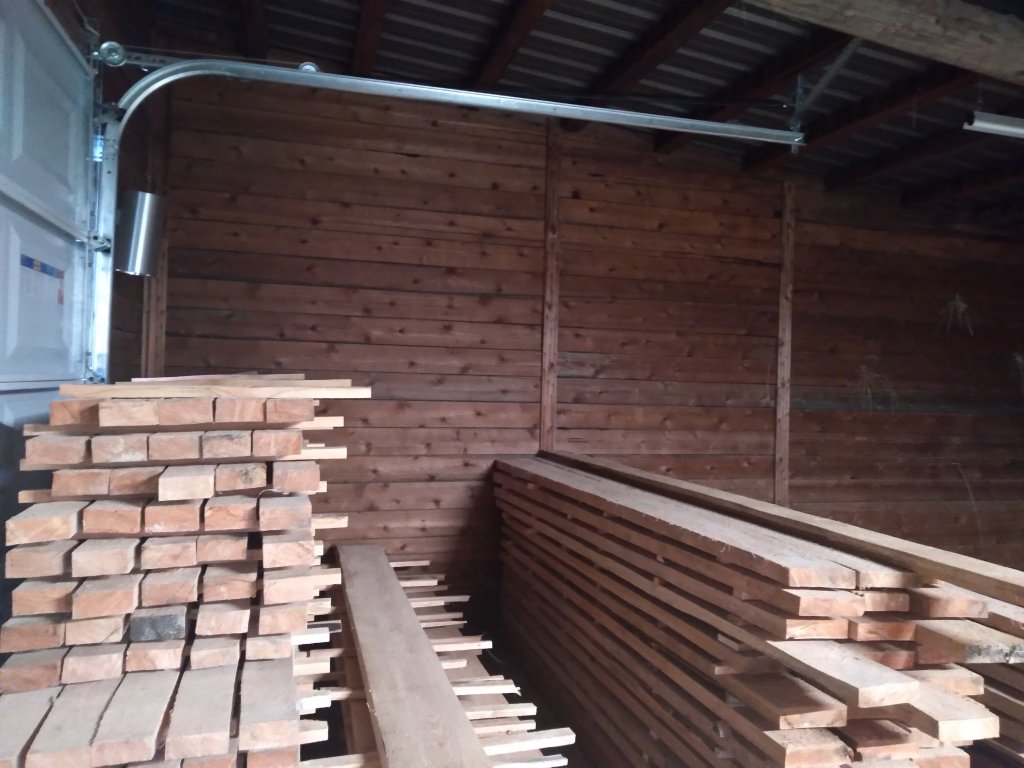
Rough Cut Lumber
Harvested as part of thinning to reduce fire danger.
$0.75 per board foot.
Call Mike (406-882-4835) or Sam (406-882-4597)
Popular Posts
Ask The Entomologist Bears Books Canada Census Community Decay Covid Covid-19 Data Deer Demography Education Elections family Firearms Game Cameras Geese Government Guns History Inflation life Lincoln County Board of Health Lincoln County MT Lincoln Electric Cooperative Montana nature News Patches' Pieces Pest Control Politics Pond Recipe School School Board Snow Taxes Teaching travel Trego Trego Montana Trego School Weather Wildlife writing
 Trego's Mountain Ear