-
There was a meme out a while back, pointing out the differences between Fahrenheit, Celsius, and Kelvin. Measuring was a challenge in those early days – heck, measuring was a challenge to me after I had completed college classes on the topic. Somewhere in the Glen Lake Irrigation District files of “as built” projects, my blunder on the Tamboer Siphon may still be recorded – I carefully picked the best spot for an inlet structure, numbered it 0+00 and began surveying. A couple weeks later, I realized that I needed shots further upstream and had to start using negative numbers to finish the project. It was a solution, but not an elegant solution. After the experience, I started at 10+00. Less mockery occurs when your mistakes aren’t so obvious.
Anders Celsius made a similar blunder – he set the boiling point of water at 0 degrees and the freezing point at 100 degrees. Then as he continued his studies, he found that the boiling point of water changes with elevation (atmospheric pressure) while the freezing point of water was independent of both latitude and atmospheric pressure. After Celsius died, the Royal Swedish Academy of Sciences noted that Celsius’ successors had reversed the measurements. It does make more sense to start measuring from something constant.

The amazing thing about the Fahrenheit scale is that it came first. Without a consistent scale on the thermometer, the extra energy involved in shifting from water to ice (or vice versa) makes precise and accurate measurements somewhere between difficult and impossible. Fahrenheit chose to set his zero at the point that the reaction between ice, water and ammonium chloride quit working. Once he had that, and marked his thermometer, he could repeat his experiment and determine that he had a consistent zero, based on a chemical reaction. His next line was assuming the human body temperature was 100 degrees. Then he could measure the temperature of ice water. A bit of refinement, and freezing became 32 degrees, body temperature 96 degrees, and individual degrees could be measured by cutting the difference in half – 32 to 16, 16 to 8, 8 to 4, 4 to 2, and in 5 steps Fahrenheit had the gradations on his thermometer. In the US we still use his method, though the rest of the world uses the modification of the Celsius system.

William Thompson (Baron Kelvin) came up with the Kelvin scale in 1848 – where zero was based on his calculations of absolute zero. Thompson’s calculations showed absolute zero at -273 degrees centigrade. In the following century and a half, his calculations have been corrected to -273.15.
All told, it’s kind of humbling to see what these folks could do in the 18th and 19th centuries, without calculators and computers. Thermometers of sorts were invented long before – but developing a universal measuring scale was long in coming.
-
As I watch a couple of congresswomen pushing for student loan forgiveness – one owes “over $70,000” and complains about it being “mostly interest”, while the other owes $17,000 and wants her loans forgiven. Congresscritters are paid $174,000 annually. Now I don’t have any experience at being paid $174,000 per year. Despite that lack of experience, I’m pretty sure I could live frugally on a mere $100,000 each year until I had paid off my own loans. I may be wrong – but the evidence I have makes me believe that I could.
I’ve had a career in the academy, and financial aid has always been on the fringes of my world, beginning with the first competitive scholarship. I can make a pretty good argument that the Basic Educational Opportunity Grants (renamed Pell Grants in 1980) and the Guaranteed Student Loans have driven the increased costs of tuition and fees – heck, even dormitories – in the past 50 years. As I recall, my first year of college saw $1304 go through my checkbook – tuition, books, dorm, pizzas – total cost. At 18, I was paid $2.50/hour for a summer job – $100/week for 12 weeks. It could be done. You can dig out your own college cost estimates – the universities all have them – and contrast them with 12 weeks pay. College costs have increased far faster than wages. It isn’t easy – but signature loans are available.
A few years back, I was assigned an advisee who was hanging in with a 1 point something GPA on probation. Lacked any academic strengths, but explained that she needed to be enrolled to keep the student loan that was paying the rent on the apartment she shared with her boyfriend. Earlier that week I had listened to a new Ph.D. telling how her student loans – a bit over $40,000 were her boyfriend’s reason for not marrying her. The Guaranteed Student Loan had become a bride price he was unwilling to pay. She was employable. My new advisee was not nearly as employable as she had been the day she graduated high school. After two years of college, she had added transcripts with a D average to her resume. I’m pretty sure she flipped me off with both hands as she walked down the hall after I suggested she evaluate things and come back later.
Glancing at UM’s page on the costs for an undergrad, I see $22,258 per year. Tuition and fees are $7,412 for Montana resident students. If we figure 16 credits per semester, 32 credits per year, that amounts to about $230 per credit. College is not an inexpensive place to find yourself.
I’ve known students who graduated from a land-grant who had $140,000 in student debt. Unusual, yes – but Congresswoman Tlaib talked about graduating with almost $200,000 in student debt. I’m used to students getting by on the cheap – but the world has changed. It’s easy to have a Bachelor’s diploma that includes half the cost of a house purchase as existing debt.
As a demographer, I’m kind of used to working with numbers about jobs. There are unyielding equations – one is that it takes a population of about 30,000 to provide a job for one Ph.D. sociologist. There’s roughly one position in Congress for every 750,000 people – it does give perspective. Those simple numbers should be available to anyone who is enrolling in college. The principle of compound interest should be a required class. I recall another student – bright woman who had started school in her 40’s. She was ABD – all but dissertation. At 52. When we worked the math on her student loans the unyielding equations said that she would not be able to make more than minimum payments. When we looked at the life expectancy charts, she could anticipate her funeral before the debt was paid off. And it is a lot easier to get a student loan than a car loan or home loan.
A table from studentloanhero.com shows 1.71 trillion dollars total in student loans. Loans owed to the government are:
Direct Loans $1.32 Trillion 35.9 Million Borrowers FFEL Loans $245.9 billion 11.0 million borrowers Perkins Loans $5.2 billion 1.7 million borrowers Total (All Federal) $1.57 trillion 42.9 million borrowers I can still (barely) handle the math. My calculator can’t handle all the zeroes. A trillion is a thousand billion. A billion is a thousand million. Just for the record, there are a few less than 330 million people living in the United states. Basically one out of eight Americans has student loan obligations. Go ahead. Work the math.
-
It began on a Fall afternoon in the mid-eighties. I was at my desk in the science building when a dark-haired young woman lurched into my office, squealed like a pig, fell across my desk, and pushed a piece of paper at me. I took the paper, and read “Please help me. I am not retarded.” Block printing, in pencil, many erasures. She squealed again as I helped her back to her feet, then sat her in my chair.
I went into analytic mode – early twenties, one hand barely functional, no balance, can’t talk. Makes communication difficult. Computer lab down the hall – let’s see how she can do typing answers.
The first thing I learned was her name – Patti. She had been in a car accident, spent 5 months or so in a coma, and then been moved to a group facility. She had gotten to campus on an outing, and planned her escape. She had lurched into my office on her 7th escape attempt. Would I help? Only much later I would get the barest idea of how hard she had worked to write and keep her note, of the many attempts the crippled girl had made before she finally made it to campus. Inside the battered body, the mind was intact but isolated.
I balanced her weak left side, and we walked across campus to Doc Brown’s domain. Doc was our college psychologist – and I explained that Patti had came into my office, wanted to enroll, but was going to need some testing to figure out what sort of accommodations she would need. Obviously communication would be a problem.
I don’t know who it was that learned Patti had been a secretary at Adolf Coors. I don’t know who got in contact with Coors. I do know that someone at Coors made sure Patti got an Apple with a word processor and brought the gift of communication back to her. At first I’d see her coming across campus balanced by one gunsmithing student or another. Later, I’d watch her cross campus alongside one of the girls basketball players. In general, it was safe to say the world respected the young woman trying to get her life back.
All the while, she would make a point of going out of her way to stop by the science building every week or two. She was recovering the ability to type with her good hand. Math – even simple addition and subtraction – was pretty much gone – but she did have a calculator. Speech never came back.
I would like to believe there was a happy ending. I left Colorado and moved back to Montana. We exchanged letters occasionally – but, as Dad said, “When the anchor goes up, everything is finished. But Patti gave me an opportunity to do right, and many people at TSJC also shared in that opportunity.
-
Some folks write that the verdict in Kim Potter’s manslaughter case was too harsh. I kind of understand the folks who figure two manslaughter convictions for the same killing could be a bit excessive. I understand that she really did intend to tase (instead of shoot) the guy. I understand the guy she shot contributed to the incident. I understand that the woman Daunte Wright pulled a gun on and attempted to rob and choke would have had a great self-defense plea. I understand Daunte was not a nice man.
I also understand that people who are authorized to use violence on behalf of the state need to be held to a higher standard than actors, than citizens in general. Potter had 26 years of experience, and her career ended with a negligent discharge and a dead guy. It is correct to expect near perfect gun handling from our police – yet many are not particularly proficient with their pistols.
Just before Christmas, a 14-year-old girl was shot and killed in a clothing store’s dressing room. The story reads like a guy who was mentally ill created a furor, attacked a woman with a bicycle lock and was shot and killed by the responding LA police. At least one officer failed to realize that behind his target was an occupied dressing room. Colonel Coopers 4th rule: 4.) Be sure of your target. The long version is “Be sure of what is between you and the target along with what is behind the target”. Responsibility accompanies the decision to carry a gun – for all of us. Even more responsibility accompanies one who is authorized to use deadly force.
Carrying a pistol on the right and a taser on the left may be a systemic problem, a decision made by someone who had little or no experience with how folks react under stress. I’ve never used a taser – but I have had folks tell me how I should pack bear spray instead of a pistol. I’ve carried a handgun off and on for over half a century. Habit tells me where it is. The phrase is unconscious competence – and if I were to convert to bear spray, my skill level would be either conscious competence, or conscious incompetence. If I carried bear spray on the left and a revolver on the right, I would probably do the habitual thing and pull the pistol. An administrative decision may have contributed to the negligent shot that killed Daunte Wright and sent Kim Potter to jail. Still, we should expect better gun handling from police.
Colonel Cooper had 4 rules:
RULE I: ALL GUNS ARE ALWAYS LOADED
RULE II: NEVER LET THE MUZZLE COVER ANYTHING YOU ARE NOT WILLING TO DESTROY
RULE III: KEEP YOUR FINGER OFF THE TRIGGER UNTIL YOUR SIGHTS ARE ON THE TARGET
RULE IV: BE SURE OF YOUR TARGET
Kim Potter violated rule II. It may have been an accident. It was definitely negligence.
-
In the last half of the seventies, the Monday after Christmas was committed. I would meet Jay Penney at Graves Creek, get into the Snow Survey crummy and then we would measure the snow depth at Weasel Divide, Stahl Peak, and Graves Creek. It’s so long ago that none of our measurements remain in the 30 year average. We were the moderns – 440 cc Skidoo Alpines, and clockwork recorders that measured the snow-water equivalents through the month – all we needed to do was wind the clock and pack the chart away. The guys we followed had done things differently – drive up Burma Road, snowshoe or ski to Weasel Cabin, build a fire, measure the snow course, eat dinner, sleep, hike into Stahl the next morning, measure the snow course, camp in the lookout, hike down, measure Graves Creek, reach the road and drive back into town.
My work was transitory – duplicating the traditional measurement dates and working with new recorders, battery power, early solar cells, and working with the technology that would make us unnecessary.
My work was easier than my predecessors. I used snowshoes where I couldn’t take a snowmobile. Today, the remote monitoring is so good that I can click the link, and learn what the snowpack is on Stahl without leaving the warmth of my house. Try it, you’ll like it. https://www.nwrfc.noaa.gov/snow/snowplot.cgi?STAM8
Date Time PST Snow Water Equivalent (inches) Snow Depth (inches) Snow Density (%) Precipitation To-Date (inches) Current Temperature (degrees F) 12/27/2021 0900 18.9 67.0 28 36.9 6.6 12/27/2021 0800 18.9 67.0 28 36.9 7.0 12/27/2021 0700 18.9 67.0 28 36.9 5.0 12/27/2021 0600 18.9 67.0 28 36.9 3.0 12/27/2021 0500 18.9 67.0 28 36.9 3.0 12/27/2021 0400 18.9 67.0 28 36.9 2.1 12/27/2021 0300 18.9 67.0 28 36.9 0.9 12/27/2021 0200 18.9 67.0 28 36.9 4.6 12/27/2021 0100 18.9 68.0 28 36.9 2.1 12/27/2021 0000 18.9 68.0 28 36.9 13.6 Nearly 19 inches of water in 67 inches of snow – 28% density, and warming after a near-zero night. Of course, this is what would have been the January 1 run, and definitely not the time to announce whether the year was a high or low snowpack. The next chart replaces the hand-written notes that Jay carried when I started, or that I carried after congestive heart failure took him off fortyfive time – 045 was the code we used for time spent on snow surveys.
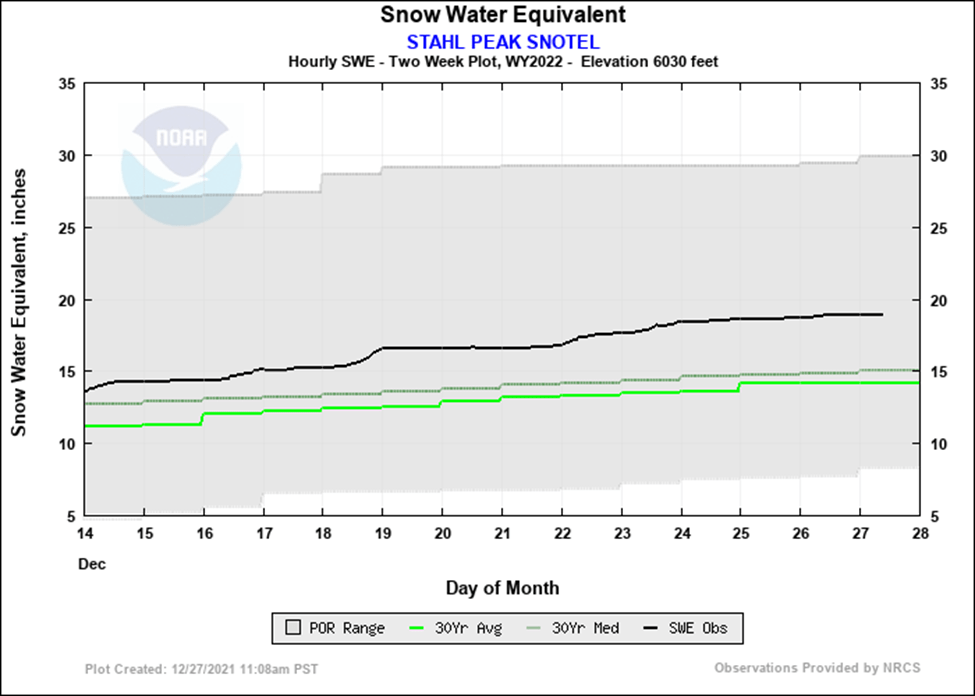
26% above the thirty-year median. It’s a number, but if we use it, we’re projecting from too little data. Things can change with January and February’s snows – but above the mean is good. Full soil profiles are good for plant growth and delay the susceptibility to fire. And the Corps of Engineers paid that fortyfive time to get information to manage the reservoirs.
The next chart shows the 30 year mean, average and this year’s numbers in the lines – but the shaded area shows the variance. You may note that by August 1, the snow is always gone, but the chart shows that it has melted off by the first week of June.

As an old man, it’s good to be able to keep up on the information. We did haul a lot of equipment in and out on those Alpines to help move toward the automated systems we have today.
-
I noticed a meme this morning, stressing the well known Finnish Sniper Simo Haya. Like all memes, it is partly true – Haya’s rifle was a Mosin-Nagant. It was also worked on to be competitive in target shooting, and he also used a submachine gun in racking up windrows of dead Russian invaders.

Simo Haya is a well-known name compared to Aimo Lahti. Of course, Finland is a small country, and allied itself with Germany in the second world war, so even the name Simo Haya doesn’t have a huge amount of recognition in the US 80 years after the war. So I will write on Lahti.
I have no doubt that John Moses Browning was our nation’s top gun designer. Likewise, it isn’t hard to put him above Mauser or Schmeisser – Browning worked with everything but bolt actions. Mauser perfected the bolt gun. Still, I would put Aimo Lahti at about the same level as John Moses Browning – an impressive gun designer, limited by his nation’s small size, and more impressively, forced into retirement as part of the deal to end the Finnish-Russian war. In the English language, Kevin O’Brien probably said it best
“The spiteful Soviets, whose troops had been shot full of holes by many Lahti designs, demanded that that the Finn retire from arms design, and he did, living on a pension until 1970. His only child became a Finnish Air Force aviator and perished during the Continuation War.”
The sentiment has probably been better written in Finnish, but I don’t read the language. O’Brien has a lengthy post about Lahti and his accomplishments at https://weaponsman.looserounds.com/?p=15260 .
I’ll include another quote from O’Brien – more to encourage folks to click the link and read the rest of the story. It includes photographs – and does a good job of explaining why I rate the man as the closest to John Moses Browning.
Aimo is little known in the Anglosphere, but his name rings a bell because two of his best-known guns bore his own name: the Lahti M/35 automatic pistol (also adopted in Denmark and in Sweden as the M/40) which combined the natural-pointing grip angle of the Luger with a completely different mechanism, and the Lahti M/39 semiautomatic antitank rifle, advertised for years in the pages of American Rifleman and other 1960s gun magazines. The M/39 was the object of every boy’s envy, later, even if by 1939 it was already marginal medicine on tanks. Lahti would use the same basic mechanism in the beefier VKT 40 anti-aircraft gun, usually seen as a twin mount.
He also co-designed the standard Finnish light machine gun of the Winter and Continuation Wars, the Lahti-Saloranta L/S 26. (It would be replaced by Russian DP LMGs which were captured in vast quantities). He was also responsible for some of the Finnish improvements to the Mosin-Nagant rifle, and for a modified Maxim for aerial and AA use called the VKT. All in all he designed over 50 weapons, counting designs like the M/27 rifle (a modified Mosin).
Lahti’s most influential gun did not bear his name at all. It was the Machine Pistol (“Konepistooli” or KP) 31, the famous “Suomi” (a word which just means “Finland.”) While by 1931 this submachine gun was not entirely revolutionary, we need to bear in mind that the 1931 model was an update of a 1926 model, which in turn was an update of a 1922 run of prototypes. That makes the Suomi, for all intents and purposes, a contemporary of the early Thompson, yielding primacy only to the Thompson and the German MP18.”
There is something I can really appreciate in a designer who comes up with a submachine gun capable of a minute of angle shots at 100 yards – particularly doing it with the tools available 90 years ago.
-
The EPA has spoken. All non-electric cars made after 2026 have to average 55 miles per gallon. I remember how I felt back in the Nixon days, when someone explained, “It’s no big deal. I’ll just trade the V-8 in on a four cylinder.” I was already driving a 4 cylinder, and it got over mpg. It was a 1960 Borgward, with a tall fourth gear. 2,469 pounds, and the factory stock specs were 22.3 mpg. The blued and balanced engine helped for fuel efficiency as well as speed. I once made the Bozeman to Trego trip on exactly 10 gallons of gas.
Still, the easiest way to improve gas mileage is to lighten the car and shrink the engine. The garage project is a 1988 Yugo – the Borgward engine had 91 cubic inches. The Yugo measures in at 55 cubes and 1643 pounds curb weight. I usually drove it with my right foot pushed into the carb – but on one trip from Libby to Havre, I kept it below 50 all the way, and almost coaxed 50 mpg out of the little beast.
It’s another unyielding equation – gas mileage relates directly to the size and speed of the vehicle, with comfort also reducing mileage (neither the Borgward nor the Yugo had air conditioning, power steering or automatic transmissions). If I remember correctly, the General Motors EV1 battery weighed in at 1150 pounds and a Tesla is about 1200 pounds. There’s a lot of energy involved just in pushing those vehicles down the road (the lightest Tesla weighs about 3,550 pounds).
I recollect an all-electric skid steer built by our ag engineering department. It didn’t pan out as practical compared to diesel – but weight on a skid steer isn’t a bad thing, and speed isn’t necessary. Mentally, I toy with the idea of a little electric pickup charging on a couple solar panels and working around the place. We have the technology to build the unit I envision – it’s just that few potential buyers share what I want the rig to do, and it is built in China, not the US.
The thing is (without checking my memory and sources) somewhere between half and five eights of US electrical generation comes from fossil fuels. It’s not enough to say gasoline is bad, electric is good in this situation – every time you convert the power, the conversion takes power.
Treehugger provides a chart of gasoline gallon equivalents, calculated by the same EPA.
Gasoline Equivalents Fuel Type Unit of Measure BTUs/Unit Gallon Equivalent Gasoline (regular) gallon 114,100 1.00 gallon Diesel #2 gallon 129,500 0.88 gallons Biodiesel (B100) gallon 118,300 0.96 gallons Biodiesel (B20) gallon 127,250 0.90 gallons Compressed Natural Gas (CNG) cubic foot 900 126.67 cu. ft. Liquid Natural Gas (LNG) gallon 75,000 1.52 gallons Propane (LPG) gallon 84,300 1.35 gallons Ethanol (E100) gallon 76,100 1.50 gallons Ethanol (E85) gallon 81,800 1.39 gallons Methanol (M100) gallon 56,800 2.01 gallons Methanol (M85) gallon 65,400 1.74 gallons Electricity kilowatt hour (Kwh) 3,400 33.56 Kwhs Using my own power bill, I come up with $0.314 per Kwh (the total bill, divided by kwh – the demand charges, etc make the 0.04957 charge shown on the bill unusable for comparison)
Basically, if I were charging my non-existent Tesla at the old gas station, the price of electric power would be roughly equivalent to $10.53/gallon regular. Kicking out the demand charges and other additions, and just using Lincoln Electric’s .04957 it’s $1.66/gallon regular.
It’s useful information – if my hypothetical solar cell (powering my equally hypothetical electric vehicle) produces 400 watts per hour, and does so for 12 hours a day, it’s pumping 4.8 Kwh into my battery – so every week it produces the equivalent of a gallon of gas – something on the close order of a trip to Eureka and back every 10 days – ignoring clouds.
I’ve been fortunate to live in the gasoline powered era.
-
The Gregorian year is 365 days in 3 years out of 4, then 366 in the leap year. The tropical year – the time it takes the planet to circle the sun is 365.242199 days. That difference from 365.25 is why we had a leap year back in 2000 but didn’t in 1900. It’s complicated, but the shifting dates on solstices and equinoxes provided the data for development of the Gregorian calendar.
The Roman calendar, prior to Julius’ corrections, worked with a 355 day year, with some extras thrown in every so often. It was a hard system to know what year it was. Julius wasn’t a great astronomer or mathematician, but he did want to get his supplies on time – so calendar reform was important to him. The Julian calendar consisted of 365 day years and a 366 day leap year every fourth year – essentially the same as the calendar we’ve known all our lives (despite the fact that we live under the Gregorian calendar – where a year is 365.2425 days.
His calendar was instituted in 45 BC, and was the standard until 1582. After 1627 years, that extra 0.0075 had added up to 12 days – and that would not have been a big deal if it weren’t for the solstice and equinox. Even with poor equipment and cloudy days, the error showed up (reliable clocks just weren’t around yet). Add in about sixty years of a math error calling every third year a leap year, the problem became too big to ignore.
Still, Julius Caesar’s calendar was almost the same as our own – the thing is, every time the century turns over, it’s only a leap year if the year can be divided by 400. Since 1900 wasn’t a leap year, and 2000 was, for our lifetimes, there has been no difference between the Gregorian and Julian calendars. Some of our youngest readers will live past February 28, 2100 – and experience the Gregorian calendar.
As for why February gets the extra day? Those old Romans started the year with March, not January.
-
I heard the comment that Joe Biden would replace Jimmy Carter as our worst President. I have to stick up for Carter – we had extreme inflation on his watch, and the Iranians took over the embassy – but his accomplishments are insignificant compared to James Buchanan. In Buchanan’s single term. He came in as “Ten Cent Jimmy” – believing that ten cents was adequate pay for a day’s work. He enforced the Fugitive Slave Act. He tried to bring Kansas into the Union as a slave state. Before he was replaced by Lincoln, 7 states had seceded.
Buchanan retired to Wheatland, secure in his belief that posterity would vindicate his decisions. It never did – though Secession is more associated with Lincoln than Buchanon. Admitted, I voted for Carter, but in my analysis Buchanan owns the title as America’s worst President.
And Buchanan has some runners-up that may keep Carter out of second or third place in the “Worst President” race. Referred to as “His Accidency,” John Tyler was the nation’s first vice-president to move into the presidency when the President (William Henry Harrison) died of pneumonia. He ran for VP as a Whig, and as President, the Whigs tried to impeach him.
We call George Washington the Father of His Country – though Tyler’s record of fathering 15 children may put him in second position there. After the presidency, he was elected to the Confederate Congress, but died before being installed.
Jimmy Carter banned hard liquor from the White House – John Tyler kept two barrels of whiskey on hand. Buchanan, as a Senator, bought 10 gallons of whisky each week from Jacob Baer. Some scholars have suggested that his whisky (and wine) habits influenced sending federal troops west for the Utah war (aka Buchanan’s Blunder).
Replacing Buchanan as the nation’s worst president is going to take some effort. I guess getting 8 states to secede would do it, but it seems a pretty high bar.
-
Generally, inflation is a product of governmental monetary policy. Stable currency isn’t often the goal of the politicians, so we wind up with inflation.
Adam Smith, in The Wealth of Nations wrote: “The value of any commodity, therefore, to the person who possesses it, and who means not to use or consume it himself, but to exchange it for other commodities, is equal to the quantity of labour which it enables him to purchase or command. Labour, therefore, is the real measure of the exchangeable value of all commodities. The real price of everything, what everything really costs to the man who wants to acquire it, is the toil and trouble of acquiring it.” If you just print more currency – whether in the Weimar Republic, Zimbabwe, or Washington DC, you’re devaluing the currency – there isn’t much toil and trouble in acquiring it.
If you travel into a third-world country, and tip in one dollar bills, you will see that even a single yankee dollar is valued above the tip in the local currency. There are some nations that have gone through enough inflation (their local monetary policy) that they no longer print their own money. Zimbabwe’s currency is worthless. Ecuador uses the yankee dollar.
Gresham’s law simplified says “Bad money drives good money out of circulation.” Since there are just under 200 nations in the world, and all politicians like to print more money, the simple answer to beat inflation is to have the best money. A century ago, it was probably the British Pound. We replaced that with the US dollar – and over the 20th century, removed the silver and gold backing. Basically, during my lifetime, the US dollar has been the best money available – but not due to monetary policy.
The problem is, long term outlooks only run so far as the next election to most politicians. We need a monetary policy that recognizes the advantages of being the world’s best reserve currency. The dollars that circulate in Zimbabwe or Ecuador aren’t coming home to be cashed in. It’s not like we need to eliminate inflation – we just need to have less than anyone else.
Both Adam Smith and Karl Marx recognized that value is produced by labor. Marx wrote something to the effect “Capital is dead labor.” The monetary policy is fairly simple – make sure you have the lowest inflation rate and the highest opportunity for production. The problem is teaching our political leaders to look further than the next election. We can’t do it as individuals. If our dollar remains the world’s best currency, a lot of Franklins will be stashed in pillows overseas. If it drops, those dollars will come home.
Want to tell us something or ask a question? Get in touch.

Recent Posts
- Voting Yourself In
- A Few Charts and Trends
- The Density of Water Explains When Dickey Lake Freezes
- Watching Iran
- The Quality of Numbers
- Robert Treat Payne Had Traveled To Greenland
- 75 Years Ago in New York
- Recovery Time for a Retiree
- Venn Diagram and DSM
- When Castro Was Cool
- You Have To Beat Darwin Every Day
- Computer Repair by Mussolini

Rough Cut Lumber
Harvested as part of thinning to reduce fire danger.
$0.75 per board foot.
Call Mike (406-882-4835) or Sam (406-882-4597)
Popular Posts
Ask The Entomologist Bears Books Canada Census Community Decay Covid Covid-19 Data Deer Demography Education Elections family Firearms Game Cameras Geese Government Guns History Inflation life Lincoln County Board of Health Lincoln County MT Lincoln Electric Cooperative Montana nature News Patches' Pieces Pest Control Politics Pond Recipe School School Board Snow Taxes Teaching travel Trego Trego Montana Trego School Weather Wildlife writing
 Trego's Mountain Ear