-
This case is in Mississippi, so it doesn’t make them legal in Montana – but there are now two district courts that have ruled in the favor of individual ownership of machine guns and against the National Firearms Act of 1935 and the ban on new machine guns of 1986. The case is US v Justin Bryce Brown. The ruling is at: courtlistener.com and it is kind of glorious. I’d say just read the whole thing – but to entice you to make the click here’s a bit of background:
- An appeal will be in the 5th Circuit – usually regarded as the most pro-second amendment Circuit Court.
- “Mr. Brown’s argument was once foreclosed by decades of precedent. Not anymore. In 2022, the Supreme Court “established a new historical paradigm for analyzing Second Amendment claims.” United States v. Diaz, 116 F.4th 458, 465 (5th Cir. 2024) (referencing New York State Rifle & Pistol Ass’n, Inc. v. Bruen, 597 U.S. 1 (2022)). Every appellate court’s “prior precedent” was rendered “obsolete.” Id. (cleaned up). Under the new standard, the government must prove that its desired firearm restriction—which here, means the statute criminalizing simple machinegun possession—is “consistent with the Nation’s historical tradition of firearm regulation.” Id. at 467 (quoting Bruen, 597 U.S. at 24).”
- “The controlling standard of the moment requires this Court to “determin[e] the contours of acceptable prosecutions through the resolution of continual as-applied challenges,” based on the evidence and arguments before it. Daniels, 124 F.4th at 978. Under that standard, Mr. Brown’s as-applied challenge is sustained. His motion is granted and the case dismissed.21 SO ORDERED, this the 29th day of January, 2025. s/ Carlton W. Reeves UNITED STATES DISTRICT JUDGE”
Judge Reeves, an Obama appointee doesn’t seem to be thrilled at his decision to dismiss – but it’s more convincing to read his decision than to read the thoughts of someone who regards the second amendment as gospel.
Personally, the case makes little difference to me – legal or not, I’ve always felt that feeding a machine gun is just too expensive. Still, Judge Reeves’ logic can be extended to suppressors and short-barrelled rifles. I was just 18 when they passed the Gun Control Act of 1968. I may live long enough to see it ruled unconstitutional. Life is good.
-
The Center for Disease Control has a lot of data available – though you have to get through their screens and promise not to use it in ways in which they might not approve. Personally, most of my research, like theirs, was government funded – and I believe that if the taxpayers paid to get the data, it rightly belongs to the people.
You can get an idea of how easy the data is to get and use by clicking on wonder.cdc.gov/natality.html#share-nav It leads to data on live births in the United States – and, as a demographer, my three topics were births, deaths and migration.
https://wonder.cdc.gov/ is the big, inclusive site to get at CDC data on births, deaths and environment. So far as the environment goes, I can easily sort out that Lincoln County had 175 heat wave days between 1981 and 2010 – which is nice data, but doesn’t necessarily tell me much. On the other hand, if I switch to death counts, I can find that the peak age for dying in Lincoln County is from 75 to 79 – a bothering statistic to a man who just turned 75. On the other hand, Lincoln County had 3,937 deaths between 1999 and 2016 – again, the data may, or may not be particularly useful. On the other hand, neoplasms caused 996 of those deaths – which is the sort of detail that some might find useful.
I’ve used CDC data to get more insight into suicides, infant mortality, accidental deaths – a whole lot of areas where the data is relevant – so I really think sharing the access is kind of a mitzvah.
Editor’s Note: For the curious, a neoplasm is a fancy term meaning “tumor”, and which doesn’t distinguish between benign and malignant forms. While the rate of cancerous vs benign tumors varies by type and size, it’s probably fair to assume that most of the ones killing people are cancerous. So, that’s 996 deaths that were mostly cancer. Might be interesting to know how many of those were mesothelioma….
-
Daniel Pellathy, University of Tennessee
During the Cold War, a heated debate arose over the role of economic planning. Did the “planned” economy of the USSR or the “free market” economy of the U.S. allocate resources more productively?
Arguments against planned economies centered on the limits of information processing, the feasibility of production forecasts and the inflexibility of centralized plans.
The Soviet Union’s collapse seemed to relegate the economic planning concept to the dustbin of history. But issues raised in those debates are still relevant today.
New research finds that the top 1% of American companies control 90% of U.S. production-related assets and account for 80% of sales revenue. This means a relatively small number of companies are responsible for the majority of U.S. economic activity.
For these companies, planning – particularly the coordination of activities across global supply chains – represents a significant strategic focus. Americans rarely think about the importance of planning, but it plays a crucial role not only in the availability of consumer products but the economy overall.
Thousands of products, millions of transactions
As a professor who teaches about supply chain issues, I have worked to understand the implications of planning.
Supply chain planning refers to the set of iterative, interconnected decisions aimed at continuously aligning company capacity, inventory and other assets to maximize profits. It integrates a range of decisions across different time horizons, from longer-term optimization of global supply networks to near-term scheduling of deliveries.
Planners also decide how much product to make or buy based on shifting consumer demand. And perhaps most importantly, they manage the time required to ensure that products arrive at the right time, in the right place and in the right form. They do this not just once but across thousands of products and millions of transactions each day.
Consider a typical Walmart store, which offers roughly 120,000 different products – technically known as stock-keeping units, or SKUs – at any given time. These products must be made available in over 10,000 stores worldwide – as well as online and at homes – 24 hours a day, seven days a week.

Natural or powder fresh? Each variety of deodorant comes with a unique SKU. Jeffrey Greenberg/Universal Images Group via Getty Images And they must be made available in an assortment that changes continuously, sometimes dramatically, based on consumer preferences and outside events. Products must be competitively priced, fueling a relentless search for lower input costs. Planners attempt to coordinate this vast network of people, products and places to profitably match supply and demand.
The best-laid plans
Sometimes plans work; sometimes they don’t. The most obvious signs of planning dysfunction are empty shelves and long wait times. Less obvious are billions of dollars in excess inventories. And even more deeply hidden are innovation delays and massive waste across the supply chain.
These dysfunctions are pervasive in most companies. But it took the COVID-19 pandemic to expose what many planners already knew: Dated planning technologies, gaps in talent and overstretched supply chains keep companies from delivering the goods.
For decades, planners have relied on enterprise resource planning systems – a form of business-management software – to integrate companies’ core business processes from raw material purchase to point of sale. Developed in the 1990s but often based on models from the 1960s, these systems can be rigid and have numerous built-in flaws.
What’s more, companies often use dozens – sometimes hundreds – of different systems to manage workflows and databases. As a result, planners must cobble together incomplete information from multiple sources to determine dynamic supply-and-demand requirements.
Automation’s potential
Automation, especially when it incorporates learning algorithms, has enormous potential for overcoming technological challenges. But the data requirements are daunting.
Those of us with a pantry full of toothpaste because we subscribed to a set-it-and-forget-it delivery service will appreciate the dangers of automating decisions based on a forecast. Solving that problem for a global supply chain requires extremely high-quality data coupled with sophisticated analytics. Most companies aren’t there yet.
And even if the systems are available, it isn’t clear that the people needed to operate those systems are ready. Businesses are increasingly turning to planners to direct supply chain processes.
But the knowledge, skills and attitudes that today’s planning professionals need are very different than what was needed just a few years ago. Planners today must be far more comfortable managing ambiguity, leading change and adapting to new technologies.
The need for planning talent comes at a time when labor shortages and training issues plague the supply chain. While innovative educational programs have emerged, it will take time to develop the needed talent.
Challenges and solutions for supply chain management
Finally, the global scope of today’s supply chains creates daily challenges for planning. Even assuming a company has the systems and people to optimize inventories for future demand, it still needs to move that inventory around the world.
So, in addition to solving a complex demand-supply matching problem, planners must execute that solution with planes, trains, trucks and ships. Even a passing glance at the headlines will give you a sense of how difficult that can be. Risks include global conflicts and infrastructure breakdown.
Companies are slowly shifting their supply chains to lower-risk places and establishing more regional networks. But creating new facilities and adding business partners takes time. It also takes systems and talent, because it’s planners who will make these decisions.
A brave new-ish world
The challenges facing companies today mirror the economic planning debates of the Cold War, with many of the same issues returning. There are clear differences with Soviet-style centralized planning. But an increasingly consolidated set of companies plan huge swaths of the U.S. economy.
For individual companies, planning failures can easily lead to business failure. And at the economy level, planning dysfunctions produce both excess and scarcity. That means too much stuff, but not the right stuff people need to improve their lives.
As the U.S. economic system faces its own challenges, the question may be whether it’s possible to plan our way to prosperity.
Daniel Pellathy, , University of Tennessee
This article is republished from The Conversation under a Creative Commons license. Read the original article.
-
No one ever mandated that the US would have a two party political system – but it definitely grew that way. Back in 1824, with Andy Jackson getting an “Anti-Andy” movement that might have rivaled today’s “Never Trump” folks, the political powers arranged that John Quincy Adams would take the presidency, rather than Andrew Jackson, a man supported by the voters and hated by the political elite of the time.
In 1828, Andrew Jackson won the Presidency so decisively that no chicanery could keep him out of the White House, and became the leader of the Democratic party. Meanwhile, former president John Quincy Adams ran Congress on the Anti-Masonic ticket.
For those who like the idea that history doesn’t always repeat itself but it sometimes rhymes, looking at John Quincy Adams and Joe Biden provide a bit of fun – John Quincy Adams, often considered one of our most intellectual Presidents, left the office to become an Anti-Masonic candidate; Joe Biden, recognized as the least intelligent President of his time, left office to be made a Mason by the Grand Master of South Carolina’s Prince Hall lodges.
With Jackson and the Democrats ascendant, it became time for a political party for the opposition – and the Anti-Masonic party replaced the weak National Republicans. That party nominated William Wirt for President in 1832, and did win all of Vermont’s electoral votes. By 1836, the Anti-Masonic party had joined with the remnants of the National Republican party to become the Whigs – although their last act was to nominate William Henry Harrison and John Tyler. The Anti-Masonic party dissolved, Harrison and Tyler ran as Whigs, starting a Whig Party that would last until Lincoln and the Republicans sent them onto the ash can of history. (Millard Fillmore, elected vice-president as a Whig, was the last Anti-Masonic Party member to occupy the White House.)
The country, split over Andrew Jackson’s Presidency, developed the first third party – the Anti-Masonic party – and then as it collapsed, moved that party’s stalwarts into the new second party – the Whigs. After about 25 years of opposing the Democrats, the Whigs were replaced by the Republicans.
We have seen political parties form and die. The Democrats essentially formed in 1824, building a group that could press Andy Jackson’s visions of America onto the country. That vision included slavery, manifest destiny, and, for those who were termed ‘the civilized tribes’ the Trail of Tears. The Anti-Masonic Party died quickly – but our history shows four presidents from that group – John Quincy Adams, Harrison, Tyler, and Fillmore. The first was as the party formed, the last four were elected as Whigs. The Whig party died as it was replaced by people who found slavery and secession unacceptable, and the Republicans became the group to oppose the Democrats.
MAGA seems to be an alliance of people whose common interests are less ideological than directed at how the Democrats are governing. The Dem’s governing seems to be reminding them of George Carlin’s observation “It’s a big club and you ain’t in it.” I recall one of my grad students explaining that libertarians should never be running government because “They don’t believe that government works.” It looks like they, like Ronald Reagan, were correct – Government has become the problem. Let’s see if lack of ideology leads to party death, or if excessive venality does. I’m not optimistic.
-
All else being equal, it seems likely that people would prefer too keep more of their cash and have the money they do spend get the best results possible.
When shopping, we try to get the best deal for our value, whatever that happens to mean for us. Some people will put more weight on items being ‘organic’ and ‘pesticide free’, while others will value ‘fair trade’ highly. So that “best value” will look different for different people. But, regardless, people generally try for efficiency in spending.
Should we apply the same principle to government? The problem there is that it’s no longer any of us as individuals at the grocery store, weighing what to purchase against the price and considering our priorities.
The what of ‘what to purchase?’ has been decided, not by any of us as individuals, but by the amalgamation known as government. And in that case, do we as individuals really value efficiency?
Efficiency is all well and good when it’s my money being spent on something I want. It’s less good when it’s on something I’d rather I not have in the first place. No matter how good the sale on orange trees is, planting them in my yard is still going to be a terrible idea. All else being equal, if I have to have orange trees planted in my yard in Trego, I might prefer fewer of them.
Do we actually want government efficiency? That depends on what it’s doing, doesn’t it?
If what the government is doing is generating regulations, well, how are we defining efficiency? Because if it’s text produced per hour, we have a problem. There are already more regulations than any of us have time to read.
Any conversation about improving government efficiency needs to start with consideration to what the role of government should be. What do we want it to be efficient at? Until then, inefficiency may be the only thing keeping us from drowning in reams of regulatory paperwork.
For accompanying thematic music- I’ll refer to Leslie Fish: “The Paper Sea”
-
The article is at RedState – these graphs may get you to read the whole thing.

Politico 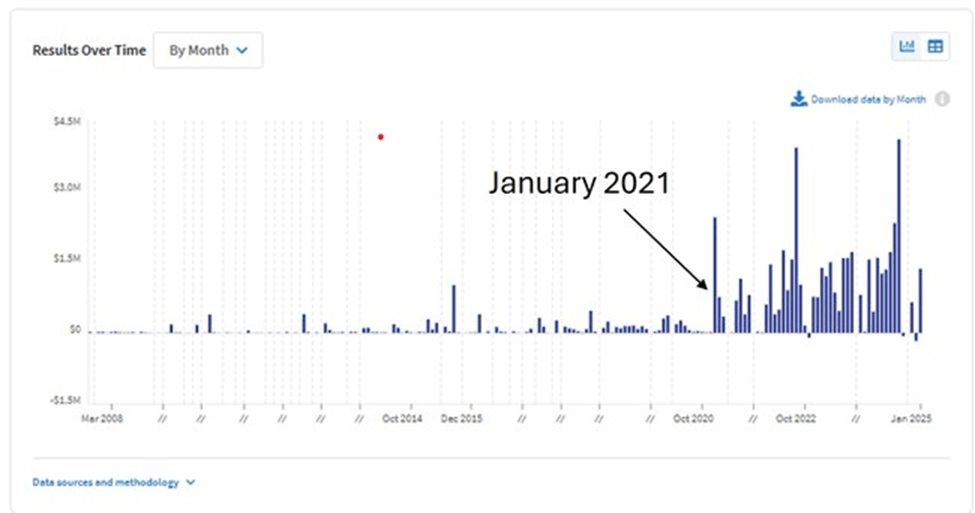
New York Times -
I read in the Economist that Americans spend 12 billion hours per year complying with federal regulations. Since a billion is a thousand million, and the US population is somewhere around 330 million – call it a third of a billion, the math is pretty easy – we cancel a mess of zeros and are left with 12,000 over 330. At this point, my ancient calculator tells me we’re talking 36 hours per year for every man, woman and child. And that doesn’t include complying with state and local regulations.
So the next thing is to call up a population pyramid – it’s a safe bet that folks under 14 don’t worry a whole lot about complying with federal regulations.
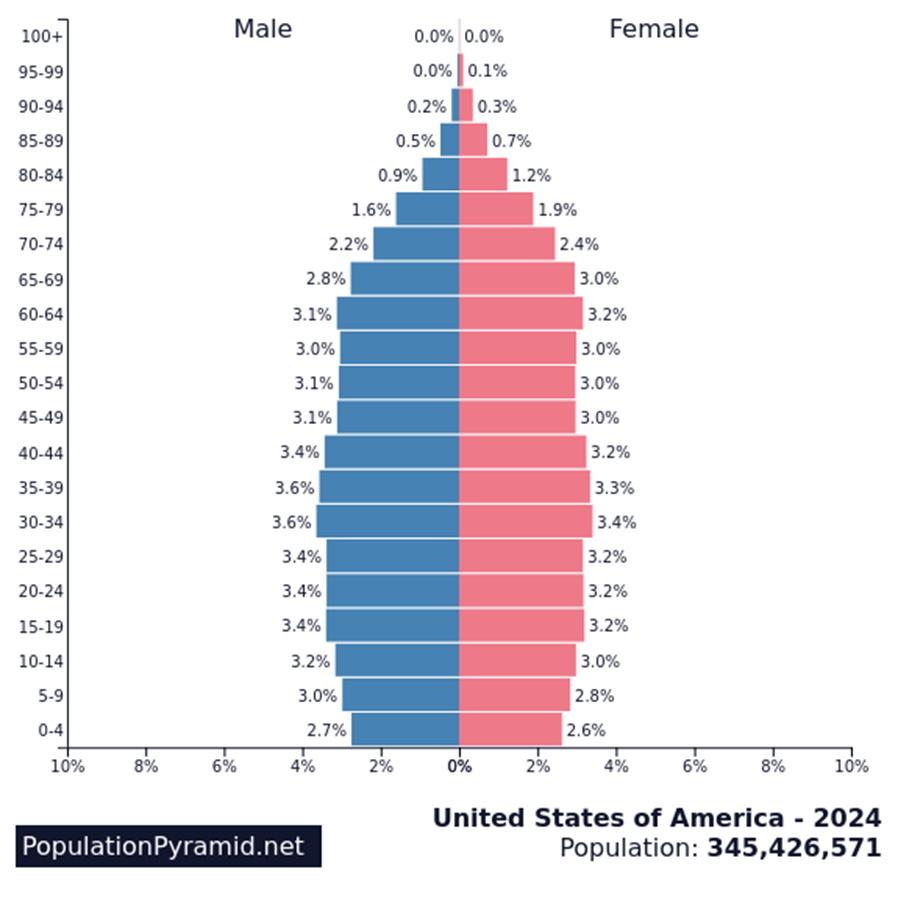
It shows that my population estimate was off by 4 percent – but about 9% of the population is under 14 – so that cuts down on the folks actively working at regulation compliance. Another 8% are over 65 – but I’m not real sure that being retired keeps people from spending time complying with government regulations. I produce just enough hay to qualify to spend time each year answering questions for the census of agriculture. Haying isn’t so much farming for me as it is keeping the fire conditions down.
I suspect some people are full-time working with government regulations – lawyers and accountants for example. When you stop to think about it, we have people working at jobs (I’m thinking of civil rights data collectors) that fundamentally consist of emailing people to get data that someone else has already collected. And we have a bunch of government employees hired for the purpose of forcing the citizens to comply with regulations – ranging from decent folks like the highway trolls to some barely concealed tyrants whose mission creep has gone beyond the imaginations of the legislators who established their departments.
Some folks have a vested interest in government regulations – income taxes come to mind. Enough income is reported to the IRS that (with minor tweaking of the regulations) they could just send each of us a bill on April 15. The tax preparation industry – ranging from the local CPA through the software corporations – exists because there is a perverse incentive not to simplify the tax codes. Making it simpler would break a lot of rice bowls.
As I look at Argentina under Milei’s libertarian leadership, I have to admit that the idea of prosperity through reduced regulations seems like a great idea.
-
The Eureka Community Players announce auditions for “Seasons on the Farm”. The Players sponsors a writers group that has been meeting to write 10-minute scenes. Now, these nine scenes have been combined into an afternoon on the farm. Each scene is set somewhere on the farm: the hayloft, kitchen table, front porch, or in the field. Each scene has 2-3 people and is 10-minutes long. The scenes take a look at a “season” of life and is narrated by the old farm wife.
Auditions for “Seasons on the Farm” is scheduled for February 18th at 6:00 p.m. at the Timbers Event Center. There are parts for up to 21 people, ages 8 to 80, men, women and youth. Everyone will have an opportunity to read parts and choose which scenes appeal to them. Script pages will be provided for review prior to the readings.
Individuals who have thought about directing also have an opportunity to try their hand at this, in a limited commitment as the Player will also be asking for volunteer directors.
This is the second year that the writers group has worked together to produce a play. Some of the writers are new to the group, such as Mike Workman and Noelle Nicholas; returning writers include Adrian Miller and John LaBonty.
Rehearsals of “Seasons on the Farm” scenes will be set by the director and actors. “Seasons on the Farm” will be presented Sunday, March 23rd.
For more information about auditioning, contact Sharon LaBonty at 406/263-9208.
-
A while back, we showed the official map of Lincoln County, drawn in 1910. This week, we’re showing how the county looks after Libby Dam was completed, and the towns along the river were no more. The present map of Lincoln County looks like this one:
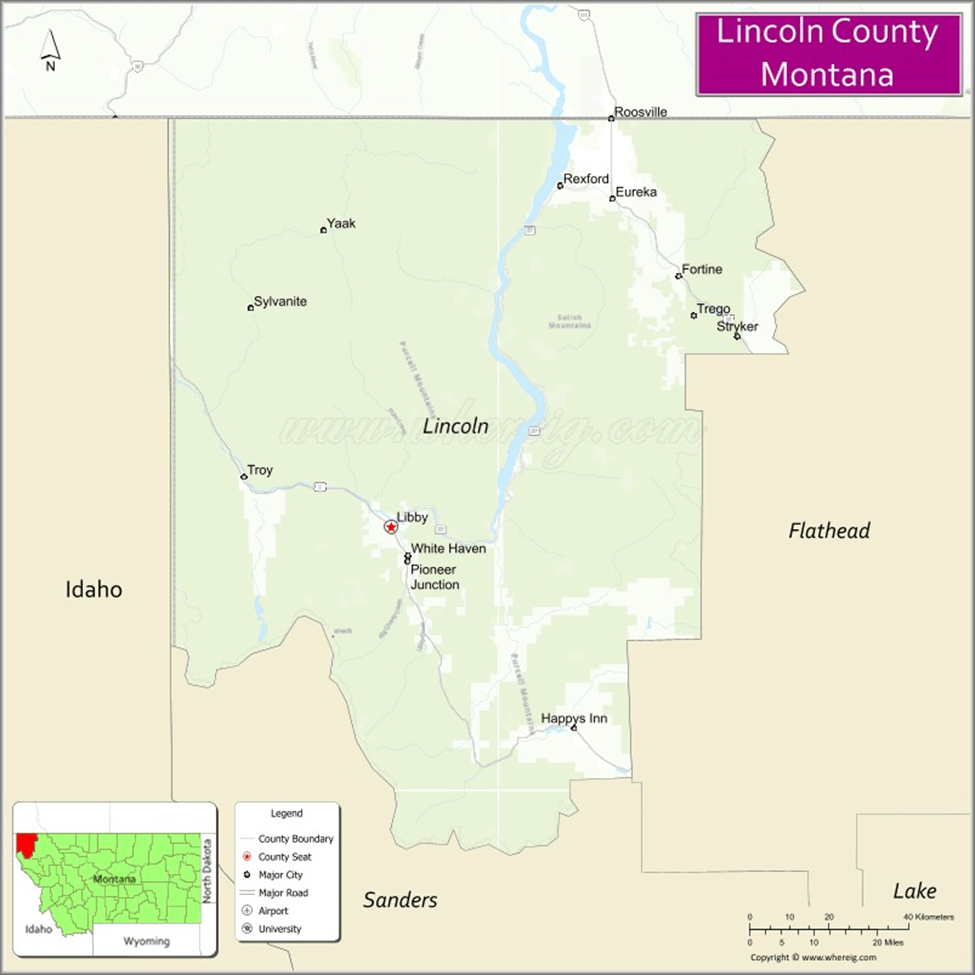
Water covers those old townsites between Rexford and Jennings Rapids now – there are a few taxable acres left in spots like Warland Creek, but by and large, where there were once towns and homes that maintained a continuous community, the north and south parts of Lincoln County are now connected by an empty space on the map. It’s the geographic reason why our county government is a travesty, where the residents of the north are taxed to support the courthouse clique in Libby, and the only blessing is that distance keeps us from getting as much government as we pay for.
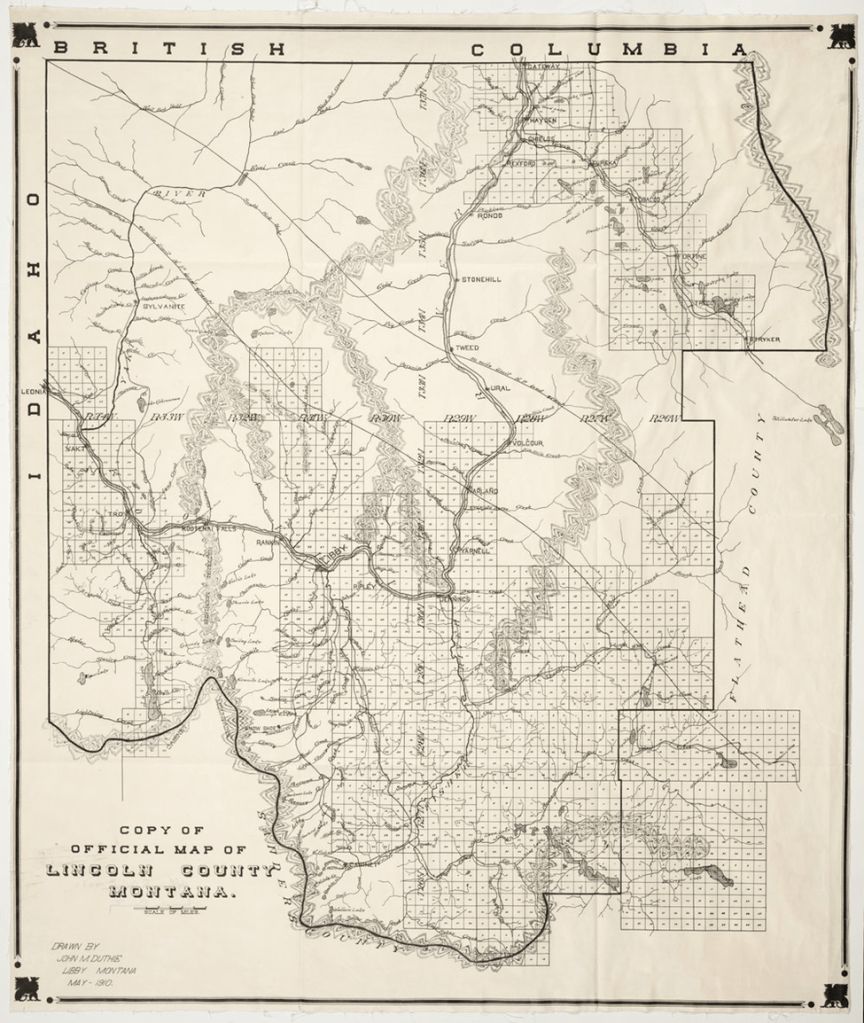
Gateway, Rondo, Stonehill, Tweed, Ural, Volcour, Warland, and Yarnell once filled those empty miles between Rexford and Libby. If I recall correctly, Laird Byers spoke of Rondo and Stonehill, Jim Kuchenski told stories about Ural from his youth, and Dave and Marylou Petersen taught in Warland before Libby Dam held the waters back and flooded those little towns.
Lincoln County was set up to be a connected community. For the last 50 years we’ve grown more into a county where the north is treated as a colony to be taxed for the benefit of the courthouse clique in Libby. The two maps illustrate the difference.

-
This is a topic where I write with some experience – Robert Santos has resigned and will not be heading the Census Bureau. Interestingly enough, Santos has been described as working to include overlooked communities – but from my perspective, as a rural demographer, one of the great losses that occurred during the past two censuses has been losing the data that was once available at the school district level. Time was when we had population data for all of our school districts – while Chicago didn’t need it, it was very useful for small rural districts. A local example would be as obvious as Eureka’s attempts to fund a new school building. In Trego, getting that back would provide full data on the district – where now I have to rely on estimates based on zip codes.
OK – that covers my rant about losing access to data. Trump will be appointing a new director – and I think I know what the next director’s mission will be. The deal is the Enumeration clause of the Constitution:
Article I, Section 2, Clause 3:
Representatives and direct Taxes shall be apportioned among the several States which may be included within this Union, according to their respective Numbers, which shall be determined by adding to the whole Number of free Persons, including those bound to Service for a Term of Years, and excluding Indians not taxed, three fifths of all other Persons
The Enumeration clause says we count persons, not citizens – and that has grown into a situation that wasn’t a concern in 1789. We don’t know the percentage of American residents that are non-citizens – the Census no longer asks for that data. On the other hand, we still have data on the number of residents who are ‘foreign born’ – so I can use that as a substitute. It’s not perfect, but it gets the point across – and California shows the problem.
I have the academic arrogance that leads me away from citing wikipedia – but in this case, wikipedia provides adequate data List of U.S. states and territories by immigrant population – Wikipedia
Montana’s population has relatively few foreign born – just 2.2%. On the other hand, Rhode Island, the state we just beat out to get a second seat in Congress has 13.2% foreign born. It doesn’t take a lot of calculation to see how the calculation of congressional seats can inflate the representation for states with more non-citizen population.
So lets look at California: California has 52 representatives in Congress. 26.9 percent of Californians are foreign born. Some of those are undoubtedly naturalized citizens – but many are not. We don’t have the data I would like – but if we use foreign born as a substitute for non-citizen, and contrast California with Montana, US citizens in California have 24.7 percent more representation in Congress than Montanans. This discrepancy affects the concept of one man, one vote. Apportioning Congressional representation by citizens as opposed to persons might move California’s Congressional delegation from 52 to 39.
22.8 percent of New York and New Jersey residents are foreign born. Florida kicks in at 21 percent. Hawaii’s at 18.7%. Texas comes in at 17.2%.
So I figure the next Census director will be adding a citizenship question to the 2030 Census – so people won’t have to substitute ‘foreign born’ for non-citizen to do rough calculations. When we look at the electoral college, California, New York, New Jersey, etc. have definitely had more influence in determining our nation’s leadership than states with smaller non-citizen populations.
Like birth tourism, this wasn’t a problem that came to mind in 1789. I know that the constitution reads persons rather than citizens – but I suspect there are a couple of lawyers working for the Trump administration that will come up with an argument that says to count by citizens.

Want to tell us something or ask a question? Get in touch.

Recent Posts
- Computer Repair by Mussolini
- Getting Alberta Oil to Market
- Parties On Economics
- Thus Spake Zarathustra – One More Time
- Suspenders
- You Haven’t Met All The People . . .
- Play Stupid Games, Win Stupid Prizes
- The Ballad of Lenin’s Tomb
- An Encounter With a Lawnmower Thief
- County Property Taxes
- A Big Loss in 2025
- Thinking of Clovis

Rough Cut Lumber
Harvested as part of thinning to reduce fire danger.
$0.75 per board foot.
Call Mike (406-882-4835) or Sam (406-882-4597)
Popular Posts
Ask The Entomologist Bears Books Canada Census Community Decay Covid Covid-19 Data Deer Demography Education Elections Eureka Montana family Firearms Game Cameras Geese Government Guns History Inflation life Lincoln County Board of Health Lincoln County MT Lincoln Electric Cooperative Montana nature News Patches' Pieces Pest Control Politics Pond Recipe School School Board Snow Taxes travel Trego Trego Montana Trego School Weather Wildlife writing
 Trego's Mountain Ear