-
It’s at least 50 years ago that Bob Brown and I listened attentively to Matt Himsl in Kalispell, as the old politician took out the sacred cow of the value of civil service, elegantly put it to death, and delivered it to the grill as he explained what Montana had lost by going to civil service instead of a spoils system.
I was there only because I was with Bob, who was a young politician with a lot of potential. People like Bob, and a lot of folks have voted for him. Suffice to say, my success has never been because of popular votes. Anyway, we learned that there was another side to the spoils system.
Fifty years back, there were Republicans in Flathead County, and Lincoln County was dominated by Unions and Democrats. Lots of Unions, lots of Democrats. Himsl had been elected to the house and senate from Flathead, and was one of the politicians who was respected from both sides.
Anyway, as I recall the lesson, one of the important aspects of Montana’s Spoils System was the state monopoly on liquor sales. Each party had a qualified liquor store manager on hand. If the Republicans got the governorship, the local Republican party moved into managing the liquor store. If the Dems won, a dem wound up with 4 years employment. This wound up with some middle-of-the-road folks working hard for the parties. As I’ve watched the extremes take over party leadership on both left and right, I’ve often thought Matt Himsl may have been absolutely correct. The center may be a lot more likely to hold when the local committee folks are involved in politics for the job instead of for the ideology.
I’ve wondered how far it went – I don’t believe that there was ever a Democrat Highway Patrol and a Republican Highway Patrol, though I have heard of counties where the Sheriff was elected and his opponent became undersheriff for twenty or thirty years.
Probably one of the greatest praises of any politician was in Matt Himsl’s Jan.1, 2007 obit in the interlake: “In 1931, Matt’s father’s business, the Plevna State Bank, was closed due to the effects of the Depression and crop failures. The state bank examiner took control of the bank’s assets. Included in those assets were 320 acres held as collateral on a failed note. Matt, after a series of legal victories over Shell Oil and the state bank examiner, acquired control of the land. As part of an oil-and-gas-production unit, he dedicated the mineral royalties to paying all depositors and creditors with interest. In 1976, all debts were paid. The Plevna State Bank is the only bank in the United States that was closed during the Depression to ultimately pay out all depositors and creditors. Victor Himsl’s Plevna State Bank went down in history as “the little bank that could” because of the integrity and commitment of Matt Himsl.”
I think Himsl wasn’t so concerned about a “deep state” developing as he was concerned about a political system that kept the center involved in politics. The folks who could play political games all day long, then have a couple of drinks together in the evening afterward. Bob can do that. I’m more likely to call an SOB a son of a bitch – and if you do that often enough you’re going to lose votes and voters.
There was never any doubt that Bob’s a Republican – even when he wrote of his preferences for Hillary over Trump. Still, the last time I spoke with him, he commented that he really wasn’t a Republican any more – his party had left him. Personally, I’ve had Republicans identify me as a Democrat and the next day had Democrats not just call me a Republican, but a damned Republican. Nobody gets run over so often as the guy who wanders over both sides of the road.
I have a hunch Matt Himsl would have agreed with Ronald Reagan – the man who said, “The person who agrees with you 80 percent of the time is a friend and an ally – not a 20 percent traitor.” I think Bob, like Himsl and Reagan, wouldn’t regard me as a 20 percent traitor.
In elementary school, I learned that the creation of Civil Service eliminated the abuses of the Spoils System. I listened to my father, who explained that voting was discouraged among Navy officers – that they served the government, not the party. I don’t believe he voted until he had retired. I tried to live so that as the state demographer, I was equally accessible and trusted by both Democrat and Republican legislators.
I learned a lot from one afternoon with Matt Himsl.
-
When we were first married, Renata and I ran across a group of folks in north central Montana who shot IHMSA – International Handgun Metallic Silhouette Association, if I remember correctly. The sport started in Mexico – south of the other border. They silhouettes out of sheet steel – gallinas, javelinas, guajalotes and borregos (chickens, pigs, turkeys and rams to our Havre teachers) and shot at them with rifles at ranges from 200 to 500 meters. No rest, no prone positions – just stand on your hind legs and try to knock the steel plates over with your hunting rifle.

Frankly, I didn’t shoot all that muy bien, and feeding my old 257 Roberts made the 40 round matches a bit spendy. Then we discovered a match with smaller targets, at closer ranges for 22 rimfire. They looked the same, but this illustrates how small the targets were:

Chickens were set up at 40 meters, pigs at 60 meters, turkeys at 77 meters, and the rams at 100 meters. You remember there are no rests, no prone or sitting shots – these folks even called me for using a sling. They were using Anshutz (one had a Winchester 52) and I was still using my old Remington 510 single shot. I was outclassed in both ability and equipment – but they were nice about it.
The IHMSA folks stayed with these ranges for pistols – and Renata, showing true kindness bought me another barrel for the TC. Unfortunately, even when I hit, those 55 grain bullets wouldn’t reliably knock over my targets. IHMSA has moved into allowing a bunch of shooting positions – back then they were teaching me to hold that long barreled Thompson Center with both hands.
When we moved to Trinidad, Colorado, we found a new sort of match – Service Rifle. Most folks were using M1 Garands – but any service rifle was acceptable. The army had issued Winchester 94 lever rifles to their folks protecting the Northwest Spruce for WWI aircraft production. Soldiers of the 339th Infantry used 1891 Mosins when they invaded Russia at Archangel. 1903 and 03a3s were perfectly acceptable. I shot my first match with a borrowed AR-15. Leonard was using a SMLE – pronounced ‘smelly’ and standing for short magazine Lee Enfield. I guess they figured that if we could still use the 1917 Enfield, we might as well let the Brit rifles compete, too. Standing, sitting, prone, 200, 300 and 600 yards, and I was expected to use the sling. I still have to think about using a rest – but I’m glad the service rifle folks got me back in the habit of using a sling.
It’s been a long while since I shot at the little steel chickens – but I have a good hill for a backstop, and I can rig the distances in the hayfield. And, while I’m old, and no longer steady, there are a few permissible modifications I can make to a Ruger 10/22. Who knows? A dozen years from now a couple of grandkids may even get into the sport. The targets are available. This batch is just a little over $100 plus shipping -but you have to paint them yourself. Even if the rules still won’t accept the sling.

-
With the whole family catching one of the plethora of illnesses being passed around, the toddler’s gotten a bit more movie time than usual, and I’ve had a chance to evaluate more movies for the faceblind.
The good dinosaur checks a lot of boxes:
- Small Cast
- Very distinctive characters (especially distinct body language)
- No laundry (The clothes never change. They should be members of the cast in their own right)
- Color Coding (Star trek does this quite well)
- Frequent use of names
- Subtitles
- Cartoons/Animals
There’s a small cast, predominantly composed of animate dinosaurs, which are very easily distinguished by size/shape/color. Absolutely no laundry. I didn’t even need subtitles.
The only thing on the list really missing is frequent use of names, as one of the major characters doesn’t have a name for a significant portion of the movie. That said, it more than makes up for it in clarity elsewhere. It’s a very easy to follow film.
It’s also toddler approved; He likes dinosaurs, and The Good Dinosaur is about the developing friendship between a lost young dinosaur an an orphaned human boy. The boy’s young, often moving about in a crouch, non-verbal and pretty much feral. Naturally, my toddler has a new hero.
I found the sad little one explaining his lack of a family to be pretty heart-wrenching, but Remi’s insisted quite happily that we need to watch the film repeatedly.
-
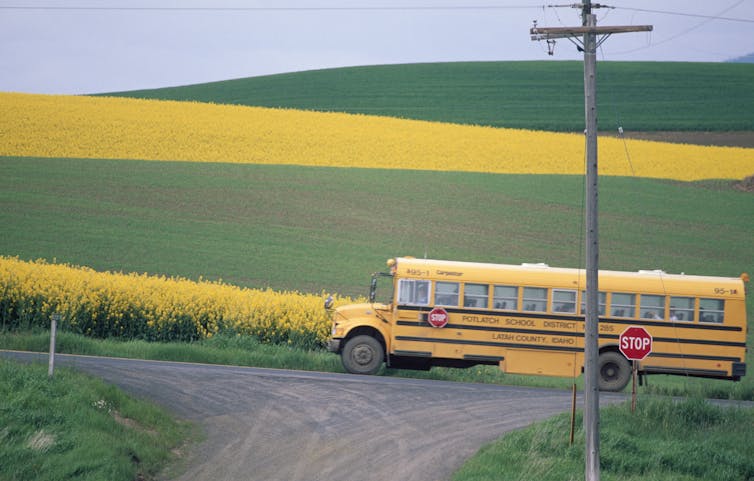
School buses play a pivotal role in rural areas. Grant Faint/The Image Bank via Getty Images Lee Ann Rawlins Williams, University of North Dakota
A week after Hurricane Sandy flooded New York City’s streets and subways in 2012, the city’s schools were back in business. But schools in rural North Carolina did not reopen until almost a month after Hurricane Helene roared through in late September 2024.
While natural disasters and health crises may have long-lasting effects on any school system, in rural areas the lack of physical, financial and organizational resources is amplified when disaster strikes.
Fortunately, there are solutions. Based on my professional research on emergency preparedness – and my experience working in educational settings – I’ve identified several strategies that may help.
Rural schools have unique disaster challenges
Unlike urban areas, rural districts often have little access to the recreation centers, cultural institutions, university campuses and other structures that could provide temporary sites for classes after a disaster.
Access to these buildings helped schools in New York City in the response to Hurricane Sandy.
Rural areas also have greater distances between homes, fewer buildings that can be used for temporary schooling, and deteriorating infrastructure. Educational resources are often insufficient, transportation is difficult, and many areas lack access to broadband.
Rural school districts may have weaker local funding streams. As a result, they may struggle to provide students full access to textbooks, technology and other essential materials.
Another major barrier for rural students is transportation.
In many rural communities, students rely on school buses to get to and from school. When natural disasters damage roads or disrupt transportation networks, students may be unable to attend school in person for extended periods.
Even after the immediate effects of a disaster subside, transportation issues can persist. For example, the North Carolina Department of Transportation estimated that it could take a year or more to repair road damage from Hurricane Helene.
‘Digital divide’ contributes to impact
Urban schools, with more reliable power and internet and better access to digital resources, are able to pivot quickly to online or hybrid learning when buildings are suddenly closed.
Students in rural schools, however, may have no access to reliable internet services or little or no access to the internet at all. In addition, teachers in rural areas may have more difficulty shifting classes online, since they are more likely to lack training or experience in digital instruction than teachers in cities.
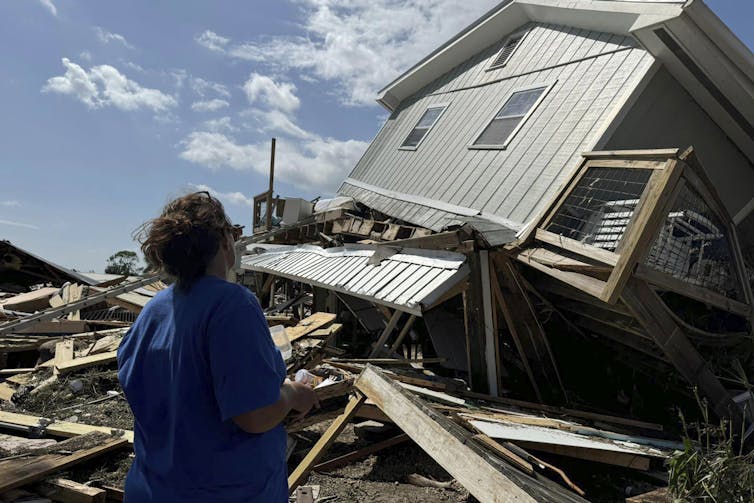
Rural communities have fewer resources to deal with major disasters, such as Hurricane Helene. AP Photo/Kate Payne Planning for disaster
The disruptions following a natural disaster have both immediate and long-term consequences. Studies have found that the effects of natural disasters include mental health issues, learning loss, lower graduation rates and diminished opportunities for higher education or career advancement.
Due to the challenges already facing rural schools, I believe preparing for a disaster in a rural area should occur earlier and take into account the specific needs of the community.
Rural schools, even more than their urban counterparts, cannot rely on a one-size-fits-all approach but need to make the best of the resources available and encourage collaboration from the local community and neighboring communities.
Here are a few strategies they could use.
Provide offline learning materials
Although it may seem intuitive, one key solution to school closures is developing learning materials that do not require internet access. I have found that many teachers focus on electronic resources, such as smartphones and Apple watches, and overlook the use of old-fashioned methods.
Instructional materials, such as workbooks and textbooks, should be available and used before a disaster occurs. This is to ensure that students can continue with their studies when they are cut off from school. These materials, which can be supplemented after a disaster, can include projects that students can work on independently or with their families.
Use mobile technology
Another approach incorporates mobile technology, such as smartphones. If service is available, students and teachers can communicate by phone.
When internet access is unavailable, schools can use mobile learning hubs. These are vehicles equipped with Wi-Fi, computers and other educational tools. These mobile hubs can travel to rural areas to provide students with access to digital resources. They serve as temporary classrooms or internet access points, bringing education directly to students.
During the COVID-19 pandemic, for example, I worked with a community college in Tennessee that provided mobile hubs at public libraries, school parking lots and on campus. Students were able to use these resources at all hours, day and night.
Create a flexible learning environment
Schools can give students more flexibility in when and how they learn during the academic year. For example, schools can allow students to make up missed work at their own pace. Or schools can provide alternative learning hours to students who may need to help their families with recovery efforts.
After Hurricane Helene downed power lines and closed roads in Beaufort County, South Carolina, students who were without power or internet were given five days to complete their work and other considerations.
This flexibility helps ensure students do not fall too far behind. It may even help students better manage stress and maintain their mental well-being.
Strengthen rural schools
Making rural school systems more resilient when disasters occur is essential to ensuring that students can continue learning.
Advance planning, flexible learning options and partnerships with families, community support services and local and federal government programs can help. But I believe the underlying issues of the lack of resources, transportation challenges and the digital divide should also be addressed to reduce the long-term impact of crises on rural education.
Lee Ann Rawlins Williams, Clinical Assistant Professor of Education, Health and Behavior Studies, University of North Dakota
This article is republished from The Conversation under a Creative Commons license. Read the original article.
-
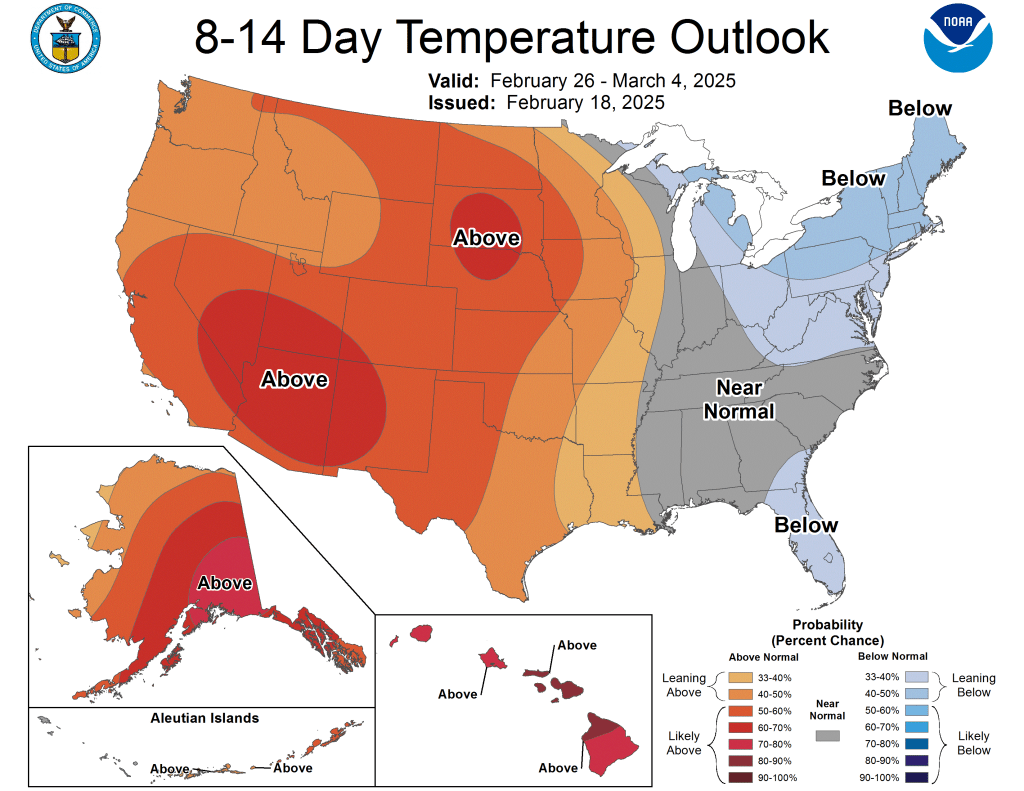
Having just received plenty of snow, we’re now due for a thaw. Forecast indicates that we can expect freezing rain and ice; warm, slightly rainy days of melting followed by freezing evenings in which all of that water turns into a sheet of ice to greet us for our morning commutes.
After a few days of that, we can anticipate water, water everywhere, as even night temperatures start to remain above freezing. For the forecast- visit weather.gov which is predicting above average temperatures for the next two weeks, accompanied by above average precipitation for most of the state.
-
The Eureka Community Players’ Writers Group 10-minutes scenes.
Have you ever thought about acting or directing but don’t want to make a major commitment? This is your opportunity to try it.
“Seasons on the Farm” was written by local writers (interested in playwriting? Watch for the next ‘writer’s workshop’) and will consist of 10 minute scenes sharing the theme of ‘Seasons on the Farm’.Auditions will be held Tueaday February 18th at 6:00 p.m., at Timbers Event Center. There are parts for men, women, youth – ages 8 to 80.
Everyone will have an opportunity to read parts and choose which scenes appeal to them. Script pages will be provided for review prior to the readings.
For More Information: call Sharon LaBonty at 406 / 263-9208 -
This Sunday, folks braved the snow to gather at Timbers Event Center to enjoy Eureka’s Got Talent and donate to the Shelly Moen scholarship fund. The Eureka Community Players have a yearly fundraiser for the scholarship and provide one student of the arts with a $1,000 scholarship per year.
Despite the cold and snow outside, folks stayed warm with coffee and cider, while they bid on items in the silent auction, purchased mystery gift cards in the “grub grab”, or mystery jewelry in the mystery box activity.
Between performances, the audience played heads or tails, a simple gambling game with a 1 dollar buy-in. Each participant picks heads or tails and remains in the pool of potential winners if their choice matches the results of the coin toss. This continues until a single winner remains and wins the item.
It was a warm event on a cool afternoon for an excellent cause. There were plenty of donations for the silent auction, grub grab, and heads/tails game from local artists and businesses.
-
Testosterone (which, for the sake of simplicity, we treat as if it’s a single thing and not a category word like ‘hawk’ or ‘cake’ with many subcategories) is a precursor molecule for estrogen (another category word, as it happens).
What does that mean? When students learn about chemical reactions, they are taught them as if they occur in a single step, react completely, and in only one direction. All of this is a vast oversimplification. The degree of oversimplification becomes even greater for organic chemistry, where the molecules involved are increasingly complex.
The short version: Making estrogen is a multi-step process, and testosterone is an important step along the way. All estrogens start out as testosterones.
The enzyme generally responsible for this conversion is aromatase. Interestingly, this is a biological pathway that pretty much runs in one direction. Testosterone convers into estrogen, but the reverse doesn’t occur.
What are the consequences? Among other things, this means that both men and women with low testosterone are also likely to show symptoms of low estrogen as well.
More interesting trivia, is that while artificially increasing testosterone levels can increase estrogen, it doesn’t necessarily always do so to a clinically significant amount. This implies there’s a mechanism at play determining the rate of conversion between testosterone and estrogen, but details on that don’t seem especially well studied. In general, the body will inhibit enzymes to downregulated their activity, so it’s probable that’s what going on in that instance.
Anyway- neat!
-
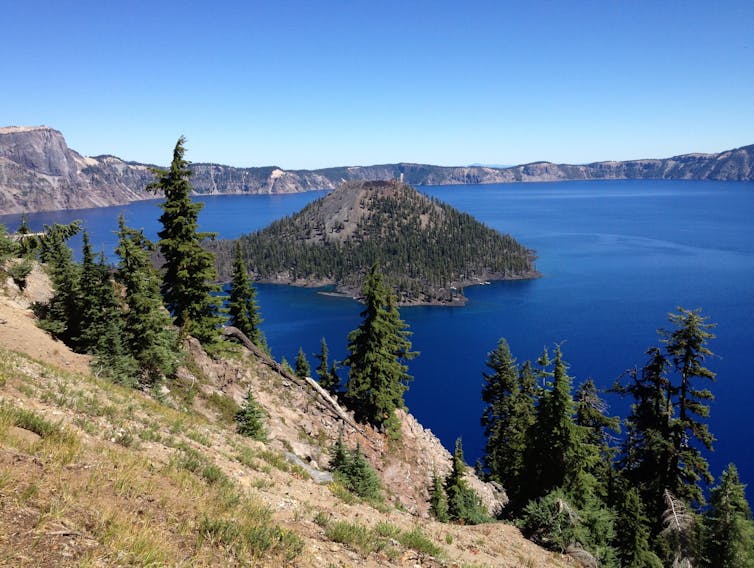
Crater Lake in Oregon looks brilliant blue because its water comes from melting snow and is extremely pure. CST Tami Beduhn, NOAA Ship Fairweather/Flickr, CC BY Courtney Di Vittorio, Wake Forest University
Curious Kids is a series for children of all ages. If you have a question you’d like an expert to answer, send it to curiouskidsus@theconversation.com.
Why is water different colors in different places? – Gina T., age 12, Portland, Maine
What do you picture when you think of water? An icy, refreshing drink? A crystal-blue ocean stretching to the horizon? A lake reflecting majestic mountains? Or a small pond that looks dark and murky?
You would probably be more excited to swim in some of these waters than in others. And the ones that seem cleanest would probably be the most appealing. Whether or not you realize it, you are applying concepts in physics, biology and chemistry to decide whether you should leap in.
The color of water offers information about what’s in it. As an engineer who studies water resources, I think about how I can use the color of water to help people understand how polluted lakes and beaches are, and whether they are safe for swimming and fishing.
Light and the color of water
Drinking water normally looks clear, but ponds, rivers and oceans are filled with floating particles. They may be tiny fragments of dirt, rock, plant material or other substances.
These particles are often carried into the water during storms. Any rainfall that hits the ground and doesn’t go into the soil becomes runoff, flowing downhill until it reaches an open body of water and picking up loose materials along the way.
Particles in water interact with radiation from the Sun shining on the water’s surface. The particles can either absorb this radiation or reflect it in a different direction – a process known as scattering. What we see with our eyes is the fraction of radiation that is scattered back out of the water’s surface. It strongly affects how water looks to us, including its color.

Visible light forms just a small part of the electromagnetic spectrum, which includes all types of electromagnetic radiation. Within the visible range, different wavelengths of light produce different colors. Ali Damouh/Science Photo Library, via Getty Images Depending on the properties of the particles in our water sample, they will absorb and scatter radiation at different wavelengths. The light’s wavelength determines the color we see with our eyes.
Waters that contain lots of sediment – such as the Missouri River, nicknamed the “Big Muddy” – backscatter light across the yellow to red range. This makes the water appear orange and muddy.
Cleaner, more pure water backscatters light in the blue range, which makes it look blue. One famous example is Crater Lake in Oregon, which lies in a volcanic crater and is fed by rain and snow, without any streams to carry sediment into it.
Deep waters like Crater Lake look dark blue, but shallow waters that are very clear, such as those around many Caribbean islands, can appear light blue or turquoise. This happens because light reflects off the white, sandy bottom.
When water contains a lot of plant material, chlorophyll – a pigment plants make in their leaves – will absorb blue light and backscatter green light. This often happens in water bodies that receive a lot of runoff from highly developed areas, such as Lake Okeechobee in Florida. The runoff contains fertilizer from farms and lawns, which is made of nutrients that cause plant growth in the water.
Finally, some water contains a lot of material called color-dissolved organic matter – often from decomposing organisms and plants, and also human or animal waste. This can happen in forested areas with lots of animal life, or in heavily populated areas that release wastewater into streams and rivers. This material mostly absorbs radiation and backscatters very little light across the spectrum, so it makes the water look very dark.
Bad blooms
Scientists expect water in nature to contains sediments, chlorophyll and organic matter. These substances help to sustain all living organisms in the water, from tiny microbes to fish that we eat. But too much of a good thing can become a problem.
For example, when water contains a lot of nutrients and heats up on bright sunny days, plant growth in the water can get out of control. Sometimes it causes harmful algal blooms – plumes of toxic algae that can make people very sick if they swim in the water or eat fish that came from it.
When water bodies become so polluted that they threaten fish and plants, or humans who drink the water, state and federal laws require governments to clean them up. The color of water can help guide these efforts. https://www.youtube.com/embed/SaGX0dzAuo4?wmode=transparent&start=0 Engineering professor Courtney Di Vittorio and her students collect water samples from High Rock Lake in North Carolina to assess its water quality.
My students and I collect water samples at High Rock Lake, a popular spot for swimming, boating and fishing in central North Carolina. Because of high chlorophyll levels, algal blooms are occurring there more often. Residents and visitors are worried that these blooms will become harmful.
Using satellite photos of the lake and our sampling data, we can produce water quality maps. State officials use the maps to track chlorophyll levels and see how they change in space and time. This information can help them warn the public when there are algal blooms and develop new rules to make the water cleaner.
Hello, curious kids! Do you have a question you’d like an expert to answer? Ask an adult to send your question to CuriousKidsUS@theconversation.com. Please tell us your name, age and the city where you live.
And since curiosity has no age limit – adults, let us know what you’re wondering, too. We won’t be able to answer every question, but we will do our best.
Courtney Di Vittorio, Assistant Professor of Engineering, Wake Forest University
This article is republished from The Conversation under a Creative Commons license. Read the original article.
-
Anonymous Concerns about the Library District
Hello, I would like to share my concerns about the formation of a library district, and another increase in my taxes. As you are aware our property appraisals went up 43%. That translates to quite an increase in our taxes. I am on a fixed income; I assure you no entity raised my income by 43%. In addition to this, I understand we will be paying more taxes for schools in May because of an undercollection by the county. I also understand that we are very likely to start paying road taxes. And when will Eureka decide it…
Forest Service warns of budget cuts ahead of wildfire season- Camille Stevens-Rumann
Forest Service warns of budget cuts ahead of a risky wildfire season – what that means for safety Camille Stevens-Rumann, Colorado State University and Jude Bayham, Colorado State University A wet winter and spring followed by a hot, dry summer can be a dangerous combination in the Western U.S. The rain fuels bountiful vegetation growth, and when summer heat dries out that vegetation, it can leave grasses and shrubs ready to burn. In years like this, controlled burns and prescribed fire treatments are crucial to help protect communities against wildfires. Well-staffed fire crews ready to respond to blazes…
Why did people lose their homes in the Great Depression?
The historical accounts pretty much say the Great Depression sucked, and some reading of Montana’s history will suggest that it started sucking out west before the “dirty thirties”. So, things sucked, people were poor- but what was the exact cause of homelessness that drove the spread of “hoovervilles”? What exactly was it people couldn’t pay? Rent, Mortgages, and Property Taxes (these are in a sense, much the same thing, with a mortgage being a lot like rent paid to the bank, and property taxes being a lot like rent paid to the government). Rent has been increasing-…
Learning of Hazards
I spotted this photo, from 1962 – in Lincoln County, as in Wittenoom, Australia, the sixties were happy days, when the hazards of asbestos exposure weren’t particularly understood. “Wittenoom was officially removed from the Western Australian maps in 2007 and legislation was introduced to forcibly remove the last three residents in 2015. This ghost town located at the mouth of the Wittenoom Gorge is the home of Australia’s greatest industrial disaster. However, being in the Hamersley Range, it can lay claim to being located in one of the most beautiful areas of the Pilbara.” https://www.aussietowns.com.au/town/wittenoom-wa This article…

Want to tell us something or ask a question? Get in touch.

Recent Posts
- Computer Repair by Mussolini
- Getting Alberta Oil to Market
- Parties On Economics
- Thus Spake Zarathustra – One More Time
- Suspenders
- You Haven’t Met All The People . . .
- Play Stupid Games, Win Stupid Prizes
- The Ballad of Lenin’s Tomb
- An Encounter With a Lawnmower Thief
- County Property Taxes
- A Big Loss in 2025
- Thinking of Clovis
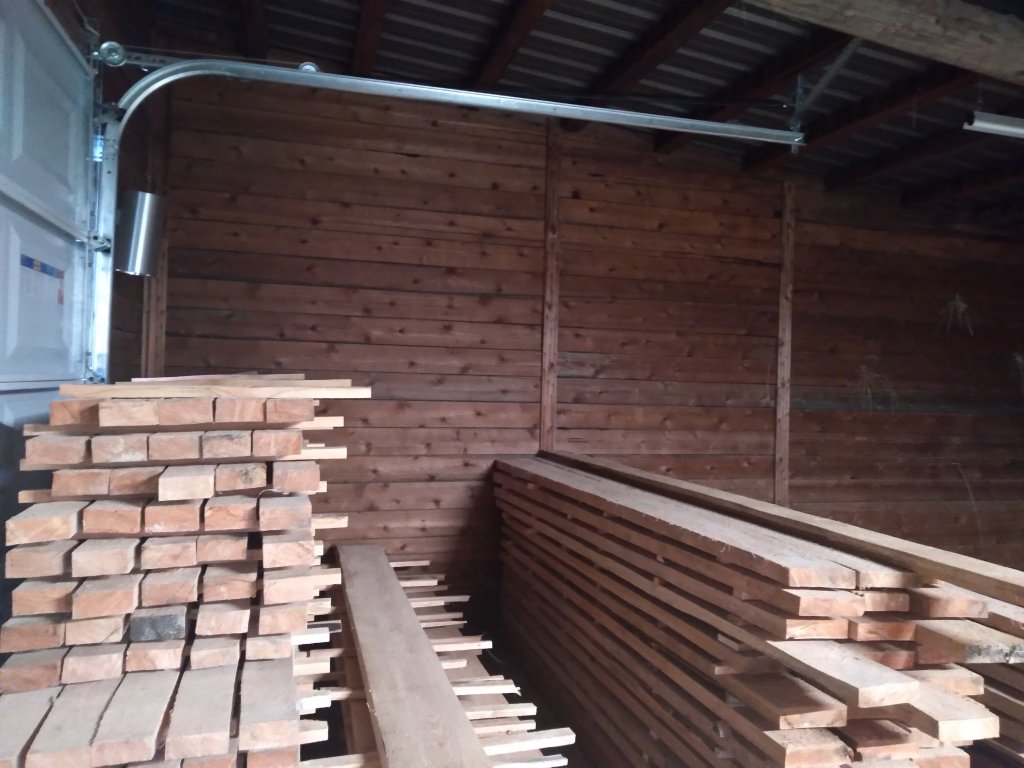
Rough Cut Lumber
Harvested as part of thinning to reduce fire danger.
$0.75 per board foot.
Call Mike (406-882-4835) or Sam (406-882-4597)
Popular Posts
Ask The Entomologist Bears Books Canada Census Community Decay Covid Covid-19 Data Deer Demography Education Elections Eureka Montana family Firearms Game Cameras Geese Government Guns History Inflation life Lincoln County Board of Health Lincoln County MT Lincoln Electric Cooperative Montana nature News Patches' Pieces Pest Control Politics Pond Recipe School School Board Snow Taxes travel Trego Trego Montana Trego School Weather Wildlife writing
 Trego's Mountain Ear