-
As you look a this map of Lincoln County, drawn just after the county was carved off from Flathead, one of the first things that grabs your attention is the number of towns that existed along the Kootenai River and the railroad.
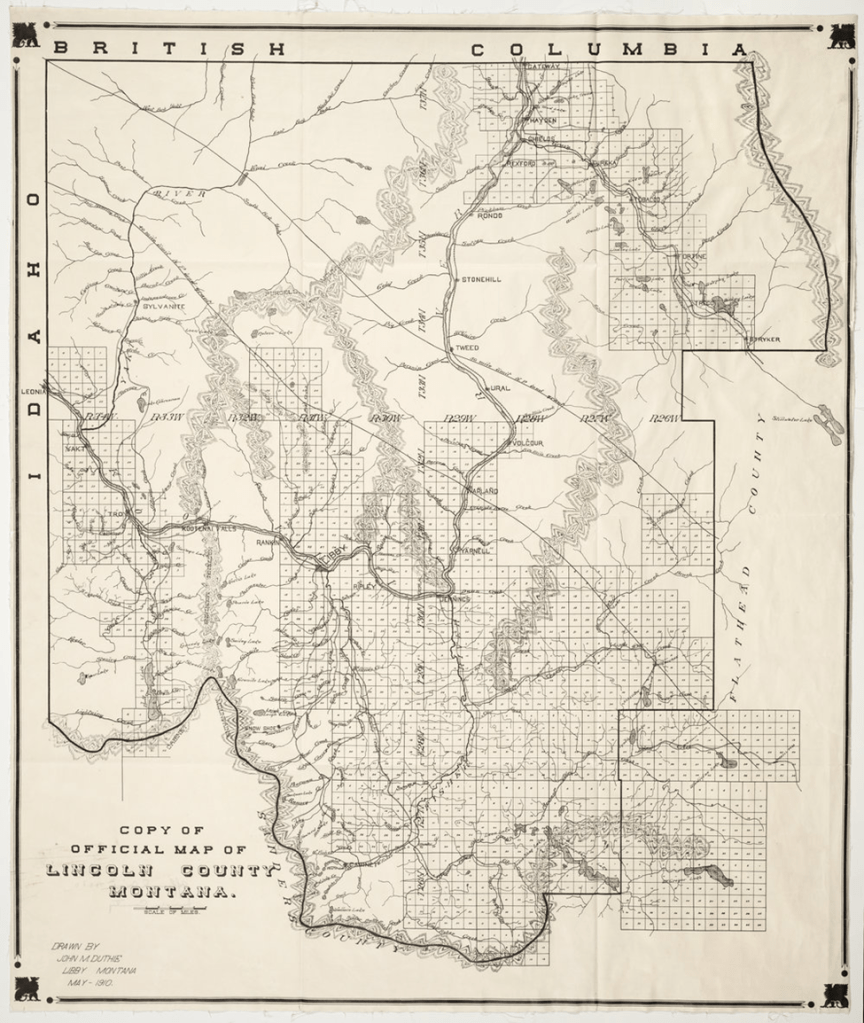
The second thing is the marked sections – the unsurveyed portions of the county were probably too remote and too rugged to be getting any homesteaders claiming land.
The third thing is that Sylvanite shows up, but not Yaak. One more point of interest is that, by the time this first county map was drawn, folks realized that Stryker, at the edge of the county, was in the Flathead drainage, not the Kootenai.
I’ll be looking for a post Koocanusa map to illustrate the communities that were lost to Libby Dam.
-
I am, once more, observing anger and hissy fits over politics and election results. Personally, I will be going to Canada again – for me, it’s a close and habitual destination. The only thing that has interfered with those visits was their legal system during covid – and it’s their country, their rules.
I don’t expect to encounter any of my fellow Americans who are threatening to move north because Trump is moving back into the White House. I don’t see changing where or how I live because of any politician – and, having lived three quarters of a century, I’m fairly certain that whichever one is elected, whether I like them or not, they’re going to vote against my interests sooner or later. I can’t see getting angry about it. I like Mike Cuffe. I like Neil Duram. Both cast votes against things I wanted – hell, Zooey Zephyr has done a better job representing me than either of them has. I’m not angry about it – I’ll just vote against them until they correct their behavior.
I had a chance to meet Hilary Clinton – but I would have had to walk a block from my office. The effort wasn’t worth the reward – I had no doubt where she stood on the second amendment. Still, I’ve known people who worked for State when she was Secretary who thought highly of her. It’s one thing to disagree on politics – it’s something else to get angry about it.
When Montana’s first Territorial Governor left, Montana was left with Acting Territorial Governor Thomas Francis Meagher. Meagher was a member of the Young Ireland party, and for his efforts at achieving independence from England was brought to court, and legend has it, the judge first wanted him to be hanged, drawn and quartered. That seemed a bit barbaric in the enlightened year of 1848, so the sentence was reduced to transportation to Van Dieman’s land for life. Those old Brits understood political anger and hatred – and, just as Thomas Francis Meagher escaped from Tasmania, becoming a Yankee general and Republican politician, we too should remember that tolerance of different beliefs is a virtue.
Meagher wasn’t altogether tolerant – angry at the editor in Virginia City, Meagher demanded a retraction and an apology or a duel. Apparently the editor’s reply of “Pistols for two and coffee for one.” made Meagher reconsider the virtue of tolerance – the two never met over pistols, and, while I am sure the editor on occasion enjoyed coffee for one, the occasion did not follow a duel.
Whichever politician wins the election, it isn’t a reason to change how a person lives.
-
In Jungian psychology, we find the term ‘synchronicity’ – defined as “Coincidence of events that appear meaningfully related but do not seem to be causally connected, taken by Jungian psychoanalytic theory to be evidence of a connection between the mind and material objects.”
We started the year with a pair of coincidental terrorist attacks – both perpetrated by Army veterans, using pickups rented through the same peer to peer car rental outfit. With the second incident, folks started looking for a pattern (both men had served at Fort Bragg). Quickly, though, the pair of attacks were dismissed as coincidence.
In sociology, we don’t have the Jungian explanation – but when the time came for railroads, people built a lot of railroads. At the same time these NCOs were renting trucks, the FBI described “the largest amount of finished explosive devices ever” being found in a rural home (OK, it was described as a 20 acre farm, but 20 acres is all hat and no cattle). Turns out the bomb maker had blown off a couple of fingers a couple years back. I’m not sure whether that’s synchronicity, coincidence, or just an occupational hazard among bomb makers.
Meanwhile, I see that Musk, using X, managed to stop a huge, pork-filled continuing resolution. Here in the northwest corner of Lincoln County facebook commentary is moving toward more confrontation with the deep county over mismanagement of garbage facilities. Coincidence? Synchronicity? Or is it just that the internet has replaced our traditional media and given the citizenry a place to get involved outside the long established government methodology?
I’m not a Jungian psychologist – but I’m seeing things that stretch the definition of coincidence.
-
I’ve finally found a chance for alliteration. In prose, not poetry. The challenge was finding parts for an old, black powder revolver. My revolver is inscribed with ‘EuroArms’ and looked like this when I bought it a bit over 50 years ago:

There was a lot I didn’t know back then – I knew that you could keep a spare cylinder loaded and change cylinders a little faster than you could reload a Single Action Army, so I made sure I had that spare cylinder. I thought it was an 1858 New Model Army – but it’s just a little smaller in the grips than the others. Turns out it’s a copy of the Remington Beals belt revolver – and the Italians at Armi San Paolo made it so the parts would interchange with the original revolvers made for Union use in the war between the states.
Back in the Fall of 1861, Samuel Remington went to Washington with a proposition that he would sell his revolvers to the government for $15 each – ten bucks less than Sam Colt was charging for his. When the Ordinance Department asked for 44 caliber, Sam said “Sure!” and just drilled a bigger hole in the cylinders and barrel. By the end of March, 1862, Sam Remington had delivered 7,250 36 caliber revolvers, and 750 44 caliber Remington-Beals revolvers. After that early bunch, all of the 44 caliber Remingtons were the New Model Army – but the folks at Armi San Paolo copied the earlier revolver. So I can understand why the replacement grips I ordered didn’t fit, and why I had to mill away ten thousandths to make my spare cylinder fit.
Since there are a lot of 1858 New Army Remington Replicas floating around, mostly made by 4 different groups of Italians, I’m writing this to share how to tell them apart. After I removed the cylinders, I measured each with my dial caliper. The Uberti measured 2.00 inches. The Pietta (one of which I milled down) measured 2.016 inches. My Euroarms by Armi San Paolo measured 2.006. I’m fairly sure that the Armi San Marco revolvers match mine – but would appreciate it if a reader who owns one would pull the cylinder, measure it and get back to me.
When I was considering a Kirst 45 cartridge cylinder, I was told that the Uberti would fit. I guess it would, but I still have the belief that those extra ten thousandths of cylinder gap wouldn’t do anything beneficial to accuracy or safety. My old revolver stayed cap and ball.
As I’m writing this, I realized that Buffalo Bill Cody used his New Model Army from 1863 to 1906, and commented that “It never failed me.” I’ve had mine for 51 years – and while I can agree with Bill that “It never failed me.” I have had to replace the front sight, a pin in the loading lever, and really should buy a new set of grips – but I know Cody bought new grips for his revolver.
-
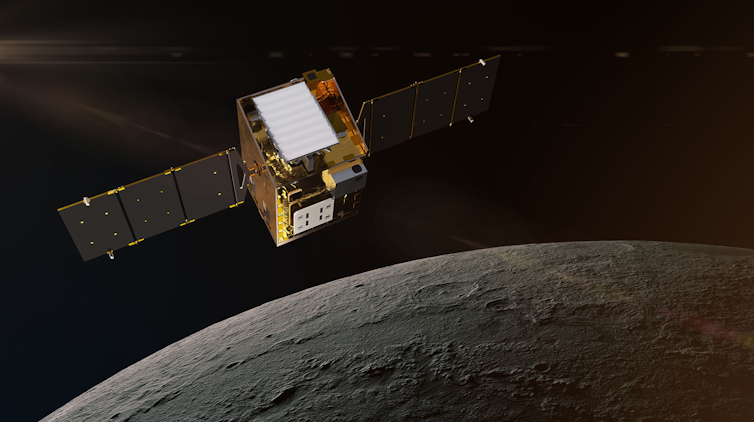
Lunar Trailblazer is planned to launch in early 2025. Lockheed Martin Space César León Jr., Washington University in St. Louis
NASA’s upcoming Artemis II mission is slated to return astronauts to the Moon no sooner than April 2026. Astronauts were last on the Moon in 1972 during the Apollo 17 mission.
Artemis II will utilize NASA’s Space Launch System, which is an extremely powerful rocket that will enable human space exploration beyond Earth’s atmosphere. The crew of four will travel in an Orion spacecraft, which the agency launched around the Moon and successfully returned during the Artemis I mission.
But before Artemis II, NASA will send two missions to scout the surface of the lunar south pole for resources that could sustain human space travel and enable new scientific discoveries.
Planetary geologists like me are interested in data from Lunar Trailblazer, one of these two scouting missions. The data from this mission will help us understand how water forms and behaves on rocky planets and moons.
Starting with scientific exploration
PRIME-1, or the Polar Resources Ice Mining Experiment, will be mounted on a lunar lander. It’s scheduled for launch in January 2025.
Aboard the lander are two instruments: The Regolith and Ice Drill for Exploring New Terrain, TRIDENT, and the Mass Spectrometer for Observing Lunar Operations, MSOLO. TRIDENT will dig down up to 3 feet (1 meter) and extract samples of lunar soil, and MSOLO will evaluate the soil’s chemical composition and water content.
Joining the lunar mining experiment is Lunar Trailblazer, a satellite launching on the same Falcon 9 rocket.
Think of this setup as a multimillion-dollar satellite Uber pool, or a rideshare where multiple missions share a rocket and minimize fuel usage while escaping Earth’s gravitational pull.
Bethany Ehlmann, a planetary scientist, is the principal investigator of Lunar Trailblazer and is leading an operating team of scientists and students from Caltech’s campus. Trailblazer is a NASA Small, Innovative Mission for PLanetary Exploration, or SIMPLEx.
These missions intend to provide practical operations experience at a lower cost. Each SIMPLEx mission is capped at a budget of US$55 million – Trailblazer is slightly over budget at $80 million. Even over budget, this mission will cost around a quarter of a typical robotic mission from NASA’s Discovery Program. Discovery Program missions typically cost around $300 million, with a maximum budget of $500 million.
Building small but mighty satellites
Decades of research and development into small satellites, or SmallSats, opened the possibility for Trailblazer. SmallSats take highly specific measurements and complement data sourced from other instruments.
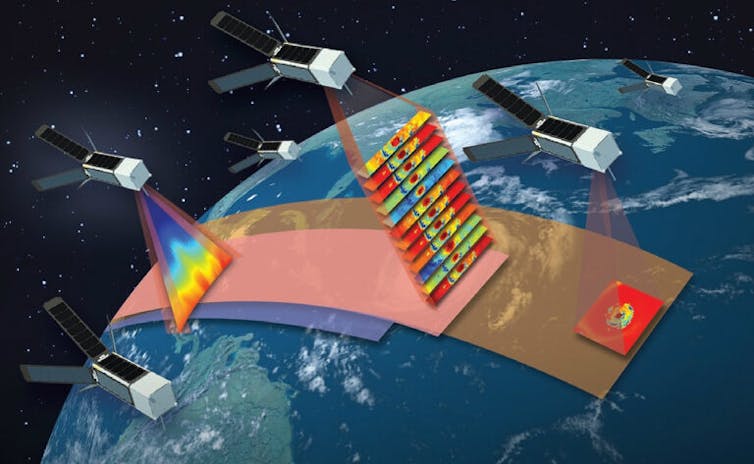
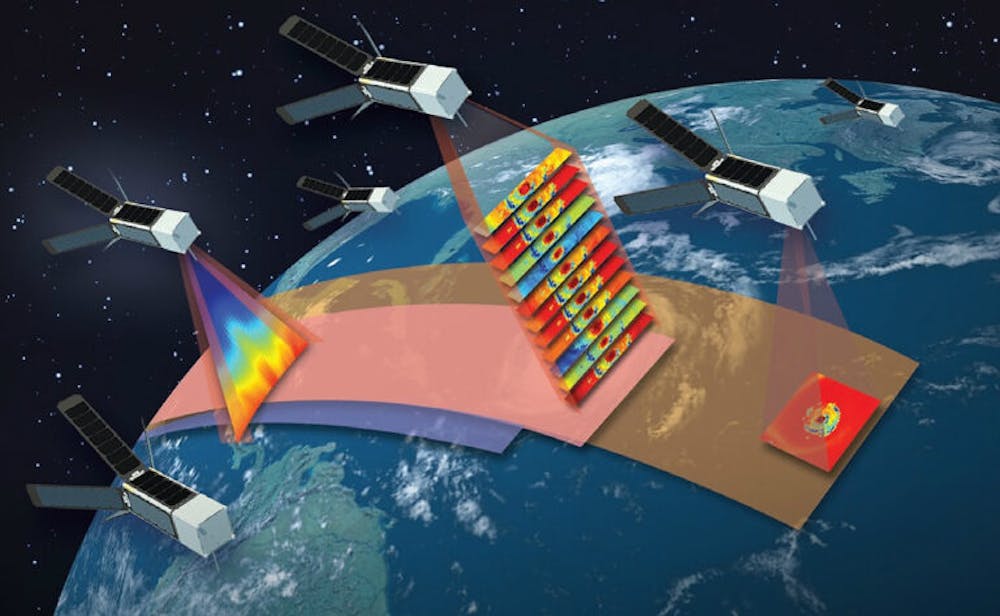
Missions like NASA’s TROPICS use a network of small satellites to take more data than one satellite would be able to do alone. NASA Applied Sciences Multiple SmallSats working together in a constellation can take various measurements simultaneously for a high-resolution view of the Earth’s or Moon’s surface.
SIMPLEx missions can use these SmallSats. Because they’re small and more affordable, they allow researchers to study questions that come with a higher technical risk. Lunar Trailblazer, for example, uses commercial off-the-shelf parts to keep the cost down.
These low-cost, high-risk experimental missions may help geologists further understand the origin of the solar system, as well as what it’s made of and how it has changed over time. Lunar Trailblazer will focus specifically on mapping the Moon.
A brief timeline of water discoveries on the Moon
Scientists have long been fascinated by the surface of our closest celestial neighbor, the Moon. As early as the mid-17th century, astronomers mischaracterized ancient volcanic eruptions as lunar mare, derived from the Latin word for “seas.”
Nearly two centuries later, astronomer William Pickering’s calculations suggested that the Moon had no atmosphere. This led him to conclude the Moon could not have water on its surface, as that water would vaporize.
However, in the 1990s, NASA’s Clementine mission detected water on the Moon. Clementine was the first mission to completely map the surface of the Moon, including the lunar poles. This data detected the presence of ice within permanently shadowed regions on the Moon in low resolution.
Scientists’ first water detection prompted further exploration. NASA launched the Lunar Prospector in 1998 and the Lunar Reconnaissance Orbiter in 2009. The India Space Research Organization launched its Chandrayaan-1 mission with the Moon Mineralogy Mapper, M3, instrument in 2008. M3, although not designed to detected liquid water, unexpectedly did find it in sunlit areas on the Moon.
These missions collectively provided maps showing how hydrous minerals – minerals containing water molecules in their chemical makeup – and ice water are distributed on the lunar surface, particularly in the cold, dark, permanently shadowed regions.
Novel mission, novel science
But how does the temperature and physical state of water on the Moon change from variations in sunlight and crater shadows?
Lunar Trailblazer will host two instruments, the Lunar Thermal Mapper, LTM, and an evolution of the M3 instrument, the High-resolution Volatiles and Minerals Moon Mapper, HVM3.
The LTM instrument will map surface temperature, while the HVM3 will measure how lunar rocks absorb light. These measurements will allow it to detect and distinguish between water in liquid and ice forms.
In tandem, these instruments will provide thermal and chemical measurements of hydrous lunar rock. They’ll measure water during various times of the lunar day, which is about 29.5 Earth days, to try to show how the chemical composition of water varies depending on the time of day and where it is on the Moon.
These results will tell researchers what phase – solid or liquid – the water is found in.
Scientific significance and what’s next
There are three leading theories for where lunar water came from. It could be water that’s been stored inside the Moon since its formation, in its mantle layer. Some geologic processes may have allowed it to slowly escape to the surface over time.
Or, the water may have arrived on asteroids and comets that collided with the lunar surface. It may even have been created by interactions with the solar wind, which is a stream of particles that comes from the Sun.
Lunar Trailblazer may shed light on these theories and help researchers make progress on several other big science questions, including how water behaves on rocky bodies like the Moon and whether future astronauts will be able to use it.
César León Jr., Ph.D. Student of Planetary Geology, Washington University in St. Louis
This article is republished from The Conversation under a Creative Commons license. Read the original article.
-
I went to the greenboxes about noon on the Saturday after Christmas. By carefully spreading out my garbage into vacant spaces in 4 dumpsters, I was able to unload my pickup. I walked behind those dumpsters to see that, by noon, garbage had missed the containers and was on the ground.
Garbage is no new thing to Lincoln County. When I surveyed in the Cabinet Mountains, I came across an old dump that showed some interesting old cans. I tossed a couple in my pack to show my archaeologist colleague – he identified the cans as Civil War era – the drop of solder in the center of the lid was the identifying feature. The same dump contained a fragment of a crosscut saw that he identified as 1877 at the earliest, so I’m guessing the cans were well past their ‘best used’ date when the saw broke.
In the Yaak, my task was to retrace the old mining claims – kind of a fun job – while his was to look for the old dumps, where he made the discovery that the main dining item for the Yaak silver miners was the woods caribou – he figured that their near extinction came from those miners . . . and that when they abandoned their mines and went north to Alaska with that gold rush, they were pre-adapted for the short days of Winter and eating caribou.
As a kid in 1960, I saw the piles of rusted cans left at the old dam on Fortine Creek. As I think back, and realize the dam operated for 20 years, I realize that there really weren’t all that many cans. In retrospect, a lot of the food they cooked must have came in something other than cans. Alongside the first old road (Fortine Creek Road is in its third location) I’ve encountered old ham cans that preceded Spam.
We didn’t have green boxes in 1960 – for Trego, the dump was just north of the turnoff to Rattlebone, on a chunk of Forest Service. Some folks still dumped in holes on their own places – and the dump was the best place to see a bear.
In the mid-sixties, as all of our communities turned into boom towns, expanding rapidly because of the construction projects, trailer courts popped up to provide housing options for the workforce. At that time, the Health Department and DEQ didn’t have the funding, staffing or authority to make folks jump through hoops to get things built. It couldn’t be done under today’s regulatory environment.
Now we think of Libby as a superfund site because of asbestos contamination associated with the vermiculite mine on Rainy Creek – but that was not Libby’s only health hazard. The early sixties also included a health hazard along Libby Creek – shallow wells, sandy soil and septic tanks. The caution that went along with 4H meetings was to avoid eating or drinking anything from Libby – stay healthy and eat what you brought. Additionally, there was an area contaminated by wood preservatives. As the county population grew with the construction impact associated with Libby Dam, Public Health began its growth to county power status. There are many heroes in Public Health – Snow with the Broad Street pump handle (the situation had some similarities with the shallow wells, sandy soils and septic tanks along Libby Creek), Pasteur, Salk, Pauling, Banting – the list of health heroes is long. The century between John Snow removing the pump handle to stop the spread of cholera and Jonas Salk developing an effective polio vaccine led to great public trust in the health profession – something that was forfeit just a few years ago by Anthony Fauci and the mismanagement of the Covid outbreak.
Lincoln County’s Garbage moved from something dealt with at the individual level to being handled by the county health department. Since Lincoln County has two virtually unconnected populations – drive 37 and look for residences between Pinkham Creek and Jennings Rapids – the decision was to have a couple of landfills. When the landfill at Eureka panned out short, the Health Department recommendation was to have one large landfill close to Libby, and drive the garbage trucks from as far as Stryker and Trego to the Libby Landfill.
In all fairness, Hooper didn’t make that recommendation – her predecessor did. Still, she is the heir of that decision – and the commissioners granted her the power to write and enforce the Lincoln County Decay Ordinance LINCOLN COUNTY ORDINANCES . Until Covid and the green boxes, only food and water providers came into contact with the Health Department – though everyone should click the link and see just how much authority the commissioners granted the Hoop and her department. (Perhaps D.C. Orr is more correct than we realize when he refers to the Hoop as “empress.”
As I think about garbage, maybe it was inevitable that the Health Department would screw up the landfills as the departmental leadership worked at becoming something that could inconvenience everyone. After all, they got a free chance at it during the covid thing. It does seem a bit foolish to leave the same department that screwed things up in charge of fixing the situation.
-
It’s Saturday afternoon, and I have just watched a young bald eagle attack a flock of turkeys – the attack started maybe 100 yards from me, and the turkeys immediately scattered and fled into the timber on the side of the hill.
The eagle’s ability to dive and fly faster than the turkeys might have made a difference if it had connected in the field. Like I said, the eagle was young – it landed at the edge of the trees and tried to walk in and hunt turkeys from the ground. By this time, I’m calling Renata to watch this operation. I can’t tell for sure, but it looks like all of the turkeys have parked in trees, with none left on the ground. I watch the eagle walking at the edge of the trees for maybe half a minute of unsuccessful hunting. It flies off, perhaps 50 yards, picking a spot to watch for a careless turkey.
It wasn’t to be. Two ravens had spotted the eagle, and as it started to fly back toward the turkeys, the ravens moved down to harass the eagle. After two passes by the ravens, the eagle decided that it didn’t want a turkey dinner that day and flew away.
The turkey flock has hens whose hatchlings have been the ravens’ prey since Spring. One was finally successful raising 4 little birds on her third clutch. They definitely weren’t falling for the old cliche “The enemy of my enemy is my friend.” From the turkey hens’ perspective, the enemy of my enemy is just the enemy of my enemy, not a third-class friend. We could stand to have a few more national level politicians that understand that perspective.
-
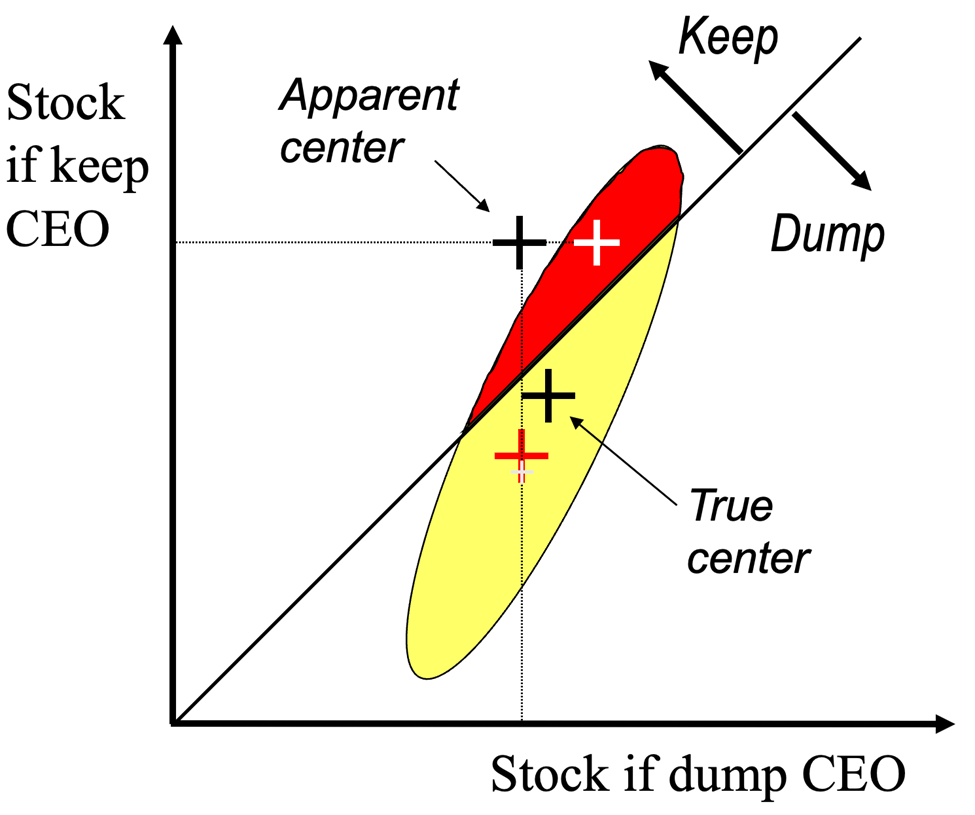
The blue line is the grade point average, the red line is the hours of homework I think we call it grade inflation.



-
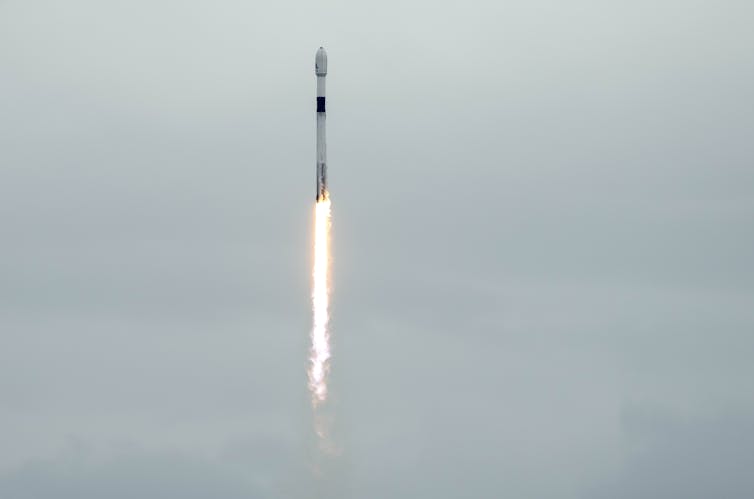
A host of space missions are planned to launch in 2025. AP Photo/John Raoux Zhenbo Wang, University of Tennessee
In 2024, space exploration dazzled the world.
NASA’s Europa Clipper began its journey to study Jupiter’s moon Europa. SpaceX’s Starship achieved its first successful landing, a critical milestone for future deep space missions. China made headlines with the Chang’e 6 mission, which successfully returned samples from the far side of the Moon. Meanwhile, the International Space Station continued to host international crews, including private missions like Axiom Mission 3.
As an aerospace engineer, I’m excited for 2025, when space agencies worldwide are gearing up for even more ambitious goals. Here’s a look at the most exciting missions planned for the coming year, which will expand humanity’s horizons even further, from the Moon and Mars to asteroids and beyond:
Scouting the lunar surface with CLPS
NASA’s Commercial Lunar Payload Services, or CLPS, initiative aims to deliver science and technology payloads to the Moon using commercial landers. CLPS is what brought Intuitive Machines’ Odysseus lander to the Moon in February 2024, marking the first U.S. Moon landing since Apollo.
In 2025, NASA has several CLPS missions planned, including deliveries by companies Astrobotic, Intuitive Machines and Firefly Aerospace.
These missions will carry a variety of scientific instruments and technology demonstrations to different lunar locations. The payloads will include experiments to study lunar geology, test new technologies for future human missions and gather data on the Moon’s environment.
Surveying the sky with SPHEREx
In February 2025, NASA plans to launch the Spectro-Photometer for the History of the Universe, Epoch of Reionization and Ices Explorer, or SPHEREx, observatory. This mission will survey the sky in near-infrared light, which is a type of light that is invisible to the naked eye but that special instruments can detect. Near-infrared light is useful for observing objects that are too cool or too distant to be seen in visible light.
SPHEREx will create a comprehensive map of the universe by surveying and collecting data on more than 450 million galaxies along with over 100 million stars in the Milky Way. Astronomers will use this data to answer big questions about the origins of galaxies and the distribution of water and organic molecules in stellar nurseries – where stars are born from gas and dust.
Studying low Earth orbit with Space Rider
The European Space Agency, or ESA, plans to conduct an orbital test flight of its Space Rider uncrewed spaceplane in the third quarter of 2025. Space Rider is a reusable spacecraft designed to carry out various scientific experiments in low Earth orbit.
These scientific experiments will include research in microgravity, which is the near-weightless environment of space. Scientists will study how plants grow, how materials behave and how biological processes occur without the influence of gravity.
Space Rider will also demonstrate new technologies for future missions. For example, it will test advanced telecommunication systems, which are crucial for maintaining communication with spacecraft over long distances. It will also test new robotic exploration tools for use on future missions to the Moon or Mars.
Exploring the Moon with M2/Resilience
Japan’s M2/Resilience mission, scheduled for January 2025, will launch a lander and micro-rover to the lunar surface.
This mission will study the lunar soil to understand its composition and properties. Researchers will also conduct a water-splitting test to produce oxygen and hydrogen by extracting water from the lunar surface, heating the water and splitting the captured steam. The generated water, oxygen and hydrogen can be used for enabling long-term lunar exploration.
This mission will also demonstrate new technologies, such as advanced navigation systems for precise landings and systems to operate the rover autonomously. These technologies are essential for future lunar exploration and could be used in missions to Mars and beyond.
The M2/Resilience mission is part of Japan’s broader efforts to contribute to international lunar exploration. It builds on the success of Japan’s Smart Lander for Investigating Moon, or SLIM, mission, which landed on the Moon using a precise landing technique in March 2024.
Investigating an asteroid with Tianwen-2
China’s Tianwen-2 mission is an ambitious asteroid sample return and comet probe mission. Scheduled for launch in May 2025, Tianwen-2 aims to collect samples from a near-Earth asteroid and study a comet. This mission will advance scientists’ understanding of the solar system’s formation and evolution, building on the success of China’s previous lunar and Mars missions.
The mission’s first target is the near-Earth asteroid 469219 Kamoʻoalewa. This asteroid is a quasi-satellite of Earth, meaning it orbits the Sun but stays close to Earth. Kamoʻoalewa is roughly 131-328 feet (40-100 meters) in diameter and may be a fragment of the Moon, ejected into space by a past impact event.
By studying this asteroid, scientists hope to learn about the early solar system and the processes that shaped it. The spacecraft will use both touch-and-go and anchor-and-attach techniques to collect samples from the asteroid’s surface.
After collecting samples from Kamoʻoalewa, Tianwen-2 will return them to Earth and then set course for its second target, the main-belt comet 311P/PANSTARRS. This comet is located in the asteroid belt between Mars and Jupiter.
By analyzing the comet’s materials, researchers hope to learn more about the conditions that existed in the early solar system and possibly the origins of water and organic molecules on Earth.
Solar system flybys
Besides the above planned launch missions, several space agencies plan to perform exciting deep-space flyby missions in 2025.
A flyby, or gravity assist, is when a spacecraft passes close enough to a planet or moon to use its gravity for a speed boost. As the spacecraft approaches, it gets pulled in by the planet’s gravity, which helps it accelerate.
After swinging around the planet, the spacecraft is flung back out into space, allowing it to change direction and continue on its intended path using less fuel. https://www.youtube.com/embed/0iAGrdITIiE?wmode=transparent&start=0 Spacecraft can fly by a planet to get a boost using gravity.
BepiColombo, a joint mission by ESA and the Japan Aerospace Exploration Agency, JAXA, will make its sixth flyby of Mercury in January 2025. This maneuver will help the spacecraft enter orbit around Mercury by November 2026. BepiColombo aims to study Mercury’s composition, atmosphere and surface geology.
NASA’s Europa Clipper mission, which launched in October 2024, will make significant progress on its journey to Jupiter’s moon Europa. In March 2025, the spacecraft will perform a flyby maneuver at Mars.
This maneuver will help the spacecraft gain the necessary speed and trajectory for its long voyage. Later in December 2026, Europa Clipper will perform a flyby of Earth, using Earth’s gravity to further increase its momentum so it can arrive at Europa in April 2030.
The ESA’s Hera mission will also perform a flyby of Mars in March 2025. Hera is part of the Asteroid Impact and Deflection Assessment mission, which plans to study the Didymos binary asteroid system. The mission will provide valuable data on asteroid deflection techniques and contribute to planetary defense strategies.
NASA’s Lucy mission will continue its journey to explore the Jupiter Trojan asteroids, which share Jupiter’s orbit around the Sun, in 2025. One key event for Lucy is its flyby of the inner main-belt asteroid 52246 Donaldjohanson, scheduled for April 20, 2025.
This flyby will provide valuable data on this ancient asteroid’s composition and surface features, which can help researchers gain insights into the early solar system. The asteroid is named after the paleoanthropologist who discovered the famous “Lucy” fossil.
ESA’s Jupiter Icy Moons Explorer, or JUICE, mission will perform a Venus flyby in August 2025. This maneuver will help JUICE gain the necessary speed and trajectory for its journey to Jupiter. Once it arrives, JUICE will study Jupiter’s icy moons to understand their potential for harboring life.
2025 promises to be a groundbreaking year for space exploration. With NASA’s ambitious missions and significant contributions from other countries, we are set to make remarkable strides in humanity’s understanding of the universe. These missions will not only advance scientific knowledge but also inspire future generations to look to the stars.
Zhenbo Wang, Associate Professor of Mechanical, Aerospace and Biomedical Engineering, University of Tennessee
This article is republished from The Conversation under a Creative Commons license. Read the original article.




Want to tell us something or ask a question? Get in touch.

Recent Posts
- Computer Repair by Mussolini
- Getting Alberta Oil to Market
- Parties On Economics
- Thus Spake Zarathustra – One More Time
- Suspenders
- You Haven’t Met All The People . . .
- Play Stupid Games, Win Stupid Prizes
- The Ballad of Lenin’s Tomb
- An Encounter With a Lawnmower Thief
- County Property Taxes
- A Big Loss in 2025
- Thinking of Clovis

Rough Cut Lumber
Harvested as part of thinning to reduce fire danger.
$0.75 per board foot.
Call Mike (406-882-4835) or Sam (406-882-4597)
Popular Posts
Ask The Entomologist Bears Books Canada Census Community Decay Covid Covid-19 Data Deer Demography Education Elections Eureka Montana family Firearms Game Cameras Geese Government Guns History Inflation life Lincoln County Board of Health Lincoln County MT Lincoln Electric Cooperative Montana nature News Patches' Pieces Pest Control Politics Pond Recipe School School Board Snow Taxes travel Trego Trego Montana Trego School Weather Wildlife writing
 Trego's Mountain Ear