-
Not all facts are equally acceptable – particularly during political season. The term “Illusory Truth Effect” is the tendency to believe false information after repeated exposure. It feels familiar, it supports a pre-existing belief framework – so we can accept something that is false as fact.
This year, I’ve been seeing announcements of Trump as Hitler and others of Kamala as communist. The Trump as Hitler allegations have resulted in a couple of local dems announcing that the folks in red MAGA hats are the same as the Ku Klux Klan – and, of course, Kamala, with a father who fits in as a Marxist Economist is in an equal spot for the illusory truth effect.
There’s another term – preference falsification – that might even apply to answering pollsters. The definition is “misrepresenting private beliefs and thoughts in public.” It was why the polls taken in South Dakota showed a greater opposition to abortion than the balloting on the issue did – the folks who were trying for more restrictions couldn’t understand why their issue lost the election.
I’m used to the explanation that there’s the Stupid party and the Evil party – and that bipartisan actually means that they have passed legislation that is both stupid and evil. Still, I’m getting a bit tired of the attack ads – and realizing how every attack ad makes the next bit of false information that much more acceptable.
I’m looking at a presidential election that has two flawed candidates. Hell, I’m looking at a choice between flawed candidates for both the Senate and the House. Just because my neighbor weighs any of the pairs differently than I do isn’t a reason to call my neighbor a closet Kluxer or Commie – we just have looked at the same candidate from different perspectives.
Where the candidate stands on gun control, on the second amendment, is a big part of my decision. In 2016, I knew where Hilary stood and hoped Trump would be better. He was. It doesn’t mean I write off friends who voted against Trump – he wasn’t my perfect candidate then. He was just better than Hillary or Slow Joe. Strange, isn’t it, that in a nation of 330 million people, these are the choices we get?
-
One of the rarest versions of the Martini-Henry rifle is the Gahendra. It’s probably the rarest because it isn’t really a Martini – it uses flat springs, and is actually a variant of a Wesley-Richards design that lost out to the Martini when the Brits were selecting a new service rifle back in 1871.
The record grants Gahendra Shumsher the honor of being Nepal’s outstanding firearms designer. Actually, he searched out designs that could be built with the artisans and tooling available in Nepal during his short lifetime – at 14, he was in charge of the ammunition department of Nepal’s army. Gahendra needed the early start – he was just 35 when he was murdered. Or choked to death by a boiled egg he was eating. It all depends on whether you believe the government report or not.
The Gahendra rifle production ended before 1899 – I’m pretty solid on that because they can be sold in the US without going through a FFL. On the other hand, production is listed as ‘beginning in the 1880’s. Gahendra was born in 1871, and was put in charge of the ammunition department of Nepal’s army in 1885 (quite a spot for a 14-year-old). I can’t see production of the rifle starting before 1885 – so, at 4 rifles per day, over no more than 14 years, total production was likely under 20,000 rifles.

I’m in the process of restoring one of the last of the Gahendra rifles available. I went through cleaning and repairing several when I was in South Dakota (my dentist liked the Gahendra and nylon stocked Remington 22 rifles). One of his that I worked on had every internal part marked with 4 – suggesting to me that Gahendra may have started production with a European gunsmith or armorer. Unlike most American gunsmiths, I had the benefit of Nepali students who could actually read the language stamped on the rifles.
The one I’m working on now needs the rear sight repaired, the action fitted to a replacement (still old stock) lever, and the rear sight repaired. When I get done, I’ll shoot a light load in 45 Colt through it, using a stainless steel adapter. That will keep the pressure a lot lower than trying to reload the original 450-577 cartridge.
Gahendra Shumsher also developed the Bira gun – a double-barreled mechanical machine gun, copied from the Gardner gun, that weighed in around half a ton. I wake from dreams of building a reduced scale 22, with the action laminated from aluminum plates and using a pair of 30 round 22 magazines. It could be done – but it seems like wasting ammunition.


I would be reluctant to put Gahendra Shumsher on the same level as John Moses Browning or Aimo Lahti – but his ability to modify European designs to something that could be artisan made in Kathmandu was impressive.
-

Having a beer in Raceland, La. Russell Lee for Farm Security Administration/WPA Kyle G. Volk, University of Montana

Uncommon Courses is an occasional series from The Conversation U.S. highlighting unconventional approaches to teaching.
Title of course:
“Intoxication Nation: Alcohol in American History”
What prompted the idea for the course?
I wanted to get students excited about studying the past by learning about something that is very much a part of their own lives.
Alcohol – somewhat surprisingly to me at first – featured prominently in my own research on minority rights and U.S. democracy in the mid-19th century. As a result, I knew quite a bit about the temperance movement and conflicts over prohibition during that period. Designing this course allowed me to broaden my expertise.
What does the course explore?
Prohibition is a must-do subject. Students expect it. But I cover several hundred years of history: from the 17th-century invention of rum – as a byproduct of sugar produced by enslaved people – to the rise of craft beer and craft spirits in the 21st century.

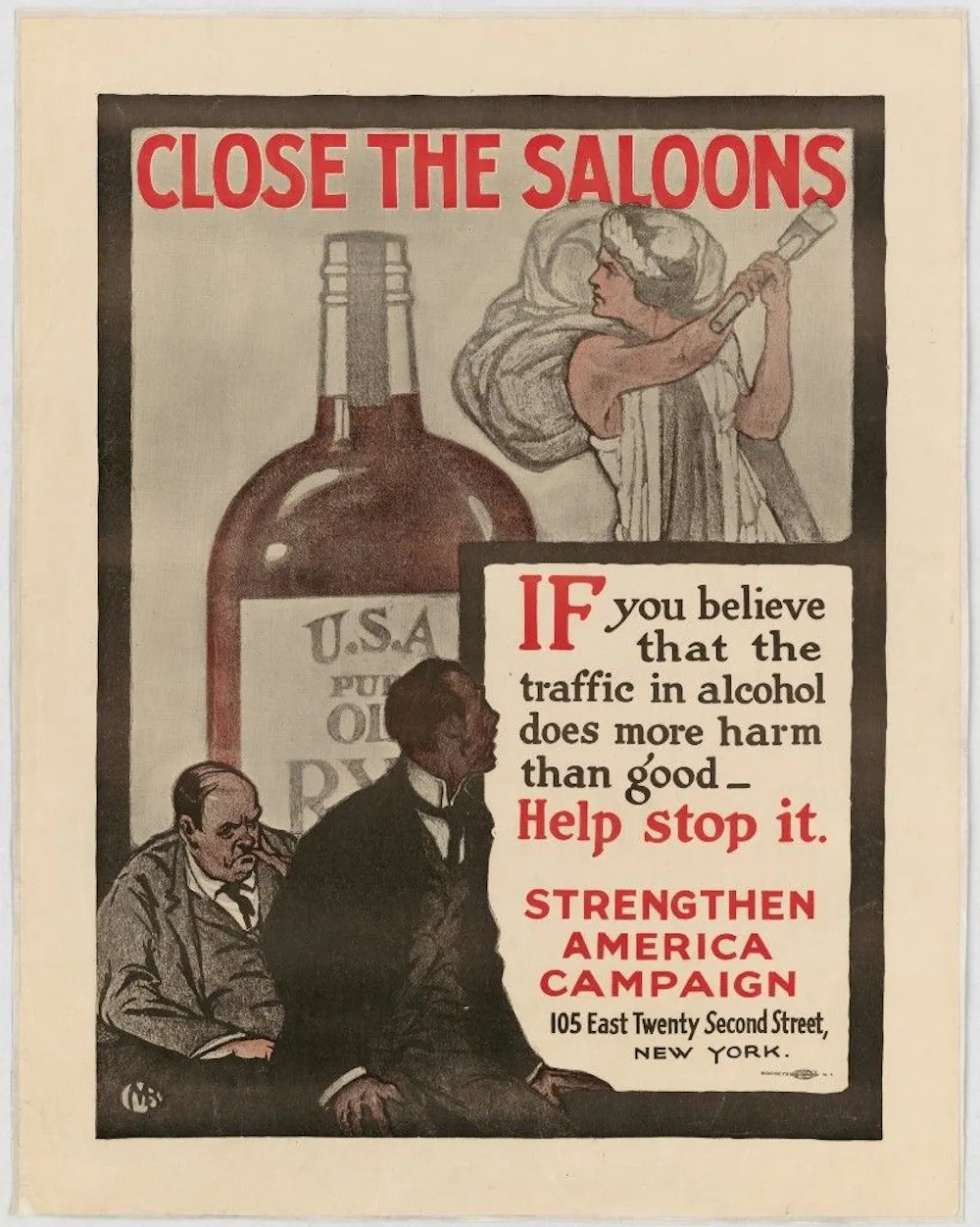
A temperance poster from the World War I era. Office of Naval Records and Library via National Archives Catalog Along the way, I’m thrilled when students get excited about details that allow them to taste a more complicated historical cocktail. For example, they learn why white women’s production of hard cider was crucial to the survival of colonial Virginia. The short answer: Potable water was in short supply, alcoholic drinks were far healthier, and white men – and their indentured and enslaved workforce – were busy raising tobacco. It fell to women to turn fruit into salvation.
Why is this course relevant now?
Alcohol remains a big and almost inescapable part of American society. But of late, Americans have been drinking differently – and thinking about drinking differently.
Examples abound. Alcohol producers, we learn, now face competition from legalized weed. Drinking levels rose during the COVID-19 pandemic, yet interest is declining among Gen Zers. The “wine mom” culture that brought some mothers together now faces mounting criticism.
And, of course, there’s the never-ending debate about the health benefits and risks of alcohol. Of late, the risks seem to be dominating headlines.
What’s a critical lesson from the course?
Alcohol has been a highly controversial, central aspect of the American experience, shaping virtually all sectors of our society – political and constitutional, business and economic, social and cultural.
What materials does the course feature?
- Historian Bill Rorabaugh’s “The Alcoholic Republic: An American Tradition”: a classic social history explaining why Americans in the early 19th century drank twice as much per capita as we do today
- Jack London’s alcoholic memoir, “John Barleycorn”: a deep dive into the notorious workingmen’s saloons of the industrial era, as well as one person’s reckoning with alcoholism
- “Days of Wine and Roses”: the 1962 film starring Jack Lemmon and Lee Remick that spotlighted the place of alcoholic marriages and Alcoholics Anonymous in post-World War II America
- Murray Sperber’s “Beer and Circus: How Big-Time College Sports is Crippling Undergraduate Education”: a provocative early 2000s assessment of college sports and the surrounding party culture vis-a-vis declining academic standards – still relevant today
What will the course prepare students to do?
Like any history course, this one aims to develop student’s analytical, written, research and verbal skills. In lots of ways, the topic is just a tool to get students to grow their brains. But I also seek to grow students’ critical awareness of the place of alcohol in their own lives. The course has also informed students’ paths after graduation – including some who wound up working in the alcohol industry or recovery organizations.
Kyle G. Volk, Professor of History, University of Montana
This article is republished from The Conversation under a Creative Commons license. Read the original article.
-
Eureka Community Players hosted their third annual cemetery tour this Sunday, at the Eureka Cemetery. Tours started in the early afternoon, with guides in period garb available to lead groups around the cemetery visiting ‘storytellers’ at the various gravesites.
Tours were fairly lengthy, but there were golf carts available for those who needed a bit of a assistance getting around the cemetery.
In the meantime, the Lincoln County Fairgrounds began the weekend by hosting the first of this year’s series of flea markets. This weekend, house plants, baked goods (supporting the local ballet group), and freeze dried goodies were available, in addition to more varied collections of miscellanea.
Weather proved warm, and the weekend pleasant for activities.
-

The Boeing Starliner, shown as it approached the International Space Station. NASA via AP Michael E. Fossum, Texas A&M University
Boeing’s crew transport space capsule, the Starliner, returned to Earth without its two-person crew right after midnight Eastern time on Sept. 7, 2024. Its remotely piloted return marked the end of a fraught test flight to the International Space Station which left two astronauts, Butch Wilmore and Sunita “Suni” Williams, on the station for months longer than intended after thruster failures led NASA to deem the capsule unsafe to pilot back.
Wilmore and Williams will stay on the International Space Station until February 2025, when they’ll return to Earth on a SpaceX Dragon capsule.
The Conversation U.S. asked former commander of the International Space Station Michael Fossum about NASA’s decision to return the craft uncrewed, the future of the Starliner program and its crew’s extended stay at the space station.
What does this decision mean for NASA?
NASA awarded contracts to both Boeing and SpaceX in 2014 to provide crew transport vehicles to the International Space Station via the Commercial Crew Program. At the start of the program, most bets were on Boeing to take the lead, because of its extensive aerospace experience.
However, SpaceX moved very quickly with its new rocket, the Falcon 9, and its cargo ship, Dragon. While they suffered some early failures during testing, they aggressively built, tested and learned from each failure. In 2020, SpaceX successfully launched its first test crew to the International Space Station.
Meanwhile, Boeing struggled through some development setbacks. The outcome of this first test flight is a huge disappointment for Boeing and NASA. But NASA leadership has expressed its support for Boeing, and many experts, including me, believe it remains in the agency’s best interest to have more than one American crew launch system to support continued human space operations.
NASA is also continuing its exchange partnership with Russia. This partnership provides the agency with multiple ways to get crew members to and from the space station.
As space station operations continue, NASA and its partners have enough options to get people to and from the station that they’ll always have the essential crew on the station – even if there are launch disruptions for any one of the capable crewed vehicles. Having Starliner as an option will help with that redundancy.

NASA has a few options to get astronauts up to the International Space Station. Roscosmos State Space Corporation via AP What does this decision mean for Boeing?
I do think Boeing’s reputation is going to ultimately suffer. The company is going head-to-head with SpaceX. Now, the SpaceX Dragon crew spacecraft has several flights under its belt. It has proven a reliable way to get to and from the space station.
It’s important to remember that this was a test flight for Starliner. Of course, the program managers want each test flight to run perfectly, but you can’t anticipate every potential problem through ground testing. Unsurprisingly, some problems cropped up – you expect them in a test flight.
The space environment is unforgiving. A small problem can become catastrophic in zero gravity. It’s hard to replicate these situations on the ground.
The technology SpaceX and Boeing use is also radically different from the kind of capsule technology used in the early days of the Mercury, Gemini and Apollo programs.
NASA has evolved and made strategic moves to advance its mission over the past two decades. The agency has leaned into its legacy of thinking outside the box. It was an innovative move to break from tradition and leverage commercial competitors to advance the program. NASA gave the companies a set of requirements and left it up to them to figure out how they would meet them.
What does this decision mean for Starliner’s crew?
I know Butch Wilmore and Suni Williams as rock-solid professionals, and I believe their first thoughts are about completing their mission safely. They are both highly experienced astronauts with previous long-duration space station experience. I’m sure they are taking this in stride.
Prior to joining NASA, Williams was a Naval aviator and Wilmore a combat veteran, so these two know how to face risk and accomplish their missions. This kind of unfavorable outcome is always a possibility in a test mission. I am sure they are leaning forward with a positive attitude and using their bonus time in space to advance science, technology and space exploration.
Their families shoulder the bigger impact. They were prepared to welcome the crew home in less than two weeks and now must adjust to unexpectedly being apart for eight months.
Right now, NASA is dealing with a ripple effect, with more astronauts than expected on the space station. More people means more consumables – like food and clothing – required. The space station has supported a large crew for short periods in the past, but with nine crew members on board today, the systems have to work harder to purify recycled drinking water, generate oxygen and remove carbon dioxide from their atmosphere.
Wilmore and Williams are also consuming food, and they didn’t arrive with the clothes and other personal supplies they needed for an eight-month stay, so NASA has already started increasing those deliveries on cargo ships.
What does this decision mean for the future?
Human spaceflight is excruciatingly hard and relentlessly unforgiving. A million things must go right to have a successful mission. It’s impossible to fully understand the performance of systems in a microgravity environment until they’re tested in space.
NASA has had numerous failures and near-misses in the quest to put Americans on the Moon. They lost the Apollo 1 crew in a fire during a preflight test. They launched the first space shuttle in 1981, and dealt with problems throughout that program’s 30-year life, including the terrible losses of Challenger and Columbia.
After having no other U.S. options for over 30 years, three different human spacecraft programs are now underway. In addition to the SpaceX Crew Dragon and the Boeing Starliner, NASA’s Orion spacecraft for the Artemis II mission, is planned to fly four astronauts around the Moon in the next couple of years.
These programs have had setbacks and bumps along the way – and there will be more – but I haven’t been this excited about human spaceflight since I was an 11-year-old cheering for Apollo and dreaming about putting the first human footprints on Mars.
Michael E. Fossum, Vice President, Texas A&M University
This article is republished from The Conversation under a Creative Commons license. Read the original article.
-
To tell the truth, I can’t tell you which phrase fits. I’ve probably built both – long before some anti-gun politician or activist came up with the two phrases.
As I understand it – and my understanding of how guns work is a lot better than my understanding of anti-gun folks – a ghost gun is a gun built on a receiver that I built or finished at home, while a zombie gun is a gun that had its original receiver destroyed, and all the parts were recycled and built back into a gun on a new receiver.
Time was that a lot of second-hand parts for model 1911’s were available -and an outfit in California was selling complete aluminum receivers (with serial numbers) for $29.95 plus shipping. I think that when I put all the pieces together, that qualified as the zombie gun. In those pre-neuropathy days, to me it was just the cheapest way to get a 45 auto.
If I wanted a pistol that grouped better, I’d usually start with a steel frame, and include some parts that never saw government service. Accuracy in a 1911 correlates with hand work – and fewer recycled parts meant that it was going to take more time to get the 1911 working reliably. Those old government surplus parts often had a lot of wear on them.
This is a photo of one of those fed ord frames – not one that I built on, but only the serial number is different:

Now a ghost gun is built on a less-finished (80% complete) receiver like this one. You can order it through the mail, and finish it at home – you’ll notice that it needs the slots milled for the slide rails, and then moved to the drill press to get a few holes drilled. It has no serial number – but adding a serial number is a fairly easy task. It just requires a stamp set and a hammer.

Frankly, it’s a lot less work to buy the completed frame – and the 80% receiver isn’t that much cheaper. Either way, I think I was putting zombie guns together. The couple of 80% receivers I did finish probably qualified as ghost zombie guns. Or maybe Zombie ghost guns. I don’t know. I’m not a hoplophobe.
Time was when folks were buying 80% receivers for AR-15s, then having a weekend party with someone who had a milling machine, and carrying a complete AR-15 home, lacking only the serial number. Before completion, it looks like this:

I never found going the 80% route worthwhile. Anderson receivers were available at Cabelas, cost the same, were a lot less work, and could be purchased with points.

Generally speaking, it’s cheaper to get new parts for an AR, so the zombie option isn’t there. And the ghost gun option is just more work than it’s worth.
Still, there are a lot of parts kits available, for AK’s, CETME’s, old submachine guns, etc. For some, an 80% receiver is an option, where a new commercial receiver isn’t available. For others, a piece of metal tubing, a welder, and a dremel allow you to build a replacement receiver. There are molds available so you can cast your own plastic receiver for Glock parts.
The Supreme Court heard arguments in Garland v VanDerStok this past week – and probably we’ll learn next year if the 80% receivers remain legal.
-
Glenn Reynolds has an article available at substack. It begins with this graph of the national debt, and the following statements:

“Debt doom is coming, everyone knows it, no one is doing anything about it.”
I suggest clicking the link and reading his article. Reading the comments might be a good idea too – some of them are well reasoned.
The optimistic part is that most states aren’t financially underwater. The pessimistic part is that California, New York, New Jersey and Illinois are – and that list is made without checking references.
Click the link, read the article. This graph, from the Visual Capitalist Purchasing Power of the U.S. Dollar Over Time supports the graph and Reynolds’ concern.

The problem is that it is both easy and fun to spend other people’s money – and we vote for politicians we like, not for politicians who are fiscally responsible.
Fifty percent plus one is a method of selecting a government. It is no more divinely inspired than monarchy.
-
Let me start with the comment that I haven’t evaluated the methodology of developing this map:

There seems to be some face validity – I would expect Massachusetts, with MIT, Harvard, Yale, etc. to lead the nation. The map is from the Visual Capitalist at Mapped: Average IQ Score by State. The data source is at Updated IQ and Well-Being Scores for the 50 U.S. States – PMC – and the methodology sounds OK. IQ is one of the most solidly researched topics of psychology, the tests are well supported, and there are still a lot of naysayers that deny the test accuracy. At Jordan Peterson on IQ – The Online Scholar Fact Check these two paragraphs describe the topic:
“In one statement, Jordan Peterson said that “so one thing you need to know is that if any social science claims whatsoever are correct, then the IQ claims are correct. Because the IQ claims are more psychometrically rigorous than any other phenomena that’s been discovered by social scientists.” A small nitpick or distinction to make here is that it could be entirely true that the IQ claims in social science could be wrong and other claims arrived at through less rigor, may well be true. However it appears Jordan is making an epistemic claims about how knowledge is arrive at and that part of the claim is certainly defensible.
The psychometric data and testing has come a long way since it’s inception and those people that say “all that a high IQ means is that the person is good at taking an IQ test”, is really missing out on all the work that has gone into the formation and development of these tests. On the other side though, one of the reasons that the IQ literature has required such rigorous psychometric data is because intelligence, and all it’s attempts to study it, is very hard. The mere definition of intelligence is still intensely debated but just so readers know, the working definition: I.Q. is the measure of one’s ability to a) solve problems and b) learn new things. This is extremely important because it does not factor in the importance of personality which causes some interference in making strong claims about specific future success.”
So I’m looking at the map and comparing Montana and California . . . and remembering a classmate who took an IQ test, scored 94, and was proud of his high score.
At What it Means to have an IQ LOWER than 83 | Jordan Peterson describes how life prospects are for the folks who score in the lower 10%, and comments that even folks scoring below 90 (and that’s one in four people) have trouble following written instructions. If Californians actually average 95.5, the state’s average is at the 38th percentile – compared with the Montana number of 103.4 at the 59th percentile (Massachusetts comes in at the 61st percentile). Starting with an average of 95.5, instead of 100, changes Peterson’s 10% to something closer to 14 or 15. I’m not sure about the 83 number – but talking about a tenth of the population – and then looking at averages below 100 – makes it a significant topic. There was a time when a guy could make a good living with a strong body and a good work ethic. Peterson’s lectures pretty much say that time is long past.
He explains that no one has found a way to increase IQ – that it is basically the luck of birth. These two college lectures quickly describe the topic:
Jordan Peterson on Increasing Intelligence and Lifetime Success
-
As I look at the news, I notice that some folks to the North are talking about sending old Canadian Military pistols to Ukraine. Others question what good 80-year-old pistols would do. I’m kind of neutral. I definitely like the Browning Hi Power – though I don’t have one any more.
My GP-35 was an Inglis Browning – Mapping the Course of Canada’s Inglis Hi-Power Pistols – Athlon Outdoors – provides a far more comprehensive story on this pistol than I will tell. Built in Canada, sent to China, then exported to the US under President Bush the first, my pistol had one of the most optimistic rear sights available – if memory serves, it elevated for making 500 yard shots. Bloody useless, but the Chinese of 1942 liked the idea of removable stocks for pistols. Mine was rigged to accept a stock, but I never had one. By 1990, the decision had been made for light carbines, and stocked pistols were just one more failed concept. Memory tells me it looked close to this:

I know I’m not the only person who regrets selling his Inglis GP-35. An article this Spring New For 2024: Inglis High Power Pistols | An Official Journal Of The NRA tells that they’re being built again. My GP35 had been through a half-century of abuse. I’m sure the Canadian military treated theirs better – so they would probably still be of use to Ukraine. Who knows what next? Maybe I will think of some reason to replace it with a new one.





Want to tell us something or ask a question? Get in touch.

Recent Posts
- Computer Repair by Mussolini
- Getting Alberta Oil to Market
- Parties On Economics
- Thus Spake Zarathustra – One More Time
- Suspenders
- You Haven’t Met All The People . . .
- Play Stupid Games, Win Stupid Prizes
- The Ballad of Lenin’s Tomb
- An Encounter With a Lawnmower Thief
- County Property Taxes
- A Big Loss in 2025
- Thinking of Clovis

Rough Cut Lumber
Harvested as part of thinning to reduce fire danger.
$0.75 per board foot.
Call Mike (406-882-4835) or Sam (406-882-4597)
Popular Posts
Ask The Entomologist Bears Books Canada Census Community Decay Covid Covid-19 Data Deer Demography Education Elections Eureka Montana family Firearms Game Cameras Geese Government Guns History Inflation life Lincoln County Board of Health Lincoln County MT Lincoln Electric Cooperative Montana nature News Patches' Pieces Pest Control Politics Pond Recipe School School Board Snow Taxes travel Trego Trego Montana Trego School Weather Wildlife writing
 Trego's Mountain Ear