-
My thoughts drift back 45 years – I had a brand new Thompson Center Contender and an old grade school classmate. Koocanusa was new, and Bob Herron was getting a maximum of fun on a still evening, shooting my new pistol and listening to the birdshot’s miniature splashes as they fell into the water. I was raised to be frugal with ammunition – but Bob’s joy at the recoil of the 45/410 still makes those two boxes of 3 inch magnums one of the cheaper joys I have experienced.
Bob loved recoil. I remember his Hawes 44 magnum – so out of time that it spit lead as the bullet entered the barrel, sometimes to the left and other times to the right. I remember explaining that a new bolt would solve that problem – but we had different perspectives. Even then I was oriented to the firing line, while Bob enjoyed recoil. He wasn’t alone – I recall a cop on the highline whose model 29 was badly out of time – but he had Clint Eastwood’s autograph on the butt, and was afraid he would ruin the autograph if he fixed the gun.
The bolt on a revolver is a term that goes back to Sam Colt. It’s a spring-loaded part that pushes up into a milled hole in the cylinder to hold the cylinder in alignment with the barrel as the revolver fires. Later, the term bolt gained a different meaning – but in revolvers the part still has the name Sam Colt gave it. Bob’s Hawes, with a lifetime of heavily loaded 44 magnums, had simply shot loose. My own revolver (marked J.P. Sauer & Sohn instead of the importer Hawes), in 357 magnum (backed with a 9mm cylinder) has had a lifetime of much lighter loads, and 50 years later is still perfectly in time. Fixed sights, hits about an inch low. Different purposes, different stresses.
Some people like to use ammunition quickly – for them, the inaccuracy of a bump stock is not the problem it is for me. I’m stuck with the desire to put one bullet as close to the X as I can. As I age, that distance seems to be growing with each birthday. Still, bump stocks have provided for folks who didn’t want to pay the transfer tax for NFA items. The fact that I don’t want either doesn’t make me more virtuous – my perspective is just different. I want bullet holes as close to the X as I can get them.
-
I’ve never been too sure about political sides like right and left, conservative and liberal, or Republican and Democrat. As I’ve started my research on buying politicians, I’m finding a bizarre clarity – there are two sides, and the sides are inside and outside.
It makes no difference if I’m right or left – if I’m outside, politics is something that happens to me. I’m rural by choice – which means my government experience begins with paying taxes and ends in some variant of an authority figure deciding what I should do. I remember the last day of Obama’s administration, when the director of Fish and Wildlife issued order 219, banning the use of lead bullets on all federal lands. When you’re outside – like rural residents of a county where ¾ of the land is Forest Service, government happens to you, not for you. Fortunately order 219 didn’t last long – but it seemed like a malicious way to treat rural people who are outside.
At the county level, it can be where your residence is. Libby, with the courthouse and seat of county government, has a higher percentage of government insiders than the more remote north county. Government services are easier to use when you live close by – when you’re remote, you hope to be left alone. Most rural folks are outside.
I might have thought myself an insider when I was invited to talk with legislative committees about my specialties – but in retrospect, when my testimony supported doing what they wanted to do, everything was smiles and nods. If my facts differed from the legislators desire, much less so. Not having a dog in the fight, I was at best an expert whose testimony supported the conclusions that were already made.
I can’t make a lot of sense in classifying the national socialists as right wingers while the international socialists are left wingers. Each group seems closer to the other than to me. Then again, insiders versus an outsider.
Where Did the Terms ‘Left Wing’ and ‘Right Wing’ Come From? | HISTORY Shows the origin of right and left in France:
“The split dates to the summer of 1789, when members of the French National Assembly met to begin drafting a constitution. The delegates were deeply divided over the issue of how much authority King Louis XVI should have, and as the debate raged, the two main factions each staked out territory in the assembly hall. The anti-royalist revolutionaries seated themselves to the presiding officer’s left, while the more conservative, aristocratic supporters of the monarchy gathered to the right.”
So if being anti-royalist is the qualification for being left-wing, I’m a leftist. I admit, I had a soft spot for Queen Elizabeth – but she’s gone, and it’s kind of hard to transfer that soft spot to Charles. Still, that family is pretty much the illustration for a bunch of government insiders – and watching Prince Andrew and Prince Harry illustrates how the move from insider to outsider occurs. As I think about it, historically we went through a time of revolution, when government was taken from these ultimate insiders, then changed to various forms of democracies and republics which a new bunch of insiders took over. No big thing – I’ve read about the first King Charles and his problems with Oliver Cromwell
-
The USDA has updated plant hardiness zones, and despite last winter’s impressive cold, we’ve jumped up a zone (to 5a from 4b in 2012; the average low went up by 6 degrees)
Hardiness zones are a (partial) climate description that’s been in existence for a bit over a century, though the government didn’t get involved in it until the ’60s (At which point they proceeded to do so badly for a few decades). They use the average minimum winter temperature to determine the zone.

The current map can be found at usda.gov/ and is searchable by zip code. Here’s the current map for Montana:

-
“The fact that millions of people share the same vices does not make these vices virtues, the fact that they share so many errors does not make the errors to be truths, and the fact that millions of people share the same form of mental pathology does not make these people sane.” ~ Erich Fromm
“There are only four types of officers. First, there are the lazy, stupid ones. Leave them alone, they do no harm…Second, there are the hard-working, intelligent ones. They make excellent staff officers, ensuring that every detail is properly considered. Third, there are the hard-working, stupid ones. These people are a menace and must be fired at once. They create irrelevant work for everybody. Finally, there are the intelligent, lazy ones. They are suited for the highest office.
General Erich Von Manstein (1887-1973) on the German Officer Corps
Always give a word or a sign of salute when meeting or passing a friend,even a stranger, when in a lonely place. Show respect to all people and grovel to none. When you arise in the morning give thanks for the food and for the joy of living. If you see no reason for giving thanks, the fault lies only in yourself.
TecumsehI think myself that we have more machinery of government than is necessary, too many parasites living on the labor of the industrious. Government big enough to supply everything you need is big enough to take everything you have … The course of history shows that as a government grows, liberty decreases. The two enemies of the people are criminals and government, so let us tie the second down with the chains of the constitution so the second will not become the legalized version of the first.
Thomas Jefferson -
While our dollars say ‘legal tender’ on them, that doesn’t mean a store has to accept them. According to the Federal Reserve, all the term means is that a lender has to accept them as a form of debt repayment.
This last executive session, the Montana Legislature passed a bill requiring that US cash be accepted as currency, which was signed into law by the governor. Merchants that do not accept cash will be subject to a $100 fine per incident.
This still begs the question: Why is this even necessary? Looking into it suggests a of messy soup of definitions that a court will probably have to sort through at some point. A few thoughts:
- The Federal Reserve says “There is no federal statute mandating that a private business, a person, or an organization must accept currency or coins as payment for goods or services” so, theoretically a store could insist on being paid in, say, chickens…
- Legal tender, as a concept, shows up in the argument over paper money, when the federal government started issuing it in order to deal with civil war debts
- There seems to be an insistence that as long as a merchant is accepting payment in dollars of some kind (like via a credit card), it doesn’t matter if they don’t accept it in another form
-
You can wear a pistol into the post office now – you’ll just have to travel to Florida to do it. Here is the link to the court results in US v Ayala, down in Tampa.
Judge Kathryn Kimbel Mizzelle issued her ruling in mid-January, based only on second amendment grounds, interpreted under the Bruen criteria (just as a side note, the judge clerked for Clarence Thomas earlier in her career).
The first page of her opinion makes things clear: “the government must point to historical principles that would permit it to prohibit firearms possession in post offices. See id. at 17, 24. The United States fails to meet that burden. Thus, I dismiss the § 930(a) charge because it violates Ayala’s Second Amendment right to bear arms.”
“2. Section 930(a)’s Application to Post Offices Has No Historical Support The United States concedes that “[t]here is no evidence of firearms being prohibited at post offices, specifically, or of postal workers being prohibited from carrying them, at the time of the founding.” Gov’t Suppl. Br. at 4. Despite the opportunity to present supplemental briefing, the United States fails to point to sufficient historical evidence supporting § 930(a)’s application here. See id. at 15–16 (providing only two paragraphs listing potential historical analogues without any analysis of how they are relevantly similar). i. The Historical Record Yields No “Distinctly Similar Historical Regulation Addressing” a Problem that “Has Persisted Since” the Founding “Constitutional rights are enshrined with the scope they were understood to have when the people adopted them.” Bruen, 597 U.S. at 34 (quotations omitted). “
I could go on quoting the court opinion – but you can click the link and read the whole thing. I am not an attorney, and my other habits are good, so I have no idea how this case will hold up if it goes to a higher court.
-
When government officials – in this case Texas Governor Abbott – begin calling for society’s passive resistance (heck, active resistance) to the conduct of the federal government and the President, things have gone past Irish Democracy.
Irish Democracy – a situation where, with no coordination or discussion, the people ignore laws with which they disagree – has already led to legalization of marijuana. But once politicians organized to pass laws decriminalizing weed, it had gone past Irish Democracy. When federal pressure led Montana’s legislature to agree to a 55 mph speed limit with a five dollar fine the legislature was counting on Irish Democracy – and today our speed limits are higher than the double nickel.
Is it Irish Democracy to do a job that the federal government is neglecting? I’m a Montanan. Historically, our legal system started at a funeral in 1863 – and before they finished shoveling the dirt back into the grave, people attending William Bell’s funeral began organizing the Montana Vigilantes. The Vigilantes formed just before Christmas, and by January 10, 1864, hanged the sheriff (and several of his associates). The Vigilantes disbanded when formal law came to the goldfields. In that case, government (i.e. Sheriff Henry Plummer) was the problem, and volunteers were the solution. Still, it ceased to be Irish Democracy at the moment organization began – probably in a conversation between Confederate Paris Pfouts and Union Nathaniel Langford. They found that they had more in common than the differences created by the war between the states . . . they moved from recognizing themselves as Illinoising or Texans to a higher level based on commonalities.
Similarly, Ireland now has the Óglaigh na hÉireann – the country’s national defense force. The group began as Irish Volunteers in 1913, and are remembered for their service in the Post Office in 1916. Organized, the Irish Volunteers took care not to include John McBride, since he was under near constant surveillance from the British Army – his involvement was indeed spontaneous rather than planned. Around 1919, the Irish Volunteers took the name Irish Republican Army.
Back to Texas – the argument is, at its simplest, barbed wire. The Supreme Court has ruled that the Federal Government has the authority and power to cut the barbed wire that the great state of Texas has put along in the southern boundary. Texas continues to put in more barbed wire. As an aggie, this seems like taking the old open range v barbed wire disagreement from personal to government . . . making it a states rights v federal authority. Definitely not Irish Democracy.
-
Editor Note: With the Recent US Goverment decision to sell the federal helium reserve, this seemed relevant.
Helium is an essential material for research and medical equipment, but it’s nonrenewable and difficult to recycle
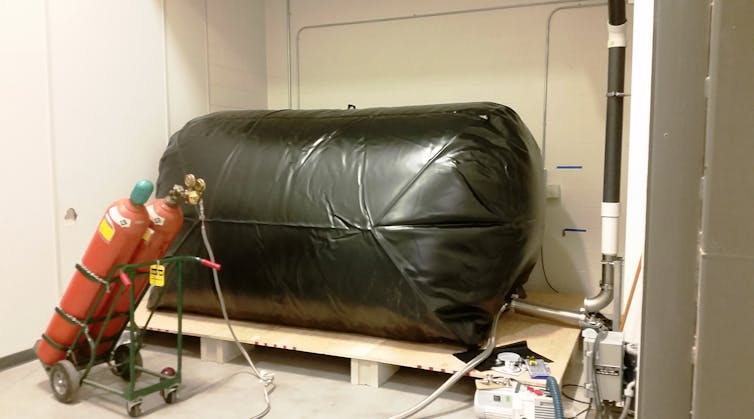
A bag full of gas used in a helium recovery system. Bluefors Cryocooler Technology, Inc. Nicholas Fitzkee, Mississippi State University
The next time you pick up balloons for your big party, remember the helium gas in those balloons is destined for the stars. Helium is so light that it easily escapes Earth’s gravity, and all helium will eventually make its way into space. Like fossil fuels, helium is a limited resource.
Helium shortages have become an acute problem for many researchers. Since early 2022, a variety of factors have put pressure on the global helium market, including the potential sale of the U.S.’s publicly held helium reserves and production infrastructure, sanctions against Russia and a series of breakdowns at helium plants.
Four helium shortages have occurred over the past decade, and these disruptions affect several high-tech industries. Beyond inflating balloons, helium plays a part in welding for certain metals and in making semiconductors.
Medical imaging and chemical analysis research also use helium. Liquid helium cooled to minus-450 degrees Fahrenheit (minus-268 degrees Celsius) keeps the superconducting magnets in instruments like magnetic resonance imaging, or MRI, and nuclear magnetic resonance, or NMR, systems cool.
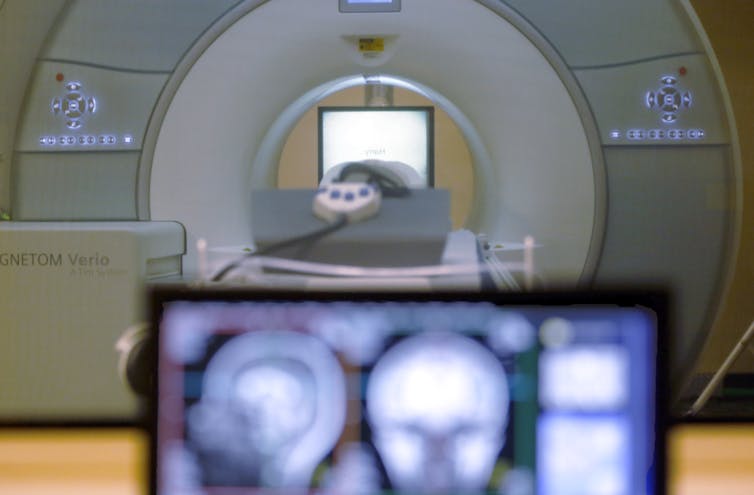
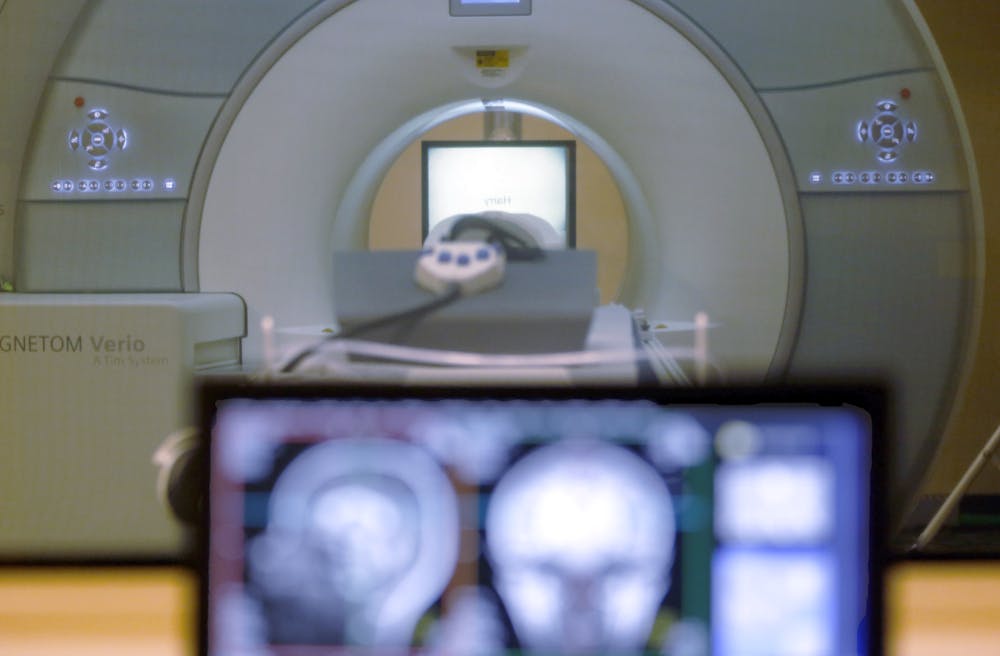
MRI machines need liquid helium to keep the magnetic field functioning. AP Photo/Keith Srakocic Helium shortages put pressure on many industries, and when a shortage hits, helium costs can spike dramatically. Even consumers can be affected – prices for inflated party balloons and helium tank kits have increased substantially.
Helium in research – a cold conundrum
Both MRI and NMR instruments require extremely strong magnetic fields to operate. The most efficient way to generate those fields uses superconducting wire. A superconducting electrical current generates a magnetic field, and once started, these currents can continue for decades without additional electrical input.
But there is a catch. Without liquid helium, the wires quickly warm up. Over time, the helium used to cool the magnets evaporates. The superconductivity goes away, and the magnetic field dissipates.
Earlier this year, LK-99, a potential new room-temperature superconductor made headlines worldwide. Such a material, if found, could eliminate the need for helium in MRI and NMR systems.
So far, LK-99 has not produced a breakthrough in superconductivity, although scientists are still hunting for new superconducting materials.
Until scientists find a functional room temperature superconductor, MRI and NMR facilities need helium. A small to midsize university or hospital may spend US$20,000 per year on liquid helium, as every few months, their liquid helium supplies need replenishing.
Larger facilities need more, and over the past two to three years, the price of helium has doubled. Some institutions have been forced to de-energize their instruments as a result. This process shuts down the magnetic field, effectively halting the instrument’s activity until the facility can buy helium again.
https://datawrapper.dwcdn.net/btsb0/2/
New helium on the horizon
One approach to address the helium shortage involves seeking additional helium sources. Helium is normally obtained as a byproduct of drilling for natural gas, since helium collects underground in pockets containing methane and other hydrocarbons.
Methane is a greenhouse gas, and burning natural gas releases carbon dioxide into the atmosphere. Methane and carbon dioxide in the atmosphere contribute to climate change.
But pockets of helium that aren’t mixed with natural gas could exist in places underground. Researchers searching in Africa have identified what could be a major store of helium in Tanzania’s Rukwa Region.
At least two companies are actively trying to locate these pockets, which originate from unique volcanic activity in the area. Drilling at these sites could be a more climate-friendly alternative – although any form of drilling has local environmental impacts.
As of early December 2023, the helium levels found from drilling these pockets seem promising. The most recent exploration reveals helium levels of at least 2% to 3%, more than 1,000 times normal atmospheric levels. This is on par with other drilling sites that produce helium.

A helium drilling system. Lorna Blaisse, Helium One Global Ltd. Two companies are currently searching for helium in Africa, and both plan to continue searching for higher helium levels. However, independent industry assessments estimate that new helium facilities may not come online until 2025 or later.
Even so, these efforts do not solve the bigger problem – the need for a renewable helium source.
Reusing existing helium
Until scientists have reliable, room-temperature superconductors or find an unlimited helium supply, conserving available helium is the best route forward. Fortunately, this is becoming easier to do.
Researchers at Iowa State University began recycling their helium in the 1960s. Since then, this technology has become cheaper, and both the U.S. National Science Foundation and the U.S. National Institutes of Health have funded efforts to install helium recovery equipment in academic research settings.
These systems are becoming more common, even in smaller NMR facilities. And scientists, including researchers in my lab, are helping each other by sharing their experiences installing this equipment.
Helium recovery systems involve three main components. First, there is a system that transports evaporated helium from the superconducting magnets. This component monitors the evaporation rate and ensures a steady flow through the system.
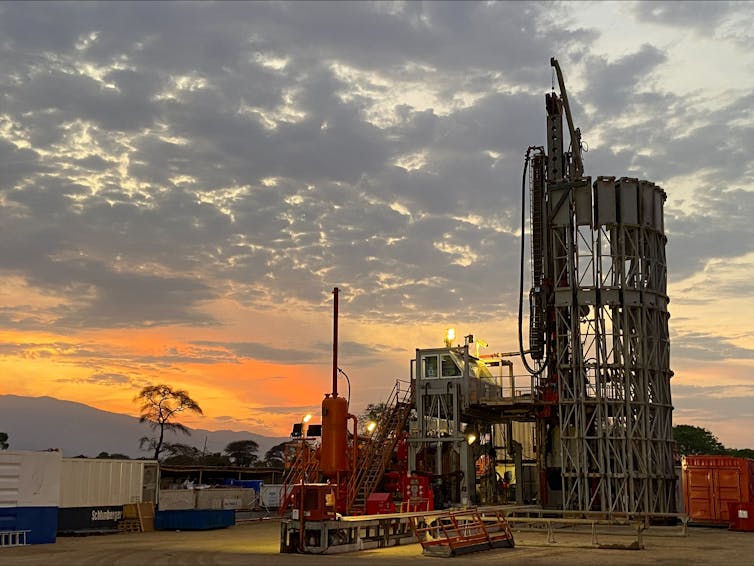
A helium drilling facility at sunset. Noble Helium Ltd Second, there is a collection system. For large facilities, this consists of a large, flexible bag. The bag expands as it collects the evaporated helium, storing it temporarily. This bag is the size of a small car, and where space is a concern, smaller facilities can use helium tanks for storage.
Third, there is a system that reliquefies the gaseous helium. This is the most expensive component, and it uses electrical energy to cool the helium. Once liquefied, the facility staff transfers the helium back to the magnets.
While the helium shortage has led to significant challenges, many scientists are optimistic about the future. Researchers continue to search for room-temperature superconductors. New helium facilities in Tanzania could increase supply. And more widespread access to helium recovery equipment is allowing scientists to conserve this valuable resource.
Nicholas Fitzkee, Professor of Chemistry, Mississippi State University
This article is republished from The Conversation under a Creative Commons license. Read the original article.
-
The creation of Trego’s new Community Computer Café has been 4 months of relatively accelerated organizing by a small group of passionate folks on the TFS Community Hall board, combined with the generous support of our local internet cooperative, Interbel.
The initial goal of creating this program was to fill some gaps in community services that are not being addressed by the current systems in place. While our local library does provide some access to computers and printers, their hours, space, and budget are really limiting when it comes to expanding those services. It seemed like there needed to be a place where anyone, but especially folks who work or go to school, could come use updated technology, Wi-Fi, and have a cup of coffee in a comfortable space. We thought it would be even better if this program also had local expert volunteers who could offer tech support, and occasional classes for regular folks who are just trying to keep themselves, and their kids, safe in a constantly changing online world.
Now here we are, a week away from launching the area’s first completely free “Community Computer Café”, complete with different types of laptops, tablets, printers, privacy panels, commercial coffee maker, and all the bells and whistles to go along with it. Starting Monday, January 29, 2024, the TFS Community Hall will be offering the open Community Computer Café from 5 to 7 PM at the Hall in Trego and every Monday evening thereafter. Each open technology night will have an experienced technology assistant to help community members with anything from email to general internet browsing to basic computer coding and development questions. Tablets are equipped with games for childhood learning and development, and we have touchscreen laptops available for community members interested in design. These events are open to anyone in the community, from folks looking to set up an email account for the first time to the brightest techno-wizards around, completely free of charge. Don’t be shy, join us!In addition to the weekly Computer Café, the TFS Hall is looking to expand this program to support technology learning opportunities for applications like Canva, Microsoft, and Square. We will also be hosting Cyber and Internet Safety courses in the coming months to discuss important topics like general internet and email safety, password best practices, internet and computer safety for children and teens, and more hosted by a trained cyber professional in our community. If you have any questions or feedback for us on what kind of courses or programs you’d like to see us implement with the new equipment, please email secretary@thehalltfs.com. We’d love to hear your ideas and are excited about the opportunity to bring more services and offerings to Lincoln County through this program.
If you have a remote or homeschooled learner at home, need a place to take a telehealth appointment, or are just looking to learn more about technology and collaborate with peers, we hope to see you Monday evenings at the TFS Community Hall starting January 29th at 5 PM. Finally, we’d like to thank Interbel for their continued partnership and support of the TFS Hall Community Computer Café.
-Casey Fuson and Heather Buker
-
‘No cash accepted’ signs are bad news for millions of unbanked Americans
Jay L. Zagorsky, Boston University
How many people don’t have a bank account? And just how difficult has it become to live without one?
These questions are becoming increasingly important as more businesses refuse to take cash in cities across the U.S. People without bank accounts are shut out from stores and restaurants that refuse to accept cash.
As it happens, a lot of people are still “unbanked”: roughly 6 million in the U.S., the latest data shows, which is about the population of Wisconsin. And outside of the U.S., more than a billion people don’t have a bank account.
I am a business school professor who researches society’s transition from cash to electronic payments. I recently visited Seattle and was amazed by the mixed signals I saw in many storefronts. Numerous shops had one sign proudly proclaiming how welcoming and inclusive they were — next to another sign saying “No cash accepted.” This tells people without bank accounts that they aren’t welcome.
Not far from Seattle, Mount Rainier National Park stopped accepting cash in May 2023. Why not have a bank account?
Why would someone want to avoid using banks? Every two years, the Federal Deposit Insurance Corporation surveys households about their connections to the banking system and asks people without bank accounts why they don’t have one. People can respond with multiple answers. In 2021, the top reason — with over 40% of respondents choosing it — was that they didn’t have enough money to meet the minimum balance.
This is consistent with data showing that poorer households are less likely to have bank accounts. About one-quarter of those earning less than $15,000 a year are unbanked, the FDIC found. Among those earning more than $75,000 a year, almost every person surveyed had some type of bank account.
The second- and third-most common answers show that some people are skeptical of banks. Roughly one-third of survey respondents agreed that “Avoiding a bank gives more privacy,” while another one-third said they simply “don’t trust banks.”
Rounding out the top five reasons were costs of dealing with a bank. More than one-quarter of respondents felt bank account fees were too high, and about the same proportion felt fees were too unpredictable.
While many middle-class and wealthy people don’t pay directly for their bank accounts, fees can be costly for those who can’t maintain a minimum balance. A recent Bankrate survey shows basic monthly service fees range between $5 and $15. Beyond these steady fees, banks earn $4 to $5 each time people withdraw cash from an ATM or need services like getting cashier’s checks. Unexpected bills can result in overdraft fees of about $25 each time an account is overdrawn.
Being unbanked in America
The FDIC calls people without a bank account “the unbanked.” People with a bank account but who primarily rely on alternative services such as check cashing outlets are called “the underbanked.”
The latest FDIC data shows almost 6 million unbanked and 19 million underbanked U.S. households. Given that 2.5 people live in the average household, this means there are over 15 million people living in a home with no connection to banks, and 48 million more in homes with only a tenuous connection to banks.
Combining the two figures means roughly one out of every five people in the U.S. has little or no connection to banks or other financial institutions. That can leave them shut out from stores, restaurants, transportation and medical providers that don’t take cash.
The true number of unbanked people is likely higher than the FDIC estimates. The questions on being banked or unbanked are supplemental questions added to a survey given to people at their homes. This means it misses homeless people, transients without a permanent address and undocumented immigrants.
These people are likely unbanked because you need a verified address and a government-issued tax-identification number to get a bank account. Given roughly 2.5 million migrants crossed the U.S.-Mexico border in 2023 alone, there are millions more people in the cash-only economy than the FDIC estimates.
How many people globally are unbanked?
While the U.S. has relatively high rates of people with bank accounts, the picture is different in other parts of the world. The World Bank has created a database that shows the percentage of each country’s population that has access to financial services. The World Bank’s definition of being banked is broader than the FDIC’s, since it includes anyone who uses a cellphone to send and receive money as having a bank account.
Overall, the World Bank estimates about one-quarter of the world’s adults don’t have access to a bank or mobile-phone account. But that varies dramatically by region. In countries that use the Euro, almost everyone has a bank account, while in the Middle East and North Africa, only about half the population does.
A more inclusive economy
Many of us swipe our credit cards, tap our phones or insert a debit card to pay without thinking. However, there are at least 6 million people in the U.S. and almost 1.5 billion worldwide who are unbanked.
When businesses stop accepting cash, the unbanked are forced to use payment methods like prepaid debit cards. However, these prepaid cards are costly. For example, Walmart, one of the largest U.S. retailers, offers a reloadable basic debit card. The card costs $1 to buy and charges $6 per month in fees, in addition to $3 each time someone wants to load the card with cash at Walmart’s registers. Paying a minimum of $10 just to set up a debit card for a few purchases is a steep price.
The next time you see a sign in a shop or restaurant window stating “No cash accepted,” you’re really looking at a business excluding many unbanked and underbanked people. Insisting that all businesses accept cash is a simple way to ensure everyone is financially included in the modern economy.
Jay L. Zagorsky, Clinical Associate Professor of Markets, Public Policy and Law, Boston University
This article is republished from The Conversation under a Creative Commons license. Read the original article.


Want to tell us something or ask a question? Get in touch.

Recent Posts
- Venn Diagram and DSM
- When Castro Was Cool
- You Have To Beat Darwin Every Day
- Computer Repair by Mussolini
- Getting Alberta Oil to Market
- Parties On Economics
- Thus Spake Zarathustra – One More Time
- Suspenders
- You Haven’t Met All The People . . .
- Play Stupid Games, Win Stupid Prizes
- The Ballad of Lenin’s Tomb
- An Encounter With a Lawnmower Thief
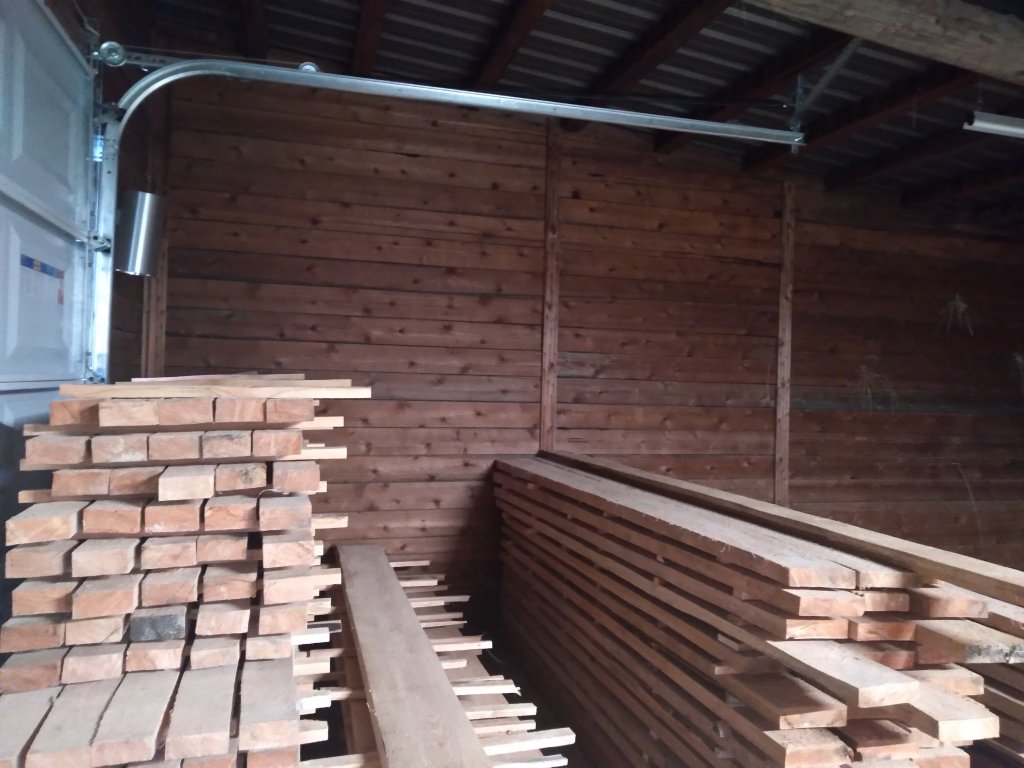
Rough Cut Lumber
Harvested as part of thinning to reduce fire danger.
$0.75 per board foot.
Call Mike (406-882-4835) or Sam (406-882-4597)
Popular Posts
Ask The Entomologist Bears Books Canada Census Community Decay Covid Covid-19 Data Deer Demography Education Elections Eureka Montana family Firearms Game Cameras Geese Government Guns History Inflation life Lincoln County Board of Health Lincoln County MT Lincoln Electric Cooperative Montana nature News Patches' Pieces Pest Control Politics Pond Recipe School School Board Snow Taxes travel Trego Trego Montana Trego School Weather Wildlife writing
 Trego's Mountain Ear
