-
At school board meetings, we’ve been talking about putting a special levy on the ballot this Spring. My thoughts were that it would have two chances of passing – slim and none. But I had forgotten – I live in Trego, and my neighbors are some outstanding people.
It was Sunday morning – I had just poured the last cup of coffee from the pot, and decided it was warm enough that I didn’t need to nuke it – and the phone rang. It was a simple conversation – Would I be home to take a $20,000 check to cover next year’s budget shortfall, and keep the donor anonymous?
Obviously, the answer was yes. An hour later, I was holding a $20,000 check and a package of warm blueberry muffins. Monday afternoon, the check was headed for deposit – and I’m fairly certain the request for anonymity has been maintained.
I’m in Trego. The community works differently than most of the world. And I can express thanks publicly for the quality of my neighbors.
-
By definition, Irish Democracy doesn’t include organization. It’s the casual, non-conspiratorial violation of unacceptable laws. This last time around, looking at the election law, we found section 7 which allowed – some might say even encouraged – voters to write in a candidate when only a single party’s candidate was on the ballot.
Instead of getting more candidates and election choice, my letter to the Secretary of State seems to have led to section 7’s repeal – 97 to 3 in the house, and 49 to 1 in the senate. My representative and my senator were both in the majority – opposing election choice.
So now, the only part of the law that discouraged single candidate elections is gone. Interestingly enough, Zooey Zephyr was one of the minority who voted to keep it – representing me better than either Mike or Neil. Your best political representation isn’t always your neighbors, or even neighbors with whom you mostly agree.
Since we can no longer write in a candidate against the unopposed politicians – who are, even if our friends, winning unopposed elections, much like Joe Stalin did – we still have the option of Irish Democracy. It’s simple, almost elegant. Continue to vote as if the election really mattered. Then only use your vote when the candidates have opponents. The result won’t change – the unopposed candidate will still win – but if we continue to cast ballots, and not vote for unopposed candidates . . . well, it should encourage opposition if an incumbent returns to Helena with 87 votes from an election where thousands of ballots were cast.
P J O’Rourke said “Don’t Vote – It only encourages the bastards.” If we make a point of not voting for the unopposed, it should encourage the opposition.
-
I’m looking at the Presidential Primary results from Nevada with envy:

Here in Montana, we don’t have “None of These Candidates” as a ballot option – if our ballot offers only one candidate, we can’t even have a write-in vote counted against him (or her). Both our local state senator and district representative voted to get rid of the legislation that authorized those write-in votes last year.
In a way, I can understand it – it would be humbling to say “I lost the election to “None of These Candidates.” On the other hand – as a voter, not as a politician – I strongly dislike elections without choices. In our last election, just in the State House of Representatives, these politicians ran unopposed:
- District 1 Steve Gunderson (R)
- District 2 Neil Durham (R)
- District 6 Amy Regier (R)
- District 8 Terry Falk (R)
- District 9 Tony Brockman (R)
- District 11 Tanner Smith (R)
- District 14 Denley Loge (R)
- District 16 Tyson Running Wolf (D)
- District 18 Llew Jones (R)
- District 19 Russel Miner (R)
- District 27 Josh Kassmier (R)
- District 29 Douglas Flament (R)
- District 32 Jonathan Windy Boy (D)
- District 34 Rhonda Knudsen (R)
- District 35 Brandon Ler (R)
- District 36 Bob Phalen (R)
- District 37 Jerry Schillinger (R)
- District 39 Gary Parry (R)
- District 40 Greg Oblander (R)
- District 43 Kerri Seekins-Crowe (R)
- District 45 Katie Zolnikov (R)
- District 53 Nelly Nicol (R)
- District 54 Terry Moore (R)
- District 55 Lee Deming (R)
- District 56 Sue Vinton (R)
- District 66 Eric Matthews (D)
- District 71 Ken Walsh (R)
- District 75 Marta Bertoglio (R)
- District 78 Gregory Frazer (R)
- District 80 Becky Beard(R)
- District 81 Ron Marshall (R)
Thirty-one of Montana’s 100 state representatives have no opponent in the general election. Since legislative districts are apportioned according to population, this essentially translates to 31% of Montanans who had no choice to vote on their state representative last November.
It’s past time to put “None of These Candidates” on the ballot. If it can be done for a Nevada primary, we can afford the extra ink for Montana general elections.
-
I’ve been rereading Terry Pratchett again. Feet of Clay is part of his series about the city watch. It has some fun recurring characters, but is thematically somewhat different than the book that came before it. It is a book about the nature of humanity disguised as a murder mystery in a fantasy setting. The leader of a city has been poisoned, two seemingly men are dead, and the city watch is on the hunt.

In general, the series (the city watch section of the Discworld novels) focuses on what does it mean to be a person, to be human? Feet of Clay takes that theme and runs with it. It uses golems, literal beings of clay with words written in their heads telling them how to be, as something of an allegory.
Ideas come to life. And eventually, the reader is lead to see that you can put words in people’s heads. That words animate humans, too. And of course, they do. That’s the nature of a good speech, a word of encouragement, a sermon, even a good book.
Pratchett isn’t just funny. He writes social commentary without being preachy, and offers an in depth study of what it is to be human, and to treat people well.
I’m of the opinion that a Terry Pratchett book is pretty much always a good read, but this is a series I’ve especially enjoyed. If you’re interested- it starts with Guards! Guards!

-
What do your blood test results mean? A toxicologist explains the basics of how to interpret them
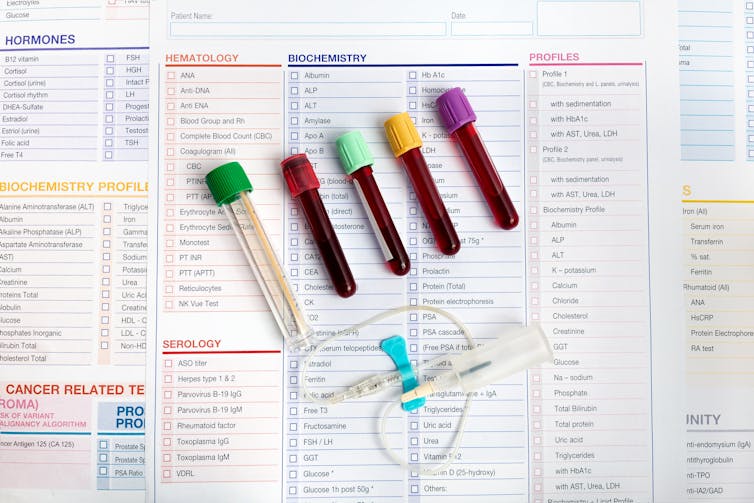
From CBC to CMP and beyond, blood test panels provide essential information to health practitioners. angelp/iStock via Getty Images Plus Brad Reisfeld, Colorado State University
Your blood serves numerous roles to maintain your health. To carry out these functions, blood contains a multitude of components, including red blood cells that transport oxygen, nutrients and hormones; white blood cells that remove waste products and support the immune system; plasma that regulates temperature; and platelets that help with clotting.
Within the blood are also numerous molecules formed as byproducts of normal biochemical functions. When these molecules indicate how your cells are responding to disease, injury or stress, scientists often refer to them as biological markers, or biomarkers. Thus, biomarkers in a blood sample can represent a snapshot of the current biochemical state of your body, and analyzing them can provide information about various aspects of your health.
As a toxicologist, I study the effects of drugs and environmental contaminants on human health. As part of my work, I rely on various health-related biomarkers, many of which are measured using conventional blood tests.
Understanding what common blood tests are intended to measure can help you better interpret the results. If you have results from a recent blood test handy, please follow along.
Normal blood test ranges
Depending on the lab that analyzed your sample, the results from your blood test may be broken down into individual tests or collections of related tests called panels. Results from these panels can allow a health care professional to recommend preventive care, detect potential diseases and monitor ongoing health conditions.
For each of the tests listed in your report, there will typically be a number corresponding to your test result and a reference range or interval. This range is essentially the upper and lower limits within which most healthy people’s test results are expected to fall.
Sometimes called a normal range, a reference interval is based on statistical analyses of tests from a large number of patients in a reference population. Normal levels of some biomarkers are expected to vary across a group of people, depending on their age, sex, ethnicity and other attributes.
So, separate reference populations are often created from people with a particular attribute. For example, a reference population could comprise all women or all children. A patient’s test value can then be appropriately compared with results from the reference population that fits them best.
Reference intervals vary from lab to lab because each may use different testing methods or reference populations. This means you might not be able to compare your results with reference intervals from other labs. To determine how your test results compare with the normal range, you need to check the reference interval listed on your lab report.
If you have results for a given test from different labs, your clinician will likely focus on test trends relative to their reference intervals and not the numerical results themselves.
Interpreting your blood test results
There are numerous blood panels intended to test specific aspects of your health. These include panels that look at the cellular components of your blood, biomarkers of kidney and liver function, and many more.
Rather than describe each panel, let’s look at a hypothetical case study that requires using several panels to diagnose a disease.
In this situation, a patient visits their health care provider for fatigue that has lasted several months. Numerous factors and disorders can result in prolonged or chronic fatigue.
Based on a physical examination, other symptoms and medical history, the health practitioner suspects that the patient could be suffering from any of the following: anemia, an underactive thyroid or diabetes.
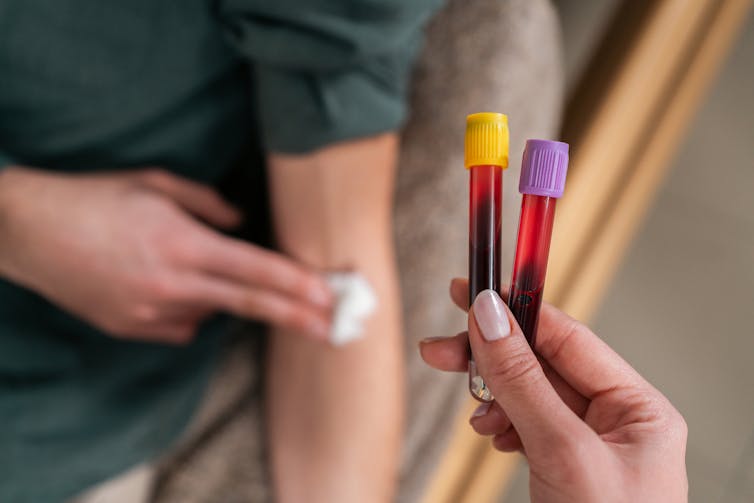
Blood tests provide clinicians with more information to guide diagnoses and treatment decisions. FluxFactory/E+ via Getty Images Blood tests would help further narrow down the cause of fatigue.
Anemia is a condition involving reduced blood capacity to transport oxygen. This results from either lower than normal levels of red blood cells or a decrease in the quantity or quality of hemoglobin, the protein that allows these cells to transport oxygen.
A complete blood count panel measures various components of the blood to provide a comprehensive overview of the cells that make it up. Low values of red blood cell count, or RBC, hemoglobin, or Hb, and hematocrit, or HCT, would indicate that the patient is suffering from anemia.
Hypothyroidism is a disorder in which the thyroid gland does not produce enough thyroid hormones. These include thyroid-stimulating hormone, or TSH, which stimulates the thyroid gland to release two other hormones: triiodothyronine, or T3, and thyroxine, or T4. The thyroid function panel measures the levels of these hormones to assess thyroid-related health.
Diabetes is a disease that occurs when blood sugar levels are too high. Excessive glucose molecules in the bloodstream can bind to hemoglobin and form what’s called glycated hemoglobin, or HbA1c. A hemoglobin A1c test measures the percentage of HbA1c present relative to the total amount of hemoglobin. This provides a history of glucose levels in the bloodstream over a period of about three months prior to the test.
Providing additional information is the basic metabolic panel, or BMP, which measures the amount various substances in your blood. These include:
- Glucose, a type of sugar that provides energy for your body and brain. Relevant to diabetes, the BMP measures the blood glucose levels at the time of the test.
- Calcium, a mineral essential for proper functioning of your nerves, muscles and heart.
- Creatinine, a byproduct of muscle activity.
- Blood urea nitrogen, or BUN, the amount of the waste product urea your kidneys help remove from your blood. These indicate the status of a person’s metabolism, kidney health and electrolyte balance.
With results from each of these panels, the health professional would assess the patient’s values relative to their reference intervals and determine which condition they most likely have.
Understanding the purpose of blood tests and how to interpret them can help patients partner with their health care providers and become more informed about their health.
Brad Reisfeld, Professor of Chemical and Biological Engineering, Biomedical Engineering, and Public Health, Colorado State University
This article is republished from The Conversation under a Creative Commons license. Read the original article.
Editor’s Note: One of the really fun things about modern tech is that with Logan Health’s app, I was able to read through my blood results on my cell phone pretty much as soon as my doctor had them, which was loads of fun (So many things to google)
-
You know things are bad when the advertisements aren’t ‘Get into credit card debt’ or ‘Quick loans from aggressive, high interest companies’, but are instead ‘borrow against your house’.
Borrow. Against your house.
I heard an advertisement on youtube, recently, that was more or less that. Can’t afford groceries? Credit card bills piling up? Borrow against your house. And it’s phrased as if it’s helping people. As if it’s a solution.
Because the solution to debt is… more debt? Who do they think we are- the government?
Two observations:
- The first is that the shift in advertisements is a marker on the state of the economy, how people are doing, and it’s bad.
- The second, is that sometimes, the best thing you can do is fold your hand.
Recognizing a losing situation is the difference between salvaging something due to an exit strategy, and playing until you have to walk away with nothing.
-
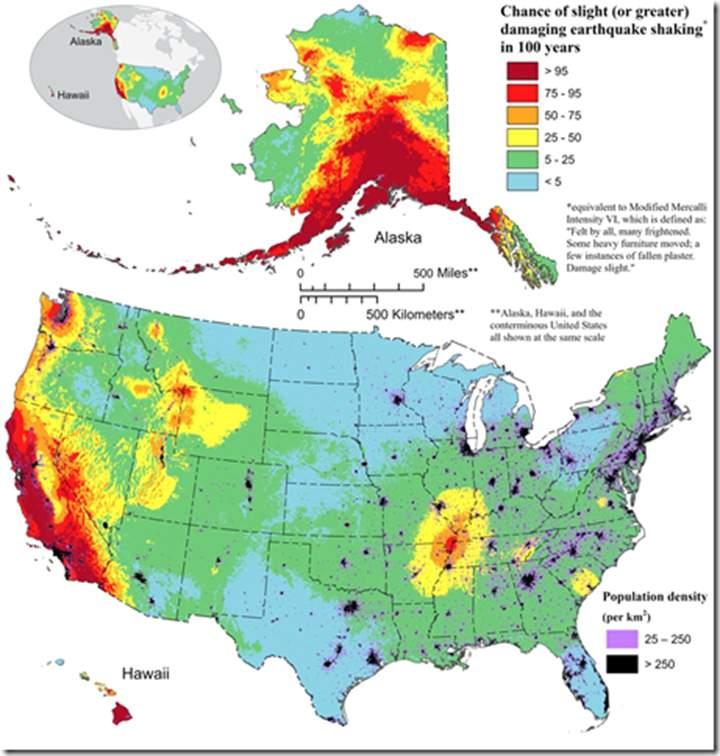
I kind of like geologists – in this case, I’m taking their model on faith, partly because I know they have more data than I, and partly because I lived on the west coast as a kid and remember how common quakes were. The map also shows likely spots for Yellowstone and New Madrid.
On the other hand, this one shows the amount of staffing growth that has accompanied a 44% increase in students since my fifth and sixth grade years.

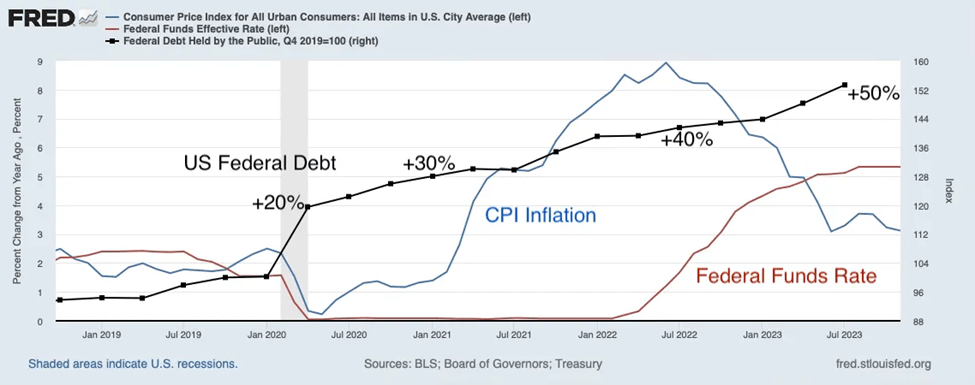
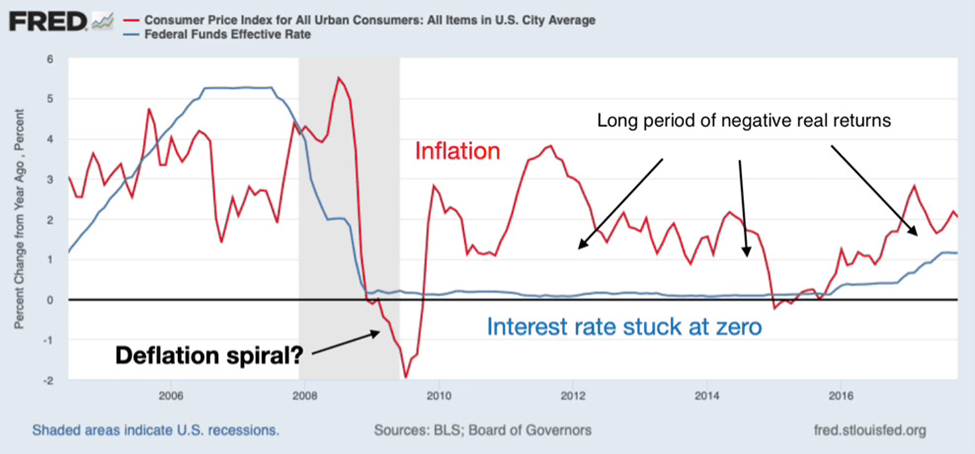
I always look at Federal Reserve graphs – the Reserve hires a lot of economists, and they tend to have some insight into what can happen with inflation and interest rates:
-
Are social media apps ‘dangerous products’? 2 scholars explain how the companies rely on young users but fail to protect them

The CEOs of Discord, Snap, TikTok, X and Meta prepare to testify before the Senate Judiciary Committee on Jan. 31, 2024. Alex Wong/Getty Images Joan Donovan, Boston University and Sara Parker, McGill University
“You have blood on your hands.”
“I’m sorry for everything you have all been through.”
These quotes, the first from Sen. Lindsey Graham, R-S.C., speaking to Meta CEO Mark Zuckerberg, and the second from Zuckerberg to families of victims of online child abuse in the audience, are highlights from an extraordinary day of testimony before the Senate Judiciary Committee about protecting children online.
But perhaps the most telling quote from the Jan. 31, 2024, hearing came not from the CEOs of Meta, TikTok, X, Discord or Snap but from Sen. Graham in his opening statement: Social media platforms “as they are currently designed and operate are dangerous products.”
We are university researchers who study how social media organizes news, information and communities. Whether or not social media apps meet the legal definition of “unreasonably dangerous products,” the social media companies’ business models do rely on having millions of young users. At the same time, we believe that the companies have not invested sufficient resources to effectively protect those users.
Mobile device use by children and teens skyrocketed during the pandemic and has stayed high. Naturally, teens want to be where their friends are, be it the skate park or on social media. In 2022, there were an estimated 49.8 million users age 17 and under of YouTube, 19 million of TikTok, 18 million of Snapchat, 16.7 million of Instagram, 9.9 million of Facebook and 7 million of Twitter, according to a recent study by researchers at Harvard’s Chan School of Public Health.
Teens are a significant revenue source for social media companies. Revenue from users 17 and under of social media was US$11 billion in 2022, according to the Chan School study. Instagram netted nearly $5 billion, while TikTok and YouTube each accrued over $2 billion. Teens mean green.
Social media poses a range of risks for teens, from exposing them to harassment, bullying and sexual exploitation to encouraging eating disorders and suicidal ideation. For Congress to take meaningful action on protecting children online, we identify three issues that need to be accounted for: age, business model and content moderation. https://www.youtube.com/embed/yUAfRod2xgI?wmode=transparent&start=261 Following vigorous prompting from Sen. Josh Hawley, R-Mo., Meta CEO Mark Zuckerberg apologized to families of victims of online child abuse.
How old are you?
Social media companies have an incentive to look the other way in terms of their users’ ages. Otherwise they would have to spend the resources to moderate their content appropriately. Millions of underage users – those under 13 – are an “open secret” at Meta. Meta has described some potential strategies to verify user ages, like requiring identification or video selfies, and using AI to guess their age based on “Happy Birthday” messages.
However, the accuracy of these methods is not publicly open to scrutiny, so it’s difficult to audit them independently.
Meta has stated that online teen safety legislation is needed to prevent harm, but the company points to app stores, currently dominated by Apple and Google, as the place where age verification should happen. However, these guardrails can be easily circumvented by accessing a social media platform’s website rather than its app.
New generations of customers
Teen adoption is crucial for continued growth of all social media platforms. The Facebook Files, an investigation based on a review of company documents, showed that Instagram’s growth strategy relies on teens helping family members, particularly younger siblings, get on the platform. Meta claims it optimizes for “meaningful social interaction,” prioritizing family and friends’ content over other interests. However, Instagram allows pseudonymity and multiple accounts, which makes parental oversight even more difficult.
On Nov. 7, 2023, Auturo Bejar, a former senior engineer at Facebook, testified before Congress. At Meta he surveyed teen Instagram users and found 24% of 13- to 15-year-olds said they had received unwanted advances within the past seven days, a fact he characterizes as “likely the largest-scale sexual harassment of teens to have ever happened.” Meta has since implemented restrictions on direct messaging in its products for underage users.
But to be clear, widespread harassment, bullying and solicitation is a part of the landscape of social media, and it’s going to take more than parents and app stores to rein it in.
Meta recently announced that it is aiming to provide teens with “age-appropriate experiences,” in part by prohibiting searches for terms related to suicide, self-harm and eating disorders. However, these steps don’t stop online communities that promote these harmful behaviors from flourishing on the company’s social media platforms. It takes a carefully trained team of human moderators to monitor and enforce terms of service violations for dangerous groups.
Content moderation
Social media companies point to the promise of artificial intelligence to moderate content and provide safety on their platforms, but AI is not a silver bullet for managing human behavior. Communities adapt quickly to AI moderation, augmenting banned words with purposeful misspellings and creating backup accounts to prevent getting kicked off a platform.
Human content moderation is also problematic, given social media companies’ business models and practices. Since 2022, social media companies have implemented massive layoffs that struck at the heart of their trust and safety operations and weakened content moderation across the industry.
Congress will need hard data from the social media companies – data the companies have not provided to date – to assess the appropriate ratio of moderators to users.
The way forward
In health care, professionals have a duty to warn if they believe something dangerous might happen. When these uncomfortable truths surface in corporate research, little is done to inform the public of threats to safety. Congress could mandate reporting when internal studies reveal damaging outcomes.
Helping teens today will require social media companies to invest in human content moderation and meaningful age verification. But even that is not likely to fix the problem. The challenge is facing the reality that social media as it exists today thrives on having legions of young users spending significant time in environments that put them at risk. These dangers for young users are baked into the design of contemporary social media, which requires much clearer statutes about who polices social media and when intervention is needed.
One of the motives for tech companies not to segment their user base by age, which would better protect children, is how it would affect advertising revenue. Congress has limited tools available to enact change, such as enforcing laws about advertising transparency, including “know your customer” rules. Especially as AI accelerates targeted marketing, social media companies are going to continue making it easy for advertisers to reach users of any age. But if advertisers knew what proportion of ads were seen by children, rather than adults, they may think twice about where they place ads in the future.
Despite a number of high-profile hearings on the harms of social media, Congress has not yet passed legislation to protect children or make social media platforms liable for the content published on their platforms. But with so many young people online post-pandemic, it’s up to Congress to implement guardrails that ultimately put privacy and community safety at the center of social media design.
Joan Donovan, Assistant Professor of Journalism and Emerging Media Studies, Boston University and Sara Parker, Research Analyst at the Media Ecosystem Observatory, McGill University
This article is republished from The Conversation under a Creative Commons license. Read the original article.
-
Twenty years ago, when demographers talked about Israel, the concept of Israel surviving as a Jewish nation was usually dismissed. There’s a single unyielding number that tells us whether a society will continue – it takes a fertility rate of 2.07 for a society to survive, and Israel didn’t have it. So when I looked it up again, I learned that the world had changed. Fertility of Jewish and Other Women in Israel, by Level of Religiosity 1979–2020 yielded this information: Jewish women are having kids at a level both above replacement, but also at a higher rate than non-Jewish women in Israel.
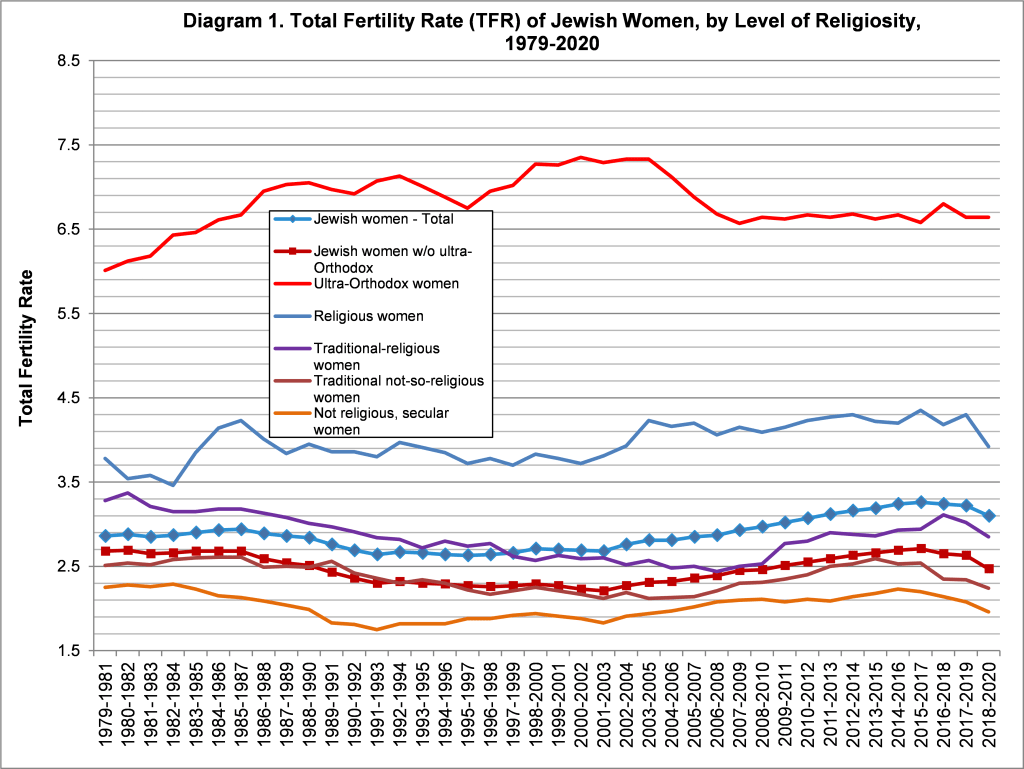
I’m fond of the phrases “demography is destiny” and “the future belongs to those who are in it.” In this case, sometime in this century, Israelis made the decision to have more kids. For years, the nation grew by immigration – now the population is increasing due to that 3.10 fertility rate we see above.
-
Now it takes a single click to get the data. So what does it mean? I measured the record lows back in 1977 – this chart, from the Grave Creek site, shows how the critical snowfall that brings us up to normal or above occurs between the February measurements and April 1. I don’t know if my record measurements will stand or not – but being the guy who measured something for the records doesn’t count for much.
Basin Site Name Elev (ft) Snow Water Equivalent Water Year-to-Date Precipitation Current (in) Median (in) Pct of Median Current (in) Median (in) Pct of Median KOOTENAI RIVER BASIN Banfield Mountain 5600 6.3 11.6 54 13.3 16.9 79 Bear Mountain 5400 22.3 35.6 63 39.4 48.0 82 Garver Creek 4250 4.8 6.8 71 9.4 13.2(24) 71 Grave Creek 4300 8.8 10.7 82 22.7 22.0 103 Hand Creek 5035 5.4 7.4 73 8.8 11.9 74 Hawkins Lake 6450 8.7 16.5 53 17.7 21.2 83 Poorman Creek 5100 12.6 23.4(22) 54 27.6 39.1(22) 71 Stahl Peak 6030 21.4 22.0 97 28.5 26.2 109 Basin Index (%) 67 84
Want to tell us something or ask a question? Get in touch.

Recent Posts
- Venn Diagram and DSM
- When Castro Was Cool
- You Have To Beat Darwin Every Day
- Computer Repair by Mussolini
- Getting Alberta Oil to Market
- Parties On Economics
- Thus Spake Zarathustra – One More Time
- Suspenders
- You Haven’t Met All The People . . .
- Play Stupid Games, Win Stupid Prizes
- The Ballad of Lenin’s Tomb
- An Encounter With a Lawnmower Thief

Rough Cut Lumber
Harvested as part of thinning to reduce fire danger.
$0.75 per board foot.
Call Mike (406-882-4835) or Sam (406-882-4597)
Popular Posts
Ask The Entomologist Bears Books Canada Census Community Decay Covid Covid-19 Data Deer Demography Education Elections Eureka Montana family Firearms Game Cameras Geese Government Guns History Inflation life Lincoln County Board of Health Lincoln County MT Lincoln Electric Cooperative Montana nature News Patches' Pieces Pest Control Politics Pond Recipe School School Board Snow Taxes travel Trego Trego Montana Trego School Weather Wildlife writing
 Trego's Mountain Ear