Several rifles Dad had on hand needed repairs when he passed on. One was missing at least two parts – and while I might have been able to file out a new firing pin if I had the old one, without the broken template my chances were not good.
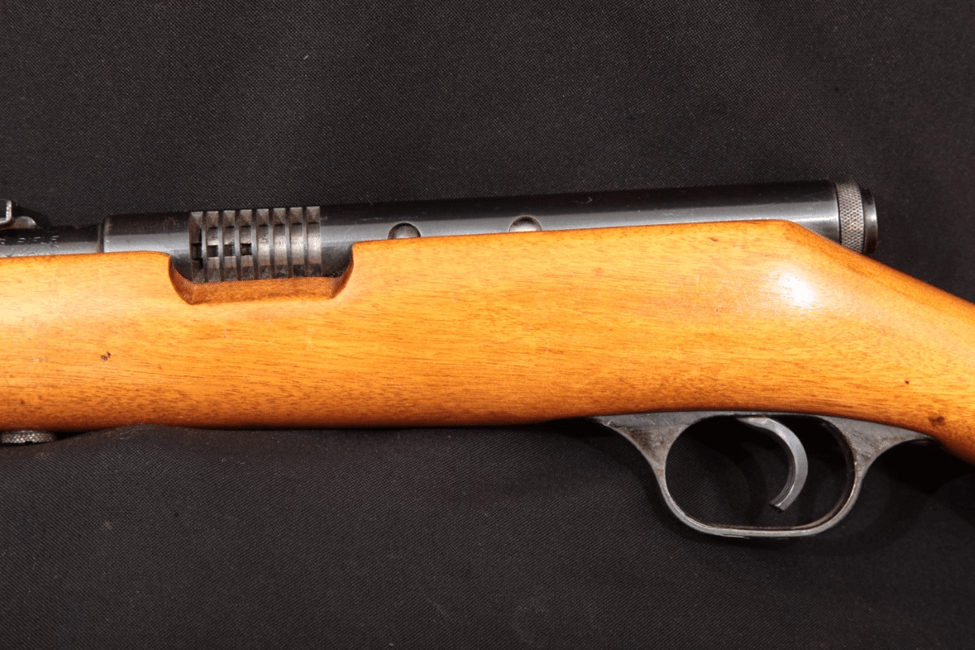
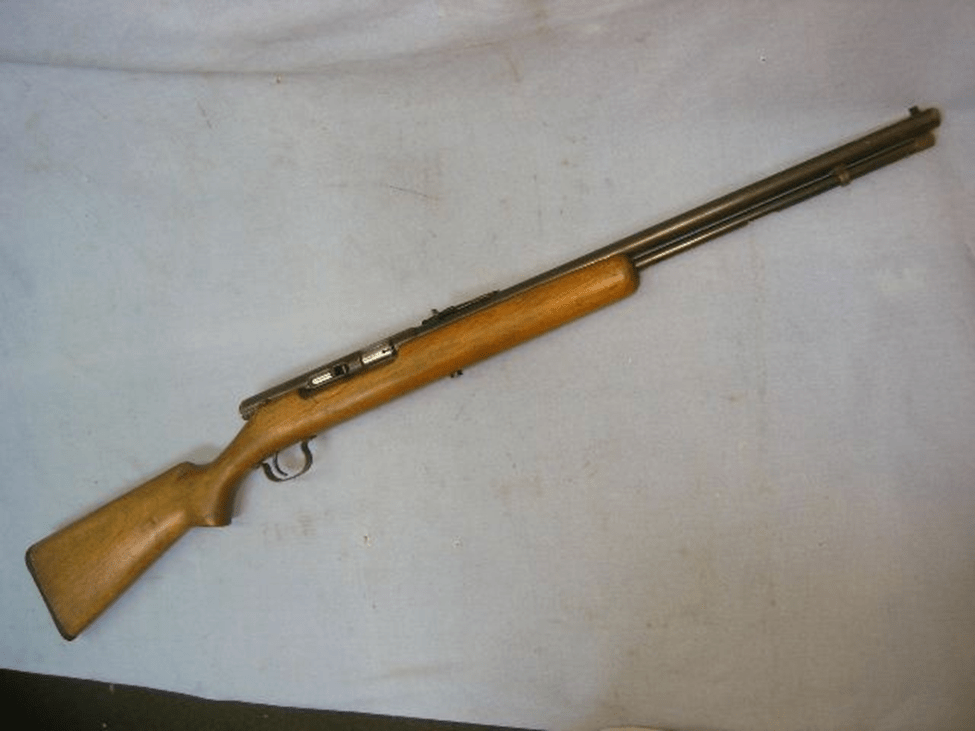
So for years, I have been hunting that firing pin. I finally found a used one – so it looks like I’ll be fixing Dad’s last broken gun. It’s from the “good old days” – the “golden age” of 22 rifles. A time when even the small mass merchandisers had their own names stamped on rifles. The stamp plainly identifies Savage as the maker of this “Hiawatha 587.” I think that Western Auto marketed them as Revelation. This is one of the “gill rifles” – named because of the cutouts on the receiver. (This photo is of the model 87, which I ruled out because the Hiawatha has only one gill on each side)
The next photo (which includes the bolt handle that is missing on the Hiawatha) shows the same gill configuration as the Hiawatha, leading me to look for spare parts under the Savage model 187.
The Hiawatha parts fit into the spaces shown for the 187 . . . so I think I’m on the right path – and if things don’t fit right, there is always the file and the dremel.
Among the many changes brought about by the pandemic is the widespread use of QR codes, graphical representations of digital data that can be printed and later scanned by a smartphone or other device, but there are some security risks. The Federal Trade Commission warned again in December 2023 about the danger of scanning a code from an unknown source.
QR codes have a wide range of uses that help people avoid contact with objects and close interactions with other people, including for sharing restaurant menus, email list sign-ups, car and home sales information, and checking in and out of medical and professional appointments.
QR codes are a close cousin of the bar codes on product packaging that cashiers scan with infrared scanners to let the checkout computer know what products are being purchased.
Bar codes store information along one axis, horizontally. QR codes store information in both vertical and horizontal axes, which allows them to hold significantly more data. That extra amount of data is what makes QR codes so versatile.
Anatomy of a QR code
While it is easy for people to read Arabic numerals, it is hard for a computer. Bar codes encode alphanumeric data as a series of black and white lines of various widths. At the store, bar codes record the set of numbers that specify a product’s ID. Critically, data stored in bar codes is redundant. Even if part of the bar code is destroyed or obscured, it is still possible for a device to read the product ID.
QR codes are designed to be scanned using a camera, such as those found on your smartphone. QR code scanning is built into many camera apps for Android and iOS. QR codes are most often used to store web links; however, they can store arbitrary data, such as text or images.
When you scan a QR code, the QR reader in your phone’s camera deciphers the code, and the resulting information triggers an action on your phone. If the QR code holds a URL, your phone will present you with the URL. Tap it, and your phone’s default browser will open the webpage.
QR codes are composed of several parts: data, position markers, quiet zone and optional logos.
The QR code anatomy: data (1), position markers (2), quiet zone (3) and optional logos (4). Scott Ruoti, CC BY-ND
The data in a QR code is a series of dots in a square grid. Each dot represents a one and each blank a zero in binary code, and the patterns encode sets of numbers, letters or both, including URLs. At its smallest this grid is 21 rows by 21 columns, and at its largest it is 177 rows by 177 columns. In most cases, QR codes use black squares on a white background, making the dots easy to distinguish. However, this is not a strict requirement, and QR codes can use any color or shape for the dots and background.
Position markers are squares placed in a QR code’s top-left, top-right, and bottom-left corners. These markers let a smartphone camera or other device orient the QR code when scanning it. QR codes are surrounded by blank space, the quiet zone, to help the computer determine where the QR code begins and ends. QR codes can include an optional logo in the middle.
Like barcodes, QR codes are designed with data redundancy. Even if as much as 30% of the QR code is destroyed or difficult to read, the data can still be recovered. In fact, logos are not actually part of the QR code; they cover up some of the QR code’s data. However, due to the QR code’s redundancy, the data represented by these missing dots can be recovered by looking at the remaining visible dots.
Are QR codes dangerous?
QR codes are not inherently dangerous. They are simply a way to store data. However, just as it can be hazardous to click links in emails, visiting URLs stored in QR codes can also be risky in several ways.
The QR code’s URL can take you to a phishing website that tries to trick you into entering your username or password for another website. The URL could take you to a legitimate website and trick that website into doing something harmful, such as giving an attacker access to your account. While such an attack requires a flaw in the website you are visiting, such vulnerabilities are common on the internet. The URL can take you to a malicious website that tricks another website you are logged into on the same device to take an unauthorized action.
A malicious URL could open an application on your device and cause it to take some action. Maybe you’ve seen this behavior when you clicked a Zoom link, and the Zoom application opened and automatically joined a meeting. While such behavior is ordinarily benign, an attacker could use this to trick some apps into revealing your data.
It is critical that when you open a link in a QR code, you ensure that the URL is safe and comes from a trusted source. Just because the QR code has a logo you recognize doesn’t mean you should click on the URL it contains.
There is also a slight chance that the app used to scan the QR code could contain a vulnerability that allows malicious QR codes to take over your device. This attack would succeed by just scanning the QR code, even if you don’t click the link stored in it. To avoid this threat, you should use trusted apps provided by the device manufacturer to scan QR codes and avoid downloading custom QR code apps.
There is a lot I don’t know about economics – but this graph, from The Visual Capitalist, covering world debt, got my attention:
Somehow, I think the graph says it better than any additions I might make. Visual Capitalist Give the link a click to find this and other topics it addresses.
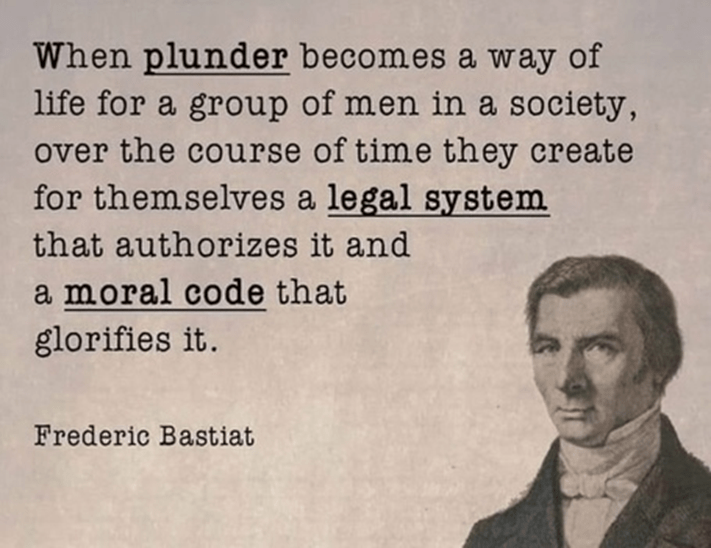
Bastiat was a French Economist – Joseph Schumpeter (who I only discovered when a student based her dissertation on his work) considered him the greatest economist who ever lived. Here are a few more of his thoughts:
“The state is the great fictitious entity by which everyone seeks to live at the expense of everyone else.”
“If the natural tendencies of mankind are so bad that it is not safe to permit people to be free, how is it that the tendencies of these organizers are always good? Do not the legislators and their appointed agents also belong to the human race? Or do they believe that they themselves are made of a finer clay than the rest of mankind?”
“Sometimes the law defends plunder and participates in it. Sometimes the law places the whole apparatus of judges, police, prisons and gendarmes at the service of the plunderers, and treats the victim – when he defends himself – as a criminal.”
“Socialism, like the ancient ideas from which it springs, confuses the distinction between government and society. As a result of this, every time we object to a thing being done by government, the socialists conclude that we object to its being done at all . . . . It is as if the socialists were to accuse us of not wanting persons to eat because we do not want the state to raise grain.”
“The real cost of the State is the prosperity we do not see, the jobs that don’t exist, the technologies to which we do not have access, the businesses that do not come into existence, and the bright future that is stolen from us. The State has looted us just as surely as a robber who enters our home at night and steals all that we love.”
“The most urgent necessity is, not that the State should teach, but that it should allow education. All monopolies are detestable, but the worst of all is the monopoly of education.”
“Everyone wants to live at the expense of the state. They forget that the state wants to live at the expense of everyone.”
“It’s always tempting to do good at someone else’s expense.”
“The state tends to expand in proportion to its means of existence and to live beyond its means, and these are, in the last analysis, nothing but the substance of the people. Woe to the people that cannot limit the sphere of action of the state! Freedom, private enterprise, wealth, happiness, independence, personal dignity, all vanish.”
“If philanthropy is not voluntary, it destroys liberty and justice. The law can give nothing that has not first been taken from its owner.”
I noticed a letter in Guns and Ammo from a Brookings preacher, asking which of his four handguns he should carry on hikes in Montana, Wyoming and Minnesota. The gun guru kindly informed him that he should sell his existing arsenal and buy a 10 mm “with at least 15 rounds of capacity.”
I have no disrespect for the 10 mm cartridge – but as a young man I had access to a 22 revolver, a 357, and a 44 caplock. I guess that there were a couple of 41 caliber revolvers around, but I didn’t have one. No big deal – my 22 High Standard accounted for 3 black bears, I had a load of 38 specials for my other pistoled bear – otherwise 10 went to my 22 single shot rifle, and one to my 03a3 30-06. To be honest, I think I was a lot more aggressive than any of the bears, and they were all hanging out too close to the school playground.
Keep in mind – I am not an expert on guns or bear . . . heck, after the third or fourth bear I was convinced that my 22 single shot was a perfectly adequate bear rifle. Now older and a bit more experienced, I figured I would take to the internet for better understanding. I still don’t have a handgun with “15 rounds of capacity.”
“Miller managed to pull out his .357 Magnum revolver and squeeze off a shot, possibly grazing the animal. Then he fell onto his stomach, dug his face into the dirt and covered his neck.
The bear went for his exposed right arm, gnawing and clawing it and chipping the bone off the tip of his elbow. The attack lasted 10 to 15 seconds, then the animal lumbered away.
As Miller rolled over and was getting to his knees, the bear, only about 40 yards away, came at him again.
He managed to fire two more shots, but with his right arm badly injured he thinks he missed the bear. Then he lay still as the animal gnawed and clawed at him.
After the second attack, Miller played dead again, lying still for three to five minutes. He tried to move and realized he couldn’t. He was too badly injured.”
I’m not sure that a miss with a 10mm would do any more good than a miss with a 357 – or a 22 rimfire for that matter. Of the two more failures he covered in the 104 incidents, one was a 22 on a polar bear, the other a 38 special on a griz.
This article (PDF) Fatal Attacks by American Black Bear on People: 1900-2009 in the Journal of Wildlife Management doesn’t take long to read, and includes a map showing the states with the highest number of black bear fatal attacks. Since British Columbia leads with 12, and Montana shows zero, I’m guessing it’s safer to hang out south of the 49th parallel.
In an older post, Weingarten observes “The grizzly bear population in the lower 48 states of the United States is the deadliest population of bears in the world. From 1975 to 2023, a population of under 2,000 grizzly bears have killed more people than all the grizzly/brown bears in Alaska.”
I’m pretty sure that he’s talking about my neighborhood. I had never stopped to do the calculation he did: “More people have been killed by the average population of 1300 grizzly bears in the lower 48 states, than by the average population of 32,000 grizzly/brown bears in Alaska. “ Like I said, I haven’t done the math – obviously I’m not afraid to step outside even if Montana’s griz are more dangerous than Alaskan bears. Still, mostly for the protection of my little dogs, I usually have a pistol when I do – but I don’t own a 10mm.
The 10 mm selection comes from the ballistic table – and I figure the only relevant column there is muzzle energy. Generally speaking, that number is in the 500 to 600 foot pound range for the 10mm. I haven’t seen anyone suggesting that an M1 carbine is good medicine for a mildly annoyed grizzly – and my book says the 30 carbine comes out with 964 foot pounds of energy.
Not that the pundit may not be correct – but as an old man in bear country, I recall the lesson I learned as a young man. Any handgun is going to feel inadequate when you run across a big grizzly up close – and even a 22 in close beats praying.
Click the links – Weingarten is definitely worth reading if you live in northwest Montana.
I got to wondering – how much do you have to pay in taxes to make buying a politician a cost-effective decision? What is a political contribution? | Investing Definitions| Morningstar provides this definition: “A political contribution is money given to legislators, political action committees, or special interest groups to influence political outcomes.”
I am certain that my politician friends won’t appreciate the analysis – but I kind of reached the point where I realize that if you’re paying over 10 grand a year in taxes, political contributions to politicians are like hedges the corn or soybean market. If done correctly, it can reduce expenses and loss. Ten thousand a year in taxes probably means you can afford to buy a politician – but I don’t know what the minimum is.
As an example, I don’t approve of US foreign aid funds being used to build the HAMAS tunnels in Gaza. Seems like the only way to stop that from being the norm is to buy a couple of congress critters. The nice thing about Montana is that with only 2 representatives and 2 senators available, you can do your in-state research easily. The bad thing about Montana is we’ll have to look at buying out of state congress critters to make a difference. In the good old days, Mike Mansfield was enough, and Montanans didn’t have to buy his influence.
Time was when I wanted to sit out the game – I had learned that donating to one campaign got me on the sucker list for both parties. I realize now that you want to be on the sucker list – if you’re on the potential donor list, you’re someone worth listening to. If you’re not, you get the bedbug letter. I’ve received, and read, the bedbug letter.
Now I’m figuring this out as I go along. The first thing is you don’t want to advertise that you’re buying politicians. Senator William Clark didn’t just bribe Montana legislators for their votes – I’m pretty sure he advertised . . . and advertising that you’re trying to buy a politician just isn’t acceptable. To be fair, Clark said something like “I never bought a man who wasn’t for sale.” but the Senate still refused to seat him.
Clark had to buy enough politicians to elect him to the Senate. But that was in a simpler, easier world – I’m suggesting that we look at buying politicians to get them to do a decent job with our country’s finances and laws – and that should be their default position.
In general, politicians are easy to like – likable people tend to accumulate votes. Curmudgeons, on the other hand, are probably a lot better at holding a line. For ease, I figure I should look for sitting politicians who generally agree with me to support – and, equally look for politicians that I can’t stand so I can throw a few bucks to their opponents.
And I still haven’t figured out how much you have to pay in taxes to make buying a politician a good investment.
I remember a conversation with a liberal grad student – remember, I lived in the Sociology department, so I dealt with a lot of liberal grad students. And I recognize that the progressives took the name liberal away from us to get rid of the blunders associated with progressivism.
His point was easy to articulate, easy to understand: libertarians should not be elected to office because they don’t believe government works – you need to fill the offices with people who believe the government can (and will) solve problems.
I didn’t articulate an argument – Eric had a point. Still, the world eventually comes to a spot where reality kicks in. Argentina has reached a point where the country has elected an openly libertarian president. Javier Milei, in a run-off election, won the presidency. Let’s look at the generations of governmental failures that moved Argentinans to vote in a Libertarian Government:
“Argentina was once one of the world’s richest economies. Only as recently as the turn of the 20th century, Argentina, along with several European and North American economies, was part of an elite club of prosperous countries – a club that, following the rapid rise of China and other emerging market economies, has grown in size in the decades since.
Argentina, however, really has fallen: while a century ago it was one of the world’s most prosperous economies, it has now, according to the World Bank, been downgraded to an upper-middle income country. This rating is still better than that of the majority of countries today, but its relative position is a far cry from scarcely 100 years ago, when its wages rivalled those of the UK. In terms of prosperity, the nation has failed to maintain its position among the European and North American economies it once rivalled. Income per capita is now on average 43 percent of that of the world’s richest nations, among whom it once ranked.”
“The last few years under the presidency of Cristina Kirchner included polices such as “instituting capital controls, running down foreign exchange reserves, [and] in effect having the central bank print money to finance a public deficit”, according to the Financial Times. While these wrongheaded policies were for a while hidden by a world commodity boom, after commodity prices went into the doldrums, the full extent of Kirchner’s economic mismanagement has become apparent.”
“The inflation rate for consumer prices in Argentina moved over the past 42 years between -1.2% and 3,079.8%. For 2022, an inflation rate of 94.8% was calculated.
During the observation period from 1980 to 2022, the average inflation rate was 206.2% per year. Overall, the price increase was 902.38 billion percent. An item that cost 100 pesos in 1980 costs 902.38 billion pesos at the beginning of 2023.
For October 2023, the year-over-year inflation rate was 142.7%.”
“Argentina will weaken its peso over 50% to 800 per dollar, cut energy subsidies, and cancel tenders of public works, new Economy Minister Luis Caputo said on Tuesday, economic shock therapy aimed at fixing the country’s worst crisis in decades.
Caputo said the plan would be painful in the short-term but was needed to cut the fiscal deficit and bring down triple-digit inflation, as he unveiled a package of measures after libertarian President Javier Milei took office on Sunday.
“The objective is simply to avoid catastrophe and get the economy back on track,” Caputo said in a recorded speech.
He said the country needed to tackle a deep fiscal deficit he put at 5.5% of GDP, adding Argentina had a fiscal deficit for 113 of the last 123 years – the cause of its economic woes.
“We’re here to solve this problem at the root,” he said. “For this we need to solve our addiction to a fiscal deficit.”
We could go on citing articles – please note that we try to make our sources easy to find and check. Probably the biggest fact we’ve mentioned is that Argentina has ran “a fiscal deficit for 113 of the last 123 years.” Over a century of irresponsible or incompetent fiscal management brought Argentina to a spot where the voters chose to elect a president who recognizes that government is not working. Just to bring the Argentine budget deficit better into focus, the US record shows six years of budget surplus since 1969 (gotta give Bill Clinton some credit). It may not be time for a libertarian government in DC – but we are getting closer to realizing that poor accounting doesn’t lead to prosperity
In 1860, Abraham Lincoln was not on the ballot in ten states. Voters in South Carolina, Mississippi, Florida, Alabama, Georgia, Louisiana, Texas, Arkansas, North Carolina, and Virginia could neither vote for, or against Honest Abe. I’m not certain that Colorado’s Supreme Court remembers how that turned out.
Lincoln was elected President with just 39.8% of the popular vote. Since the Republicans, at that time, were the third party, it was probably a bit easier to keep him off the ballot in those southern states – Colorado’s Supreme Court had to strain at defining the January 6 crap as an insurrection.
“The election of 1860 positioned the nation on the brink of fundamental change. A Republican win would end the South’s political dominance of the Union. Southerners had been President of the U.S. for two-thirds of the time since 1789, and none of the Northern Presidents had ever won reelection. Up to that point in American history, Southerners had also controlled the speakership of the House, the presidents pro tem of the Senate, and the majority of Supreme Court justices for most of the time. A Lincoln victory needed only the addition of Pennsylvania, plus either Indiana or Illinois, to the Republican list of states won by Frémont in 1856.
When the votes were tallied, Lincoln, who was not on the ballot in any Southern state, carried all of the North but one state in the popular vote.
Personally, I don’t see a lot of difference between Colorado’s Supreme Court taking Trump off the ballot, ten southern states taking Lincoln off the ballot, and 97% of Montana’s legislature voting to eliminate section 7 and get rid of write-in votes – Zooey Zephyr did a better job of supporting choice in elections than my representative and senator did.
California’s Secretary of State is looking for ways to keep Trump off the ballot – but he won’t get any electoral votes there anyway. Maine is looking at keeping him off. Michigan’s appeals court has ruled to keep him on.
2024 President – Sabato’s Crystal Ball shows only four states where the 2024 presidential election is a contest. Nevada, Arizona, Wisconsin and Georgia. Since it takes 270 electoral votes to win, the Republican candidate has to get three of those four states. Taking Trump off the ballot in those four states eliminates his chances of winning. There are several states that are listed as “Safe D” – since we have an electoral college, the Colorado decision really doesn’t make any difference. Now if Georgia made that call, it could be a game changer.
Lincoln was able to do all of his campaigning in the North. Trump can campaign in part of Nebraska, Nevada, Arizona, Wisconsin and Georgia.
Click on the link – Sabato’s Crystal Ball does a good job of showing where our system is breaking down.
In 2010, P.J. O’Rourke published “Don’t Vote. It Just Encourages the Bastards”. As I think about our upcoming election – where the choice is limited to a crap sandwich or a crap salad – PJ’s advice looks better. If there’s an unopposed candidate – why encourage the bastard? Don’t vote. Even if the unopposed candidate is a friend – don’t vote. An unopposed candidate is, by present rules, going to win. Don’t encourage the bastard. Let him, or her, win with the smallest number of votes possible. If we don’t vote for the unopposed bastard, it might just encourage an opponent in the next election.
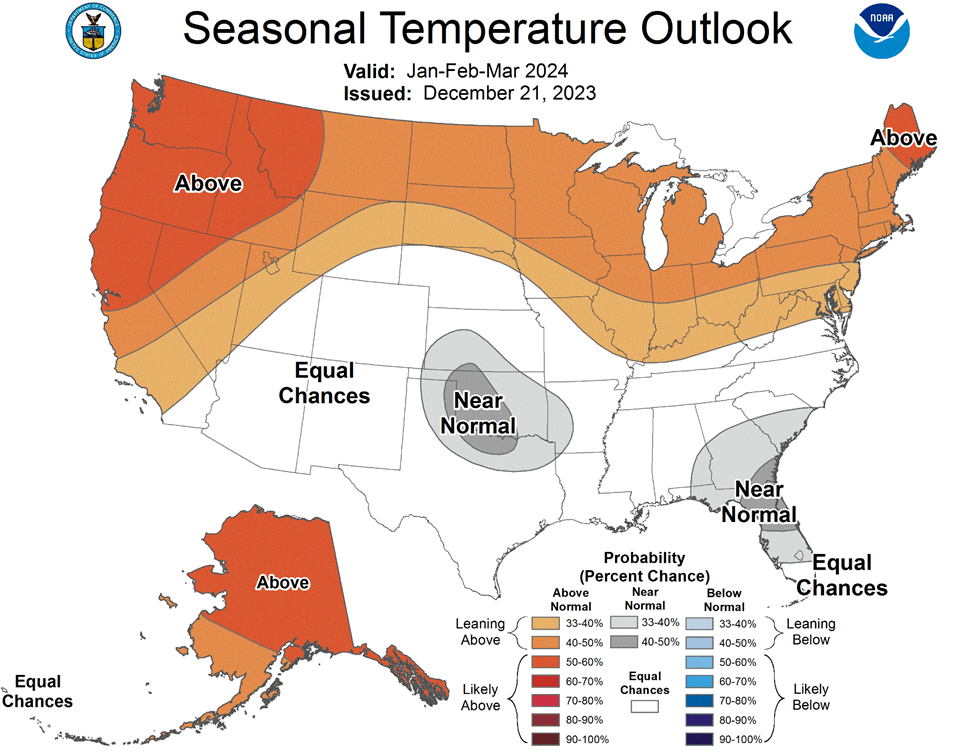
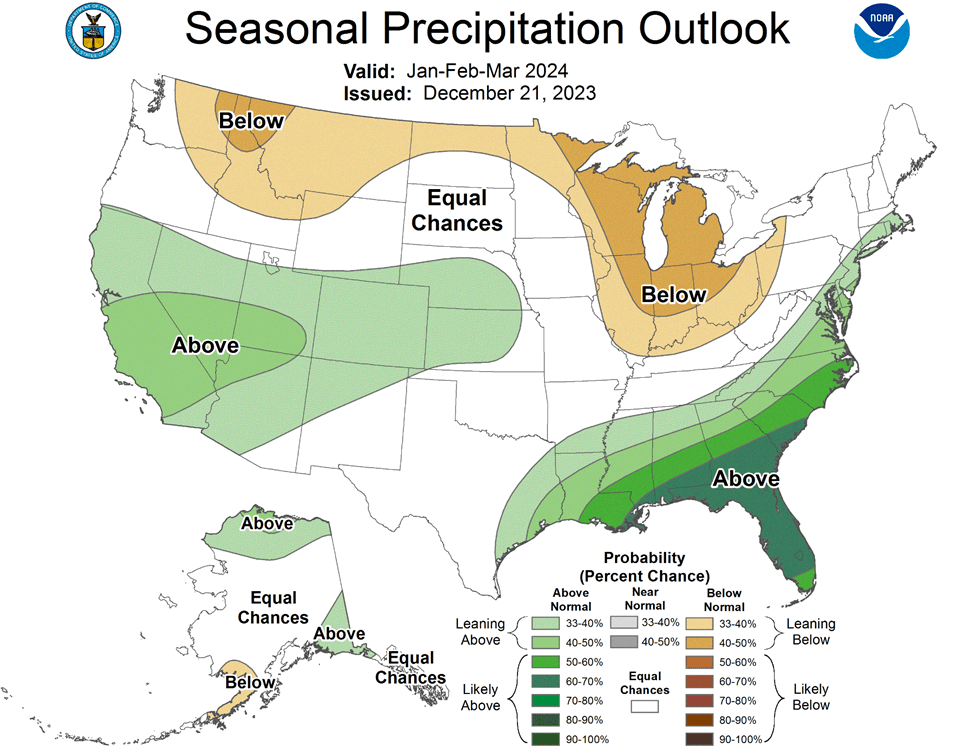
If the folks at NOAA are right – and they usually are – it might be a good idea to plan for an early gardening season. As always, click the link if you want more information.
When I did snow surveys, I had to look at how easy we had it. The old guys would leave Eureka, chain up and drive up Burma, ski or snowshoe into Weasel Cabin, measure the Weasel Divide Snow Course, then start trekking the next morning to Stahl Peak, build a fire in the lookout, measure Stahl, and head downhill the next day, sample the Grave Creek course, get to the pickup and drive out. With the benefit of snowmobiles, it was a single day task for me. Of course, there were 5 days to measure the Kootenai snow courses.
I suppose I always knew that technology would make the job I did in the seventies unnecessary – but I am glad I was there to enjoy watching the sun come up on a mountainside covered with snow. It wasn’t an easy task, but it was fun much of the time. I’m equally glad that, as an old man, I can still get the information and understand how well the winter is following the forecasts. Click the link, and see how easy it is to get the data I once worked all week to deliver. And stay warm doing so.
LikeLoading…
Want to tell us something or ask a question? Get in touch.










 Trego's Mountain Ear