-
When I did snow surveys, I had to look at how easy we had it. The old guys would leave Eureka, chain up and drive up Burma, ski or snowshoe into Weasel Cabin, measure the Weasel Divide Snow Course, then start trekking the next morning to Stahl Peak, build a fire in the lookout, measure Stahl, and head downhill the next day, sample the Grave Creek course, get to the pickup and drive out. With the benefit of snowmobiles, it was a single day task for me. Of course, there were 5 days to measure the Kootenai snow courses.
Now, things are a bit easier. You click this link: Montana SNOTEL Snow/Precipitation Update Report and the most current data for all Montana snow courses downloads.
I suppose I always knew that technology would make the job I did in the seventies unnecessary – but I am glad I was there to enjoy watching the sun come up on a mountainside covered with snow. It wasn’t an easy task, but it was fun much of the time. I’m equally glad that, as an old man, I can still get the information and understand how well the winter is following the forecasts. Click the link, and see how easy it is to get the data I once worked all week to deliver. And stay warm doing so.
-
From the Moon’s south pole to an ice-covered ocean world, several exciting space missions are slated for launch in 2024
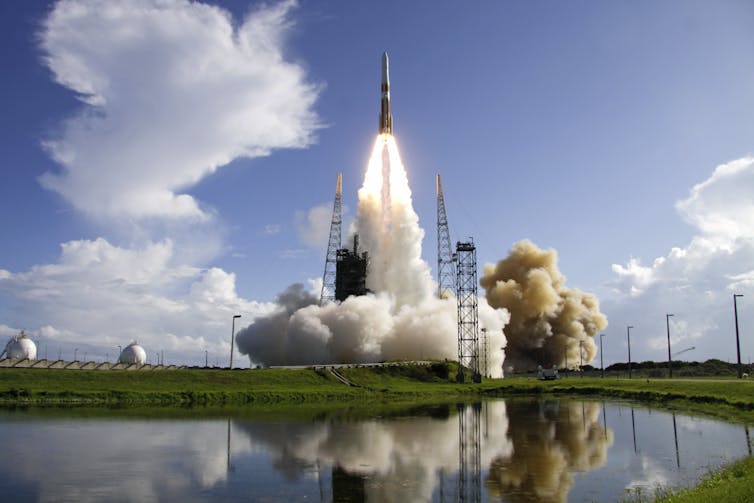
NASA isn’t the only space agency with exciting missions to watch for in 2024. AP Photo/John Raoux Ali M. Bramson, Purdue University
The year 2023 proved to be an important one for space missions, with NASA’s OSIRIS-REx mission returning a sample from an asteroid and India’s Chandrayaan-3 mission exploring the lunar south pole, and 2024 is shaping up to be another exciting year for space exploration.
Several new missions under NASA’s Artemis plan and Commercial Lunar Payload Services initiative will target the Moon.
The latter half of the year will feature several exciting launches, with the launch of the Martian Moons eXploration mission in September, Europa Clipper and Hera in October and Artemis II and VIPER to the Moon in November – if everything goes as planned.
I’m a planetary scientist, and here are six of the space missions I’m most excited to follow in 2024.
1. Europa Clipper
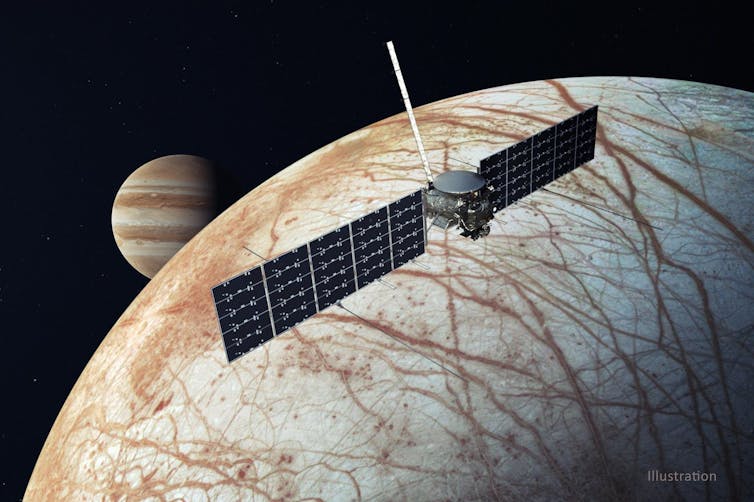
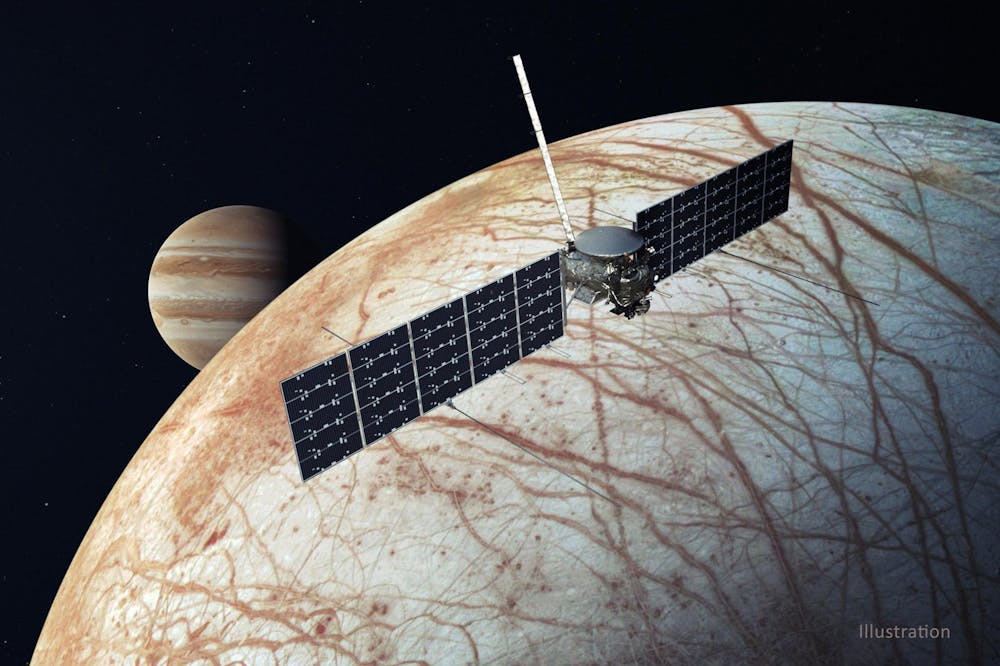
Illustration of what the Europa Clipper spacecraft will look like flying by Europa, a moon of Jupiter. NASA/JPL-Caltech NASA will launch Europa Clipper, which will explore one of Jupiter’s largest moons, Europa. Europa is slightly smaller than Earth’s Moon, with a surface made of ice. Beneath its icy shell, Europa likely harbors a saltwater ocean, which scientists expect contains over twice as much water as all the oceans here on Earth combined.
With Europa Clipper, scientists want to investigate whether Europa’s ocean could be a suitable habitat for extraterrestrial life.
The mission plans to do this by flying past Europa nearly 50 times to study the moon’s icy shell, its surface’s geology and its subsurface ocean. The mission will also look for active geysers spewing out from Europa.
This mission will change the game for scientists hoping to understand ocean worlds like Europa.
The launch window – the period when the mission could launch and achieve its planned route – opens Oct. 10, 2024, and lasts 21 days. The spacecraft will launch on a SpaceX Falcon Heavy rocket and arrive at the Jupiter system in 2030.
2. Artemis II launch
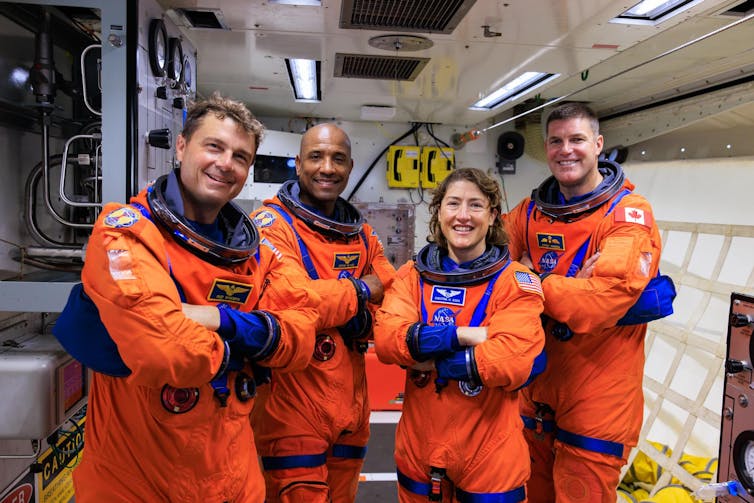
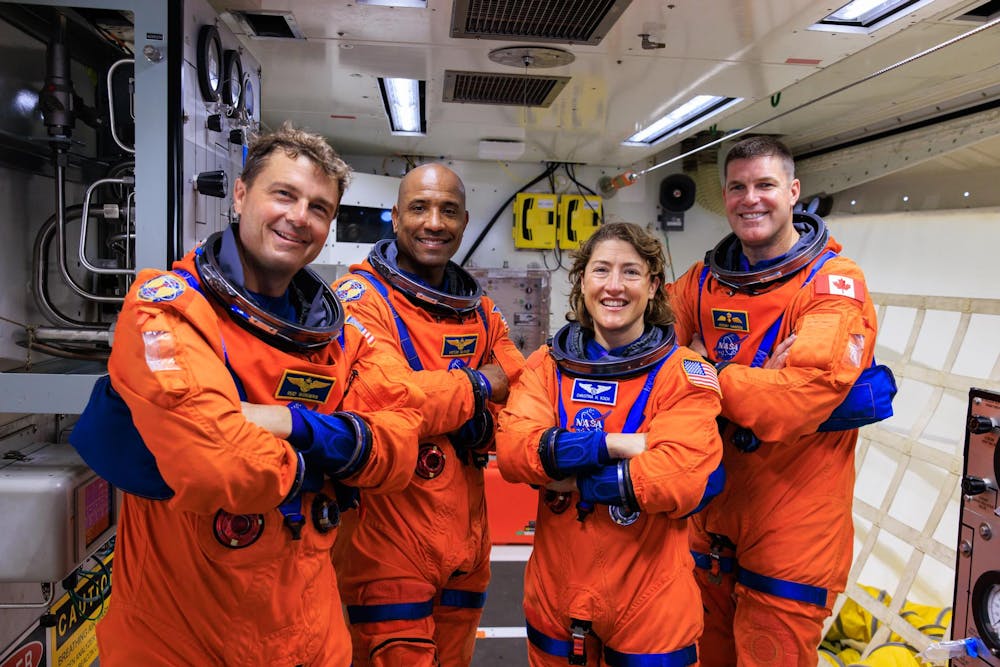
The Artemis II astronauts at the launchpad during a ground systems test in September 2023 at Kennedy Space Center. NASA The Artemis program, named after Apollo’s twin sister in Greek mythology, is NASA’s plan to go back to the Moon. It will send humans to the Moon for the first time since 1972, including the first woman and the first person of color. Artemis also includes plans for a longer-term, sustained presence in space that will prepare NASA for eventually sending people even farther – to Mars.
Artemis II is the first crewed step in this plan, with four astronauts planned to be on board during the 10-day mission.
The mission builds upon Artemis I, which sent an uncrewed capsule into orbit around the Moon in late 2022.
Artemis II will put the astronauts into orbit around the Moon before returning them home. It is currently planned for launch as early as November 2024. But there is a chance it will get pushed back to 2025, depending on whether all the necessary gear, such as spacesuits and oxygen equipment, is ready.
3. VIPER to search for water on the Moon
https://www.youtube.com/embed/S9Y6n1G5hhc?wmode=transparent&start=0 The VIPER rover to survey water at the south pole of the Moon.
VIPER, which stands for Volatiles Investigating Polar Exploration Rover, is a robot the size of a golf cart that NASA will use to explore the Moon’s south pole in late 2024.
Originally scheduled for launch in 2023, NASA pushed the mission back to complete more tests on the lander system, which Astrobotic, a private company, developed as part of the Commercial Lunar Payload Services program.
This robotic mission is designed to search for volatiles, which are molecules that easily vaporize, like water and carbon dioxide, at lunar temperatures. These materials could provide resources for future human exploration on the Moon.
The VIPER robot will rely on batteries, heat pipes and radiators throughout its 100-day mission, as it navigates everything from the extreme heat of lunar daylight – when temperatures can reach 224 degrees Fahrenheit (107 degrees Celsius) – to the Moon’s frigid shadowed regions that can reach a mind-boggling -400 F (-240 C).
VIPER’s launch and delivery to the lunar surface is scheduled for November 2024.
4. Lunar Trailblazer and PRIME-1 missions
NASA has recently invested in a class of small, low-cost planetary missions called SIMPLEx, which stands for Small, Innovative Missions for PLanetary Exploration. These missions save costs by tagging along on other launches as what is called a rideshare, or secondary payload.
One example is the Lunar Trailblazer. Like VIPER, Lunar Trailblazer will look for water on the Moon.
But while VIPER will land on the Moon’s surface, studying a specific area near the south pole in detail, Lunar Trailblazer will orbit the Moon, measuring the temperature of the surface and mapping out the locations of water molecules across the globe.
Currently, Lunar Trailblazer is on track to be ready by early 2024.
However, because it is a secondary payload, Lunar Trailblazer’s launch timing depends on the primary payload’s launch readiness. The PRIME-1 mission, scheduled for a mid-2024 launch, is Lunar Trailblazer’s ride.
PRIME-1 will drill into the Moon – it’s a test run for the kind of drill that VIPER will use. But its launch date will likely depend on whether earlier launches go on time.
An earlier Commercial Lunar Payload Services mission with the same landing partner was pushed back to February 2024 at the earliest, and further delays could push back PRIME-1 and Lunar Trailblazer.
5. JAXA’s Martian Moon eXploration mission
https://www.youtube.com/embed/yiS6NdpEL2A?wmode=transparent&start=0 The JAXA MMX mission concept to study Phobos and Deimos, Mars’ moons.
While Earth’s Moon has many visitors – big and small, robotic and crewed – planned for 2024, Mars’ moons Phobos and Deimos will soon be getting a visitor as well. The Japanese Aerospace Exploration Agency, or JAXA, has a robotic mission in development called the Martian Moon eXploration, or MMX, planned for launch around September 2024.
The mission’s main science objective is to determine the origin of Mars’ moons. Scientists aren’t sure whether Phobos and Deimos are former asteroids that Mars captured into orbit with its gravity or if they formed out of debris that was already in orbit around Mars.
The spacecraft will spend three years around Mars conducting science operations to observe Phobos and Deimos. MMX will also land on Phobos’ surface and collect a sample before returning to Earth.
6. ESA’s Hera mission
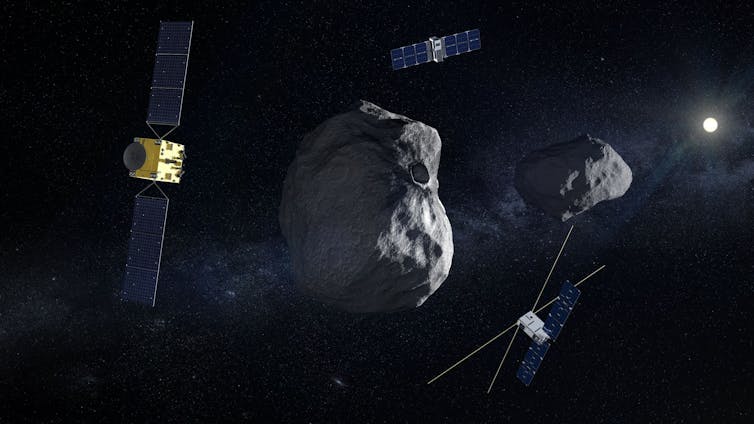
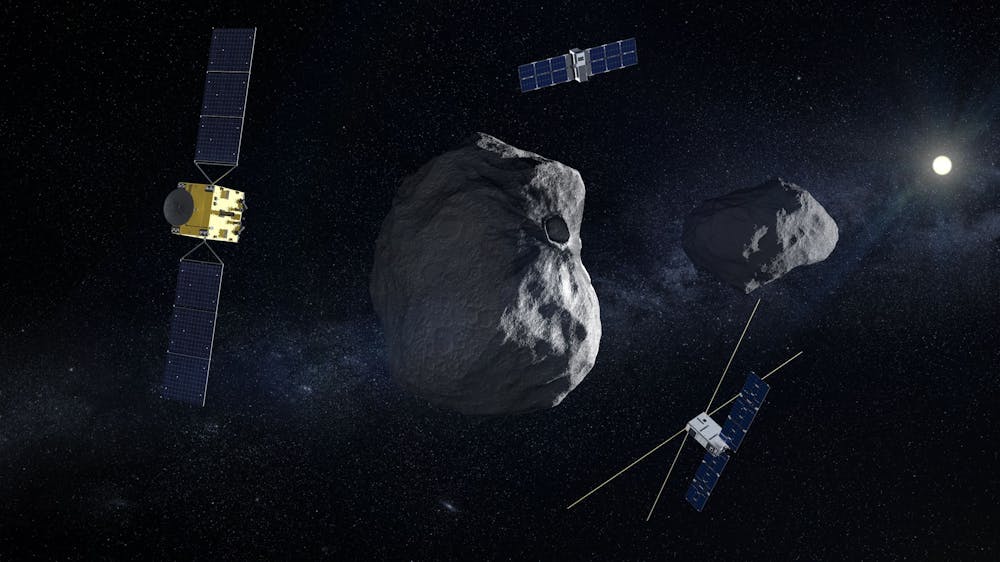
An artist’s conception of the Hera mission to literally measure the impact of NASA’s DART mission in 2022. ESA Hera is a mission by the European Space Agency to return to the Didymos-Dimorphos asteroid system that NASA’s DART mission visited in 2022.
But DART didn’t just visit these asteroids, it collided with one of them to test a planetary defense technique called “kinetic impact.” DART hit Dimorphos with such force that it actually changed its orbit.
The kinetic impact technique smashes something into an object in order to alter its path. This could prove useful if humanity ever finds a potentially hazardous object on a collision course with Earth and needs to redirect it.
Hera will launch in October 2024, making its way in late 2026 to Didymos and Dimorphos, where it will study physical properties of the asteroids.
Ali M. Bramson, Assistant Professor of Earth, Atmospheric, and Planetary Sciences, Purdue University
This article is republished from The Conversation under a Creative Commons license. Read the original article.
-
I’ve been re-reading the paperbacks of my youth – the Matt Helm series by Donald Hamilton. Matt has a somewhat cynical view of the world – a view that is hard to reject, but doesn’t match socially acceptable. The author, Donald Hamilton described Matt: “He’s actually a nice guy. He just happens to kill people for a living.”
Here are a few quotations from the series:
“Once you point a gun at someone, you’re a murderer; whether or not you get around to pulling the trigger is irrelevant.”
“Washington is the city of the soft heads and the chicken hearts.”
“You find them in every sport. The next time you reach the top of Everest, there’ll be a mountaineering expert waiting to tell you sternly that you should be banned from the cliffs and slopes because you used the wrong color of rope and didn’t hammer in your pitons with the proper stylish stroke.”
“When you act like a nice guy, everyone examines your motives with a microscope. When you act like a conscienceless louse, they generally take you at face value.”
“There’s nothing more frightening to me than a character who thinks he knows what a real American is – mainly because it generally turns out he’s convinced it’s somebody like him. It seems an odd notion to me. I certainly don’t want to live in a country populated with people just like me, God forbid! Anyway, I figure there’s room for a little variety in a nation as big as ours.”
“Certainly, if the world ever is saved, it’ll be by somebody young enough not to know that it can’t be done.”
“Always call them ‘Sir.’ They aren’t any harder to kill later!”
“The girl whispered, “I’m dying, aren’t I?” “I should hope so,” I said. “If not, we’ll have to send my associate back to marksmanship school.”
“My job is defending the people and to hell with the laws. Your job is defending the laws and to hell with the people.”
“Being hove to in a long gale is the most boring way of being terrified I know.”
“Certain people never learn that if they push folks around long enough, sooner or later they’ll start shoving somebody who won’t take it. He’ll blow right up in their faces and demolish them and the surrounding landscape; and they – those who are left – will scream about how misunderstood and abused they are, and why didn’t somebody tell them the guy was dangerous so they could be nice to him? It never seems to occur to them that there’s a very simple
answer: just be nice to everybody.”
“I get very unhappy without my 38 caliber security blanket.”
“The evening of any day in which someone has tried to kill you and failed is always beautiful, simply because you’re alive to see it.”
“My religion is as indefinite as my politics, but I’ve never been conceited enough to kid myself that, with a few billion other souls to worry about, the Deity takes a special interest in my affairs, although it sometimes does seem that the other guy likes to hang around making things difficult.”
“It’s always a little hard to interpret these characters who deal in abstract concepts like law and justice.”
-
I started out believing Christmas was a Christian holiday – probably mostly a Protestant holiday at that. Those early years were Methodist. Yet as I’ve gone through life, I’ve grown to realize that, like Saint Patrick’s day, Christmas is for everyone.
I’ll receive Christmas greetings from Japan – and Christians are rare there. This article Christmas in Japan 2023 : Facts and Traditions | JRailPass tells of the importance of Christmas to all of Japan:“One fun fact about the holiday season in Japan is that Christmas Eve (december 24) is the most romantic day of the year. It’s the Japanese version of Valentine’s Day. As a matter of fact, if you don’t have a date on Christmas Eve, you won’t want to be seen alone in public. Japanese couples, especially the youngest, book dinners at romantic restaurants, the stores sell romantic Christmas gifts, and the streets are decorated to perfection to embody this most romantic day.
The Japanese Christmas cake or “kurisumasu keki” is sold on practically every street corner from Hokkaido to Kyushu! This dessert is light and spongy with whipped cream filling and frosting, topped with perfectly cut deep red strawberries.
This beloved, and delicious, Christmas treat, very popular for birthdays too, is also seen as a symbol of prosperity since Japan rose from ruins after World War II.”
Click the link – learn why fried chicken is the Christmas meal in Japan – and Merii Kurisumasu to all.
I’m in Trego – and won’t be seeing any of my Jewish friends this Christmas – but I recall Bob Mendelsohn’s explanation of how he loved Christmas music, the lights and the trees. From “Let it Snow” and “Chipmunks Roasting on an Open Fire” to “White Christmas” and “Silver Bell” much of our Christmas music has Jewish composers. Hanukkah fits into the secular American holiday symbolized by the “silly fat man in a funny red suit, stuck in the smokehole of our tipi” – and I am sure that song will be played this season.
I recall my surprise at receiving apples from a couple of my Chinese students as Christmas approached. In China Christmas is a mercantile holiday – yet the song ‘Silent Night’ has morphed into Christmas Eve being ‘peaceful night.’ Since I’ve retired, I haven’t had Nepalis around at Christmas – my students from Nepal were either Hindu or Buddhist, and they took to Christmas with a more formal, good natured courtesy.
My Christmas tree probably shows a connection with the Roman Saturnalia holiday – but, as with the rest of Rome, when Emperor Constantine went over to Christianity, the tree too became Christianized. Or it might have been St. Boniface’s attempt to convert the Druids. At any rate, my tree shows a connection between Christianity and pagan thought. It’s kind of neat to realize that Christmas isn’t just for Christians.
-
“If defending free speech doesn’t get you into trouble, then you are not in fact defending free speech. The only speech worth defending is unpopular and very often it comes out of the mouths of people nobody likes.”
Peter Hitchens“I may not agree with you, but I will defend to the death your right to make an ass of yourself.”
Oscar Wilde“Whoever would overthrow the liberty of a nation must begin by subduing the freeness of speech.”
Benjamin Franklin“In order to be able to think, you have to risk being offensive.”
Jordan Peterson“If you’re not going to use your free speech to criticize your own government, then what the hell is the point of having it?”
Michel Templet“To view the opposition as dangerous is to misunderstand the basic concepts of democracy. To oppress the opposition is to assault the very foundation of democracy.”
Aung San Suu Kyi“Ultimately, saying that you don’t care about privacy because you have nothing to hide is no different from saying you don’t care about freedom of speech because you have nothing to say.”
Edward Snowden“Because if you don’t stand up for the stuff you don’t like, when they come for the stuff you do like, you’ve already lost.”
Neil Gaiman“Restriction of free thought and free speech is the most dangerous of all subversions. It is the one un-American act that could most easily defeat us.”
William O. Douglas“The claim “hate speech is not free speech” implies “free” is a type of speech, as opposed to how speech is treated in a free society.”
Michael Malice“You can’t pick and choose which types of freedom you want to defend. You must defend all of it or be against all of it.”
Scott Howard Phillips“To criticize a person for their race is manifestly irrational and ridiculous, but to criticize their religion, that is a right. That is a freedom. The freedom to criticize ideas, any ideas – even if they are sincerely held beliefs – is one of the fundamental freedoms of society. A law which attempts to say you can criticize and ridicule ideas as long as they are not religious ideas is a very peculiar law indeed.
It all points to the promotion of the idea that there should be a right not to be offended. But in my view the right to offend is far more important than any right not to be offended. The right to ridicule is far more important to society than any right not to be ridiculed because one in my view represents openness – and the other represents oppression.”
Rowen Atkinson“If there be any among us who would wish to dissolve this Union, or to change its republican form, let them stand undisturbed as monuments of the safety with which error of opinion may be tolerated, where reason is left free to combat it.”
Thomas Jefferson“There is freedom of speech, but I cannot guarantee freedom after speech.”
Idi Amin“The majority of people are not fully committed to either the right or the left. Nor either to censorship or to absolute freedom of speech. People are too caught up in the daily struggle for survival to pour a lot of energy into ideology.”
Wendy McElroy“Truly, whoever can make you believe absurdities can make you commit atrocities. If the God-given understanding of your mind does not resist a demand to believe what is impossible, then you will not resist a demand to do wrong to that God-given sense of justice in your heart.”
Voltaire -
The Christmas Spider, an Eastern European Legend
Many cultures have their own unique Christmas ornaments… When I was little, my folks had a straw goat ornament from Finland, a “Joulupukki”, or “Jule Goat”, a representation of the harvest season’s spirit – something that made an appearance when folks celebrated the return of the light.
Keep readingThe Yule Cat
As December begins, and thoughts turn to cat-proofing (if such a thing is possible) the Christmas decorations, I am reminded of a bit of Icelandic folklore. The Yule Cat, Jólakötturinn, is a giant cat very invested in whether or not folks are wearing new clothes for Christmas. While it’s not clear whether the individuals without new clothes get eaten, or just their food, it’s clear that the cat’s invested in the outcome. There is, of course, music about it:
Keep readingFestive Parasites
Mistletoe is a classic Christmas decoration, which has always struck me as rather odd, considering that all varieties of mistletoe are parasitic plants. Depending on how bad the infestation is, mistletoe is quite capable of killing its host plants. There are many types of mistletoe (117 species globally, 5 species of dwarf mistletoe are common in Montana). While mistletoe have many different host plants, around here our mistletoe varieties tend to be specialists on conifers – I’ve spotted some local Western Dwarf Mistletoe, generally found on Ponderosa Pines. As for why we associate mistletoe plants with kissing? They’ve been plants…
Keep readingHow Long do Gift Cards Last?
Buying gift cards has some appeal, as a way to help out local businesses. Buy it now- giving the business some much needed cash, redeem later when business is better. What about using an existing gift certificate? Does putting off redeeming a gift card actually benefit the business? It depends on the state, and how long you want to put off using the gift card. When a gift card is purchased, the business gains cash and marks an IOU down on its ledgers, more or less. For a business, Cash is good, and an IOU that’s never redeemed would seem…
Keep reading -
I noticed this meme this morning – really noticed instead of just seeing it and moving past without thinking about it:

It’s a simple question that doesn’t have a simple answer. The term ‘wage-slave’ started before the US Civil war, and was an argument southern slave-holders used to prove the northern abolitionists weren’t standing on perfect ground. By the 1870’s the progressive upstarts in the Republican party were protesting against wage-slavery.
Thirty years ago, the middle class (as a group) owned twice as much of the nation’s wealth as the top 1 percent did. That situation has changed over a generation – now, the top 1 percent of Americans own more of the nation’s wealth than the entire middle class.
Where Do I Fall in the American Economic Class System? | Family Finance | U.S. News offers a few thoughts on the economic class situation in the US:
“In the second quarter of 2023, the median weekly earnings for full-time American workers was $1,100, according to the U.S. Bureau of Labor Statistics. That puts the median annual income at about $57,200.
LOWER INCOME MIDDLE INCOME UPPER INCOME 2023 Middle-Class Salary $38,133 $57,200 $114,400 “ It’s part of the problem with inflation – it’s hard to keep score in dollars when the actual values keep changing. And, there’s an age factor to figure in. When we look at net worth, those top 1 percenters really demonstrate the difference between the average (mean) and the median.
Average American Net Worth by Age: Compare Yours – NerdWallet
“The average net worth for U.S. families is about $1.06 million. The median — a more representative measure — is $192,900.”
Net worth totals vary by education, age, income and other factors. We’ll focus on the median and average net worth figures for different age groups:
Age of head of family Median net worth Average net worth Less than 35 $39,000 $183,500 35-44 $135,600 $549,600 45-54 $247,200 $975,800 55-64 $364,500 $1,566,900 65-74 $409,900 $1,794,600 75+ $335,600 $1,624,100 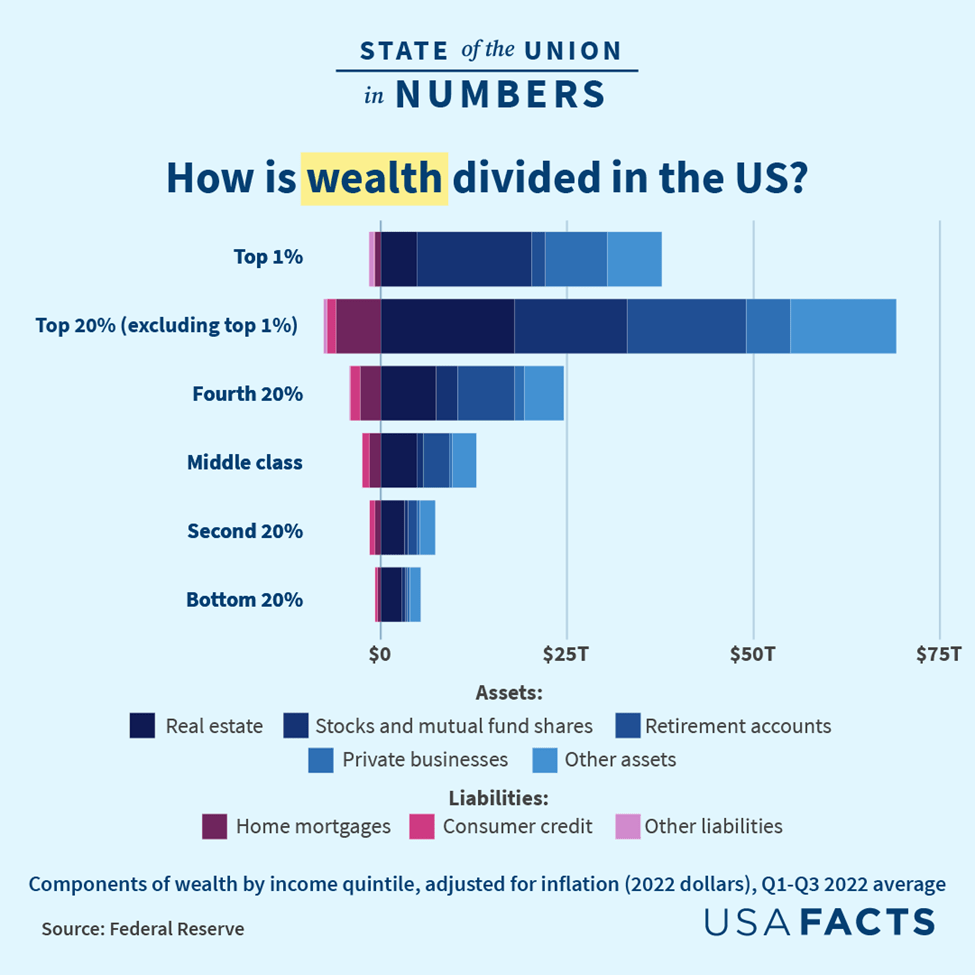
-
As snow blankets my part of the world in the beginning of Winter, I begin the wait for the solstice – the shortest day. Technically, this year the solstice occurs on Thursday, December 21, at 8:27 pm (in Eureka). On the 21st, the sun will rise at 8:30, and at 8:31 on Friday the 22nd – but on Friday sunset is a minute later – 4:46. The change isn’t sunrise, it’s sunset.
Our shortest day is 8 hours, 14 minutes and 37 seconds. By year end dawn will be 3 minutes later, and sunset 7 minutes later. And, winter officially starts with the solstice – the snows and freezing temperatures before that are Christmas tree season up here. The days will grow longer until June 21 – when the day length reaches 16 hours, 11 minutes and 4 seconds. And on that note, summer will officially begin.
Twilight was never absolutely clear – but when you realize that there are three types of twilight, it becomes a lot easier. Civil twilight is basically a time when you can still see the sights – from sundown to where the sun is 6 degrees below the horizon. Nautical twilight has the sun between 6 and 12 degrees below the horizon – and you can see both the horizon and stars.
Astronomical twilight has the sun between 12 and 18 degrees below the horizon – still too much light for astronomers to view the dimmer stars.
And after astronomical twilight comes night. We get a lot more night at the winter solstice than the summer solstice.
-
When authoritative sources hold onto bad data: A legal scholar explains the need for government databases to retract information
Government information sources like the U.S. patent database often file bad information without labeling it or providing a way to retract it. Thinglass/iStock via Getty Images Janet Freilich, Fordham University
In 2004, Hwang Woo-suk was celebrated for his breakthrough discovery creating cloned human embryos, and his work was published in the prestigious journal Science. But the discovery was too good to be true; Dr. Hwang had fabricated the data. Science publicly retracted the article and assembled a team to investigate what went wrong.
Retractions are frequently in the news. The high-profile discovery of a room-temperature superconductor was retracted on Nov. 7, 2023. A series of retractions toppled the president of Stanford University on July 19, 2023. Major early studies on COVID-19 were found to have serious data problems and retracted on June 4, 2020.
Retractions are generally framed as a negative: as science not working properly, as an embarrassment for the institutions involved, or as a flaw in the peer review process. They can be all those things. But they can also be part of a story of science working the right way: finding and correcting errors, and publicly acknowledging when information turns out to be incorrect.
A far more pernicious problem occurs when information is not, and cannot, be retracted. There are many apparently authoritative sources that contain flawed information. Sometimes the flawed information is deliberate, but sometimes it isn’t – after all, to err is human. Often, there is no correction or retraction mechanism, meaning that information known to be wrong remains on the books without any indication of its flaws.
As a patent and intellectual property legal scholar, I’ve found that this is a particularly harmful problem with government information, which is often considered a source of trustworthy data but is prone to error and often lacking any means to retract the information.
Patent fictions and fraud
Consider patents, documents that contain many technical details that can be useful to scientists. There is no way to retract a patent. And patents contain frequent errors: Although patents are reviewed by an expert examiner before being granted, examiners do not check whether the scientific data in the patent is correct.
In fact, the U.S. Patent and Trademark Office permits patentees to include fictional experiments and data in patents. This practice, called prophetic examples, is common; about 25% of life sciences patents contain fictional experiments. The patent office requires that prophetic examples be written in the present or future tense while real experiments can be written in the past tense. But this is confusing to nonspecialists, including scientists, who tend to assume that a phrase like “X and Y are mixed at 300 degrees to achieve a 95% yield rate” indicates a real experiment.
Almost a decade after Science retracted the journal article claiming cloned human cells, Dr. Hwang received a U.S patent on his retracted discovery. Unlike the journal article, this patent has not been retracted. The patent office did not investigate the accuracy of the data – indeed, it granted the patent long after the data’s inaccuracy had been publicly acknowledged – and there is no indication on the face of the patent that it contains information that has been retracted elsewhere.
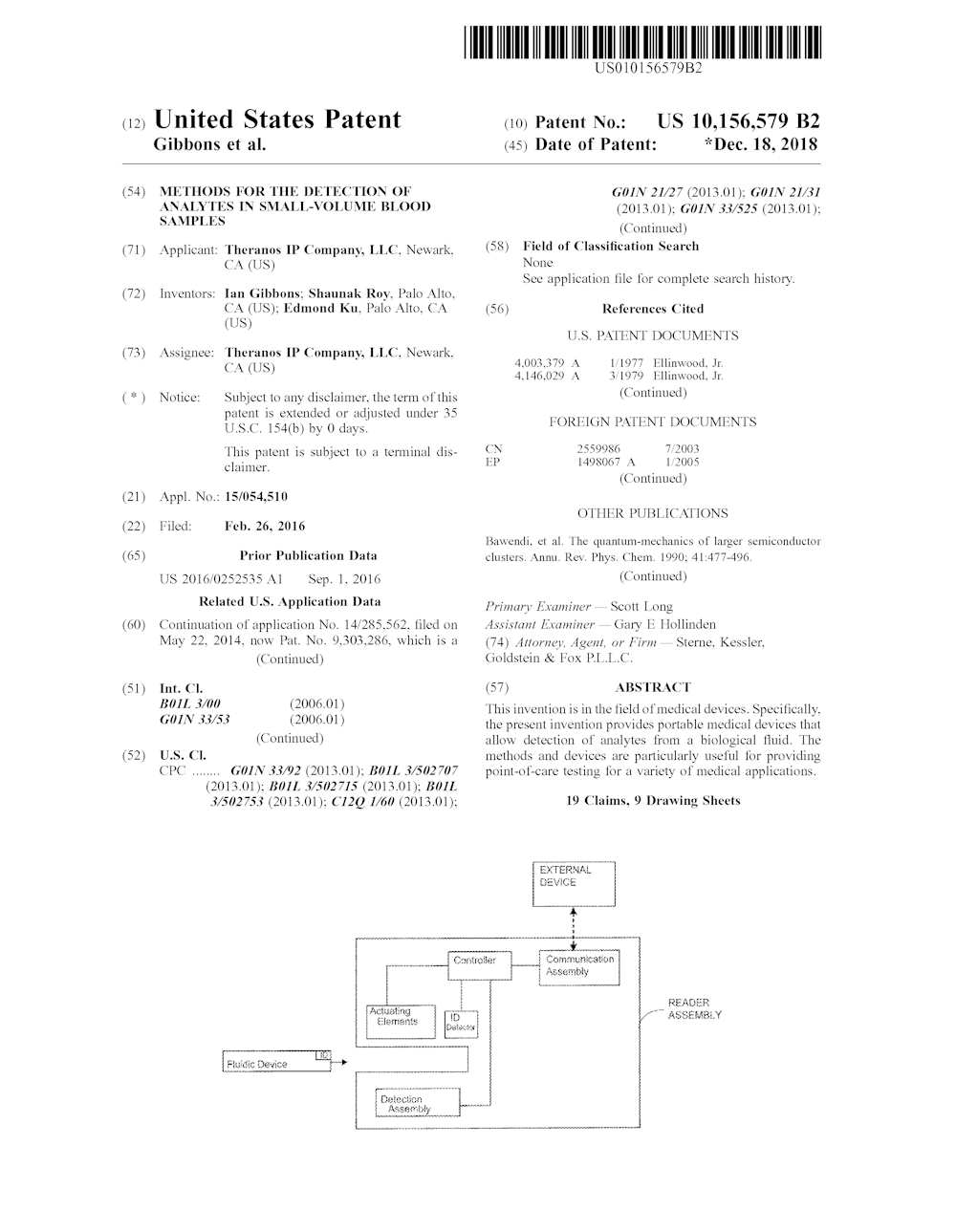
This is no anomaly. In a similar example, Elizabeth Holmes, the former – now imprisoned – CEO of Theranos, holds patents on her thoroughly discredited claims for a small device that could rapidly run many tests on a small blood sample. Some of those patents were granted long after Theranos’ fraud headlined major newspapers.
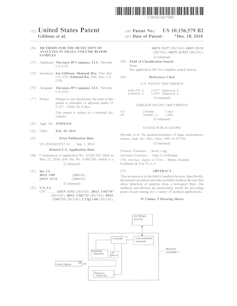
The U.S. Patent and Trademark Office granted a patent to Theranos on Dec. 18, 2018, three months after the company was dissolved following a series of investigations and lawsuits that detailed its fraud. The patent has not been rescinded and contains no notice of the faulty nature of the information it contains. U.S. Patent and Trademark Office Long-lived bad information
This sort of under-the-radar wrong data can be deeply misleading to readers. The system of retractions in scientific journals is not without its critics, but it compares favorably to the alternative of no retractions. Without retractions, readers don’t know when they are looking at incorrect information.
My colleague Soomi Kim and I conducted a study of patent-paper pairs. We looked at cases where the same information was published in a journal article and in a patent by the same scientists, and the journal paper had subsequently been retracted. We found that while citations to papers dropped steeply after the paper was retracted, there was no reduction in citations to patents with the very same incorrect information.
This probably happened because scientific journals paint a big red “retracted” notice on retracted articles online, informing the reader that the information is wrong. By contrast, patents have no retraction mechanism, so incorrect information continues to spread.
There are many other instances where authoritative-looking information is known to be wrong. The Environmental Protection Agency publishes emissions data supplied by companies but not reviewed by the agency. Similarly, the Food and Drug Administration disseminates official-looking information about drugs that is generated by drug manufacturers and posted without an evaluation by the FDA.
Consequences of nonretractions
There are also economic consequences when incorrect information can’t be easily corrected. The Food and Drug Administration publishes a list of patents that cover brand-name drugs. The FDA won’t approve a generic drug unless the generic manufacturer has shown that each patent that covers the drug in question is expired, not infringed or invalid.
The problem is that the list of patents is generated by the brand-name drug manufacturers, who have an incentive to list patents that don’t actually cover their drugs. Doing so increases the burden on generic drug manufacturers. The list is not checked by the FDA or anyone else, and there are few mechanisms for anyone other than the brand-name manufacturer to tell the FDA to remove a patent from the list.
Even when retractions are possible, they are effective only when readers pay attention to them. Financial data is sometimes retracted and corrected, but the revisions are not timely. “Markets don’t tend to react to revisions,” Paul Donovan, chief economist of UBS Global Wealth Management, told the Wall Street Journal, referring to governments revising gross domestic product figures.
Misinformation is a growing problem. There are no easy answers to solve it. But there are steps that would almost certainly help. One relatively straightforward one is for trusted data sources like those from the government to follow the lead of scientific journals and create a mechanism to retract erroneous information.
Janet Freilich, Associate Professor of Law, Fordham University
This article is republished from The Conversation under a Creative Commons license. Read the original article.
-
There’s an article on RealClearPolitics titled Why Social Security Must Be Reformed | RealClearPolitics It’s not necessarily news – but it is worth a read.
The author describes Social Security: “This type of retirement system is frequently referred to as a “generational transfer.” That is, we are transferring income from younger generations to the retired generation. This is not unlike the traditional model that existed in tribal and rural societies for millennia, where younger generations provided for those who had grown too old or infirm to contribute. When Social Security was created in 1937, the U.S. nationalized and monetized this traditional model.”
Then he does a great job of bringing out population pyramids to demonstrate the failure of that traditional model. Our population pyramids aren’t pyramids anymore (and I like it when folks bring in real demographics to illustrate the point).
“Demographers have developed a tool called the population pyramid to visualize how the relative size of generations compare. There is a valuable website, www.populationpyramid.net, which shows the population pyramid for every country in the world. It has historical data going back to 1950 and projections through the end of the 21st century. Here are their calculations of the pyramids for the U.S. in 1950 and 2100.

In 1950, just ten years after Social Security began paying benefits, 58% of Americans were 20-64 and only 8% were over 65. As a result, there were just over seven Americans of working age for every potential retiree. Since 1950, the percentage of the population in the working age bracket is about the same (57%), but the percentage over 65 has more than doubled to nearly 19%. That lowers the ratio from 7:1 in 1950 to 3.1:1 today.”
As one of those old duffers getting a social security check every month, let me say a solid thank you to those three youngsters who work diligently to make sure my social security checks arrive on time and don’t bounce. I never received that sort of a thank you when in my pre-retirement days, and I do believe it is owed to them. I’m not sure when generational transfer turns into a pyramid scheme. A dozen years ago, Forbes called social security “much worse than a ponzi scheme.”
“The facts about Social Security are these. Yes, it’s a Ponzi scheme, thus criminally fraudulent (as I’ll explain), but even worse, because it coerces us to be a part of it. Since the scheme began in 1935 the full force of the U.S. government has compelled a growing portion of citizens to suffer by it, such that we all do so by now. A scheme of such widespread, compulsory fraud is unprecedented in U.S. history, and perhaps one of the most shameful (and popular) of FDR’s New Deal schemes.”
Here’ that author’s plan:
But here’s a plan – call it the Salsman Plan – that would ensure electoral support from all three groups, and thus potentially guarantee a political landslide for the candidate who proposes it. First, tell the elderly that they’ll no longer be subject to political scare tactics, because immediately they’ll be given an account in their name that’s full of U.S. Treasury bills and bonds, whose worth equals the present value of what they’d otherwise receive in Social Security checks for the likely balance of their lives. They can do what they wish with their new account: cash it out now, slowly liquidate it over time, perhaps buy an annuity, or keep most of it as is. Second, tell the young and the middle-aged they will no longer have to pay the 15.3% payroll tax, and they too will immediately receive an account in their name with U.S. Treasury bills and bonds, based on what they’ve already paid in so far. They too can do what they wish with their sudden investment windfall. Social Security, no longer empowered to tax payrolls or send retiree checks, would then be closed overnight.”
Click the links and read both articles – the quotes are here to lure you into reading the whole thing. If Salsman is right . . . and I think he is – well, the 2.31 younger workers who are supporting my social security definitely deserve my thanks. And your 2.31 younger workers deserve yours.

Want to tell us something or ask a question? Get in touch.

Recent Posts
- Recovery Time for a Retiree
- Venn Diagram and DSM
- When Castro Was Cool
- You Have To Beat Darwin Every Day
- Computer Repair by Mussolini
- Getting Alberta Oil to Market
- Parties On Economics
- Thus Spake Zarathustra – One More Time
- Suspenders
- You Haven’t Met All The People . . .
- Play Stupid Games, Win Stupid Prizes
- The Ballad of Lenin’s Tomb

Rough Cut Lumber
Harvested as part of thinning to reduce fire danger.
$0.75 per board foot.
Call Mike (406-882-4835) or Sam (406-882-4597)
Popular Posts
Ask The Entomologist Bears Books Canada Census Community Decay Covid Covid-19 Data Deer Demography Education Elections Eureka Montana family Firearms Game Cameras Geese Government Guns History Inflation life Lincoln County Board of Health Lincoln County MT Lincoln Electric Cooperative Montana nature News Patches' Pieces Pest Control Politics Pond Recipe School School Board Snow Taxes travel Trego Trego Montana Trego School Weather Wildlife writing
 Trego's Mountain Ear