-
As I read of Ted Kaczynski’s death, my thoughts went back to the many journalists who called me after his arrest. It’s not like Ted had a personal grudge against me (though it turned out I did have friends on his Christmas card list). My screwed up day was basically collateral damage – Ted got busted in Lincoln, Montana. I was a County Extension Agent in Lincoln County, Montana – and there were a hell of a lot of journalists who didn’t know that the town of Lincoln is in Lewis & Clark County. It’s amazing how many journalists let their fingers do the walking for them on the telephone while never considering looking at a map.
I didn’t have anything particularly important planned for those two days in April, 1996 – which was just as well, because telephone calls flooded the county answering machine – and the first phone connection the journalists could get was “Agricultural Extension Agent.” Yeah, the automated directory was alphabetical, and I was first on the list. I spent a couple of days talking with folks from ABC, BBC, CBC . . . ad infitum – each wanting information about Ted. Each got the same answer: “I wouldn’t recognize him if he walked into my office and bit me on the leg. You do know that it’s a five-hour drive to get from Libby to Lincoln? No? You do know that Montana is the fourth largest state? No? Then I guess you don’t know that Lincoln is in Lewis & Clark County? Somebody in Helena might be able to help you but I surely can’t.” By the time the journalists were done calling, I had it down pat – and a quarter century later, the repeated responses are still solid in my memory.
I shared the story with the County Agent in Lewis & Clark – accidentally setting him up, since he actually had met Kaczynski. When the FBI called Larry to investigate his interactions with Kacynski, he thought that it must be another agent pranking him, so he responded with a grossly exaggerated description of Ted . . . eventually hearing “Young man, you may believe you are quite a wit, but I really am with the FBI, and you’re not going to enjoy the experience if you don’t straighten out right now.”
I guess Larry thought it was me pranking him – his last phrase was “He didn’t sound a bit like you.”
Rest in peace, Ted. One’s mind is a terrible thing to lose.
-
It’s been a long time since I was a teenager in a $150 car. Part of it is inflation. But there are still ways to get a handle on depreciation. Ramseysolutions provides charts that give a handle on the topic:
Initial Car Value $30,000 New Car Value After . . . 1 minute $27,000 1 year $24,000 2 years $20,400 3 years $17,340 4 years $14,740 5 years $12,530 I got to listening to Dave Ramsey and his financial peace university driving across the great plains, listening to him as he gave advice to people who were in horrible financial binds. AM radio has its programming, and his seems pretty down to earth:
“There’s a reason why the average millionaire drives a four-year-old car with 41,000 miles on it. By buying used cars, they let someone else bear the brunt of a new car’s rapid depreciation in its first few years. And they still end up with a reliable car that’ll run for years and years with proper maintenance.”
Spglobal shows that the average car on US highways is 12.2 years old. How things have changed. Stlouisfed begins with this: “In 1970, the average age of a car in use in the U.S. was less than 6 years. By 2016, the average age had climbed past 11 years.”
The report goes on to explain:
Dupor also noted that new vehicle sales typically fall more heavily during recessions, which causes the average age of cars on the road to rise even faster. One of two things may happen during the subsequent recoveries:
- The average age of cars could drop if new vehicle sales rebound strongly enough.
- The average age could remain higher than its prerecession levels if new vehicle sales aren’t rebounding as much.”
Ramsey explains car purchases:
How much car can you afford? And we’re not talking about car payments here. You should pay for a car—in full—with cash. Plain and simple. Yes, that means you’ll have a serious dent in your savings, but you’ll skip the stress of spending hundreds of dollars on car loan payments each month. Isn’t that awesome?
Let’s say you borrow $10,000 for a car with a 5% interest rate and a term of five years. You’ll end up spending an additional $1,322.74 in interest. Not so affordable anymore!
The truth is, you don’t need car loans. You can find reliable used cars in any price range.”
So it’s not just inflation – car depreciation, inflation – it makes for a complex topic. Back in 1970, when the average car was 6 years old, mine was 11. Things may not have changed all that much.
-
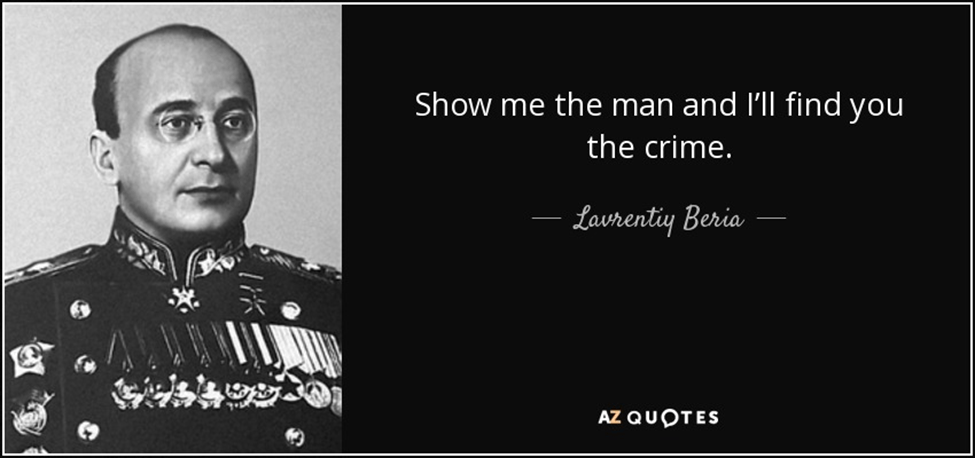
Given a short time with a psycho-politician you can alter forever the loyalty of a soldier in our hands or a statesman or a leader in his own country, or you can destroy his mind.
He who is not blind sees that our party, during its difficult days, is closing its ranks still more closely, that it is united and unshakable.
“Let us once and for all root out the seeds of individual ambition. Let us smash any manifestation of anti-party groupism, put an end to efforts to destroy party discipline, in whatever form these efforts manifest themselves”
“Let our enemies know that anyone who attempts to raise a hand against the will of our people, against the will of the party of Lenin and Stalin, will be mercilessly crushed and destroyed”
That’s it for Beria quotations. From History Today these excerpts show some of the efforts of Nikita Kruschev to improve liberty in the Soviet Union following the death of Stalin:
“Accounts of what happened vary considerably, but it seems that Beria’s downfall was engineered by Nikita Khrushchev, secretary to the Party Central Committee, who quietly secured the support of other powerful figures, including Malenkov and a number of generals. On June 26th, apparently, at a hastily convened meeting of the Presidium, Khrushchev launched a blistering attack on Beria, accusing him of being a cynical careerist, long in the pay of British intelligence, and no true Communist believer. Beria was taken aback and said, ‘What’s going on, Nikita?’, and Khrushchev told him he would soon find out. The veteran Molotov and others chimed in against Beria and Khrushchev put a motion for his instant dismissal. Before a vote could be taken, the panicky Malenkov pressed a button on his desk as the pre-arranged signal to Marshal Zhukov and a group of armed officers in a nearby room. They immediately burst in, seized Beria and manhandled him away.
Beria’s men were guarding the Kremlin, so the officers had to wait until nightfall before smuggling him out in the back of a car. He was taken first to the Lefortovo Prison and subsequently to the headquarters of General Moskalenko, commander of Moscow District Air Defence, where he was imprisoned in an underground bunker. His arrest was kept as quiet as possible while his principal lieutenants were rounded up – some were rumoured to have been shot out of hand – and regular troops were moved into Moscow.”
This is the official story – there’s a legend that Nikita, in the aftermath of Stalin’s death, personally put a bullet into Beria, and that the arrest and subsequent trial made use of a stand-in. Still, while Stalin referred to Beria as “my Himmler”, obviously there was a problem with Beria’s style of management. “Show me the man and I’ll find the crime isn’t always a winning philosophy.”
-
Nothing lasts forever, and there is always the question of what to do when something no longer works. Solar panels are no exception.
Like many pieces of modern technology, the materials that go into solar panels are sufficiently complex/rare to make recycling seem like a rather good idea.
While solar panels are expected to last for at least a quarter century, their increased prevalence makes the question of recycling grow more important.
Which components can be recycled? According to the EPA: Glass, aluminum, copper, plastic and potentially silver, aluminum tin, tellurium, antimony,gallium and indium (some of these make the Department of the Interior’s list of minerals critical to national security and the economy)
While some of this sounds relatively straight forward (even if glass recycling requires a rather significant drive from our neck of the woods), separating those components isn’t necessarily.
According to MIT Technology Review, only about 10% of US solar panels are recycled, which might have something to do with the expense of doing so.
Reduce, Reuse, Recycle: Reuse? Not so much. Solar panel efficiency decreases with time, though estimates seem to vary on how much time. So far, solar panel recycling doesn’t seem particularly cost effective, though there are companies working on developing more cost effective processes. Ultimately,for recycling to occur, it’s going to need to be cost effective.
If the use of solar panels is going to continue to increase, recycling is going to be a problem sooner rather than later.
-
I got to wondering about the debt limit, and found that, like everything else, the information is available if you do a simple search. Here is the result of that search:
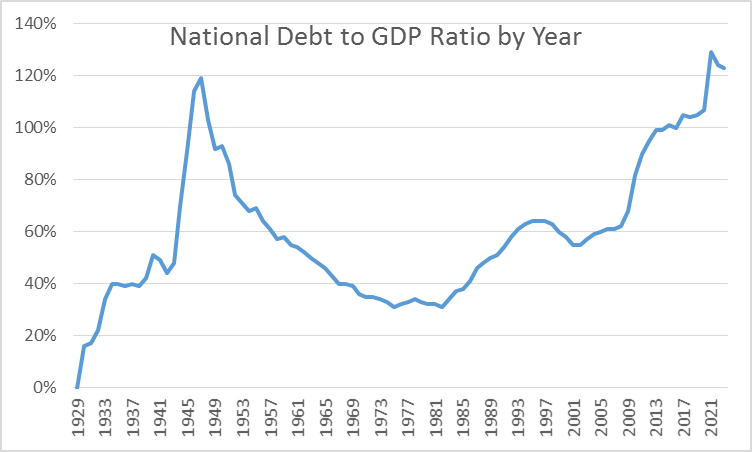
END OF FISCAL YEAR DEBT (IN BILLIONS, ROUNDED) DEBT-TO-GDP RATIO MAJOR EVENTS BY PRESIDENTIAL TERM 1929 $17 16% Market crash 1930 $16 17% Smoot-Hawley reduced trade 1931 $17 22% Dust Bowl drought raged 1932 $20 34% Hoover raised taxes 1933 $23 40% New Deal increased GDP and debt 1934 $27 40% 1935 $29 39% Social Security 1936 $34 40% Tax hikes renewed depression 1937 $36 39% Third New Deal 1938 $37 42% Dust Bowl ended 1939 $40 51% Depression ended 1940 $43 49% FDR increased spending and raised taxes 1941 $49 44% U.S. entered WWII 1942 $72 48% Defense tripled 1943 $137 70% 1944 $201 91% Bretton Woods 1945 $259 114% WWII ended 1946 $269 119% Truman’s 1st term budgets and recession 1947 $258 103% Cold War 1948 $252 92% Recession 1949 $253 93% Recession 1950 $257 86% Korean War boosted growth and debt 1951 $255 74% 1952 $259 71% 1953 $266 68% Recession when war ended 1954 $271 69% Eisenhower’s budgets and Recession 1955 $274 64% 1956 $273 61% 1957 $271 57% Recession 1958 $276 58% Eisenhower’s 2nd term and recession 1959 $285 55% Fed raised rates 1960 $286 54% Recession 1961 $289 52% Bay of Pigs 1962 $298 50% JFK budgets and Cuban missile crisis 1963 $306 48% U.S. aids Vietnam, JFK killed 1964 $312 46% LBJ’s budgets and war on poverty 1965 $317 43% U.S. entered Vietnam War 1966 $320 40% 1967 $326 40% 1968 $348 39% 1969 $354 36% Nixon took office 1970 $371 35% Recession 1971 $398 35% Wage-price controls 1972 $427 34% Stagflation 1973 $458 33% Nixon ended gold standard and OPEC oil embargo 1974 $475 31% Watergate and budget process created 1975 $533 32% Vietnam War ended 1976 $620 33% Stagflation 1977 $699 34% Stagflation 1978 $772 33% Carter budgets and recession 1979 $827 32% 1980 $908 32% Volcker raised fed rate to 20% 1981 $998 31% Reagan tax cut 1982 $1,142 34% Reagan increased spending 1983 $1,377 37% Jobless rate 10.8% 1984 $1,572 38% Increased defense spending 1985 $1,823 41% 1986 $2,125 46% Reagan lowered taxes 1987 $2,350 48% Market crash 1988 $2,602 50% Fed raised rates 1989 $2,857 51% S&L Crisis 1990 $3,233 54% First Iraq War 1991 $3,665 58% Recession 1992 $4,065 61% 1993 $4,411 63% Omnibus Budget Act 1994 $4,693 64% Clinton budgets 1995 $4,974 64% 1996 $5,225 64% Welfare reform 1997 $5,413 63% 1998 $5,526 60% LTCM crisis and recession 1999 $5,656 58% Glass-Steagall repealed 2000 $5,674 55% Budget surplus 2001 $5,807 55% 9/11 attacks and EGTRRA 2002 $6,228 57% War on Terror 2003 $6,783 59% JGTRRA and Iraq War 2004 $7,379 60% Iraq War 2005 $7,933 61% Bankruptcy Act and Hurricane Katrina. 2006 $8,507 61% Bernanke chaired Fed 2007 $9,008 62% Bank crisis 2008 $10,025 68% Bank bailout and QE 2009 $11,910 82% Bailout cost $250B ARRA added $242B 2010 $13,562 90% ARRA added $400B, payroll tax holiday ended, Obama Tax cuts, ACA, Simpson-Bowles 2011 $14,790 95% Debt crisis, recession and tax cuts reduced revenue 2012 $16,066 99% Fiscal cliff 2013 $16,738 99% Sequester, government shutdown 2014 $17,824 101% QE ended, debt ceiling crisis 2015 $18,151 100% Oil prices fell 2016 $19,573 105% Brexit 2017 $20,245 104% Congress raised the debt ceiling 2018 $21,516 105% Trump tax cuts 2019 $22,719 107% Trade wars 2020 $27,748 129% COVID-19 and 2020 recession 2021 $29,617 124% COVID-19 and American Rescue Plan Act 2022 $30,824 123% Inflation Reduction Act and student loan forgiveness -
What’s the difference between dehydrating food and freeze drying it?
Dehydrating food in a dehydrator or freeze drying it serves the same purpose- to remove moisture. In other words, to desiccate it. Life requires water- remove the water, and the ability for life to grow declines substantially. Sufficient dehydration actually prevents the growth of mold and bacteria. Decay is a biological process and requires living organisms. Prevent life and you prevent decay. This is essentially the principle behind any form of water removal as a means of preserving food.
Freeze Drying and dehydrating are both means of preserving food via desiccation. They differ in a few key respects: Method of desiccation, cost, life expectancy of preserved food, and amount of moisture removed
Dehydrating food, as one might in a modern food dehydrator is an old process. Humans have been doing this for a very long time. Use of the sun (as in a solar dehydrator) requires no electricity. It removes most, though not all, of the moisture from food and can preserve it for many years.
Freeze drying is a more modern process and relies upon the ability to expose food both to extremely cold temperatures and to vacuum. It requires substantially more expensive equipment, but removes more water. Because more water is removed, the food weighs less and is shelf-stable for longer.
-
It is a time when data – information is ever so readily available. A brief internet search turned out the data on presidents elected with less than a majority of the popular vote – and it goes back to John Quincy Adams, 1824, elected with 30.9% of the popular vote and 32.18% of the electoral votes. (Before John Quincy the record I called up shows only electoral vote percentages)
- James Polk – 1844 – elected with 49.5% of the vote.
- Zachary Taylor – 1848 – elected with 47.3%
- James Buchanan – 1856 – elected with 45.3%
- Abraham Lincoln – 1860 – elected with 39.9%. To be fair, in 1864 Abe was reelected with 55% of the vote – but on the third hand 13 Confederate states showed their lack of support with musketry instead of ballots in that election.
- Rutherford B. Hayes – 1876 – 48% of the vote.
- James Garfield – 1880 – 48.3%
- Grover Cleveland – 1884 – 48.5%
- Benjamin Harrison – 1888 – 47.8%
- Grover Cleveland – 1892 – 46.1%
- Woodrow Wilson – 1912 – 41.8%
- Woodrow Wilson – 1916 – 49.2%
- Harry Truman – 1948 – 49.4%
- John F. Kennedy – 1960 – 49.7%
- Richard Nixon – 1968 – 43.4%
- Bill Clinton – 1992 – 43%
- Bill Clinton – 1996 – 49.2%
- George Bush – 2000 – 47.9%
- Donald Trump – 2016 – 46%
Interesting. If I had stopped to think about it, it was kind of obvious that Lincoln had to be our least popular president – after all, 13 states seceded when he was elected.
-
At this time of year I point at least one camera towards the ponds. I hope to capture pictures of the goose families to get an accurate count of goslings. I have 3 separate hatches of goslings, Plus I plan on pictures of the ducks and duckling to aid in species ID and duckling count. I have a bufflehead with ducklings, and a cinnamon teal with a row of ducklings closely following her, After 5 years of wind, rain, snow, and deer mishaps, my camera had blank pictures. This camera is barely functional. I have lost all ability to program it. When it takes pictures, it takes clear pictures.
I thought I’d better bring the camera in to dry with the hope that would return the camera to its barely functional state. I happened to glance at the lens to find a spider had cached her food on the camera lens and in and around other dry places. After cleaning the lens and cleaning the food cache the camera is back on the job. There is a first time for everything.

Date and time are not accurate. What I have seen on the other game cameras include deer (of course), turkeys, ravens, skunks, raccoons, coyotes, and feral cats. Nothing out of the ordinary.
-Patches
-
When I was still an undergraduate – tutoring statistics in dormitory poker games – noted butterfly expert Paul Ehrlich was explaining his expertise in demography and environmental change. To be fair, when I first read Malthus on population, like Paul, I was pretty well impressed – but I was 13 at the time.
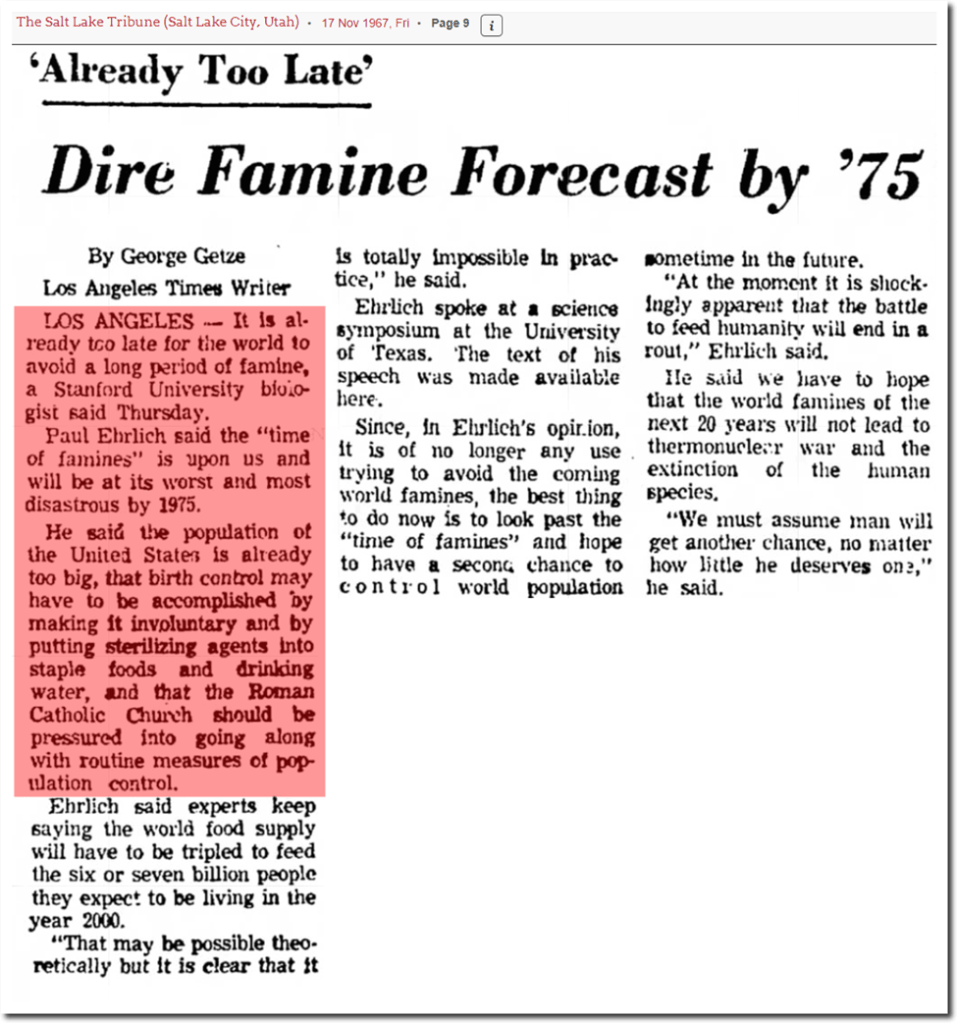
1975 was pretty good – I was beginning my career as a conservationist, surveying for irrigation projects and spending winters on snow surveys – the government was paying for the snowmobiles and life was good.
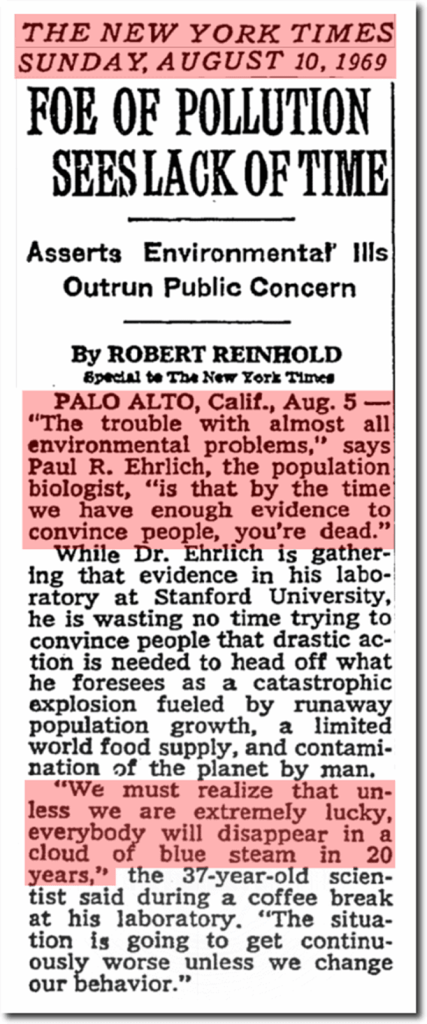
Paul made it into the New York Times in 1969 – as a sophomore, I was just beginning to look at demographic transition theory. I must have been extremely fortunate, since I didn’t disappear in a cloud of blue steam.
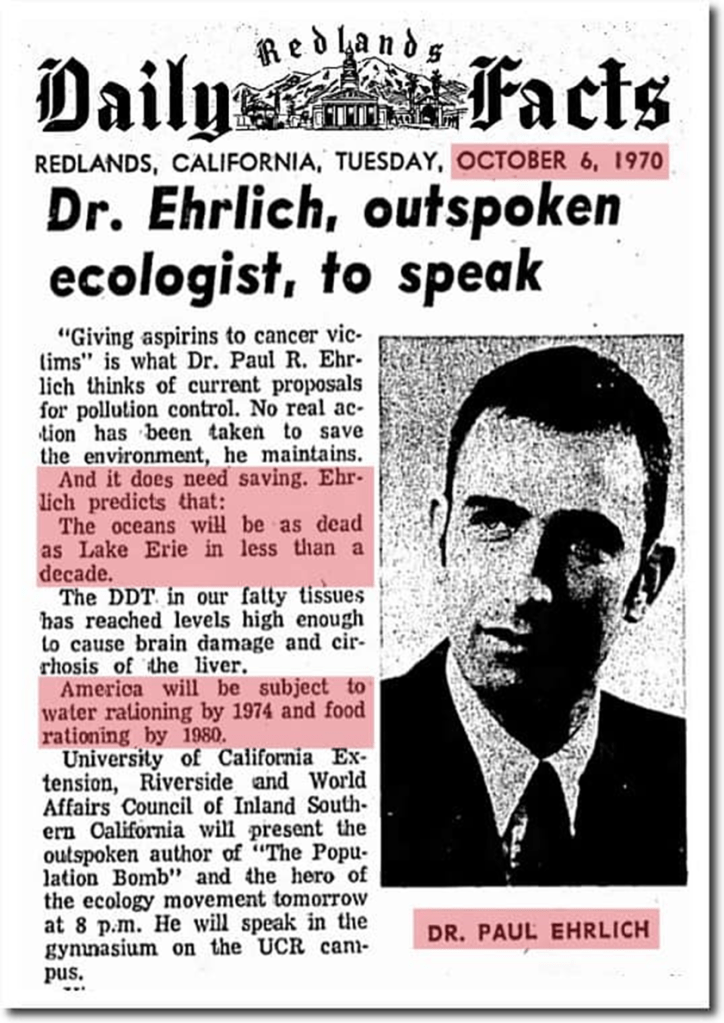
I missed the food rationing Paul was predicting for 1980 – and it hasn’t showed up in the grocery stores I frequent (I will admit to running across unofficial toilet paper rationing in the covid irrationality, but that isn’t the same thing).
George Kukla was predicting an ice age in 1974 – while I spent most of that decade on snow surveys, the ice age never made it into my neighborhood . . . I actually measured record lows. This clip is from Time magazine.
-
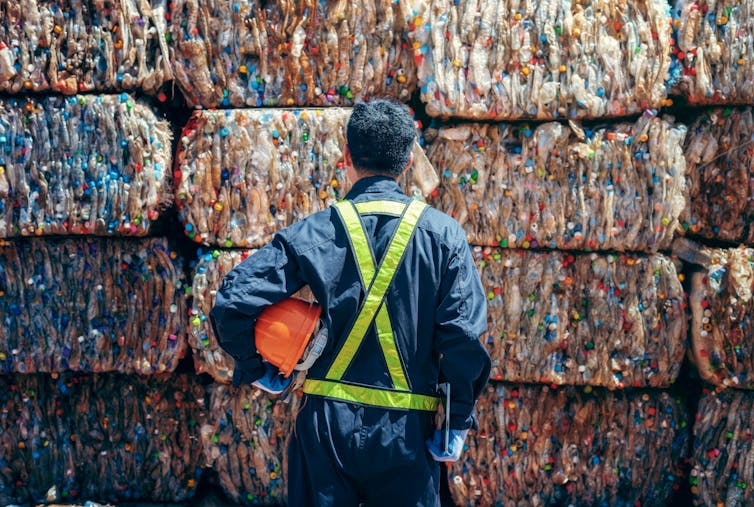
3 little-known reasons why plastic recycling could actually make things worse
Chanchai Phetdikhai, Shutterstock Pascal Scherrer, Southern Cross University
This week in Paris, negotiators from around the world are convening for a United Nations meeting. They will tackle a thorny problem: finding a globally binding solution for plastic pollution.
Of the staggering 460 million tonnes of plastic used globally in 2019 alone, much is used only once and thrown away. About 40% of plastic waste comes from packaging. Almost two-thirds of plastic waste comes from items with lifetimes of less than five years.
The plastic waste that escapes into nature persists and breaks up into smaller and smaller pieces, eventually becoming microplastics. Plastics now contaminate virtually every environment, from mountain peaks to oceans. Plastic has entered vital systems such as our food chain and even the human blood stream.
Governments and industry increasingly acknowledge the urgent need to reduce plastic pollution. They are introducing rules and incentives to help businesses stop using single-use plastics while also encouraging collection and recycling.
As a sustainability researcher, I explore opportunities to reduce plastic waste in sectors such as tourism, hospitality and meat production. I know how quickly we could make big changes. But I’ve also seen how quick-fix solutions can create complex future problems. So we must proceed with caution.
Plastic avoidance is top priority
We must urgently eliminate waste and build a so-called “circular economy”. For plastics, that means reuse or recycling back into the same type of plastic, not lower grade plastic. The plastic can be used to make similar products that then can be recycled again and again.
This means plastics should only be used where they can be captured at their end of life and recycled into a product of the same or higher value, with as little loss as possible.
Probably the only example of this to date is the recycling of PET (polyethylene terephthalate) soft-drink bottles in Norway and Switzerland. They boast recovery rates of 97% and 95% respectively.
The waste management pyramid below shows how to prioritise actions to lessen the waste problem. It is particularly relevant to single-use plastics. Our top priority, demanding the biggest investment, is prevention and reduction through redesign of products.
Where elimination is not yet achievable, reuse solutions or recycling to the same or higher-level products can be sought to make plastics circular.
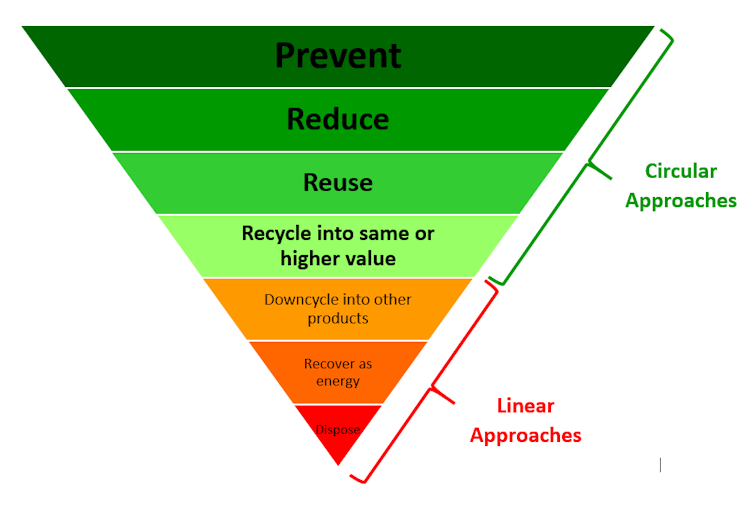
In the inverted pyramid of waste management priorities, downcycling is almost the last resort. Pascal Scherrer Unfortunately, a lack of high-quality reprocessing facilities means plastic waste keeps growing. In Australia, plastic is largely “downcycled”, which means it is recycled into lower quality plastics.
This can seem like an attractive way to deal with waste-plastic stockpiles, particularly after the recent collapse of soft-plastics recycler RedCycle. But downcycling risks doing more harm than good. Here are three reasons why:
1. Replacing wood with recycled plastics risks contaminating our wildest natural spaces
An increasing number of benches, tables, bollards and boardwalks are being made from recycled plastic. This shift away from timber is touted as a sustainable step – but caution is warranted when introducing these products to pristine areas such as national parks.
Wood is naturally present in those areas. It has a proven record of longevity and, when degrading, does not introduce foreign matter into the natural system.
Swapping wood for plastic may introduce microplastics into the few remaining places relatively free of them. Replacing wood with downcycled plastics also risks plastic pollution through weathering or fire.
2. Taking circular plastics from their closed loop to meet recycled-content targets creates more waste
Clear PET bottles used for beverages are the most circular plastic stream in Australia, approaching a 70% recovery rate. When these bottles are recycled back into clear PET bottles, they are circular plastics.
However, the used PET bottles are increasingly being turned into meat trays, berry punnets and mayonnaise jars to help producers meet the 2025 National Packaging Target of 50% recycled content (on average) in packaging.
The problem is the current industry specifications for plastics recovery allow only downcycling of these trays, punnets and jars. This means that circular PET is removed from a closed loop into a lower-grade recovery stream. This leads to non-circular downcycling and more plastic sent to landfill.
3. Using “compostable” plastics in non-compostable conditions creates still more plastic pollution
Increasingly, plastics are labelled as compostable and biodegradable. However, well-intended use of compostable plastics can cause long-term plastic pollution.
At the right temperature with the right amount of moisture, compostable plastics breakdown into soil. But if the conditions are not “just right”, they won’t break down at all.
For example, when a landscape architect or engineer uses a “compostable” synthetic fabric instead of a natural alternative (such as coir or jute mats) they can inadvertently introduce persistent plastics into the environment. This is because the temperature is not hot enough for the synthetic mat to break down.
We must also differentiate between “home compostable” and “commercially compostable”. Commercial facilities are more effective at composting because they operate under more closely controlled conditions.
Learning from our mistakes
Clearly, we need to reduce our reliance on plastics and shift away from linear systems – including recycling into lower-grade products.
Such downcycling may have a temporary role in dealing with existing plastic in the system while circular recycling capacity is being built. But we must not develop downcycling “solutions” that need a long-term stream of plastic waste to remain viable.
What’s more, downcycling requires constantly finding new markets for their lower-grade products. Circular systems are more robust.
So, to the negotiators in Paris, yes the shift to a circular plastics economy is urgent. But beware of good intentions that could ultimately make things worse.
Pascal Scherrer, Senior Lecturer, Faculty of Business, Law and Art, Southern Cross University
This article is republished from The Conversation under a Creative Commons license. Read the original article.
Want to tell us something or ask a question? Get in touch.

Recent Posts
- The Quality of Numbers
- Robert Treat Payne Had Traveled To Greenland
- 75 Years Ago in New York
- Recovery Time for a Retiree
- Venn Diagram and DSM
- When Castro Was Cool
- You Have To Beat Darwin Every Day
- Computer Repair by Mussolini
- Getting Alberta Oil to Market
- Parties On Economics
- Thus Spake Zarathustra – One More Time
- Suspenders
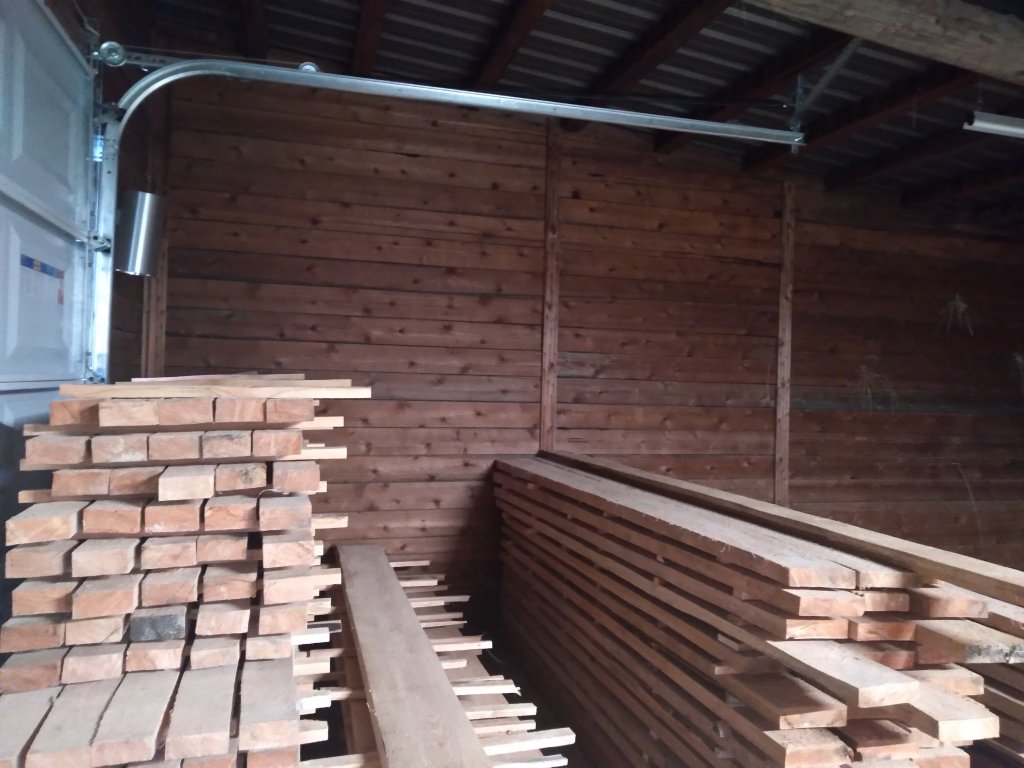
Rough Cut Lumber
Harvested as part of thinning to reduce fire danger.
$0.75 per board foot.
Call Mike (406-882-4835) or Sam (406-882-4597)
Popular Posts
Ask The Entomologist Bears Books Canada Census Community Decay Covid Covid-19 Data Deer Demography Education Elections family Firearms Game Cameras Geese Government Guns History Inflation life Lincoln County Board of Health Lincoln County MT Lincoln Electric Cooperative Montana nature News Patches' Pieces Pest Control Politics Pond Recipe School School Board Snow Taxes Teaching travel Trego Trego Montana Trego School Weather Wildlife writing
 Trego's Mountain Ear