-
In hospital settings, many things are used and discarded. Linens are generally washed, but the syringe we fed my baby from, once, is discarded. Gloves? Discarded, often. There’s a movement to shift away from single-use plastics, indeed, single-use items in general.
It’s intuitive. If we don’t just use things once and throw them away, of course it’s better. Less wasteful, better for the environment, more energy and cost efficient.
But it’s a tradeoff. Reusing items allows a greater risk of infection, because sanitization procedures (especially those we can do at home in the kitchen sink rather than with, say, an autoclave) are imperfect. My reusable grocery store bag is more likely to vector germs to my food than a plastic one. My reusable straw is more likely to still contain mold or other ickiness from the last time I used it for a smoothie and didn’t quite get it cleaned out fully.
Reusuable items are more likely to vector dirt or disease than single-use items. The trade-offs between the two are obvious, so the question becomes one of risk and of priority. How high is the likelihood of dirt and disease causing illness and how important is it to reduce plastic waste?
-
The Trego Fortine Striker (TFS) Volunteer Fire Department has benefited from several fundraisers in the last week (a contra dance at the hall on Friday, and axe throwing at Jerry’s on Sunday) and has another large one coming up.
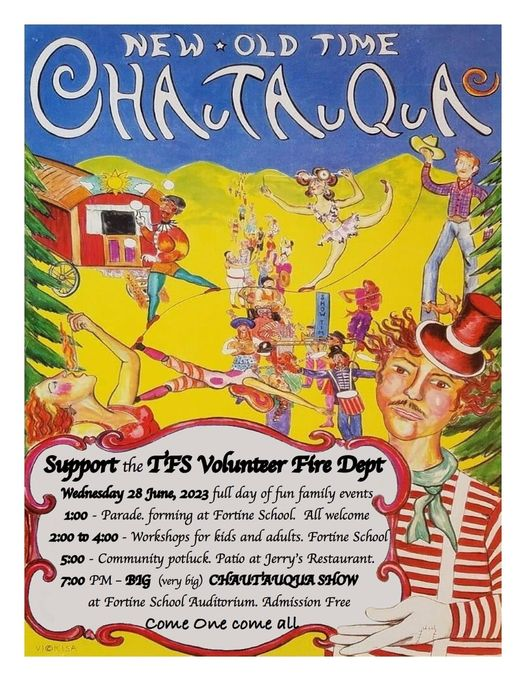
Next Wednesday’s event, Chautauqua Extravaganza, takes place in Fortine. It’s really a series of events- first, a parade, then workshops (at the school– including one that’s teaching juggling), a potluck at Jerry’s, and finally concluding with a Variety Show at 7 pm in the Fortine School auditorium. The event is free, while collecting donations for the TFS Fire Department.
There are two opportunities to see the show. The first, (in miniature) is on Sunday. This time, donations go to support the Trego School Music Program.

(June 25th- there is a typo) -
One of the blessings of research is that it can change perspective. I’m accustomed to seeing organized crime as crime. Luigi Belletta and Andrea Levezzi, in their paper “The economics of extortion: Theory and the case of the Sicilian Mafia” provide that different perspective.
The abstract:
“This paper studies extortion of firms operating in legal sectors by a profit-maximizing criminal organization. We develop a simple taxation model under asymmetric information to find the Mafia optimal extortion as a function of firms’ observable characteristics, namely size and sector. We test the predictions of the model on a unique dataset on extortion in Sicily, the Italian region where the Sicilian Mafia, one of the most ancient criminal organizations, operates. In line with our theoretical model, our empirical findings show that extortion is strongly concave with respect to firm size and highly regressive. The percentage of profits appropriated by the Mafia ranges from 40% for small firms to 2% for large enterprises. We derive some implications of these findings for market structure and economic development.”
In their study, they describe the Mafia as a “source of extra-legal governance”. This paragraph excerpts parts, but not all of the study:
“Being a provider of extra-legal governance, Mafias implement their own taxation system. In particular they impose extortion, i.e. the forced extraction of resources, on firms operating in legitimate sectors, under the threat of punishment for non-compliance. In this paper we provide a theoretical and empirical analysis of extortion based on a unique dataset of first-quality data on the exact amounts of pizzo paid by a sample of Sicilian firms, matched with data from their financial statements. Our aim is to understand how Mafia establishes the amount of money that businesses are forced to pay on the basis of their characteristics, namely size, and how this relationship varies by sector. In particular, we identify the stylized facts of the relationship between pizzo and firm size and sector and then show that they can be accounted for by a taxation model in which the criminal organization cannot perfectly observe firms’ productivity. The main empirical implication of our model, which we test using our dataset, is a concave relationship between firm size and the amount of pizzo paid.”
I guess it’s a question of how legitimate the government is, or at least the perception of legitimacy. As I think back to the history of Rome, at the time the new testament was written, it seems to me that there were a bunch of people in Palestine who didn’t consider Rome their legitimate government. Besides – the folks I know who supported Trump tend to figure Biden isn’t legitimate, and the folks who are happy with Biden don’t seem to figure Trump was ever legitimate. I’m thinking that obeying the laws may not be an important part of a government’s legitimacy.
Take the time to read the article at Science Direct
-
Missing Titanic sub: what are submersibles, how do they communicate, and what may have gone wrong?

OceanGate Stefan B. Williams, University of Sydney
An extensive search and rescue operation is underway to locate a commercial submersible that went missing during a dive to the Titanic shipwreck.
According to the US Coast Guard, contact with the submersible was lost about one hour and 45 minutes into the dive, with five people onboard. The vessel was reported overdue at 9.13pm local time on Sunday (12.13pm AEST, Monday).
The expedition was being run by US company OceanGate as part of an eight-day trip with guests paying US$250,000 per head to visit the wreck site. As of Monday afternoon (Tuesday morning in Australia), US Coast Guard Rear Admiral John Mauger said the watercraft likely had somewhere between 70 and the full 96 hours of oxygen available to the passengers.
The Titanic’s wreck sits some 3,800 metres deep in the Atlantic, about 700km south of St John’s, Newfoundland. Finding an underwater vehicle the size of a small bus in this vast and remote expanse of ocean will be no small feat. Here’s what the search and rescue teams are up against.
OceanGate’s Titan submersible goes missing
Submersibles are manned watercraft that move in a similar fashion to submarines, but within a much more limited range. They’re often used for research and exploration purposes, including to search for shipwrecks and to document underwater environments. Unlike submarines, they usually have a viewport to allow passengers look outside, and outside cameras that provide a broader view around the submersible.
The missing submersible in question is an OceanGate Titan watercraft, which can take five people to depths of up to 4,000m. The Titan is about 22 feet in length, with speeds of about 3 knots, or 5.5km per hour. Although submersibles are often connected to a surface vessel by a tether, video and photos suggest the Titan was likely operating independently of the surface ship.
According to OceanGate’s website, the Titan is used “for site survey and inspection, research and data collection, film and media production, and deep-sea testing of hardware and software”.
It also has a “real-time hull health monitoring (RTM) system”. This would likely include strain gauges to monitor the health of the Titan’s carbon fibre hull. A strain gauge is a kind of sensor that can measure applied force and small deformations in material resulting from changes in pressure, tension and weight.
The Titan’s carbon fibre hull connects two domes made of composite titanium – a material that can withstand deep-sea pressures. At 3,800m below sea level (the depth of the Titanic) you can expect pressures about 380 times greater than the atmospheric pressure we’re used to on the surface of the earth.

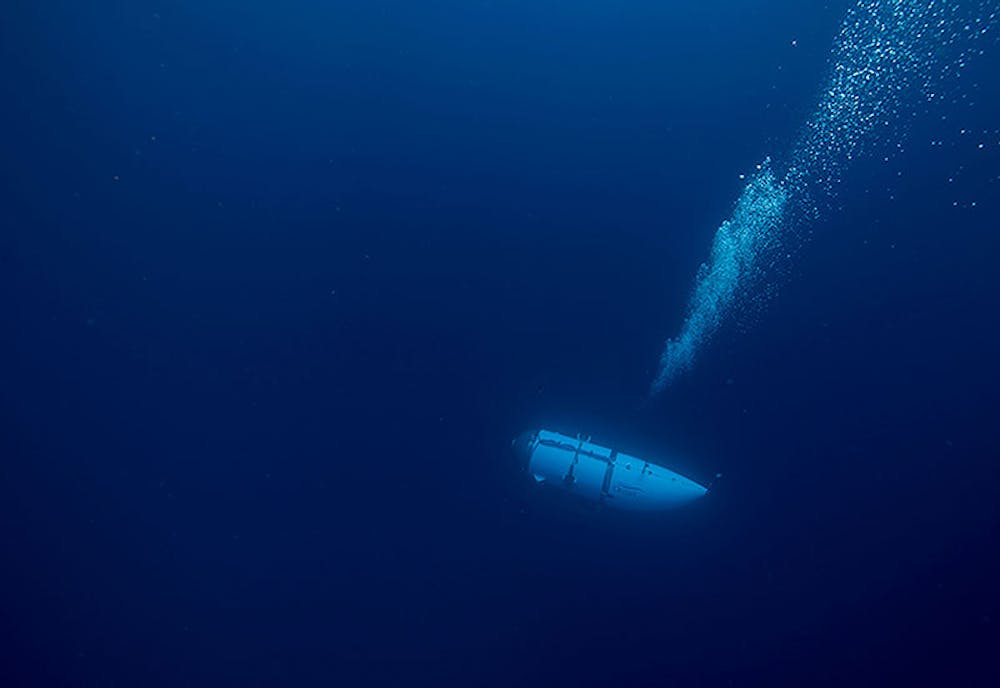
Titan on the launch platform underwater, awaiting a signal to commence the dive. OceanGate Communication and rescue efforts
The Titan would have had an acoustic link with its surface vessel, set up through a transponder (a device for receiving a sonar signal) on its end, and a transceiver (a device that can both transmit and receive communications) on the surface vessel.
This link allows for underwater acoustic positioning, as well as for short text messages to be sent back and forth to the surface vessel – but the amount of data that can be shared is limited and usually includes basic telemetry and status information.
The Titan is a battery-operated watercraft. Given it has lost all contact with its surface vessel, it may have suffered a power failure. Ideally, there would be an emergency backup power source (such as an independent battery) to maintain emergency and life support equipment – but it’s unclear if the missing vessel had any power backup on hand.
According to reports, at least two aircraft, a submarine and sonar buoys were being used to search for the vessel. The sonar buoys will be listening for underwater noise, including any emergency distress beacons that may have gone off.
One of the major challenges in the rescue effort will be contending with weather conditions, which will further shrink an already narrow search window.

Titan commencing a dive to 4,000m underwater. OceanGate What might have happened?
In a best case scenario, the Titan may have lost power and will have an inbuilt safety system that will help it return to the surface. For instance, it may be equipped with additional weights that can be dropped to instantly increase its buoyancy and bring it back to the surface.
Alternatively, the vessel may have lost power and ended up at the bottom of the ocean. This would be a more problematic outcome.
The worst case scenario is that it has suffered a catastrophic failure to its pressure housing. Although the Titan’s composite hull is built to withstand intense deep-sea pressures, any defect in its shape or build could compromise its integrity – in which case there’s a risk of implosion.
Another possibility is that there may have been a fire onboard, such as from an electrical short circuit. This could compromise the vehicle’s electronic systems which are used for navigation and control of the vessel. Fires are a disastrous event in enclosed underwater environments, and can potentially incapacitate the crew and passengers.
Time is of the essence. The search and rescue teams will need to find the vessel before its limited supplies of oxygen and water run out.
There’s an ongoing debate in scientific circles regarding the relative merit of manned submersibles, wherein each deployment incurs a safety risk – and the safety of the crew and passengers is paramount.
Currently, most underwater research and offshore industrial work is conducted using unmanned and robotic vehicles. A loss to one of these vehicles might compromise the work being done, but at least lives aren’t at stake. In light of these events, there will likely be intense discussion about the risks associated with using these systems to support deep-sea tourism.
Stefan B. Williams, Professor, Australian Centre for Field Robotics, University of Sydney
This article is republished from The Conversation under a Creative Commons license. Read the original article.
-
My copy of Cartridges of the World is the 9th edition – published in 2000. For every surviving cartridge (particularly in rimfire) there are many that did not survive – the book lists them as current. The first obsolete cartridge I find is the 5mm Remington Rimfire Magnum – and it came out in 1970 – it’s younger than I am. It’s also still available – Aguila turns these cartridges out in Mexico and they are available online.

The next obsolete cartridge is the 22 Short – 40 grain . . . but Aguila (Mexico) now turns out their 22 subsonic sniper – a 22 short case with a 60 grain bullet. This is the cartridge that feeds my Smith & Wesson jamamatic (Escort) with awesome reliability.
The old 22 Extra Long is listed as obsolete – but anything chambered for the Extra Long can still be used with the 22 long rifle cartridge – the 22 Extra Long is long obsolete, but the old rifles can still be used.


Then we come to the 22 Winchester Rimfire (22 WRF). It’s listed as obsolete – but Winchester kept coming up with an occasional run of ammunition that kept my old (model 1906) rifle fed, and now CCI produced 22 WRF is usually available. It does cost about a quarter per round – but given that my old Winchester won’t take anything else, the rifle is still useful. It did go through about 30 years of limited use as I hoarded shells to keep it full.
Fiocchi still produces the 9mm (Flobert) shotshell – but it costs about $1.10 per cartridge, so it’s cheaper to use a 12 gauge – but the cartridge is still in production.

Declaring something obsolete doesn’t always count it out.
-
It’s difficult to select the worst president. I’ve thought that Buchannan, with 13 states seceding on his watch, rated mention – yet the idea of fairness makes me believe his failure may have been that the challenges he faced were too large. Nobody would have taken the job anticipating the Dred Scott decision and John Brown’s raid on Harper’s Ferry. While Buchanan was opposed to slavery, he believed that ten cents/day was a fair wage for the working man – which says something about him – but it doesn’t cinch the title.

Warren Harding is often on the short list – but the narcissism that leads to truly awesome presidential failures wasn’t in him: here are a couple of his quotations that show his lack of narcissism: “I am not fit for this office and should never have been here.” and “I knew that this job would be too much for me.” Harding’s campaign slogan was “a return to normalcy.” I think Biden claimed the same. Come to think about it, Harding was accused of campaigning from his front porch – Biden from his basement. Still, two shared points aren’t enough to make a correlation.

One of Kristofferson’s songs includes the line “sometimes the best that you can do is buy some time ‘til they can find somebody better.” Harding came after Woodrow Wilson. In grade school, I was taught that Woodrow Wilson was a great president – yet as I continued to read, I learned that this former Princeton University president did more to promote racism than any other American president.

Unlike Harding’s humility, Wilson entered the presidency with this quotation: “Remember that God ordained that I should be the next president of the United States. Neither you nor any other mortal or mortals could have prevented this.” Now that sounds a little narcissistic to me – but it may just be that I’ve never been an attorney or a political scientist.
The Libertarian Republic offers what the author considers Woodrow Wilson’s top ten racist quotations. They’re bad. This link provides a fairly objective story of his presidential accomplishments – including this statement: “Wilson’s progressive agenda did not apply to all Americans, however. During his first term, he oversaw the re-segregation of many branches of the federal workforce, including the Treasury, the Post Office, the Bureau of Engraving and Printing, the Navy, the Interior, the Marine Hospital, the War Department and the Government Printing Office. The action reversed hard-fought economic progress made by Black Americans since Reconstruction.”
Woodrow won the Nobel Peace Prize – an interesting award for a man whose second campaign had the slogan “He kept us out of war.” yet broke off diplomatic relations with Germany on February 3, 1917. Academics tend to rate Wilson highly – but Wilson was an Academic, and his progressive, internationalist approach fit well in the academy.
Four US Presidents have won the Nobel Peace Prize. Only one is on Mount Rushmore. It isn’t Woody. It took the country about fifty years to find a philosophical successor to Jefferson Davis – and maybe Woodrow isn’t so bad if you compare his accomplishments with Confederate presidents.
-
I heard the story of Adolf Metzger when I was young – but it is only recently I encountered photographs of his bugle – discovered about 20 years after bugler Metzger wound up using it as his weapon at the Fetterman massacre (or, in Lakota terms, the battle of a hundred in the hand). I’ve read the story of Metzger’s death in histories, and heard the tale from Lakota – the versions have few discrepancies, though the Lakota version has more details.
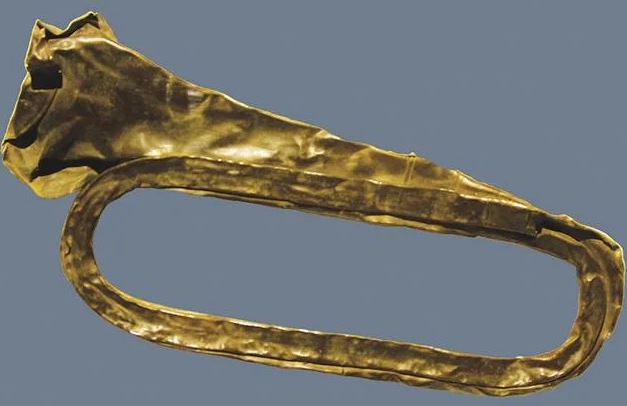
The Lakota story of the Fetterman fight describes Metzger riding in armed only with a “noisemaker” (his bugle) – and describes his role in the battle as seen through native eyes. His conduct was viewed as the only soldier who was there to essentially “count coup.” The story at Buffalo Bulletin includes
“The story of the bugle begins in November 1866, when 32-year-old Metzger traveled with the other members of Company C of the 2nd U.S. Calvary to the recently completed Fort Phil Kearny.
Tensions were high upon his arrival as U.S. troops and Native American forces had been fighting in the area for months.
On Dec. 21, a wood train going up to what is now Story was attacked by native forces. Those on the train signaled for reinforcements, which were sent out under the guidance of Captain William Fetterman.
Native American decoy riders lured the troops over the ridge just north of the fort. There they were met by more than 1,000 Cheyenne, Lakota and Arapaho warriors. The troops were out of sight of the fort and were quickly killed by native forces.
As the bugler, Metzger was responsible for directing troop movement after he was given a command.
“He would have, to all of our knowledge, been unarmed,” Bruner said. “It’s unfortunate that he wasn’t armed, but unless he could have afforded it on his own, he wouldn’t have been issued a weapon by the military.”
Legend has it that Metzger fought for survival using only his bugle. This courage in the face of staggering odds is likely what earned Metzger the respect of the Native Americans, Bruner said.
While Metzger and all 81 men under Fetterman’s command were killed during the fight, the bugle lived on – abandoned on the battlefield before being discovered by early Johnson County rancher Christian Hepp in 1887.
The bugle first joined the museum’s collection when it was given to museum namesake Jim Gatchell in the early 1950s. Whether Gatchell received the instrument from Hepp or some other mystery middleman is unknown although there is evidence of communications and transactions between Gatchell and Hepp.”
History Net offers these comments:
“In the wake of the Civil War, the federal government ignored a standing treaty with the Sioux—still a sovereign nation in 1866—and built three forts along the Bozeman Trail, which led to the Montana goldfields. In response, the Sioux, Northern Cheyennes and Arapahos besieged the forts. This was Red Cloud’s War—the only successful Indian campaign in the West, and the war in which Adolph Metzger became famous, however briefly, as the bravest of the brave.
Fort Phil Kearny, DakotaTerritory (in the part that would become Wyoming) was manned by a mixed detachment of the 18th U.S. Infantry and the 2nd Cavalry, including Metzger’s Company C. Commanding the post was Colonel Henry Carrington, a Yale graduate who had spent the Civil War as an administrative officer and had never seen combat. Among Carrington’s subordinates was Captain William Fetterman, a Civil War combat veteran who was unimpressed with the Lakotas, although he might not have actually said, “With 80 men, I could ride through the whole Sioux Nation.” On December 6, 1866, Lieutenant Horatio Bingham and Sergeant Gideon Bowers were killed when they pursued Lakota decoys into an ambush. The other troopers, including Metzger, barely escaped with their lives after Carrington encountered the self-possessed bugler and told him to blow recall.
Following this incident, the colonel apparently warned Fetterman never to pursue Indians out of sight of the fort. Then, around noon on December 21, Indians attacked a party of woodcutters not far from the fort. Fetterman set out with two other officers, 27 men of the 2nd Cavalry, 49 men of the 18th Infantry and two civilian scouts, James Wheatley and Isaac Fisher. The latter two had served in the Civil War and wanted to try out their new 16-shot Henry repeating rifles. As Fetterman’s foot soldiers followed his horsemen over Lodge Trail Ridge, at least 1,500 warriors rose from the snow-filled gullies and attacked.
Wheatley and Fisher with their repeaters and a half-dozen troopers with seven-shot Spencer carbines forted up in some rocks and hit an estimated 60 Indians or horses before being overwhelmed and literally cut to pieces. The 49 infantrymen died next. The Indians rushed in as soon as they saw the flashing ramrods of their single-shot Springfield muskets, and they clubbed or slashed the soldiers to death. Fetterman and his second-in-command, Captain Frederick Brown, did not place revolvers to one another’s temples and commit double suicide, though Brown might have shot himself. Many soldiers died cringing and piled in a heap while the Indians hacked at them.
Not Adolph Metzger. As the cavalrymen around him fell amid showers of arrows —40,000 according to one estimate— Metzger kept firing his seven-shot Spencer until he ran out of ammunition. As the Indians closed in, he used his bugle as a club, hitting several Indians over the head until the bugle was a twisted piece of brass. Wounded a dozen times, Metzger collapsed and died.The Sioux, instead of carving him up, cut a simple cross on his chest to indicate he had died facing the enemy and then covered his body in a buffalo robe as if he were sleeping. “His heroism had aroused the admiration of the savages,” Finn Burnett, a civilian at the post, said later. “They had covered his corpse with a buffalo robe as a symbol of extreme respect.”
At the time of the ambush, the Lakotas were mostly armed with bows and arrows and remained leery of the Army’s firepower. They had taken the precaution of having a hermaphrodite ritually curse the ambush site, zigzagging around with a black blanket over his/her head until envisioning 100 dead soldiers—and no survivors. Hermaphrodites, said to control life and death because they had two sets of genitals, garnered unwavering respect among the Lakotas. Nobody and nothing could be spared; the Indians even killed the soldiers’ pet dog, though one of them later said, “He looked so sweet.” The only survivor was Dapple Dave, an Army horse so badly wounded he had to be shot.
The Fetterman Fight was the worst defeat the Plains Indians handed the Army until Custer’s Last Stand, 10 years later. Metzger’s courage became frontier legend; it was later resurrected by Dee Brown in Fort Phil Kearny: An American Saga in 1962 and Evan S. Connell in Son of the Morning Star in 1984. In Lakota tradition, the German bugler remains among the bravest of the brave.”
My guess is that there was no hermaphrodite present – among the Lakota, a berdache was called a winkte, and those individuals had kind of a special spot. Still, the description is close enough that it almost fits the culture and the story. After all, it’s the west – and when the facts don’t match the legend, print the legend.
-
Mary Louise Peters had an interesting visitor recently- the Governor stopped by to present the Spirit of Montana Award. Previous award winners include a police department (Lewistown), a “sewing and vaccuum” company from eastern Montana, a fire department rescue team, several high school students, a construction crew and a basketball coach, among others.
But go on- read the article. It’s a rare thing when Mary Louise consents to a photograph in the news.
-
The ability to fight fire effectively is based on substitution of technology for human muscle power. A bucket brigade takes a lot more people and moves less water than a pumper.
National Humanities Center describes how, in 1880, the Census included fires – now we’d call them incidents – and provides this map:

Causes of fires (1880, U.S):
- Clearing land 1,152
- Lightning 32
- Hunters 628
- Prairie 12
- Locomotives 508
- Prospectors 10
- Malice 262
- Coal Pits 9
- Improving Pasturage 197
- Woodcutters 3
- Camp Fires 72
- Carelessness 3
- Indians 56
- Travelers 2
- Smokers 35
- Spontaneous Combustion 2
The article begins with this paragraph:
“For the 1880 census, Charles Sargent mapped forest fires. Fire was nearly everywhere, some places more vigorously than others. The amount of burning was, by today’s standards, staggering. A developing nation, still primarily agricultural, the United States had a fire-flushed landscape not unlike those of Brazil and Indonesia in more recent decades. While lightning accounted for some ignition, and steam power (notably locomotives) for a growing fraction, the principal sources of fire were people—people burning for hunting, for traditional foraging, for landclearing, for clearing field fallow, for pasturage, for the ecological equivalent of housecleaning. And of course there was a significant amount of sheer fire littering. Where spark met large caches of combustibles (as around logged sites), horrific fires, implacable as hurricanes, broke out. The idea that one might abolish fire seemed quixotic, in fact, dangerous. Without fire most lands were uninhabitable. Free-burning fires came and went with the seasons, as unstoppable as the movement of the sun across the heavens. Right-thinking conservationists, as good Progressives, argued for government intervention to stop them.”
Another Section seems worth including:
“The railroads of the country, using in the construction and maintenance of their permanent ways vast quantities of timber, inflict far greater injury upon the forests than is represented by the consumption of material. Railway ties, except in California, are almost invariably cut from vigorous young trees from 10 to 12 inches in diameter; that is, from trees which twenty or thirty years ago escaped destruction by fire or browsing animals, and which, if allowed to grow, would at the end of fifty or one hundred years longer afford immense quantities of valuable timber. The railroads of the United States, old and new, consume every year not far from 60,000,000 ties; the quantity of lumber in 60,000,000 ties is comparatively not very great, and would hardly be missed from our forests; but the destruction of 30,000,000 vigorous young trees, supposing that an average of two ties is cut from each tree, is a serious drain upon the forest wealth of the country and should cause grave apprehensions for the future, especially in view of the fact that in every part of the country there are now growing fewer seedling trees of species valuable for railway ties than when the trees now cut for this purpose first started.
The author ends with “Curiously, the problem of industrial fire as a landscape force has not been systematically examined, save the issue of fossil-fuel combustion as a contributor of greenhouse gases. Yet the controlled combustion of fossil biomass is rewriting the Earth’s landscapes wholesale. (Just think of automobiles and how they have refashioned scenes, for beginners.) Until the study of fire acquires a disciplinary standing, however, these questions are unlikely to become the theme of coherent discourse.”
So why did I become interested? That’s easy to explain. A few days after I graduated from high school I took a job on the fire crew at Grand Canyon’s North Rim. I returned for fifteen seasons, and then helped write fire plans at other parks for three summers more. Meanwhile I studied in the humanities, acquiring a Ph.D. in 1976. It finally occurred to me that I ought to apply the techniques of scholarship that I had learned to the subject that most enthralled me. I started what has evolved into a dozen books on fire, six of them organized into a suite—what I call Cycle of Fire—that attempts to survey the history of fire on Earth. When I began on the North Rim, we were called smokechasers. That’s what I still do, chasing smokes, though with a pencil rather than a shovel.”
It’s worth reading.
-
As I read of Ted Kaczynski’s death, my thoughts went back to the many journalists who called me after his arrest. It’s not like Ted had a personal grudge against me (though it turned out I did have friends on his Christmas card list). My screwed up day was basically collateral damage – Ted got busted in Lincoln, Montana. I was a County Extension Agent in Lincoln County, Montana – and there were a hell of a lot of journalists who didn’t know that the town of Lincoln is in Lewis & Clark County. It’s amazing how many journalists let their fingers do the walking for them on the telephone while never considering looking at a map.
I didn’t have anything particularly important planned for those two days in April, 1996 – which was just as well, because telephone calls flooded the county answering machine – and the first phone connection the journalists could get was “Agricultural Extension Agent.” Yeah, the automated directory was alphabetical, and I was first on the list. I spent a couple of days talking with folks from ABC, BBC, CBC . . . ad infitum – each wanting information about Ted. Each got the same answer: “I wouldn’t recognize him if he walked into my office and bit me on the leg. You do know that it’s a five-hour drive to get from Libby to Lincoln? No? You do know that Montana is the fourth largest state? No? Then I guess you don’t know that Lincoln is in Lewis & Clark County? Somebody in Helena might be able to help you but I surely can’t.” By the time the journalists were done calling, I had it down pat – and a quarter century later, the repeated responses are still solid in my memory.
I shared the story with the County Agent in Lewis & Clark – accidentally setting him up, since he actually had met Kaczynski. When the FBI called Larry to investigate his interactions with Kacynski, he thought that it must be another agent pranking him, so he responded with a grossly exaggerated description of Ted . . . eventually hearing “Young man, you may believe you are quite a wit, but I really am with the FBI, and you’re not going to enjoy the experience if you don’t straighten out right now.”
I guess Larry thought it was me pranking him – his last phrase was “He didn’t sound a bit like you.”
Rest in peace, Ted. One’s mind is a terrible thing to lose.

Want to tell us something or ask a question? Get in touch.

Recent Posts
- Robert Treat Payne Had Traveled To Greenland
- 75 Years Ago in New York
- Recovery Time for a Retiree
- Venn Diagram and DSM
- When Castro Was Cool
- You Have To Beat Darwin Every Day
- Computer Repair by Mussolini
- Getting Alberta Oil to Market
- Parties On Economics
- Thus Spake Zarathustra – One More Time
- Suspenders
- You Haven’t Met All The People . . .

Rough Cut Lumber
Harvested as part of thinning to reduce fire danger.
$0.75 per board foot.
Call Mike (406-882-4835) or Sam (406-882-4597)
Popular Posts
Ask The Entomologist Bears Books Canada Census Community Decay Covid Covid-19 Data Deer Demography Education Elections Eureka Montana family Firearms Game Cameras Geese Government Guns History Inflation life Lincoln County Board of Health Lincoln County MT Lincoln Electric Cooperative Montana nature News Patches' Pieces Pest Control Politics Pond Recipe School School Board Snow Taxes travel Trego Trego Montana Trego School Weather Wildlife writing
 Trego's Mountain Ear