-
I noticed this cartoon – and it holds a message that doesn’t come from the typical guidance counselor’s office:
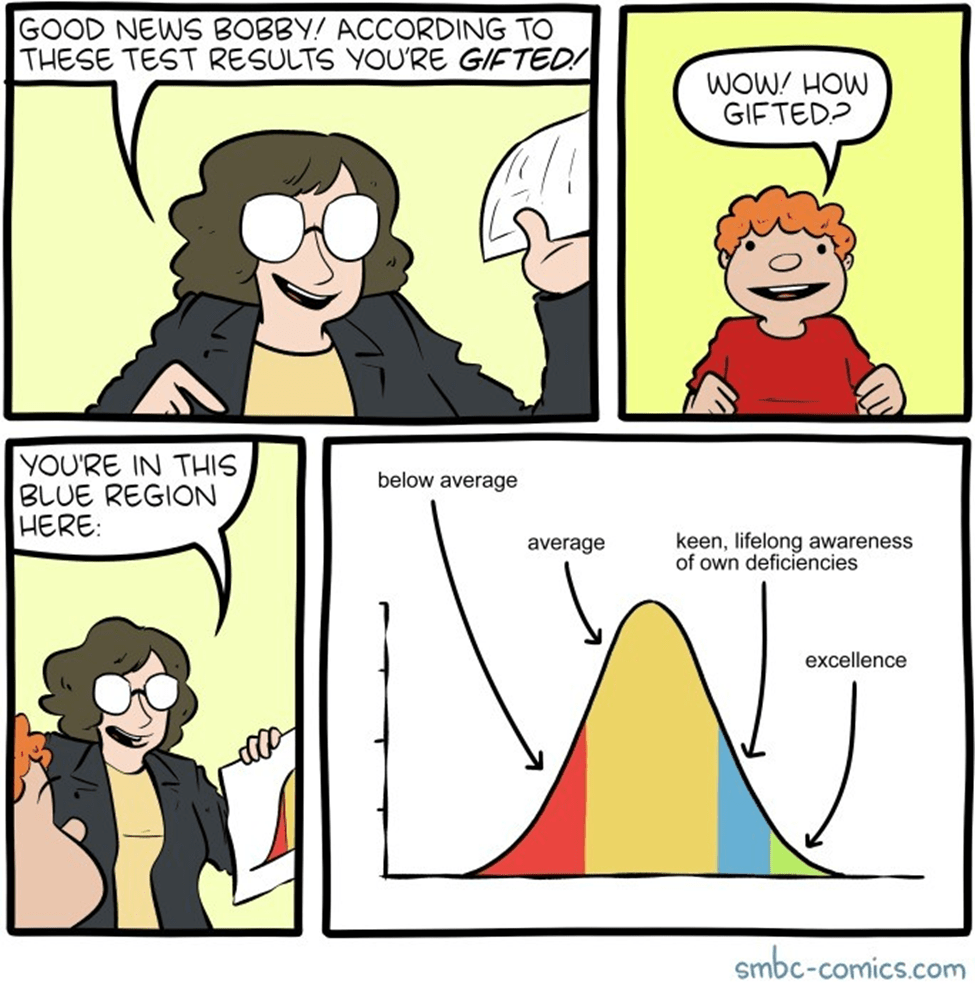
It’s a slightly different way of displaying the bell curves that explain IQ (intelligence, the G factor)

The article describes parts of the author’s life after the brain injuries associated with multiple concussions – “Two standard deviations below the mean is considered to be low IQ or mentally handicapped. We accept that people with low IQ fall outside the norm and may need additional assistance to adapt and be successful in society. Sadly, the same compassion and understanding does not often exist for people more than two standard deviations above the mean. The existence of only “positive” words to describe IQ on the high side is an example of that. A big difficulty for people with high IQs is that they are sorely in the minority. Though there is a long tale to the bell curve it is a narrow one. 96% of all people fall within 30 points of the mean IQ of 100.” Clicking the link takes you to her page, where she discusses her own experiences of high intelligence and traumatic brain injury.
“One of the biggest difficulties for Gifted/Brain Injured adults is that all of our life we have been able to rely on our ability to pick things up quickly, make the thought connections between disparate ideas, multitask, multi-think . . . We relied on it even if we were unaware that we were doing so. Suddenly those abilities have been stripped from us. That is huge. We are completely at a loss how to navigate life. Even with a very mild TBI executive functions involving planning, multitasking, and sequencing are usually compromised. Because the gifted tend to “coast” relying on the enhances abilities, this fall from grace is into an especially deep pit.”
Note the verbal, the grammatical error in the statement, and how they support the situation she describes. Her writings are worth the click and the time it takes to read them.
-
In 1990, the Supreme Court ruled that the National Guard is controlled by the federal government and not an independent state militia. It wasn’t a second amendment case – the governor of Minnesota was objecting to the Minnesota Guard being sent to Central America.
He lost at the Supreme Court –
“Held: Article I’s plain language, read as a whole, establishes that Congress may authorize members of the National Guard of the United States to be ordered to active federal duty for purposes of training outside the United States without either the consent of a state governor or the declaration of a national emergency. Pp. 496 U. S. 347-355.
(a) The unchallenged validity of the dual enlistment system means that Guard members lose their state status when called to active federal duty, and, if that duty is a training mission, the training is performed by the Army. During such periods, the second Militia Clause is no longer applicable. Pp. 496 U. S. 347-349.
(b) This view of the constitutional issue was presupposed by the Selective Draft Law Cases, 245 U. S. 366, 245 U. S. 375, 245 U. S. 377, 245 U. S. 381-384, which held that the Militia Clauses do not constrain Congress’ Article I, § 8, powers to provide for the common defense, raise and support armies, make rules for the governance of the Armed Forces, and enact necessary and proper laws for such purposes, but in fact provide additional grants of power to Congress. Pp. 496 U. S. 349-351.
(c) This interpretation merely recognizes the supremacy of federal power in the military affairs area, and does not significantly affect either the State’s basic training responsibility or its ability to rely on its own Guard in state emergency situations. Pp. 496 U. S. 351-352.
(d) In light of the exclusivity of federal power over many aspects of military affairs, See Tarble’s Case, 13 Wall. 397, the powers allowed to the States by existing statutes are significant. Pp. 496 U. S. 353-354.
(e) Thus, the Montgomery Amendment is not inconsistent with the Militia Clauses. Since the original gubernatorial veto was not constitutionally compelled, its partial repeal by the Amendment is constitutionally valid. Pp. 496 U. S. 354-355.
880 F.2d 11 (CA 8 1989), affirmed.
STEVENS, J., delivered the opinion for a unanimous Court.
The second amendment says “A well regulated Militia, being necessary to the security of a free State, the right of the people to keep and bear Arms, shall not be infringed.”
The Perpich decision, ruling that “During such periods, the second Militia Clause is no longer applicable” plays hob with the argument that the second amendment exists to arm the National Guard. It doesn’t make any difference that the guard is “well regulated” if it isn’t a militia. I’ve spent a lot of my life around college campuses, and heard that argument many times – but I never took the time to find Perpich and read it. I kind of wish I’d had it on hand when my Dean pushed that National Guard argument on me – but research too late doesn’t change decisions.
-
A TikTok ban isn’t a data security solution. It will be difficult to enforce – and could end up hurting users
Shutterstock Milovan Savic, Swinburne University of Technology
Montana has made an unprecedented move to become the first US state to ban TikTok.
However, doubts have been raised over the decision’s legal foundation, enforcement mechanisms and underlying motives. While the move draws attention to data security on social media, banning TikTok alone may not provide a comprehensive solution to this problem.
For one, the move risks alienating the many young people who have come to rely on the app for meaningful connection, and in some cases their income. It also does little in the way of ensuring better future data privacy and protection for users.
Caught in political crossfire
Since its meteoric rise in 2020, TikTok has been caught in geopolitical tensions between the US and China. These tensions peaked in late 2020 when then-president Donald Trump signed an executive order directing ByteDance – the Chinese media giant and parent company of TikTok – to divest from its US operations, or face being banned. In response, TikTok partnered with Oracle on Project Texas: a US$1.5 billion initiative to relocate all US user data to servers outside China.
Allegations that China-based employees at ByteDance had accessed the TikTok user data led to TikTok CEO Shou Zi Chew appearing before Congress in March amid yet more calls for it to be banned, and reports of the Biden administration pushing for its sale.
Throughout these controversies, TikTok has denied sharing user data with the Chinese government, and said it wouldn’t do so even if asked. Nonetheless, governments worldwide – including in Australia – have banned TikTok on government devices, citing concerns over data protection.
Enforcing a ban is a daunting task
Montana’s new law will make downloading TikTok within state lines illegal from January 1 2024. The law imposes fines of up to US$10,000 per day for entities offering access to or downloads of the app within the state. Users themselves will not incur penalties.
The current legislation places responsibility for blocking access on Apple and Google – the operators of app stores on iOS and Android devices. These companies would be held liable for any violations. However, they lack the capacity to enforce geofencing at the state level, making it difficult for them to prevent Montana residents from downloading TikTok.
As a result, it may ultimately fall on TikTok itself to block usage by Montana residents by collecting geolocation data. But this raises privacy concerns – the very concerns driving the ban in the first place.
For now, the ban’s enforceability remains to be seen. How will the government of Montana prevent users from using virtual private networks (VPNs) to access TikTok? VPNs encrypt data traffic and allow users to present themselves as being in another location, making it possible for tech-savvy users to bypass bans. Residents could also cross state lines to download the app.
Montana may become a testing ground for the “TikTok-free America” that some national lawmakers envision. Apart from TikTok, the ban also targets messaging apps including Chinese-owned WeChat and Russian-founded Telegram – highlighting growing apprehensions over data security and privacy.
But it’s unclear if such a ban is an effective solution for lawmakers’ concerns about American users’ privacy and data security.
Even if the ban in Montana is successful, its national impact will be limited. The state has a population of just over one million, whereas the US as a whole has more than 100 million monthly TikTok users. As such, the ban in Montana will likely affect only a few hundred thousand prospective users, at best.
TikTok’s importance for Gen Z
While TikTok’s popularity in the US continues to soar, nearly half of all US-based users are the digital-native teens and 20-somethings of Generation Z. TikTok is Gen Z’s playground.
Young people have protested potential bans by flooding the app with videos mocking lawmakers they see as out of touch with modern technology, further magnifying their disdain for such regulation.
Congresswoman Alexandria Ocasio-Cortez supported young protesters, highlighting the unprecedented nature of banning an app that would stifle free speech while raising questions regarding digital rights in the US.
TikTok has emerged as a vital platform for Gen Z users to express their political views, entertain themselves and interact with their peers. Where other platforms might feel saturated with older generations, TikTok provides an environment where young people can safely lower the barriers to meaningful online participation.
And despite what some may think, it’s not just a quirky app for dance videos. TikTok has become a golden goose for millions of content creators who rely on the app as their stage to showcase their talents, build their brands and connect with fans and customers. Many local small businesses also rely on TikTok to reach potential customers.
With the app now under threat, the future livelihoods of these creators and small businesses are in jeopardy too.
A ban won’t fix privacy and data security issues
A successfully implemented TikTok ban may drive users to Silicon Valley’s big tech platforms. But the security of user data with these companies, including Meta (which owns Facebook and Instagram) and Google, can’t be assumed to be more secure than TikTok. They also collect significant amounts of user data that can be shared or sold to third-party entities, including those with connections to China or countries with similar data laws.
The underlying issues of data security will persist beyond a TikTok ban. If data security really is the main concern, policymakers should address the problem comprehensively and systematically across social media platforms.
Tackling the root cause is essential. Until that’s done, snapping off the branches – TikTok or otherwise – will do little to keep users’ data safe.
Milovan Savic, Research Fellow, ARC Centre of Excellence for Automated Decision-Making and Society, Swinburne University of Technology
This article is republished from The Conversation under a Creative Commons license. Read the original article.
-
Trego has completed its school board elections – for the first time since 2007. Sixteen years – a long time for a democratic institution to operate in the absence of voter input. It isn’t a stretch to say that the people who make democracy work aren’t the people who win elections – democracy works at this basic level because of the people who lose elections.
I’ve been appointed to the board once – to fill a vacant position. Appointed to the board, by the board. After that, I was elected by acclamation. That means I was the only person to apply for the position, and there was no election. After all, there is no point in holding an election if there is just a single candidate. The actual expense of the election at Trego was $3,315.19 (not including the time the school clerk spent setting it up). For a change, for the first time in at least 16 years, the majority of our school trustees have been elected by the voters.
And the election occurred because there were enough candidates to have losers as well as winners. Without losers, voting doesn’t occur, and the winners are elected by acclamation. My term has 2 more years to run – and I hope that I am the last trustee elected by acclamation.
Only 15% of registered voters bothered to vote. That seems like a small percentage – but without the candidates who chose to run, who lost the election, no voter input would have selected the trustees. School trustees were the first ‘officials’ where elections were abandoned for ‘acclamation’. It’s understandable – the position, when done correctly, is notably unrewarding. Here, in Trego, in 1988, nepotism had reached a point where the County School Superintendent, Cindy Middig, was actively trying to correct it.
Cindy left office before her term was over, and the commissioners appointed Mary Hudspeth – about eight years later, I asked Mary why she didn’t do something about the nepotism at Trego. The answer was simple – Trego’s clerk completed the year-end reports perfectly, and that made the nepotism tolerable. Long story made short – for over 30 years, the county superintendent’s office ignored and enabled nepotism at Trego school.
So here’s to the folks who run for school boards and lose. The winners – elected by ‘acclamation’ – may well attempt to do things properly . . . or at least the best they know how. But without the people who are willing to run for office and lose the election, we lack actual public input, public decision making – hell, we lack any choice. We need those losers to have legitimate election winners.
Of course, Trego’s past problems – and the record of 16 years between the most recent elections doesn’t argue strongly that competitive elections will continue – are not unique in Lincoln County. The County had a single-party election in 2022. Part of that was a single word in the election codes: may. Had that word been exchanged for shall, the unelected county election administrator would not have had the power to guarantee single party dominance of Lincoln County’s political structure – subsection 7 would have been allowed to function.
The people who lose elections do as much or more to keep the democratic process functioning as the people who win. In general, I don’t mark the ballot for an unopposed candidate – but that isn’t enough – if we don’t have enough candidates to make sure that every elected position is contested, we’re on the same path that Cindy Middig tried to correct in Trego back in 1988. Democracy may well die in darkness – but elections by ‘acclamation’ and unopposed general elections probably qualify as darkness.
Thanks to our losing candidates. In Trego, each performed a larger service by legitimizing the winning candidates.
-
If the past is a foreign country, it’s one where the weed is a lot less potent. This may be part of the reason that psychosis as a result of marijuana intake is becoming more of a concern.
Legal, certainly in some places. But safe? One of the principles of toxicology (the study of poisons) is that “the dose makes the poison”. Most medicines (indeed, most substances) are toxic in sufficient quantity though they may be safe in smaller doses.
One of the risks of marijuana use that’s becoming more apparent is psychosis. Psychosis is essentially a break from reality and can include various forms of hallucinations.
What do we know?
- “15% of new cases of psychosis are assosiated with cannabis”
- Exposure during adolescense multiplies the risk of developing schizophrenia
- There appears to be a correlation between an increase in marijuana strength and an increase in schizophrenia diagnosis
- In Ontario, Cannabis-related ER visits in the 10-24 year olds increased almost 5x between 2003 and 2017
- Almost half the people diagnosed with cannabis-induced psychosis go on to be diagnosed with schizophrenia or bipolar disorder
Is any of this conclusive? No. And there seem to be a lot of factors determining likelihood of psychosis: age, frequency of use, concentration, etc.
On the other hand, we can’t technically prove that cigarettes cause cancer either. Correlation might not be causation, but sometimes it’s pretty suggestive of it.
4
-
Critical Race Theory is explained in Wikipedia: “Roy L. Brooks defined critical race theory in 1994 as “a collection of critical stances against the existing legal order from a race-based point of view”. While there are not many (probably none) full-blooded Neanderthals in my neighborhood, the genetic evidence implies that many of my neighbors are part Neanderthal. The fossil evidence is that the full-blood Neanderthals have been gone for about 30,000 years. Still a 23 and Me blog says
“Most people have Neanderthal DNA, on average about 2.5 percent. But there are outliers, who have much more. What it means to have a higher percentage of Neanderthal DNA – whether you’re hairier, or brutish or short, for instance – isn’t known.
There are some theories, however, of how Neanderthals contributed to modern humans. One is that interbreeding gave us some sort of “hybrid vigor,” according to Peter Parham, a geneticist at Stanford University School of Medicine. At the very least research appears to support the theory that at some point during the tens of thousands of years Neanderthals and modern humans lived side by side, a few of them may have shacked up. Or as Elizabeth Kolbert deftly phrased it in the New Yorker: “Before modern humans ‘replaced’ the Neanderthals, they had sex with them.” Provocative to say the least, but it’s actually an idea that’s floated around for some time.”
23 and Me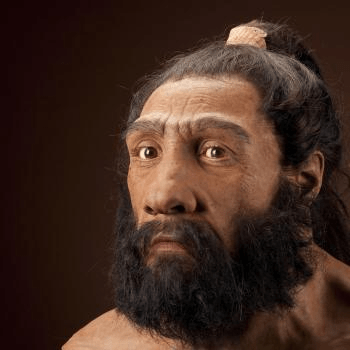
When you define species as Homo sapiens sapiens and Homo sapiens neanderthalensis, and describe on as “modern” humans, the loss of pure-blood Neanderthals is not surprising. It is a race-based point of view. My 2 ½ percent Neanderthal DNA converts to 1 in 40 – there are Cherokee tribal members with as little as 1/1024 Cherokee heritage. If you can be a Cherokee with that level of blood quantum (Neither I nor Elizabeth Warren could make it) consistency suggests that folks who are 1/40th Neanderthal need to have their racial heritage respected. From a race-based perspective, the pure Homo sapiens sapiens have been discriminating for millenia. A journalist named James Fellows tested out at 5% Neanderthal. There’s a story that a German guy tested at over 9% Neanderthal. There’s a guy in Canada claiming to be a pureblood Neanderthal . . . not that I believe it – but heck, he identifies as Neanderthal. As you glance at the picture – I’ve seen folks who look like that on the streets of Kalispell (not, of course, on the more highly evolved streets of Eureka).
I could go on – there is a strong temptation to go into detail of a high school classmate pointing the discrete Neanderthal bun on the back of my skull. An experience so traumatic that I have avoided the butch, crew cuts and a shaved head for over 50 years. My victimhood in that single, friendly observation has affected my haircuts for over half a century!
There may be something to this Critical Race Theory. If race is socially defined, those of us who are part Neanderthal have a claim on victimhood if we use the theory. Matter of fact, I think that if fractional Neanderthals aren’t allowed under the umbrella of Critical Race Theory, the theory is flawed.
-
The past year gave us a massive increase in the vole population – with a corresponding damage to fruit trees and garden plantings. I suspect it was partially due to weather or climate factors, but I think we have also lost some of our small predators. For the lack of a couple tiny weasels, I’m looking at methods of poisoning rodents. Fortunately, in one of my careers I was a county agent, so I know how to do the relevant research.

I don’t want to harm any of the little weasels I may still have – they’re cute, they help control rodents, and in general I like them. Sam’s two cats come by for vole hunting, and seem to be doing a reasonable job. The marsh hawk cruises by on his vole patrols – so while poisoning the voles is an option, I need a poison that won’t harm my allies – while bromethalin is listed as the most effective bait for voles, the Merck veterinary manual describes cats as “exquisitely sensitive.” While it isn’t proven that they can ingest enough to harm them if they dine on a vole that has been slowed by the neurotoxin, I don’t have to take the risk. Frankly, I doubt if my problem voles have developed the resistance to the anticoagulants that bromethalin replaced.
Even so, I figure I need to be developing some bait stations to limit the exposure to other animals – in other words, the poison goes into a chunk of inch and a half pvc pipe, along with a slice of apple (to attract the vole to the inside of the pipe)
Voles live only 3 to 6 months – but the little beasts can produce up to 10 litters of young each year – and each litter has three to six baby voles. Since my small predators are no longer capable of controlling the population, this year becomes the year of artificial controls.
-
Why are some mushrooms poisonous?

Poisonous or edible? Ekaterina Morozova/iStock via Getty Images Plus Karen Hughes, University of Tennessee

Curious Kids is a series for children of all ages. If you have a question you’d like an expert to answer, send it to curiouskidsus@theconversation.com.
Why are some mushrooms poisonous and some are not? – Alice T., age 11
You may have noticed that mushrooms pop up in your yard or in parks right after a rain but don’t last for long.
A mushroom is the above-ground part of a fungus. Most of the time, fungi live as threadlike structures called hyphae underground or in materials like wood. For fungi to reproduce, a mushroom must form above ground.
Some mushrooms are poisonous for the same reason some plants are poisonous – to protect themselves from being eaten so they can reproduce. Other mushrooms use the opposite strategy. They need animals to eat them in order to spread spores through poop. Still other mushrooms have completely different game plans.
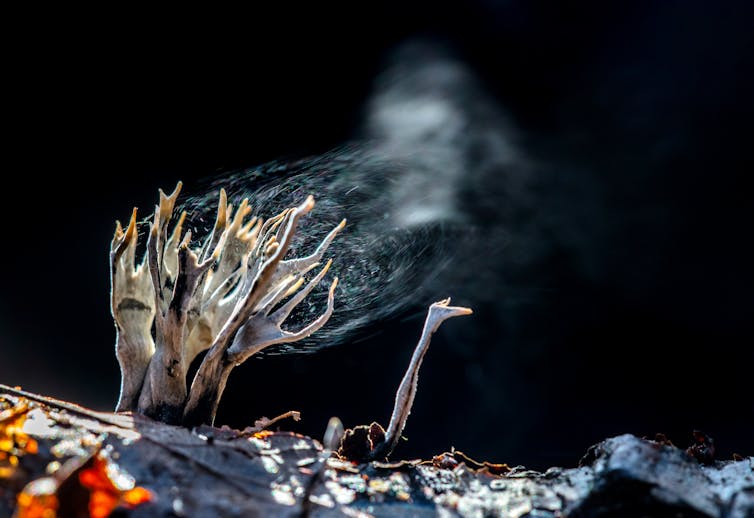
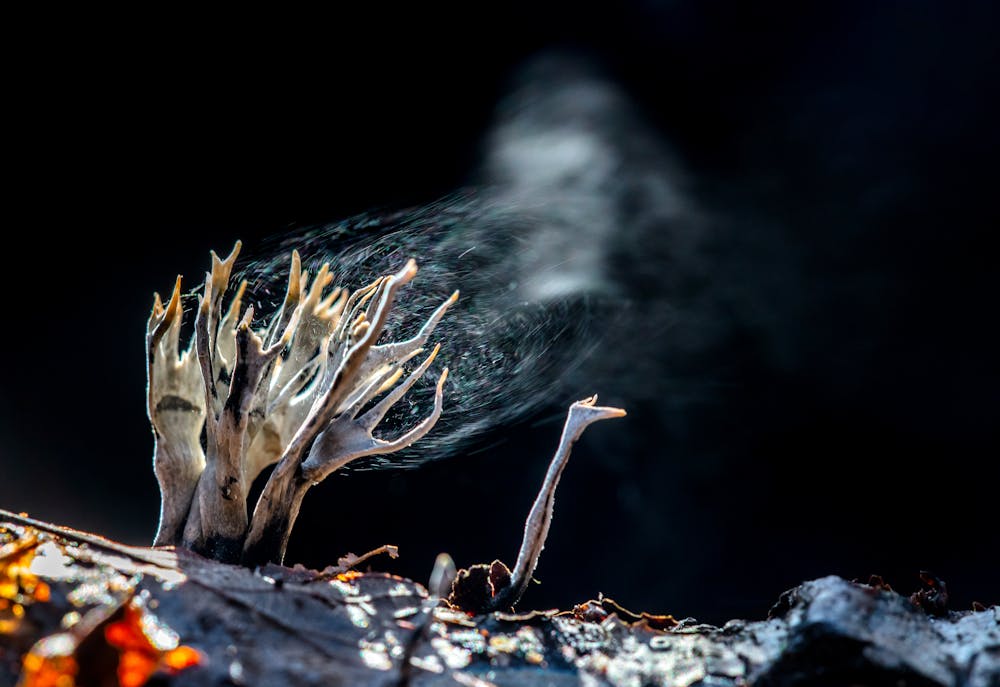
The candlestick fungus, Xylaria hypoxylon, releases its spores. Jasius/Moment via Getty Images Spreading spores
Mushrooms develop when the temperature is right and there is enough water. They usually consist of a cap and a stalk. On the underside of the cap, mushrooms produce spores that, like the seeds of plants, produce new fungi.
If you peek under a variety of mushroom caps, you will notice they are not all the same.
Some mushrooms have gills that look like a pleated sheet of paper. Some have pores that look like sponges. And some have toothlike structures. All of these surfaces produce spores. To create a new generation of fungi, spores need to get to new areas – and there are many fascinating ways mushrooms accomplish this.
For some mushrooms, spores simply fall from their caps and are carried to new homes by air currents.
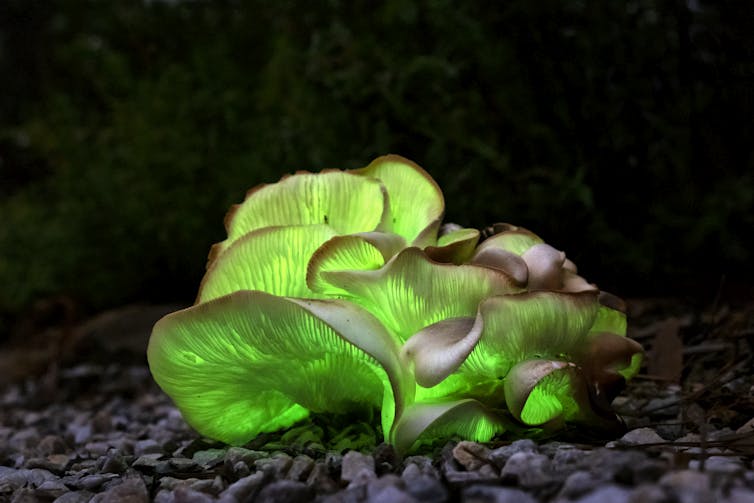
The ghost fungus, Omphalotus nidiformis, at night in an Australian driveway. Louise Docker Sydney Australia/Moment via Getty Images Other mushrooms attract insects by glowing at night. The glow from fungi in the woods at night can be very strong and is sometimes called foxfire. Insects, which are attracted to the light, inadvertently pick up spores as they investigate the glow and carry them elsewhere when they move on.
Some mushrooms never form an above-ground structure. Instead the mushroom stays underground and is eaten by squirrels and mice, which spread the spores by taking pieces back to their nests and by pooping. Such mushrooms are called truffles, and sometimes people will pay a lot of money for them.
A window of opportunity
Since mushrooms don’t last long, it’s important they spread their spores quickly. This is where poisons and toxins can come in.
Mushrooms are pretty tasty to snails, some insects, beetles, chipmunks, squirrels, deer and people. If an animal eats a mushroom, usually its spores are lost – unless they’re the type encased in a protective covering meant to be carried to a new neighborhood in poop.
Scientists have figured out that insects and snails avoid eating mushrooms that contain poison. Some mushroom poisons may make the eater only sick enough to avoid that species in the future, but some can be fatal.
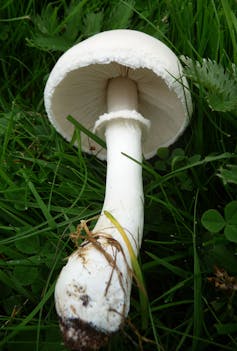
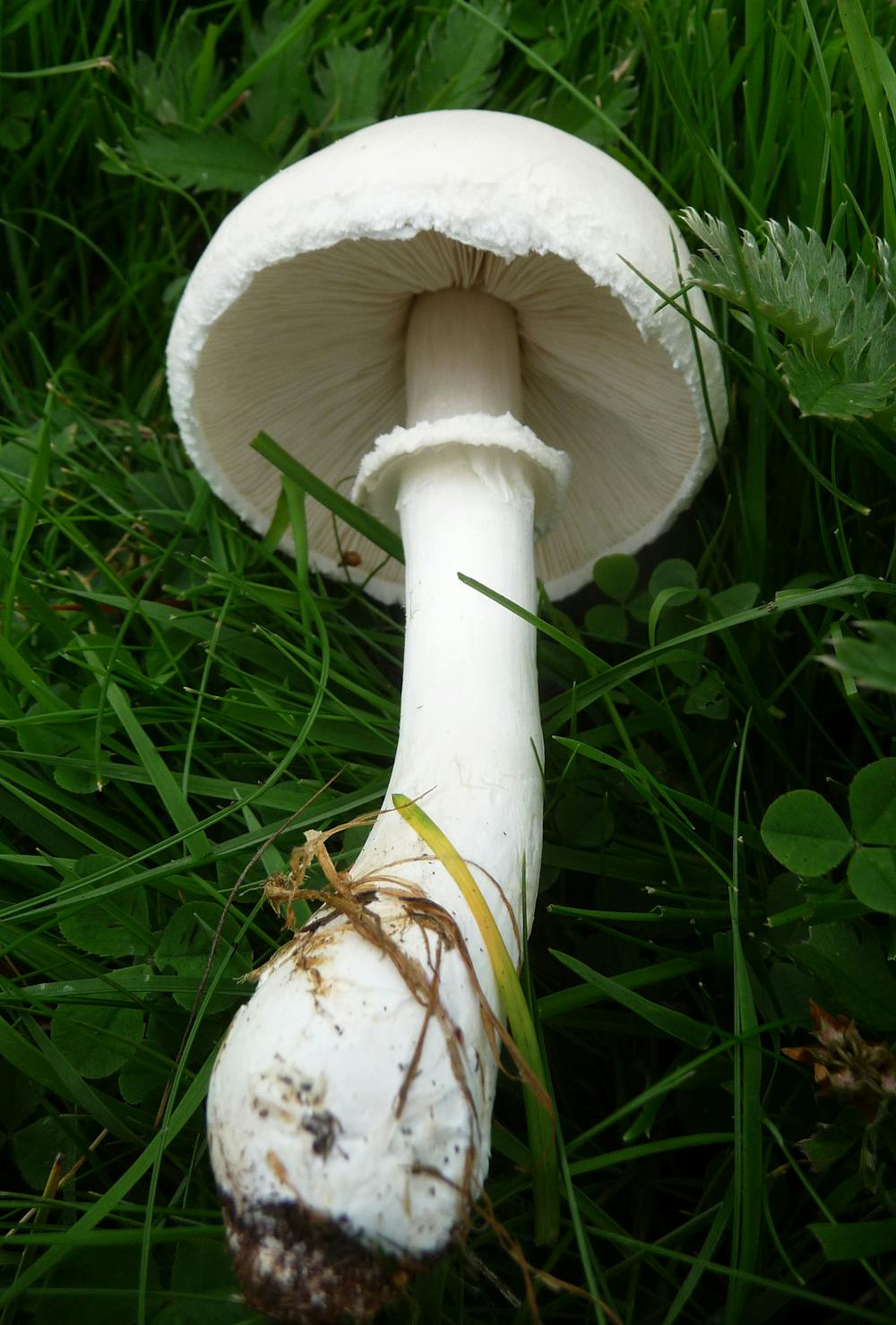
A deadly poisonous mushroom, Amanita virosa. gailhampshire/Flickr, CC BY There are many different mushroom poisons. One kind belongs to a group of very beautiful mushrooms, the amanitas, also called “destroying angels” because they are both pretty and deadly. Amanitas are often mistaken for mushrooms that can be eaten, and they cause several deaths worldwide each year.
People use some mushroom poisons in medicine. The poison of the ergot fungus, for example, was developed into a drug used to prevent migraine headaches.
Approximately 1%-2% of mushrooms are poisonous to humans. The common term for such a mushroom is a “toadstool,” but there is no easy way to distinguish a poisonous mushroom from one that is edible. So it’s not a good idea to eat mushrooms you find, because it’s hard to be sure whether they’re poisonous or not.
Many mushrooms are healthy and delicious. Just make sure you get them from a store or from someone who is a mushroom expert.
Hello, curious kids! Do you have a question you’d like an expert to answer? Ask an adult to send your question to CuriousKidsUS@theconversation.com. Please tell us your name, age and the city where you live.
And since curiosity has no age limit – adults, let us know what you’re wondering, too. We won’t be able to answer every question, but we will do our best.
Karen Hughes, Professor of Mycology, University of Tennessee
This article is republished from The Conversation under a Creative Commons license. Read the original article.
-
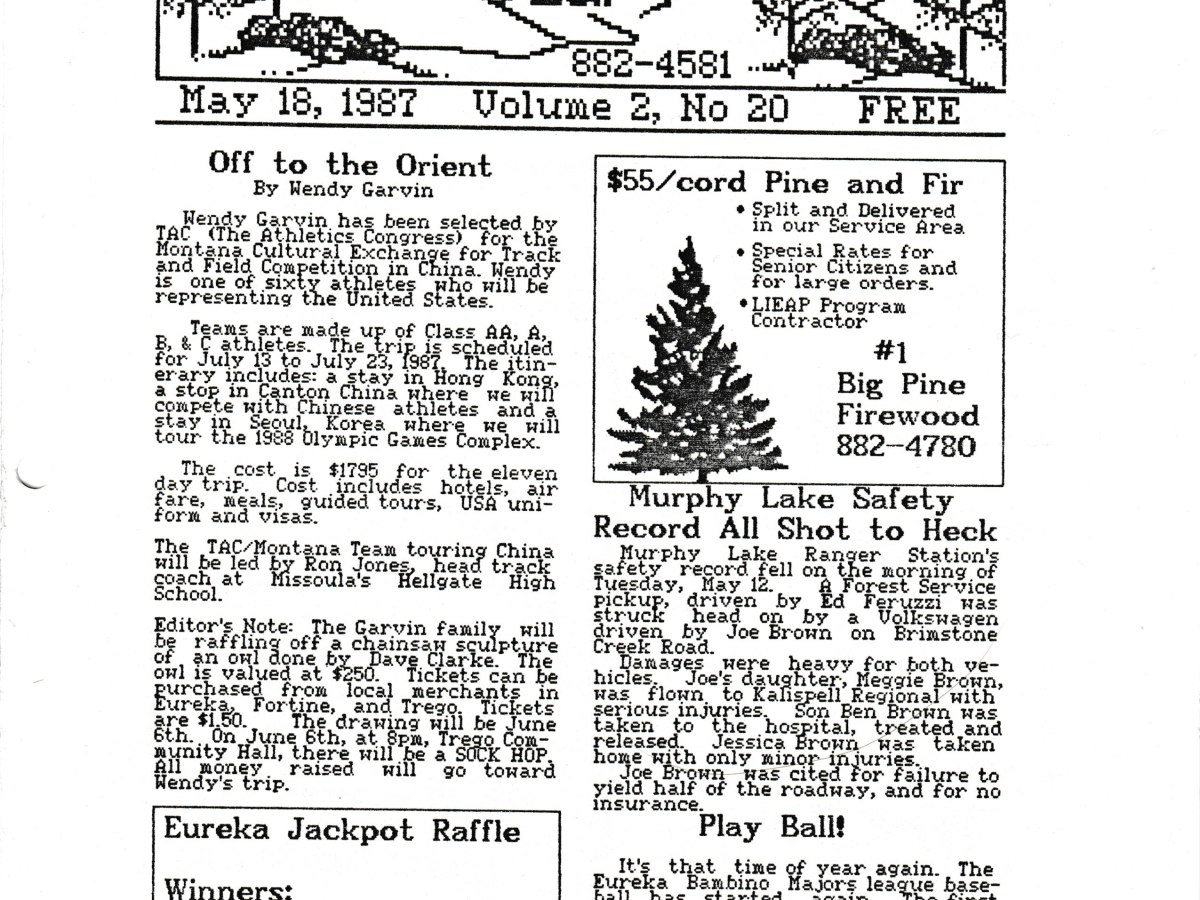
This day in 1987
Anyone remember $55/cord firewood? Or the Montana Cultural Exchange? As it turns out, there are still programs of that sort out there. The easiest to find was a wrestling exchange with Germany. Bomb threats in the Yaak? If our 1987 coverage is anything to go by, things were pretty conflict heavy in the school district that year. Also- fireman’s ball? It’s certainly been a while since we’ve had one, though there was some discussion of reviving the practice at annual meetings for both the hall and the fire department.
Lilacs Blooming? Time to plant Beans (among other things)
I’ve noticed the lilacs beginning to bloom in Eureka, and remembered that the blooming time of lilacs corresponds to the planting time for some crops. They are an “indicator” species, as it were. The study of when plants bloom and other seasonal events (such as migration) is phenology. It can be used by observant gardeners to determine when to plant, even across different regions. Lilacs bloom at the same number of growing days, even when they do so at different dates. Beans, cucumbers, and squash should be safe to plant when the lilacs are in full bloom. The timing…
Around the Pond
New on the game cam this week is a badger. The badger tends to be transitory with few Columbia grounds squirrels residing in the field to become dinner. The geese are being geese. The goslings are growing and hiking along the pond’s edge. The turkeys are being camera shy. The deer look like they need a good combing.-Patches
Mayflies
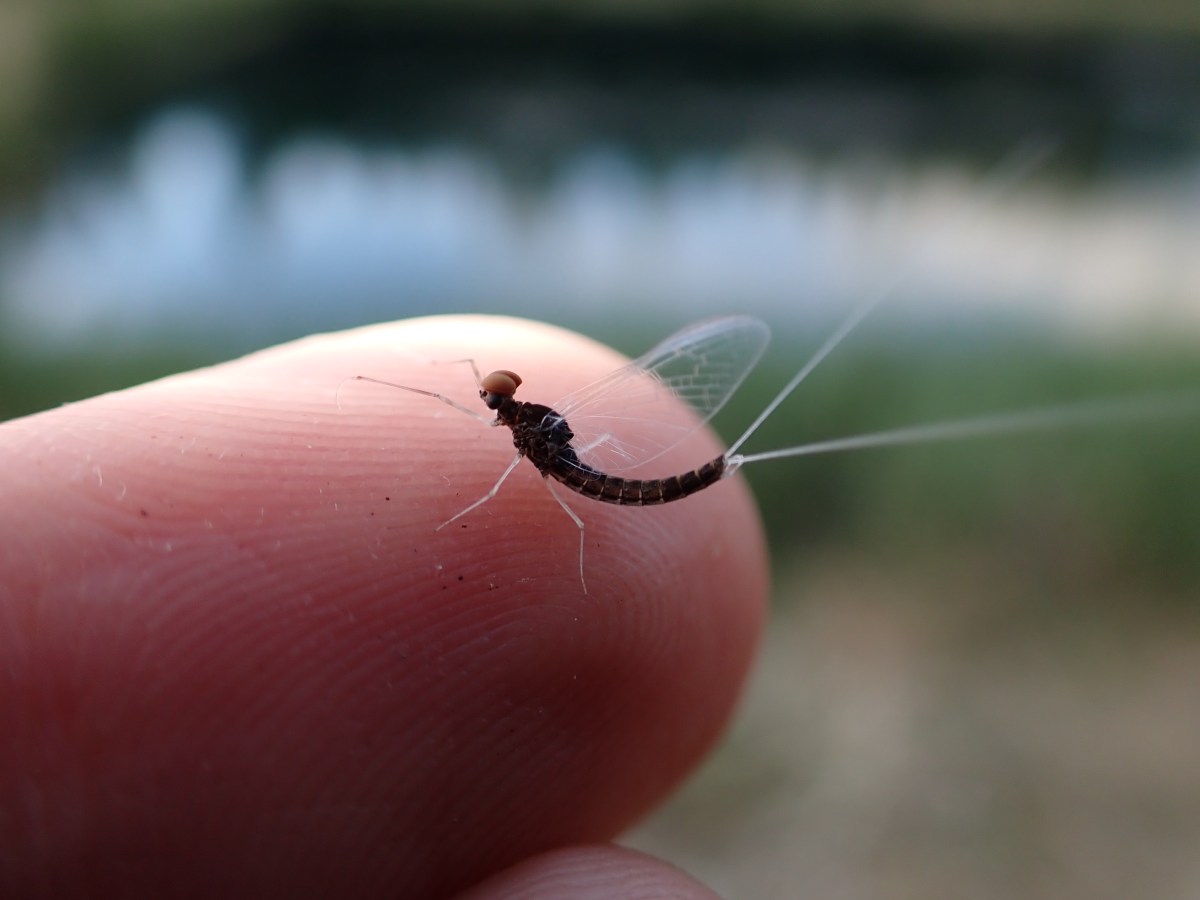
True to schedule, the mayflies have returned. Of course, the mayflies didn’t wait for May proper… they’ve been with us for the past month at least. Here’s the shed skin of one I watched emerging this past week. Note the three tail filaments – this is how you can tell it is a mayfly skin. Our pond tends to have the smaller species of mayflies in good abundance – primarily genus Callibaetis. Here are some higher-quality photographs of other mayfly nymphs, so you can get a sense of the variety. All mayflies belong to Order “Ephemeroptera”, which is Greek…
-
It’s 11:00 am, Thursday morning, and the computer tells me that Grave Creek is down to 0.1 inch of snow water equivalent (2% of average), and that Stahl Peak is at 25 inches (66% of average). Grave Creek is at 4030 feet elevation, while the snow pillow at Stahl is at 6030 feet.
I’m recalling my last month of snow surveys – Jay Penney had been taken off duty when he was diagnosed with congestive heart failure, and Tom Engel had been sent to Arizona, so I was getting both the Kootenai and the Flathead snow courses with assistance from the Forest Service – a new guy every day. Absolutely essential help in getting the job done, and only one major mishap – when my FNG tried to turn in reverse and broke the ski off the Alpine. At least we were on the way out when that happened – but I did have to swap machines and drive out another 15 miles with no steering. As the photo shows, even without breaking the ski off, steering was never the Alpine’s best feature. (The best feature was two tracks instead of one)

I liked the Alpines – two tracks and a 640cc engine. A box on the back for equipment. Snowshoes – I don’t believe I could be comfortable driving a snowmobile across the hayfield without snowshoes. I’ve broken too many snowmobiles to ever be comfortable without the old-fashioned oversnow traveling tools. In Kalispell that year, I met my Forest Service assistants at the fair grounds – which were also being used by the movie folks who were filming “Heaven’s Gate.” Kind of fun – they offered a job when I helped hitch the horses to a wagon, but the May snow survey runs had turned into a full-time job.
Snoriderswest offers an article describing the Alpine:
“The single-ski Ski-Doo Alpine is somewhat of a classic among old sled enthusiasts. These old sleds build on Ski-Doo’s early heritage of manufacturing a snowmobile or “tracked vehicle” to get “woodsmen through the forest and muskeg and then back home safely.”
Thus the Alpine proved popular as a work sled for utility companies, game wardens, trappers, pipeline inspectors or anyone who needed to check on remote locations or lines in the middle of winter.
Purportedly the double-tracked Alpine was the “world’s slowest” moving snowmobile but extremely reliable and dependable, so it’s little wonder that backwoodsmen, hunters and workmen loved the machines.”
I think our record week was 5 machines broke down – engines and transmissions turned to trash by mountains in the Kootenai filled with wet powder. We packed crowbars so we could turn the things on their sides and get the snow out when it filled the tracks – sometimes every half-mile. The best thing about the Alpines was that when one broke down, it was time to turn it around and head out for the truck on a trail that was already broken and packed.

We didn’t have NOAA climate prediction sites back then – those early electronic calculators weren’t reliable in cold weather, so we still used slide rules in the field and checked our calculations when we got back in the warm. The photo above is the model I used (along with the Alpine) for snow surveys (though not the same one). Others like it served on the Apollo missions. Photo from article at sliderule.ca. If you grew up without using a slide rule (or even if you did) it’s kind of a fun site to visit.

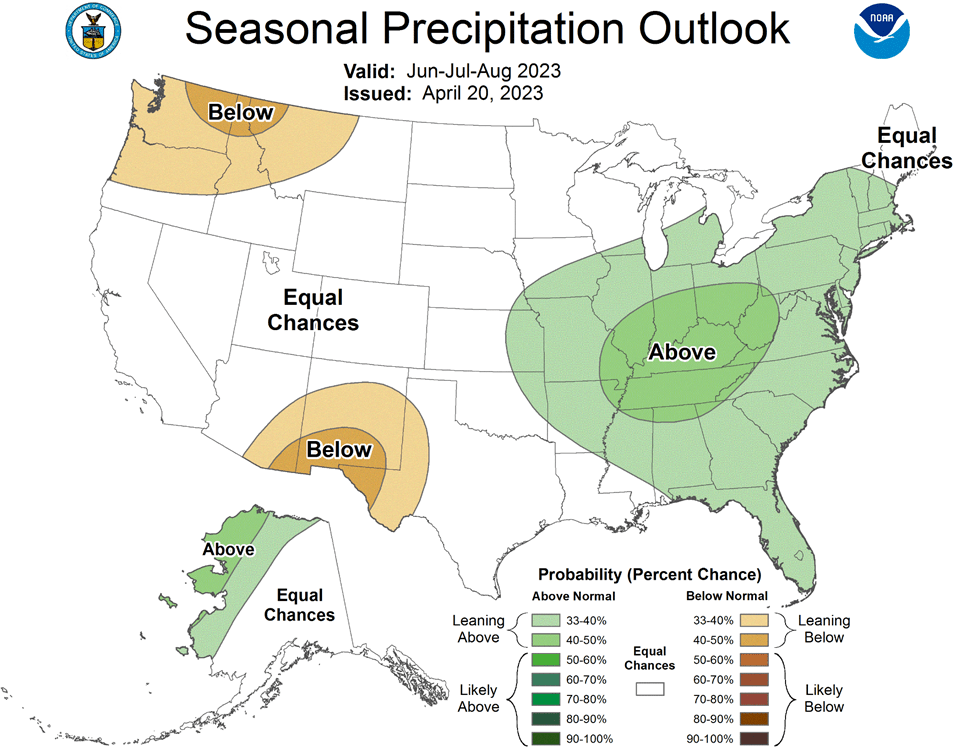
It looks like it should be a good summer for putting up hay – but I’m betting on less yield than last year. It amazes me that so much climate data is available just by turning on a computer and checking the internet.





Want to tell us something or ask a question? Get in touch.

Recent Posts
- Watching Iran
- The Quality of Numbers
- Robert Treat Payne Had Traveled To Greenland
- 75 Years Ago in New York
- Recovery Time for a Retiree
- Venn Diagram and DSM
- When Castro Was Cool
- You Have To Beat Darwin Every Day
- Computer Repair by Mussolini
- Getting Alberta Oil to Market
- Parties On Economics
- Thus Spake Zarathustra – One More Time

Rough Cut Lumber
Harvested as part of thinning to reduce fire danger.
$0.75 per board foot.
Call Mike (406-882-4835) or Sam (406-882-4597)
Popular Posts
Ask The Entomologist Bears Books Canada Census Community Decay Covid Covid-19 Data Deer Demography Education Elections family Firearms Game Cameras Geese Government Guns History Inflation life Lincoln County Board of Health Lincoln County MT Lincoln Electric Cooperative Montana nature News Patches' Pieces Pest Control Politics Pond Recipe School School Board Snow Taxes Teaching travel Trego Trego Montana Trego School Weather Wildlife writing
 Trego's Mountain Ear