-
This print was once in barrooms across the west – and appreciated by the winner’s descendants.

While the print is not particularly accurate, Budweiser definitely had a different approach to advertising back in 1892.
Adolphus Busch got the painting and a Missouri saloon when the owner couldn’t pay the $35,000 he owed for Budweiser. Anheuser-Busch has printed and distributed over a million copies.
-
The One Big Union – the Industrial Workers of the World – is available online at IWW . It never did become the one big union – the website describes the membership as “The Industrial Workers of the World (IWW) is a labor union representing nearly 9,000 workers across North America.” We can put that number in perspective by pointing out that Montana alone has 52,000 union members.
Still, I once toyed with the idea of joining the IWW. Unlike Montana, where the teachers’ union is ranked as the third strongest in the nation South Dakota’s teacher union is ranked #34, and fourth tier. I’d made the smartalec comment that maybe we could become Wobblies – and, when I looked at the IWW website, I realized we actually could get IWW membership. The IWW looked at things realistically – had we joined, their assistance would have been in updating resumes and finding jobs in other states.
Coming of age in Trego, I’ve always had a soft spot for the Wobblies. A little over a century ago, they were here, organizing labor in the logging camps. A description at washington.edu begins
“The Lumber Strike of 1917
The Pacific Northwest was viewed as the final frontier in the continental United States at the turn of the nineteenth century. Loggers from the east migrated to the Northwest because the timber harvest was abundant at the beginning of the twentieth century. There was an abundance of land, an abundance of trees, and many men in the forests who helped make great profits for the employers. Companies such as the Simpson Logging Company, Weyerhaeuser, Long-Bell, St. Paul and Tacoma were the main logging companies and earned immense profits. Fredrick K. Weyerhaeuser owned so much land in the Northwest that the government investigated him for corruption; but due to the way land was sold in the region, the government could do nothing to limit Weyerhaeuser. Even though the employers (lumbermen) earned huge profits, they passed little on to the loggers. On average, the loggers made only 35 cents an hour working in wet and dangerous conditions. In addition, the working conditions in the woods were unsafe, unsanitary, and cooks subjected the loggers to food that was inedible at times. For example, the food was so wretched in one Northwest logging camp that one logger, A. Linquist killed the chef claiming that “God told him Ed Gosseling (the cook) was the devil.” In logging towns, it was fairly common to hear of periodical work-related deaths occurring in the forests because conditions were unsafe and the trees and machinery were very unforgiving in event of an accident. Lumbermen did not want to sacrifice profits for the sake of safety. One logging camp close to Port Angeles had two separate, accidental logging deaths on the same day in 1915. Even though the majority of loggers were discontented with working conditions, there was little they could do to increase their wages or improve working conditions.
Prior to World War I, work was scarce, labor was in abundance, and the lumbermen knew it. Lumbermen exploited employees and did not worry whether or not horrible working conditions would drive them away. After working a ten-hour day in the woods, the “timber beast” (as the logger was commonly called) retreated to a blazing fire at the camp. In the camp, the logger had to share space with numerous pigs, (which were kept at all logging camps to eat food scraps). Even though outhouses existed, they were located 100 yards or more from the camp and were seldom used. As a result, the “timber beast” lived in an intensely unsanitary living environment. The typical year for a labor worker in the Northwest consisted of orchard and construction work in the summer and lumber in the winter. Thus, the low demand for labor and constant labor turnover prevented any real improvements in working conditions. As a result, the wages stayed low, the conditions unsafe, and the food bad.”
What separated the IWW from other unions was its organization and ability to bring together a union and organize a strike. The IWW created pro-labor propaganda in attempts to strengthen their union. In addition to trying to spread their beliefs, they demanded hefty stipulations when workers went on strike, breeding the hatred of employers. In Montana, the IWW asked for a wage raise from $3.50 to $5.00 along with a cut in the working day from 10 to 8 hours. In addition to striking, the IWW operated in an all or nothing strategy. If the hostile union did not get their way, they encouraged sit down strikes and sabotages when the workers went back to work.
As a result of all the work stoppages and violence, many people, including local authorities, employers, and even other unions such as the American Federation of Labor (AFL), were against the IWW. The AFL condemned the IWW for its un-American propaganda and tried to persuade everyone not to support or join the IWW. In Aberdeen, Washington, the AFL council “Condemned any interference with the bonafide unions of this city (Aberdeen) by the antagonistic union, un-American organization styling itself the Industrial Workers of the World.” Three days later, the Central Labor Council of Seattle also denounced the IWW stating that “the IWW, by their radical methods, had succeeded in erecting an insurmountable wall of prejudice between capital and labor so far as members of that organization were concerned.” The IWW had irritated a great number of people and organizations because of their intense antagonism and degree of success. It was highly successful at stopping work across the Northwest in the summer of 1917.
To understand the nature and significance of the IWW in the Northwest lumber industry, it is necessary to look at the demographics of their recruits. Many members of the IWW were migrant laborers or hobos. However, a smaller, yet significant number of IWW members were recruited from lower socio-economic levels of the settled workers. Such workers were naturally drawn to the closing words of the communist manifesto: “The proletarians have nothing to lose but their chains. They have a world to win. Workers of the world, unite!” It was easy for the IWW to make headway amongst its men, shaping their ideas, tactics, and actions as they went along. As the rest of the population sacrificed for the general welfare of the country in the name of patriotism, most if not all of the IWW workers could have cared less. Harold Hyman wrote concerning this class difference in the United States, “The mob spirit, always close to the surface in America and now clad in patriotic garb, was merely accelerating a process of class cleavage that had long been under way . . . Patriotism was an emotion that ‘a bum without a blanket’ could hardly share.” The Bulletin of the 4L described this problem frequently. Looking back on the strike, it wrote, “It was a complete industrial collapse, an orgy of loafing and plundering. A reign of horror.” By the time of the 1917 lumber strike, this lack of patriotism was to be one of the hardest obstacles to overcome in an attempt to end the strike.”
As a kid, I knew some of these old loggers that had been involved in the great 1917 strike. While Pinkham Creek inherited the moonshining reputation, Trego kept the reputation the strikers built – suspected of being wobblies and socialists just by residence.
The IWW, though small, remains close – there is still a General Membership Branch listed in Missoula.
The IWW is an affordable union – the website shows that the basic dues are $11/month (rising with income up to $33/month).
The website includes stories about why the IWW members were called wobblies, links to the little red songbook, and tales of Joe Hill. They are part of our history, and it is kind of nice to see that there is still a bit of an IWW organization in Missoula.
-
I can make an argument that the big year in cartridge firearms was 1873 – the new guns were just improvements of existing designs, but all of those improvements included a single development – the centerfire primer.
In 1873, the new guns were the model 73 Winchester, the 1873 Trapdoor Springfield, and the 1873 Colt Single Action Army. Each was developed from a rimfire predecessor.
Let’s look at Colt first – the Army wanted more power than Smith and Wesson was offering, and Colt first offered up the 1872 Colt – basically the old percussion Colt with a new cylinder chambered for the 44 Henry rimfire . . . and the Cavalry officers remembered that the Dragoon Colt, a quarter century earlier, fired loads with 40 grains of black powder. They wanted that power back. In 1873, they got it – a cartridge that held 40 grains of powder, the Single Action Army was built with a top strap, and, while it may not have been in continuous production by Colt, someone, somewhere, has been building Single Action Army revolvers over the last 150 years.
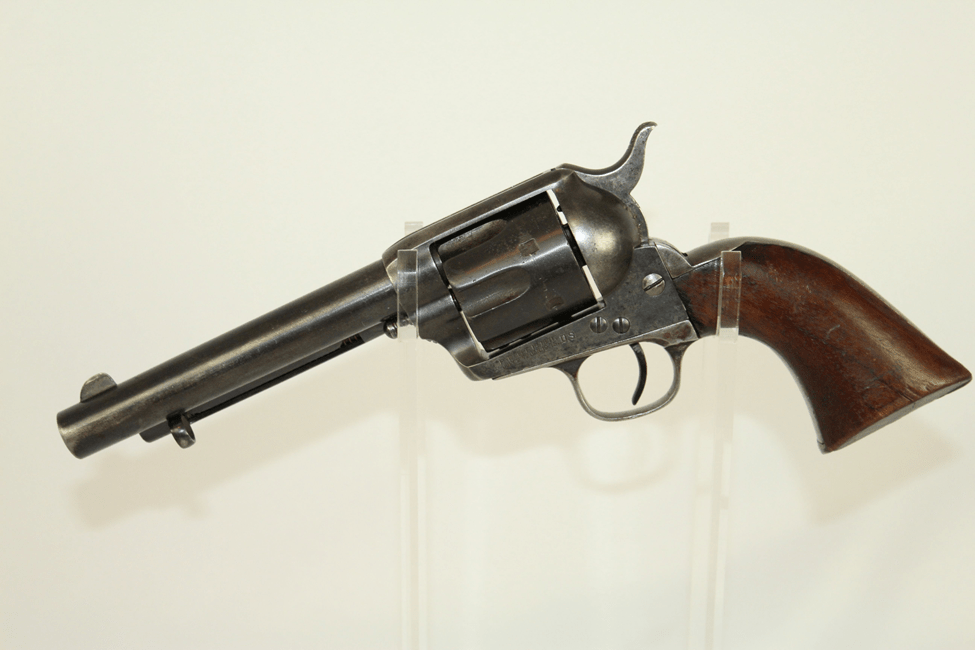
That same 44 Henry rimfire brought in the Henry lever action – 16 shots fast back in the Civil War times. Oliver Winchester bought up New Haven Arms Company, hired Benjamin Tyler Henry, and began working on improving the lever action rifle – first with the 1866 Winchester continuing to use the rimfire cartridges, followed by the model 1873, with the centerfire 44-40. The old rimfire’s reliability had been enhanced by two firing pins (which made it easy to calculate the number of Henry rifles used at the Little Bighorn), and the similarity between the 45 Colt and the 44-40 Winchester led to an immediate development of the 1873 Frontier Colt – identical to the SAA except the caliber.
The model 1873 is produced at Winchester and available. Other copies, without the Winchester name have been available, though often made in Brazil or Italy. The 1873 is often called “the rifle that won the west.”

The third cartridge was the 45-70 Government – introduced along with the 1873 Trapdoor Springfield. Erskine Allin first developed the Trapdoor action in 1865, as a way to make use of the millions of muzzle loading rifled muskets left at the end of the war between the states – and those first trapdoor Springfields were chambered in .58 rimfire. I have no idea how many were made – obviously, the .58 rimfire wasn’t a particularly satisfactory cartridge – but ammunition catalogs from 1910 still listed the .58 rimfire.

The 1873 Springfield was used by the second-place finishers at the Little Bighorn on June 25 & 26, 1876, along with the Single Action Army Colt revolvers.
Production of the 1873 Springfield continued until 1893, in 1892 the trapdoor rifle began to be replaced by the bolt action Krag-Jorgensen rifle. Since there were only 30,000 Krag-Jorgensen rifles available when the Spanish-American War began, the venerable old 1873 Trapdoors came back in service to arm volunteer units.
If it’s a Springfield model 1873, it qualifies as a pre-1898 antique and is exempt from the registration and sales requirements of the Gun Control Act of 1968 – though some folks might argue against that interpretation.
-
The report “The Militarization of Federal Bureaucracy – Updated Statistics Through March 31, 2023” can be accessed with a click here:
The article starts with sources, then breaks into these statements:
BREAKING: NEWLY UPDATED NUMBERS THROUGH MARCH 31, 2023
BIG SPEND: Since 2006, 103 rank and file agencies outside of DOD spent $3.7 billion on guns, ammunition, and military-style equipment (inflation adjusted to CPI). 27 of those agencies are traditional law enforcement under the Department of Justice (DOJ) and the Department of Homeland Security (DHS).However, 76 agencies are push-pushing, regulatory agencies, i.e. Environment Protection Agency (EPA), Social Security Administration (SSA), Veterans Affairs (VA), Internal Revenue Service (IRS), and Health and Human Services (HHS).
HEADCOUNT OF FEDERAL AGENTS: There are now more federal agents with arrest and firearm authority (200,000) than U.S. Marines (186,000).
I grew up with respect for Marines – even if the Marine Corps is outnumbered by armed EPA, IRS, Social Security and HHS agents, I don’t figure that head to head it would be a fair match. On the other hand, there is the question about why in the hell a health and human services employee needs to be armed and have arrest authority.
UPDATED CASE STUDY: INTERNAL REVENUE SERVICE (IRS) current through March 31, 2023
IRS BY THE NUMBERS: Since 2006, spent $35.2 million on guns, ammunition, and military-style equipment (CPI adjusted). The years 2020 and 2021 were peak years at the IRS for purchasing weaponry and gear. Just since the pandemic started, the IRS has purchased $10 million in weaponry and gear. (See chart below.)
Special agents at IRS: nearly 2,100 special agents. Recently, the IRS chief testified that they are adding 600 new positions (20,000 new hires with 3% ratio of special agents). Based on headcount, the IRS ranks in the equivalent of the top 50 largest of 12,261 police departments across the country.

Not to stress the obvious, but the IRS folks probably feel unloved and have a psychological need to be armed. I would love to have that budget to spend on shooting toys – can you imagine how I would be treated at Sportsmen or Cabelas when I walked in?
“INTERESTING IRS PURCHASES (SINCE 2020):
- $2.3 million on duty ammunition
- $1.2 million on ballistic shields, plus another $1.3 million on ‘various other gear for criminal investigation agents” – very non-transparent description
- $474,000 on Smith & Wesson rifles
- $467,000 on duty tactical lighting
- $463,000 on Baretta1301 tactical shotguns
- $354,000 on tactical gear bags
- 267,000 on ballistic helmets
- $243,000 on body armor vests”
My guess is those S&W rifles are AR-15 platforms, and that someone misspelled Beretta. Still, 2.3 million spent on ammunition suggests that the IRS is taking marksmanship seriously.
This 2018 report to Congress, at GAO-19-175, FEDERAL LAW ENFORCEMENT: Purchases and Inventory Controls of Firearms, Ammunition, and Tactical Equipment, covers federal law enforcement purchases and inventory controls of firearms, ammunition and tactical equipment. It is interesting, at the least.
-
These days, most of my meal planning comes under the heading of “What do I do with…?” In the case of “too many onions” the answer is “onion soup”. In the case of cabbage, I’ve had a bit more difficulty.
Cabbage is a cruciferous vegetable, which just means that it’s in the same group of plants as broccoli, and Brussels sprouts among others. The name has something to do with the flowers looking vaguely cross-shaped, but can be translated into everyday terms as “may cause gas”.
So, what do you do with a whole cabbage? If you’re unaccustomed to having it as a regular part of your diet- medicate accordingly. Otherwise: Fried cabbage (breaded, or otherwise), spring rolls, soup, and cabbage rolls.
What’s a cabbage roll? Leftovers wrapped in a boiled cabbage leaf and baked, after the leaf is covered in a tomato sauce (a premade sauce, or canned tomatoes and tomato paste, or even tomato soup in a pinch).
Basic filling ingredients: hamburger (not necessarily cooked- it can be cooked when the rolls are baked), rice (cooked), onion, garlic
Additional ingredients? Anything else that might be handy. (More) cabbage, corn, beans, carrot, potato, pepper, etc.
Directions: Mix filling. Boil cabbage just enough to get the leaves flexible (a few minutes. Probably no more than 5). Remove leaf. Add filling. Wrap. Add to baking dish. Repeat. Once the dish is full, add a tomato sauce over everything. Bake covered at 350 degrees for an hour or more, until everything is done.
-
Zooey Zephyr has made the national stage from Montana’s House banning the representative from speaking. It’s kind of rough having a state representative who is banned from speaking – and I suspect Missoula is the only place in Montana to elect a transexual to the house. Here, we tend to elect old retired republicans – but let’s look at how many Montana districts didn’t get a choice of candidates to represent them:
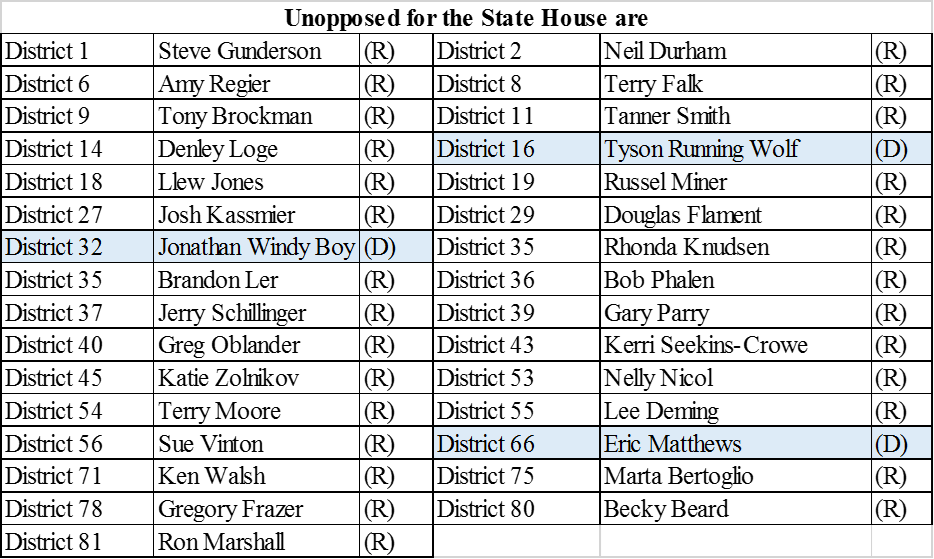
Thirty-one of Montana’s 100 state representatives have no opponent in the general election. Since legislative districts are apportioned according to population, this essentially translates to 31% of Montanans who had no choice to vote on their state representative last November.

Zooey at least won the election to the state house – a place where 31% of the candidates were unopposed in the general election. Nothing personal – but when a competitively elected representative gets banned from speaking, in an assembly where 31% of the membership ran unopposed, it may say as much about our state house of representatives as it does about the silenced representative.
It’s unclear how “elected” those 31% actually were. In Lincoln County, Mike Cuffe and Neil Durham were effectively chosen by Election Administrator Paula Buffe when she decided to ignore write-in votes. It seems probable that this is the case for the others in their counties.
-
When Trump announced that he was running for president, it didn’t take long for folks to announce that his narcissism made him unsuitable, a clear and present danger, an unacceptable risk. Whether licensed psychologists with doctorates, or just solid political partisans, they didn’t like Trump’s narcissistic traits.
Personally, it seems likely that you’re likely to have quite a few narcissistic traits if you want to be president. In a nation of 330 million, probability suggests that there are at least a million people who could handle the job better than you or I. As a generality, if you think you’re the best qualified to be President of the United States, you probably have some narcissism in your soul.
With Trump, I deferred to the guy who edits the professional journals on personality disorders – Allen Frances. The headline reads “The psychiatrist who wrote the guide to personality disorders says diagnosing Trump is “bullshit”. What’s missing in Gartner’s diagnosis, according to Frances, is the key element to diagnosing all mental illness: suffering. “Everyone has a personality,” Frances says. “It’s not wrong to have a personality; it’s not mentally ill to have a personality. It’s only a disorder when it causes extreme distress, suffering, and impairment.”
Trump’s willingness to lie and endless self-promotion are traits that have, so far, worked out largely to his advantage.”
Still, there seem to be some shrinks who agree that narcissism is fairly common in the political realm:
“Consider that two of the things narcissists most desire are money (i.e., lots of money) and power (the more the better). And these two assets can be tightly interwoven. Consider also that many of the individuals entering the political arena have already made their fortune, or inherited it. So what typically drives them is a lust for power, prestige, status, and authority. These (let’s call them) “objects of admiration” not only gratify their need for self-aggrandizement by feeding their oversized ego. They also provide them with compelling evidence to confirm their sense of superiority to others—probably their most coveted need of all.”
psychologytoday.comKind of makes sense to me – the idea that politics (particularly high level politics) would attract people who are a bit narcissistic. Another paragraph explains one of the true horrors: “One of the primary characteristics of narcissists is their exaggerated sense of entitlement. It’s hardly surprising then that so many politicians (or narcissist-politicians) somehow think they “deserve” to game the system. After all, from their self-interested perspective, isn’t that what the system is for? In their heavily self-biased opinion, if they want something, by rights it should be their’s. So, nothing if not opportunistic, they take from public and private coffers alike whatever they think they can get away with. And given their grandiose sense of self, they’re inclined to believe they can get away with most anything. Sad to say, in today’s world of capitalistic politics their judgment isn’t that skewed. Which is to say they’re much more often right than wrong.”
In that case, if memory serves, Trump left the Presidency with less money than he entered it. We’re not sure yet on President Biden – but it looks like his political positions have been money makers. An internet search of “Obama net worth 2008 2016” shows that the Obamas were worth 1.3 million in 2008. A Forbes article says his wealth increased by 20 million while he was in office. It looks like the psychology today article may well be correct.
“But finally, is it possible that narcissism might just be an unintended prerequisite for being a successful politician? For to be elected to public service would seem to require a level of ambitiousness that may intimately relate to core narcissistic drives. As Pepper Schwartz, a sociologist at the University of Washington, reflects: “How many of us would have the desire, much less the ability, to promote ourselves ceaselessly? You have to do that as a politician. It’s an amazing level of self-love . . . and need for affirmation.”
forbes.comDSM has this to say about the folks who qualify as having a narcissistic personality disorder:
“People with NPD tend to exaggerate their skills and accomplishments as well as their level of intimacy with people they consider to be high-status. Their sense of superiority may cause them to monopolize conversations and to become impatient or disdainful when others talk about themselves. In the course of a conversation, they may purposefully or unknowingly disparage or devalue the other person by overemphasizing their own success. When they are aware that their statements have hurt someone else, they tend to react with contempt and to view it as a sign of weakness. When their own ego is wounded by a real or perceived criticism, their anger can be disproportionate to the situation, but typically, their actions and responses are deliberate and calculated. Despite occasional flare-ups of insecurity, their self-image is primarily stable (i.e., overinflated).”
Allen Frances explains that Trump doesn’t qualify – but I think we could afford to check some of our other national level politicians.
-
This year, my view of Rendezvous was from the historical village. It was a much warmer day, and very busy as time for the parade approached.
Things were crowded, and much to my surprise we rarely heard the music from across the street at Riverside park over the hum of conversations.
While the crowd seemed busy to me, and there seemed to be plenty of vendors (stretching up to folks with tables set up along the street), the recurrent conversation I kept hearing was about how much smaller things were. It was typically a nostalgic conversation, with a wistful question at it’s heart: how long will this continue?
Rendezvous was a lot of fun and I hope it continues for many years to come. It seemed like a good turn out from where I was sitting.
-
Technically, there is no such cartridge as the 45 long Colt. There are short and long 22 cartridges. There are short and long 32 cartridges. There are short and long 38 cartridges. Same for 41 cartridges – but there aren’t any 45 short Colts. I got to looking at Cartridges of the World, and I think I have figured out why we call that old cartridge a 45 Long Colt.
In 1873, the Army chose the Colt 1873 Single Action Army (caliber 45) as the standard Army revolver. Naturally they fed it 45 Colt ammunition. Then, in 1875, the Army brought in the Smith and Wesson Schofield – purchasing about 9,000 of them between 1875 and 1878. The Army purchased 12,500 Colts – and, while the Colt and the Schofield were both 45 caliber, the cartridges weren’t the same length. The Colt .45 cartridge is 1.60 inch long, while the Schofield cartridge is 1.43 inch. In other words, the 45 Colt cartridge wouldn’t fit in over 40% of the Army revolvers.
Well, the solution was obvious – feed both revolvers the Smith & Wesson cartridge. Obvious, and wrong. Rim diameter on the S&W Schofield cartridge is 0.522 inch. Rim diameter on the .45 Colt is 0.512 – that 1/100 of an inch made it somewhere between difficult and impossible for the Colt cylinders to turn – essentially, with a little bit of dirt – and black powder is dirty – over 50% of the Army’s revolvers jammed.

The second obvious solution was a new cartridge that would work in both revolvers – the 45 Colt Government. Cartridges of the World, 9th Edition, on page 306 describes it: “This was something of a bastardized cartridge, combining the length of the S&W Schofield revolver round with the rim of the Colt SAA round. Army ordnance described at least one version of this cartridge as Revolver Ball Cartridge, Caliber 45. The evident military incentive for such a loading seems obvious: With both S&W and Colt 45-caliber revolvers (similar but differently chambered) in use, supplying the correct ammunition to far-flung outposts must have been something of a logistical nightmare. One has to wonder how often troopers found themselves in possession of ammunition that would not work in the gun they had been issued. The 45 Colt ammunition is longer than the Schofield cylinder, chambering the Schofield ammunition leaves precious little room for rim clearance. It seems likely that some early 45 Colt SAA’s would not have chambered some Schofield ammunition, even when the gun was clean. Conversely, the 45 Colt Government, combining the shorter case and smaller rim worked (after a fashion) in either gun. . . Available information suggests that this cartridge was available between the late 1870s and the 1930s.
When the chips are down, having any ammunition that will fit and work in the gun at hand is much better than throwing rocks. However, the S&W Schofield does not function as dependably using the smaller-rimmed 45 Government cases: Incautious manipulation or a somewhat worn gun can result in the extractor slipping past the rim of one or more partially extracted cases. The gun cannot then be closed. Worse, if the cylinder is the slighted bit dirty (blackpowder, remember) removing the offending case can require a dowel, a hammer and at least three hands.”
Doing an internet search for ‘45 short colt’ yielded an article describing the old box of Winchester 45 Colt Government cartridges the author owns.

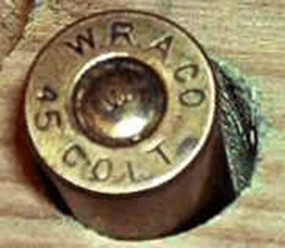
“The Winchester .45 Colt’s that Paco and I have came from Shootist Keith Owlett who gave them to us a short time before he passed on. The cartridge box is deteriorated and I have it put away now – at least what’s left of it. But it is plainly marked “.45 Colt Government”. The head-stamp on the cartridges is “.45 Colt” … BUT these are SHORT .45 Colts! The head-stamp is the same as the longer .45 Colts, even down to the “W” on the primers.”
So the 45 Colt Government informally became the 45 Short Colt, leaving the 45 Colt to unofficially be termed the 45 Long Colt. And it has taken me a long time to get motivated enough to figure out why I am shooting a 45 Long Colt – but the 45 Colt Government went off the shelves before my father turned 12.
-
This April 28-30th, The Tobacco River Muzzleloaders club hosted the 45th annual David Thompson Black Powder Shoot, first started by Jim Kirsch and Joe Nelson. While Jim was present this year in the flesh, and continues to impart much wisdom, Joe passed away three weeks after last year’s Rendezvous and is much missed. He returned in spirit, however, and managed a perfect score, leading in all three events.

Joe Nelson reminds us of what proper shooting looks like. While the shoot had a rough few years due to Covid-19 regulations, things seem to be improving once again. This year, 71 folks competed in some mixture of the three events (Muzzleloading Rifle, Muzzleloading Pistol, and Tomahawk & Knife). There is no obligation to participate in all three, and many folks opt for one or two.
It was a pleasure to see that more Canadians were present this year, thanks to relaxation of border-crossing regulations. But to me, the greatest joy was to see several generations represented, and old shooters mentoring young kids just starting out in the hobby.

In the final shooting group, Kaelan Yanak scores a hit on one of the last three pistol targets. Folks are encouraged to get most of their events taken care of on Friday and Saturday, but participants are allowed to compete in one event on Sunday morning prior to distributing blanket prizes and striking camp.
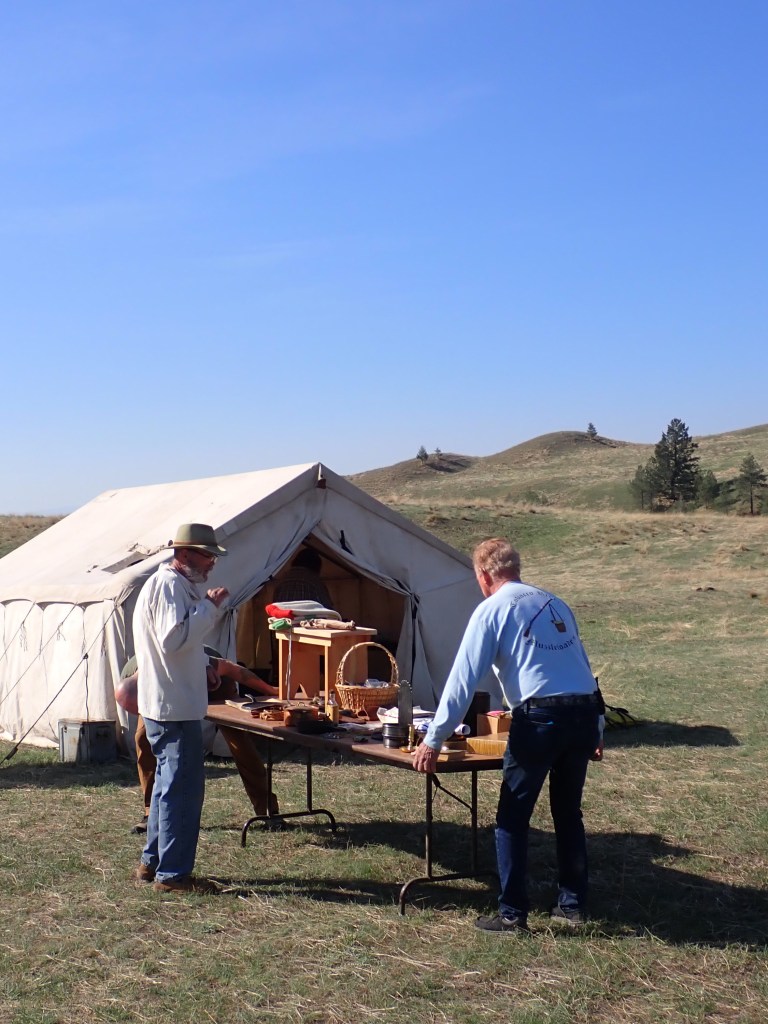
Blanket prizes being brought out on Sunday morning. 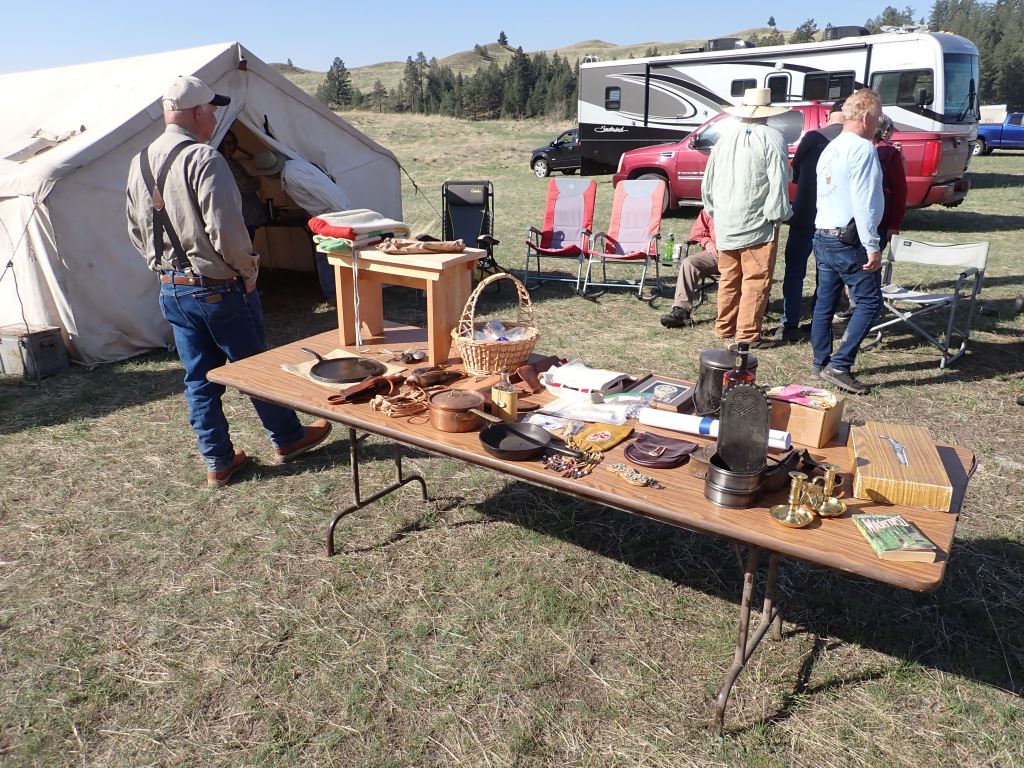
A fine mixture of prizes this year – knives, horns, leatherwork, and traditional cookware, to name a few. Participation in blanket prizes is optional, but quite enjoyable. To join in this year, one was advised to bring a gift relevant to traditional muzzleloading culture, and worth at least $15. At the blackpowder shoot’s conclusion on Sunday morning, the combined scores were read, starting with the highest, and those who’d brought blanket prizes were able to select something from the table when their name came.
Afterwards, a drawing was held for this year’s grand prize, a muzzleloading pistol kit donated by the family of a gentleman no longer with us. An experienced shooter won the draw, and straightaway gave the kit to a young boy just starting out in the hobby.

Rifle and pistol targets regathered, awaiting the next rendezvous. After prizes were distributed, shooters helped take down the remaining targets and ensure the grounds used were free from trash.
We’ll hope to see you there next year,
Jedidiah McCurry
Want to tell us something or ask a question? Get in touch.

Recent Posts
- Watching Iran
- The Quality of Numbers
- Robert Treat Payne Had Traveled To Greenland
- 75 Years Ago in New York
- Recovery Time for a Retiree
- Venn Diagram and DSM
- When Castro Was Cool
- You Have To Beat Darwin Every Day
- Computer Repair by Mussolini
- Getting Alberta Oil to Market
- Parties On Economics
- Thus Spake Zarathustra – One More Time

Rough Cut Lumber
Harvested as part of thinning to reduce fire danger.
$0.75 per board foot.
Call Mike (406-882-4835) or Sam (406-882-4597)
Popular Posts
Ask The Entomologist Bears Books Canada Census Community Decay Covid Covid-19 Data Deer Demography Education Elections family Firearms Game Cameras Geese Government Guns History Inflation life Lincoln County Board of Health Lincoln County MT Lincoln Electric Cooperative Montana nature News Patches' Pieces Pest Control Politics Pond Recipe School School Board Snow Taxes Teaching travel Trego Trego Montana Trego School Weather Wildlife writing
 Trego's Mountain Ear