-
In September’s past, we’ve looked at the Community Decay Ordinance, Beer Taxes North and South, Paper Wasp Body Language, Why it had to be Guns, Bears and Apples, and Back to School Bread.
Community Decay…Part 1
One could be forgiven for assuming that community decay ordinances were the business of rather fussy municipalities in places other than here. One would, as it happens, be wrong on two counts. Lincoln County, Montana, has one. Back in December of 2018 the Lincoln County Board of Commissioners adopted Ordinance 2018-05 “An Ordinance to Control Community Decay Within Lincoln County and to Establish Procedures for its Enforcement”. So, this leaves us with several pressing questions: What exactly is community decay? Who does this apply to? Enforcement? None of these have short answers, so I’ll discuss each in depth in later…
Beer Taxes North and South
I listened to a comment from north of the line about how cheap beer is south of the 49th parallel. So I decided to investigate – and a lot of the difference is alcohol prices is the governmental controls. Taxes do make a difference in what we drink – particularly when we look at alcoholic beverages. A 2018 report titled “Beer Taxes – A Canadian – U.S. Comparison” makes the research easy. “Beer taxes in Canada are higher in both absolute value and when calculated as a percentage of selling price with an average government beer tax percentage of 47%…
Paper Wasp Body Language
If you know what signs to look for when you meet a wasp, it’s easy to avoid being stung. Have you ever been buzzed by a bee or a paper wasp? They dive bomb you, fly close to your face, even collide with you, but without stinging? Those were probably sentries for a nest, trying to keep danger away. Sentry wasps can be stationed 10 to 20 feet away from the nest they’re guarding, and circle back to it from time to time. These wasps are the ones you’re most likely to come into conflict with. Yesterday, I went out…
Why Did it Have to be …Guns?
Why Did it Have to be … Guns? by L. Neil Smith lneil@lneilsmith.org Over the past 30 years, I’ve been paid to write almost two million words, every one of which, sooner or later, came back to the issue of guns and gun-ownership. Naturally, I’ve thought about the issue a lot, and it has always determined the way I vote. People accuse me of being a single-issue writer, a single- issue thinker, and a single- issue voter, but it isn’t true. What I’ve chosen, in a world where there’s never enough time and energy, is to focus on the one…
Bears know that the apples are ready…
It’s time to pick apples – at least according to the local wildlife. This weekend, we happened upon an adult black bear and her cubs munching on the apples down by the Trego railroad crossing in the wee morning hours. Bears aren’t too picky about ripeness. Like many mammals, they’re attracted to the smell of fermentation – (the smell indicates a fruit has the highest calorie content it’s going to get). As apples get ripe (and then overripe) they become even better bear attractants. Can bears become inebriated? Certainly! Glacier Park had a number of incidents back in the 80’s.…
Back to School Bread
This versatile classic frequently receives compliments. It can be made into rolls and bread-sticks. With a little cornmeal it becomes pizza dough. It also serves as the foundation of Lunch in a Bun, a popular menu item at Trego School. For lunch in a bun, each bun has a filling. Sometimes, it is taco meat and cheese. At other times, they are filled with pepperoni, ham and cheese, then served with marinara sauce. These numbers in this recipe are reduced to result in a smaller amount of bread than is produced in the school kitchen. Single Rise Dough 2 Tbsp.…
-
Over 50 years ago, Laurence Peter published The Peter Principle – the principle is simple – “In a hierarchy, every employee tends to rise to his level of incompetence.” Peter held a doctorate in education, so it is probably no surprise that his early research took place in schools.
According to Dr. Peter, “Work is accomplished by those employees who have not yet reached their level of incompetence.” He described governments: “Any government, whether it is a democracy, a dictatorship, a communistic or free enterprise bureaucracy, will fall when its hierarchy reaches an intolerable state of maturity.”
He saw the advantages of aptitude testing in job placement: “The main difference between tested and untested employees is that the tested people reach their levels of incompetence in fewer steps and in shorter time.”
Sometimes the organization, the hierarchy, tops out before the employee can reach his level of incompetence. Peter termed this summit competence, and did not believe that it falsified the Peter Principle – it demonstrated that the limited size of the hierarchy did not allow everyone to reach his level of incompetence.
The Marine Corps has the “terminal lance” as a descriptor of those who will end their enlistments as lance corporal. While it could be a level of incompetence, it more likely shows that that the organization is too small for everyone to reach a level of incompetence during a 4 year enlistment.
Peter later published The Peter Prescription – basically a list of techniques to avoid the promotions that will force you to your level of incompetence. In schools, these are frequently teachers who stay in the classroom and avoid promotions to administration. Still, Peter describes people who are competent students, yet arrive at their levels of incompetence with the first teaching job.
“Many an employee never realizes that he has reached his level of incompetence. He keeps perpetually busy, never loses his expectation of further promotion, and so remains happy and healthy.” When I worked for USDA, I equated that with a GS-9 step 10.
I’m sure that copies of The Peter Principle are still available – it is definitely worth reading.
-
While it was windy, and a bit rainy towards the end, the school’s annual BBQ was well attended. There were school age kids, as well as those too young to attend yet, making friends, running around, and generally having a good time. Food was simple and good, and school staff were quite busy.
It seemed there was always someone asking a question of a teacher, quizzing about bus schedules, or asking about the history of the school. The school was open and anyone interested was able to take a peak into the classrooms and see any changes. The library was looking very organized, a project that began several years ago when the school was going through their books and digitizing their catalog.
-
I listened to a 5-minute presentation on the topic of intelligence and IQ from Jordan Peterson. The topic is one that psychologists have been researching and replicating for over a century, yet still seems almost politically incorrect.
I’m not sure why we can value the extremes in athletic ability and still minimize the values of other measurable abilities. Peterson points out that IQ has no correlation with industriousness, and that intelligence doesn’t particularly reduce impulsiveness. Basically, he says that we have no idea what makes people industrious . . . and that brought thoughts of one of the brightest failures I have ever met. So I checked online – some of the correlations listed on this web page seem to have been determined through experimental methods and have been replicated. I’ll include a few examples from the website – but it is probably worthwhile to click the link and check out the conclusions on your own.
This chart shows the correlations psychologists measured between IQ and reaction times – it intrigued me because there was essentially no difference associated with the fastest reaction times, but the right hand side of the chart continue much farther into the slow reaction times for the “subnormal.”
“Lower IQs have longer reaction times with greater variance (SDRT), since from time to time they produce much slower reaction times, which increases the mean and the variance.

The next chart works only from the right hand side of the chart – all the data was from high scorers on the SAT (which correlates closely with IQ test results).
“Reaction time is correlated with IQ, as both are signs of efficiency of the central nervous system.
Reaction times are measured as follows: Someone is placed in front of a small lamp that will light. Whenever he does, he simply presses the button in front of him as quickly as possible.
It is a sign of the efficiency of the nervous system since it is in a way a basic treatment of informations. Reaction times are measured in milliseconds.
Below, simple reaction times: green IQ < or = 130, purple IQ > or = 160.

Below: SRT for normal IQs and IQs below average.
Lower IQs have longer reaction times with greater variance (SDRT), since from time to time they produce much slower reaction times, which increases the mean and the variance.”
Other correlations included myopia, brain pH, distinguishing sounds and colors, head size, telomere length, violence and more. I’m not certain all the correlations and data in the tables will replicate . . . as a sociologist, the concept of national and racial IQs seems to offer other conditions that might better explain the differences. On the other hand, my experience and views may be that the observations I’ve made come largely from the right hand side of the bell curve. Anyway, Peterson is worth spending a few minutes listening on most of his topics – and the web site gives a bit of support to his applications.
-
Years ago, I picked up a much used copy of The Devil’s Dictionary by Ambrose Bierce. He disappeared in 1914, visiting the Mexican Revolution, so it’s not likely the story of his end will be discovered . . . not dead, just gone away.
I thought of his writings when i ran across the definition: “Manicheism, n.,The ancient Persian of an incessant warfare between Good and Evil. When Good gave up the fight, the Persians joined the Victorious Opposition.”
AMBITION, n. An overmastering desire to be vilified by enemies while living and made ridiculous by friends when dead.
BORE, n. A person who talks when you wish him to listen.
CORPORATION, n. An ingenious device for obtaining individual profit without individual responsibility.
Calamities are of two kinds: misfortune to ourselves, and good fortune to others.
EDIBLE, adj. Good to eat, and wholesome to digest, as a worm to a toad, a toad to a snake, a snake to a pig, a pig to a man, and a man to a worm.
HISTORY, n. An account mostly false, of events mostly unimportant, which are brought about by rulers mostly knaves, and soldiers mostly fools.
CONSERVATIVE, n. A statesman who is enamored of existing evils, as distinguished from the Liberal, who wishes to replace them with others.
PRAY, v. To ask that the laws of the universe be annulled in behalf of a single petitioner, confessedly unworthy.
FUTURE, n. That period of time in which our affairs prosper, our friends are true and our happiness is assured.
Egotist, n. A person of low taste, more interested in himself than in me.”
Lottery: A tax on people who are bad at math.
Faith, n. Belief without evidence in what is told by one who speaks without knowledge, of things without parallel.”
Scriptures, n. The sacred books of our holy religion, as distinguished from the false and profane writings on which all other faiths are based.”
Education, n. That which discloses to the wise and disguises from the foolish their lack of understanding.
“Cogito cogito ergo cogito sum — “I think that I think, therefore I think that I am;” as close an approach to certainty as any philosopher has yet made.”
“““““““““““““ To lay the foundation for a future offense.
-
It’s 6:05 a.m. There is enough dawn to see the world in black and white as I listen to the wheels on the rails a mile away hauling freight across half a continent. The colors that accompany dawn are still a half hour from becoming reality. As the little dog and I step outside, we encounter the doe and her twin fawns – her choice is to stay close to the house and more distant from predators. Coffee perks, and there is a bowl of red tomatoes from the garden.
I’ve spent most of my life in rural areas where this sort of morning has been, in various incarnations, normal. It has required longer commutes to work, and created limits – yet trading these mornings for short commutes and a higher ceiling in the world of work never fit. A few urban years as an undergrad, small town years as my first careers started, but the rural mornings always pulled.
I enjoy the mountains . . . but the prairie dawns were more spectacular. The southwest deserts offered their own beauty – there, I lived on the edge of the mountains, on the eastern slope. I recall the horned toad in the garden . . . and those town sounds included the railroad, but also the interstate.
At 4:00 am, taking the dog out to do her business turns me into a temporary astronomer. The light pollution in urban areas prevents a lot of observing stars – but when you’re sufficiently rural, the stars shine through. I recall stories of Europeans landing in Sioux Falls intimidated by the darkness during the hour drive north to the University . . . maps show how it is possible to live with lots of light pollution.

Mornings are a time unaffected by politics and government unless I choose to let them into my rural world. Yet the steel wheels on the iron rails, the engineer sounding the horn, these remind me that my isolation is, at least in part, the self-deception of looking only at my favorite parts of morning, in the early black and white twilight. The full colors of the morning accompany my world’s expansion into full society.
The sound of the rails reminds me of how the local school taxes (Trego) are spread out. As the county was established in 1909, school district boundaries were mapped that gave each school a portion of the railroad revenues – I recall a map across National Forest that gave Yaak its own share of the rails in the Kootenai valley. With the railroad relocation that accompanied Libby Dam, the Trego school district’s taxable railroad increased dramatically. Possibly that’s fair – most of us do hear the railroad, and a lot of folks are closer than I. The Kootenai river communities are gone – Dave and Marylou Peterson were the last faculty from Warland school that I knew. In my rural world, history is recent.
The county that was laid out to be connected by the river and railroad lasted from 1909 until the mid-sixties, when the Corps of Engineers acquired the private lands that would be covered by the reservoir. A county that has developed over the past half century into (in Hunger Games terms) the Capital and the districts. It is morning. The world is beautiful. I’ll ignore the politics and enjoy the world.
-
Trego Elementary School is going to a block schedule, so we can take advantage of the knowledge that is in our community. For over a century, we’ve been a rural school in the standard elementary model – a single teacher, full-time in a single classroom . . . in our case a single multi-grade classroom.
This year, kindergarten through 4th grade retains that model – but 5th through eighth goes to block schedules, so we can bring in the sort of classes that haven’t been offered. The new offerings include a two-hour block on Monday afternoons that will be stressing the performing arts. Friday afternoon is a block teaching electrical wiring. And Thursday afternoon is a two hour block stressing music. As we set up the blocks, I thought of the many advantages to getting a real music teacher.
As a kid, 60 years ago, we Mrs. Taylor taught singing – she started with a pitch pipe to give us the right note to start, and a book full of Stephen Foster songs. I kind of liked the Camptown Races – and Bobby Herron’s book always seemed to direct him to sing Old Black Joe – regardless of the assigned song. Over a half-century later, I understand how Mr. Berg didn’t believe I really had the background necessary to enroll in his band when I went to high school.
So this year, backup plan 4 was simple – I committed. If we can’t get a regular music teacher, I’ll get the kids harmonicas, some harmonica books, and volunteer to spend 13 weeks, 2 hours a week, teaching our kids to play harmonica.
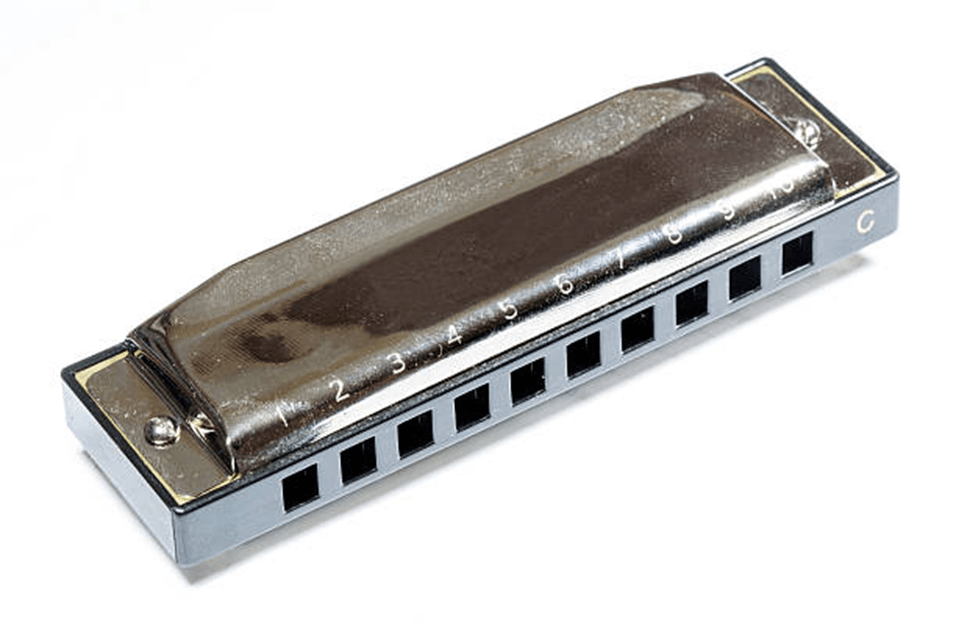
Frankly, I think all schools should teach harmonica. It’s inexpensive, and doesn’t take up much space. If it ever goes out of tune (and I have had two go bad) a new one is affordable. It isn’t much of an instrument for a marching band – but the mouth harp is always there if the power goes out.
Nothing stops a harmonica player from reading notes – but the beginner’s songbook is illustrated with up and down arrows (to show whether to breath in or out) and numbered 1 through 10 to show which hole gets the breath. 20 notes are enough for a lot of music.
So Thursday afternoon, I’ll be a volunteer classroom aid, showing 5th, 6th and 7th grade students how to get music out of a harmonica. We’re still recruiting for part-time teachers for the second and third trimesters.
The other neat thing about the block scheduling is that home-schooled students (fifth through eighth grades) now have an option to come in for a single class.
-
This past week, I read an article about racism in medicine based on different life expectancies between black and white Americans. The next day, I got a notice of the death of an Indian friend. He had taught his native language in a tribal college, was younger than I, and his diabetes had required amputations.
I suspect that diabetes was a greater killer in Europe and Asia as agriculture and cereal grains developed. Just a hunch – I have enough information for a hypothesis, but inadequate data to prove or disprove it.
I pulled this illustration of varying life expectancies at birth from simplyinsurance the web page has more statistics, and might well be worth reviewing if the topic interests you. There are differing life expectancies listed by race . . . but women tend to live longer than men as well. Let’s ignore the sex bias in life expectancy and check the numbers based on race:
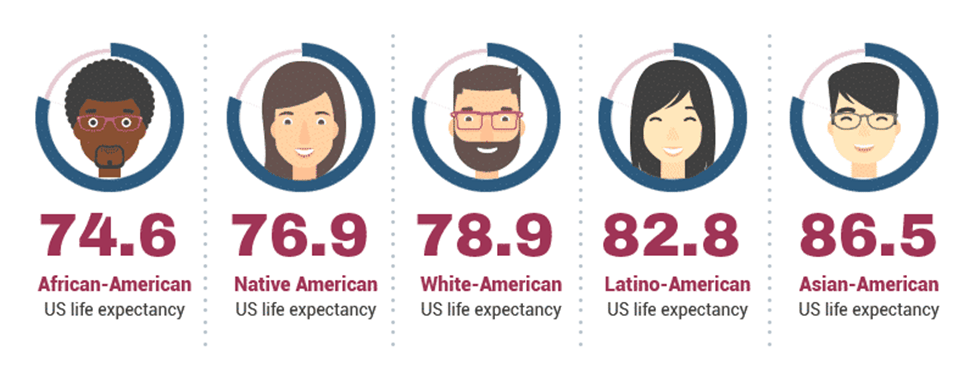
86.5 years – Asian-American
82.8 years – Latino
78.9 years – White
76.9 years – Native American
74.6 years – African-American
You will note, the difference in life expectancies shows Latino living longer than white, and Asians living even longer. Matter of fact, white Americans are smack-dab in the middle.
The web page offers this explanation:
The 11.9-year gap between Asian American and African American life expectancy. 60% of the deaths in the gap were from heart disease, cancer, homicide, diabetes, and mental health conditions. African-Americans in the US are more likely to die from heart disease White-Americans suicide rates are twice as likely than African-Americans Latest available data is from 2017 – OECD
It’s possible too that they’re right – so far as it goes. Native American death rates eclipse white rates on both diabetes and suicide. The blood quantum requirements show that there are a bunch of white folks in the ancestry on most reservations. Black Americans’ data shows more heart disease and homicide deaths. When I glance at the “Latino” category, I think back on a colleague with two century-old grandmothers, both from Mexico. In the US, the surnames make them Latino – in Mexico, speaking Spanish instead of one of the native languages was the decider.
Race, as we look at it, is an untidy classifier. Jay’s grandmothers are genetically more Indian than Spanish. A bunch of tribal members whom I know are only 25% Indian by blood quantum. Some of the tribes are mandating DNA testing to document ancestry.
Dr. James Thompson describes the intellectually lowest 5% of the population as: “High Risk”
“These are the least able 5% of the population. In a town of 10,000 persons these would constitute 500 citizens. Learning is slow, so all intellectual achievements take a fair bit of time. Since all lifespans are finite, and for this group lifespans are shorter than average, many skills are effectively out of reach because it is very unlikely that they will ever be learnt. Of course, some learning always takes place, because everyone can learn, but in their case the pace must be slow, the materials simple, and the steps carefully supervised.
Lifespans are more than 21% shorter than average, and they are more than 50% more likely to be suffering psychological difficulties than average. They are most at risk of all health problems, and all the problems of life.”
So, lifespans are not equal. Jay Vargas’ grandmothers lived longer lives than my grandmothers. Women tend to live longer than men. The bright tend to live longer than the dull. Asians tend to live longer than American Indians. The world isn’t a fair place – and passing new laws won’t achieve equality of life expectancy. I can live with that reality. As you step out today, enjoy the fact that you can still walk . . . Will spent his last years on wheels because of the ravages of diabetes. I heard humor, not regrets over unfairness. He continued to enjoy life. Now, gone away – and I wish for his wife and family that he hadn’t gone so far
-
At the start of each school year, Trego School hosts its annual BBQ which serves as something of a meet and greet for the community. It’s this Saturday and Noon. There will be food and the opportunity to meet new staff, visit with familiar faces, and check out any changes that have been made to the building before the new school year begins. The BBQ is open to the public
School starts on Wednesday, August 31st.
-
A bear seeks trashcans, fawns frolic, and a new coyote hunts beside the pond.






Want to tell us something or ask a question? Get in touch.

Recent Posts
- A Few Charts and Trends
- The Density of Water Explains When Dickey Lake Freezes
- Watching Iran
- The Quality of Numbers
- Robert Treat Payne Had Traveled To Greenland
- 75 Years Ago in New York
- Recovery Time for a Retiree
- Venn Diagram and DSM
- When Castro Was Cool
- You Have To Beat Darwin Every Day
- Computer Repair by Mussolini
- Getting Alberta Oil to Market
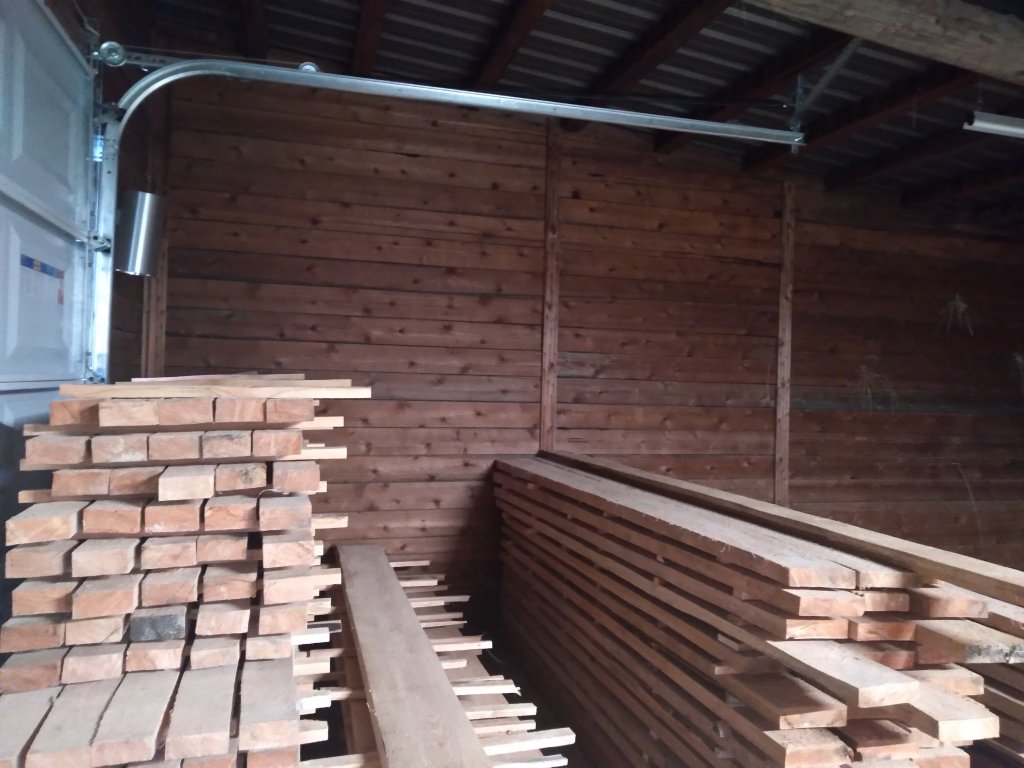
Rough Cut Lumber
Harvested as part of thinning to reduce fire danger.
$0.75 per board foot.
Call Mike (406-882-4835) or Sam (406-882-4597)
Popular Posts
Ask The Entomologist Bears Books Canada Census Community Decay Covid Covid-19 Data Deer Demography Education Elections family Firearms Game Cameras Geese Government Guns History Inflation life Lincoln County Board of Health Lincoln County MT Lincoln Electric Cooperative Montana nature News Patches' Pieces Pest Control Politics Pond Recipe School School Board Snow Taxes Teaching travel Trego Trego Montana Trego School Weather Wildlife writing
 Trego's Mountain Ear