-
Nobody filed as a democrat for the Lincoln County positions – and the only competitive race in the primary was between republicans for county commissioner. Basically, all the county’s administrative positions are determined in the courthouse, then we get to vote for a single slate of candidates.
When I was a lot younger, my elementary and high schools described the difference between the two party system we had in the USA, and the single party system that operated in the USSR. At twelve, I could see the argument. At 72, looking at the choices I will have in November, locally I don’t see any debate – the argument is a slightly more polite version of “Shut up, peasant. Joe Stalin received 100% of the votes.”
So let’s look at those unopposed administrative positions. There has at least been primary opposition for the county commissioners – but the county administrative positions are similar to the entrenched bureaucracy that in DC is often called “Deep State.” In Lincoln County, the unopposed County Clerk and Recorder could be considered the primus inter pares of Deep County. She (these positions are predominantly occupied by women) learned the ropes as a departmental employee in Libby, and was anointed to the position upon her predecessor’s retirement. County Treasurer is similar, though years ago Nancy Trotter Sutton moved into that office from the superintendent of schools office, where she had served as secretary.
It seems a safe generality to look at the real – not the legal – requirements of Lincoln County’s elective administrative positions as three-fold: Republican, Libbyan resident, and time served in the courthouse bureaucracy. None of these things make a person evil – but commonality of experiences can lead to a common world view. The big thing that leads to this shrunken candidate pool is the filing fees that keep the opposition from running a Quixotic campaign. Spending $300 just to make sure folks have a choice is an expensive gesture.
Filing fees are listed in the Montana Codes:
“Filing Fees
13-10-202. Filing fees. Filing fees are as follows:
(1) for offices having an annual salary of $2,500 or less and candidates for the legislature, $15;
(2) for county offices having an annual salary of more than $2,500, 0.5% of the total annual salary;
(3) for president in a presidential preference primary, an amount equivalent to the filing fee required for a United States senate candidate;
(4) for other offices having an annual salary of more than $2,500, 1% of the total annual salary;
(5) for offices in which compensation is paid in fees, $10;
(6) for officers of political parties, presidential electors, and officers who receive no salary or fees, no filing fee is required.”It looks like the legislators have kept their filing fees down – but let’s first look at how that half percent of the annual salary works out for our county offices:
Position Annual Salary Filing Fee Commissioner $60,560.88 $302.80 Sheriff $60,560.88 $302.80 Clerk and Recorder $58,560.88 $292.80 County Treasurer $58,560.88 $292.80 Clerk of Court $58,560.88 $292.80 Justice of the Peace $58,560.88 $292.80 Superintendent of Schools $58,560.88 $292.80 County Coroner $17,568.26 $87.84 Data taken from resolution archives at lincolncountymt.us Simply enough, the structure of the county administrative positions makes the filing fee the equivalent of a high stakes ante – it keeps otherwise qualified people from running for the job. I’m not saying we have bad people in those offices – but the system limits the potential candidates. The only particular qualifying criteria I noticed was that the County Coroner needs to have a high school diploma or GED. I’m guessing the other positions don’t demand the same high educational credentials.
“How legislators are compensated, or paid, for their work as public officials is outlined in Title 5, Part 2 of the 2019 Montana Code Annotated.
- SALARY RATE- $100.46/day (Equivalent to $12.56/hr)
- PER DIEM RATE (Session)- $126.12/day
- TRAVEL RATES (Caucus/Orientation/Interim)- (Note: Rates listed are as of 2/26/2021. (Certain rates change annually)
- Meals – $7.50(B)/ $8.50(L)/ $14.50(D)
- Lodging, Helena – $103.00 (plus applicable taxes)” (leg.mt.gov)
If we assume that Montana’s legislature meets for just 90 days every odd numbered year, that every other year salary is $9,041.40. . . or $4,520.70 per year. Their $15 filing fee, divided by .005 is proportional to a $3,000 annual salary – so the state senators and representatives are protected a bit from the filing fees. Still $15 isn’t enough to keep me from a Quixotic gesture. Three Hundred dollars probably is. The fact that, if I were to win, I would likely have to work with an office filled with my opponent’s supporters isn’t something that attracts me to local politics.
So what would I suggest? Two changes should bring back the two party system – first, for the local administrative offices, only require the filing fee from incumbents. Since we have so few competitive races, the counties won’t lose that much money. This year the loss in fees would have been about $300. Single party unopposed elections aren’t particularly good fundraisers.
Second, a simple addition to the ballot for any unopposed incumbent. A spot to vote to keep the candidate, and a spot to vote to send the candidate back to work in the private sector.
Of course there is still the option of trying to secede from a county that doesn’t serve the isolated north well.
-
Its getting a bit frustrating looking at single party elections. As a demographer, I’m kind of cynical about how congressional districts are gerrymandered every ten years after the census. It’s easiest to find conservative articles on the evils of gerrymandering because the dims are better at it.
Doesn’t really make any difference, since the republicans aren’t that far behind. From a Reason article: “Under the new congressional maps recently approved by state governments, there will be just 60 districts (out of 435 in total) that would have been decided by fewer than eight percentage points in the 2020 election, according to a recent analysis from the Brennan Center for Justice, a pro-democracy think tank housed at New York University.’
“To understand why this happens, take a look at Illinois . . . Democrats were focused on packing as many of the state’s Republican voters into as few districts as possible, thus maximizing the number of districts where Democrats would be favored to win. The result is three deeply red districts and 14 blue districts, many of which are nearly impossible for Republicans to hope to win—though a few of them rate as barely competitive. The map got a grade of “F” from the independent Princeton Gerrymandering Project, but fairness isn’t the goal of the partisans who control redistricting in many states. Maximizing victories is.”
But that means many voters don’t get a meaningful say in who represents them in Washington. Cynical single-party gerrymandering contributes to—and, circularly, is driven by—the hyperpartisanship that defines American politics right now.
“As a district leans further toward one party or the other, the general election becomes increasingly insignificant while the favored party’s primary becomes the real contest,” write Brennan Center analysts Michael Li and Chris Leaverton. “As a result, primary voters can effectively decide which candidate will represent the district in Congress, even though they make up a small fraction of the electorate and are often far more partisan than the average general election voters.”
That effect is compounded in states where strict ballot access laws limit the ability of third-party and independent candidates to compete as well. The two major parties limit competition between their own candidates by drawing single-party districts, then keep anyone who can’t win a Republican or Democratic primary election off the ballot as well—a pretty neat trick!”
And those ballot access laws hit close to home:
“On November 8, 2021, the U.S. Court of Appeals for the Ninth Circuit held that Montana’s signature-distribution requirement for party-qualifying petitions (described in more detail below) violated the Equal Protection Clause of the Fourteenth Amendment to the United States Constitution. It is unclear how this decision will affect Montana’s broader statutory scheme for forming a new political party.”
“In order to qualify to hold a primary election, aspirant political parties must petition the Montana Secretary of State for recognition.
A party qualifying petition must be signed by a number of registered voters equal to at least 5 percent of the total votes cast for the successful candidate for governor in the most general election, or 5,000 electors, whichever is less. In 2012, for example, 236,450 votes were cast for successful gubernatorial candidate Steve Bullock. Because 5 percent of that total is 11,823, aspirant parties were required until the election season following the gubernatorial race of 2016 to gather 5,000 valid signatures for qualifying petitions.
This number must include registered voters in more than one-third of the legislative districts equal to at least 5 percent of the total votes cast for the successful candidate for governor at the last general election in those districts, or 150 electors in those districts, whichever is less. In 2014, for example, 119 signatures were required from each of the 34 districts from the Montana House of Representatives.[120][121]
One week before the petition is due to the secretary of state, the petition and affidavits of circulation must be presented to the election administrator of the county in which the signatures were gathered to be verified. The election administrator must forward the verified petition to the secretary of state at least 85 days before the date of the primary.[120]
The form of the petition is prescribed by the secretary of state. Petition forms and affidavits of circulation can be obtained via the secretary of state’s website.[122]
All qualified political parties must submit to the secretary of state a copy of the current rules of party government. Further, county-level party committees must submit a copy of the current rules of party government to the county election administrator.[123][124]
Maintaining party status
Political parties that fielded a candidate for statewide office in either of the last two general elections who received at least 5 percent of the total votes cast for the most recent successful candidate for governor maintain state-qualified status and may continue to nominate candidates by primary elections. To maintain qualified party status in 2014, for example, a party would have had to run a candidate for statewide office in either 2012 or 2010 who received at least 11,823 votes (5 percent of the votes cast for the successful gubernatorial candidate in 2012).
https://ballotpedia.org/Ballot_access_requirements_for_political_parties_in_the_United_StatesThat isn’t the only spot where Montana’s election laws have been hammered by the 9th Circuit.
“On August 10, the Ninth Circuit issued an opinion in Pierce v Jacobsen, 21-35173. The opinion strikes down Montana’s ban on out-of-state circulators for initiative petitions (Montana has never banned out-of-state circulators for other types of petition).
https://ballot-access.org/2022/08/10/ninth-circuit-invalidates-montanas-ban-on-out-of-state-circulators-for-initiative-petitions/
The plaintiffs had also challenged Montana’s ban on paying circulators on a per-signature basis. The decision declined to strike down that ban. It says the ban may be unconstitutional, but plaintiffs didn’t present enough evidence to justify striking it down.”Another Ninth Circuit ruling showed up last month:
“The U.S. Ninth Circuit Court of Appeals has sided with two conservative Montana residents who the state’s Commissioner of Political Practices had made register as a political group because of the law’s vague language regarding the definition of a political committee.
At issue was former Montana lawmaker Ed Butcher and Lonny Bergstrom, who maintain a website, “Legistats,” which tracks how well Republicans in the state Legislature voted with the party on bills generally considered partisan.
While running the site, the two got requests from various Republican and conservative groups to speak. They traveled, often eating at fast-food restaurants, and using their own gas money to visit the state, one time staying at a Glendive motel. According to court records, they never received compensation for their time nor were they reimbursed for their expenses.
Jeff Mangan, Montana’s Commissioner of Political Practices, ruled their activities triggered state law, which required them to file reports and disclose that they were a political committee because they had spent more than $250 engaged in the political process.
However, the Ninth Circuit overturned federal district Judge Dana Christensen’s ruling that Montana’s political practice rules did not violate Butcher and Bergstrom’s political free speech. Instead, a panel of judges wrote that Montana’s rules were impermissibly vague and therefore likely unconstitutional. The panel voted 2-to-1 in the split decision.”
https://dailymontanan.com/2022/07/07/9th-circuit-rules-montanas-political-laws-too-vague-to-be-enforceable/Read the articles – I’ve just excerpted enough to illustrate a couple of spots where Montana’s election laws and practices have been ruled unconstitutional. I’m fairly certain that not all politicians have high regard for fair elections.
-
Our old coyote – a long-time resident – has been gone for about a year. He was a pretty good neighbor, who avoided the area around the house, left the little dogs alone, and hunted with his one-eyed consort. We watched her and she would hunt the edge of the trees while he would work the drainage ditch. I doubt if she could have survived well on her own.
Now, new coyotes are wandering through the fields and trails, trying to establish a new territory. There’s a new pair coming by in the nights and early morning – and I have no idea what sort of neighbors they might be.
Then we have the young single coyote – it doesn’t seem to be much of a problem, but hunting voles and mice along the edge of the pond at noon doesn’t seem to be a good habit. Cute little guy, but too close. Entirely too close.
We lost one fawn today – from the location, I think it was hit on the road, made it back onto the place, and then was eaten by the bear. Not like I’m any great tracker, but bear scat tends to be easy to recognize. I’ve enjoyed watching the twins – their mother tried to keep them close to the house as a safe place . . . but cars are as dangerous to little deer as predators are.
The geese are all gone from the pond, as are the diving ducks. The young mallards are all flying, with mothers giving the injured bird impersonations – and there are at least six little coots and two adults.
-
I found myself explaining that being a tree is sort of the plant equivalent of being a crab. There’s a ton of variety of trees out there, and they all look, well, like trees. The thing about that is, they aren’t really closely related at all. An apple tree is more closely related to a dandelion than it is to a Ponderosa Pine. Completely different lineage.
This is an example of what evolutionary biologists tend to call Convergent Evolution. What basically happens is that there is one really good way to be something, and so lots of distantly related groups end up looking very similar. In animals, this looks like crabs.
It’s so common there’s actually a specialized word for it; carcinization. It’s definitely an oversimplification to say that everything evolves into crabs, but crabs have evolved five different times, which definitely suggests that there is something good about being a crab.
Of course, trees have evolved independently way more times than crabs have, so arguably being a tree might be better than being a crab.
So- there’s your new word, and biology trivia, all in one.
-
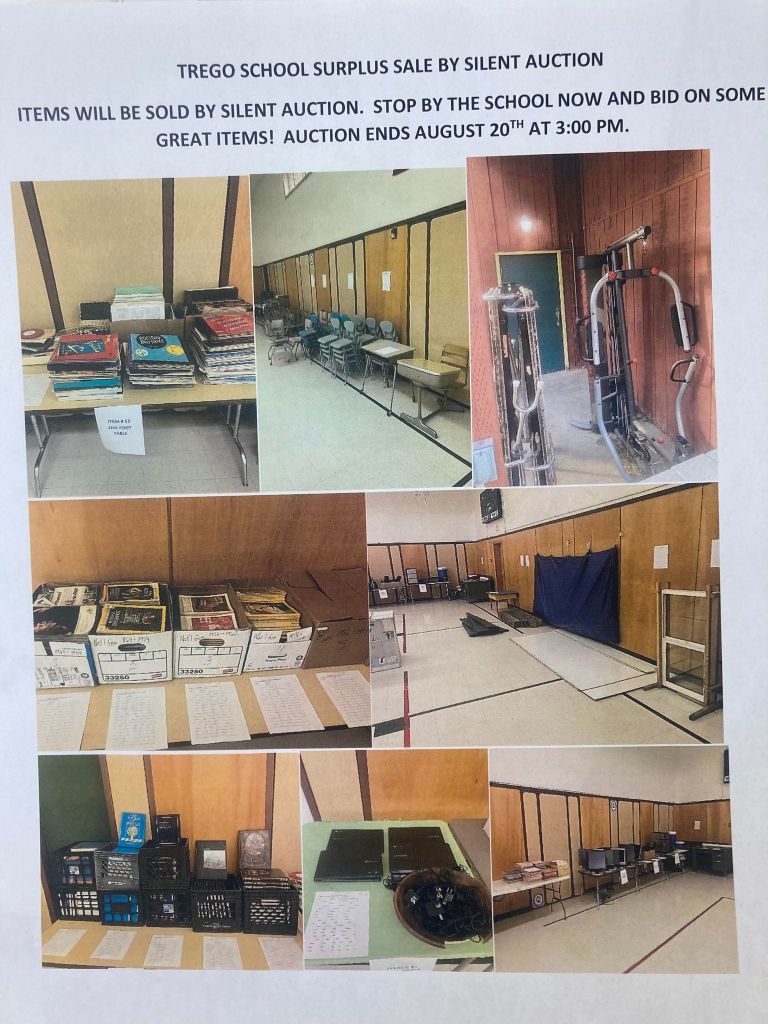
Trego School is selling surplus items by silent auction through the 20th of August. So, if any of this looks interesting, stop by before 3:00 PM this saturday and put in a bid! Books, chairs, national geographic, computers and more!
-
We had a bear on the porch Saturday morning. We know this because it took the black garbage can from the porch, pulled the lid off, and strewed scraps of wood, cloth, paper and diet soda empties across the drive. I had heard of bears that recognized the shapes of garbage cans – and this seems to be the case. It left the indoor type garbage can alone, and a box with similar contents. Shape, I think, not smell. Poor little mess maker didn’t even get a snack, much less a meal. I am definitely glad it stayed out of the garden . . . reinforcing the idea that this bear hunts for shapes, not by scent.
It’s not the first time my garbage was raided. The first time was in Trinidad, Colorado, in the early years of my first professor mikey gig. That time it was a large dog that tipped over the garbage can and ran whimpering away. I put 2 and 2 together after I rushed out to pick the mess up bare handed, and discovered that Renata had heavily pruned an indoor cactus, cleverly concealed all the cuttings in white plastic bags, and picking up those white plastic bags was an experience that could be compared with juggling porcupines.
This time, young no more, I picked up the trash in the painless method, using a tool to pick things up without bending. I feel a lot better picking up after the bear than I did picking up the camouflaged cactus clippings.
-
I extracted this data shortly after I wound up on Trego’s school board. It’s important to remember that Fortine is only six miles distant, as the enrollment figures below show it has steadily increased enrollment. The data includes enrollments over time and 2010 census numbers for ages 5 to 14. Students from Trego (district 53) attended both Eureka and Fortine. I have included those districts in this table (raw numbers 2005 to 2015 from County Superintendent report, 2019 data from Mr. Selle and calls to Fortine and Eureka). The percentages are from the three schools total enrollment. Looking at the percentages rather than the raw data, the 2010 Census data demonstrates that the drop in enrollment is not demographic. The percentages show that our students are leaving the district. It needs to be considered whether management decisions are responsible for some portion of the decline.
Year Trego Fortine Eureka Total 2005 47 (7.8%) 50 (8.3%) 505 (83.9%) 602 2006 56 (9.1%) 52 (8.8%) 507 (82.4%) 615 2007 47 (7.3%) 56 (8.75%) 537 (83.9%) 640 2008 35 (5.7%) 57 (9.3%) 519 (84.9%) 611 2009 32 (5.3%) 59 (9.8%) 508 (84.8%) 599 2010 27 (4.5%) 69 (11.6%) 498 (83.8%) 594 2010 census age 5-14 76 (9.8%) 77 (9.9%) 621 (80.2%) 77 (9.9%) 2011 21 (3.8%) 72 (13%) 460 (83.2%) 553 2012 29 (5.2%) 76 (13.5%) 458 (81.3%) 563 2013 26 (5%) 70 (13.5%) 423 (81.5%) 519 2014 25 (4.9%) 82 (15.9%) 408 (79.2%) 515 2015 22 (4.3%) 76 (14.8%) 416 (80.9%) 514 2019 6 (1.06%) 89 (15.8%) 470 (83.2%) 565 Comparing the North County enrollment data with the 2010 Census suggests that over 20% of the eligible youth were not enrolled in any of the three elementary schools. Trego, at 35% has been worse at enrolling district students than Fortine (89.6%) or Eureka (80%). Eureka, at 80% enrollment, may be influenced by the West Kootenai population.
And that’s the gist of things with the data that was available in 2019. By the end of that school year, Trego was down to 4 ANB (Average Number Belonging). It always seems that building back is a harder task.
Since 2019:
Trego School Enrollment Soars
Enrollment at Trego School continues to rise, in defiance of the historical trend. For the last few decades, school enrollment has been fairly steadily dropping. How low did enrollment actually get? The lowest official ANB (Average Number Belonging -i.e. the official state count of students) that I can find is seven, in the spring of…
-
The United States Sentencing Commission released a 40 page document titled “What Do Federal Firearms Offenses Really Look Like?” It’s available at this link
It begins with the explanation “The Commission’s prior research shows that firearms offenders are generally younger, have more extensive criminal history, and are more likely to commit a new crime than other offenders. The Commission’s previous research also shows that firearms offenders are more likely than other offenders to engage in violent criminal behavior.”
The Key Findings include:
Firearms offenses are among the most common crimes prosecuted and sentenced in federal court.
The guidelines exert a strong influence on the sentences imposed in firearms cases.
Firearms offenders sentenced under §2K2.1 have criminal histories that are more extensive and more serious than other offenders.
The vast majority of firearms offenders (88.8%) sentenced under §2K2.1 were prohibited from possessing a firearm.
In addition to most §2K2.1 offenders being prohibited from possessing a firearm, firearms offenders often engaged in aggravating criminal conduct.
Firearms offenses often involved stolen firearms or particularly dangerous weapons.
The average sentence for §2K2.1 firearms offenders varied depending on the presence of aggravating factors.
Prohibited persons who did not engage in aggravating conduct received an average sentence of 35 months. Courts imposed longer sentences on prohibited persons whose offenses involved:
- • a stolen firearm or a firearm with an altered or obliterated serial number (55 months);
- a prohibited weapon (such as a sawed-off shotgun or machine gun) (58 months);
- trafficking in firearms (62 months); or
- the use of, or conspiracy to use, a firearm in connection with a crime of violence or drug trafficking crime (119 months).
The report does a pretty good job of showing how firearms cases are treated in the federal courts.
Still, it seemed supported by this article at: courant.com
““The investigation revealed that the firearm was registered to a family member of Boucher, and that Boucher had purchased 10 other firearms at various gun stores in Connecticut between 2018 and 2021,” federal prosecutors said in a statement. Boucher admitted to investigators that she had purchased firearms for others, and no longer had any of the 10 firearms that were registered to her, the statement said,
Authorities in September 2021 recovered from another felon one of the 10 firearms Boucher purchased, but the other nine firearms have not been found, the statement said.
Boucher was arrested on a federal criminal complaint on Oct, 15, 2021, and has been in custody since February 23, 2022, when her bond was revoked, according to federal prosecutors. She pleaded guilty on April 29 to making a false statement to a firearms dealer.”She got one year for 10 straw purchases, and the felon she bought for got five years for possession.
The article seems worth reading.
-
I saw this map on Ace of Spades blog – and decided to find the source article. It’s at projects.propublica.orgit. I’d been reading an email from Jon Tester on how great the Inflation Reduction Act is . . . though he didn’t stress that it will more than double the number of IRS agents at a cost of 80 billion dollars.

The map at the link is interactive – so clicking on Lincoln County, I learn that we’re a little more likely to get audited here than in Missoula County (among others) – but it depends on how much you make:
“Kim M. Bloomquist, the author of the study, which was first published in the industry journal Tax Notes, served as a senior economist with the IRS’ research division for two decades. He decided to map the distribution of audits to illustrate the dramatic regional effects of the IRS’ emphasis on EITC audits. Because more than a third of all audits are of EITC recipients, the number of audits in each county is largely a reflection of how many taxpayers there claimed the credit, he found.”
I noticed that there seem to be more audits on Reservations – but I suspect that as a western rural demographer that’s something I spot readily. The study explains: “The five counties with the highest audit rates are all predominantly African American, rural counties in the Deep South. The audit rate is also very high in South Texas’ largely Hispanic counties and in counties with Native American reservations, such as in South Dakota. Primarily poor, white counties, such as those in eastern Kentucky in Appalachia, also have elevated audit rates.”
Click the link – if we’re going to see the IRS workforce doubled, it’s probably a very relevant read in the immediate future. There aren’t enough billionaires to keep 86,000 more IRS employees busy with audits. According to irs.gov “in FY 2021, the IRS used 78,661 full-time equivalent (FTE) positions in conducting its work, a decrease of 12.9 percent since FY 2012.”

I don’t know how 86,000 more IRS agents are going to correct inflation – but Jon Tester seems convinced it will work.
-
Psychology has a difficult time with scientific methodology. The Diagnostic and Statistical Manual – the bible for diagnosing mental illness, personality disorders, etc. is a document where consensus has been important. The ed psych folks – with IQ tests and the g factor – do tend to have a record of replicable research. It’s hard to do science when everything is a case study – Psychologist Hans Eysenck termed Freud as “a genius, not of science, but of propaganda, not of rigorous proof, but of persuasion, not of the design of experiments, but of literary art.” I have to give them credit – doing science at the individual level is challenging. So I’m looking back to 1973, when Rosenhan published “On Being Sane in Insane Places.” The whole article is worth reading.
The summary:
- Between 1969 and 1972, Prof. David Rosenhan, a psychiatrist at Stanford University, sent eight pseudo-patients to 12 psychiatric hospitals without revealing this to the staff. None of the pseudo-patients had any symptoms or history of mental disorders.
- In all 12 instances, pseudo-patients were diagnosed with a mental disorder and hospitalised. In no instance was the misdiagnosis discovered during hospitalisation.
- In some of the 12 hospital stays, pseudo-patients observed significant deficits in patient-staff contact.
- In a follow-up study at one hospital, Prof. Rosenhan asked staff to rate patients seeking admission on a 10-point scale, from “highly likely to be a (healthy) pseudo-patient” (1 or 2) to “least likely to be a pseudo-patient.” Staff were aware of the previous study, and told one or more pseudo-patients would be sent their way, unannounced. Forty-one (21.24%) of 193 patients received a 1 or 2 score. No pseudo-patients were, in fact, sent.
- These findings provided convincing evidence against the accuracy and validity of psychiatric diagnoses.
- The current state of psychiatric diagnoses is still broadly at odds with recent neurological findings, leading to uncertainty regarding their accuracy. A number of interventions are proposed or underway to correct this. None counts with widespread support yet.
There’s a good read between the summary and Rosenhan’s conclusion:
It is clear that we cannot distinguish the sane from the insane in psychiatric hospitals. The hospital itself imposes a special environment in which the meanings of behaviour can easily be misunderstood.
Rosenhan 1973, p. 257Years ago, reading Rosenhan convinced me that psychologists may not have the answers – but with his death, and the anonymity of his “pseudo-patients”, his study is hard to falsify too.



Want to tell us something or ask a question? Get in touch.

Recent Posts
- A Few Charts and Trends
- The Density of Water Explains When Dickey Lake Freezes
- Watching Iran
- The Quality of Numbers
- Robert Treat Payne Had Traveled To Greenland
- 75 Years Ago in New York
- Recovery Time for a Retiree
- Venn Diagram and DSM
- When Castro Was Cool
- You Have To Beat Darwin Every Day
- Computer Repair by Mussolini
- Getting Alberta Oil to Market

Rough Cut Lumber
Harvested as part of thinning to reduce fire danger.
$0.75 per board foot.
Call Mike (406-882-4835) or Sam (406-882-4597)
Popular Posts
Ask The Entomologist Bears Books Canada Census Community Decay Covid Covid-19 Data Deer Demography Education Elections family Firearms Game Cameras Geese Government Guns History Inflation life Lincoln County Board of Health Lincoln County MT Lincoln Electric Cooperative Montana nature News Patches' Pieces Pest Control Politics Pond Recipe School School Board Snow Taxes Teaching travel Trego Trego Montana Trego School Weather Wildlife writing
 Trego's Mountain Ear