-
This article is the board chairman’s speech for Trego’s graduation. It comes after a year of strife and the board’s decision to move to a new model of education that recognizes the level of expertise and education that is present within our community. The era of the single-classroom generalist teacher has passed. We’ve recognized that our school will be better integrated into the community by accepting the 21st Century and hiring adjunct faculty to teach the specialized classes our students need as they move from 5th through 8th grades. Call Shari at 882-4713 if you’re interested in being part of the team – you may have a great idea that hasn’t crossed our minds.
Fifty-nine years ago, I graduated from Trego’s eighth grade. The graduation speaker was a forester, who seemed to be directing his remarks to Marvin Osler, explaining that Osler Brothers Mill wouldn’t be there for his career. He was right – as I drive by the old mill site, I see a Koocanusa Brewery building and sign where the Osler brothers once supplied dimension lumber to the nation.
I graduated from a different building, with 3 classrooms down where the outside basketball hoops grow from the asphalt. This school building came along three years later, as Trego became a boom town for the tunnel and railroad relocation projects.
I think of the sawmills that are gone – Ksanka, Osler Brothers, Tobacco River, Stevens, Owens & Hurst – and how the timber industry powered the economy in the valley. Now, the Economic Research Service classifies us as recreational, government dependent and retirement destinations for the economic drivers. Trego school remains.
A century ago, my mother was finishing the first grade at Trego. I don’t know how much she learned, but I recall two stories. The first was seeing a bear as she walked to school, and how her teacher didn’t believe her. “There aren’t any bears in Trego.” The second was a tale of technology – you see, toilet paper was a new technology in 1922, and that same teacher was teaching students to use that new technology. One square per trip to the outhouse. I don’t recall the teacher’s name – but I do recall the lesson that my mother didn’t accept. I guess we could say that the teacher was preparing her students for the great covid toilet paper shortage of 2020.
A century ago, Trego’s main industry was transportation – specifically transporting logs to Eureka from the old dam on the Dickinson place. Picture if you can – the gates of the dam blasted open with a dynamite charge, and a crew riding that small flood filled with logs for the 20 mile trip to Eureka. The dam was last used around 1954 – that industry is gone. The one-room log school of the twenties burned. Trego school remains.
Marvin went on to become a teacher – he completed his master’s quite a while before I got mine. Mom went on to nursing school in Spokane – along with the invasion of Guadalcanal, the Navy put a hospital in grass huts at Milne Bay in New Guinea. Trego’s home industries were gone – but education pushed their way into future careers.
The eighth grade is the first big step. When public education began, it was the step into the working world. Now, it’s the step into high school. Congratulations. You are Trego’s final graduate of the old model. It was a good system, serving the purpose of preparing young people for the working world. Still, we probably should have made the change from the 19th century model at least 20 years ago.
The students you’re leaving behind are going to enter a different world of education – and the first change will be learning from specialized teachers instead of generalist elementary teachers for fifth grade up.
Our first goal is that our eighth grade graduates will have the opportunity to bring a credit in algebra and a foreign language credit with them as they enter high school. Not everyone will pass high school algebra in the eighth grade – but if you do, that credit travels with you. We’re looking at filling that fifth block with a foreign language that can travel with you to high school.
The friends you leave can expect classes based on blocks and a trimester system. Imagine for a moment, having a professional wildlife biologist teaching life science for thirteen weeks, then getting 13 weeks of Newtonian physics, followed by 13 weeks of earth science from a geologist. The friends you leave behind will be moving into an exciting world that takes them further into the sciences.
Social studies – this is my area . . . I became a sociologist and demographer – but next year, the friends you leave behind will move into social studies as well as history. Think for a moment of 13 weeks specializing in Montana history . . . of 13 weeks learning enough economics that you could CLEP the first college course . . . CLEP? College Level Examination Program – your friends might not learn enough at Trego to take the test and get credit – but I’m betting at least half of them would. Between the blocks and the trimesters, your friends will have experts preparing them for high school. In college, the teachers would be called adjunct faculty – coming in to teach what they are really, really good at teaching – subjects that they love.
Math? I spent 3 years with dear Mrs. Price – and may have moved ahead 3 months. Picture a math program that includes the real world applications of surveying, of forestry, of statistics. Math is power, math is fun – and next year, Trego’s students will be studying math in ways that use real world applications that make math fun and relevant.
English? Three teachers over a year let us have a teacher who loves grammar, a teacher who loves teaching speech and drama, and another who teaches writers.
I haven’t even started on the afternoon half-blocks. Picture a two-hour block taught by a professional artist on Monday, moving to Tuesday’s music class. When I went to High School from Trego, band wasn’t an option for me – I hadn’t taken the required classes in Junior High. We will be correcting that long-term omission. Picture 13 weeks of learning electrical wiring, followed by another 13 weeks emphasizing solar energy. I could go on – 3 trimesters and 5 blocks each week will let us offer fifteen artistic, vocational and PE classes each year. Who knows? We may even rebuild the greenhouse and get some horticulture going.
The 21st Century perspective offers opportunities. We can’t out-Eureka Eureka. Eureka has a century of experience at developing outstanding athletic teams. We can’t out-Fortine Fortine – they still have their first school building in operation. Our first burned down, and our second was dismantled by Tommy and LeeRoy. We’re moving on to be the best Trego we can be.
This summer will see some additions to the playground – centered around the idea of individual, life-long sports. A combination frisbee golf and pitch and putt course will be set up – forms of golf that don’t require a lot of travel or expense (or break windows). We’re looking at a cross-country ski course for our students – I’ll cheerfully admit that the ability to use cross-country skis kept me employed for six or seven years. We’re talking about adding air-rifle training – all activities that qualify as PE and can be added to the afternoon half-blocks.
Fifty-nine years between us – and we’re both examples of the old model. That’s OK – previous graduates have shown that you can go anywhere from here. The world will provide you a living – you just have to work every day to collect it. Grab it with both hands – you’re the last of the old model. From your peer, over 50 years in the past, my heartfelt “Congratulations.” I envy the things that you will see.
-
My post-Uvalde thoughts move toward hardening our own little school. School shootings are always statistically unlikely. The timeline at Uvalde shows that at 11:27, a teacher props the door open. It remains open for 6 minutes before the crazy little bastard enters the school. He doesn’t close it – the door remains open and is the access point for police. A safety protocol broke down. The crazy little bastard had a six-minute window of opportunity. Twenty-one people died and 17 more were wounded. Six minutes.
In demography, our phrase is “Malthus only has to be right once.” I listened to a Fed describing terrorist attacks – “They have to get lucky once. We have to get it right every day.” The exercise showed how hard that was. A teacher, secure in the misbelief that a statistically unlikely event wouldn’t happen, propped a door open. For 6 minutes. The crazy got in. The statistically unlikely event happened. We play poker hoping for statistically unlikely events to occur.
It’s easy to look at the police failures – but the initial failure was the teacher who wedged the door open . . . secure in the belief that there was no risk in violating that simple safety protocol. Staying alert, maintaining security against something that does not occur, day after day, is difficult.
I can think of many situations where a teacher wouldn’t want to keep unlocking the door. It’s Spring – the time when contracts are, or are not renewed. We’ve had that this year at Trego – and seen a bit of hostility over it. It gives me a perspective that, in Uvalde, the shooter gained access not through police failure, but through a teacher’s carelessness. I can understand both carelessness and resentment.
I have forgotten the name of the teacher who left his female engineering students to be killed at the Montreal Polytechnique Massacre. I hope he came to some sort of grips with his failure – I know I could not have accepted that decision had it been mine. Perhaps the Uvalde teacher who spent 20 lives for easier access to the door can come to grips with that conduct. I would hate to have to rationalize it had it been my blunder.
It is difficult to stay constantly on the alert for the statistically unlikely occurrence. Years of boredom are eventually interrupted by a few minutes of stark terror. Uvalde’s police, like Parkland’s, made poor choices – but the timeline shows that a teacher who propped the door open had the best opportunity to eliminate the shooter’s opportunity. Was it just casual carelessness? Was it carelessness coupled with resentment? I do not know – but I have read the pricetag, and it was too high.

-
Trego School is accepting applicants to teach a four hour science class, once a week, to the upper grades. While most teaching contracts run the entirety of the school year, that isn’t necessarily the case for this one. Trego School is operating on a trimester system, which means that an applicant could choose to teach for a single trimester. At four hours a week, and thirteen weeks in a trimester, that means a commitment of 52 hours.
Who’s qualified? Anyone licensed to teach the subject to the relevant grades. As it happens, this means anyone with an elementary license for grades k-8, as well as anyone with a secondary (high school license) for grades 5-12. In the case of the high school license, the area of endorsement must correspond to the classes taught.
Out of state license? Shouldn’t be too much of a problem. Montana’s Office of Public Instruction should be making it easier to obtain a Montana Teaching License for those licensed to teach in other states.
Retired Montana Teacher? Anyone receiving a retirement from Montana’s Teacher Retirement System can be paid up to $21,400 a year by a public school without interfering with their retirement.
What could you teach? The state of Montana provides teaching standards for Life Science, Earth and Space Science and Physical Science. It would be quite reasonable to expect a trimester devoted to each. Large districts typically divide those into a year of earth science, a year of life science and a year of physical science. Why? Those classes are taught by the same teacher each year, someone who specializes in the topic. Trego school is using the same approach- each class taught by someone who specializes. And, unlike the model of the large districts, this approach is effective in a multi-grade classroom.
Experience tells me that the same standards can be met in more than one type of class. Earth Science standards might be met in an astronomy class, which begins with the big bang and ends with the formation of planets and the processes that shape them. A class detailing earth’s geological history might meet the same standards. Life Science standards can be met with an introductory biology course, but a class on evolution will naturally include cell biology and ecology as well. The interconnected nature of life science means a variety of classes can teach those standards. Short answer? Teach the class you love to teach.
Why have a part-time teacher? We ask a lot out of elementary teachers. We license them to teach students from kindergarten up to the eighth grade- and those two age groups have considerable differences. Then, if that’s not enough, we license them to teach every subject; Art, PE, Science, Math, English, Social Studies- for every grade! Allowing teachers to focus and dive deep into a single area keeps teachers from being spread too thin and lets them teach the subjects they love.
Interested in Applying? Contact Shari Puryer (clerk@tregoschool.org) for more details and to pick up a copy of the District Application.
-
When it comes to the House of Representatives, I’m a Constitutional scholar. Specifically Article 1, Section 2 – “The House of Representatives shall be composed of Members chosen every second Year by the People of the several States, and the Electors in each State shall have the Qualifications requisite for Electors of the most numerous Branch of the State Legislature.
No Person shall be a Representative who shall not have attained to the Age of twenty five Years, and been seven Years a Citizen of the United States, and who shall not, when elected, be an Inhabitant of that State in which he shall be chosen.
(Representatives and direct Taxes shall be apportioned among the several States which may be included within this Union, according to their respective Numbers, which shall be determined by adding to the whole Number of free Persons, including those bound to Service for a Term of Years, and excluding Indians not taxed, three fifths of all other Persons.) (The previous sentence in parentheses was modified by the 14th Amendment, section 2.) The actual Enumeration shall be made within three Years after the first Meeting of the Congress of the United States, and within every subsequent Term of ten Years, in such Manner as they shall by Law direct. The Number of Representatives shall not exceed one for every thirty Thousand, but each State shall have at Least one Representative; and until such enumeration shall be made, the State of New Hampshire shall be entitled to chuse three, Massachusetts eight, Rhode Island and Providence Plantations one, Connecticut five, New York six, New Jersey four, Pennsylvania eight, Delaware one, Maryland six, Virginia ten, North Carolina five, South Carolina five and Georgia three.
When vacancies happen in the Representation from any State, the Executive Authority thereof shall issue Writs of Election to fill such Vacancies.
The House of Representatives shall chuse their Speaker and other Officers; and shall have the sole Power of Impeachment.”
The lines highlighted in yellow govern the decennial Census and apportionment of Congresscritters. Congresscritters are apportioned according to population – not according to the number of citizens a state has. As you look at the data, you can see that one out of each seven people represented by a California Congresscritter isn’t a US Citizen.
If Congress were to pass a law requiring seats in the House of Representatives be apportioned based on citizens instead of population, California would probably lose 5 seats, New York and Florida each 2, and New Jersey and Illinois 1 each. Somehow, I don’t think it will happen.
State demographics by citizenship status|
Citizenship status of residents, 2014State Total Population Native Foreign-born
TotalForeign-born
NaturalizedForeign-born
Non-citizenAlabama 4,817,678 4,651,201 166,477 55,514 110,963 100.0% 96.5% 3.5% 1.2% 2.3% Alaska 728,300 676,620 51,680 27,910 23,770 100.0% 92.9% 7.1% 3.8% 3.3% Arizona 6,561,516 5,677,869 883,647 339,481 544,166 100.0% 86.5% 13.5% 5.2% 8.3% Arkansas 2,947,036 2,811,266 135,770 40,384 95,386 100.0% 95.4% 4.6% 1.4% 3.2% California 38,066,920 27,776,284 10,290,636 4,911,899 5,378,737 100.0% 73.0% 27.0% 12.9% 14.1% Colorado 5,197,580 4,690,377 507,203 192,391 314,812 100.0% 90.2% 9.8% 3.7% 6.1% Connecticut 3,592,053 3,101,593 490,460 235,507 254,953 100.0% 86.3% 13.7% 6.6% 7.1% Delaware 917,060 840,181 76,879 35,527 41,352 100.0% 91.6% 8.4% 3.9% 4.5% District of Columbia 633,736 545,110 88,626 34,483 54,143 100.0% 86.0% 14.0% 5.4% 8.5% Florida 19,361,792 15,571,963 3,789,829 1,960,009 1,829,820 100.0% 80.4% 19.6% 10.1% 9.5% Georgia 9,907,756 8,945,010 962,746 371,908 590,838 100.0% 90.3% 9.7% 3.8% 6.0% Hawaii 1,392,704 1,143,424 249,280 140,906 108,374 100.0% 82.1% 17.9% 10.1% 7.8% Idaho 1,599,464 1,503,829 95,635 34,229 61,406 100.0% 94.0% 6.0% 2.1% 3.8% Illinois 12,868,747 11,081,821 1,786,926 838,686 948,240 100.0% 86.1% 13.9% 6.5% 7.4% Indiana 6,542,411 6,229,726 312,685 112,699 199,986 100.0% 95.2% 4.8% 1.7% 3.1% Iowa 3,078,116 2,934,406 143,710 54,017 89,693 100.0% 95.3% 4.7% 1.8% 2.9% Kansas 2,882,946 2,687,052 195,894 68,325 127,569 100.0% 93.2% 6.8% 2.4% 4.4% Kentucky 4,383,272 4,235,463 147,809 52,653 95,156 100.0% 96.6% 3.4% 1.2% 2.2% Louisiana 4,601,049 4,419,407 181,642 72,250 109,392 100.0% 96.1% 3.9% 1.6% 2.4% Maine 1,328,535 1,281,406 47,129 25,631 21,498 100.0% 96.5% 3.5% 1.9% 1.6% Maryland 5,887,776 5,050,375 837,401 397,433 439,968 100.0% 85.8% 14.2% 6.8% 7.5% Massachusetts 6,657,291 5,639,925 1,017,366 520,931 496,435 100.0% 84.7% 15.3% 7.8% 7.5% Michigan 9,889,024 9,278,502 610,522 308,236 302,286 100.0% 93.8% 6.2% 3.1% 3.1% Minnesota 5,383,661 4,980,116 403,545 193,791 209,754 100.0% 92.5% 7.5% 3.6% 3.9% Mississippi 2,984,345 2,917,374 66,971 23,498 43,473 100.0% 97.8% 2.2% 0.8% 1.5% Missouri 6,028,076 5,792,081 235,995 103,033 132,962 100.0% 96.1% 3.9% 1.7% 2.2% Montana 1,006,370 985,850 20,520 10,894 9,626 100.0% 98.0% 2.0% 1.1% 1.0% Nebraska 1,855,617 1,735,200 120,417 42,721 77,696 100.0% 93.5% 6.5% 2.3% 4.2% Nevada 2,761,584 2,234,549 527,035 233,551 293,484 100.0% 80.9% 19.1% 8.5% 10.6% New Hampshire 1,321,069 1,247,657 73,412 38,529 34,883 100.0% 94.4% 5.6% 2.9% 2.6% New Jersey 8,874,374 6,969,969 1,904,405 989,166 915,239 100.0% 78.5% 21.5% 11.1% 10.3% New Mexico 2,080,085 1,874,204 205,881 70,926 134,955 100.0% 90.1% 9.9% 3.4% 6.5% New York 19,594,330 15,218,385 4,375,945 2,317,787 2,058,158 100.0% 77.7% 22.3% 11.8% 10.5% North Carolina 9,750,405 9,009,170 741,235 240,268 500,967 100.0% 92.4% 7.6% 2.5% 5.1% North Dakota 704,925 684,370 20,555 7,484 13,071 100.0% 97.1% 2.9% 1.1% 1.9% Ohio 11,560,380 11,091,189 469,191 233,953 235,238 100.0% 95.9% 4.1% 2.0% 2.0% Oklahoma 3,818,851 3,604,070 214,781 70,846 143,935 100.0% 94.4% 5.6% 1.9% 3.8% Oregon 3,900,343 3,516,357 383,986 150,498 233,488 100.0% 90.2% 9.8% 3.9% 6.0% Pennsylvania 12,758,729 11,976,626 782,103 401,469 380,634 100.0% 93.9% 6.1% 3.1% 3.0% Rhode Island 1,053,252 915,234 138,018 70,049 67,969 100.0% 86.9% 13.1% 6.7% 6.5% South Carolina 4,727,273 4,500,820 226,453 81,502 144,951 100.0% 95.2% 4.8% 1.7% 3.1% South Dakota 834,708 810,308 24,400 9,096 15,304 100.0% 97.1% 2.9% 1.1% 1.8% Tennessee 6,451,365 6,146,570 304,795 109,057 195,738 100.0% 95.3% 4.7% 1.7% 3.0% Texas 26,092,033 21,795,085 4,296,948 1,454,672 2,842,276 100.0% 83.5% 16.5% 5.6% 10.9% Utah 2,858,111 2,618,427 239,684 84,697 154,987 100.0% 91.6% 8.4% 3.0% 5.4% Vermont 626,358 600,178 26,180 15,201 10,979 100.0% 95.8% 4.2% 2.4% 1.8% Virginia 8,185,131 7,236,647 948,484 454,434 494,050 100.0% 88.4% 11.6% 5.6% 6.0% Washington 6,899,123 5,978,429 920,694 427,201 493,493 100.0% 86.7% 13.3% 6.2% 7.2% West Virginia 1,853,881 1,826,341 27,540 12,969 14,571 100.0% 98.5% 1.5% 0.7% 0.8% Wisconsin 5,724,692 5,456,268 268,424 114,684 153,740 100.0% 95.3% 4.7% 2.0% 2.7% Wyoming 575,251 555,915 19,336 7,063 12,273 100.0% 96.6% 3.4% 1.2% 2.1% Source: United States Census Bureau, “Selected Characteristics of the Native and Foreign-Born Populations” -
It’s been years. I really don’t know if I prevented a school shooting or not. A guy walked into the school and I could see the print of his snubby – so I walked up close, smiled an engaging smile, and asked, “What are you packing there?” His answer was “I didn’t come here to see you.” When someone is wandering into your college with a sneaky little gun, that’s probably the most reassuring answer you can get.
My answer was to bring him into my office, pour a cup of coffee, and reply with, “Now, tell me what’s up.” I think he really did come in to see me – the tale was a bit unusual. His wife, a student, had been into an amateur attempt at sex conversion therapy with another student, “a cute young gay man.” It had worked to the extent that she was pregnant – and the guy with the sneaky little gun had gone through a vasectomy on his first marriage. I think he mostly wanted to be able to talk to someone – so I listened, unloaded his Brazilian made revolver, stashed the cartridges, listened some more, and, after a half-hour or so, returned his revolver and sent him home with an empty cylinder. I may have prevented a school shooting – but probably not. I think it was just a case of an overpowering problem and a need to find an audience who took him seriously. To this day, I don’t remember where I stashed the cartridges – but I’m willing to bet someone was really surprised to find them when I moved on. I know I didn’t send the shells back home with his wife.
My experience was with one man, emotionally charged, who wanted to be talked out of it, who really timed things so he could be defused. We had no school shooting. We had no police called. I suspect that, even so, I’ve been closer to school violence with this one incident than most of the folks who are willing to tell us exactly what needs to be done.
I don’t have the answers. I developed a personal answer in 1989, when I read of the Montreal Polytechnique Massacre
“On 6 December 1989, a man entered a mechanical engineering classroom at Montreal’s École Polytechnique armed with a semi-automatic weapon. After separating the women from the men, he opened fire on the women while screaming, “You are all feminists.” Fourteen young women were murdered, and 13 other people were wounded. The shooter then turned the gun on himself. In his suicide note, he blamed feminists for ruining his life. The note contained a list of 19 “radical feminists” who he said would have been killed had he not run out of time.”
My personal answer was simple enough: I will not leave my students.
There was always a secure feeling in a class where I had a Marine enrolled – probably a bit more than sailors or army. That was a security that elementary and secondary teachers never will have – that if worse came to worst in the classroom, I had reliable backup. I don’t believe that a teacher exists who hasn’t looked at the world, and already determined what he or she will do if Hell comes through the classroom door.
I’ve read of Sandy Hook – I have no doubt that Dawn Hochsprung and Mary Sherlach knew what they moved toward, and that their decisions were made long before Hell entered their school. The wonderful thing is that such women lived – and that their actions and warnings protected others. The sadness is that the only items they possessed to protect their students were their bodies.
Perhaps I do have a small suggestion – I believe that most teachers have thought about what they will have to do if their classroom is invaded. Perhaps if every police officer spends a bit of time thinking about how to respond, when Hell enters the classroom they might be a bit more effective.
-
I believe that scientific method gives us the best chance of finding the truth through one variant of experiment or another. That doesn’t mean that research flaws can’t slip in and give us incorrect conclusions that can be accepted for a while.
I’ve just noticed some articles about African Neanderthals – these guys may have ranged from the Med to Jo’berg. It conflicts with all my training – that sub-Saharan Africans lack Neanderthal genetics has been an article of rather amusing faith.
I researched the correlation between technology – cell phones, mostly – and Hutterite outmigration. The data looked fine – the statistical probability of my research not being significant was extremely low – yet one interview with an old Hutterite minister, and an article in the Mennonite Quarterly Review brought forward a confounding situation. The presence of a group called the Arnoldleut, and their earlier incorporation and eventual ejection from the colonies was far more significant than the technological changes I studied. While that discovery was part of my research, it was also luck – a secretary with whom I had worked arranged the interview not so much to help my research but to create a situation where a runaway could spend an evening back on the colony visiting with her mother as I interviewed the minister. I trust the scientific method – but without that last interview, I would have published nonsense . . . and my last interview occurred because of a secretary’s kindness in finding a way for a grandmother to meet her new grandchild.
I believe that scientific method is the best way we have to get facts – but all of our results are subject to further examination. The physical laws that Isaac Newton developed were all the results of observations that occurred within earth’s gravity and atmosphere – yet most of the universe is vacuum and free fall. The ability to observe the very small increased after Newton – and we’ve moved into a time when Quantum became the word to describe a form of physics that was not available for Newton to observe.
I trust scientific method. Scientific method insists that all of our findings are tentative . . . I am unlikely to be the last person to research Hutterite outmigration. My findings are correct (due to a secretary getting me one more interview) and I was saved the embarrassment of publishing an incorrect explanation of that outmigration. Newton’s laws are in print, and useful – but later researchers till the fields of quantum physics. The results of scientific inquiry are always tentative, they can always be questioned. It’s worth remembering that Piltdown man spent nearly 40 years in mankind’s family tree before the hoax was conclusively proven in 1953.
Science does not move through consensus nor certainty. Trust the method – but question the results. We do not prove with statistics – statistical methodology just quantifies the likelihood of something occurring due to random happenstance. We take that statistical data, and infer causality. I’m one of the lucky ones – Mary Kidwiler arranged an opportunity that kept me from the embarrassment and mockery that accompanies publishing a scientific blunder. Follow the scientific method – but remember, all conclusions are tentative and subject to revision.
-
It’s the time when the snowpack can rise quickly – a cool, rainy Spring. The latest observation is 34.3 inches of water on the pillow – 151% of the 30 year average. It is definitely a lot easier to click the link than it was to haul the snow tubes up to get the data in the late seventies.
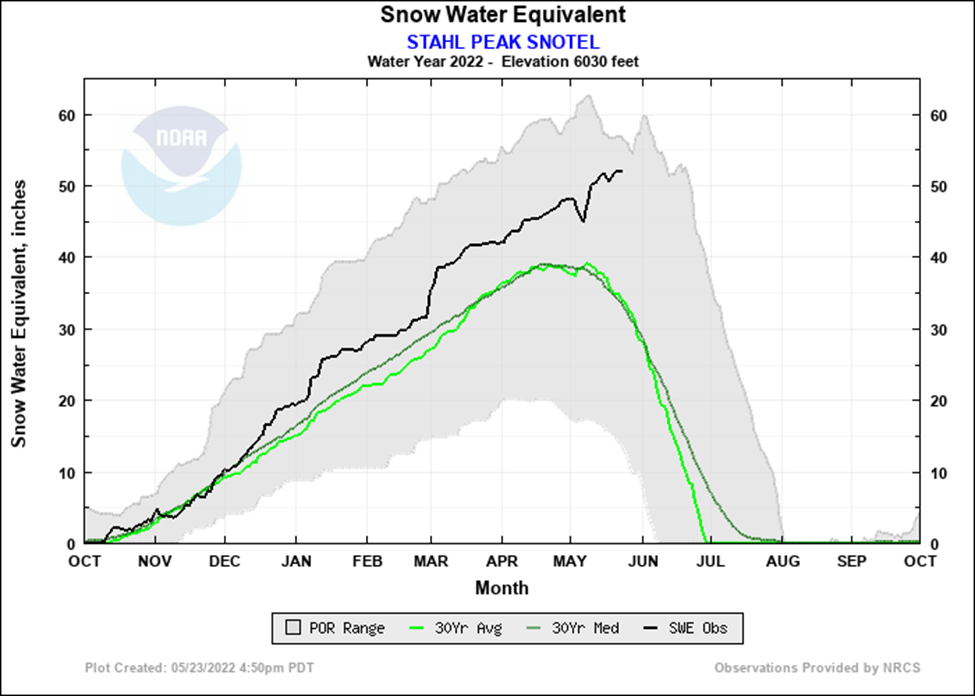
What happens next is a question for the weather forecasts. NOAA has released these projections for June, July and August.

The folks who know about these things are calling for a warmer and drier summer than normal. If that’s the case, it is good to be going in with a little extra water in the high country.
-
I’m looking at my primary ballots. Montana has an extremely civilized method of conducting primary elections without forcing people to register with one questionable party or the other. It’s nice – in South Dakota, the most fervent Democrat I knew had been registered as a Republican for 40 years, just so he could vote in the primaries. Here, in the privacy of my own home, I can pick the party I want, send it in, and never have to publicly endorse either party.
My Democratic Party ballot includes the names of only three democrats – Monica Tranel, Tom Winter, and Cora Neumann. They are democrats – Tranel lives in Missoula, Winter in Polson, and Neumann in Bozo. In short, there are no Lincoln County democrats on the ballot in Lincoln County. And I don’t have any particular preference for the other 3 – though wikipedia says Monica was an Olympic rower. I’m not sure that overcomes the achievement of becoming an attorney. I can think of a couple good reasons to keep attorneys out of the places where laws are made. Similar arguments go for the clergy.
I’ve checked the telephone book, and found no evidence of Alferd Packer in Lincoln County – but if memory serves (and it does) the 1883 sentencing quote seems relevant: “Alferd Packer, stand up you son of a bitch. There were seven democrats in Hinsdale County, and you, you voracious man-eating son of a bitch, you ate five of them. I sentence you to be hanged by the neck until you are dead, dead, dead. You republican cannibal. I would sentence you to hell itself but the statutes do not permit it.” (You can check Alferd Packer out on line – I’m writing from memory because I’d rather print the legend – the actual sentence may have been a bit milder) Here’s Alferd’s picture:

So I look at the empty democratic primary ballot, with the thought that it is difficult to have a two-party system if one party doesn’t show up. What societal trends have occurred that the metaphysical ghost of Alferd Packer has his imprint on our ballots? Heck – Alferd left 2 democrats in Hinsdale County – the closest democrat on our ballot is in Polson.
The ballots show only a single choice in partisan candidates for local political offices. If I want to make that choice, I can vote for either Brian Teske or Stuart Crismore to fill the blank spot as county commissioner from Libby. Doubtless, both fine men. Have to be. It’s the only spot on the ballot where we actually have an election. The other candidates will move unopposed into the offices in November.
We need to stop Alferd Packer’s ghost. Encourage your local democrats to come out of the closet. I can remember one brave democrat at the county fair, trying to sell me a raffle ticket, with the argument, “Your side has been in power and caused all these problems. You should at least kick a dollar into helping us.” I asked “Who are the libertarians who have been in power?” and he left. I’m thinking that I should have kicked a couple dollars in just to encourage the dems to come out into the open – that blank ballot does show the death of a two-party system . . . and history gives me plenty of examples of single party systems.
Let’s be kind to our local democrats, and see if we can stop the ghost of Alferd Packer from roving around Lincoln County.
-
There’s a large, expensive tombstone in Fortine Cemetery, dating back to 1918. The name, Waseles is one of the names the man lived under – but to his contemporaries in Trego and Eureka, he was Mike Smith.
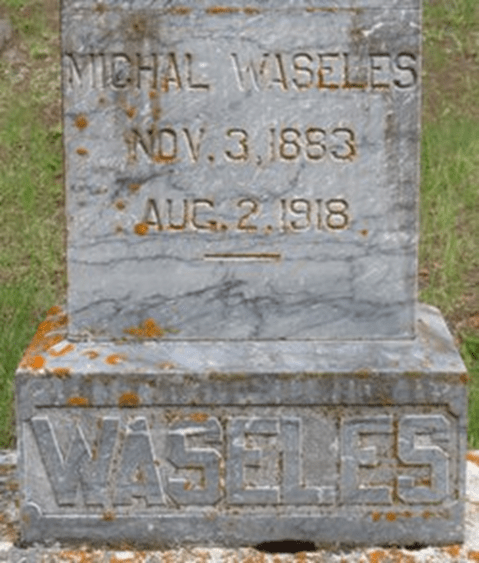
It tells part – a small part – of the story. My grandfather bought Waseles’ homestead in 1918. He had met Waseles – but knew him as “Mike Smith.” P.V. Klinke had the job of settling the estate – and here is the data he had to attempt to run down the next of kin. On the east side of Fortine Creek Road, his root cellar is merging with the earth. On the west side, his log cabin and barns are still visible and maintained.

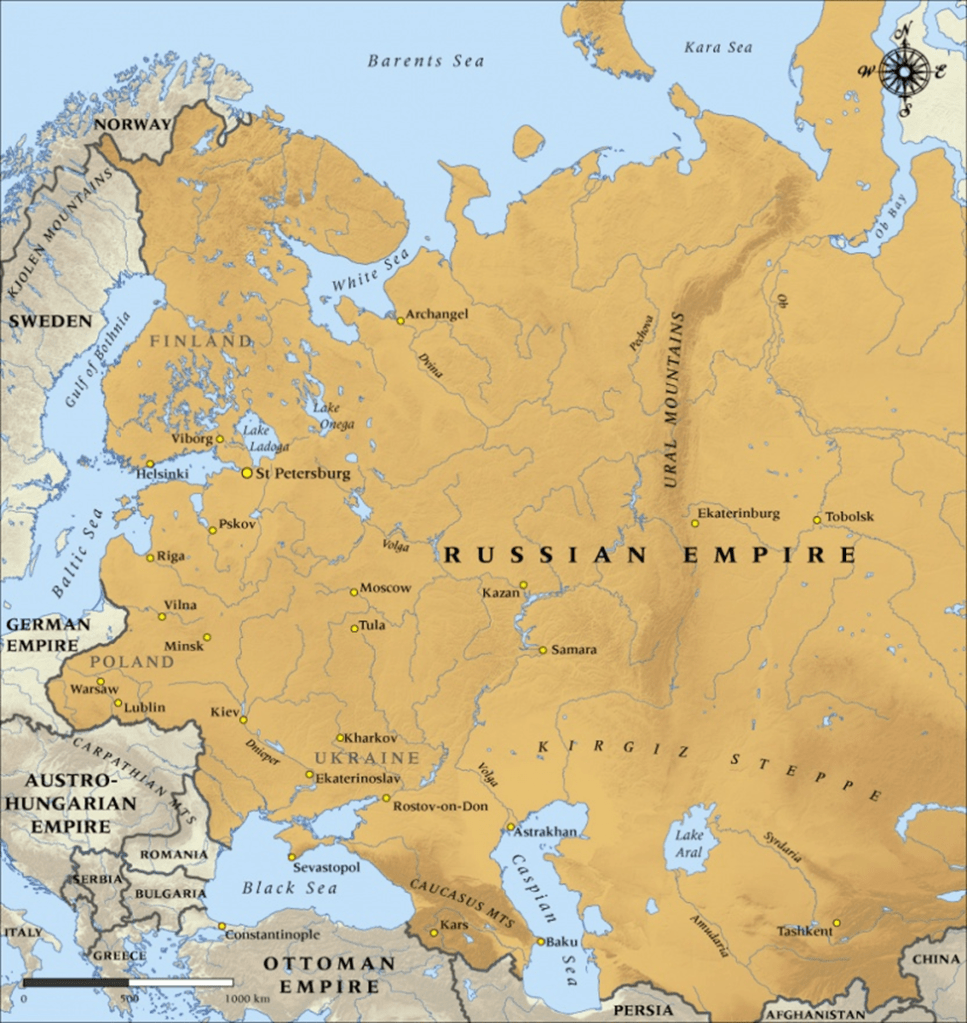
This 1914 map of Russia pretty well demonstrates the impossibility of finding his next of kin, with only the word “Russia” to go by – Michal Waseles could have been a Finn, a Ukrainian, a Pole – he came to the US from a very different Russia than we recognize today.
You may note that there was an autopsy performed. At the time Waleses (Smith) died, he was under indictment for torching a couple of logging camps and tossing tools in the pond behind the splash dam on Fortine Creek. (I still use an axehead that I took from the creek, removed the lime, and rehafted. I had thought it was lost by one of the loggers – but more likely, it was tossed in by Mike Smith and I recovered it 50 years later.) It had been a time of strife, with the logging strike of 1917 shutting down the woods across the nation. Waleses had been bossing the crew that ran the logs from Trego to Eureka – but the assumed name of Smith, the legal charges, and the time suggest that he had moved from management to labor activist.
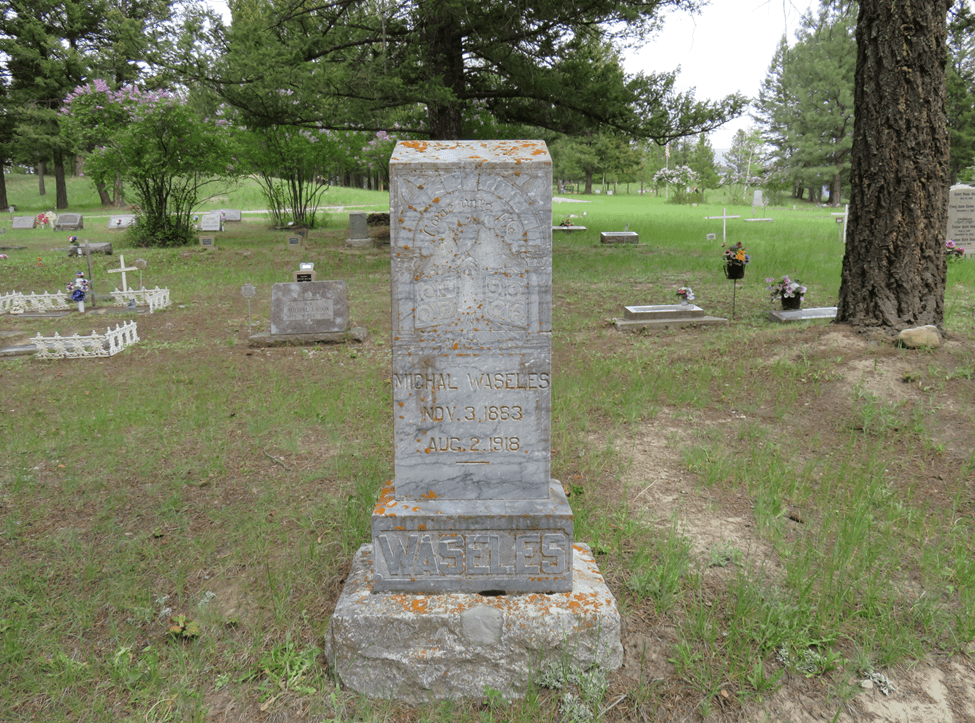
With no way to find next of kin or heirs, it looks like P.V. (Peter Vigo) Klinke decided to spend all of the estate’s income he could on the finest tombstone for Michal Waseles (AKA Smith) he could, and minimize the share that went to Lincoln County.
-
Mitochondria are one of the types of organelles (cell equivalent to organs) found within our cells. They’re often referred to as the “Powerhouse of the Cell” because of their role in metabolizing food into usable energy. But they may also play a role in aging.
There has to be considerable amount of communication between the nucleus (which controls the cell and houses your DNA) and the mitochondria. Over time, this communication can break down, and this may be what leads to aging (or at least an element of aging).
It makes a certain sense that mitochondria would be important- energy generation is an essential function. Diseases of the mitochondria are severe. But- watch the whole thing:
Want to tell us something or ask a question? Get in touch.

Recent Posts
- A Few Charts and Trends
- The Density of Water Explains When Dickey Lake Freezes
- Watching Iran
- The Quality of Numbers
- Robert Treat Payne Had Traveled To Greenland
- 75 Years Ago in New York
- Recovery Time for a Retiree
- Venn Diagram and DSM
- When Castro Was Cool
- You Have To Beat Darwin Every Day
- Computer Repair by Mussolini
- Getting Alberta Oil to Market
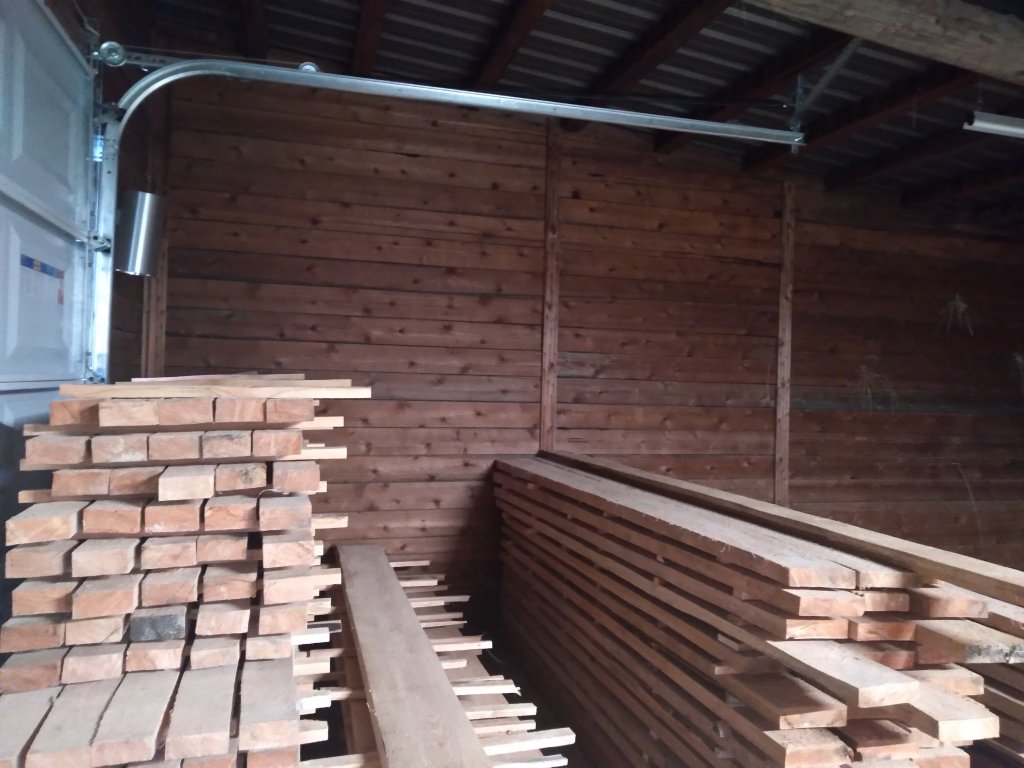
Rough Cut Lumber
Harvested as part of thinning to reduce fire danger.
$0.75 per board foot.
Call Mike (406-882-4835) or Sam (406-882-4597)
Popular Posts
Ask The Entomologist Bears Books Canada Census Community Decay Covid Covid-19 Data Deer Demography Education Elections family Firearms Game Cameras Geese Government Guns History Inflation life Lincoln County Board of Health Lincoln County MT Lincoln Electric Cooperative Montana nature News Patches' Pieces Pest Control Politics Pond Recipe School School Board Snow Taxes Teaching travel Trego Trego Montana Trego School Weather Wildlife writing
 Trego's Mountain Ear