-
The New York Times shows 43 competitive Congressional districts. 270 to
Win shows 68 districts as a toss-up back in 24. Both show Montana’s western district as competitive.270 to Win showed 197 Congressional seats safe for whatever Republican is running, and 170 safe Democrat seats. The distance between the parties isn’t so great as it seems – six of the nine California districts labeled as toss-up are occupied by dems, and when you Gerrymander correctly, you put the opposing party in districts that are 70 or 80% their party, and your own party gets districts that are 55%.
Still, if the 270 numbers are correct, the Republicans need only 21 non-competitive seats to control Congress in every election.
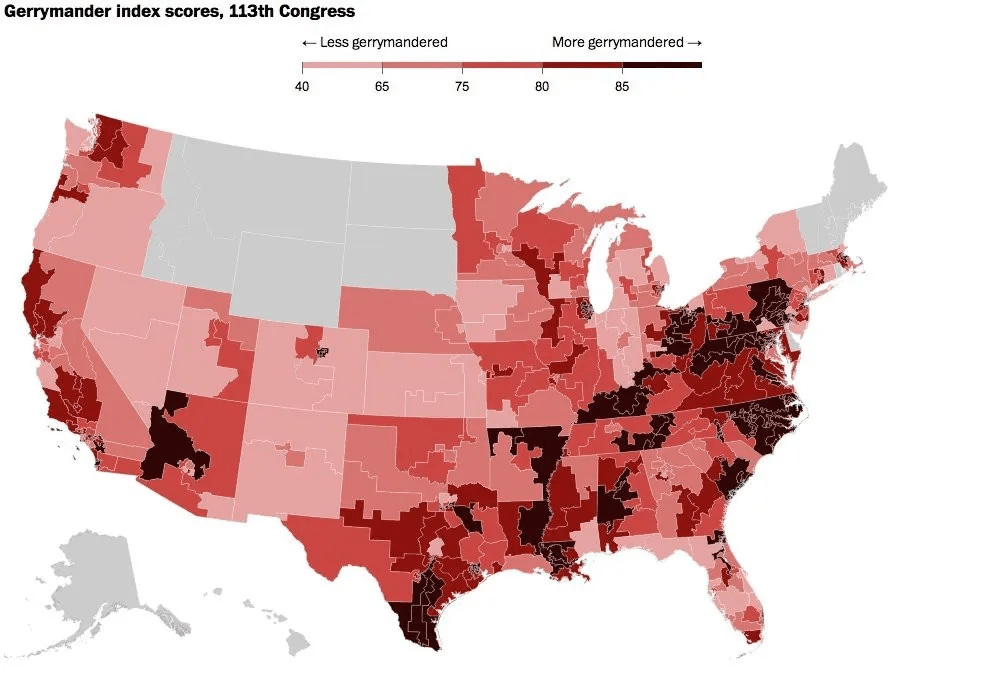
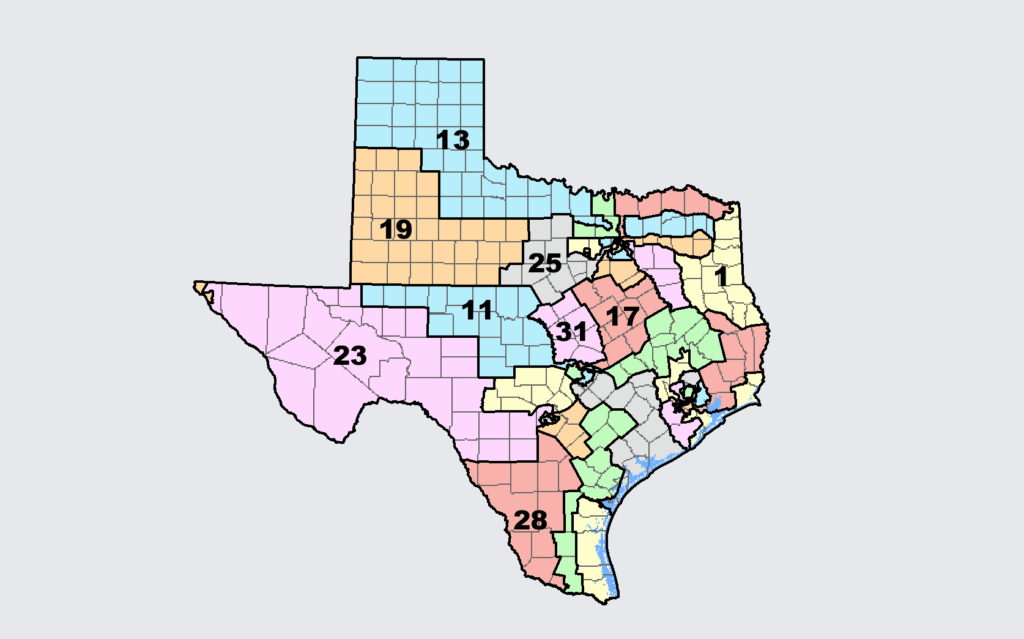
Rant.Com show this map to see the most Gerrymandered states. They show that the Republicans have been better at Gerrymandering than the Democrats:
-
Article 1, Section 2, Clause 3 covers two things – the Census and apportionment of representatives in Congress. Here it is:
Representatives and direct Taxes shall be apportioned among the several States which may be included within this Union, according to their respective Numbers, which shall be determined by adding to the whole Number of free Persons, including those bound to Service for a Term of Years, and excluding Indians not taxed, three fifths of all other Persons. The actual Enumeration shall be made within three Years after the first Meeting of the Congress of the United States, and within every subsequent Term of ten Years, in such Manner as they shall by Law direct. The Number of Representatives shall not exceed one for every thirty Thousand, but each State shall have at Least one Representative; and until such enumeration shall be made, the State of New Hampshire shall be entitled to chuse three, Massachusetts eight, Rhode Island and Providence Plantations one, Connecticut five, New-York six, New Jersey four, Pennsylvania eight, Delaware one, Maryland six, Virginia ten, North Carolina five, South Carolina five, and Georgia three.
The last sentence doesn’t count anymore. The critical terms are that the “respective Numbers, which shall be determined by adding to the whole Number of free Persons, including those bound to Service for a Term of Years, and excluding Indians not taxed, three fifths of all other Persons,” “and within ten years.” It doesn’t say citizens. On the other hand, we quit excluding “Indians not taxed” back in 1924. We quit counting slaves as 6/10ths back in the 1870 Census. https://www.kff.org/other/state-indicator/distribution-by-citizenship-status/?currentTimeframe=0&sortModel=%7B%22colId%22:%22Location%22,%22sort%22:%22asc%22%7D will take you to the individual states populations listed by citizenship.
Six or seven percent of US residents are not US citizens – but the number varies by state. Over 99 % of Montana residents are citizens. Almost 95% of Californians are citizens. The average congressional district has about 761,000 people (2020 Census) – Montana’s population in 2020 was 1,137,233 and we have 2 congress critters. Basically, we don’t have any complaints about being underrepresented this time around. Before the 2020 Census, we only had one congresscritter – and were extremely underrepresented.
So there are a couple questions about Trump ordering another census. The Enumeration clause says “within 10 years.” I suspect that five out of nine Supreme Court Justices will agree that 6 years is within 10 years. (I won’t guarantee that they will agree with me, but they should) Then there’s the question of whether illegal aliens should be counted. That’s going to be one for the courts – but if a guy can’t be there legally, I can’t see why he should be counted as a resident.
By choice, I’d see congressional seats apportioned by number of citizens – but that isn’t how our founding fathers wrote the Constitution.
-
There are six hatchling coots swimming in the pond with their parents. Usually two or three survivors is the norm, basically because, in general, coots are really bad at parenting. This year, the parents have stayed together and worked at raising the little birds.
A coot doesn’t quack like a duck – but it swims like a duck. They have a heck of a time getting airborne – and they lack webbed feet. This picture, from the National Park Service, shows why a coot isn’t a duck:

While we are close enough to photograph the coots in the pond, getting a picture that shows the feet is just about impossible. Usually only two or three of the little guys survive – but this year there are six getting close to flying stage.

Learning to take off is a challenge to the young coot – as they begin to get airborne, they have to add to their speed by running across the water:

We have a single goose with two goslings that have stayed on the pond rather than taking off to develop into the larger flocks that will be heading south in another month or so. The eagle took the gander, and the single goose doesn’t seem ready to take her surviving goslings from the pond to the next life step.
-
Three weeks after the surgery, the swelling has gone down – still a lot of swelling, but less. My infrared thermometer tells me that the left knee is 8 degrees warmer than the uncarved right. But it’s great.
On 3 weeks and 2 days, I managed to walk a mile and a half. Not fast, and not without pain and stiffening up – but I’ve spent the last six months unable to walk that far because of pain on the worn out knee joint. On 3 weeks and 3 days, I could sit on the Kubota and use the clutch. Today – 3 weeks and 4 days – I expect to be able to drive the pickup to the green boxes and dump the garbage. As I’ve learned before, recovery is enjoyable.
The longer walks are making the knee feel more like my own. I think that the knee deteriorated a little at a time, and felt natural, if painful when I walked. Now, there is a subtle difference as I walk – somehow the knee just doesn’t feel quite right. I figure it’s just a question of time and miles until the brain recognizes and accepts the new knee as my own. Folks who have gone through this before me tell me that 12 weeks are needed – yet before 4 weeks are complete I have a working knee again, and I can walk the woods. There’s still some big swelling – but the knee fits in my denims. I’ve used the Kubota to till parts of the garden. I’m looking forward to getting my chainsaw back to work. Life is good.
-
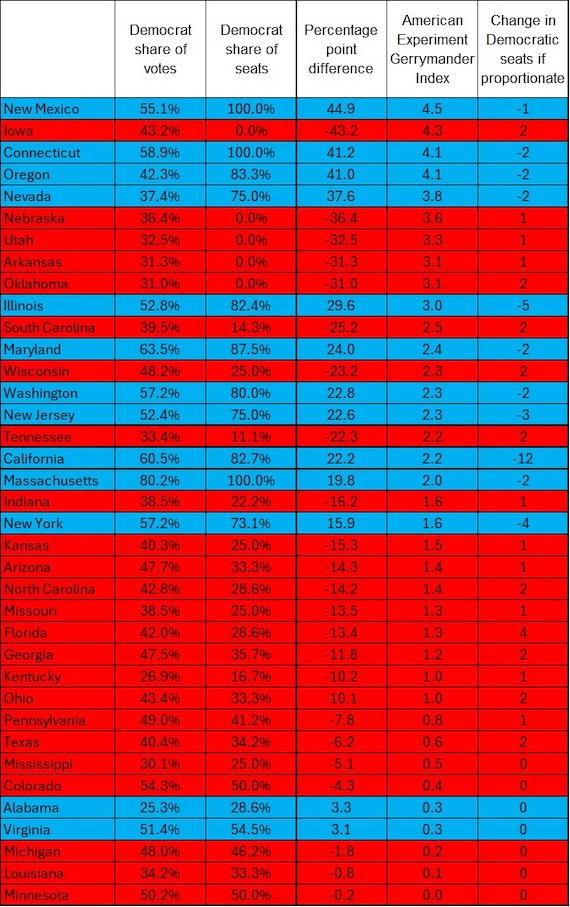
For the entire article, go to https://www.powerlineblog.com/archives/2025/08/whos-gerrymandering-whom.php It is worth a read.
-
I’ve been encouraged to research and write Trego’s history. This first section basically covers 1900 to 1925, from a Sociologist’s perspective rather than a historian’s.
Trego’s history begins with social and economic events – there is no individual responsible for building the community, despite the fact that Octav Fortin was the first settler. The first official institution was the school – School District 53 was created by the Flathead County Commissioners in 1904, as they looked at a location with a single operating ranch that had development barreling down on it – from the southeast, railroad reconstruction moving the mainline through the area that would become Trego, to the southwest was construction of the logging dam on Fortine Creek (though in those days, it was Edna Creek all the way down to its juncture with Grave Creek where the two streams joined to become the Tobacco River) and, to the North, where the Forest Service was beginning construction of the ranger station at Ant Flat. Simply enough, Trego started as a construction boom town, and the official focus wasn’t the town, but the elementary school.
A drive to Kalispell shows the narrow passage between stream and stone as you travel past the Point of Rocks – a name that preceded the restaurant that burned several years ago. You can note it as you drive between Eureka and Olney – a place where the rock wall almost pushed the early travelers into the Stillwater River. The first ten years of the 20th Century opened travel to Trego – partially with the railroad pushing a line through from Whitefish to Eureka, where it joined the paths down the Kootenai River from Canada.
For those who want to look at history as occurring due to exceptional men – there were exceptional men. John F. Stevens was the engineer who relocated the Great Northern main line to run through Trego (he also located Marias Pass and the Panama Canal. “Big Daddy” Howe headed the Eureka Lumber Company, and was responsible for bringing the logging dam into existence and its twenty-year operation. Fred Herrig, the rough rider who tracked and recovered Teddy Roosevelt’s lost mules during the Spanish American War in Cuba, became the Fortine District’s first ranger. And, of course, Octav Fortin who was here first. The reality is that Trego was twice a boomtown, both times due relocation of the railroad and building of a new dam.
The most credible story I’ve heard for the town’s name is that a Great Northern employee who was courting a girl in Minnesota or Michigan, named Jeanette Trego, assigned the name to get along a bit better with her Father. Then, in a predictable error, the railroad station next to Octav Fortin’s ranch got the Trego sign, while the Fortine sign wound up posted at the next station to the north. There are other stories – if you prefer them, I won’t argue.
For Trego, commercial transportation began with the Splash Dam on Fortine Creek – built around 1905, and last used in 1924. The remains of the dam are about a mile south of Trego School, on the Dickinson place. This photo, from 1922, gives an idea of Trego’s early history. (Note the logs along the bank, waiting for the next flood to transport them to the mill in Eureka)
I recall my grandmother’s concerns about playing by the creek – and hadn’t realized that the final use of floods to transport the logs occurred thirty years earlier. And that memory brought the message home that most folks who live here don’t realize just how important the dam was in settling Trego.
A dozen years after the dam was built, Trego became the site of labor unrest. ‘Big Daddy’ Howe ran the lumber company in Eureka, and the laborers who ran the logs down Fortine Creek and the Tobacco River were unionizing – chief among their demands was a call for hot showers as part of the working requirements.
Waseles was known as Mike Smith – and ran the crew that specialized in the twenty-mile river run that kept the mill running in Eureka. He died without any known next-of-kin, so P.V. Klinke (assigned as executor by the county) sold his homestead (just below the dam) and bought the large tombstone you see as you drive into Fortine Cemetery.
Their 1917 strike grew into a nationwide timber strike, and ‘Big Daddy’ Howe refined his already existing hatred of organized labor . . . specifically the International Workers of the World, the IWW.
When Waseles died, he was under indictment for torching a logging camp, and for sabotaging the log runs by throwing all the tools he could into the pond behind the dam. (I am still using a double bit axe whose head I recovered from Fortine Creek, and, with a new handle, a recovered cant hook now works my small mill a century after the log runs and the great strike)
Trego was typecast as a hotbed of socialist wobblies for many years by Eureka’s more prominent residents – a view that diminished rapidly with the many union jobs that came into both communities with the railroad relocation that accompanied Libby Dam in the sixties.
By Loco Steve, CC BY 3.0, https://commons.wikimedia.org/w/index.php?curid=54585133
The logging dam operated for about twenty years, and was mostly gone by the time the railroad mainline bypassed both Trego and Eureka – but the sounds of the trains still are heard in Trego in the 21st Century. And the Jake brakes of logging trucks have replaced the floods that moved the logs down Fortine Creek to the sawmills.
The Great Depression came early to Trego – while my Grandfather kept the two homesteads that he bought in 1917 and 1918, he moved his family to a small town near Spokane in 1925. He continued to spend parts of summer and fall in Trego, pruning and harvesting Christmas trees. The big mill in Eureka had closed, and Trego’s industry was left to small mills and tie hacks for the next 30 years. While the automobile age was well begun in 1925, my grandfather moved to the Spokane area with his children in a covered wagon.
Next Chapter – 1925 to 1950 – active years with few records
-
Time was when I had to use U-Haul rental rates to get a handle on migration between states. I could combine that with Census data to get a fairly clear picture of what type of people leave California to come to Montana – just an example, you understand.
The net continues to grow as an information source – some good info, some questionable, some downright bad. https://votewithyourfeet.net/map/?map=migration seems to be a good link, showing the number of people leaving one state for another, and what their income level is. Someone other than me has already done the work to provide the data.
Looking at the map, I see that over 25,000 Californians moved to Montana in the ten years between 2012 and 2022 – and that they brought with them $2,199,819,000 in yearly income. If I drop off the last three zeroes from each number (so my old calculator can handle it), it looks like the California immigrants brought an average of $90,000 per year income with them. This may go a little way in explaining the increasing land values the tax assessors keep showing.
When we moved home, back in 2015, Renata and I were part of the 450 people moving from South Dakota to Montana. Come to think of it, Sam’s move to teach in Geraldine made us 3 out of the net 450 people in the ten year migration – it’s a small number when a family of three can be almost a full percent of the ten-year migration.
-
I’ve completed my third week with the new knee. I haven’t been making the progress I wanted, so I got on line, and pulled up the recovery timeline. The first one I called up was for people over 65 – and all of a sudden, I started feeling much better. It’s nice to be 75 and find out that I’m healing up quicker than the over 65 chart shows. So I’ll quit sniveling – but I still want the full recovery to come a little quicker.
The timeline says I’m having trouble with driving. There is the advantage of an automatic transmission in a couple of the cars – but my tractors still use a clutch. So once I wriggle into the car, I’m fine. On the other hand, the tractor seat isn’t in the right spot yet. It took a couple days getting around with a borrowed walker, but at the end of week 3, I’m getting by with just a cane. To be fair, I have a lot more experience with a cane than a walker.
According to the recovery timeline, my only problem seems to be impatience. That said, the orthopedic folks told me what to expect – I just didn’t think it really applied to me. The biggest shock was reading the anesthesiology nurse’s report the day before surgery – it included a 3.7% chance of death. It took a while to understand how that could be – everyone who told me about how good knee replacement surgery was survived it. In contrast, the folks who died as part of knee replacement surgery have been remarkably tight lipped about their experience.







Want to tell us something or ask a question? Get in touch.

Recent Posts
- Getting Alberta Oil to Market
- Parties On Economics
- Thus Spake Zarathustra – One More Time
- Suspenders
- You Haven’t Met All The People . . .
- Play Stupid Games, Win Stupid Prizes
- The Ballad of Lenin’s Tomb
- An Encounter With a Lawnmower Thief
- County Property Taxes
- A Big Loss in 2025
- Thinking of Clovis
- I Started The Year With Optional Surgery
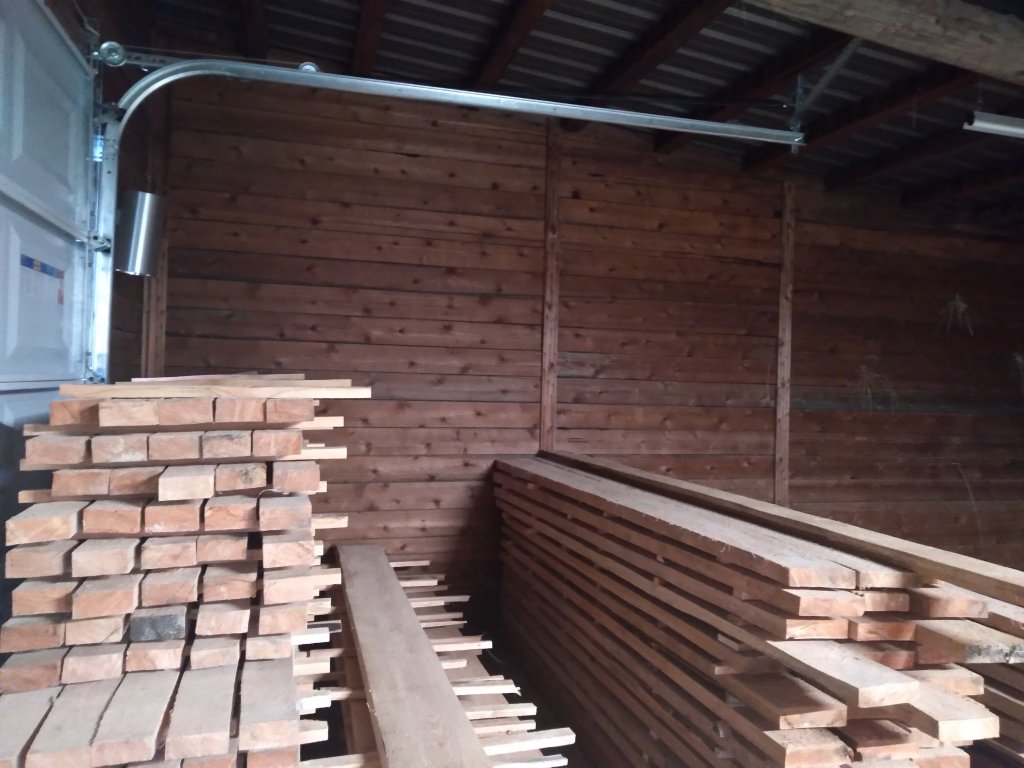
Rough Cut Lumber
Harvested as part of thinning to reduce fire danger.
$0.75 per board foot.
Call Mike (406-882-4835) or Sam (406-882-4597)
Popular Posts
Ask The Entomologist Bears Books Canada Census Community Decay Covid Covid-19 Data Deer Demography Education Elections Eureka Montana family Firearms Game Cameras Geese Government Guns History Inflation life Lincoln County Board of Health Lincoln County MT Lincoln Electric Cooperative Montana nature News Patches' Pieces Pest Control Politics Pond Recipe School School Board Snow Taxes travel Trego Trego Montana Trego School Weather Wildlife writing
 Trego's Mountain Ear