-
I’m not much of a collector. A collector has a theme to the collection. John McBride’s collection included American Military firearms. I’m not sure how a collector would describe my TT Olympia – it’s a Chinese copy of the Walther that beat out the Colt Woodsman at the 1936 Olympics. Somehow mine isn’t marked with anything to say ‘made in China’ – but it is. It’s also well finished, and, since my cataract surgery a few years ago, shoots well for me again.
It’s an example of how things connect in the gun world. I never found a Woodsman for sale at the right price when I wanted one – not that I couldn’t stretch a budget to include one, but that they’re more costly than I can justify for my purposes. So is the Walther. Instead, my Chinese knock-off was more accurate than pricey – so I kept it. It came in cheap cardboard and styrofoam, like this:
The Chinese builders did a nice job – good trigger pull, and must be at least close to the pre-war German workmanship. Admitted, the wood in the grips would never have made it into either Walther or Colt’s factory – the grips are downright ugly – but they do fit my hand well. Bolting the weight on does control the minimal recoil of a 22 cartridge – and it’s set up to be used with one hand. The right hand – it doesn’t fit the left.
When Walther got too busy with World War II, Hammerli (in Switzerland) picked up the design and produced slightly improved versions. As the Olympic competition got tougher, the basic design went to America and became the basis of the Smith and Wesson model 41. And mine is the Chinese knock-off that directly copies the 1936 Walther. As you can see, good looking grips didn’t seem to be a Chinese priority.
So what do I actually have? A cheap, accurate, well built pistol that just barely made it into the United States before Clinton cut off importation. Then it briefly sold well in Canada before the Trudeau government shut off sales. I have no idea where it might be sold today, or where parts might be available. The TT Olympia’s barrel is just under 5 inches long, it feeds just about any 22 shells I load, and, while sight acquisition is a little slow, is amazingly accurate.
I’ve written about cheaply made poor quality guns. This little pistol was cheap, well made, and accurate. I’ll keep using it -though the barrel weight will stay in the drawer. And I expect it will still be working fine when it goes to the next generation.
-
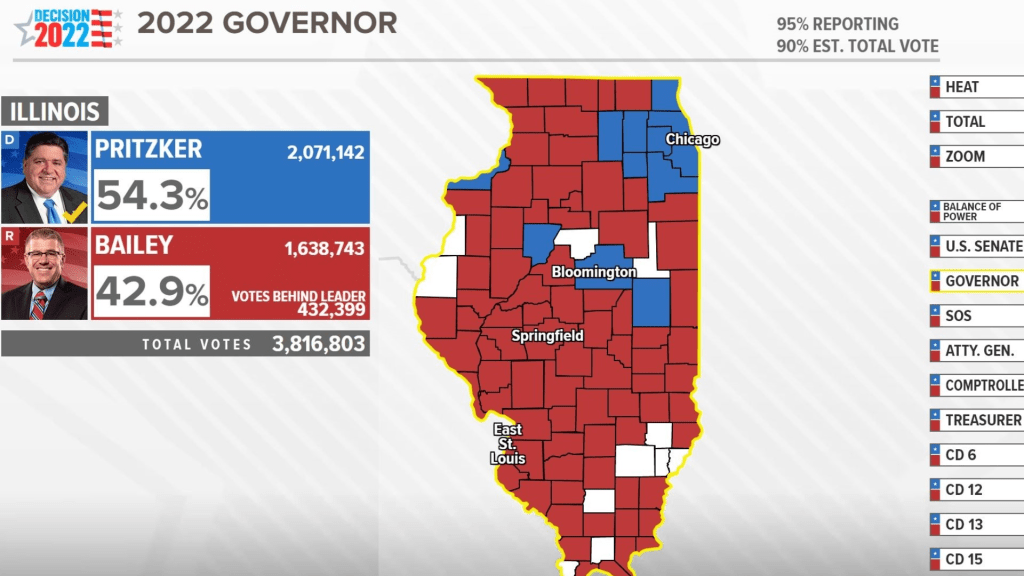
There’s a bit of discussion going on about redistricting Texas seats in the House of Representatives between Decennial Censuses. The Governor of Illinois has badmouthed it as Gerrymandering. Illinois has 3 Republican Representatives and 14 Democrats. In the last election, Kamala Harris got 54.37% of the votes, Trump got 43.47%. 3 out of 17 is 17.64 percent. The County election map looks like this:
In California, Democrats outnumber Republicans about 2:1. In California’s Congressional Delegation, there are 43 Democrats and 9 Republicans. California becomes a bit more special when you remember that house seats are apportioned by population, not by number of citizens. According to https://www.kff.org/ , California has 33,398,800 citizens and 4,739,400 non-citizens. A little over 14% of California residents are non-citizens. If you contrast that with Montana’s 1,096,297 citizens and 9,300 non-citizens, less than 1% of Montana residents are non-citizens.
Now, back to the proposed Texas redistricting:
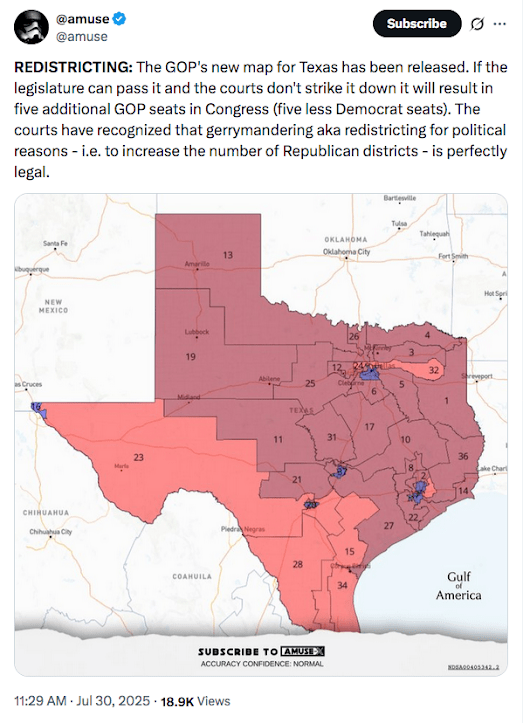
Texas has 26,713,800 citizens, and 3,081,700 non-citizens. A higher percentage of citizens in the population than California. I suspect that, from my perspective, all three example states will wind up Gerrymandered – it’s just a question of which party is doing the Gerrymandering.
Let’s give Elbridge Gerry his due – initially, the man opposed political parties, and the original Gerrymander cartoon appeared only after he had given up and signed on with one party. I doubt if Elbridge Gerry ever got so ambitious as the politicians in Illinois, California and Texas have. To be fair to Gerry, he signed both the Declaration of Independence and the Articles of Confederation, served as the fifth Vice-President of the United States, refused to sign the Constitution because it did not include a Bill of Rights, and is the only signer of the Declaration buried in DC.
-
There are some strangely irrational arguments going on about immigration. There is a simple answer. Like all humans, each potential immigrant is unique. The management concept that regards humans as interchangeable is unsound. Each immigrant has unique skills and abilities. Some make our society a better place to live, some worsen it. That makes for a simple policy. I want immigrants who will make my country a better place. It’s the same argument whether it’s the neighborhood or the nation.
Much of my life has been spent as college faculty. Consequently, I have seen different foreign students, different immigrants, than my friend whose career was in ICE. He tells me how bad the Haitian immigrants are – and Jean Michel Basquin’s face and smile come into my mind. I would like to have Jean Michel as a neighbor and a fellow citizen. My neighborhood and country would be improved. I hear of the problem of anchor babies – and I remember Gonzalo. His mother, a pregnant teenager, had traveled from the Yucatan to El Paso, around 1960, that he might be born with more opportunities. Not to belabor the point, but if Gonzalo inherited only half his mother’s courage and drive, he would make my country a better place.
I haven’t met a Nepali who won’t improve my America. India? I think of Priyanka and Prasanthi, and hope each will make a home in my country, and make it a better place. I recollect one of the lost boys of the Sudan, who enlisted, not in the US Army, but in the South Dakota National Guard, explaining that “these are my people, they took me in.” I think of Li Li, whom I knew as a Ph.D. student, now an Army non-com in Colorado. These are people who make my country a better place.
Not all immigrants make my country better. Just being a refugee and having suffered doesn’t make one a good person. The bastard who ran his semi into the rear of my daughter’s pickup was a Bosnian refugee. Our research showed he was violating several laws when he hit her. Then he lied. The morning he ran over her was the last day she could recognize a face. He was brought into the country because he was a Bosnian refugee. He made my country a worse place.
Immigration? The solution is simple. Bring in people who can be expected to make our country better. I have known many. Deport the ones who make our country a worse place. Throw out the emotion, and do the unyielding calculations.
-
Echelon Insights ( https://echeloninsights.com/tribes/ ) identifies 8 political ‘tribes’ that determine our nation’s electoral results. It seems more sensible than a 2 party system – personally, if I had to classify my voting pattern, it would be ‘reliably republican’ – and I don’t particularly like the Republican Party – it’s just that the Dems are, in general, a little harder to stomach – and they definitely lose me at the second amendment.
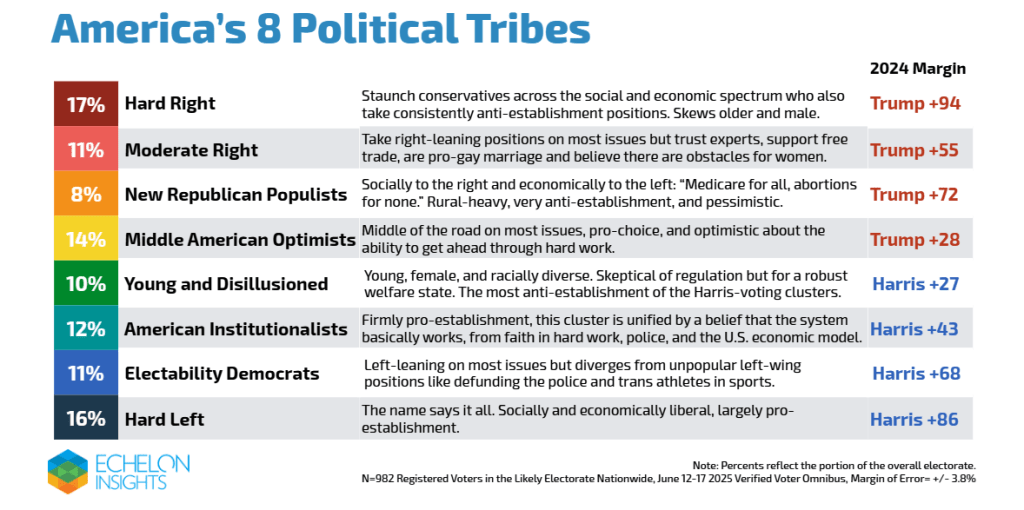

I got to looking at this because of an article in my newsfeed from the Liberal Patriot ( https://www.liberalpatriot.com/p/a-fascinating-new-look-at-americas?utm_campaign=email-half-post&r=223eek&utm_source=substack&utm_medium=email ) It’s worth reading. Personally, I like the title of “Middle American Optimists.”
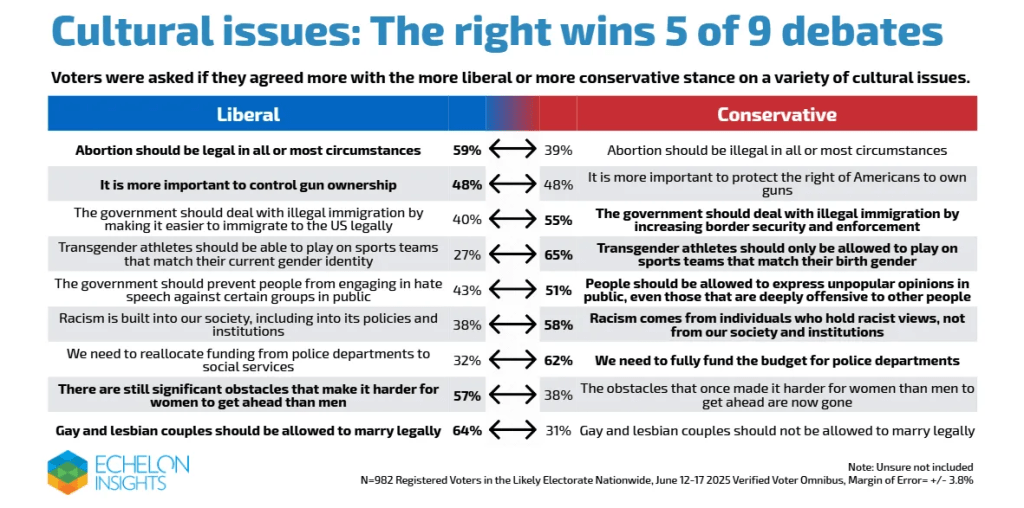

I can’t say that Echelon Insights has all the answers – or even any answers. On the other hand, I do like a way of looking at American politics that goes beyond the simple two party classifications – I really don’t feel alone disliking both major parties. There’s a lot more on the Echelon Insights website, and I encourage folks to look beyond the teasers I’ve presented.
-
I began watching Mohammed Ali when he boxed as Cassius Clay in the Olympics. Part of it was probably the time, another part was watching how different physical gifts lead to different lives – sizewise, I could have dressed out of Ali’s closet, but could never have accomplished what he did. I still recall with bitter feelings when he was stripped of the Heavyweight title because of his stance on the Viet Nam war and the draft.
Let’s look at some of the things he said in his life and career.
If you look at the world the same way when you’re 50 that you did when you were 20, then you wasted 30 years.
I calculate that I took 20,000 punches, but I earned millions and kept a lot of it. I may talk slow, but my mind is OK.
I can’t believe some of the things I did.Can’t believe it. Sayin’ I was the greatest and the beautifulist and I was gonna whup this guy and that guy, sayin’ I’m pretty, I can’t be beat.
We all have the same God, we just serve him differently. Rivers, lakes, ponds, streams, oceans all have different names, but they all contain water. So do religions have different names, and they all contain truth, expressed in different ways forms and times. It doesn’t matter whether you’re a Muslim, a Christian, or a Jew. When you believe in God, you should believe that all people are part of one family. If you love God, you can’t love only some of his children.
When you’re right, nobody remembers. When you’re wrong, nobody forgets.
It’s just a job. Grass grows, birds fly, waves pound the sand. I beat people up.
To be a great champion you must believe you are the best. If you’re not, pretend you are.
And the saddest quote – going back to my high school days: I came back to Louisville after the Olympics with my shiny gold medal. Went into a luncheonette where black folks couldn’t eat. Thought I’d put them on the spot. I sat down and asked for a meal. The Olympic champion wearing his gold medal. They said, “We don’t serve niggers here.” I said, “That’s okay, I don’t eat ’em.” But they put me out in the street. So I went down to the river, the Ohio River, and threw my gold medal in it.
-
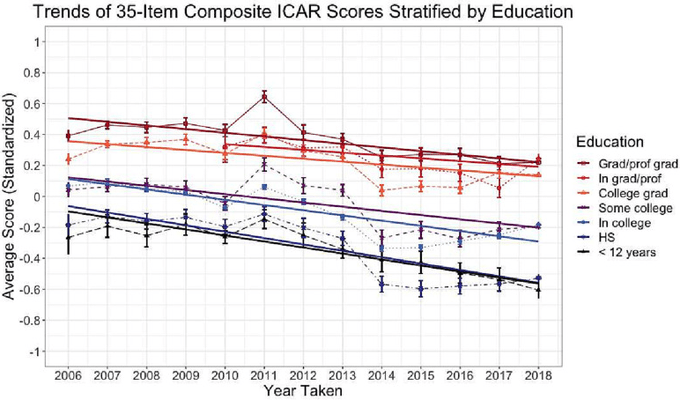
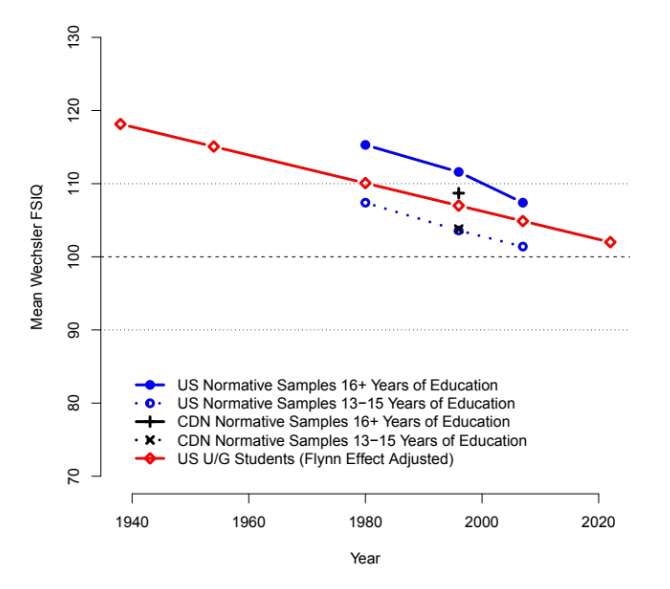
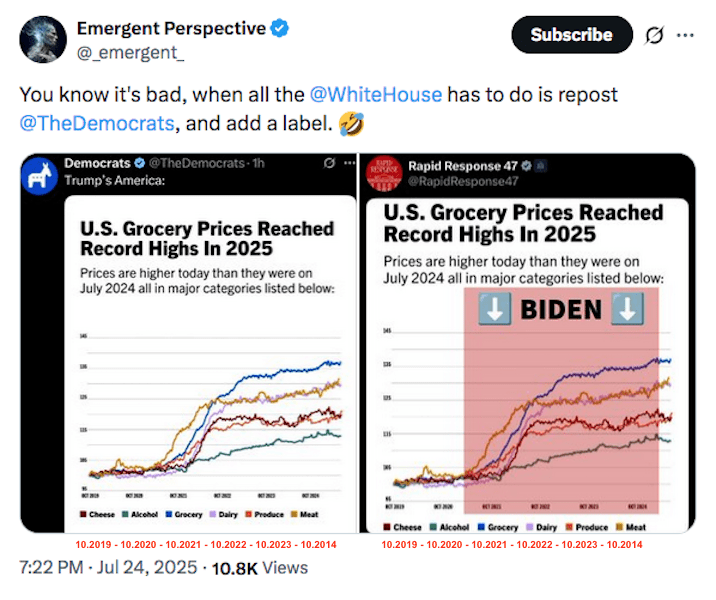
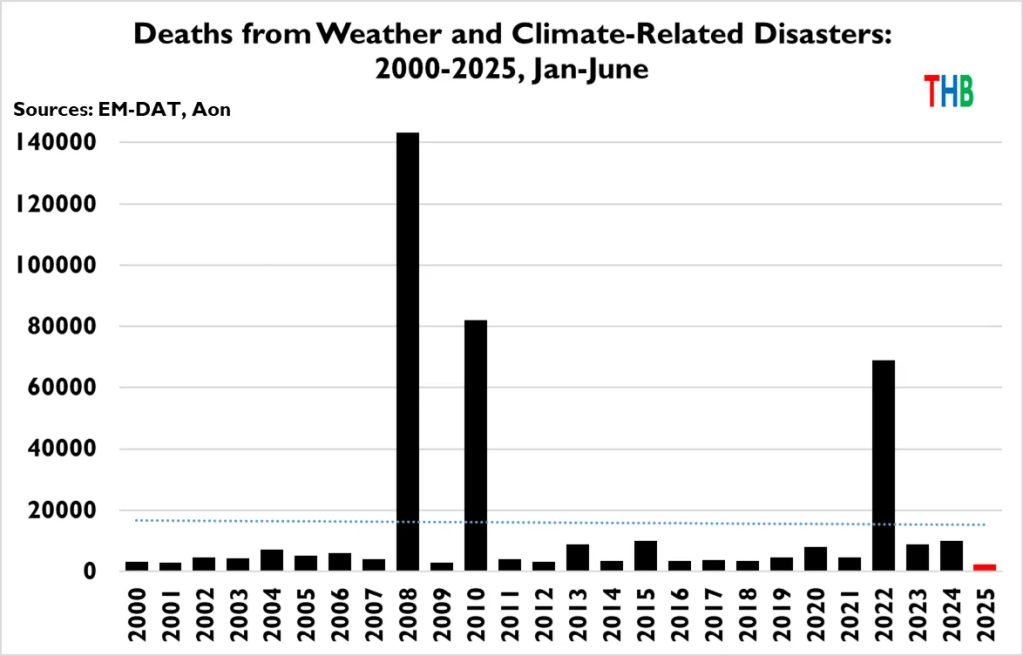
Amazing what a block of color can do to interpreting a chart:
-
Colleges – and even high schools – exist to provide credentials. Probably the highest example of credentialism is the MD or DO – but most of our programs boil down to taking the correct group of classes, achieving a certain minimum score, and acquiring a credential. You pretty much have to get the credential to get the interview that gets you the job. In this simplification, there isn’t a lot of difference between the bachelors, masters and doctorates in the academy and the classifications of apprentice, journeyman and master in the skilled trades (take plumbing or electricity for examples).
There are a whole lot of jobs where I lack the credentials to even apply. We’ve developed a credentialed society, and sometimes the benefits of the credential seem hard to find. Sometimes the requirements in terms of work experience seem like gatekeepers. And more frequently, people are asking what is the value of the credential.
My credential is a Ph.D. in sociology. If you haven’t noticed, there are a lot of people who recommend against getting a degree in sociology. I suppose I’m lucky – I got a job in the subject, and retired working at the same topic that interested me as an undergrad. Other folks have other credentials. I’m reading Neil Howe’s book about the fourth turning – and his jacket blurb identifies him as a demographer holding graduate degrees in history and economics from Yale. There are a lot of ways to get the title of demographer – his was, obviously, different than mine.
After retiring, I’ve spent a few years on the local school board – and teaching jobs are open only to the certified. I started with the belief that certification in special education brought with it some incredible teaching skills – yet as I left the board, I left with a strong suspicion that we had hired people with the credential to evaluate our students, but once the evaluation was complete we wound up with teacher’s aides who did most of the actual teaching. I knew Dave Peterson – and saw more than one of his students go on to graduate and become teachers. But those years of closer observation showed me that Dave was a special teacher – but that wasn’t directly related to a special education certificate. At the Libby Campus of FVCC, I worked in the Academic Reinforcement Center with Connie Malyevac. Connie was a better teacher than I – I watched her reach out and find ways to get students on track, students who were beyond my reach. I was good – Connie was great. It wasn’t a question of credentials – she simply had more ability to reach out and bring students back onto the path.
Remembering those days when I Worked with Connie makes me understand why we need to be moving into some different forms of credentials that reflect ability. I’m looking at the SAT – the Scholastic Aptitude Test is now reducing the length and complexity of statements to which students respond and from which they determine the correct information. These are the questions my students referred to as “story questions.” The real world has too much information – much of the problem of thinking is just deciding the data that is relevant to the problem.
I’m glad to have had the University system as a place to work – but I could see how it was breaking down and no longer providing valid credentials. I think on Howe’s work – where his credentials are more the Ivy League degrees than the topic – and I recall the Whorfian Hypothesis. Benjamin Whorf was a Chemical Engineer (MIT BS and MS) who studied the Hopi language and came up with the idea that people experience the world based on the structure of their language. This link shows that MIT still remembers (web.mit.edu.allanmc.www.whorf.scienceandlinguistics.pdf )
Benjamin Whorf’s name moved into social science fields because of his competence in linguistics, while his credentials were degrees in Chemical Engineering from MIT. Perhaps it’s time for us to start looking at developing competence over credentialing?
-
Sitting with a recovering knee, I found the time to hunt down the court case that legalized discriminating against higher IQ scores. I knew it was out there, but finding the story took some effort. We have to go back nearly thirty years – to a time when a man named Robert Jordan applied for a job with New London’s police. Jordan scored 33 on the placement exam – the equivalent of an IQ score of 125. He didn’t get the job. New London’s police interviewed candidates who scored from 20 to 27, believing that folks who scored higher would get bored and quit, wasting the community’s training. (ABC News, Court Okays Barring High IQ for Cops Sept. 8, 2000).
Now it wasn’t a Supreme Court decision – just the second court of appeals. The court did also notice that “the policy may be unwise, but is a rational way to reduce job turnover.” The article goes on to describe the police average IQ as about 104 – basically just a little above the average. Jordan’s score of 125 places him in the top 5% of Americans.
Now I’ll have to check on the average convict IQ – I don’t see any court cases where discriminating against criminals by IQ is a thing.
-
The first two fawns we saw this Spring were in the mouths of coyotes on the game cameras. It’s a data point, not necessarily proving any trend – but it does support my hypothesis. Coyote predation has changed – and here’s the story as I see it.
For several years, we had a pack of two elderly coyotes on the hill. He was buff – several times I had folks who glimpsed him tell me of a wolf. I had better views – for some reason of his own, watching me on the tractor was a worthwhile activity for him. I don’t know why -with his deep chest there may have been a little bit of dog in his genetics. Makes no difference – he knew he coexisted with humans, and left the house and my little dogs alone.
His consort was missing an eye – the sort of thing it takes a lot of observation and trail camera time to observe. When they hunted, he was invariably to her left. If she did any tractor watching, she picked better concealment than he.
I don’t know what took out the old coyotes – it could have been someone with a rifle, but it is probably just as likely that it was old age. If he went first, the wild life would have had no place for her disability. For whatever reason, my small pack of neighborhood coyotes is gone.
In the absence of a resident pack, the trail cameras show that we now are included in the overlapping ranges of 3 larger packs – one group comes from the north, a second from the southeast, and the third from the west. Where we once had a pair of coyotes making a living full-time, we now have over a dozen hunting on the edges of their expanded ranges.
The prey species has changed – the trail cameras show that the new packs have all focused on feral cats. Non-ferals, too – we don’t know how Cream disappeared, but circumstantial evidence points to the west coyote pack. And the population of feral cats living in downtown Trego is declining on the trail camera. I don’t know which pack has developed a taste for skunks, but fewer skunks are showing up on the cameras (I can’t believe we would have three packs of skunk-eaters.) I suppose that reducing the skunk and feral cat populations does help keep the area free of rabies.
I kind of miss the old pair of coyotes that coexisted well with us – on the other hand, an uncontrolled population of feral cats pretty much calls for something to start preying on them. Studies in Chicago show that coyotes keep cat populations confined to residential areas.





Want to tell us something or ask a question? Get in touch.

Recent Posts
- Getting Alberta Oil to Market
- Parties On Economics
- Thus Spake Zarathustra – One More Time
- Suspenders
- You Haven’t Met All The People . . .
- Play Stupid Games, Win Stupid Prizes
- The Ballad of Lenin’s Tomb
- An Encounter With a Lawnmower Thief
- County Property Taxes
- A Big Loss in 2025
- Thinking of Clovis
- I Started The Year With Optional Surgery

Rough Cut Lumber
Harvested as part of thinning to reduce fire danger.
$0.75 per board foot.
Call Mike (406-882-4835) or Sam (406-882-4597)
Popular Posts
Ask The Entomologist Bears Books Canada Census Community Decay Covid Covid-19 Data Deer Demography Education Elections Eureka Montana family Firearms Game Cameras Geese Government Guns History Inflation life Lincoln County Board of Health Lincoln County MT Lincoln Electric Cooperative Montana nature News Patches' Pieces Pest Control Politics Pond Recipe School School Board Snow Taxes travel Trego Trego Montana Trego School Weather Wildlife writing
 Trego's Mountain Ear