-
I’ve been reading of how the credibility of experts is declining – and it comes as no surprise. I’ve spent a lot of my life as an expert, dealing with other experts – and I’ve found that a lot of the experts I encounter aren’t. Let’s look at what it takes to be an expert: I’m a demographer. I have the training. I’ve held the title. I know what it takes – I ‘m well informed on three topics – birth, death and migration. Still, Paul Ehrlich is better known as a demographer than I – and he studied butterflies. And turned his ignorance of demography into a best selling book called The Population Bomb.
Here’s the deal – I know the interaction between birth, death and migration. Paul doesn’t – but he has sold more books. Because he has sold so many books, he’s an expert. Since he doesn’t know the topic, he is frequently wrong. Since he is frequently wrong, he contributes to the public’s lack of trust in experts. His demography is called Malthusian – and the Reverend Thomas Malthus made sense in 1798. But the Industrial Revolution came along, followed by the development of industrial agriculture, and Malthus theories have been out of step with reality for about 300 years.
There are two specific areas where I have demonstrated my expertise in demography – Hutterite outmigration and Reservations. I’m not just a demographer, I’m a rural demographer. And my specific areas of expertise include the Dakota/Lakota people and the Dariusleut Hutterites. Frankly, not many people give a damn about Reservation demographics or Hutterite outmigration. Not a problem – its just a matter of focusing on the topics where my expertise is. Paul’s area of expertise – butterflies – doesn’t support his conclusions – so he reduces the credibility of the actual experts.
Another graduate got her Ph.D. in psychology, and wanted to diagnose Trump as having a narcissistic personality disorder. Not bad – but when I asked about Frances (Allen Frances edited the journals about personality disorders) she sex changed him to female. I got her recommendation that if I wanted to learn about personality disorders, I should read he dissertation.
Here’s the deal: the dissertation is the project that shows you are capable of doing original research while supervised. It is not expected to be one’s finest work – for example, Einstein’s dissertation was on using Brownian motion to determine an approximation of Avogadro’s number. It wasn’t his finest work – within a couple of years, his technique ceased to be used, because another, better technique gave the actual number. Einstein went on to greater discoveries. The second thing is that if you’re not keeping up with the journal articles, your expertise isn’t current. She believed that her dissertation completion made her an expert. Completing a Ph.D. doesn’t make you an expert – it recognizes that you are capable of performing original research under limited supervision.
So we have more people claiming to be experts on increasingly large topics. And we’re surprised at a declining belief in the credibility of those experts?
-
Well, technically the beast is a Columbia Ground Squirrel – but it has moved in at a time of my infirmity – as I use a walker to get the left knee back into shape, pretty much confined to the porch and first floor, the gopher has moved into the garden. And he goes down the row, eating the peas down to ground level.
Fifty or sixty years back, I was trying for gopher control in the same location, and I accidentally trapped a lactating badger by her front foot. I had heard all the stories about how dangerous a badger could be in close – but when I knew she had little ones, leaving her trapped didn’t seem right. So I got her where she pulled the trap and chain as far from the stake as I could, and as she strained against the trap, I used a stick to take the tension from the jaws of the trap, and she pulled loose. I picked up the rest of the gopher traps, and felt good for the rest of the day.
The next day I was back with the 22, shot a gopher, and she bit it, backed off, and apparently made the decision: “This guy helped me when I was trapped, and now he’s helping me catch gophers while my foot hurts. He’s OK.” I spent six weeks or so that summer shooting gophers for my badger companion. I don’t imagine we were ever much closer than 20 yards or so. We probably hunted together no more than 40 times – but it turned into one of my more fun hunting experiences.
So I’m thinking of my badger buddy as I try to come up with a plan to get the gophers out of my garden. In the old days, I would have bummed a bit of 1080 – but my new world doesn’t allow such lethal formulas to its citizenry. I remember that I own 3 gopher traps – but I don’t remember where I stashed them. I could borrow a trap from a friend, and build a mini-fence around the gopher hole – but that would be a lot easier with a working left knee. It looks like my solution is going to be these green bait bars in a bait station
Fortunately, I have the internet and amazon prime available. By the time I can get out to the garden again, I’ll have my green bait bars and bait station. It’s been a good problem to have – remembering the mother badger that was once my hunting companion.
-
I’ve been lucky with knees. The right knee has been scoped twice and is still working. The left knee has been scoped three times, and on Tuesday it went through a total knee replacement. Each surgery has protected me from qualifying as a cripple – and none of the surgeries could be done a century ago. Modern medicine makes it a good time to be alive.
Which kind of gets us to the point of what has happened to the Mountain Ear. Coming out on Tuesdays just kind of quit working when Sam found herself tied to Trego’s Monday school board meetings. Adding in the challenge of two small boys has kind of whelmed getting it out on time – and we’ve reached a spot where a recovering knee let’s me try to get things out where we’re kind of on time – I’ll be a little stove up, but it won’t keep me from writing and editing. Sam, with a $700,000 grant to develop a home school/public school model at Trego will be spending more time in the public sector – and I’ll be back writing. And the answer is yes – she’s fortunate to have two healthy little boys, and I’m lucky to be going through the sixth knee surgery that will give me back walking. I’ve missed it.
-
The US Constitution says: No state shall coin money, emit bills of credit, or make any thing but gold and silver coin a tender in payment of debts. ~ Art. I, sec. 10, cl. 1.
I think that translated to a gold and silver based economy if a state were to mint its own coins. I don’t think it ever limited the Federal government to gold and silver – the old phrase ‘not worth a continental’ makes me believe that the US was created on paper money.
That said, the price of gold went up past $3,400 a couple weeks back. That’s doggone near 100 times the price gold had when I got my first official laboring paycheck after I turned 18. So it got me thinking.
I was 18, and making $2.50 per hour. A 13 week summer job grossed $1,300 – just a little less than the cost of a year’s tuition, fees and dormitory expenses. Or, to put things on the gold standard, 37 ounces of gold and five silver dollars.
At $3,400 per ounce, that gold is worth $125,800. At junk silver prices, those five silver dollars amount to $126. At today’s prices, my summer’s labor was worth $125,926. Divide that by thirteen 40 hour work weeks – the result is $242.16 per hour, in today’s currency, for the summer of 1968. Obviously, I was well paid – well, I knew that because other students had work study jobs in the $1.25 range.
I think that was the year that I found where someone had stolen two cartons of C rations from a fire camp. I thought it was no foul when I lifted the thief’s stolen C rats, and tossed the boxes into the stuff I took to college that year – figuring that if I really got broke, I’d have a couple dozen meals on hand. I did get really broke, and opened my stash, and learned that I hadn’t robbed the thief – I opened the carton to find that I had salvaged two cartons of lima beans and ham. Somewhere on this planet, there is probably someone who likes lima beans and ham. It is not me. I was so broke that I ate lima beans and ham, and got a brief job on a jackhammer for a stake to get me back in the dormitory poker games.
I had no idea how rich I was, until I started looking at 1968 on today’s gold standard. Think about it – today, a $50,000 pickup is a short 15 ounces of gold – almost, but not quite, 5 weeks labor. Rich, I tell you, rich and I never realized it.
Still, I need to check these numbers out with the power of compound interest. I know that a hundred dollars, invested in gold in 1968, would be worth $9714.28 at today’s gold prices. At 8 percent interest, compounded monthly, my hundred 1968 dollars would be $9,553.57.
As I contrast the value of gold and the power of compound interest, it looks like there isn’t a whole lot of difference. Still, I’m one of the lucky ones – my college interest in sociology yielded me a good career (though there were times that a job surveying paid the bills). In a world where an interest in sociology and a backup ability of seeing the world through a transit can make a good living, the value of gold just isn’t relevant.
-
As a kid, I knew all of the names – Mickey Mantle, Yogi Berra, Joe Dimaggio, Roberto Clemente -the list goes on. My knowledge of professional baseball came from the radio. In 2006, driving across South Dakota, I listened to an interview that epitomized the love of the game.
Edgard Clemente, of the Sioux Falls Canaries, was being interviewed – and he was happy to be able to make a living playing the game he loved. His uncle was Roberto – whose baseball career was much more successful than Edgard’s – but I didn’t know that when I listened to the radio. I was listening to a young man who was overjoyed to be playing baseball, for the Canaries, in Sioux Falls, and was willing to tell everyone in the listening audience just how great it was to have the opportunity to play professional baseball in Sioux Falls.
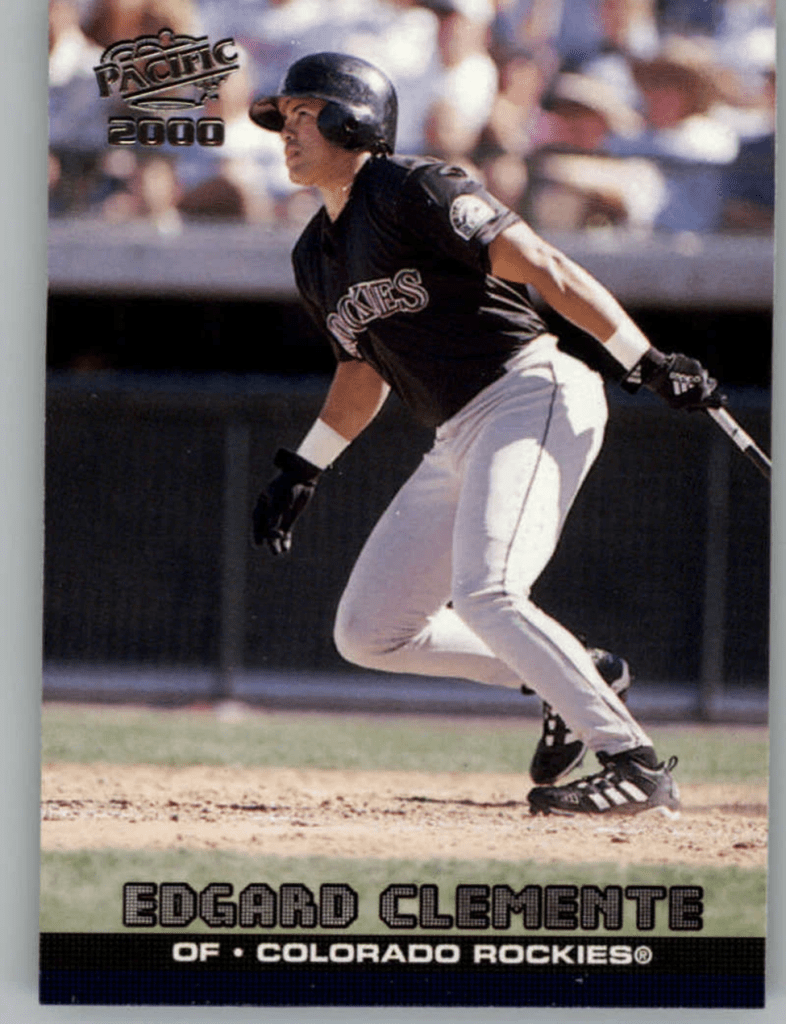
Over the years, I watched Clemente’s career. He’d started out playing 3 years for the Colorado Rockies, where he hit all of his 8 major league home runs in 1999. He had been a tenth round draft pick. From the Colorado Rockies, he moved to the Anaheim Angels in 2000. In 2005, he played for Puerto Rico in the World Cup – and performed well enough that when I listened to the happy young man, he was on his second year with the Canaries. From the Canaries, he went on to the Somerset Patriots – it was Atlantic League, but he was briefly back in league ball. I’m sure that he felt Sioux Falls was the place that gave him a chance to get back into league ball, even if it was the minors.
In 2010, he played for the Broncos de Reynosa in the Mexican league. The last mention I found as I followed his career was 2012, when he played first for the New Jersey Jackals and ended with the Puebla Pericos (parrots).
His professional baseball career ran from 1993 to 2012. It was rare for Edgard to spend two years with the same team, playing for 23 different teams over his 20 year career. I never saw Edgard Clemente play – but I listened to an interview with a once major league ball player who was happy to be able to continue his career in South Dakota.
-
I’m thinking of a high school friend who didn’t make it back from Viet Nam. Over fifty years ago, when I read the citation on his Silver Star, I thought that his sergeant did a good job of describing Keith Utter – and I moved from mildly supporting my country’s involvement in Viet Nam to supporting the soldiers and Marines who went there and opposing the politicians who sent them.
But I write this to remember Keith – not to add more animosity toward Lyndon Johnson. Keith’s classmate at LCHS, Doug Sterner (he was Claude when we attended high school, but he wanted to be Doug even then) has published a lot of books on military medals – here’s the citation on Keith:
Headquarters, 101st Infantry Division (Airmobile), General Orders No. 10961 (September 14, 1970)The President of the United States of America, authorized by Act of Congress, July 9, 1918 (amended by act of July 25, 1963), takes pride in presenting the Silver Star (Posthumously) to Corporal [then Private First Class] Keith Edward Utter (ASN: US-56988031), U.S. Army, for gallantry in action in the Republic of Vietnam, on 14 July 1970. Corporal Utter distinguished himself while serving as a rifleman in Company D, 2d Battalion (Airmobile), 501st Infantry Regiment, 101st Airborne Division (Airmobile), during combat action near Hue, Republic of Vietnam. While in a night defensive position, Corporal Utter’s unit came under an intense hostile attack, and he immediately maneuvered through the hostile fire to the section of the perimeter that was hardest hit. While directing effective fire on the enemy, Corporal Utter spotted a wounded comrade lying in an exposed position. When his attempt to reach the man was halted by the hostile fire, he noticed small arms fire being directed at the casualty. Corporal Utter immediately rushed to him, but was mortally wounded by hostile fire while attempting to move the man to a protected position. Corporal Utter’s personal bravery and devotion to duty were in keeping with the highest traditions of the military service and reflect great credit upon himself, his unit, and the United States Army.
You can read it at https://valor.militarytimes.com/recipient/recipient-24822/ It includes a blurry photo of Keith in uniform – my memory of his face is much clearer.

I wouldn’t say we were particularly close friends – Keith was a young man who liked everyone. As I said, the sergeant that provided the words for the Silver Star described the guy I knew:
“Corporal Utter spotted a wounded comrade lying in an exposed position. When his attempt to reach the man was halted by the hostile fire, he noticed small arms fire being directed at the casualty. Corporal Utter immediately rushed to him, but was mortally wounded by hostile fire while attempting to move the man to a protected position.” The man I knew could not have acted otherwise – it goes on to describe his bravery, for an act that more accurately describes his decency.
Keith and I shared a birthday. So I guess that I tend to think of him more often than other friends who did not return from those games. Occasionally, infrequently, I run across his nephew – now a middle-aged man, married to a neighbor’s daughter, who displays the same basic decency and goodness that I remember in Keith. When I do, I can smile, partly at a man I respect, and partly at the memory of a high school friend that I liked and regarded highly.
It took Keith’s death to make the Viet Nam war personal – at the time, I had a 1-Y deferment, which a Veteran friend described as “It means that when they call out women and children to stack sandbags around statues of Benedict Arnold, you’ll be used as a sandbag.” Keith went, and I have no memory of the last time we saw each other – the risks weren’t apparent to my younger self. He made sure that I supported our soldiers and Marines even while opposing the war.
And on Memorial Day, I think of the faces of my classmates, now grandparents and great-grandparents, and look at a blurred photo of a friend who never received that memorial of wife and children. And I am pleased when I encounter, or hear mention, of his nephew who shows the same basic decency as Keith.
-
May 19th, I left the school board, and my successor was installed. I’ve learned as I have moved from one job, one position to the next that you don’t have a replacement, you have a successor.
It hasn’t been an easy six years – somehow a culture of conflict, best described through the Karpman drama triangle developed over the years, and overcoming it became a terrible challenge. In the Karpman triangle, there are three positions – a victim, a persecutor and a rescuer. The roles are interchangeable – if you think back to Little Red Riding Hood, Little Red is the victim, the wolf is the persecutor, and the woodsman who tackles the wolf with his axe is the rescuer. Seems simple, until you look at things from the wolf’s perspective. As Wolfie is being chopped by the woodsman with his axe, Wolfie is pretty darned sure he’s the victim. Hopefully the Karpman drama triangle is gone, where rescuers become persecutors.
The emphasis has moved to a classical education model – reading, writing and arithmetic. The emphasis is on taking the exams and having all the students proficient or above in the basic skills. I have no doubt that the students who start at Trego will achieve those goals. It’s a bit harder to predict the level of those who transfer in where the kids may not have studied under the same emphasis.
The legislation that has been passed over my lifetime has made it all but impossible for school boards to function well – the proliferation of rules calls for an expensive administrator for small schools as well as large ones. If we encounter a perceived problem, the answer is at Helena – either OPI can develop a new rule, or our legislators can pass a new law. We’ve seen how the new laws can work – Zooey Zephyr of Missoula did a better job at looking out for Trego School than Neil Durum and Mike Cuffe. It’s an eyeopener when a University administrator can see the problems that the local elected officials are blind to.
There are two items on my list now – personal is getting a knee rebuilt and recovering from the surgery. The public task is correcting the Lincoln County High School Board. Since 1988, the LCHS board responsibilities have been held by the Eureka Elementary board and a pair of token board members, one from Trego and one from Fortine. This is not in keeping with state law – A county high school’s board, by state law, consists of 4 members from the district where the high school is located and three from the other districts. Eureka’s elementary board has been operating the high school as part of a unified district – yet they did not unify the districts. A simple way of describing this is that they have unlawfully taken and kept powers that the Montana laws deny them for almost 37 years.
I am hoping that a return to a school board that matches the composition called for by state law will move toward a high school that performs in, at least, the top half of the evaluated schools. And, as my successor deals with the new challenges of Trego Elementary, I’ll be writing on what happened at Eureka, where the Elementary board has been operating the county high school, in opposition to state law, since July 1, 1988.
-
On the morning of Memorial Day, I read a headline – “No Heroic Sacrifice Is Ever Wasted”. I thought of Ukraine – a spot where the day before I was reading of drones being weaponized, where, according to the article, no one was safe from drones ten miles back from the front lines. The article was describing Russian drones – but both sides have done a job of making drones lethal as hell.
I think back a dozen, maybe fifteen years. A half-dozen or more of our grad students were housed in “the bullpen” – an old lounge from when the building was a dormitory. Anton Mighty played with his tiny drone, running it to peer at computer screens over people’s shoulders – he was good with the thing. He showed and described the future of drones.
My experimentation was ground-based. I would, on occasion, run a remote controlled rat down the hallway and under someone’s desk. It’s pretty much all a question of what people find amusing – and today I read of people who made our tools of jest into something long range and lethal.
I recall a story I heard at Sinte Gleska University – the story teller laid out a tale of Tom Custer’s conduct at the Little Big Horn. A little background – Captain Tom Custer was the first soldier to receive the Medal of Honor twice. The story I heard in Mission, South Dakota, was that, had there been anyone to report how he fought on that hillside in June of 1876, he might well have received his third. Heroic sacrifice – and I have no idea of how much truth was in the conjecture and semi-legend I heard. Heroic, futile, and unrecorded.
The Ukraine war seems the same – it’s hard to tell the difference between Ukrainians and Russians – the first Slavic state was the Kievan Rus, descended from Vikings and developing the area that would, centuries later, be known as Ukraine, Belarus and Russia. The only heroic sacrifice that comes to my mind is Taras Bulba – and he was a fictional character played by Yul Brinner.
One of the most enduring lessons from my undergraduate years occurred as I walked (from one class to another) past a teach-in protester. It took less than a minute to walk past – and I have no idea who the speaker was. So near as I can remember, about 57 years later, he explained, “Ho Chi Minh isn’t your problem. The men you need to worry about are your own leaders.”
I personalized that lecture to understand that Lyndon Baines Johnson was a far greater threat than any Vietnamese leader. No notes, no exam, yet probably the most effective single lecture I ever heard as a college student.
I have great respect for the heroic sacrifices that are recorded, and those that were not recorded. I cannot read of the VMI cadets at New Market, in 1864 without choking up, and realizing that I could never match their conduct – yet the history of the War Between the States does a good job of showing that the heroic sacrifice was both real and wasted. The Alamo, with its defenders dying to nearly the last man – and I do recall Louis Rose, who left the Alamo on March 3 and Brigido Guerrero – a Mexican deserter who spent those thirteen days of glory shooting at Santa Ana’s troops, then convinced them that the Tejanos had held him prisoner through the entire affair. I have a lot of respect for Brigido’s presence of mind.
So I get back to the drones – a device that makes sacrifice moot and eminently wasted. And I wonder – how much of their conflict goes back to Josef Stalin – the Georgian who ruled the Soviet Union? A shared leader who left the divisions and hostilities that fueled the present war.
-
I was finishing lunch Friday when a knock came at the door. It was Ethan, Fish, Wildlife and Parks biologist – and he wanted to try to get a small gosling adopted into one of the flocks on the pond. I had other things scheduled – but a small animal who needs assistance always goes to the head of the list.
Several years ago I watched 3 little coots move in on Goose, Gander and their flock – so I was pretty well convinced that geese will adopt birds that are kind of shaped like geese. Still, we didn’t know how to proceed.
Fortunately, the geese knew what to do. Ethan put the gosling in the channel, I wandered around the pond herding the geese toward the channel – and when the little gosling saw flocks of geese, it started peeping and motorboating toward them.
The first flock had much older goslings and mother goose was quick to reject the little fellow. Then it tried to move in on a larger flock with smaller goslings. Success – a pair that had 5 little geese now has six – and you can’t tell who was adopted. It was a great afternoon.
The little diving duck has 11 little ones – I think. It’s really hard to get a good count on these little guys – by the time they’re a week old, they wander off doing their own thing, and in the midst of a count some will dive and others will surface. It’s been a good Spring for pond watching. Soon we’ll be watching fawns in the field.

Want to tell us something or ask a question? Get in touch.

Recent Posts
- Getting Alberta Oil to Market
- Parties On Economics
- Thus Spake Zarathustra – One More Time
- Suspenders
- You Haven’t Met All The People . . .
- Play Stupid Games, Win Stupid Prizes
- The Ballad of Lenin’s Tomb
- An Encounter With a Lawnmower Thief
- County Property Taxes
- A Big Loss in 2025
- Thinking of Clovis
- I Started The Year With Optional Surgery

Rough Cut Lumber
Harvested as part of thinning to reduce fire danger.
$0.75 per board foot.
Call Mike (406-882-4835) or Sam (406-882-4597)
Popular Posts
Ask The Entomologist Bears Books Canada Census Community Decay Covid Covid-19 Data Deer Demography Education Elections Eureka Montana family Firearms Game Cameras Geese Government Guns History Inflation life Lincoln County Board of Health Lincoln County MT Lincoln Electric Cooperative Montana nature News Patches' Pieces Pest Control Politics Pond Recipe School School Board Snow Taxes travel Trego Trego Montana Trego School Weather Wildlife writing
 Trego's Mountain Ear