-
I was finishing lunch Friday when a knock came at the door. It was Ethan, Fish, Wildlife and Parks biologist – and he wanted to try to get a small gosling adopted into one of the flocks on the pond. I had other things scheduled – but a small animal who needs assistance always goes to the head of the list.
Several years ago I watched 3 little coots move in on Goose, Gander and their flock – so I was pretty well convinced that geese will adopt birds that are kind of shaped like geese. Still, we didn’t know how to proceed.
Fortunately, the geese knew what to do. Ethan put the gosling in the channel, I wandered around the pond herding the geese toward the channel – and when the little gosling saw flocks of geese, it started peeping and motorboating toward them.
The first flock had much older goslings and mother goose was quick to reject the little fellow. Then it tried to move in on a larger flock with smaller goslings. Success – a pair that had 5 little geese now has six – and you can’t tell who was adopted. It was a great afternoon.
The little diving duck has 11 little ones – I think. It’s really hard to get a good count on these little guys – by the time they’re a week old, they wander off doing their own thing, and in the midst of a count some will dive and others will surface. It’s been a good Spring for pond watching. Soon we’ll be watching fawns in the field.
-
The specific spot where the tariff changes got to me was antacid tablets – the best product for dealing with my GERD is produced in England, and I have been able to buy it through Amazon. The de minimus exemption from tariffs – which exists because it would cost the government more to collect the tariff on my antacids than it would collect – coupled with the free shipping from Amazon Prime, made it an economically viable choice to import a better antacid from England.
After the tariffs started becoming an issue, and the de minimus rule went out the window, I could no longer order four 48 packs at a time. I can still order a single 24 pack – but the economics of importing a superior antacid have changed. I still had 3 unopened packs on hand – but replacing my stash looked like it would be a lot more expensive.
After checking the online availability for a couple of weeks, a new American made generic version showed up on my Amazon search – some ingredients, now 50 tablets packed loose in a pill bottle instead of packaged in individual bubbles – costing slightly less per tablet than my orders of 192 at a time. Took some time online to find the alternative – and I don’t know yet if it will work as well – but at present, it looks like some American has already started mixing the antacids and alginate to solve my problem.
I’m not sure that it isn’t capitalism in action. Damned if I don’t think it’s a miniature example of what Trump had in mind. The final test will be if the replacement product works as well.
-

Eyes down, headphones on – what message are you sending? vm/E+ via Getty Images How much do you engage with others when you’re out in public? Lots of people don’t actually engage with others much at all. Think of commuters on public transportation staring down at their phones with earbuds firmly in place.
As a professor of social psychology, I see similar trends on my university campus, where students often put on their headphones and start checking their phones before leaving the lecture hall on the way to their next class.
Curating daily experiences in these ways may appeal to your personal interests, but it also limits opportunities for social connection. Humans are social beings: We desire to feel connected to others, and even connecting with strangers can potentially boost our mood.
Though recent technological advances afford greater means for connection than at any other moment in human history, many people still feel isolated and disconnected. Indeed, loneliness in the American population has reached epidemic levels, and Americans’ trust in each other has reached a historic low.
At the same time, our attention is increasingly being pulled in varied directions within a highly saturated information environment, now commonly known as the “attention economy.”
It is perhaps not surprising, then, that so many Americans are experiencing a crisis of social connection. Research in social psychology helps to explain how the small behaviors and choices we make as individuals affect our experiences with others in public settings.
Where you focus your attention
One factor shaping people’s experiences in public settings concerns where they focus their attention. Since there is more information out in the world than anyone could ever realistically take in, people are driven to conserve their limited mental resources for those things that seem most crucial to navigating the world successfully. What this means is that every person’s attention is finite and selective: By attending to certain bits of information, you necessarily tune out others, whether you’re aware of doing so or not.
More often than not, the information you deem worthy of attention also tends to be self-relevant. That is, people are more likely to engage with information that piques their interest or relates to them in some way, whereas they tend to ignore information that seems unrelated or irrelevant to their existence.
These ingrained tendencies might make logical sense from an evolutionary perspective, but when applied to everyday social interaction, they suggest that people will limit their attention to and regard for other people unless they see others as somehow connected to them or relevant to their lives.
One unfortunate consequence is that a person may end up treating interactions with other people as transactions, with a primary focus on getting one’s own needs met, or one’s own questions answered. A very different approach would involve seeing interactions with others as opportunities for social connection; being willing to expend some additional mental energy to listen to others’ experiences and exchange views on topics of shared interest can serve as a foundation for building social relationships.

It can feel alienating to be surrounded by people who have basically hung out a ‘do not disturb’ sign. Drazen/E+ via Getty Images How others interpret your actions
Also, by focusing so much attention on their own individual interests, people may inadvertently signal disinterest to others in their social environments.
As an example, imagine how it would feel to be on the receiving end of those daily commuting rituals. You find yourself surrounded by people whose ears are closed off, whose eyes are down and whose attention is elsewhere – and you might start to feel like no one really cares whether you exist or not.
As social creatures, it’s natural for human beings to want to be seen and acknowledged by other people. Small gestures such as eye contact or a smile, even from a stranger, can foster feelings of connection by signaling that our existence matters. Instead, when these signals are absent, a person may come to feel like they don’t matter, or that they’re not worthy of others’ attention.
How to foster connection in public spaces
For all these reasons, it may prove valuable to reflect on how you use your limited mental resources, as a way to be more mindful and purposeful about what and who garner your attention. As I encourage my students to do, people can choose to engage in what I refer to as psychological generosity: You can intentionally redirect some of your attention toward the other people around you and expend mental resources beyond what is absolutely necessary to navigate the social world.
Engaging in psychological generosity doesn’t need to be a heavy lift, nor does it call for any grand gestures. But it will probably take a little more effort beyond the bare minimum it typically takes to get by. In other words, it will likely involve moving from being merely transactional with other people to becoming more relational while navigating interactions with them.
A few simple examples of psychological generosity might include actions such as:
- Tuning in by turning off devices. Rather than default to focusing attention on your phone, try turning off its volume or setting it to airplane mode. See if you notice any changes in how you engage with other people in your immediate environment.
- Making eye contact and small talk. As historian Timothy Snyder writes, eye contact and small talk are “not just polite” but constitute “part of being a responsible member of society.”
- Smiling and greeting someone you don’t know. Take the principle of “innocent until proven guilty” to the realm of social relations, by showing your willingness to welcome other people rather than displaying disinterest and avoidance. Such simple acts may help to foster feelings of belonging and build a sense of community with others.

Acknowledging another human with a smile, even when using an automated system, can help them feel seen and valued. izusek/E+ via Getty Images Among the most cynical, examples like these may initially be written off as reflecting pleas to practice the random acts of kindness often trumpeted on bumper stickers. Yet acts like these are far from random – they require intention and redirection of your attention toward action, like any new habit you may wish to cultivate.
Others might wonder whether potential benefits to society are worth the individual cost, given that attention and effort are limited resources. But, ultimately, our well-being as individuals and the health of our communities grow from social connection.
Practicing acts of psychological generosity, then, can provide you with opportunities to benefit from social connection, at the same time as these acts can pay dividends to other people and to the social fabric of your community.
Linda R. Tropp, Professor of Social Psychology, UMass Amherst
This article is republished from The Conversation under a Creative Commons license. Read the original article.
-
A look at the map, and you can see that Lincoln County was created to work. Sure, Yaak and Sylvanite weren’t on the Great Northern like the rest of the communities – but in 1909, most of the towns were connected to each other by the railroad – which from Stryker to Libby was only 5 years old.
Logging and lumber was the game – the dam on Fortine Creek could transport logs to the big mill in Eureka, opening 20 miles of stream for harvest. From old Rexford to Libby, the Kootenai Valley was gentle enough to allow logging railroads. Libby Creek led to the millpond at Libby – and a spanking new continent crossing railroad connected nearly all the communities.
Libby won the election and became the county seat – and the county was connected by the steel wheels and the river. It actually worked as a county for over 50 years – but just as an outside force (the first railroad relocation) built the county, another proposal – this time from the Corps of Engineers – changed the geography so that it became more of a challenge for Lincoln County government to work.
Drive 37 from Eureka to Libby. The small towns along the river are gone. The rails now come from Stryker to Libby – and Amtrak makes but one stop in Lincoln County. Rexford has moved from the valley floor to the high ground – and there are a lot of miles without farms, ranches or towns between Rexford and Jennings Rapids. Libby Dam left the county with a beautiful long lake – but that lake separates the remaining communities.
The geography no longer connects the communities – North Lincoln County now commutes and shops in Whitefish and Kalispell. The Inland Empire of Spokane and it’s surrounding communities is closest to Troy. The hollowed out center, with it’s beautiful blue water, creates shopping and commuting patterns that leave Libby isolated.
Libby, in the Fifties, was connected through J. Neils and the logging industry along that valley. J. Neils operated from Libby and had another base in Rexford. With the valley flooded, either Eureka became isolated or Libby did. Again, Kalispell is almost as close as Libby – and offered more. Libby moved from having a large lumber operation to virtually none. The most reliable jobs, the best jobs, became those in the schools and the courthouse. The alliterative phrase ‘courthouse clique’ moved into being a real thing in Libby.
Glance at https://lincolncountymt.us/ and get an idea of the county jobs that exist in the courthouse (and annex). When the sawmill and plywood plant were operating, county jobs were relatively low paid. Now, with the union jobs gone, those political jobs are the good jobs. And, generally speaking, the county clerk and recorder candidates have years of training and indoctrination in the department. The treasurer spent a long apprenticeship as a county employee before running for office. If you want to go on, check the website – I’d be writing the same thing over and over. Let’s use the County Treasurer or Clerk & Recorder positions as an example: if you were to run for either position, from north county, and managed to win, your first task toward success would be winning over the employees you were elected to supervise. I doubt if I could do it – it was in a meeting in Libby where I first heard the abbreviation PLU. The speaker wanted to bring in People Like Us – and I don’t believe I would qualify. In the unlikely event that a north county resident would be elected to the position, he or she would not get a honeymoon to learn the job, or inherit staff that would naturally support the elected leadership. The people elected to run those departments have been, and will continue to be, PLUs.
Our county commissioners serve in six-year terms. That was probably a good idea – it takes a long time, even with total immersion, to learn the job. A new commissioner comes in trusting the county employees to tell him things as they are, and takes a while to learn that he or she is not necessarily on the same side as the clerk & recorder, or whichever employee the new commissioner is relying on. By the time the new commissioner is up for reelection, he or she is a lame duck. Look at the past couple of elections – one term and out. I don’t expect it to change. The people we elect to run the county government are not so well connected with the courthouse clique that they can govern as they should and be reelected.
The other problem for a new North County commissioner is that, geographically, the Troy and Libby commissioners are going to be closer to each other. When I was county agent, living in Rawlins Tracts, my commissioner came from Eureka – and I was in a Libby suburb. The southern boundary for the North County commissioner has moved north – reflecting the increasing population in the north portion of the county.
The folks who created Lincoln County in 1909 were good thinkers – they created a county where the communities were interconnected and could work together. They didn’t anticipate Libby Dam and how a wonderful hydroelectric plant and recreation lake would affect county government. Our new geography has divided the county.
Is there a solution? Yes – but it isn’t one that everyone will like. North Lincoln County has a population and a tax base about like Blaine County. The distance between West Kootenai and Eureka isn’t much different than the distance between Chinook (Blaine’s County Seat) and Turner. Both counties border Canada and have border crossings. County 57 is an idea whose time has come. Blaine county has too many similarities to casually dismiss the idea as unworkable.
South Lincoln County can keep the infrastructure – somehow I don’t expect many of the ‘courthouse clique’ will clamor to move north. The geographic problem becomes a geographic solution when we form county 57. After all, Lincoln County was created when governance from Kalispell wasn’t working, and County 56 became a viable solution in 1909. It’s time to embrace a county 57 solution – so our county government can work again.
-
I’m watching a new generation of goose leadership develop – or fail to develop, as the case may be. With Gander gone, it’s the first season when two geese nested on the island – for 8 years, he made sure that the only goose nesting on the island was his consort.
His last consort returned, nesting in her regular place, accompanied by a replacement old gander. I had hoped for one more season with Gander – but while the replacement shows his age, he doesn’t show any of Gander’s mannerisms.
As I watch this year, I don’t have the gander who would decoy eagles from his nesting mate and land next to me – confident that the predators would not land six feet from where I stood. With the wingspan of a Canada goose, six feet of leeway let me feel the wind from his wings. I don’t know which goose is going to take the leadership role, and I think back to the little coots that joined Gander’s hatch. We have a coot nesting again – their parenting is terrible, yet they try. And the lesser Canadians seem to be willing to bring anything vaguely goose shaped into the flock.
The Redwing blackbird male is on his second year here. He’s not so friendly as Gander was, but perches on the fence as I work the garden. The raven harasses a large hawk – not from any desire to protect the waterfowl, just to keep it away from the raven nest. A couple of years back, I recall the blackbird teaming up with a raven to make the pond unappealing to a bald eagle.
It’s been several years since I’ve seen a least weasel – while the vole population is up, the field remains free of ground squirrels, so I suspect that the weasels are still here, but my reduced mobility keeps me from encountering them. Perhaps the rebuilt knee will bring them back to my view.
The pond is full, and the recent rains suggest we’ll have a good hay harvest. Old age with a view of nature is a plus.
-
I was a beginning teacher – and I had a student who just couldn’t get it. He’d done a tour in the army, where he’d been a Gama Goat driver. A Gama Goat is about the closest the military gets to a rubber tired skidder, so I figured that his problems with math were something Doc Brown could fix. I referred him to her shop – and then I got a phone call.
Doc and I discussed my student – we agreed he was a pleasant young man, but she agreed that he had problems with math. She was going to do some further testing – what sort of tests would I like her to run? That’s a heady question for a first-year teacher specializing in cowboy engineering.
Flattered at being included in the process, I answered. “Doc, I think we should start with an IQ test.” I was green. I didn’t know all of the tests they have for learning disabilities. I sure didn’t expect the disappointment in her answer: “Mike, you do know that a low IQ isn’t a learning disability?” My reply confirmed my ignorance: “But what could be more of a learning disability than being stupid?”
So I learned – a low IQ is an intellectual disability. Learning disabilities affect a student’s abilities to master specific skills. Forty-five years later, I still haven’t totally accepted that simple explanation. I’ll work with the framework, but somehow it seems like we’re copping out. I’ll agree with the definition – a low IQ is an intellectual disability – but somehow it seems to also be a learning disability.
Most of the tests that matter are essentially IQ tests. The military has the ASVAB – Armed Services Vocational Aptitude Battery. Its average score is 50, with standard deviations of 10 points. A friend was talking about his ASVAB score – or perhaps I should say knocking the Air Police. So I checked the requirements for Air Force security – 33. Yeah, definitely below the average 50.
The IQ test is normed to 100, with standard deviations of 15 (16 on the Wechsler test). Time on the school board has left me unhappy with special ed – they test our kids, and do a pretty good job. Then the idea of an intervention is to hire a paraprofessional – which translates to a high school graduate who spends time with the kid working on math or reading. Special Ed is not always a racket – but too often we provide very good testing and then prescribe less than mediocre interventions. Where we need a great teacher to deal with ‘intellectual disabilities’, we hire a teacher’s aide who might only have a few hours of online training. We do all of our students a disservice if this intervention makes sure no child is left behind.
And there was no intervention to make my gama goat driver a capable engineering technician. The last time I saw him, he was tending the oven at Shaky’s Pizza. When I asked about him 3 months later, the owner replied “We had to let him go. Nice guy, but he couldn’t get a pizza right. An intellectual disability isn’t the same as a learning disability.
-
I was a freshman at MSU when I encountered Manny’s – formally Manny’s Burger Inn. It was one of these old diners built into the space of an old railroad car – less than a dozen stools, usually all filled.
I’m remembering Manny’s because I’m seeing items resembling his menu offered in Eureka – steak, two eggs and hash browns. When I first went into Manny’s a dollar bought a half-pound hamburger steak, with two eggs staring at you and a plateful of hash brown potatoes. With coffee. Two dollars and the upscale meal was a ribeye steak – but the eggs, hash browns and coffee were the same.
I suspect that it was John Bolen who introduced me to Manny’s – John had little appreciation for dorm food, so explored the classy eateries of Bozeman more than I. In retrospect, I’m not certain that Manny wasn’t the man who invented cholesterol – but at seventeen I was much more capable of handling grease than I am at seventy five.

Flo was the waitress. I had watched her dress down several students who asked for milkshakes – so I knew better than to ask. The rumor was that on rare occasions, she would offer to make a milkshake for students she liked – but the facts seemed to run more toward the fact that Flo didn’t like anyone. She served the staple hamburger steaks with a cigarette dangling from her left lip, probably an inch of ash still attached – and the ash never fell into my food.
When Spring came, I was in Manny’s by myself, and was shocked when Flo asked me if I wanted a milkshake with that. Knowing Flo, I asked what flavor she recommended – and Flo told me strawberry. I took it. As my meal arrived, 3 more stools filled, and the denizens decided that they too needed milkshakes. Flo dressed them down – making me feel at once shamed for getting better treatment than my peers yet simultaneously proud of receiving the legendary special treatment Flo occasionally gave.
Only once did I turn down a milkshake when Flo offered one – I explained that I only had the one dollar and couldn’t afford it. I was shocked to find it substituted for my coffee. Since then, I’ve realized that it wasn’t my wonderful personality that got me Flo’s special treatment. It was the same courtesy that Grace Cuffe had expected at the school lunchroom in Eureka. There were cool students who were rowdy at Manny’s – but Flo made milkshakes for folks who treated her with courtesy.
As I moved out of the dorms, I could cook for myself – and the grocery store was closer than Manny’s. Rumor had it that lung cancer took Flo – not unanticipated, as the cigarette on the left side of her face was an identifying feature. I don’t know if the story was true – by the time I returned Manny’s was gone.
Then, when I left MSU Extension and went to SDSU (Brookings, South Dakota) I drove down Main and encountered Nicks:
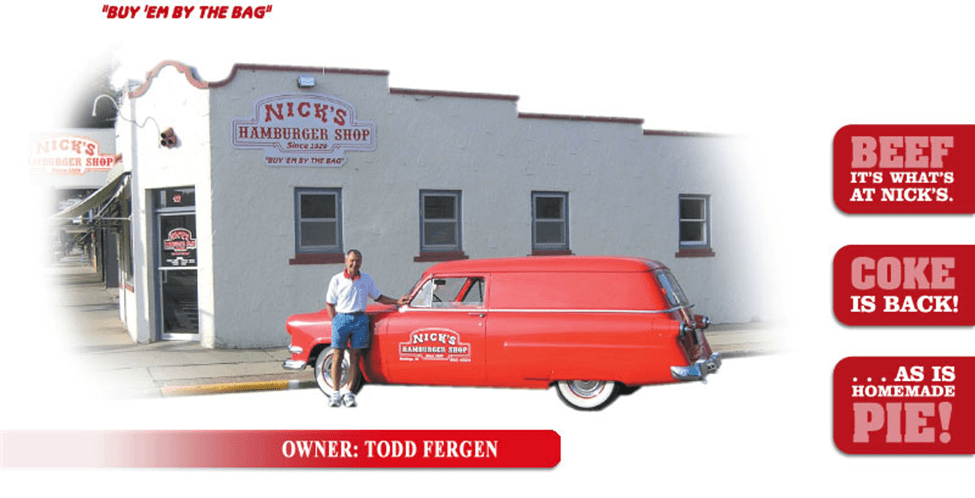
Burgers were up to two dollars when I retired and left Brookings. At Nick’s, you didn’t get a cheeseburger – a slice of cheese was a condiment, available at extra cost. Now, the menu online shows me that cheeseburgers are available. Such is progress. We would occasionally do dinner at Nick’s as Sam waited for her taekwondo class.
-
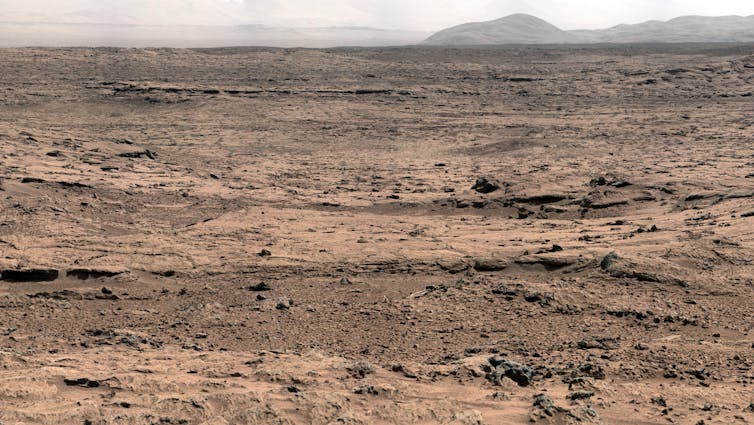
A panorama created from images taken by the rover Curiosity while it was working at a site called ‘Rocknest’ in 2012. NASA/JPL-Caltech/Malin Space Science Systems Elisabeth M. Hausrath, University of Nevada, Las Vegas
Mars, one of our closest planetary neighbors, has fascinated people for hundreds of years, partly because it is so similar to Earth. It is about the same size, contains similar rocks and minerals, and is not too much farther out from the Sun.
Because Mars and Earth share so many features, scientists have long wondered whether Mars could have once harbored life. Today, Mars is very cold and dry, with little atmosphere and no liquid water on the surface − traits that make it a hostile environment for life. But some observations suggest that ancient Mars may have been warmer, wetter and more favorable for life.
Even though scientists observing the surface of Mars conclude that it was once warmer than it is today, they haven’t been able to find much concrete evidence for what caused it to be warmer. But a study my colleagues and I published in April 2025 indicates the presence of carbonate minerals on the planet, which could help solve this puzzle.
Carbonate minerals contain carbon dioxide, which, when present in the atmosphere, warms a planet. These minerals suggest that carbon dioxide could have previously existed in the atmosphere in larger quantities and provide exciting new clues about ancient Mars’ environment.
As a geochemist and astrobiologist who has studied Mars for more than 15 years, I am fascinated by Mars’ past and the idea that it could have been habitable.
Ancient carbon cycle on past Mars
Observations of Mars from orbiting satellites and rovers show river channels and dry lakes that suggest the Martian surface once had liquid water. And these instruments have spotted minerals on its surface that scientists can analyze to get an idea of what Mars may have been like in the past.

Today, Mars is very cold, with a thin atmosphere and dry climate. But in the ancient past, it may have been warmer and wetter, with a thicker heat-trapping atmosphere. NASA/J. Bell – Cornell U./M. Wolff – SSI via AP, File If ancient Mars had liquid water, it would have needed a much warmer climate than it has today. Warmer planets usually have thick atmospheres that trap heat. So, perhaps the Martian atmosphere used to be thicker and composed of heat-trapping carbon dioxide. If Mars did once have a thicker carbon dioxide-containing atmosphere, scientists predict that they’d be able to see traces of that atmospheric carbon dioxide on the surface of Mars today.
Gaseous carbon dioxide dissolves in water, a chemical process that can ultimately contribute to formation of solid minerals at and below the surface of a planet − essentially removing the carbon dioxide from the atmosphere. Lots of scientists have previously tried to find carbonate minerals on the surface of Mars, and part of the excitement about a warmer, wetter early Mars is that it could have been a suitable environment for ancient microbial life.
Finding carbonates on Mars
Previous searches for carbonates on Mars have turned up observations of carbonates in meteorites and at two craters on Mars: Gusev crater and Jezero crater. But there wasn’t enough to explain a warmer past climate on Mars.
For the past few years, the Mars Science Laboratory Curiosity rover has been traversing a region called Gale crater. Here, the rover’s chemistry and mineralogy instrument has discovered lots of the iron-rich carbonate mineral siderite.

The Curiosity rover has detected carbonates on Mars’ surface. NASA As my colleagues and I detail in our new study about these results, this carbonate mineral could contain some of the missing atmospheric carbon dioxide needed for a warmer, wetter early Mars.
The rover also found iron oxyhydroxide minerals that suggest some of these rocks later dissolved when they encountered water, releasing a portion of their carbon dioxide back into the atmosphere. Although it is very thin, the modern Martian atmosphere is still composed mainly of carbon dioxide.
In other words, these new results provide evidence for an ancient carbon cycle on Mars. Carbon cycles are the processes that transfer carbon dioxide between different reservoirs − such as rocks on the surface and gas in the atmosphere.
Potential habitats for past microbial life on Mars
Scientists generally consider an environment habitable for microbial life if it contains liquid water; nutrients such as carbon, hydrogen, nitrogen, oxygen, phosphorus, sulfur and necessary trace elements; an energy source; and conditions that were not too harsh − not too acidic, too salty or too hot, for example.
Since observations from Gale crater and other locations on Mars show that Mars likely had habitable conditions, could Mars then have hosted life? And if it did, how would researchers be able to tell?
Although microorganisms are too small for the human eye to detect, they can leave evidence of themselves preserved in rocks, sediments and soils. Organic molecules from within these microorganisms are sometimes preserved in rocks and sediments. And some microbes can form minerals or have cells that can form certain shapes. This type of evidence for past life is called a biosignature.
Collecting Mars samples
If Mars has biosignatures on or near the surface, researchers want to know that they have the right tools to detect them.
So far, the rovers on Mars have found some organic molecules and chemical signatures that could have come from either abiotic − nonliving − sources or past life. https://www.youtube.com/embed/oHLbXTOaw7w?wmode=transparent&start=0 The Curiosity rover travels across Mars searching for signs that the planet could have once been habitable.
However, determining whether the planet used to host life isn’t easy. Analyses run in Earth’s laboratories could provide more clarity around where these signatures came from.
To that end, the Mars 2020 Perseverance rover has been collecting and sealing samples on Mars, with one cache placed on the surface of Mars and another cache remaining on the rover.
These caches include samples of rock, soil and atmosphere. Their contents can tell researchers about many aspects of the history of Mars, including past volcanic activity, meteorite impacts, streams and lakes, wind and dust storms, and potential past Martian life. If these samples are brought to Earth, scientists could examine them here for signs of ancient life on another planet.
Elisabeth M. Hausrath, Professor of Geoscience, University of Nevada, Las Vegas
This article is republished from The Conversation under a Creative Commons license. Read the original article.








Want to tell us something or ask a question? Get in touch.

Recent Posts
- Computer Repair by Mussolini
- Getting Alberta Oil to Market
- Parties On Economics
- Thus Spake Zarathustra – One More Time
- Suspenders
- You Haven’t Met All The People . . .
- Play Stupid Games, Win Stupid Prizes
- The Ballad of Lenin’s Tomb
- An Encounter With a Lawnmower Thief
- County Property Taxes
- A Big Loss in 2025
- Thinking of Clovis
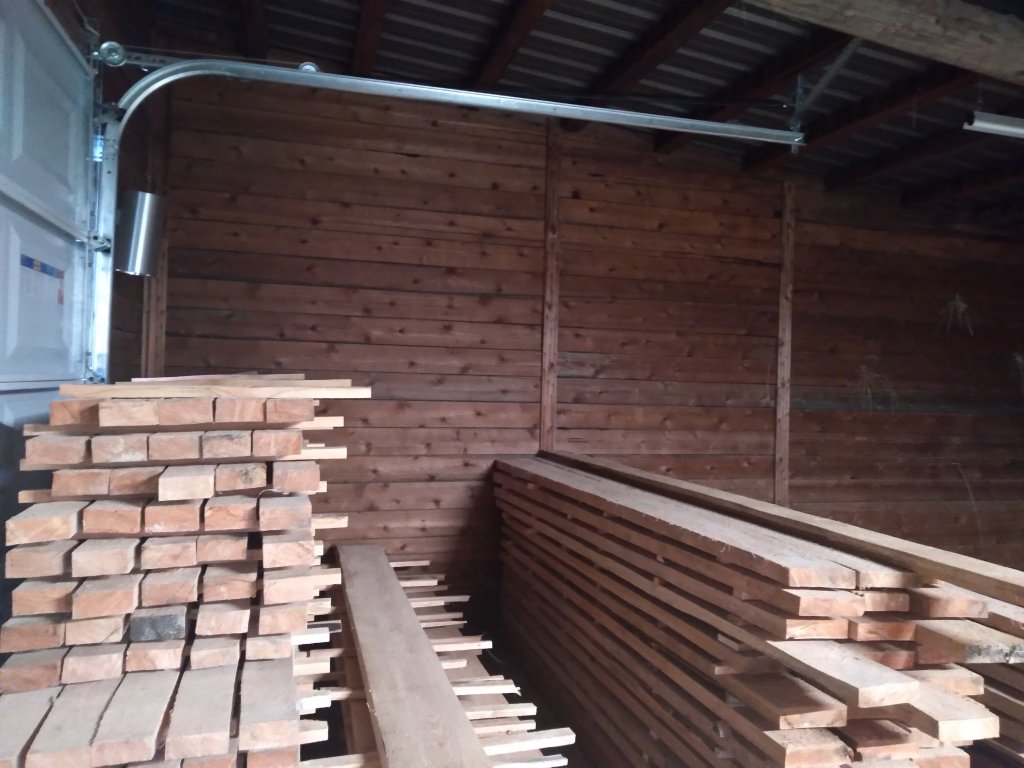
Rough Cut Lumber
Harvested as part of thinning to reduce fire danger.
$0.75 per board foot.
Call Mike (406-882-4835) or Sam (406-882-4597)
Popular Posts
Ask The Entomologist Bears Books Canada Census Community Decay Covid Covid-19 Data Deer Demography Education Elections Eureka Montana family Firearms Game Cameras Geese Government Guns History Inflation life Lincoln County Board of Health Lincoln County MT Lincoln Electric Cooperative Montana nature News Patches' Pieces Pest Control Politics Pond Recipe School School Board Snow Taxes travel Trego Trego Montana Trego School Weather Wildlife writing
 Trego's Mountain Ear