-
I’ve had some questions brought up after I pointed out that the composition of the LCHS board has been in violation of state law for the past 37 years. The first question, repeated several times is “How did it happen?”
In 1988, there was an election to unify Lincoln County High School and Eureka Elementary. It passed in Eureka and Rexford. The County Superintendent replaced the LCHS Board with the Eureka Elementary Board plus 3 people representing the rural districts, and tasked the Elementary board with a few things to do before the unification was complete.
Among the things that had to be done was renaming LCHS, since state law doesn’t allow a county high school to be unified. Here I’m giving my best guess as to what occurred – some crass and low lout pulled the relevant minutes from the LCHS record and disposed of the document. I wasn’t there – but my guess is that several members of that first unified board didn’t want to lose the LCHS name. I’m guessing that they argued so long and intensely about it that they missed the window of time for unification.
Cindy Middig resigned – and in her absence, there was nobody on the county staff to declare the unification failed due to not completing the legally required tasks. When Mary Hudspeth was appointed months later, she knew nothing about it.
Middig’s appointment of the elementary board and the tokens was legal and correct. When that board failed to perform the tasks of unification – and I think the big one was renaming the high school – unification failed. Not because of the voters, but because the board, for one reason or another, failed to complete the first tasks it was legally required to perform.
Since they didn’t complete the task, the two districts were unified from April 20, 1988 to July 1, 1988. On July 1, the unification was invalid, and the LCHS board should have been called back to duty and the Elementary board reduced to their original elementary duties. But Middig was gone, and the county had no one on staff to enforce the law – and the Eureka elementary board took over control of the high school in violation of Montana law.
Here’s the relevant law:
Montana Code Annotated 2023
TITLE 20. EDUCATION
CHAPTER 3. ELECTED OFFICIALS
Part 3. School District Trustees
Membership Of Elected Trustees Of County High School District And Nomination Of Candidates
20-3-356. Membership of elected trustees of county high school district and nomination of candidates. (1) The trustees of a county high school district must include the following:
(a) four trustee positions filled by members residing in the elementary district where the county high school building is located; and
(b) three trustee positions filled by members one of whom resides in each of the three trustee nominating districts in the territory of the high school district outside of the elementary district where the county high school building is located. The county superintendent shall establish the nominating districts, and, unless it is impossible, the districts must have coterminous boundaries with elementary district boundaries.
(2) The provisions of 20-3-305 govern the nomination of candidates for the trustee election prescribed in this section.
Obviously five Eurekans with a token representative from Trego and from Fortine does not match that requirement. Effectively, LCHS has been governed by an outlaw board of trustees for nearly 37 years. I am not an attorney – I have no idea how this affects the legality of any decision the board of trustees has made over the past 37 years. Can an outlaw board grant tenure? Can it even legally hire? The one thing I do know is that when Suzy Rios established a new and proper LCHS board of trustees, those folks are going to have a big job looking at the past 37 years of decisions.
How did the minutes disappear? Who took them? Again, I can only provide my best guess. My hypothesis is that some crass and low lout took them. There were 35 years of opportunity to remove the minutes before I went looking for them. I figure that the crass and low lout had access to the minutes, and saw some advantage to continuing to operate with the Elementary board of trustees running the county high school – so I figure Crass and Low was either a trustee or a school administrator. That leaves plenty of suspects, and unless Crass and Low confesses, we’ll never know who the perp was. What we do know is that there was some advantage – likely financial – to maintaining the un-unified district with the elementary board running things. The absence of the minutes shows that it was worth breaking the law to perpetuate the unified district setup. And for heaven’s sake don’t blame Joel – I think he was as surprised as I to learn someone lifted the minutes.
Why did it take so long to find? Frankly, the Crass and Low lout who pulled the minutes covered the evidence pretty well. I’m kind of used to researching things – heck, research was my career for years – and it took a stubborn, persistent researcher to figure out what happened. And luck. When you’re dealing with school trustees, it isn’t enough just to believe in miracles – you have to rely on them. Renata had done an article on the unification for the Ear back in 1988, and it put me on the track.
What do you want? After all, it’s been working fine for 37 years? I want the law to be followed. I started looking into this as a Trego board member about 6 years ago. Trego had only a token member on the high school board – and LCHS had not exactly been topping the state in academic performance.There’s an advantage to a school board that only has to worry about the high school. And real trustees for the rural areas, instead of token representatives will improve things for us. Did you know that the LCHS bus doesn’t go past Trego school to pick up students? In the sixties Mrs. Gilmond drove the high school bus up to Lake Creek.
What I want is for us all to support Suzy Rios (Lincoln County Superintendent of Schools) in correcting the error that fell through the cracks on July 1, 1988. I expect Noel Durum to be interested in correcting a blunder that allowed the wrong board to control the county high school for 37 years. It’s just one more example of errors perpetuated for decades.
Ted Roo probably wouldn’t appreciate it, but I would suggest that Suzy Rios bring him back to finish his tour as the most recent legitimate chair of the LCHS board. I’d suggest that no one on the present board be appointed to the reformed LCHS board of trustees – not saying that they’re bad people, but they have been perpetuating a long term error. And I’d suggest that Trego continues to have one trustee on the board, that Fortine has one, and that both bantam districts get to vote on a shared third trustee. That new board will have a lot to do. -
It’s time. It has been a challenging six years. When I started, Trego was funded at 4 ANB – ANB is how the Office of Public Instruction abbreviates “’average number belonging”. Four isn’t very many students. Our first challenge was to change that downward trend. The second challenge was the lack of a county superintendent of schools. The commissioners listened and reinstated the position – just in time for a teacher insurrection led by a board member who had moved to Rexford but insisted she was still on the board. We survived that challenge.
So where is the board as I am stepping off? Simply enough, personnel is policy. It has taken a while, but we have a lead teacher who agrees that our school needs to be home school friendly. Our clerk is also a certified teacher (science). We’re recruiting for an additional full-time K-8 teacher. We have a team that consists of educators. We have a team that knows what the state standards are and plans to teach so the students exceed them.
Trego exceeded those standards before – back when Mike Sartori taught the upper grades, our graduates went to Eureka and spent the next year and a half on the honor roll. That return starts next Fall. I will not be on the board as Trego school goes back into the promised land – but it will happen.
Will my replacement do as good a job? Hopefully better – when I came on the board, we needed Dave, Kenny and I to make needed changes. Funded for only four students, it had to be done. With a reputation as a failing school, recruiting great teachers was more than a challenge.
Over my six years, most of the tough decisions have been made by 3-2 votes. When the board is unanimous, there is little conflict. I’ve prioritized decisions this way:
- Is this decision best for the students?
- Is this decision best for the school facility?
- Is this decision best for the employees?
- Is this decision best for the trustees?
Often the decision that makes things easiest for the trustees – and particularly the board chair – is the poorest for the higher priorities of students, community and facility. If you leave the board without having been called bad names, you probably haven’t done your job.
I leave the school board with a single slogan stamped into my mind’s blackboard: It is not enough to believe in miracles – you must rely on them.
I leave the board having been elected and re-elected by acclamation – the only candidate running. This ballot, the one that replaces me, has five names for two positions. It is good. I will admit that I pushed to have a small levy added to the ballot – I hope it increases the number of votes cast.
When my father left the board about 60 years ago, he was certain that the school would continue – with the railroad relocation Trego school had adequate funding to continue forever, and the building was new. In retrospect, he didn’t anticipate the equalization decision that took three quarters of the taxes paid by Trego property owners out of the community, and he didn’t anticipate the long run of nepotism that occurred. With his example, I recognize that, while Trego school today is the best place for your first or second grader, a bad board and poor teachers can revert quickly.
I don’t expect a board with five good trustees at all times – the tough decisions will be made by three members. The trick is electing a majority of good trustees. I have a couple of guidelines – the school employees should stay out of the campaigns. Entirely out. Period. We’ve had too many times in the past where an employee and a couple board members ran the school – usually in the way they thought was correct, but when I came onto the board, Trego was funded at 4 ANB.
We do not get the government we deserve – that’s a fallacy. We get the poorest government we are willing to tolerate. Democracy is probably not the best form of government – but it has provided the best governments history has to show us. We need community involvement – and we need voters to select the candidates that come from the right side of the bell curve.
My advice to the new board members? It is not enough to believe in miracles. You must rely on miracles. When the community supports the school, those miracles somehow come through when they’re needed.
-
I spent a couple of hours Sunday on a task I didn’t want to do. The decision to give me an unwanted task was made by someone saving time – driving a little too fast for the conditions, and leaving me with a badly injured doe in the middle of the trailer court.
The task was complicated by someone calling the game warden. Game warden didn’t get the call, so a deputy sheriff showed up to finish the animal off. A 12 gauge to her lungs left her suffocating in her own blood, so I grabbed the old High Standard and did a head shot. By definition, a mercy killing should be merciful.
Understand, I’m not angry with the cop – I don’t imagine he wanted to kill a doe on his Sunday morning. And I don’t expect a high standard of marksmanship to go with the badge. Some cops shoot well. Most drive well. And I don’t expect any of them to want to drive out and kill something on a Sunday morning.
So, because of a bit of careless driving, there’s a cop driving back to town who has done his job, and not enjoyed a minute of it, and me, the guy who finished the deer up close and personal with a head shot. Neither of us had an uplifting experience that Sunday morning.
Four or five times a year, I have the unscheduled, unwanted task of disposing of the body after someone hits a deer alongside my place. If I leave it on the road, it’s a risk to my dogs, and the neighbor’s dogs. It has to be done. At 75, it’s a bit harder to load the body into the pickup and haul it off. When I’m lucky, the deer is already dead. When I’m really lucky, the guy who hit it, or the next guy to come along, has already used a pistol in a headshot. When I’m luckiest, drivers haven’t hit any deer – and that’s most days.
Still, it has me thinking – I probably spend eight hours a year cleaning up road killed deer. Say I have a mile of road frontage – just for easy math. It takes two minutes to drive by at 30 mph, and only one minute at 60 mph (see why I’m using easy math?). Now let’s look at the time balance – I have 480 minutes involved in cleaning up 5 roadkills. Round it up to 500 for easy math. Five drivers didn’t save any time because they hit a deer. No, make that four – the ambulance didn’t stop or slow down. Still, that’s four with dead deer, auto body damage and no time saved.
My rough calculations show that driving by my place at 60 mph instead of the legal 35 can save you, at best, a minute. Since I am already putting in 500 minutes in cleaning up bodies – and we also have about another hour of the deputy’s time on this last one – is it asking so much to just follow the bloody speed limit and look out for deer when you drive by? Sure, it may take an extra minute – but that minute isn’t saved – it’s passed on to me as a damned unpleasant task. It’s passed on this time to a deputy, in an unpleasant job, who hears my unvoiced criticism of his shooting ability in the single round from my 22 as he gets in his cruiser.
I’m 75. It’s taking me longer to clean up. I don’t mind picking up behind the ambulance – saving the crew a few minutes may save a life. When the savings in time isn’t measured in life or death, asking my neighbors to follow the speed limit doesn’t seem unreasonable. Most already do.
-
I’m still operating on the premise that, while Canadians are malevolently well informed about US politics, we’re benevolently ignorant of how politics work in Canada. I’m pretty sure it was Trev Edwards – an architecture student from Edmonton back in my undergrad days – that shared that observation with me. That’s close to sixty years ago – and it was just this past month that I quizzed a couple of Canadian friends to learn that they too have senators, but Canadian senators are appointed by the Provincial Premier, and not elected.
This map shows how the election went (it’s easier to understand if you remember that in Canada the conservatives are blue and the liberals are red)
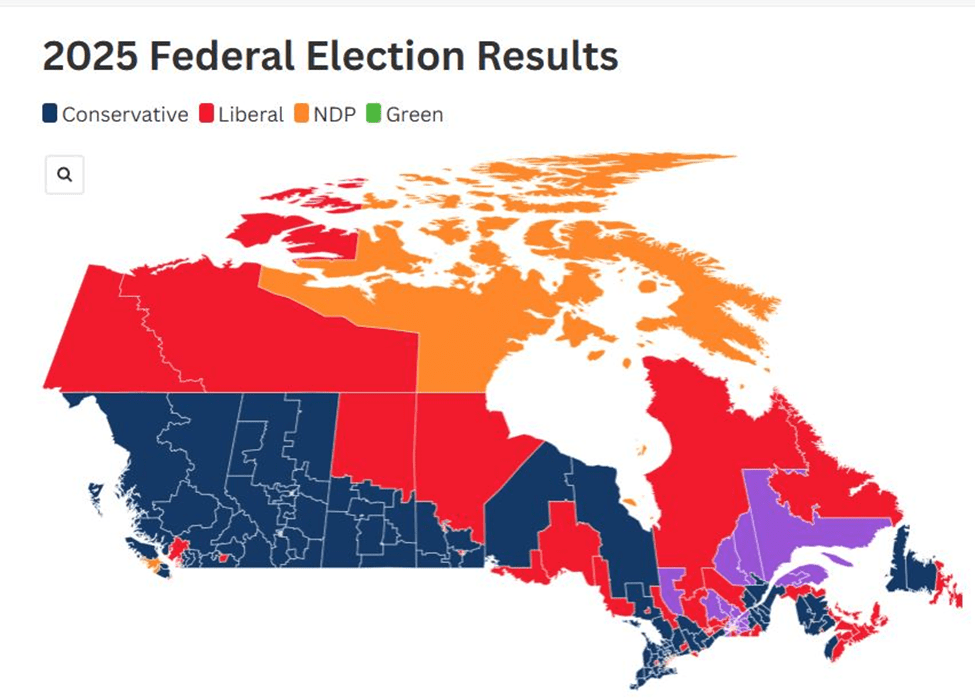
Parliament this time will be a combination of Liberals and the more liberal NDP – in Canada, the magic number for a majority is 172 – and the Liberals have 168. That means another coalition government, where they need to keep four of the seven NDP members of parliament on board to keep the government. It’s kind of like the Republican majority in the House of Representatives. There, they have 218 representatives out of 435 members. Canada, like the US, will be ran by a fragile majority.
This time, in Canada (like every time in the US) the losing candidate, Pierre Poilievre lost his seat in parliament. Since he’s kind of a career politician, I think that may be a bit of a problem for him. This situation isn’t the norm in Canada – while in the US, both Richard Nixon and Kamala Harris had to return, unemployed, to California.
In Canada, the run for parliament is reported in ridings, rather than districts. Which is interesting, since wiki tells me that riding is no longer the correct term for district. It comes from an old English term for a third, much like the term farthing (old English for a quarter). Like Trev said, we’re benevolently uninformed about Canada.
So what happens next? I can recall Quebec trying to leave a couple of times – but now, staying in Canada is definitely in Quebec’s economic best interest. I don’t expect another ‘Quebec libre’ movement anytime soon:
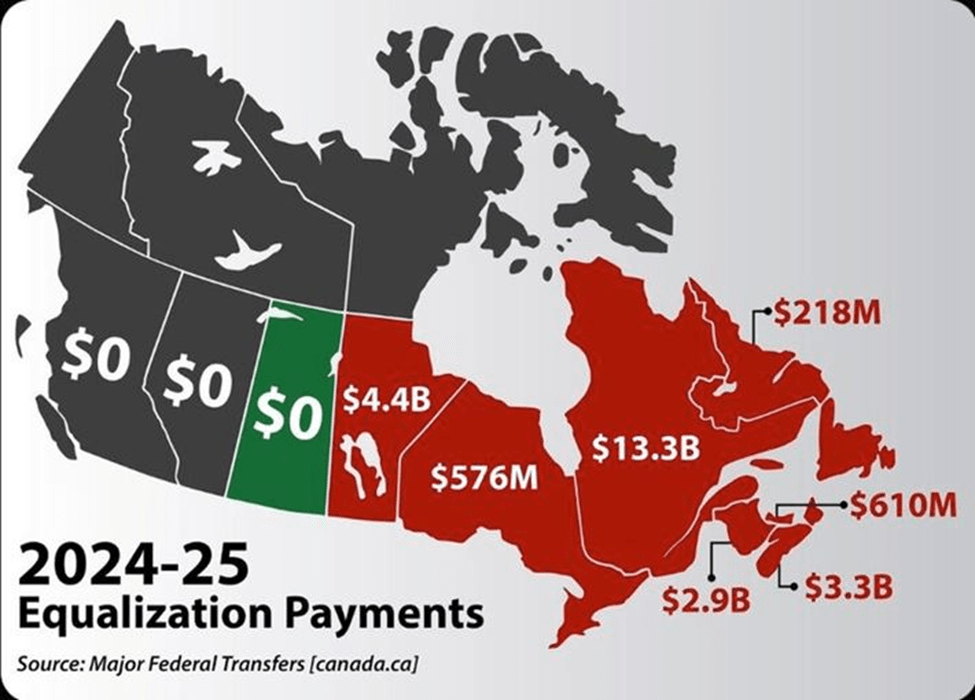
Life in Alberta, on the other hand, may become a lot more interesting.
-
So I see a facebook posting that lists Murphy’s Law as ‘the more you fear something, the more likely it is to occur.’ Would have been a surprise to Murphy, who said “If anything can go wrong, it will.” Sam sent me another AI generated theme that claimed “No person, no problem” came from the film The Lion King.
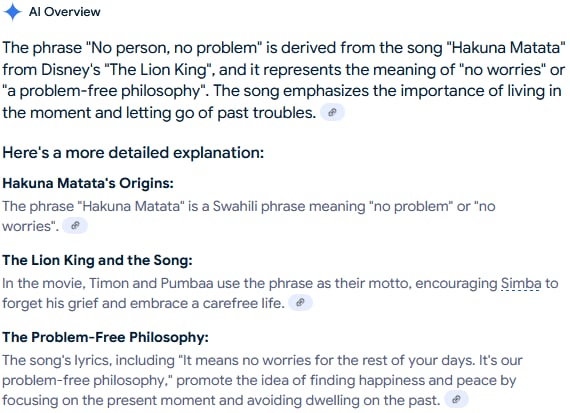
Pretty sure that phrase came from the great Soviet philosopher Joe Stalin. Heck, Uncle Joe left us photos to prove it:

The problem I’m seeing with artificial intelligence is that, while AI can quickly review the literature, it lacks the ability to separate bad data from good. I’m not seeing announcements on AI making discoveries that alter our understanding of physics. I am seeing where high school students and undergraduates are using AI as a way to plagiarize papers.
It’s a fast way to do a literature review – and that’s essentially what a high school term paper is. The problem is discernment. The cop instructor at TSJC and I were about the same age. He had completed a cohort based master’s in public administration – I had a research bachelor’s in Sociology and had then gone back in Ag Engineering. He started a doctorate (pretty much correspondence) from Nova – and was shocked to learn that including the Encyclopedia Britannica in your sources wasn’t acceptable in a Ph.D. program. His master’s degree was one of those termed a “terminal degree” – meaning that it wasn’t meant to prepare him for a doctoral program.
And that seems to be the weakness of AI programs – they can definitely read faster than I can, and condense the information – but AI (so far) doesn’t have the ability to sort out the bull. The spot where AI scares me is that students will use it, rely on it, and not have the ability to discern bad research, bad assumptions, from good. I can see where AI has great potential for speeding research – but I remember my own dissertation, where a single conversation with one old Hutterite minister disproved my hypothesis. When I knew what I was looking for, I could find the data – but without that conversation I would have published bad research.
My belief is that AI can develop some very sloppy research habits in students – and it will probably be more damaging in my own area of social sciences than it will in quantum physics.
-
In the US, the Supreme Court ruled secession illegal in Texas v White (1869). Admitted, this occurred after the Justice Department dropped the treason case against Jefferson Davis – for fear that a Virginia jury would have supported the idea that once Mississippi seceded, Davis was no longer a citizen of the United States, and could not have committed Treason.
Despite the 1869 Supreme Court decision, there’s something to be said for believing the secession issue was resolved by US Grant and the Union army.
In Canada, it’s more recent – the decision was made in 1998. The document is at Reference re Secession of Quebec, 1998 CanLII 793 (SCC), [1998] 2 SCR 217 I think that the conclusion at the end of this document says that secession is legal in Canada, but once the province has voted to secede, there’s a whole lot of negotiation required. Remember, I’m not a lawyer, and sure as hell, not an international lawyer – and the only family experience with secession didn’t work out all that well. Here’s what I think is relevant:
“151 Quebec could not, despite a clear referendum result, purport to invoke a right of self-determination to dictate the terms of a proposed secession to the other parties to the federation. The democratic vote, by however strong a majority, would have no legal effect on its own and could not push aside the principles of federalism and the rule of law, the rights of individuals and minorities, or the operation of democracy in the other provinces or in Canada as a whole. Democratic rights under the Constitution cannot be divorced from constitutional obligations. Nor, however, can the reverse proposition be accepted. The continued existence and operation of the Canadian constitutional order could not be indifferent to a clear expression of a clear majority of Quebecers that they no longer wish to remain in Canada. The other provinces and the federal government would have no basis to deny the right of the government of Quebec to pursue secession, should a clear majority of the people of Quebec choose that goal, so long as in doing so, Quebec respects the rights of others. The negotiations that followed such a vote would address the potential act of secession as well as its possible terms should in fact secession proceed. There would be no conclusions predetermined by law on any issue. Negotiations would need to address the interests of the other provinces, the federal government, Quebec and indeed the rights of all Canadians both within and outside Quebec, and specifically the rights of minorities. No one suggests that it would be an easy set of negotiations.”
This cartoon came from the Canadian Blog Small Dead Animals – with a 1915 date, I’m fairly sure it’s in the public domain. It does suggest that the idea that Alberta is being ripped off by Quebec and Ontario isn’t a particularly new one.
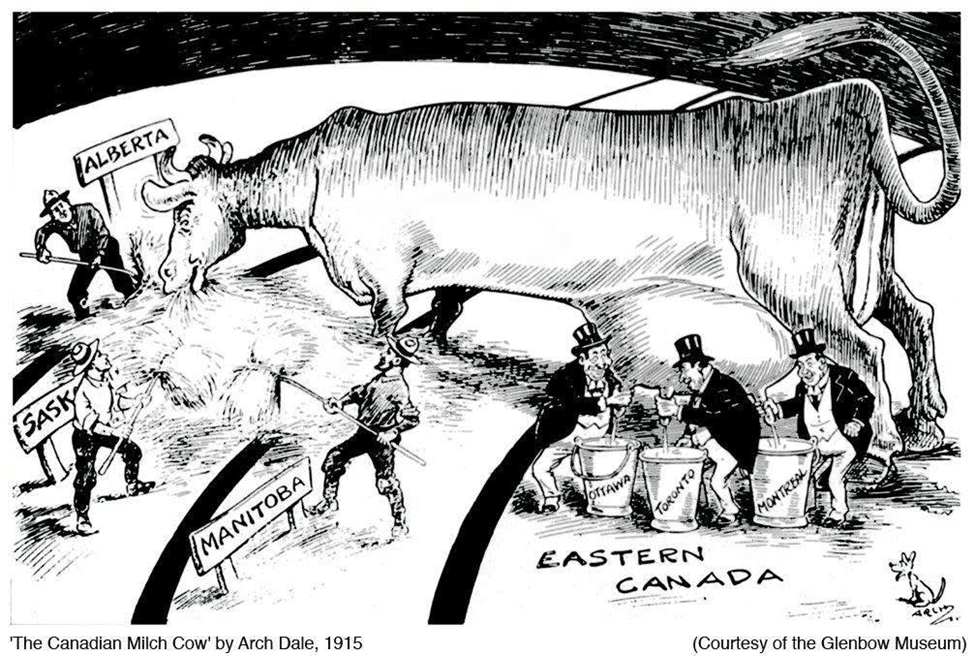
The article headed by this cartoon includes this observation: “British Columbia has 19 border crossings with the United States, Alberta has 6, Saskatchewan has 12, and Manitoba has 16. There is just 1 narrow 2 lane road through 1,000 miles of wilderness connecting all of Western Canada with Ontario, Quebec and the Atlantic provinces, yet the East rules the lives of Western Canada?” To read the whole thing, complete with links, click Western Canada Secession: Why Does the West stay in Canada?
Click the links and read – you’ll probably understand secession in Canada better than the average American.
-
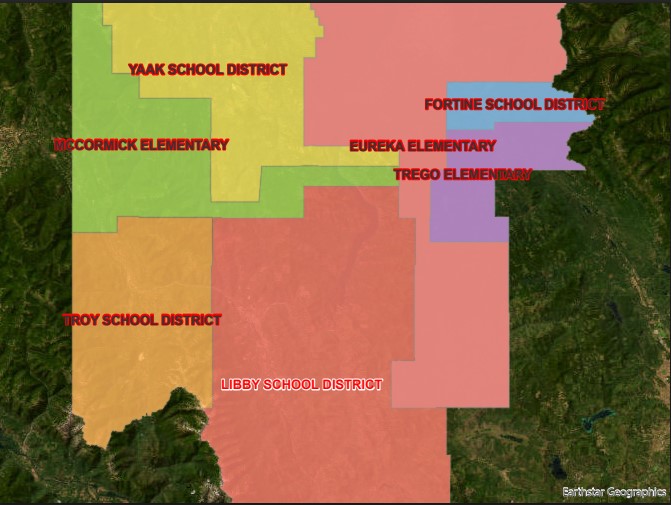
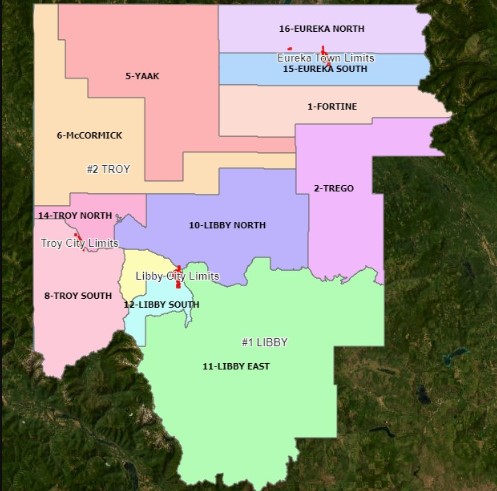
These maps are taken from the county website, and I believe that they were drawn up in the county planner’s office. I also believe that the school district map is in error – when the railroad relocation occurred, Trego school district boundaries were presented as shown in the voter precinct map:

The next illustration shows the school district maps. Notice how Eureka Elementary district now has a township wide strip west of Trego (School District 53) that includes only National Forest, but puts Eureka (School District 13) adjacent to, and surrounding School District 53 and claiming the area which I would describe as Wolf Prairie. Wolf Prairie includes a large amount of railroad, a bit of small private land (as I recall), and a significant amount of corporately owned forest lands. (While my memory is from 35 years back, I covered a lot of the area while working on cadastral surveys)
I noticed the change when I called up the map and was looking for the location where our district border touched Libby. Obviously, I was a little shocked to find that it no longer does.
The area south of Trego is part of the Lincoln County High School District (High School District 13) and this error may have resulted from the 1988 attempt to consolidate LCHS and Eureka Elementary – though the strip taken from the east edges of McCormick and Yaak argues for a deliberate decision rather than a decision made through conflation of elementary district 13 and LCHS district 13.
If I am correct, the area south of Trego, shown as elementary district 13, should be shown as Trego, district 53. The area to the west should be returned to McCormick and Yaak.
You might wonder at the Gerrymandered shape of Yaak and McCormick. This was done in the early history of Lincoln County, stretching those districts across the Kootenai valley in a spot where it included only national forest lands. The location was selected to make sure all the school districts at the time included a few miles of railroad land to kind of equalize the tax burdens (according to the answer I received from school superintendent Wilda B. Totten about sixty years ago).
We (Joel Graves and I) were unable to find the minutes where the consolidation of LCHS and Eureka Elementary was rejected – yet it must have been because Montana law requires the high school to forfeit county high school status if it becomes part of a consolidated district. It’s still Lincoln County High School 37 years after the vote to consolidate (though the vote to consolidate failed in both Fortine and Trego districts.
I do not expect the Superintendent’s office records to show the missing documents. The consolidation vote occurred in the middle of 1988, and Superintendent Cindy Middig made a temporary change in the LCHS board structure to reflect that decision and instructed that board in the actions it had to complete in order to consolidate the district. I believe that the county superintendent’s old records went the same way as Extension’s did back in 1997 or 98. Records were stored in the annex basement and a broken wastewater (sewage) line ruined most of them. The commissioners records – somewhere between May and September of 1988 may provide relevant information on what the LCHS board did or did not do.
After instructing the new LCHS board in their required actions, Cindy Middig resigned and left the county. About six months later, Mary Hudspeth was appointed as County Superintendent – but in those months without a superintendent, everything about the consolidation fell through the cracks.
So far as the district maps are concerned – I had a similar problem with our most recent county election administrator who re-issued my voter registration showing a non-Trego school district residence (LCHS). New to the position, she did not realize that state law requires school board members to be registered in the school district. I had not realized why she made the mistake (and argued that there was no need to correct it) until I saw this map.
Assuming I am correct and there has been no redistricting to include an area where Eureka’s buses have never run, we need to correct the errors in the map, and make certain that Eureka elementary is not, and has not, been taxing the Lincoln County High School District. Additionally, we should look at correcting the LCHS board membership to reflect that LCHS is not, and apparently never has been consolidated with Eureka Elementary.
-
In case anyone was wondering how many children are attending our local schools, we have some answers: ANB, which is a measurement of enrolled students, is done twice per school year, and is what determines a significant component of school funding. It is also publicly available on the OPI’s website.

Overall, total enrollment between Trego, Fortine, Eureka, Yak, McCormick and Libby holds relatively steady, though we can see a distinct drop associated with Fall of 2020-Spring 2021.
We can look a little closer at Trego, Yak and McCormick. Why those three? All three are so small that they do not have an administrator, and instead have that role filled by the county superintendent.
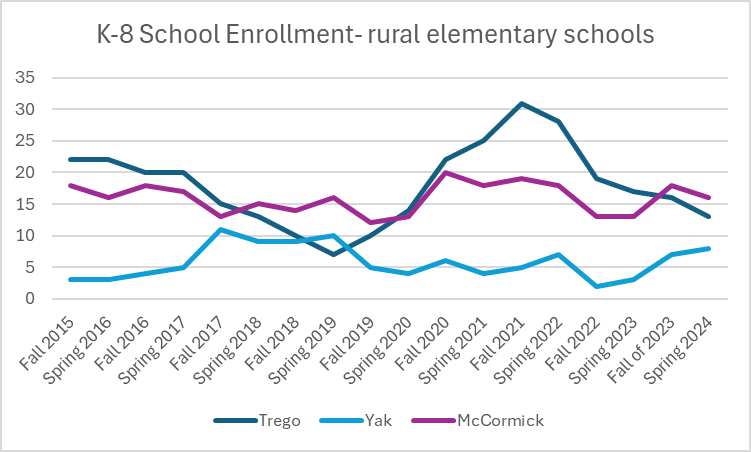
In that comparison, we can see that Yak typically runs the lowest of the three, and that all three experience fairly frequent and significant fluctuations.
Comparing the elementary schools in North Lincoln County involves looking at Fortine, Eureka and Trego enrollments. Overall, we see a slight increase in K-8 enrollments in North county, though they’ve been steady for the past few years. We additionally notice that the Fall 2020 enrollment drop occurred mostly in Eureka.


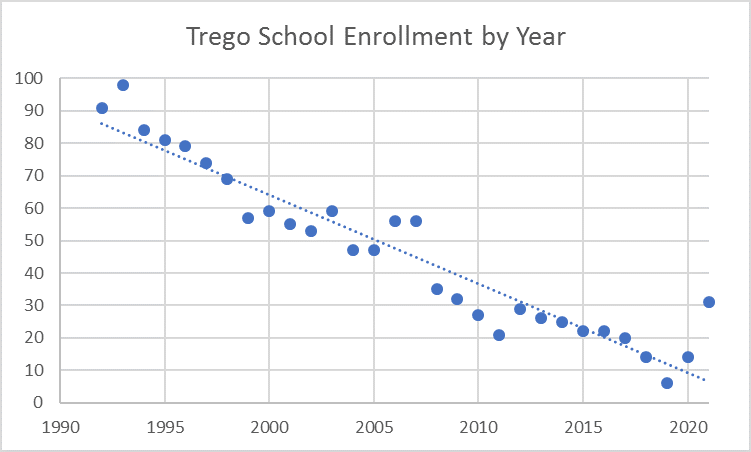
We can also look at each school individually. First, Trego:
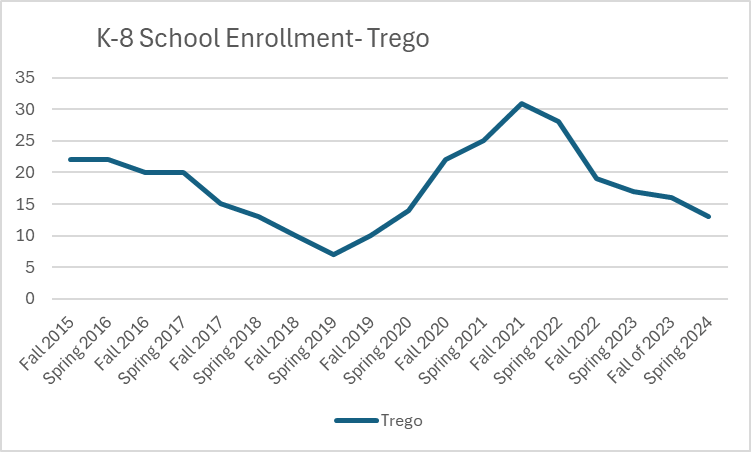
We’ve looked at Trego’s trendline in previous years: Historical School Enrollment, so a longer term trend-line is available. What we see is that Trego Elementary is facing a long-term trend of lowering enrollment.
Fortine: From the ANB Data available, it’s not apparent if the drop that shows represents a trend or not. Fortine has experienced a drop in enrollment over the period we’re looking at.

Eureka: Shows an increase over the time we’re looking at. It doesn’t line up perfectly with the enrollment changes in Trego and Fortine, which implies that there’s something else going on as well (population changes, or fluctuations in homeschool rates likely also contribute).

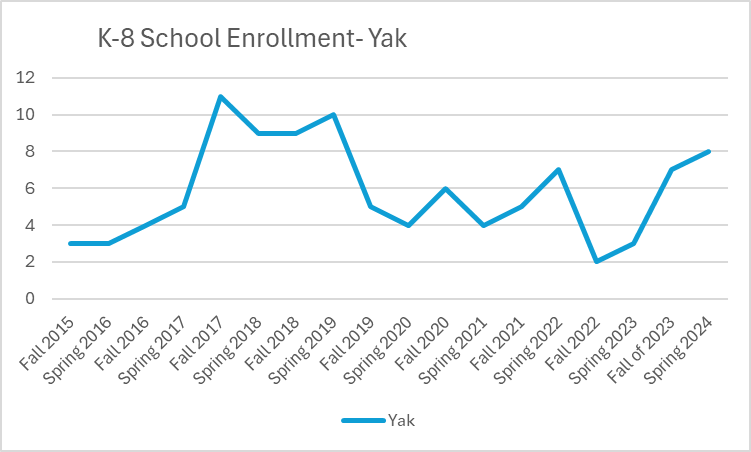
Yak: Experiences massive enrollment fluctuations. A longer period of data would be necessary to determine a trend. School enrollment in the Yak has been quite low at times.
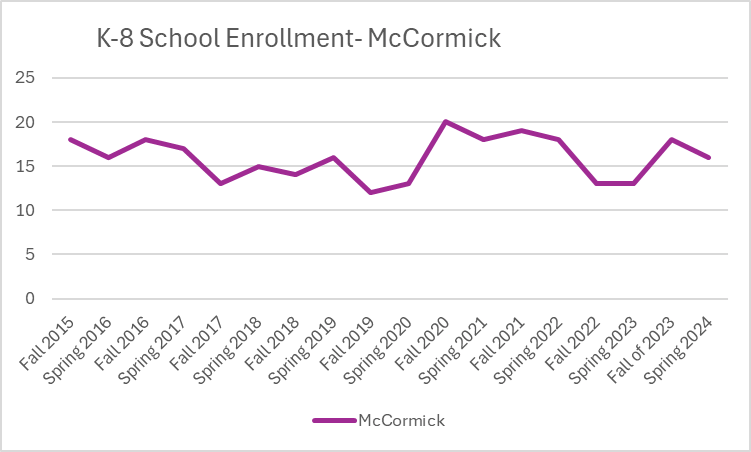
McCormick: Enrollment Fluctuates significantly, enough that it’s probably a continual budget concern, but it doesn’t necessarily indicate a downward trend. More data needed, but the years we have hold a fairly stable average.
Libby: Not as steady as Eureka, but probably also impacted by different demographic factors.

-
Last week, we asked the question: Is it normal for school district transportation budgets to be constant from year to year? Looking again at the school budgets (public information- available for download here), we’ll check Trego’s transportation budget against Fortine and Olney-Bissell.
Trego Fortine Olney-Bissell 24/25 $40,000 $100,000 $212,343.85 23/24 $49,000 $110,000 $182,153.42 22/23 $49,000 $100,000 $178,610.31 21/22 $49,000 $79,000 $148,389.48 20/21 $49,000 $79,000 $142,509.61 19/20 $39,600 $79,000 $136,007.52 18/19 $56,500 $77,000 $128,707.28 17/18 $54,000 $77,000 $132,116.37 16/17 $48,925 $77,000 $123,648.45 15/16 $48,925 $79,000 $121,413.44 Looking through the numbers- my first response is: That’s really weird. Olney-Bissell shows a steady increase over the last decade. Inflation being a thing that exists, that makes sense. Trego and Fortine fluctuate, but not a whole lot. For those of us that like graphs:

There are really two factors to be considered in the costs associated with transportation: Mileage, and time (paying the bus drivers). Both of these are going to be related to number of students and district size.
We can absolutely get an approximate number of students- from the same file, even. It’ll be an approximate (ANB funding will usually be based on the three year average, though it might also be the current year, depending on changes in enrollment). The mileage, well, that’s going to be more interesting to find.
For the moment, we can observe that a recent increase in Fortine’s transportation budget seems to coincide with lowered enrollment.

Meanwhile, the transportation budget in Trego doesn’t seem to have been connected to enrollment at all.

-
This article is excerpted from a report I made to Trego’s school board several years ago. I don’t have an answer to what went on when Eureka Elementary and Lincoln County High Schools were unified by election in 1988 – the relevant board minutes were missing, and Joel and I were unable to find them.
I began looking for data when I read of Eureka’s Elementary district’s inability to pass a levy for a new school building – the suggested alternatives included getting the high school to build a new school, and passing the existing high school on to the elementary district. While it was offered as an “out of the box” solution, it has been done before – the Lincoln County High School I attended is now the Eureka middle school.
As a Trego taxpayer, I have the privilege of supporting LCHS and Trego Elementary – but when LCHS buildings go to Eureka Elementary, we Trego residents have effectively been taxed to support Eureka Elementary as well as Trego Elementary. (Joel tells me that Eureka Elementary paid LCHS a fair price for the old high school – but as I rewrite these notes, I still don’t know what the fair price was. Trego and Fortine districts provide about 20% of the High School tax base. Turning the old high school into the middle school is a great deal for Eureka – but may have been unjust taxation for Fortine and Trego landowners. I have assurances that that is not the case – but I do not have figures that allow me to do my own calculations.
Understanding the significance requires data. And that data is available at https://svc.mt.gov/dor/property/cov#/256 where the state shows market and taxable values for each district. To minimize the data dazzle, I will attempt to explain using only the market values of District 13 elementary and District 13 high school, then converting them to percentages for ease of understanding. (this data is from my original report to the Trego board, and is not current)
High School District 1,375,196,172
Elementary District 1,108,162,025
Subtracting the elementary market value from the high school market value shows that 2,670,341, or 19.4% of the property tax values going to LCHS are from Fortine and Trego districts. The decisions on running the high school are made by five board members elected from the Eureka elementary district – the appearance of representation for Fortine and Trego is a member from each small district, outvoted at the best, and, at the worst a pair with Quisling quality loyalty to the communities they represent.
I believe that the codes mandate that the Fortine district trustee be voted in by Fortine, and Trego’s trustee be voted in only by Trego voters – but I have found no evidence that elections have occurred in that manner.
I have been gathering data to better understand the governance of Lincoln County High School over the past three years. It is a bit perplexing . . . LCHS has, throughout my lifetime, been closely related to Eureka Elementary. When I attended LCHS, the cafeteria was over in the Roosevelt building. Roger Ranta was superintendent over both LCHS and Eureka Elementary. The lines of demarcation were never well defined. In many ways, LCHS and Eureka Elementary have behaved as a unified district over at least the past sixty years – but with lip service toward recognizing the outlying districts (now only Fortine and Trego) as part of Lincoln County High School’s district and independent of Elementary 13.
MCA 20-6-101-3(4) states “As used in this title, unless the context clearly indicates otherwise, a county high school is a high school district that has not unified with an elementary district under 20-6-312. The context of the name “Lincoln County High School” does not clearly (or even murkily) indicate unification with Eureka Elementary. I suspect that this section of the law was why discussion of the need to change the high school’s name was reported in the Mountain Ear when the unification was discussed in 1988. (Joel tells me that the two districts are not unified, but that they operate together under a memorandum of agreement)
I began searching for documentation of unification when I read that comment in the Mountain Ear archives. I now have a copy of the April 20, 1988 letter to the trustees of Eureka Elementary, District 13 from Cindy Middig, then Lincoln County Superintendent of Schools. That letter begins: “Congratulations on the success of your unification election” then gives instructions on actions that need to be completed before July 1st, 1988.
Since Eureka/LCHS does not term itself a “Unified District” while Libby does, I am assuming that a more detailed review of the LCHS minutes, or the Lincoln County Superintendent’s correspondence will unearth more relevant information. Middig’s letter ends with “The additional high school trustee nominating areas (the 3 outlying districts) will remain the same. The trustees presently representing them, Mrs. Lora Johnson (Trego), Mrs. BeeGee Cole (Fortine) and Penny Williams (Rexford) are hereby appointed to hold office until a successor is elected and qualified at the next regular school election in April of 1989.”
The fortunate thing is that BeeGee Cole and Ted Roo (LCHS board chair at the time) live. When I called BeeGee she recalled being appointed to the High School board to represent Fortine, but had no firm recollection of anything being done to unify the districts. She explained to me that she was a Fortine board member and sent by the board to represent the Fortine District at the LCHS board meetings. This differs substantially from the role Marcy Butts filled on the LCHS board, and it appears that change is a result of Cindy Middig’s letter. It appears that Middig did not consider that her change to the board structure would essentially create a taxation without representation situation when the Eureka Elementary Board could vote to take high school properties that were 20% funded by Fortine and Trego.
I spoke with Ted Roo, whose recollection was that Cindy Middig’s letter removed all the high school board members and gave all the authority over the school to the elementary board. From Ted’s recollections, we can point to April 20, 1988 as the time when the event occurred. (Ted only served on the high school board, and ceased being a board member with Middig’s letter.) If Ted’s recollections are correct, we need to see if “The Lincoln County High School Trustees” performed all the requirements for the first transaction listed in Middag’s letter.
Since the May 16, 1988 minutes show LCHS board members Ted Roo, Lora Johnson, Penny Williams, L. Jack Higle, Andy Ivers and BeeGee present, we need only review the minutes from that date through July, 1988 to determine if the LCHS board completed that required transaction before July 1, 1988. My reading of the Middig Unification letter is that, if that transaction was not performed by the LCHS board before July 1, the unification did not legally occur. The old Mountain Ear article pointed out that there was a discussion that the name of the high school would be changed – yet it remains Lincoln County High School. The unchanged name suggests that there is a significant possibility that the requirements listed by Middig were not performed.
If those three specific actions Middig’s letter says were required before unification could occur were never done, as I read the letter, the unification was never completed. Yes, that would create a challenge to getting LCHS a high school board after the Elementary board has controlled both operations for 35 years – but I know of no statute of limitations that forces us to accept governmental misconduct or blunders. MCA 20-6-312 lists the requirements for County high school unification. 20-6-313 seems to support Middig’s instructions: “(1) Whenever a county high school is unified with the elementary district where the county high school building is located, the following transactions must be completed on or before the July 1 when the unification becomes effective:”
Since the High School continues to operate as Lincoln County High School, which name does not clearly indicate the unification with Eureka Elementary, and after talking with then LCHS board chair Ted Roo, I have questions on whether those required transactions occurred – the LCHS name continuation suggests that there is, at the least, some probability that the Middig letter unified the districts, but the other activities that were required to occur before July 1, 1988 did not.
I (along with Superintendent Joel Graves reviewed the records from May 16, 1988 through August, 1988, and we were unable to find the minutes that described the board activities to complete the following transactions required in Supt. Middig’s letter:
1. The Lincoln County High School trustees shall surrender all minutes, documents, and other records to the trustees of the “new” high school district.
2. The county treasurer, after allowing for any outstanding or registered warrants, shall transfer all end-of-year fund cash balances of the county high school to similar refunds established for the high school district. All previous years’ taxes levied and collected for the county high school shall be credited to the appropriate fund for the high school district.
3. The board of county commissioners shall execute, in the name of the county, all necessary and appropriate deeds, bills of sale and other instruments for the conveyance of title to all real and personal property of the county high school, including all appurtenances and hereditaments, to the high school district.
Another necessary search through Eureka’s records is to determine the circumstances of the transfer of the old high school building from LCHS to the Eureka elementary district. If the LCHS board was eliminated – and I trust Ted Roo and his memory – the Eureka Elementary board held five of the votes that transferred the county high school to the Eureka Elementary District.
I asked Suzy Rios, Lincoln County Superintendent of Schools, to search her department’s records from May 16, 1988 to August 1, 1988 to see if documentation exists that provides further information on the unification election – but I suspect that the county superintendent’s record went the same way as Extensions – and I disposed of Extensions records when they had been spoiled by years of a sewage leak in the annex basement.
Middig did not complete her term of office, and was replaced by Mary Hudspeth as County superintendent of schools. The dates when Cindy Middag left the office and Mary Hudspeth came in may explain some of my confusion. (At Trego, we are missing our 1988 and 89 board minutes)
If neither Superintendent can find evidence that the LCHS board took the action Superintendent Middag required, our next step is to ask Sedaris Carlson (County Treasurer) to see if those actions required of the county treasurer occurred. If they did, it is evidence that the unification occurred. If not, it supports the null hypothesis. Again, 1988 was early in computer evolution – any records will be on paper, and have long been stashed away somewhere.
We can also check the county commission’s records for the same time period to see if their required actions were performed. Their minutes for the middle of 1988 will show, or not show, if they did what they were required to do.
As I understand it, if Superintendent Middig’s letter stood without negation, we have a high school that is unified with part, but not all, of its constituent elementary districts. Since Fortine and Trego both exist as independent districts, Eureka elementary has essentially been granted power to tax both Fortine and Trego for the high school district, then turn the high school property over to the elementary district. If I recall correctly, taxation without representation was the impetus behind the American revolution. This situation also suggests that if the unification did occur, Cindy Middig did not correctly consider representation and taxation of Fortine and Trego – which is probably a constitutional issue.
My conversations with BeeGee and Ted leads me to these tentative (and testable) assumptions:
- Prior to the unification vote the outlying districts assigned board members to the LCHS board. This makes sense in terms of communication both ways.
- The unification vote that was announced as a success by Supt. Middig was partially enacted – the high school board was replaced by Eureka Elementary’s board, plus a mandated representative from Fortine and from Trego. Rexford later entered Eureka as a consolidation – ownership of Rexford school and its history may show something: If the necessary transactions were completed, the building would have been property of the consolidated district when Eureka took over Rexford district. Additional research needs to be done on the old high school. Joel explained that Eureka Elementary bought the old high school building from LCHS – that can provide a great deal of light to the questions. If it was purchased from LCHS, that indicates that there is no unified district. If it was sold at less than fair market value, that indicates the high school and elementary districts were acting as a unified district to the economic disadvantage of Fortine and Trego taxpayers. If the building was still owned by LCHS, it strongly suggests that the transactions Superintendent Middig demanded were not completed.
- Whether LCHS and Eureka Elementary are unified or not, the LCHS board is set up to exploit Trego and Fortine. I cannot even vote against the Eureka board member who votes to finance a new high school and sell the existing building to Eureka Elementary for $100 the minute the high school bonds are paid off . . . and a single Trego rep, not even connected with Trego’s board can’t change that. A governing board with five votes out of seven can institute a policy that elementary students can be transported by high school buses from Trego, through Fortine, to Eureka Elementary. This amount of power over the two small districts that Cindy Middig granted to Eureka Elementary seems not only unconscionable, but unconstitutional.
My thanks to Joel Graves and Suzy Rios for their help in reviewing the records – and demonstrated the old research adage: “Absence of Evidence is not evidence of absence.”
Our high school board is not (and has not been for over 35 years) matching this description:
Montana Code Annotated 2023
TITLE 20. EDUCATION
CHAPTER 3. ELECTED OFFICIALS
Part 3. School District Trustees
Membership Of Elected Trustees Of County High School District And Nomination Of Candidates
20-3-356. Membership of elected trustees of county high school district and nomination of candidates. (1) The trustees of a county high school district must include the following:
(a) four trustee positions filled by members residing in the elementary district where the county high school building is located; and
(b) three trustee positions filled by members one of whom resides in each of the three trustee nominating districts in the territory of the high school district outside of the elementary district where the county high school building is located. The county superintendent shall establish the nominating districts, and, unless it is impossible, the districts must have coterminous boundaries with elementary district boundaries.
(2) The provisions of 20-3-305 govern the nomination of candidates for the trustee election prescribed in this section.
Want to tell us something or ask a question? Get in touch.

Recent Posts
- Computer Repair by Mussolini
- Getting Alberta Oil to Market
- Parties On Economics
- Thus Spake Zarathustra – One More Time
- Suspenders
- You Haven’t Met All The People . . .
- Play Stupid Games, Win Stupid Prizes
- The Ballad of Lenin’s Tomb
- An Encounter With a Lawnmower Thief
- County Property Taxes
- A Big Loss in 2025
- Thinking of Clovis
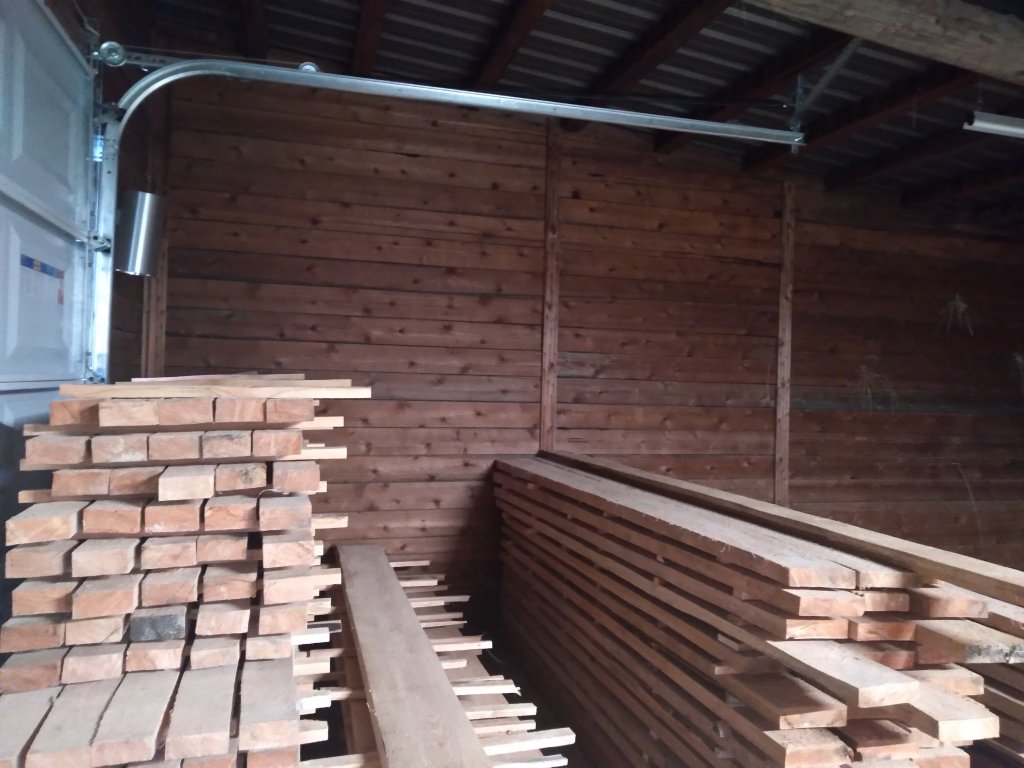
Rough Cut Lumber
Harvested as part of thinning to reduce fire danger.
$0.75 per board foot.
Call Mike (406-882-4835) or Sam (406-882-4597)
Popular Posts
Ask The Entomologist Bears Books Canada Census Community Decay Covid Covid-19 Data Deer Demography Education Elections Eureka Montana family Firearms Game Cameras Geese Government Guns History Inflation life Lincoln County Board of Health Lincoln County MT Lincoln Electric Cooperative Montana nature News Patches' Pieces Pest Control Politics Pond Recipe School School Board Snow Taxes travel Trego Trego Montana Trego School Weather Wildlife writing
 Trego's Mountain Ear