-
The easiest way to answer “how would merging the districts impact local taxes?” is to compare the overall levy rates between the two districts, and their impact on school taxes, depending on property value. We’ll neglect tuition, since it’s not clear what those values are going to be, or if the law will change.
Fund Trego Fortine General 38.28 36.95 Transportation 0.0 26.13 Bus Depreciation 8.28 7.53 Tuition 0.0 0.00 Technology 0.0 0.0 Building Reserve 2.08 2.89 Total 48.64 73.50 This means that switching from Trego to Fortine would be an increase of 24.86. This has a sizeable impact on taxation.
House Value $100,000 $300,000 $600,000 Tax Increase $33.56 $100.68 $201.37 This is a “worst case” scenario, to some extent. It assumes that adding Trego’s taxable value to Fortine’s wouldn’t make it possible to lower the levies somewhat (if not to Trego’s level). It likely would do so, though the decision to lower them would have to be made at a school board level, not by the taxpayers more broadly.
At any rate, the difference in taxable values between the districts mean that while a mill is calculated similarly for tax impact, it’s not calculated similarly for income to the school (this is where the difference in taxable valuation of the district comes in). So the next relevant question is: What would a merger do for the income to the school district? More on that in a later week.
-
I’m noticing comments on the evils of tariffs from folks who wanted forgiveness on their student loans back when Biden was a president. I’m not an economist (neither are they) so I don’t know all the international implications – but I suspect that some tariffs will be good and others will suck. Of course that’s the way I look at the government, regardless of which party dominates.
My little baler is Chinese made – so I suspect a tariff there would increase my cost of producing hay. I’ll live with it – but these cute little round balers may wind up with a limited population. My other Chinese product is the occasional harmonica purchase. Hohner is listed as an American manufacturer – but most of their product line comes from the people’s republic. China is pretty much the source of harmonicas for all of us – and I usually play a tremolo harp. Most tremolo harps are Asian – so, I suspect tariffs on Chinese goods will impact my harmonica purchases. It’s not like I have any shortage of harmonicas, so I can survive the tariffs on them. Tariffs on Chinese bailer parts might be a different story.
I guess I look at a tariff as kind of a sales tax, based on where the product comes from. I recall one of my Japanese students explaining that Japan had a very high tariff on rice, to keep the price up and the profitability of small farms high enough that the country could be agriculturally self-sufficient. Judging from the little white pickups I see on the road, I doubt if GM would sell a whole lot of full-size pickups in Japan even if the tariff was at zero.
But I’m not an economist – I’m kind of ignorant about how tariffs affect trade. Still, I’m pretty sure that a bunch of the folks writing on the topic are probably as ignorant as I am.
-
I was introduced to TS Eliot in high school. His poetry and prose have been with me for a lifetime. I suppose that “The Love Song of J. Alfred Prufrock” and “The Hollow Men” began my appreciation of Eliot’s work. Some of his lesser known thoughts include these:

Most of the trouble in the world is caused by people wanting to be important.
We should not confuse information with knowledge.
If you do not push the boundaries, you will never know where they are.
Those who arrive at the end of the journey are not those who began.
For us, there is only the trying. The rest is not our business.
Success is relative. It is what we make of the mess we have made of things.
If you haven’t the strength to impose your own terms upon life, then you must accept the terms it offers you.
Half of the harm that is done in this world is due to people who want to feel important. They don’t mean to do harm. But the harm does not interest them.
Between the conception and the creation, between the emotion and the response, Falls the shadow.
If you aren’t in over your head, how do you know how tall you are?
People exercise an unconscious selection in being influenced.
I was neither at the hot gates
Nor fought in the warm rain
Nor knee deep in the salt marsh, heaving a cutlass,
Bitten by flies, fought. -
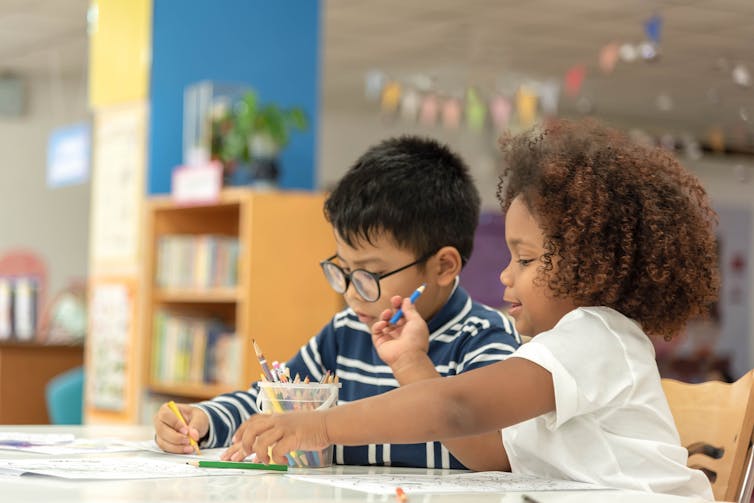
Rachaphak/Shutterstock Sinéad McCauley Lambe, Dublin City University
It’s a milestone that leaves parents beaming with pride: the first time their child shakily writes out their own name. And it’s the start of many more key childhood moments, from Christmas lists to writing their own stories.
If you’re keen to help your child learn to write, you might think about asking them to try to copy shapes, or trace over the dotted outline of a letter. But there’s a lot more that goes into writing. It requires fine motor skills using the hands – and this can be practised through threading beads, rolling playdough and stacking blocks.
However, while fine motor skills play a central role in getting children ready to write, it doesn’t end there. Handwriting is a complex developmental process, and preparation for handwriting also involves the development of key gross motor skills, as well as visual-perceptual skills.
I’m a researcher who works on how children learn to write. Below are five ways to help your child to prepare for handwriting that you might not have considered.
Take them to the playground
It might not seem that obvious, but a trip to the playground is perfect preparation for handwriting. All that open space and climbing equipment provide ample opportunities for young children to develop their gross motor skills.
Gross motor skills involve the body’s large muscles and are needed for balance and stability as well as posture and coordination. Think monkey bars – a fantastic and fun way to develop shoulder stability which allows for greater control of the small motor movements of the hands and fingers.
Another important element of gross motor skills is what’s known as crossing the midline. The midline is an imaginary line that runs down the centre of a child’s body. It plays a central role when developing hand dominance as children learn to reach across their bodies to write. Can your child hang from the monkey bars with their hands crossed? That’s great practice in crossing the midline.
And all that open space, interspersed with bulky and busy playground equipment, provides the ideal opportunity for children to develop spatial awareness as they duck and dive, swerving to avoid oncoming obstacles. Spatial awareness plays a key role in letter formation, placement and size, as well as spacing and page alignment.
Lots of blank space
Through early mark making and scribbling, children explore a range of movements and shapes. This early stage of mark making is essential in laying the foundations for handwriting development as the child develops a growing awareness of space and their place within it.

Give children space for mark making. AnikaNes/Shutterstock Look for large blank spaces in and outside of your home that children can use for mark making and drawing. Forget colouring books, and instead think large sticks of chalk on big open pavements, rolls of paper across open floor space, or large sheets of blank paper on an easel.
Teach them how to look carefully
Think about asking a young child to copy a shape, or a letter using their pencil. “Just copy the shape” – it’s simple, isn’t it?
The problem is, it’s not simple. At all.
It begins with visual perception – the process whereby the brain extracts and organises information, giving meaning to what we see. This makes a collection of lines into a square, for instance. Visual-motor integration is the ability to be able to coordinate fine motor skills and visual-perceptual skills to produce that letter, shape or number in a legible manner.
The visual component enables children to discriminate between letter shapes to recognise each letter’s specific characteristics, and to identify their orientation. The motor element allows the child to carry out the necessary sequence of movements to form the letter.
By exposing young children to lots of opportunities to develop their visual-perceptual skills, you can help to prepare them for handwriting. Think richly illustrated picture books, jigsaw puzzles and Where’s Wally books – these help children sort out the meaning in marks and shapes. Picking out shapes, numbers and letters on the street as you walk to the shop together is a good opportunity, too.
Shapes before letters
It might be tempting to pick up a colourful ABC practice book with a neat “wipe clean” whiteboard feature to help your child learn to write. But hold off putting it in your shopping basket for now. Before children are ready to write letters formally, they should first be able to copy nine geometric shapes.
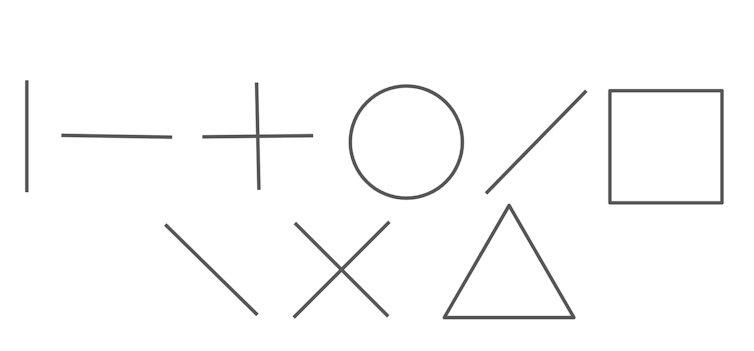
Pre-writing shapes. The Conversation The ability to copy geometric forms is recognised in research as an indication of writing readiness in a young child. Formal handwriting training should be delayed until a child can successfully copy a vertical line, a horizontal line, a cross, a circle, a right oblique line, a square, a left oblique line, an oblique cross and a triangle.
Ditch the broken crayons
There are few things more frustrating for a young child than fading markers, blunt colouring pencils or a box of broken and bruised crayons. My research has found that the quality of writing materials matters when it comes to motivating the reluctant writer to give it a go.
Providing children with a variety of novel and fun writing materials leads to increased motivation and enjoyment of writing. These could be brightly coloured felt pens, gel pens, highlighters, magic markers and even scented markers and pencils, and don’t forget the finger paints. The messier the better.
Sinéad McCauley Lambe, Assistant Professor, School of Inclusive and Special Education, Dublin City University
This article is republished from The Conversation under a Creative Commons license. Read the original article.
-
Someone recently suggested on facebook that we should close our local elementary school, with the premise that doing so would lower our taxes.
The first question then, is what happens when a school closes? Would we no longer pay school taxes? No. When a school closes, it joins an adjacent district of similar type, and the area is taxed accordingly. In the case of Trego, that would mean the tax bill would be at Fortine’s mill levy rate.
Who’s keeping our school open? Strictly speaking, open is the default state of a public school. If it has no students, it may eventually experience an involuntary merger. Otherwise, merging districts is subject to vote- and not by the school board.
In the case of Trego Elementary, the relevant law is thus: 20-6-423. District consolidation. (1) Any two or more contiguous elementary school districts may consolidate to organize an elementary district
What this means is that Trego could merge with either Fortine Elementary District, or with Olney-Bissell.
Who decides? Voters in both districts. “The proposition is approved in the district if a majority of those voting approve the proposition”
How is this process started? Either (i) the trustees may pass a resolution requesting the county superintendent of the county where the district is located to order an election to consider a consolidation proposition involving their district; or (ii) not less than 20% of the electors of an individual district who are qualified to vote under the provisions of 20-20-301 may petition the county superintendent of the county where the district is located requesting an election to consider a consolidation proposition involving their district.
How would it impact local taxes? Based on the 24/25 school year budgets, (all publicly available from OPI), we can make some inferences. The total mill levies were as follows:
- Fortine: 73.5
- Olney-Bissell: 81.41
- Trego: 48.64
One of the difficulties of school taxes is that it isn’t obvious what a “mill” is, or how it impacts your bill. While the numbers make it pretty obvious that Fortine and Olney-Bissell are taxed more, it isn’t clear how that impacts our bills. “One mill is one dollar per $1,000 dollars of assessed value.”
But wait- it is not so simple: We take the market value of the property, multiply it by the assessment rate (1.35%), to get the taxable valuation of the property. For a $100,000 property, that taxable value is $1,350. We then take that value, multiply it by the mills, and then by .001 to account for the fact that mills are not the same as millage rate.
So, in real numbers: 73.50 mills in Fortine is $99.23, 81.41 mills in Olney-Bissell is $109.90, and 48.64 in Trego is $65.66
It’s probably reasonable to assume that if we merge districts, the mills assessed probably aren’t going to drop down to our level. This does beg the question: Why does Trego tax so much lower? More on that next week, when we compare taxable valuations of the districts and take a closer look at school budgets.
-
Editor’s Note: This was originally published about a year ago (last March), but we’re publishing it again because the bill is coming due. We won’t know the amount until the school year is up and every school in the state has to figure out how much to bill other districts for, but permissive levy notices have gone out and tax payers are learning how this will impact their bill.
One of the ‘Things Our Government Has Been Up To’ is House Bill HB203, which passed into law. It’s marketed as a bill about school choice, although Montana was already a state that allowed for out of district enrollments.
One of the things it does, is that it makes it harder for schools to say no to out of district enrollment. “Perhaps the most compelling and direct impact of HB203 is that Montana public school districts will no longer have absolute discretion to deny applications for out-of-district attendance.” There are very limited circumstances in which the law will allow districts to reject out of district enrollment.
More choice for parents? Not here. Our local schools have already been accepting out of district enrollments when they’ve been able to do so and meet the needs of the students. Less choice for school boards? Definitely. And for taxpayers…?
The taxpayers of the district accepting students aren’t on the hook for funding those students (and really weren’t before, since the state distributes school funding based on enrollment anyway), but the donating school district can expect to contribute over a thousand dollars of tuition per leaving student.
Will this impact district taxes and levies? Probably, especially in smaller districts where budgets run tight.
Did it increase our choices for where to send our kids to school? No. Not here. Not for us. Did it turn our kids into dollar signs for other school districts? They already were, due to the state’s method of redistributing funds. But it’s increased the number that goes with the dollar sign.
What did our local senator and representative vote? Yea.
-
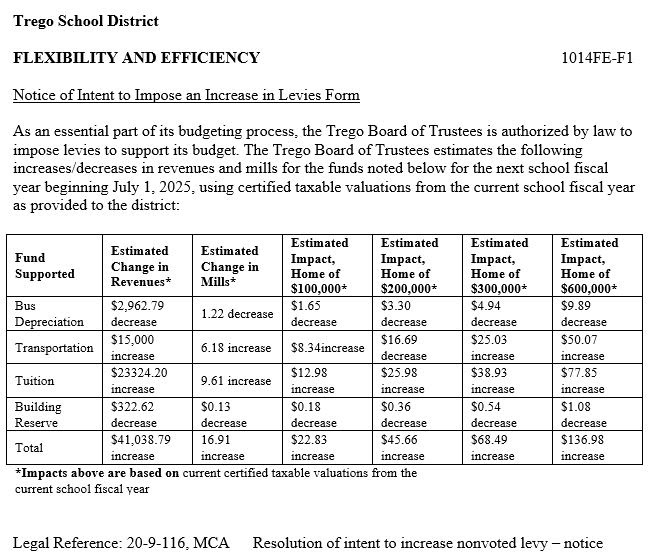
With taxable valuations now tentatively available, schools are publishing estimates of changes in the levies that no one other than the school board gets to vote on. Just in time for school board elections (Election Day: May 6th).
It’s notable that these are estimates. They are not set in stone, and will not be finalized until the school budget meetings are held. What this means is that taxpayers with concerns have time to vote their wallets with regards to the upcoming school board election, and also to make their thoughts known to the board well in advance of the budget meeting.
Also notable is that none of these “permissive” levies are in the general fund. The uses of these funds are all very specifically defined by state law. For example, the transportation levy cannot be used to pay a classroom teacher- it can’t even be used for field trips. It is explicitly for expenses associated with transporting students to and from school.

-
The ice is out, and the island is waiting for nesting geese – but we’re getting ready to spend our first Summer here without Gander. He was slowed down last Summer when he left with the hatchlings – and we didn’t see him bring them all back for the last stop before they headed south.
Our lesser Canadian Geese all look alike – so it’s been behavioral patterns that have let us tell Gander from the other geese. The first behavior was that his consort nested on the island – usually alone – and he maintained sentry status swimming around the island and her nest. This year he isn’t back at his station.
It’s been fun watching him operate as the top goose. The first year he started training the goslings before they could fly, leading them onto the floating dock, and teaching landings as they would jump from the dock and into the water. I watched as he made the decision to get airborne to distract the eagle from the nest, then landing alongside me so that he had backup when the eagle followed him in. I figured Gander might have been semi-domestic, using people to reduce the risk from predators.
There was the year when one gosling had a wing problem – the little goose could almost fly. Gander would bring his flights by every other day, checking to see if the little one’s flying ability had improved. First, Goose, Gander and 7 hatchlings – then a flight of 16 geese. By the time they flew south that year, Gander led a flight of 42.
So I’m watching some new pairs beginning to nest. I’ve enjoyed watching my same regular neighbors raise their flocks – there was a particular amusement when two little coots hung out with Goose, Gander and their goslings. I doubt if anything is quite as poor at parenting as a coot, while Gander took parenting seriously.
I suspect I may enjoy these newcomer geese as much as I have enjoyed watching Goose and Gander raise their goslings – but the old geese really had worked out most of the challenges of successfully raising each year’s flock.
-
Mia Love joined the majority a week or so back. She was one of the great success stories of immigrant Americans, born to Haitian immigrants in New York, and becoming the first black Republican woman elected to congress. No Trump supporter, yet the Republican party grew in a way where she still fit with a party where she was no longer able to win elections. We’ll cover a few quotations from her favorite economist, Frederic Bastiat:

The state is the great fictitious entity by which everyone seeks to live at the expense of everyone else.
If the natural tendencies of mankind are so bad that it is not safe to permit people to be free, how is it that the tendencies of these organizers are always good? Do not the legislators and their appointed agents also belong to the human race? Or do they believe that they themselves are made of a finer clay than the rest of mankind?
Sometimes the law defends plunder and participates in it. Sometimes the law places the whole apparatus of judges, police, prisons and gendarmes at the service of the plunderers, and treats the victim – when he defends himself – as a criminal.
The real cost of the State is the prosperity we do not see, the jobs that don’t exist, the technologies to which we do not have access, the businesses that do not come into existence, and the bright future that is stolen from us. The State has looted us just as surely as a robber who enters our home at night and steals all that we love.
The most urgent necessity is, not that the State should teach, but that it should allow education. All monopolies are detestable, but the worst of all is the monopoly of education.
Everyone wants to live at the expense of the state. They forget that the state wants to live at the expense of everyone.
When law and morality contradict each other, the citizen has the cruel alternative of either losing his moral sense or losing his respect for the law.
It’s always tempting to do good at someone else’s expense
Here I encounter the most popular fallacy of our times. It is not considered sufficient that the law should guarantee to every citizen the free and inoffensive use of his faculties for physical, intellectual and moral self-improvement. Instead, it is demanded that the law should directly extend welfare, education, and morality throughout the nation. This is the seductive lure of socialism. And I repeat: these two uses of the law are in direct contradiction to each other.
But how is this legal plunder to be identified? Quite simply. See if the law takes from some persons what belongs to them and gives it to other persons to whom it does not belong. See if the law benefits one citizen at the expense of another by doing what the citizen himself cannot do without committing a crime.
RIP, Mia Love. It is hard to look at politics through Bastiat’ principles and to continue to be elected.
-
Shirsh Lata Soni, University of Michigan
The Sun periodically ejects huge bubbles of plasma from its surface that contain an intense magnetic field. These events are called coronal mass ejections, or CMEs. When two of these ejections collide, they can generate powerful geomagnetic storms that can lead to beautiful auroras but may disrupt satellites and GPS back on Earth.
On May 10, 2024, people across the Northern Hemisphere got to witness the impact of these solar activities on Earth’s space weather.
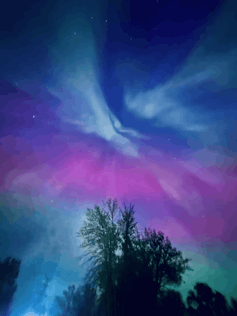
The northern lights, as seen here from Michigan in May 2024, are caused by geomagnetic storms in the atmosphere. Shirsh Lata Soni Two merging CMEs triggered the largest geomagnetic storm in two decades, which manifested in brightly colored auroras visible across the sky.
I’m a solar physicist. My colleagues and I aim to track and better understand colliding CMEs with the goal of improving space weather forecasts. In the modern era, where technological systems are increasingly vulnerable to space weather disruptions, understanding how CMEs interact with each other has never been more crucial.
Coronal mass ejections
CMEs are long and twisted – kind of like ropes – and how often they happen varies with an 11-year cycle. At the solar minimum, researchers observe about one a week, but near the solar maximum, they can observe, on average, two or three per day.
During the solar maximum, solar flares and coronal mass ejections are more common.
When two or more CMEs interact, they generate massive clouds of charged particles and magnetic fields that may compress, merge or reconnect with each other during the collision. These interactions can amplify the impact of the CMEs on Earth’s magnetic field, sometimes creating geomagnetic storms.
Why study interacting CMEs?
Nearly one-third of CMEs interact with other CMEs or the solar wind, which is a stream of charged particles released from the outer layer of the Sun.
In my research team’s study, published in May 2024, we found that CMEs that do interact or collide with each other are much more likely to cause a geomagnetic storm – two times more likely than an individual CME. The mix of strong magnetic fields and high pressure in these CME collisions is likely what causes them to generate storms.
During solar maxima, when there can be more than 10 CMEs per day, the likelihood of CMEs interacting with each other increases. But researchers aren’t sure whether they become more likely to generate a geomagnetic storm during these periods.
Scientists can study interacting CMEs as they move through space and watch them contribute to geomagnetic storms using observations from space- and ground-based observatories.
In this study, we looked at three CMEs that interacted with each other as they traveled through space using the space-based observatory STEREO. We validated these observations with three-dimensional simulations.
The CME interactions we studied generated a complex magnetic field and a compressed plasma sheath, which is a layer of charged particles that, once they reach the upper atmosphere of Earth from space, interacts with its magnetic field.
When this complex structure encountered Earth’s magnetosphere, it compressed the magnetosphere and triggered an intense geomagnetic storm.
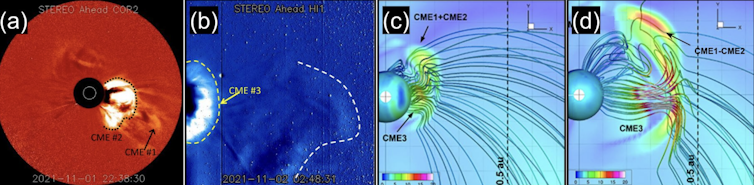
Four images show three interacting CMEs, based on observations from the STEREO telescope. In images C and D, you can see the northeast flank of CME-1 and CME-2 that interact with the southwest part of CME-3. Shirsh Lata Soni This same process generated the geomagnetic storm from May 2024.
Between May 8-9, multiple Earth-directed CMEs erupted from the Sun. When these CMEs merged, they formed a massive, combined structure that arrived at Earth late on May 10, 2024. This structure triggered the extraordinary geomagnetic storm many people observed. People even in parts of the southern U.S. were able to see the northern lights in the sky that night.
More technology and higher stakes
Scientists have an expansive network of space- and ground-based observatories, such as the Parker Solar Probe, Solar Orbiter, the Solar Dynamics Observatory and others, available to monitor the heliosphere – the region surrounding the Sun – from a variety of vantage points.
These resources, coupled with advanced modeling capabilities, provide timely and effective ways to investigate how CMEs cause geomagnetic storms. The Sun will reach its solar maximum in the years 2024 and 2025. So, with more complex CMEs coming from the Sun in the next few years and an increasing reliance on space-based infrastructure for communication, navigation and scientific exploration, monitoring these events is more important than ever.
Integrating the observational data from space-based missions such as Wind and ACE and data from ground-based facilities such as the e-Callisto network and radio observatories with state-of-the-art simulation tools allows researchers to analyze the data in real time. That way, they can quickly make predictions about what the CMEs are doing.
These advancements are important for keeping infrastructure safe and preparing for the next solar maximum. Addressing these challenges today ensures resilience against future space weather.
This article was updated to clarify how a compressed plasma sheath interacts with the Earth’s upper atmosphere and magnetic field.
Shirsh Lata Soni, Postdoctoral Research Fellow, University of Michigan
This article is republished from The Conversation under a Creative Commons license. Read the original article.


Want to tell us something or ask a question? Get in touch.

Recent Posts
- Computer Repair by Mussolini
- Getting Alberta Oil to Market
- Parties On Economics
- Thus Spake Zarathustra – One More Time
- Suspenders
- You Haven’t Met All The People . . .
- Play Stupid Games, Win Stupid Prizes
- The Ballad of Lenin’s Tomb
- An Encounter With a Lawnmower Thief
- County Property Taxes
- A Big Loss in 2025
- Thinking of Clovis
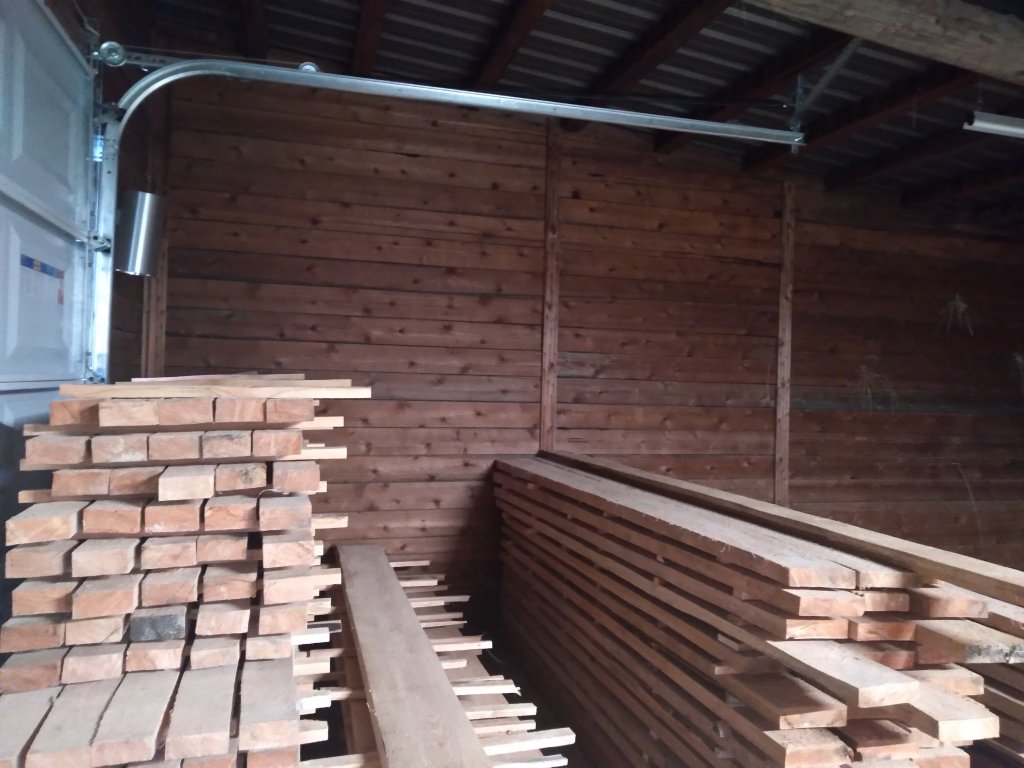
Rough Cut Lumber
Harvested as part of thinning to reduce fire danger.
$0.75 per board foot.
Call Mike (406-882-4835) or Sam (406-882-4597)
Popular Posts
Ask The Entomologist Bears Books Canada Census Community Decay Covid Covid-19 Data Deer Demography Education Elections Eureka Montana family Firearms Game Cameras Geese Government Guns History Inflation life Lincoln County Board of Health Lincoln County MT Lincoln Electric Cooperative Montana nature News Patches' Pieces Pest Control Politics Pond Recipe School School Board Snow Taxes travel Trego Trego Montana Trego School Weather Wildlife writing
 Trego's Mountain Ear